Council on Energy, Environment and Water Integrated | International | Independent

Suggested citation: Tyagi, Akanksha, Prashant Badal and Ajinkya Kale. 2025. How Big is the Solar Module Recycling Industry in India? Sizing the Market, Investment, and Emission Reduction Opportunity. New Delhi: Council on Energy, Environment and Water.
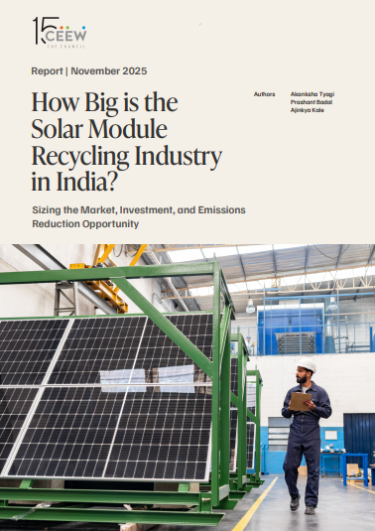
Solar module recycling can advance India’s energy transition by reducing dependence on imported critical minerals and strengthening domestic manufacturing. However, the module recycling industry remains nascent, hindered by weak regulations, inefficient technologies, and limited markets for recovered materials. A robust database of key information is vital to guide industry and policy decisions in developing a domestic recycling ecosystem.
This study provides estimates on India’s solar module waste by 2047, module recycling market opportunity, required investments to set up the recycling infrastructure, virgin material demand met by module recycling, and emissions reduction. It also provides suggestions on appropriate business models to scale the recycling industry.
India’s solar sector currently faces two major problems— growing waste, and the fact that domestic manufacturing is vulnerable to geopolitical risks. To manage these issues, the country needs to transition to a circular solar industry. The biggest roadblock to this is that India currently lacks a strong domestic solar module recycling industry. There is an urgent need for targeted interventions to establish and scale this industry.
To support this planning, we have sized India’s solar module recycling capacity and investment requirement by 2047, and market opportunity in 2047. We also estimate the reduction in demand for virgin materials by recycling, and the corresponding emission reductions. We use this evidence to recommend immediate priorities for policymakers, manufacturers, and recyclers to create a robust solar module recycling industry in India.
First, we estimate India’s solar waste by 2047 using our in-house waste estimation model (MNRE and CEEW 2024). The capacity installations used for this waste estimation are based on the actual annual installations until 2024, and the projected annual additions until 2047, as per the growth rates from our earlier study (Das et al 2025). According to this trajectory India’s cumulative solar capacity reaches 534 GW by 2047. Based on projected waste, we estimate the number of recycling facilities and the investment needed to support this infrastructure for both crystalline silicon and thin-film modules. The market opportunity is estimated based on the recovery rates and resale values for different materials reported in literature. The emissions savings are estimated using a standard lifecycle analysis approach using India-specific emission factors for different parameters.
Establishing a solar module recycling ecosystem is essential to manage rising solar waste, recover valuable materials, and reduce import dependence. It can create economic and social opportunities, support domestic solar manufacturing, lower carbon emissions, and ensure resource security, making it a key enabler of India’s clean energy transition and circular economy goals.
The module recycling industry faces key challenges, including the absence of clear regulatory mandates, a lack of granular spatial data on solar capacity deployment and manufacturing to identify waste hotspots, limited efficiency and scalability of current recycling technologies, and weak domestic markets for recovered materials. These barriers restrict commercial viability and hinder large-scale adoption in India.
Market growth will be driven by the rising volume of end-of-life solar modules, introducing collection, recycling and recovery targets under Extended Producer Responsibility (EPR) for solar waste, improving recycling technologies, and increasing demand for recovered materials in domestic manufacturing. Policy incentives and private sector investments will further support industry expansion and commercial viability.
Existing business models for solar module recycling can be categorised into three categories based on their operational models, financial implications, and potential for scalability. These include the integrated recycling model, the recycler-owned model, and the third-party/waste management company model.
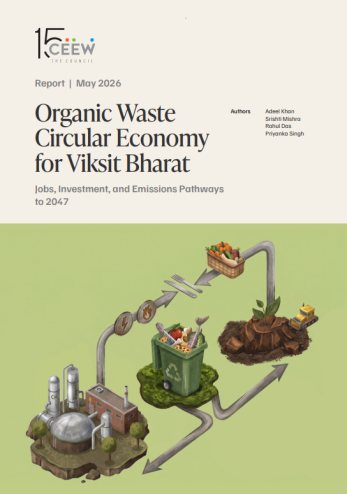
Organic Waste Circular Economy for Viksit Bharat

Roadmap of the methodology to assess the climate co-benefits of the SUP ban in Maharashtra

Building a Green Economy for Viksit Bharat

Financing for Treated Used Water Reuse in India
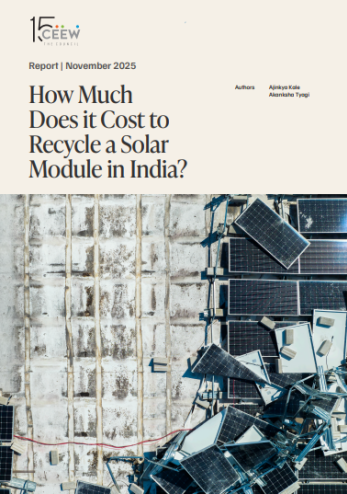
How Much Does It Cost to Recycle a Solar Module in India?