Other Publications
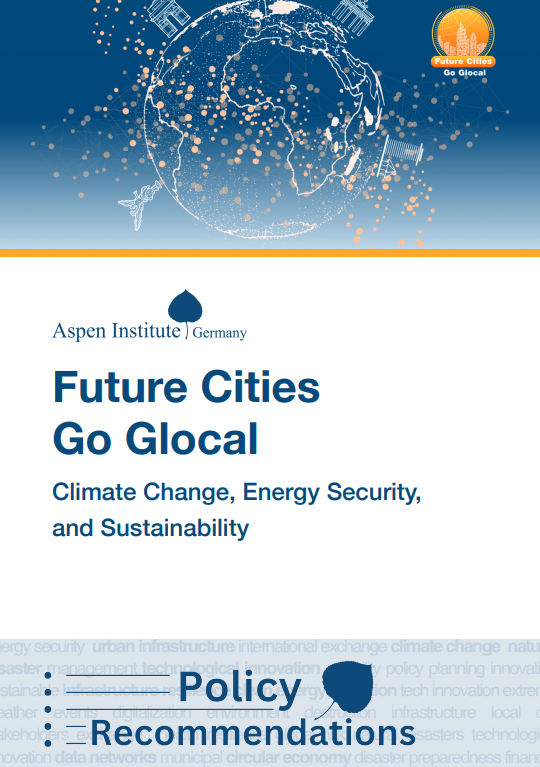
Future Cities Go Glocal:
Climate Change, Energy Security, and Sustainability
Nitin Bassi
June 2025 | Sustainable Water
Suggested Citation: Aspen Institute Germany. 2025. Future Cities Go Glocal: Climate Change, Energy Security, and Sustainability. Berlin: Aspen Institute Deutschland e.V.
Overview
Cities today stand at the forefront of pressing global challenges, such as climate change, physical risks, energy insecurity, environmental degradation, social inequality, migration, and public health issues, impacting their ability to meet the Sustainable Development Goals. Taking cognisance of such challenges, the ‘Future Cities Go Global’ initiative brought together 20 urban decision-makers from Berlin, Nairobi, New Delhi, and Mexico City to co-develop practical strategies across three interconnected domains of climate change, energy security, and sustainability. This policy brief presents the local, digital and international recommendations for the just, secure, and sustainable energy transition; environmental management for resilient, equitable, and healthy cities; and, urban planning for accessible and efficient infrastructure and mobility. Further, it highlights that implementing the strategies will require aligning local actions, digital innovations and international cooperation to create inclusive, resilient and climate-friendly cities.
Key Findings
- Enabling just, secure, and sustainable energy transition
- Cities have substantial energy demand and are among the major consumers of energy, with fossil fuels still dominating energy supply and thus are major contributor to climate change.
- Future energy supply must meet three requirements, i.e. environmental sustainability to mitigate climate change; resilience to ensure a secure and reliable supply; and economic and social equity to provide affordable energy access while fostering public trust in the energy transition process.
- Cities need to invest in developing digital tools to map and consolidate energy needs, usage and infrastructure conditions for better planning of the energy transition.
- Ensuring environmental management for resilient, equitable, and healthy cities
- Social and environmental externalities of poor urban development planning are evident. Further, climate-induced hazards, such as prolonged heatwaves, storms, flash floods, droughts, and hazardous air pollution make it difficult for maintaining liveable conditions in urban areas.
- Cities need to mainstream circular economy solutions for water, sanitation, and solid waste management to enhance their climate resilience and sustainability. Further, urban planning should integrate nature-based solutions, such as green spaces and natural water bodies, to address the rising temperatures in cities.
- Innovative digital solutions are required for extreme weather events communication, disaster preparedness planning, and relief and rehabilitation.
- Promoting urban planning for accessible and efficient infrastructure and mobility
- Lack of accessible and efficient infrastructure for mobility is one of the key challenges in urban areas. Extreme weather events frequently disrupt transportation networks and damage infrastructure, revealing critical vulnerabilities in systems that lack the resilience to withstand these pressures. Further, the urban transport sector accounts for substantial proportion of CO2 emissions.
- Transition to environmentally sustainable and resilient mobility, such as electrified vehicles, comprehensive bicycle and pedestrian infrastructure, and shared mobility solutions is a growing need. Thus, transforming mobility and urban infrastructure towards a ‘pedestrian first, public transit first’ approach.
- Substantial reduction in CO2 emissions from the transport sector is possible using a combination of complementary measures, such as taxes on polluting vehicles, incentives for vehicles that use less fossil fuel, or investments in public transport, without compromising quality of life.
“The Cities of the Future need innovations in governance, financing, technology, capacity building and data management to enable energy security, promote citizen centric mobility, optimise use of natural resources and build resilience to climate change”