Council on Energy, Environment and Water Integrated | International | Independent

Suggested Citation: Katyaini, Suparana, Don Mani Paul, Munish Kumar Upadhyay, Manya Dikshit, Pritish Kumar Acharya, Tejaswi Joshi, Arpit Srivastav, and Nitin Bassi. 2026. Scaling Climatesmart Micro-Irrigation in Gujarat: Policy and Technology Synergies. New Delhi: Council on Energy, Environment, and Water.
Gujarat has emerged as a national leader in promoting water-efficient agriculture, ranking among India's top three states in micro-irrigation (MI) adoption. With access to just 2 per cent of India's water resources while supporting 5 per cent of its population, the state has turned this challenge into an opportunity by championing MI systems that deliver water precisely to crop roots with under 10 per cent application losses, compared to roughly 50 per cent with conventional flood irrigation.
This report by CEEW, in collaboration with the Gujarat Green Revolution Company (GGRC) and the DCM Shriram Foundation, provides a detailed analysis of MI adoption across three strategically selected districts: Banaskantha, Rajkot, and Kachchh. These represent diverse agro-climatic zones, hydrological conditions, and stages of adoption. Drawing on consultations with over 250 farmers and key stakeholders, and integrating the COM-B behavioural framework with CEEW's Scalability Framework, the study examines what drives farmers' decisions to adopt and sustain MI. It maps nine central and state policies that collectively support MI expansion and co-creates actionable recommendations with GGRC to strengthen adoption, making it more equitable, financially viable, and technically robust, particularly for over 2 million marginal farmers who stand to benefit the most.
The Global South faces a severe freshwater crisis (Hoogesteger 2022), putting the sustainability of food production, economic stability, and the environment at significant risk. As a critical case, India consumes 80 per cent of its freshwater in agriculture despite water scarcity (CWC 2023). Addressing this complex challenge requires adopting innovative and efficient irrigation, climateresilient agricultural practices, and integrated water management strategies. These are crucial for enhancing water use efficiency (WUE) and saving water in agriculture, especially in arid and semi-arid regions.
Among the innovations in irrigation, micro-irrigation (MI) systems are a game-changer. Their adoption in India is rooted in a strategic synergy between supportive policies and innovative technologies. The ‘Per Drop More Crop’ national initiative has spearheaded adoption of drip and sprinkler irrigation. This policy driven technological shift is essential for India where a more efficient use of every drop is vital for combating the complex water-energy-food nexus, and securing a sustainable future. This commitment was recently strengthened in April 2025 by the Modernisation of Command Area Development and Water Management (M-CADWM)’s approval as a sub-scheme under Pradhan Mantri Krishi Sinchayee Yojana (PMKSY), backed by an initial INR 16,000 million (USD 177.19 million as on 15 January 2026) investment to modernise supply networks (Ministry of Jal Shakti 2025). This strategic investment in the supply network complements India’s existing high financial commitment to MI, underscoring the twin pillars of infrastructure modernisation and farm-level water-use efficiency.
Gujarat has emerged as a national leader in this transition, ranking among the top three states with a 13.16 per cent adoption rate (Figure ES1). To date, the state has successfully scaled MI across 2.31 million hectares (ha), benefiting 1.48 million farmers (Ministry of Agriculture & Farmers Welfare 2024). This achievement is particularly significant as it demonstrates a successful model for enhancing WUE in a region grappling with limited freshwater resources through scaling up climate-smart solutions. Despite high adoption rates, a significant gap remains between current usage and the total potential for MI. As of 2020, Gujarat has tapped only 30 per cent of its potential (1.53 million ha), while India as a whole has reached less than 20 per cent (12.54 million ha) (Mohan et al. 2024). To achieve this potential, a significant challenge needs to be addressed—the lack of understanding of farmers’ decision-making processes, encompassing perceptions of risk, and key factors influencing their choices to adopt, use, or not adopt.
Figure ES1. Gujarat ranks 3rd in India in adopting micro-irrigation (MI) systems between 2005 and 2024
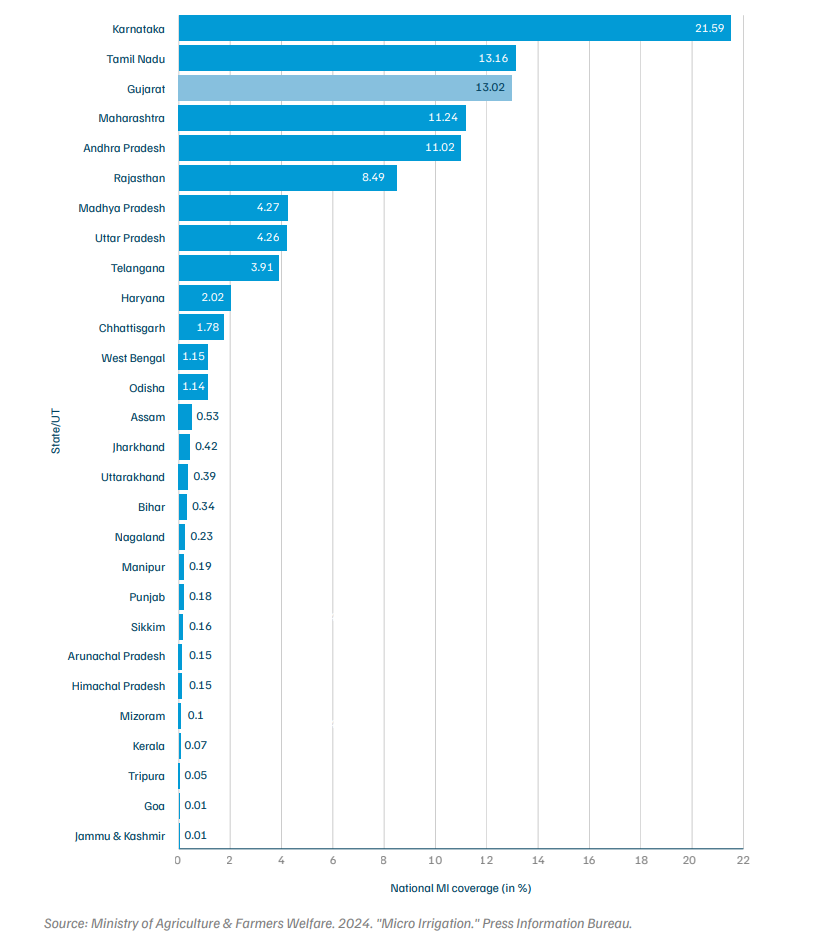
Source: Ministry of Agriculture & Farmers Welfare. 2024. "Micro Irrigation." Press Information Bureau.
This study provides a hyper-granular analysis of select districts in Gujarat to identify the barriers and enablers of MI use. By examining these local realities, we offer targeted insights to accelerate the transition toward efficient water management, crucial for scaling up and speeding up the adoption of these vital technologies. Strategically selected Banaskantha, Rajkot, and Kachchh represent diverse agro-climatic zones, hydrological conditions, and socio-economic contexts. These districts, with their varying rates of MI adoption, offer crucial insights.
By concentrating the study on these high-demand, high-scarcity contexts, the research aims to maximise insights into scaling MI effectively.
Figure ES2. Over 50% of farmers in five districts of Gujarat adopt water-saving systems
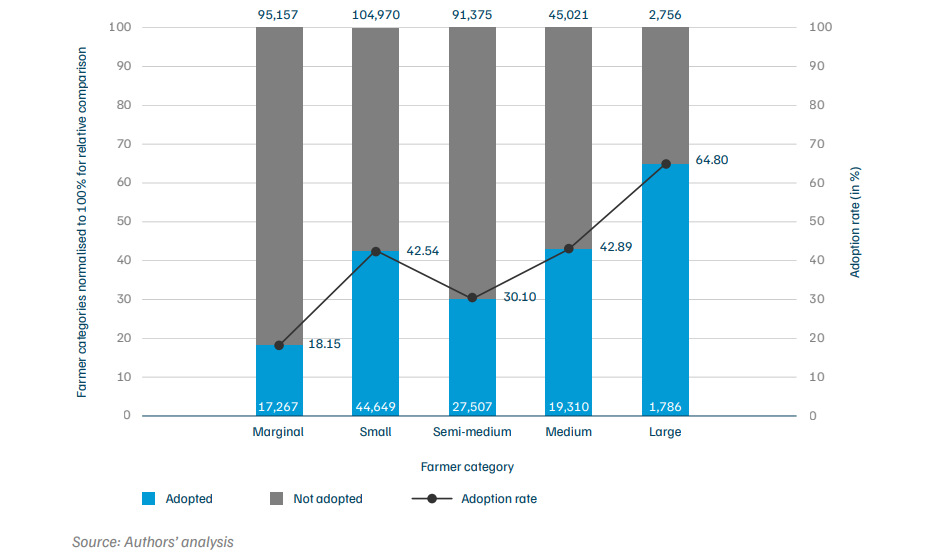
Adoption of MI systems is highest (nearly 65 per cent) among large farmers in Banaskantha. Further, small farmers have relatively higher adoption than semi-medium farmers (land holding of 2–4 ha). Marginal farmers have the lowest adoption of merely 18 per cent. These indicate differential uptake of MI among farmer categories, and require a deep-dive into their decisionmaking (Figure ES3).
Figure ES3. MI adoption is highest among the large, medium, and small farmers in Banaskantha,/b>
Our study combined two innovative frameworks to analyse farmers’ decision-making, to provide a holistic view of the factors driving or hindering the adoption of MI systems: the Capability, Opportunity, and Motivation-Behaviour (COM-B) framework to understand farmer behaviour linked to MI adoption, and the CEEW’s Scalability Framework to analyse institutional factors, including economic, technical, and institutional arrangements that influence the scalability of MI systems.
Based on a questionnaire emerging from these frameworks, we consulted over 250 farmers during the field research, comprising small, marginal, semi-medium, medium, and large farmers. The other key stakeholders were representatives from the Gujarat Green Revolution Company (GGRC), agriculture science centres (Krishi Vigyan Kendras or KVKs), and local NGOs. The private sector was represented by suppliers and technicians.
We supplemented the key informant interviews and focus group discussions with these key stakeholders with district-level data and policy analysis. Through this analysis, we identified the key policies driving expansion of MI systems in synergy with each other for enhancing WUE, improving farmer livelihoods, and ensuring long-term agricultural sustainability (Figure ES4).
Figure ES4. Methodological framework used to engage with and understand the factors driving farmers’ decisions to adopt MI systems
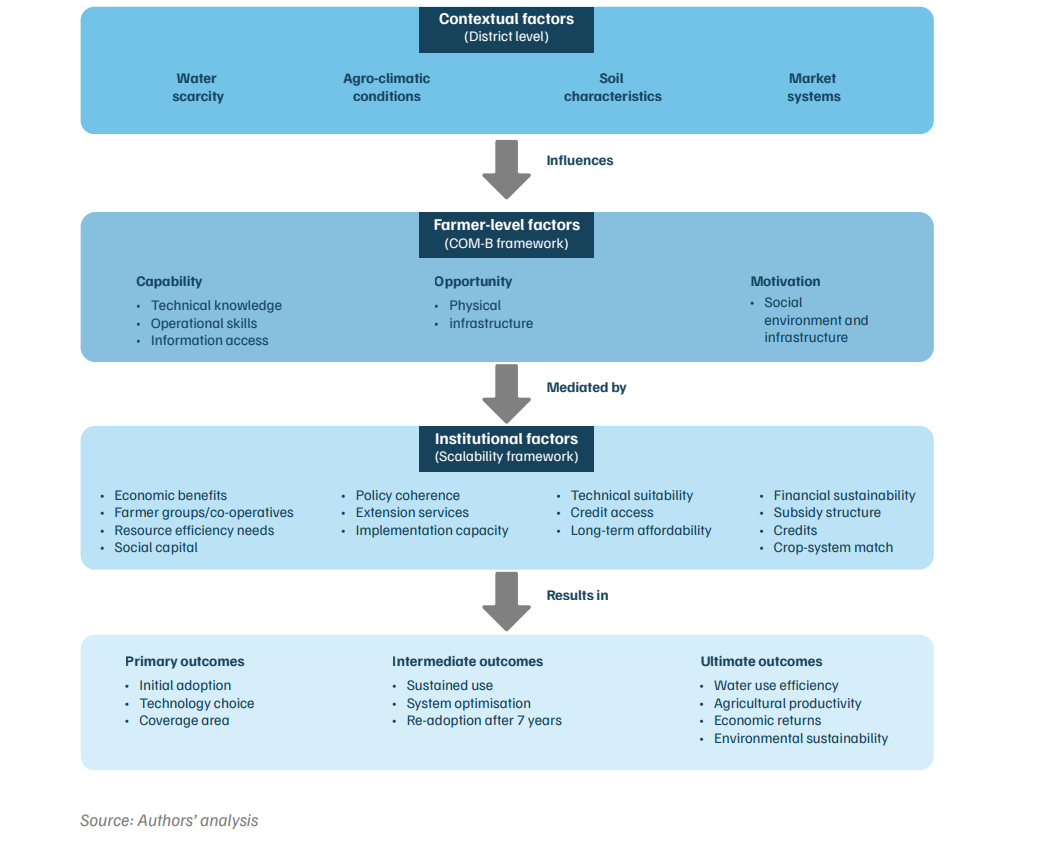
This comprehensive approach offers practical recommendations for improved system design, funding models, capacity building, and inclusive policy frameworks to scale up MI in Gujarat’s semi-arid and arid regions. It also holds potential for identifying the implementable lessons from Gujarat to inform strategies in other semi-arid and arid contexts across India and the Global South, grappling with common barriers.
The study confirms that MI expansion is a crucial necessity for Gujarat’s agricultural sustainability, driven by the significant water demands of key cash crops (like paddy and cotton) across all seasons. Gujarat’s MI programme is highly effective, supported by an INR 80,268.5 million investment and a coherent policy framework (e.g., ‘Per Drop More Crop’, ABY, PM-KUSUM) that integrates MI with broader goals of groundwater conservation and energy security. Policy evolution over two decades reflects a strategic integration of the Water-EnergyFood (WEF) nexus. This is backed by nine central and state-specific policies with the Per Drop More Crop as the core policy on MI expansion (Figure ES5).
Figure ES5. Nine central and state policies are contributing to scale-up of MI adoption in Gujarat
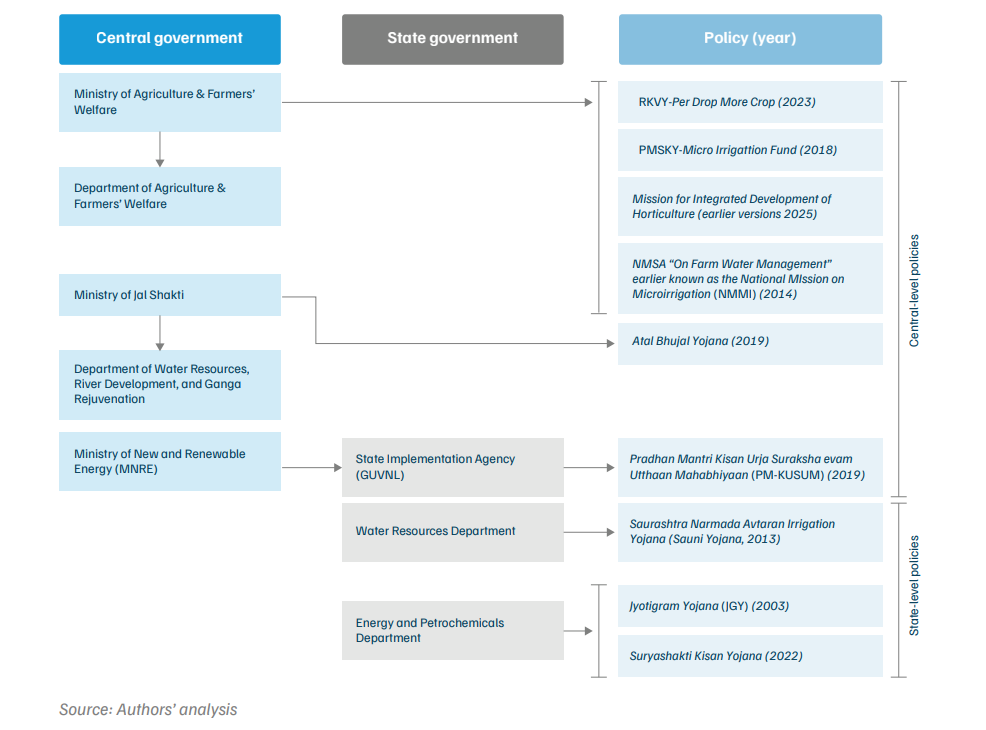
This institutional support offers financial incentives (up to 80–90 per cent subsidy) for inclusion of farmers in tribal and remote areas. Regulatory mechanisms, like the ABY, have made adoption of MI mandatory in over-exploited groundwater zones, resulting in decline of its peak extraction rate of 67 per cent in 2011 to 54 per cent in 2024. Policy support through PM-KUSUM for solar irrigation is facilitating the transition to renewable energy for MI technology (Figure ES5 and Table ES1). These policy-technology synergies are crucial for holistic development by addressing groundwater decline, improving soil health, and integration of renewable energy for advancing a water-secure and climate-resilient Gujarat.
Table ES1. Policy analysis to identify avenues to strengthen coherent policy efforts
| Policy | Recognise convergence with other policies |
|---|---|
| RKVY-Per Drop More Crop
(core policy on MI expansion)
|
|
Source: Authors’ analysis
The GGRC is a special purpose vehicle (SPV) of the state government for advancing the adoption of MI systems. It is a critical institutional innovation, representing a public-private partnership that has received appreciation at the national level. By providing comprehensive, dedicated institutional support, GGRC acts as a vital enabler that has spurred adoption across over 2.3 million ha (Table ES2). Further, the NITI Aayog, which replaced the Planning Commission of India, has acknowledged the achievements of the GGRC in scaling MI in Gujarat through effective interventions, including awareness initiatives.
Table ES2. Technology-wise cost and discharge for three different types of MI systems
| Indicator | Drip | Sprinkler | Mini-sprinkler |
|---|---|---|---|
| Cost without GST (INR/ha) | 1,20,000 | 22,000 | 1,10,000 |
| Discharge (L/h) | 2–14 | 2,500–4,000 | 250–1,500 |
| Suitable for crops | orchid (grapes, bananas, pomegranates, papayas); nuts (cashew) | horticulture crops | groundnut; potato; onion; ginger; short statured fodder crops |
| Adoption (%) | 54 | 46 | Considered part of drip |
| Adoption (number) | 8,05,591 | 6,78,467 | |
| Adoption (area in ha) | 12,59,442 | 10,53,656 | |
| Prominence in districts | Bhavnagar, Dang, and Kachchh | Banaskantha | Banaskantha |
Source: GGRC. 2025. "Subsidy Norms of Micro Irrigation Scheme." and Mohan, G., R. Mishra, A. Reddy, H. Matsuda, M. Sekiyama, and K. Fukushi. 2022. "Scaling up microirrigation technology to address water challenges in semi-arid South Asia."
For further catalysing the adoption, we identified the key drivers and barriers. Adoption is primarily driven by individual economic motivations (reduced costs, increased income) and strong community peer-to-peer influence. Farmers are highly proficient in system operation (Table ES3). The state possesses conducive institutional support and policy synergies that enable scale-up and speed-up of MI adoption.
The structural barriers related to land, finance, and post-adoption support need further consideration for equitable scale-up. Particularly, the land documentation requirement for subsidies, the reduced subsidy value due to GST, and the lack of affordable credit are vital issues that need to be addressed to encourage adoption by small and marginal farmers.
Table ES3. Enablers and barriers to MI adoption
| Level | Banaskantha | Rajkot | Kachchh | |
|---|---|---|---|---|
| Environmental | Enablers | Severe water stress necessitates MI; favourable soil/water quality (TDS ~400 mg/L) allows adoption. | Diverse soil profile suitable for Drip; surface and existing groundwater sources available. | Acute water stress makes MI urgent; localised pockets have good water quality. |
| Barriers | High-intensity cropping practices degrade soil health (organic matter loss). | Declining groundwater yields (but implied by low rainfall and high use). | Widespread high salinity and TDS (EC > 5,000 µS/cm), causing clogging, high maintenance, and restricting crop choice. | |
| Level | Banaskantha | Rajkot | Kachchh | |
|---|---|---|---|---|
| Individual | Enablers | Addition of a cropping cycle; significant operational savings (40% labour reduction); high perceived price premiums (15%). | High technical proficiency (3–12 years' experience); substantial perceived economic advantages (yield, lower input/electricity costs). | Positive perception of MI as 'easy to use'; significant labour savings; community adaptation to salt-tolerant crops. |
| Barriers | Severe land fragmentation (0.25–0.75 ha); Uneven awareness of specific subsidies; women's limited decision-making authority. | High initial installation cost; high maintenance costs (rodent damage); seven-year waiting period/GST hinders re-adoption. | Low proficiency in advanced technical skills (maintenance, fertigation); dependence on informal knowledge channels. | |
| Community | Enablers | Strong social learning and peer-driven diffusion; success of early adopters drives follow-on uptake. | High adoption rate (60–90%) validates technology; peer observation and Sarpanch-led meetings strengthen learning. | Social capital/trust facilitates adoption; community adaptation to salt-tolerant crops (castor, date palm). |
| Barriers | Existing collectives focus on seed/fertiliser, not MI management; lack of formal water sharing mechanisms; risk perception due to scattered plots. | Structural/cultural barriers limit women's participation in formal water management. | Gaps in formal community water sharing/management structures. | |
| Institutional | Enablers | Targeted campaigns (Krishi Mahotsav); efficient physical access (15–20 day installation); policy correction (reintroducing sprinkler-to-drip upgrade). | GGRC focus on small/marginal farmers mitigates financial barriers; access to low-interest loans from District Co-op Bank. | Efficient localised technical support (GGRC suppliers resolve issues quickly); data transparency (Panchayat office display). |
| Barriers | Rigid land documentation mandate restricts subsidy access for genuine small farmers (due to undivided land/family titles); GST erosion of subsidy value; lack of post-warranty support. | Cost of spare parts; need to simplify agricultural scheme mobile applications. | Limited service reach/timeliness in remote areas; limited electricity supply restricts irrigation duration; need for more flexible policies (subsidies on filters). | |
Source: Authors’ analysis
The adoption of MI systems is characterised by interdependency, where institutional barriers or enablers directly influence community cooperation and individual financial behaviour, thus linking all three levels of constraint and facilitation. These analytical findings led to the development of key policy recommendations, co-developed with GGRC, which we propose in the next section.
Gujarat is at a pivotal point in speeding up and scaling up the expansion of MI with two decades of policy and technologies evolution. The policy recommendations co-created with the GGRC, drawing on the key barriers and enablers, emphasise on prioritising equity, sustainability, and contextual strategies to successfully integrate MI as a solution for water and livelihood resilience. This approach ensures MI is a foundational, sustainable component of climate-smart agricultural policy.
Table ES4. Strategic recommendations for policy and equity
| Priority | Recommendation | Policy rationale/key action |
|---|---|---|
| Subsidy equity and access | Revise subsidy structures for small and marginal farmers. | Implement the recent change to a 0.4 ha base unit for cost calculation and remove all ceilings. This technical and financial dual-intervention is crucial to ensure small farmers achieve the intended 70% effective subsidy rate, unlocking adoption for the 2.02 million marginal farmers. |
| Financial re-adoption support | Implement better-designed incentives for re-adoption. | Reform the subsidy structure to accommodate system replacement after seven years. Absorb the 12% GST (following models in Tamil Nadu/Uttar Pradesh) to counter the reduction of effective subsidy to 33%, thereby minimising financial risk for continuous usage and upgrades. |
| Land tenure and documentation | Address barriers from shared land and land records. | Develop mechanisms to allow individual farmers operating undivided family landholdings to access subsidies without requiring co-owners’ consent or a time-consuming formal partition. This aligns policy with socio-cultural realities of land sharing. |
| Cluster-based collective action | Strengthen cluster-based initiatives for centralised water access. | Implement collective action models (leveraging existing farmer collectives or establishing new ones) to finance shared infrastructure (e.g., borewells, solar pumps) in areas of fragmented holdings and water scarcity. This lowers the high individual capital cost barrier. |
Source: Authors’ analysis
Table ES5. Technical and operational recommendations
| Priority | Recommendation | Policy rationale/key action |
|---|---|---|
| Water quality & durability | Leverage technology to address water quality challenges. | Mandate or subsidise the incorporation of disc filters (superior to screen filters) to resolve frequent emitter clogging caused by high TDS and ferrous content in groundwater, especially in districts like Kachchh. |
| Technical capacity building | Enhance farmers' comprehensive technical knowledge. | Increase the frequency and regional customisation of capacity building, focusing on practical, hands-on training for fertigation and troubleshooting complex issues (e.g., clogging management). Utilise agricultural universities and KVKs for multi-tiered training aligned with cropping seasons. |
| System upgrade pathway | Recognise mini-sprinklers and encourage drip transition. | Revise policy to recognise mini-sprinklers as a distinct MI option, and allow farmers to transition from sprinkler to drip irrigation after three years of use, aligning with national PDMC guidelines and driving higher water-use efficiency. |
| Financial disbursement | Strengthen financial disbursement mechanisms for suppliers. | Optimise the Direct Benefit Transfer and banking processes to reduce transfer times (currently 3–15 days), ensuring prompt payment to MI suppliers. This enhances market confidence and physical access to equipment. |
Source: Authors’ analysis
Table ES6. Community, governance, and monitoring
| Priority | Recommendation | Policy rationale/key action |
|---|---|---|
| Community water management | Establish community level institutions for integrated management. | Promote village-level cooperatives and self-help groups to facilitate collective decision-making, joint equipment purchasing, shared maintenance, and peer-to-peer learning. Implement 'dampati (couples) training' to foster women's agency in water management. |
| Holistic sustainability | Account for complementary farming resources. | Strengthen conservation initiatives (e.g., storage ponds/talavadi) and incentivise organic farming to ensure long-term soil health. Complementary resources are crucial for making MI effective and environmentally sustainable. |
| Monitoring and evaluation | Establish a robust Monitoring, Evaluation, and Learning (MEL) plan. | Create a centralised dataset to track farm-level parameters, including seasonal crop choice, water savings, and value chain aspects. Regular monitoring is essential to understand trends, assess policy effects, and guard against the Jevons Paradox. |
| Policy alignment with ground reality | Ensure policy aligns with ground realities. | Address the dissonance created by the seven-year re-adoption mandate versus the 3–5 year system degradation observed by farmers. Require context-specific solutions, especially in tribal areas, where multiple co-owners need resolution for subsidy access. |
Source: Authors’ analysis
Addressing Gujarat’s water stress necessitates integrated, adaptive responses across technological, institutional, and behavioural dimensions. Scaling MI, with its documented benefits in water savings, productivity, and energy, is essential for long-term sustainability. Sustainable MI scaling requires shifting policy focus beyond financial subsidies to address structural inequities and post-adoption support. This includes ensuring equitable access for smallholders through group-based support and accessible digital extension; reforming the subsidy process to accommodate informal land tenure; and introducing mechanisms for robust post-warranty technical support and affordable credit. Institutional support, particularly through cooperatives and FPOs, is critical for building capacity and facilitating collective access. However, a gendered dimension must be addressed: although MI offers time-savings for women farmers, their access to subsidies and programmes is often male-dominated, highlighting the necessity of genderresponsive extension services. Furthermore, policy must proactively manage the risk of the Jevons Paradox—where resource efficiency leads to increased overall consumption—by coupling efficiency gains with long-term resource monitoring and regulation. Gujarat’s journey offers key lessons for similar semi-arid contexts in the Global South.
Irrigation is a fundamental necessity in modern agriculture, serving to optimise crop development, support effective landscape management, and significantly mitigate the risks posed by insufficient rainfall and climate variability and change. Approximately 17 per cent of global croplands are irrigated, contributing about 40 per cent of cereal production (Singh et al. 2017; Bhavsar et al. 2023). Shifting rainfall, rising temperatures, and frequent droughts caused by climate change are severely straining water resources. Given that 60 per cent of Indian agriculture relies on the monsoon, irrigation is essential for achieving water security, food security, and climate resilience (Kakar 2020; World Bank 2024). Nearly 90 per cent of total freshwater withdrawals (761,000 billion litres annually) are used in agriculture (Kakar 2020). Agriculture systems are an indispensable backbone of the rural economy. Approximately 70 per cent of rural households depend on it for their livelihood, and it engages 54.6 per cent of the total workforce, underscoring its central role in rural employment, food and water security (National Statistical Office 2021; Ministry of Finance 2023).
Climate-smart MI technologies enhance WUE through delivering water precisely to the root zone in small, frequent amounts at low-pressure, to minimise losses (ICID 2022). Typically operating at 2–20 litres per hour (L/h) through a network of pipes and emitters, this system conserves both water and nutrients. With application losses under 10 per cent, compared to roughly 50 per cent in conventional surface irrigation, MI is particularly well-suited for arid and water-scarce regions (Mohan et al. 2022; Bhavsar et al. 2023).
While MI offers significant advantages, its adoption in South Asia is limited by factors like high initial costs, complex maintenance, and misaligned incentives (Mohan et al. 2022; Ganapathi and Shanthasheela 2024). The notable exception is India, where MI is rapidly growing as a critical strategy to address water scarcity and ensure sustainable agriculture (Bell et al. 2020).
Aligned with the national priorities of doubling farmers’ income, agricultural sustainability, and environmental enhancement, the Pradhan Mantri Krishi Sinchai Yojana (PMKSY) champions MI adoption via the ‘Per Drop More Crop’ principle. Micro-irrigation systems offer immense potential, capable of achieving 30–70 per cent water savings and 20–90 per cent yield enhancement in India. Supported by national and state capital subsidies (55 to 75 per cent), MI currently covers 7.83 million ha (11 per cent of total irrigated land), with a near-equal split between drip and sprinkler irrigation (from 2015–16 to 2022–23). This success is evident in Gujarat, which ranks among the top five MI-adopting states. The following sub-section examines the state’s severe water scarcity challenges, and the essential role MI can play.
Critical issue of water scarcity in Gujarat and the potential of MI system
Spanning 7.3 per cent of India’s area, Gujarat is a water-stressed state, holding just 2 per cent of India’s water resources while supporting 5 per cent of its population (NABARD 2024). The arid and semi-arid context of Gujarat experiences desertification due to water and wind erosion, vegetation degradation (Bahinipati and Viswanathan 2017; Ministry of Environment, Forest and Climate Change 2023).
Gujarat’s total water availability of 55 billion cubic metres (BCM), which includes 17.5 BCM of groundwater, exhibits high temporal and spatial variability (NABARD 2024; Gulati et al. 2021). This variability significantly shapes agricultural productivity and MI adoption. Despite the clear pressure on groundwater resources, 80–85 per cent of the state’s irrigated areas still rely on it (Bahinipati and Viswanathan 2017).
Gujarat is one of India’s most chronically drought-prone states, recording major events two to three times every decade over the last three decades, leading to severe water scarcity, particularly in Saurashtra, Kachchh, and North Gujarat (Bandyopadhyay et al. 2020; Vemireddy, Nagarajan, and Vishwanath 2023). This drought-prone nature was exacerbated by unsustainable groundwater use: extraction rapidly increased from 41 to 67 per cent between 2004 and 2011, resulting in nine districts being categorised as critical or semi-critical and further stressing water supplies. However, the situation has recently improved, with the extraction rate declining to approximately 54 per cent in 2024 (Government of Gujarat 2024), necessitating continued planning and action.
To combat drought vulnerability and optimise resource management, Gujarat has implemented comprehensive water and energy policy reforms, primarily promoting MI for efficient use. The state drives MI adoption—considered key for ‘sustainable intensification’—through the centrally sponsored ‘Per Drop More Crop’. It is intended for individual farmers, and has been implemented by the GGRC, a special-purpose vehicle of the state government established in May 2005 (GGRC 2024a; Bahinipati and Viswanathan 2016). The model is structured to accelerate uptake through financial subsidies, technical support, and farmers’ training.
Moving forward, the model must be further strengthened based on key considerations to enable farmer decision-making, build local adaptation, and advance long-term sustainability (Liebrand 2017). Recognising both its achievements and potential for enhancement provides a useful framework for equitably and sustainably scaling the adoption and usage of MI systems.
This study is guided by two principal objectives:
1. Identify adoption drivers: To identify the key barriers and enablers influencing farmers’ decisions regarding the adoption and use of MI systems in Gujarat. This analysis systematically investigates natural, individual, collective, and institutional factors.
2. Co-create policy solutions: To co-create actionable policy recommendations with multiple stakeholders, that leverage enablers and overcome barriers, thereby facilitating the scaleup and speed-up of MI technology adoption.
The report is structured into six sections, diving into the key factors driving farmers’ decision to embrace MI systems, or the challenges they face in adopting and using them. After establishing the context of water scarcity in Gujarat and the report’s objectives in this section, we provide a comprehensive literature review on water security and MI adoption in section 2. Section 3 details the research design, including data sources and the application of the COM-B behavioural model and CEEW’s Scalability Framework to analyse farmer decisions.
Section 4 presents findings from case studies, consultations, and policy analysis, highlighting MI adoption patterns, and key enablers and barriers in scaling-up adoption. Section 5 synthesises the main findings and discusses their implications for sustainable and equitable MI adoption in Gujarat. Section 6 offers actionable policy recommendations to address barriers, and outlines priorities for future research and programmatic action, such as subsidy design, sustainable financing, and water/energy monitoring. This analysis identifies crucial policy and technology synergies required for successful MI expansion, offering clear lessons for other states.
The literature review is organised into six sub-sections that cover two core themes: water security challenges in Gujarat, which focuses specifically on the interconnected issues facing agriculture, groundwater resources, and climate change impacts; and the enablers of MI system adoption.
Water security challenges in Gujarat: Agriculture, groundwater, and climate change
Climate change severely intensifies Gujarat’s water security concerns, affecting availability and agricultural demand. The state faces significant groundwater depletion (an estimated 27 per cent loss over two decades, with 50 per cent concentrated in North Gujarat), where water tables have fallen up to 70 metres below ground level (BGL), causing irreversible salinisation of aquifers (Bandyopadhyay 2023). This crisis of diminishing quantity and quality is compounded by doubled groundwater dependency due to demographic pressure and agricultural intensification (CGWB 2022; CGWB 2023). Furthermore, the energy–irrigation nexus (driven by subsidised electricity) fuels unsustainable water use (Shah et al. 2008), a challenge where MI technologies offer a solution by significantly reducing the energy demand for pumping, especially in deep-aquifer regions (Mukherji et al. 2011). The next sub-section details the key enablers of MI adoption.
Enablers of adoption of MI systems
Adoption of MI directly advances two of the UN’s Sustainable Development Goals (SDG)— SDG 2 (Zero Hunger) and SDG 6 (Clean Water) (Mohan et al. 2022)—and strengthens policy coherence (SDG 17.14) across water, food, and climate resilience (CEEW and IWMI 2024).
Reforms in Gujarat’s water, energy, and agriculture policies provide an impetus for the adoption of MI. Six national initiatives anchored by the Ministry of Agriculture and Farmers’ Welfare, the Ministry of Jal Shakti, and the Ministry of New and Renewable Energy, and three state-level energy initiatives encourage its uptake (Figure ES3 and Figure 1). These reforms prioritize groundwater sustainability, building upon the regulatory framework established in 1973. They specifically address the 2001 restrictions set by the Gujarat Ground Water Authority, which limited extraction in 57 'dark' and saline zones. More recent reforms are institutionalised water users’ associations and promoted water conservation through the Gujarat Water Users’ Participatory Irrigation Management Act of 2007, and the Gujarat State Water Policy of 2015 (Viswanathan, Bahinipati and Mohanty 2022).
Gujarat’s water reforms are complemented by its energy initiatives that have implications on farmers’ decisions on technology selection. The electricity tariffs for pumps since 1989 led to an initial spike in groundwater extraction, prompting reforms like Jyotigram Yojana (JGY), which regulates pumping and facilitates water conservation. Organisation of the regional power distribution companies further enhanced supply management and recovery through tariff. This integrated approach has positive implications on the transition towards water security and agricultural sustainability (Viswanathan, Bahinipati and Mohanty 2022).
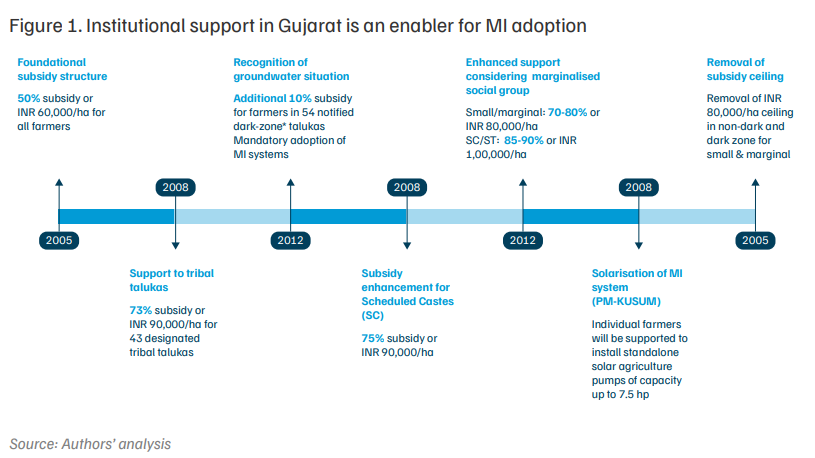
The GGRC serves as a critical institutional innovation for MI implementation, primarily by deploying a tiered subsidy strategy to ensure targeted, equitable support. These subsidies are strategically designed to prioritise high-risk areas, specifically those with critically low groundwater (called ‘dark zones’), alongside communities demanding greater social equity, such as SC/ST populations and small/marginal farmers (Figure 1).
The financial assistance is maximised where the need for water conservation and social equity is greatest:
• Small and marginal farmers are eligible for enhanced support of up to 80 per cent (or INR 80,000/ha) in dark zones.
• The highest assistance is reserved for SC/ST farmers, who can receive up to 90 per cent subsidy or INR 100,000/ha in dark zones (GGRC 2025a).
These focused initiatives have successfully driven large-scale adoption across Gujarat, covering 2.31 million ha and benefiting over 1.48 million farmers through the central and state financial assistance of INR 80,268.5 million during 2005 to 2023 (NABARD 2024). The distribution of adopters reflects the state’s farming demographics, with medium and small farmers forming the majority (55 per cent being medium landholders). Importantly, the strategy has achieved significant social penetration, with tribal farmers constituting approximately 14 per cent of the total beneficiaries (GGRC 2024b).
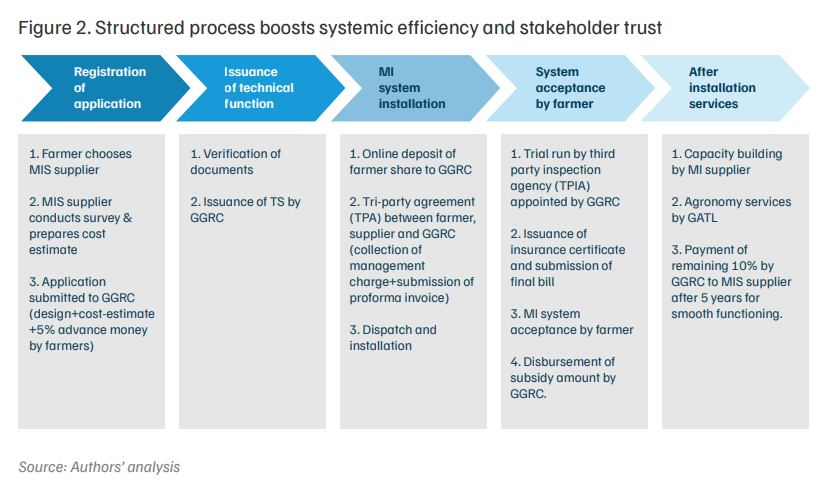
The subsidy process is clearly structured into five key stages, which ensures efficient disbursal while maintaining technical accuracy and transparency (GGRC 2022). This methodical approach has successfully generated significant stakeholder trust in both the process and the implementing institution (Figure 2).
The success of GGRC’s SPV model has informed national policy guidelines on Per Drop More Crop as it recommends that states establish dedicated SPVs to accelerate implementation and enhance overall efficiency (Government of India 2021).
Dedicated Implementing Agency/Special Purpose Vehicle (SPV): States/UTs with good micro irrigation coverage have shown that dedicated Implementing Agency/Special Purpose Vehicle (SPV) can accelerate the scheme’s success with overall efficiency. Therefore, states/UTs should set up a dedicated Implementing Agency/Special Purpose Vehicle (SPV) at the state level with dedicated manpower to ensure that the needed attention is given in the implementation of the scheme. (Government of India 2021).
Adopting MI systems: Water and energy savings and improved WUE
Global evidence demonstrates that using MI significantly boosts efficiency and farmer resilience. The system typically results in substantial savings: water (50–90 per cent), energy (31 per cent), and fertiliser (29 per cent). Additionally, farmers benefit from reduced tillage, lower labour and energy costs, and increased crop yields (Bahinipati and Viswanathan 2016; Chand et al. 2020), collectively leading to a 42 per cent enhancement in farmer income levels. These efficiencies also support farmer resilience by enabling the cultivation of larger areas during challenging climatic events like a delayed monsoon or heatwave (Kishore et al. 2014; Zotarelli et al. 2015).
In Gujarat, improved WUE through MI is complemented by substantial energy savings (25–77 per cent), which translate into significant financial benefits per 5 hp pump in the Kharif (INR 42,242) and Rabi (INR 45,838) seasons (Table 1). The adoption of MI also contributes to reduced fertiliser usage and is complemented by extensive infrastructure development like canal networks, check dams, and solar pumps.
| Indicator | Units | Kharif season | Rabi season | Source |
|---|---|---|---|---|
| Water savings | Per cent | up to 70–80% | Viswanathan, Bahinipati, and Mohanty 2022 | |
| Yield improvements | Per cent | up to 90% | Viswanathan, Bahinipati, and Mohanty 2022 | |
| Yield improvement (crop-wise) | Per cent |
Drip irrigation compared to flood irrigation:
MI compared to others:
|
Randev 2015; Viswanathan, Kumar, and Narayanamoorthy 2016; Shah 2011 | |
| Savings in electricity consumption | Per cent | 25%–77% | Kumar et al. 2021 | |
| Energy savings | Average savings in electrical units per farmer | 117.21 | 127.19 | NABARD 2024 |
| Financial savings associated with energy savings | Using 5 hp pump (INR) | 42,242 | 45,838 | |
| Using 7.5 hp pump (INR) | 63,363 | 68,757 | ||
Source: Authors' analysis
Adopting MI systems: farmers’ perceptions and decision-making processes
While subsidies accelerate adoption, farmers’ decisions are ultimately governed by four key personal and behavioural factors—perceived risks, belief in benefits, confidence in operating and maintaining the systems, and social validation of the technology (Alam et al. 2024; Ganapathi and Shanthasheela 2024).
The perception of high financial risk associated with the initial investment critically influences MI adoption decisions—it is estimated between INR 65,000 and 150,000 per hectare depending on system, crop, and soil type (Bahinipati and Viswanathan 2019; Malik 2017). These fixed costs are often viewed by farmers as sunk investments (Bhamoriya and Mathew 2014), exacerbated by pervasive credit constraints. This risk is most acute for small and marginal farmers, who constitute over 85 per cent of India’s agricultural workforce (Malik 2017). Furthermore, systemic issues like insufficient, delayed, or complex subsidy disbursement affect policy effectiveness. Finally, the return on investment is crop-dependent; farmers cultivating low-value staples have lower profitability, and are less likely to view MI as financially viable.
The second critical driver of adoption is farmers’ subjective belief in the technology’s benefits and reliability. Research confirms that positive beliefs regarding the advantages of MI translate into a higher likelihood of adoption (Alam et al. 2024). However, awareness regarding the full spectrum of MI benefits—including enhanced fertiliser efficiency (fertigation) and reduced labour costs, beyond simple water savings—remains limited in many regions. This reflects a persistent gap in the effective demonstration and communication of MI’s advantages, suggesting that targeted knowledge dissemination is essential to transform scepticism into confidence (Namara, Upadhyay and Nagar 2005).
The third factor, operational confidence, is severely undermined by concerns over system maintenance and technical reliability. Many farmers perceive a deficit in their knowledge regarding MI operation and upkeep, which leads directly to suboptimal system performance and frequent breakdowns. Technical issues are prevalent, including common problems like filter clogging, blocked drippers, and difficulties in maintaining optimal pump pressure (Malik 2017). These challenges are often compounded by inadequate water quality in many regions, significantly reducing system efficiency and lifespan. Consequently, the high perceived risk of system disruption and the complexity of troubleshooting act as major disincentives for adoption.
Limited post-adoption support and services, coupled with a lack of spare parts for MI systems and low awareness, significantly impede widespread adoption (NABARD 2024). The absence of reliable technical support is a major barrier, as farmers fear system failures and their capacity to resolve technical issues, forcing them to rely on informal networks (Malik 2017). Comprehensive training and reliable after-sales service are crucial for successful adoption (Bahinipati and Viswanathan 2016); without them, farmers may hesitate to adopt MI due to concerns over their technical capacity.
The operation and maintenance of MI systems face a significant challenge due to labour scarcity (Gidwani and Ramamurthy 2018; Rai 2019). The shift from flood to drip irrigation demands new labour skills for installation, maintenance, and operation. This labour gap is increasingly filled by women (Khabar Lahariya and Sethi 2015) as men engage in circular migration, leaving women to manage both farm and household tasks (Lyon et al. 2017; Pattnaik et al. 2018). The difficulty in securing reliable agricultural labour makes MI adoption not just a technical or economic issue, but one deeply connected to social and gendered labour dynamics (Birkenholtz 2023).
Social influence significantly impacts the adoption of MI technology through peer learning and community norms. Farmers are largely influenced by the experiences and opinions of neighbours and their immediate social networks (Alam et al. 2024). Most farmers rely on neighbouring farmers, agro-dealers, and lead farmers for information, rather than formal government or NGO sources. Successful adoption by respected community farmers can strongly catalyse wider acceptance of the technology (Bahinipati and Viswanathan 2017). Understanding these social dynamics is key to unlocking the full potential of MI.
To overcome farmers’ risk perceptions and boost MI adoption, key suggestions centre on reforming subsidy structures, which include relaxing farm size restrictions for eligibility and revising subsidy caps to adjust for inflation and rising equipment costs (Malik 2017). Furthermore, market development is crucial, requiring the creation of premium pricing incentives to reward sustainable farming practices. Finally, a strategy of integrated support is recommended, involving linking MI adoption with crop insurance schemes and weaving it into broader agricultural support services like credit facilities and extension programmes, thereby creating a more compelling mechanism for non-adopters (Palanisami 2017).
The adoption of MI is a complex decision influenced by economic, technical, and social factors. A holistic approach combining financial support, technical assistance, and market development is necessary to address these challenges. Incorporating farmer suggestions and learning from successful models can create a supportive ecosystem. Realising MI’s full potential will enhance WUE and crop productivity, ultimately improving farmer livelihoods and contributing to India’s goals of water and food security and sustainable development. Gujarat’s experience, driven by its geographical and water constraints, provides key insights for scaling up MI policies in similar agro-climatic regions.
To understand the ground reality of MI adoption, this study utilised a four-stage sequential methodology within a qualitative research design. This approach employed a cross-sectional case study method to analyse farmers’ decision-making criteria, institutional mechanisms, and district-level variations at a specific point in time. We rigorously validated findings from consultations with secondary information, to ensure analytical depth (Yin 2018).
Literature review to establish the research context
The study began with a comprehensive review of existing literature to establish the knowledge base regarding water and energy use patterns and the level of WUE for various crops in Gujarat. This stage involved the collection of quantifiable metrics, including:
• Water footprint per crop (litres/kg).
• Energy consumption per unit of water pumped (kWh/m³).
• Irrigation efficiency (percentage of water used by crops).
• Subsidy disbursement rates and timelines.
Given the significant regional variations in soil, climate, and cropping patterns within Gujarat, this analysis focused on understanding localised factors that influence agricultural water and energy use. This approach ensures the development of targeted and effective MI solutions.
Purposive multi-stage sampling for selection of ACZ and districts for deep dive
The study employed purposive multi-stage sampling to select diverse contexts for understanding MI adoption. Three agro-climatic zones (ACZs), representing different MI adoption levels, were selected. Within each ACZ, the sampling proceeded sequentially: one district, one taluka (block), two representative villages. Respondents were chosen to reflect diversity in adoption status, barriers, and enablers, providing rich insights into on-ground MI experiences (Campbell et al. 2020). This design facilitated narrative analysis and ACZ-specific findings, which may require future validation across other zones (Campbell et al. 2020; Yin 2018).
The selection of ACZs and districts was guided by a set of indicators drawn from literature and critical insights from experts at GGRC and the DCM Shriram Foundation. Key indicators included: relative water scarcity and extent of agricultural coverage (essential for MI expansion potential), prevailing climatic conditions, and dominant crop types.
The selection of the focus areas—North West Gujarat, North Saurashtra, and North Gujarat—is based on the critical need for enhanced WUE in these regions. Despite 70 per cent of Gujarat’s freshwater being concentrated in the water-abundant South and Central ACZs, approximately 75 per cent of the state’s agricultural land lies within the relatively water-scarce North West, Saurashtra, and North Gujarat ACZs (Viswanathan, Pathak and Bahinipati 2016). This substantial agricultural activity in highly water-stressed zones highlights a critical need and potential for increasing WUE through MI (Figure 3). By concentrating the study on these high-demand, highscarcity contexts, the research aims to maximise insights into scaling MI effectively.
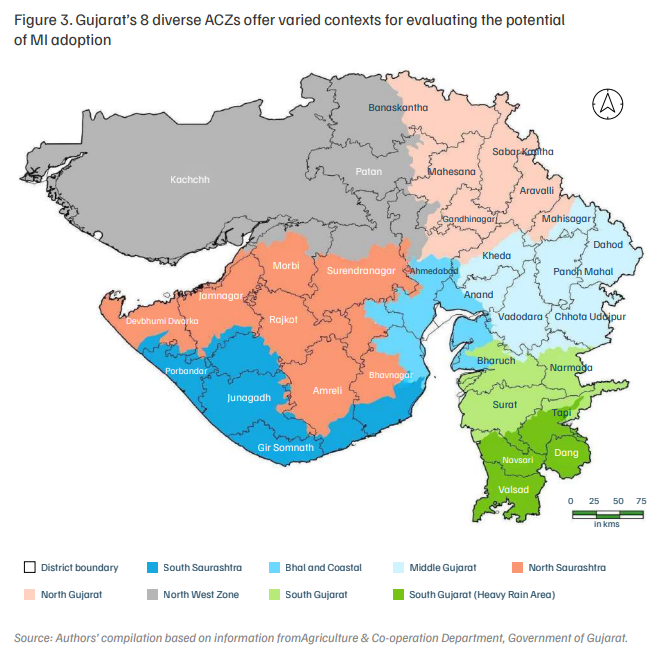
Representative districts were selected from the three focus ACZs based on three key criteria: proportion of beneficiaries, the stage of groundwater development, and the usage of MI systems. It is to be noted that some districts span multiple ACZs.
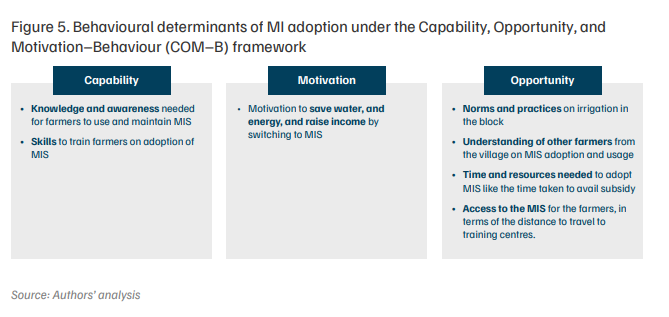
The core novelty of this study lies in integrating two complementary frameworks to analyse MI adoption: the COM-B model at the farmer level, and the CEEW Scalability Framework at the system level. The COM-B model explains adoption behaviour of the farmers towards the adoption of the MI (B) in terms of capability (C), opportunity (O), and motivation (M) (McDonough et al. 2018). It is grounded in the understanding that these are shaped by interactions with other farmers, families, farmer groups, agriculture policies and markets, and also the farmer’s understanding of the soil, rainfall, land, and climate (Nguyen et al. 2013).
The Scalability Framework identifies enabling conditions such as institutionalisation, financial sustainability, leadership, and policy alignment. By combining these, the study offers a multilayered conceptual model where adoption is shaped by both individual behavioural determinants and broader systemic factors. This integrated framework ensures that recommendations address behavioural, institutional, and policy barriers simultaneously (Moore 2015). District-wise beneficiaries: The selection of representative districts from the three chosen ACZs was rigorously based on the percentage of MI beneficiaries (encompassing all farmer categories) to facilitate an analysis between adopters and non-adopters. The study strategically included districts with the lowest beneficiary proportions to deeply understand the barriers to adoption: specifically, Kachchh (1.34 per cent) in the Northwest Gujarat ACZ; Dwarka (0.60 per cent), Morbi (1.81 per cent), and Botad (3.28 per cent) in the North Saurashtra ACZ; and Mehsana (0.66 per cent), Gandhinagar (1.13 per cent), and Aravalli (3.64 per cent) in the North Gujarat ACZ. This focus on low-adoption areas was balanced by the inclusion of Banaskantha (19.56 per cent)—the district with the state’s highest proportion of beneficiaries—to capture the success factors and enabling mechanisms crucial for large-scale adoption (Table 2).
| ACZ* | District | No. of beneficiaries | District-wise proportional beneficiaries (%) | Stage of ground water extraction (%) |
|---|---|---|---|---|
| North Gujarat | Gandhinagar | 16,706 | 1.13 | 92.3 |
| Mehsana | 9,801 | 0.66 | 108.2 | |
| Aravalli | 54,006 | 3.64 | 41.92 | |
| Banaskantha | 290,245 | 19.56 | 115.52 | |
| Sabarkantha | 71,184 | 4.80 | 71.31 | |
| North Saurashtra | Botad | 48,690 | 3.28 | 50.26 |
| Surendranagar | 52,045 | 3.51 | 47.7 | |
| Morbi | 26,903 | 1.81 | 45.9 | |
| Rajkot | 83,013 | 5.59 | 62.85 | |
| Jamnagar | 40,014 | 2.70 | 36.42 | |
| Devbhumi Dwarka | 8,920 | 0.60 | 56.5 | |
| North West Gujarat | Kachchh | 19,924 | 1.34 | 54.05 |
| Patan | 23,962 | 1.61 | 98.74 | |
| Total | 1,484,058 | 100 | ||
Source: Authors' compilation based on primary data received from GGRC, 2025
Note: *Only covered selected ACZ
• Stage of groundwater extraction: The level of groundwater development is a critical indicator for assessing regional water needs and guided the final selection of study sites, as approximately 80–85 per cent of Gujarat’s cultivated land is irrigated using groundwater (Kishore 2013; Vishwanathan et al. 2016). Signifying severe water stress and over-exploitation (groundwater extraction rate exceeding 100 per cent), the study focused on regions exhibiting unsustainable extraction levels: such as Banaskantha (North Gujarat ACZ) with 115.52 per cent, and Mehsana (North Gujarat ACZ) with 108.2 per cent (Government of India 2023).
• Experience with different MI systems: Understanding farmer preferences for specific MI technologies (drip and sprinkler) based on crop and soil types was a key criterion for district selection, drawing on findings from an IIM Ahmedabad study (IIM Ahmedabad 2017; Vemireddy, Nagarajan and Vishwanath 2023). The study highlighted the top districts for adopting different MI systems. This distribution confirms the relevance of the selected study districts for analysing both the barriers and enablers of drip and sprinkler adoption across varied contexts in Gujarat.
Based on these criteria and in collaboration with GGRC, an initial list of districts was created: Kachchh (North West Gujarat); Botad, Rajkot, Dwarka (North Saurashtra); Banaskantha and Sabarkantha (North Gujarat). The final selection was narrowed down to three districts for comprehensive analysis, primarily due to the substantial proportion of small and marginal farmers within them (NABARD 2024). One block was subsequently selected from each focus district, and two villages were identified within each block, resulting in six final study sites (Table 3).
| District (ACZ) | Block | Villages |
|---|---|---|
| Banaskantha (North Gujarat) | Deesa | Mudetha, Jherda |
| Kachchh (North West Gujarat) | Bhuj | Jambudi, Mankuva |
| Rajkot (North Saurashtra) | Gondal | Daliya, Kamadhiya |
Source: Authors' analysis
Data was collected through key stakeholder consultations across the six selected study sites, engaging over 250 participants.
Stakeholder consultations
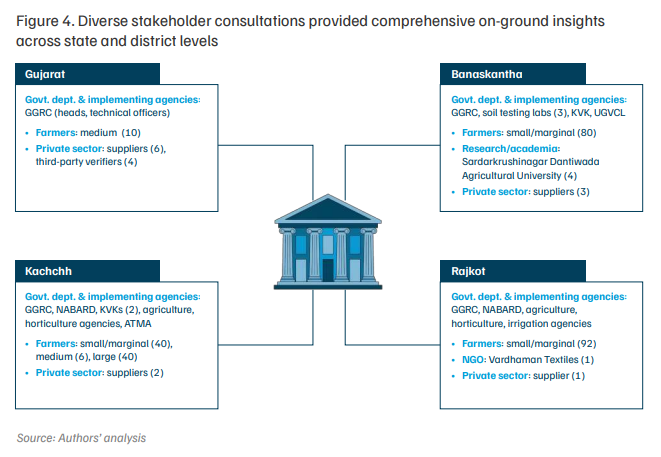
The participants represented four key stakeholder groups to capture a comprehensive, multifaceted understanding of MI adoption (Figure 4). Through interaction with government agencies, we explored the dimensions of policy implementation, resource management (water and energy), and institutional frameworks. Farmers and farmer organisations (FPOs, water users’ associations or WUAs) were consulted on capturing diverse perspectives on MI adoption, operation, and maintenance, segmented by scale (small, marginal, medium, large) and gender. Civil society organisations, research, and academia provided expert knowledge on sustainable agriculture practices and climate-smart technologies. Private sector (suppliers, technicians) offered practical insights into MI implementation, including equipment manufacturing, supply chains, and maintenance support. This wide engagement ensured that the data we gathered addressed not only the behavioural drivers at the farm level but also the systemic and policy barriers affecting MI scalability across Gujarat.
The consultations were guided by a semi-structured questionnaire aligned with two important frameworks for understanding behavioural aspects and scaling up of policy interventions (Figure 5).
The second is the Scalability Framework developed by CEEW for the context of India, identifying key success factors that enable scaling up of a programme like the adoption of MI in Gujarat (Figure 6).
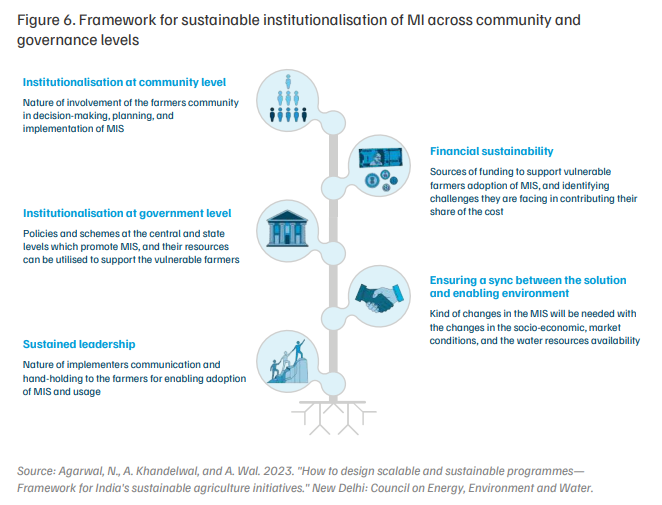
The factors which enable scaling up include institutionalisation at the community and government levels, sustained leadership, financial sustainability, and synchronisation between the solution and enabling environment (Agarwal, Khandelwal and Wal 2023). By combining the behavioural lens of the COM-B framework and the systemic lens of the CEEW Scalability Framework, the study created a multidimensional framework to comprehensively analyse the three district case studies and ensure recommendations addressed both individual and systemic barriers simultaneously (Table 4).
| S. No. | Theme and description | Subtheme | Codes | ||||||||
|---|---|---|---|---|---|---|---|---|---|---|---|
| 1. | District profile: Establishes the key characteristics of the selected districts, encompassing the natural resources, and socio-economic and market conditions that influence the adoption of MI systems. |
|
|||||||||
| 2. | Capability of farmers: Assessment of capabilities needed in adopting and using MI systems. This includes understanding the mechanisms of knowledge transfer and skill development among small and marginal farmers. |
|
|||||||||
| S. No. | Theme and description | Subtheme | Codes | ||||
|---|---|---|---|---|---|---|---|
| 3. | Opportunities to farmers: Evaluation of the physical and social environment that enables or constrains MI system adoption. It explores how regional variations in infrastructure development, water availability, and social capital influence adoption patterns. |
|
|||||
| 4. | Motivation of farmers: Understanding the complex interplay of factors that act as internal and external motivators, including water scarcity concerns, energy costs, and potential productivity gains. It examines how farmers weigh these factors against perceived risks and challenges. |
|
|||||
| 5. | Community institutionalisation for scalability: Analysis of the effectiveness and coordination of Gujarat's institutional mechanisms for promoting MI system adoption. This involves examining the roles, responsibilities, and interactions between key institutions like GGRC, KVK, and other state agencies. |
|
|||||
| 6. | Government institutionalisation for scalability: Evaluation of government mechanisms and policies supporting MI system adoption. |
|
|||||
| S. No. | Theme and description | Subtheme | Codes | ||||
|---|---|---|---|---|---|---|---|
| 7. | Financial sustainability for scalability: Evaluation of the economic viability of adoption under current policy and market conditions, considering multiple angles of initial investment requirements, subsidy accessibility, operational costs, and long-term economic benefits. |
|
|||||
| 8. | Social dynamics: How social structures and relationships in the agricultural communities influence MI system adoption and usage patterns, considering gender roles, and influence of social networks in decisions and system operation. |
|
|||||
| 9. | Recommendations and future outlook: Explores farmers' experiences and support needs in consultation with stakeholders for enhancing adoption, focusing on immediate improvements and long-term strategies across technical, institutional, and policy aspects. |
|
|||||
Source: Authors' analysis
We subsequently analysed both primary and secondary data gathered through the stakeholder consultations.
Data and policy analysis approach
We analysed primary qualitative data using Atlas.ti, following a three-phase coding structure. This process moved from open theme identification to axial mapping, where we organised themes within the integrated analytical framework based on the COM-B and CEEW Scalability parameters. The final phase involved the selective synthesis of key narratives. We ensured robustness of the findings through triangulation of primary consultation data, secondary report and confirming reliability (Flick 2018).
We conducted a review of nine key policies related to MI adoption using content analysis of policy documents and associated guidelines (Figure ES5). The analysis specifically examined policy objectives to assess their support for the water–energy–food nexus dimensions of MI. Based on this review and analysis, we co-created actionable recommendations with the GGRC. This collaborative approach ensures that the suggested interventions aim to strengthen policy coherence for effectively speeding up and scaling up the adoption of MI systems. The next section presents this analysis.
The analysis is structured into three key sections to comprehensively address the challenges of and opportunities for MI adoption. First section establishes the context by analysing state-specific crop water requirements for major crops, categorised season-wise. This analysis is crucial for determining the necessary scope and direction of the expansion of MI coverage to optimise WUE.
The second is a detailed policy coherence analysis across nine key central and state policies, pertaining to water, food systems, and energy security. The assessment brings forth alignment to enable MI adoption and advance sustainable development.
The final section presents the findings from district-level case studies on application of the integrated framework, in consultation with key stakeholders.
State-specific crop water requirement: determining scope for MI expansion
Gujarat’s crop water requirement exhibits significant variation across seasons and crops, highlighting the critical need for efficient irrigation systems.
• Kharif (monsoon) season: paddy, cotton, and castor are the most water-intensive, each requiring the highest water volume at 5,000 m3/ha (Figure 7).
• Rabi season: sugarcane is the most water-intensive, with a requirement of 18,000 m3/ ha, more than the combined total of the next two most water-intensive crops, fennel and sorghum (7,000 m3/ha each) (Figure 8).
• Summer season: Water requirements show even greater intensity during the summer. Paddy requires 17,000 m3/ha, nearly double the water compared to the next most waterintensive crop, maize (9,800 m3/ha) (Figure 9).
• Vegetables and spices: These crops show considerable variability with requirements, yet they occupy small cultivation areas across all seasons (Figure 10).
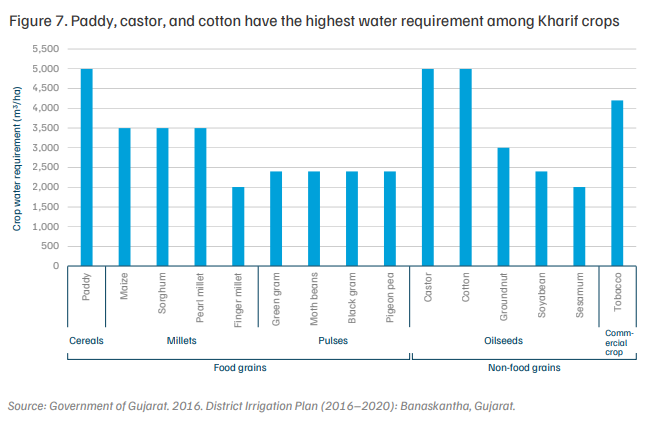
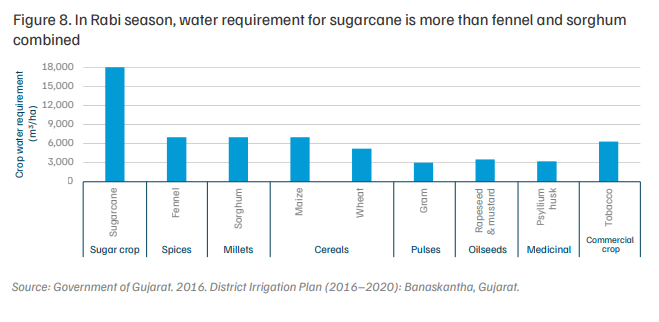
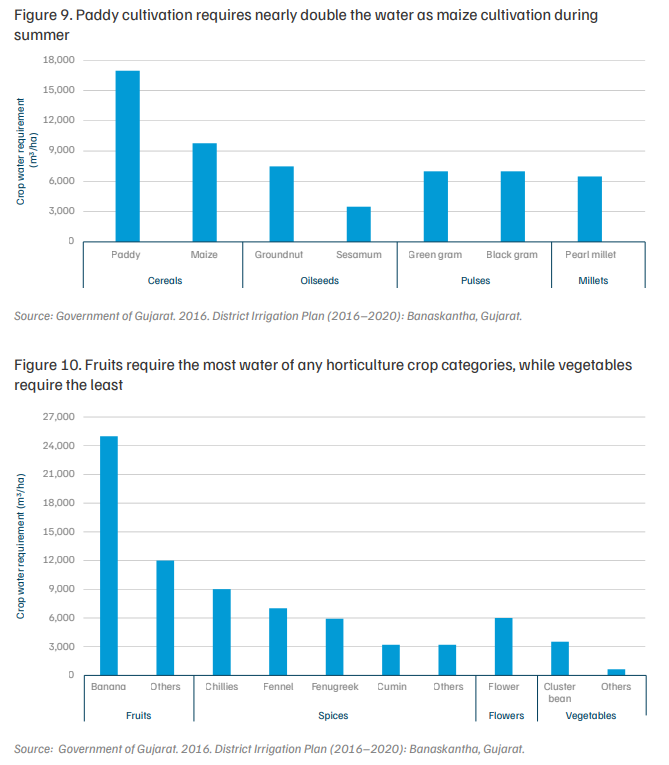
These water-use patterns underscore the necessity of promoting MI for highly water-intensive crops like paddy and cotton, while simultaneously encouraging the adoption of drought-resistant alternatives. In fact, the primary crops utilising MI are groundnut (1.01 million ha) and cotton (0.69 million ha) (NABARD 2024). This existing adoption highlights significant scope for further MI expansion in these key cash crops, demonstrating both impact and scaling potential.
Policy analysis
The policy landscape in Gujarat demonstrates a robust commitment to MI, supported by a substantial investment of INR 80,268.5 million from both central and state grants. This investment has directly benefited 1.48 million farmers and resulted in MI coverage spanning 2.31 million ha.
The coherence of water, food, and energy security policies consistently complements the objectives of the flagship ‘Per Drop More Crop’ initiative through several mechanisms:
• Funding and expansion: Schemes like the PMKSY-MIF enable states to mobilise funds specifically for expanding MI coverage.
• Sectoral integration: The Mission on Integrated Development of Horticulture (MIDH) embeds MI as a core element for holistic growth, linking it directly to sustainable water use and quality output.
• Groundwater conservation: Critically, the ABY mandates MI adoption in groundwaterover-exploited ‘dark zones’, explicitly connecting the technology to groundwater conservation and farmer behavioural change.
• Energy integration: Policies like PM-KUSUM and Jyotigram Yojana integrate MI with energy solutions. PM-KUSUM encourages solar-powered pumps compatible with MI, while Jyotigram Yojana improves electricity distribution to support its stable operation.
• Regional initiatives: Initiatives such as the SAUNI scheme and Surya Kisan Yojana further highlight MI’s role in drought mitigation and sustainable energy use for irrigation (Table 5).
| S. No. | Policy | Objectives: consideration of MI & policy coherence | Targeted outcomes | Geographic and demographic coverage | Temporal duration | Provision for implementation | Target groups | Source |
|---|---|---|---|---|---|---|---|---|
| 1. | RKVY- Per Drop More Crop (PDMC) | Enhance farm-level WUE through adoption of MI | 1. Better WUE and conservation 2. Higher crop productivity 3. Higher fertiliser use efficiency 4. Higher farmers' income 5. Adaptation to climate change |
Pan-India, focus on diverse agro-climatic zones | Initial phase: 2015–16 Transition phase: 2022–23 |
Funding pattern —60:40 Centre and state | Farmers, FPOs, agri-partners, agri-preneurs | Ministry of Agriculture & Farmers Welfare 2023 |
| 2. | PMKSY- Micro-Irrigation Fund (MIF) | Ensure irrigation for every field (Har khet ko pani) | 1. Facilitate states in mobilising additional resources to expand the coverage of MI beyond the provisions of the PDMC | Pan-India, focus on states with lower adoption | Initial phase: 2019–20 Renewal: 2021–27 |
Initial allocation of INR 50,000 million under NABARD for states to mobilise funds. Union Budget 2021-22 allocated INR 50,000 million with 2 per cent interest |
Farmers with unirrigated lands, small and marginal landholdings, in rain-fed/degraded areas | NABARD 2024; MoA&FW 2023 |
| 3. | Mission on Integrated Development of Horticulture (MIDH) | MI is a key consideration in the holistic growth of horticulture | 1. Enhancing sustainable water use 2. Enhancing quality of horticulture products for export 3. Increase in farmers' income 4. Strengthening nutritional security |
Pan-India | Initiated in 2014, ongoing | Funding pattern—60:40 Centre and state | All farmers, focus on inclusion of women | Dept of Agriculture & Cooperation 2014 |
| 4. | National Mission for Sustainable Agriculture (NMSA) | 1. Adoption of environment-friendly technologies for water and energy use efficiency 2. Issuance of Soil Health Card |
1. Enhancing agricultural productivity and income 2. Diversification of income through crop diversification 3)Environmental sustainability and climate resilience through conservation, WUE, reduced chemical inputs |
Pan-India, focus on diverse agro-climatic zones, rain-fed and dryland | 2014-onwards | 2024–31: Allocation is INR 101,030 million | Small and marginal farmers, FPOs, SHGs, NGOs | Dept of Agriculture & Cooperation 2014 |
| 5. | Atal Bhujal Yojana (ABY) | 1. MI is mandatory in the 'dark zones' where groundwater is over-exploited 2.Change farmers' behaviour towards groundwater conservation |
1. Community-led water security planning 2. Improved agricultural WUE |
Gujarat among the 7 semi-arid and arid states | Launched in 2019–20, ongoing | Total financial outlay of INR 60,000 million. 50% funding from World Bank (loan), 50% from Govt of India (grant) | Gram panchayats, and farmers in ground water-stressed blocks | Ministry of Jal Shakti 2026 |
| 6. | Pradhan Mantri Kisan Urja Suraksha evam Utthaan Mahabhayan (PM-KUSUM) | Pradhan Mantri Kisan Urja Suraksha evam Utthaan Mahabhayan (PM-KUSUM) | 1. Integration of renewable energy into agriculture 2. Increase farmers' income by surplus solar energy 3. Positive environmental impact by using clean energy and water conservation |
Pan-India, focus on states with high potential, land availability, groundwater dependence for irrigation | 2019–20 to March 2026 | Centre (MNRE)—state—farmer ratio = 30:30:40 | Off-grid farmers: individual and group Cooperatives, panchayat, FPOs, water user associations | Ministry of New and Renewable Energy 2024 |
| 7. | Saurashtra Narmada Avtaran Irrigation (SAUNI) | 1. Drought mitigation and water security in most water stressed regions. 2. Use of pipeline-based water distribution system with MI |
1. Reduce dependency on monsoon 2. Improve agricultural productivity 3. Improve climate resilience |
Gujarat, focus on 11 districts | 2012–25 | Total financial outlay of approximately INR 185,630 million, funded by the state government | Farmers | Narmada Water Resources Dept 2025 |
| 8. | Jyotigram Yojana (JGY) | Improving electricity distribution and promoting farmers' adoption of MI through subsidy to reduce groundwater reliance | 1. Improving agricultural productivity 2. Separation of agricultural feeder from non-agricultural ones 3. Economic growth and employment generation |
Gujarat, focus on rural areas (18,000 villages) | 2003–present | Total financial outlay of INR 11,000–12,900 million, funded by state government grants | Farmers, focus on remote and tribal areas | Mishra 2009 |
| 9. | Surya Shakti Kisan Yojana (SKY) | Providing farmers with access to solar-powered water pumps. The grid-connected system allows farmers to both consume and sell excess solar energy, promoting sustainable and efficient irrigation practices | 1.Enhancing energy security 2. Sustainable agricultural practices 3. Improve farmers' income |
Gujarat (12,400 farmers from all 33 districts) | 2018–present | Subsidy: 60 per cent of project cost Loan: up to 35 per cent of project cost (4.5–6 per cent interest) Farmer contribution: 5 per cent of project cost |
Existing grid-connected farmers with adequate land | Uttar Gujarat Vij Company Limited 2018 |
| 10. | Kisan Suryoday Yojana (KSY) | Providing solar energy for irrigation during daytime | 1. Enabling transition to renewable energy for agriculture sector | Gujarat (drought-prone, tribal regions) | 2020–21–present | State allocated INR 35,000 million for transmission infrastructure | Farmers: small and marginal, tribal | Energy and Petrochemicals Department 2026 |
Source: Authors' analysis
This layered policy approach—incorporating direct subsidies, dedicated funding, energy integration, and regional water security measures—demonstrates that MI adoption consistently contributes to water security and climate-resilient agriculture in the semi-arid and arid context of Gujarat.
District-level case studies
Each district-level case study is structured around two parts: first, a fact-sheet detailing key aspects of agriculture, water use, farmer demographics, and the specific MI technology utilised; and second, a meticulous analysis identifying the key enablers that facilitate the scaling up of MI adoption and the systemic barriers that impede its widespread implementation.
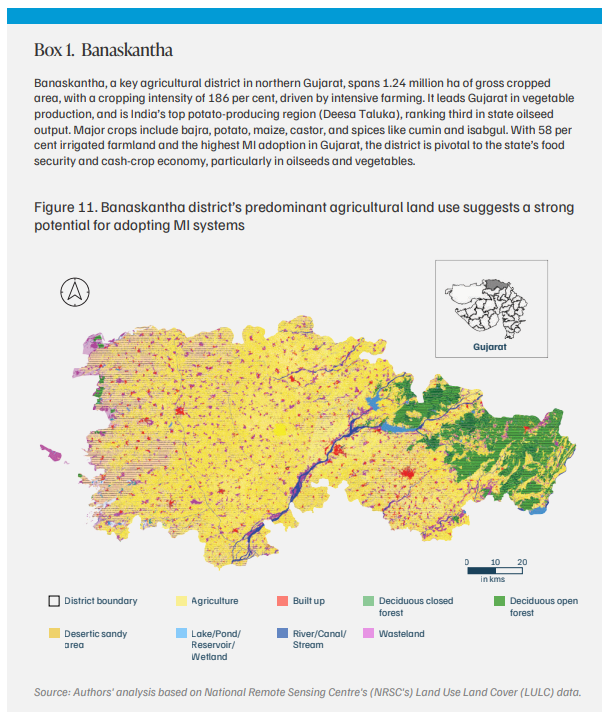
"There are significant water savings with micro-irrigation systems. More land space is available for cropping as channelling is not required compared to flood irrigation. We have seen increased productivity—crops sprout within 10 days compared to 15–20 days with conventional flood irrigation. Labour costs have reduced considerably as well."
- MI adopter from Mudetha village since 2018
This section provides a comprehensive analysis of the enablers and barriers influencing adoption, categorised by environmental, individual, community, and institutional factors.
Environmental enablers
The factors of water availability, quality, and soil characteristics act as both enablers and barriers for the choice of MI technology.
1. Severe water stress in semi-arid Banaskantha (682 mm rainfall) and critical groundwater depletion (tables below 1,000 feet) necessitate the immediate adoption of any highefficiency MI system (drip or sprinkler) as an essential replacement for traditional flood irrigation (Kumar et al. 2008; Bahinipati and Viswanathan 2017). MI adoption reduces water consumption by 30–40 per cent, consistent with observations across semi-arid regions of India. This acts as an enabler for adoption in water-scarce context (Mohan et al. 2024).
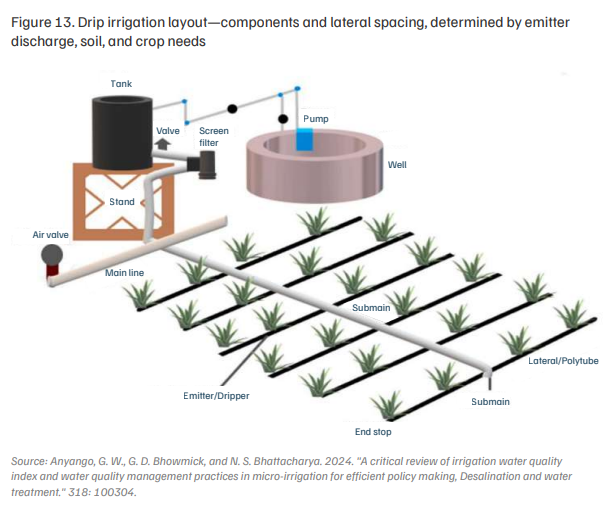
2. Water quality, measured through TDS level as a key parameter, acts as a crucial enabler for MI technology adoption in Banaskantha, though it directs the choice toward a specific system. Total Dissolved Salts is measured at approximately 400 mg/L in Banaskantha (CGWB 2023a; CGWB 2011) (Table 8). According to global MI standards (Anyango, Bhowmick, and Bhattacharya 2024), this TDS level is classified as good for MI usage. This favourable water quality serves as a fundamental enabler, ensuring the technical viability and longevity of MI equipment, unlike highly saline areas where systems fail rapidly. Among the three MI options, the ‘mini-sprinkler system is better suited than drip, as the fine emitters in drip systems may still get clogged at 400 mg/L TDS’ according to the GGRC district official for Banaskantha, potentially leading to maintenance issues and uneven water distribution (Figure 15).
| TDS level (mg/L) | Classification | Suitable MI system | Risk | Regions in Gujarat (mg/L) |
|---|---|---|---|---|
| 0 | Ideal | Drip & sprinkler | No clogging risk | |
| 0-450 | Good | Drip & sprinkler | Minimal clogging | Danta and Palanpur (Banaskantha): 400 |
| 450-1,200 | Permissible | Drip & sprinkler | Moderate clogging risk | Most regions: 800-1,500 |
| 1,200-1,600 | Severe | Sprinkler (preferred) | High emitter clogging in drip | Kachchh: 200-2,200 |
| 1,600-2,000 | Polluted | Sprinkler | Drip systems prone to failure | |
| >2,000 | Highly polluted | Sprinkler | Drip systems unsuitable | Tharad and Dantiwada: >3,000 |
Source: Mohan, G., L. N. Perarapu, S. K. Chapagain, A. A. Reddy, I. Melts, R. Mishra, R. Avtar, and K. Fukushi. 2024. "Assessing determinants, challenges and perceptions to adopting water-saving technologies among agricultural households in semi-arid states of India." Current Research in Environmental Sustainability 7: 100255 and authors' analysis.
3. The prevailing sandy soil texture and low-to-moderate salinity enable the successful and preferred deployment of mini-sprinklers. The sandy to sandy loam soils (high infiltration rates) make mini-sprinkler irrigation the preferred and technically suitable option (Kumar et al. 2008; FAO, n.d.). Furthermore, the region’s low-to-moderate soil salinity is better served by mini-sprinklers, which provide uniform moisture and minimise initial growth stress.
Environmental barriers
1. Soil characteristics make drip irrigation less suitable in Banaskantha, as it is generally more suitable for high salinity areas. Drip creates protective desalination zones around the roots by leaching salts downwards.
2. High-intensity farming practices, driven by MI usage, pose a critical long-term barrier to soil health and overall sustainability: The Rabi season exhibits peak water stress, covering approximately 520,000 ha with high-demand crops (potato/mustard). Irrigation dependence soars to 87 per cent in Rabi, significantly higher than other seasons (43–51 per cent). This relentless, season-after-season high-volume irrigation cycle is directly responsible for soil degradation. The district officials confirm the key concern: ‘Back-to-back seasons have drained the land of organic matter, leading to a weaker soil structure.’ This loss of organic matter undermines the soil’s natural capacity to retain water and nutrients, effectively decreasing the long-term benefit of even efficient MI technology. This transforms the land itself into a barrier against sustained agricultural productivity.
Individual-level enablers
1. Adoption of MI has led to addition of a cropping cycle: Banaskantha is dominated by agriculture and dairy, focusing on staples (pearl millet, sorghum, wheat) and high-value cash crops (cotton, potato, castor). The adoption of MI has enabled a robust three-season cropping pattern (Kharif, Rabi, Zaid), significantly boosting farmer incomes.
2. Reduced operational costs and improved crop quality serve as the most compelling economic motivations for adoption: Adopters report significant economic gains, aligned with literature (Kumar et al. 2008; Gandhi et al. 2021), including:
• Operational savings: Approximately 40 per cent reduction in labour costs and substantial water and energy savings.
• Productivity gains and price premiums: The prospect of lowering operational costs (especially labour costs). This efficiency also leads to notable improvements in crop yields, enhancing overall agricultural productivity. Non-adopters noted that MI-grown crops often command a market price approximately 15 per cent higher than conventionally irrigated crops due to superior quality. Literature supports this, citing price premiums up to 16 per cent and profit margins exceeding 100 per cent in certain crops (Kumar et al. 2008).
• Other savings: Additional motivators include cost savings in fertiliser and pesticide use (Viswanathan and Bahinipati 2015).
• These benefits culminate in substantial income gains: NABARD (2024) estimates an annual increase of INR 211,913 in farm income associated with MI adoption, providing a powerful incentive for both initial uptake and sustained use.
3. Women are active operators of MI systems, drawing on their practical skills: This high level of involvement and labour contribution to agriculture and water use demonstrates women’s competence and stake in the technology’s success.
Individual-level barriers
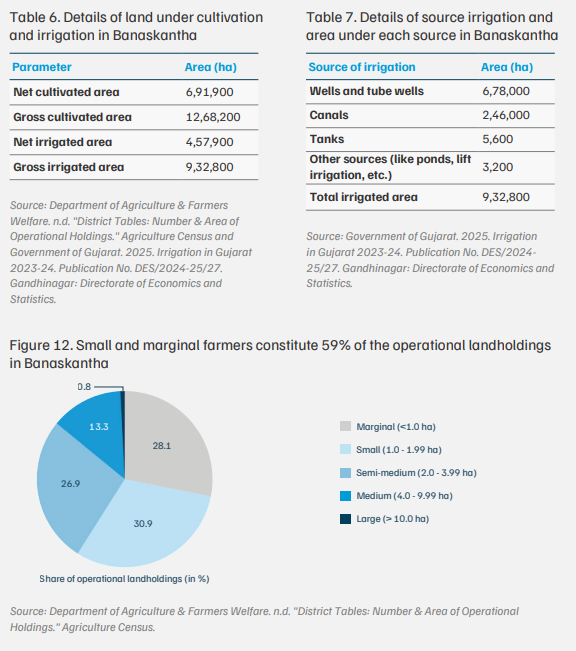
1. Land fragmentation, driven by evolving social structures, has resulted in small (1–2 ha) and marginal landholdings (<1 ha) across India. In Banaskantha, this fragmentation is severe, with individual holdings often restricted to a mere 0.25–0.75 ha (2–3 bighas), and with MI adoption of only 18 per cent (Figure ES3).
2. Awareness of specific subsidies and policy benefits remains uneven. This knowledge gap is particularly pronounced among farmers who have not yet adopted MI.
3. Women’s limited decision-making authority: Despite operating the systems, women face a barrier in having decision-making authority over the initial MI adoption or major system changes.
Community level enablers
1. Social learning and peer-driven diffusion: Social influence and community dynamics are key catalysts for MI diffusion in Banaskantha. Adoption is largely driven by observational learning—farmers initiate MI use after observing visible benefits in demonstration plots and learning directly from their peers. This aligns with broader findings on social learning as a critical driver of technology uptake (Viswanathan and Bahinipati 2015). The leadership and success of early adopters motivate others to follow suit, which explains the significant variation in MI adoption between communities (Mudetha village: 40–50 per cent; Jherda village: 80 per cent). Consequently, supporting such early adopters represents a strategic method to enhance the spread of sustainable agricultural technologies.
Sustaining MI adoption is primarily driven by continuous, informal learning. While suppliers provide initial technical knowhow, continued proficiency relies on peer-to-peer interactions, observation, and hands-on experience.
2. Improving community relations emerged as a crucial consideration for establishing formal community institutions: Our findings suggest that fostering community respect for MI’s infrastructure effectively curbs theft incidents reported by adopters, and improving community relations for conflict resolution and optimal resource allocation. This presents a significant opportunity to develop more formalised and effective community frameworks.
3. Women’s contribution to water resources management: Women’s substantial labour in operationalising MI systems on-farm provides greater influence over resource management.
Community level barriers
1. Inadequate focus of existing collectives: The current farmer groups (agricultural collectives, community based organisations, mandlis) primarily focus on seed and fertiliser distribution, not on promoting or managing MI. This indicates a gap in their capacity to support MI adoption.
2. Need for community driven water sharing: There are gaps in community level support for organised community initiatives for water sharing. This is a critical barrier, especially where landholdings are fragmented and water sources are shared. Individual MI adoption is complex and risky without a formal system for collective water access and management.
3. Risk perception due to lack of support: Farmers with scattered plots perceive the investment in MI as risky because of the absence of robust community support structures. In summary, the core barrier is the limited institutional support and collective action mechanisms needed to manage shared resources and risks associated with MI adoption within the community.
4. Broader social norms and traditional gender roles act as the primary constraint, limiting people’s ability to participate meaningfully in formal water management and adoption debates.
Institution-level enablers
1. Adoption driven by targeted campaigns to build farmers’ capability: Effective knowledge campaigns have positioned Banaskantha as Gujarat’s leading district in MI adoption. This high uptake is sustained by farmers’ reliance on information disseminated through government programmes, interpersonal networks (family, neighbours, and acquaintances), and targeted mobile SMS campaigns. The annual agriculture festival (Krishi Mahotsav) functions as an important platform for knowledge dissemination and farmer engagement. Approximately 1,700 to 1,800 farmers are engaged annually in extension services featuring both seasonal and crop-specific training sessions, offered jointly with GGRC through KVKs.
2. The process for enhancing physical access to MI equipment has become highly efficient and is acknowledged by farmers. The advance supply mechanism developed by GGRC has significantly reduced equipment delivery and processing time, with installation often occurring within 15–20 days of application, and sometimes fast-tracked to 2–3 days. Furthermore, suppliers provide timely repairs and replacements within 1–2 days under the five-year warranty period.
3. Institutional support for data-driven decision making: Effective MI usage relies heavily on data comprehension to inform decisions on cropping and fertiliser application. Block-level soil testing laboratories are crucial in facilitating this by providing farm-level Soil Health Cards (Figure 16). Key soil parameters directly impact MI performance and longevity:
• Soil pH (5.5–8.5 range): Critical as it affects nutrient availability in irrigation water and can accelerate emitter clogging.
• Electrical conductivity (EC): Provides essential information on soil salinity, which dictates necessary irrigation scheduling and leaching requirements under MI.
• Organic carbon (OC) content (0.50–0.75 per cent): Directly impacts water retention and infiltration rates. This information is vital for the design and operation of drip or sprinkler systems and for effective fertigation to maintain high WUE.
This reliance on soil data underscores the need for farmers to fully integrate Soil Health Card recommendations into their MI management practices.
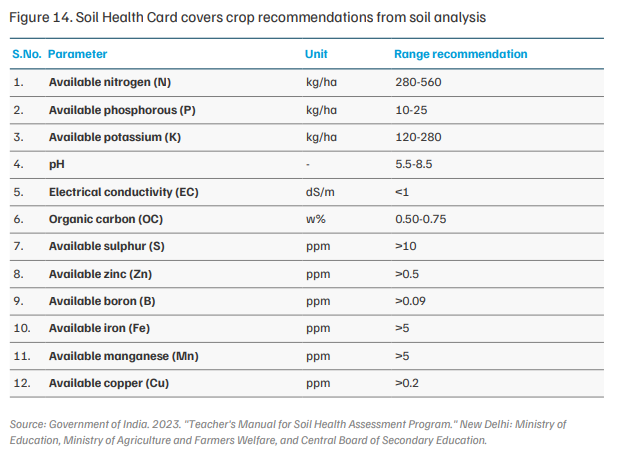
4. Market access and technology: The market for MI equipment in Banaskantha has undergone significant transformation, evolving from a few suppliers to approximately 60 over the last two decades (GGRC 2025). This proliferation has enhanced farmer access to diverse technology, spare parts, and competitive pricing through regional markets (mandis). The combined influence of increased technological adoption, market integration, and strategic institutional support where GGRC played a pivotal role—including capacity building by KVKs—has created a market-oriented agricultural ecosystem. This shift facilitates farmers’ pursuit of premium market opportunities and contract farming, leading to enhanced income stability, though continuous attention to quality assurance mechanisms remains essential.
5. Policy correction for technology upgrade—the sprinkler-to-drip adaptive path: The evolution of the Per Drop More Crop subsidy guidelines demonstrates effective adaptive policy correction in technology adoption. Initial policy allowed farmers to upgrade from sprinkler to drip irrigation after a minimum usage period (e.g., three years) with a differential subsidy (drip subsidy minus sprinkler subsidy availed). The removal of this upgrade provision in 2014–15 created an economic lock-in effect. Farmers who had initially invested in subsidised sprinkler systems faced the full, prohibitive cost of switching to the superior drip technology, causing stagnation in the adoption of higher WUE systems. Latest revised PDMC guidelines commendably reintroduced the technology upgrade pathway as an adaptive corrective measure This policy adjustment is vital for driving progressive technological adoption, enhancing WUE, water savings, and ensures the farmer’s initial investment in sprinkler technology acts as a step, not a barrier, to adopting the next level of water-saving technology.
‘However, the beneficiary may be allowed to avail effective differential subsidy in case he intends to install Drip Irrigation System on the same plot/field from the existing Sprinkler Irrigation System at least after three years to promote crop diversification irrespective of seven years’ subsidy cycle’ (Government of India 2024).
6. Water-Energy-Food (WEF) nexus acknowledged in strategic policy convergence drives district-level adoption: The significant surge in water-efficient technology adoption observed in the district since 2018–19 was driven by the successful strategic convergence addressing the interconnectedness of resources. The ABY’s conservation works augmented water availability, which GGRC’s MI systems then used efficiently, directly enhancing agricultural productivity. Energy efficient MI systems are more efficient than traditional flood irrigation, reducing the energy required for water pumping—a key WEF synergy. The accelerated adoption was a direct consequence of moving beyond siloed schemes.
Institution-level barriers
1. Despite substantial governmental agricultural support in Banaskantha, a recent policy transition concerning land documentation has emerged as a significant institutional constraint to MI subsidy access. Historically, local revenue officials (Tehsildar) provided certification for marginal farmer status, which was utilised when family land remained undivided. Following concerns over fraudulent claims, the government now mandates the use of formal, legally updated land records for subsidy eligibility. This shift, while intended to improve transparency, creates a considerable barrier for genuine small and marginal farmers, whose complex, undivided, or inherited landholdings make obtaining updated formal documentation difficult and time-consuming, thereby limiting access to essential MI support.
2. Impact of GST on subsidy efficacy: The initial investment for MI remains significant, with the average cost of a drip system ranging between INR 120,000 and INR 183,594 per ha. Even with subsidies, first-time adopters are required to contribute approximately 20–30 per cent of the total cost (Bhamoriya and Mathew 2014). A key challenge has emerged from the implementation of the 12 per cent GST on MI equipment. Farmers indicated that the introduction of GST has effectively eroded the value of the subsidy benefit, making the technology more expensive. This impact is particularly pronounced for farmers considering re-adoption, where one farmer noted, ‘the introduction of GST has reduced the subsidy benefits [from 45 to 33 per cent], which makes it costlier to adopt MI a second time’. This policy friction reduces the effective incentive for technology uptake.
3. Accessibility and cost of credit for farmer contribution: For economically weak farmers, the requirement to contribute their share of the subsidised cost presents a significant financing hurdle. The lack of accessible and affordable credit to cover the farmer’s contribution is a major deterrent. Farmers expressed unwillingness to avail credit due to two primary factors: high interest rates that increase the total financial burden, and hassle and charges. As highlighted by a farmer, ‘Nobody takes loans to pay their subsidy amount mainly because of the hassle in documentation and processing charges at the bank’s end.’ This evidence highlights the need for streamlined, accessible financing mechanisms to bridge the gap between subsidy disbursement and the farmer’s required contribution, a challenge consistently identified in prior research on MI expansion (Gandhi et al. 2021).
4. Decentralised approach to peer-to-peer learning leads to challenges in system optimisation and troubleshooting, with common issues (broken valves and cracked tubes) indicating a need for more advanced technical capacity building. There is a need for more advanced, formal technical capacity building to ensure farmers—both current and future adopters—gain the confidence required for long-term system operation and maintenance. The findings suggest there are significant opportunities to enhance extension services targeting these critical aspects.
5. A critical challenge remains the lack of robust post-warranty support. Farmers identified this gap as a significant obstacle to long-term system maintenance and durability. This need for strengthened after-sales services is not isolated to Banaskantha, with similar policy considerations identified across other states like Maharashtra, Uttar Pradesh, and Madhya Pradesh (Gandhi et al. 2021).
6. The requirement for formal land documentation in subsidy applications presents a significant institutional and administrative hurdle, particularly where the operational reality diverges from the legal land records. The core challenge lies in undivided family landholdings, and lack of land ownership by women. When the official land documentation registers the entire family holding under the name of the eldest member, the total land area often classifies the family as large farmers. This creates a systemic barrier for brothers or family members who are operating only a portion of the land and genuinely qualify as small or marginal farmers based on their actual operational landholding. To access the MI subsidy under the small/marginal farmer category, the operating farmer must submit documentation that accurately reflects their individual share. This disconnect forces the genuine small and marginal farmer to undertake the financially and time-intensive process of formally partitioning the land, simply to align with bureaucratic subsidy requirements.
Since MI subsidies and adoption decisions are typically tied to land titles which women rarely hold, this structural barrier creates an ‘economic lock-out’ from the adoption process.
Individual farmer’s profile
Kamlaben Ashok Kumar Mali is a farmer from Vadaval village in the Deesa block of Banaskantha. Her household comprises six members with four females, and has a landholding of 3.8 bighas (equivalent to 0.95 ha). The main source of irrigation is tubewell. Her experiential account of switching to mini-sprinklers is discussed here with changes in agricultural practices, crop productivity, and resource management.
• Transitioned to MI in 2023.
• Irrigated area: remained unchanged after MI adoption.
• Main crop cultivated: shifted from bajri to groundnut in Kharif, from mustard to potato in Rabi, and addition of a fodder crop (Rajka bajri) in Zaid (Table 9).
| Crop | Season | Cropped area (in ha) | Total production of main crop (kg) | Amount sold (kg) | Selling price (INR/kg) | ||||
|---|---|---|---|---|---|---|---|---|---|
| Pre | Post | Pre | Post | Pre | Post | Pre | Post | ||
| Bajri | Kharif (monsoon) | 0.95 | 2,800 | 2,800 | 22 | ||||
| Groundnut | Kharif | 0.95 | 2,625 | 2,625 | 50 | ||||
| Mustard | Rabi (winter) | 0.95 | 2,400 | 2,400 | 50 | ||||
| Potato | Rabi | 0.95 | 40,000 | 40,000 | 10 | ||||
| Rajka bajri | Zaid (summer) | 0.95 | 75,000 | 75,000 | 0.57 | ||||
Source: Authors' analysis
Infrastructure and energy
• New bore well: constructed in 2009 (INR 6 million, 600 ft depth).
• Energy costs: INR 10,000/month for electricity (flat rate, INR 8 per unit).
• Pump capacity: 50 hp installed in 2020.
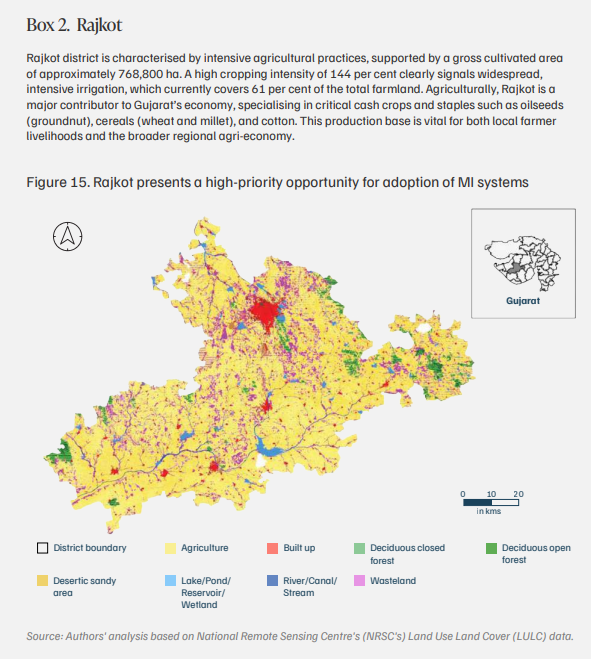
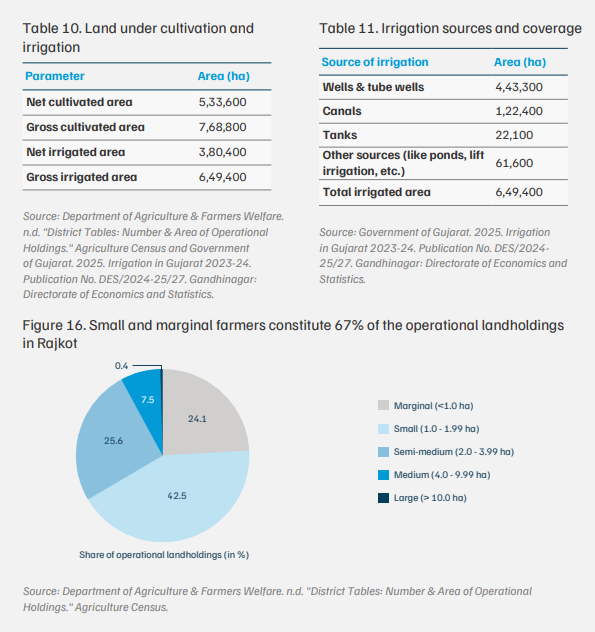
"We know micro-irrigation saves water, but the 12 per cent GST makes it hard for us to afford. Good-quality components are expensive, so we end up buying cheaper, low-quality spares."
- MI adopter from Kherdi Village since 2021
Environmental enablers
1. Diverse soil profile enables MI adoption and usage: The presence of sandy, loamy sand, clayey, silty, and black cotton soils makes the area highly suitable for drip irrigation. Drip systems are effective across this range, minimising runoff in clayey soils, and reducing rapid water loss in sandy soils.
2. Water use efficiency through MI in comparison to flood irrigation: Costs are perceived to be saved through reduced water consumption, lower electricity use due to decreased pumping energy, and reduced requirement of labour as compared to previous practice of flood irrigation.
Environmental barriers
1. Low groundwater yields, a result of low rainfall, high use, and limited storage capacity of the weathered and fractured zones of the Deccan Trap basalt (top 20m) creates a challenge for adoption of MI systems. Although major rivers (Bhadar, Aji, and Machhu) provide vital surface water, this resource has not been used for MI due to limited appropriate infrastructure, making sustained water access unreliable (CGWB 2022a; Mohapatra 2013).
Individual-level enablers
1. Farmers demonstrated a well-established and high level of knowledge and awareness regarding MI: The capability is primarily built through support from government programmes and institutional efforts, particularly the GGRC. Many farmers have accumulated significant practical experience, often using MI for over a decade, with reported experience ranging from 3–12 years across villages. The community also shares knowledge through interactions in village meetings.
2. Farmers, drawing on years—often decades—of hands-on experience, have developed a high degree of technical proficiency in using MI: Their capacity to independently operate and maintain the systems, along with informed preferences for system components such as pipe diameters, reflects a nuanced understanding of MI’s technical requirements and functionalities. The GGRC provided crucial technical training and resources, covering essential skills like pump operations, water distribution, optimal usage, and system maintenance. Farmers noted that no additional training was required, besides technical skills related to water pump operation, indicating their existing foundational knowledge.
3. The economic advantages are perceived by the farmers to be substantial: Farmers linked increase in crop yields, and reduction in fertiliser use, leading directly to lower input cost to increased income. Similarly, due to the system’s efficiency, lower electricity consumption leads to tangible cost savings and helps farmers manage their expenses better. Furthermore, labour costs have significantly declined, making farming more cost-effective and efficient. Cultivating more than one crop per year has provided an additional layer of financial security and stability. These factors have highlighted the considerable economic benefits, and contribute to the long-term sustainability of farming practices facilitated by MI. This indicates that the motivation for farmers to adopt MI is firmly rooted in its numerous perceived benefits.
Individual-level barriers
1. Key challenges for the small and marginal farmers are high initial installation costs, significant maintenance expenses, barriers to re-adoption: The current flat subsidy of INR 70,000, irrespective of land size, translates to higher initial installation costs for small and marginal farmers. This requires rethinking the subsidy structure to overcome this skew. Furthermore, though low-interest loans from the District Co-operative Bank and government schemes aid adoption, competition from cheaper open-market alternatives suggests that more competitive pricing needs to be considered in official schemes. Second, a significant challenge is ongoing maintenance costs, particularly due to frequent damage caused by rodents. Addressing this requires pest-control strategies and financial assistance for repairs. Third, the waiting period of seven years, and GST reducing the subsidy for re-adopters to merely 33 per cent, are significant barriers to their investment decision for re-adoption. These challenges need further knowledge and awareness-generation on the life span of MI as seven years, and alternative approaches to tackle the concern regarding GST.
2. To improve the viability of MI and enhance farmer livelihoods, several key areas need attention. Farmers are particularly concerned about maintenance costs driven by frequent rat damage to components, and expressed the need to shift to larger (120 mm) PVC pipes.
3. Addressing the high cost of mulching and spare parts is also critical.
Community level enablers
1. Applicability to a diverse range of crops has led to high adoption: High adoption rates (60–90 per cent) in specific villages (Moviya, Daliya, Kamadhiya, and Lodhika) indicate that drip irrigation is prominent in the communities. Peer success encourages new farmers to adopt the technology. The wide application to various crops (groundnut, cotton, chilli, mango, etc.) shows that the community has collectively experimented and validated the technology’s effectiveness across the local agricultural portfolio. Shared knowledge and trust build community confidence.
2. Farmers’ decision to adopt MI extends beyond formal training and institutional support to peer observation and interaction as key influences: Knowledge-sharing on MI enables practical demonstrations and experience exchanges directly on the land. In Moviya village, for instance, about 50 per cent of farmers using drip irrigation effectively motivate others by demonstrating MI’s tangible benefits, including increased crop production and reduced water consumption. This visible success proves to be a powerful persuasive tool for those considering the technology or yet to adopt it. Further, in Daliya village, the Sarpanch actively facilitates peer interaction by convening meetings every month specifically to address MI-related issues, and share insights. These regular meetings foster a community-driven approach to MI, where farmers troubleshoot problems and share practical expertise. Rooted in a history of peer support dating back to 2008, this continuous interaction has strengthened local capabilities and created a social framework that evolves with the technology's growing adoption.
3. Local organisations play a pivotal role in providing grassroots-level support for MI: Locally operating organisations play a pivotal role in facilitating the adoption and sustained use of MI. Notably, local foundations have been instrumental in supporting farmers across several villages. They are recognised for their efforts in mitigating agricultural risks and offering timely support during external shocks. They serve as vital information conduits, helping farmers navigate available government schemes and financial assistance options. This strengthens institutional trust and knowledge-sharing at the grassroots level, and is important for community centric support systems for promoting adoption of the technology.
Community-level barriers
1. Societal constraints and traditional gender roles have historically limited women's access to formal irrigation training and assets. Yet, women’s active participation in FGDs regarding MI adoption enablers suggests this is changing. Their keen interest in the technical side of water management marks a move toward greater inclusion in farming decisions. Recognizing and addressing these underlying barriers remains critical to promoting equitable technology adoption.
Institution-level enablers
1. Institutional support is a key enabler for investment in MI infrastructure: This comprehensive support originates from various government bodies and programmes. The GGRC serves as the nodal agency, coordinating these efforts. Key initiatives such as the ABY and NMSA further enhance farmers’ capacity to adopt and utilise MI. Additionally, access to affordable credit is a significant enabler. The District Co-operative Bank provides lowinterest loans, which substantially reduce the financial barriers associated with the initial investment in MI infrastructure.
2. Training and streamlining the adoption process, and ensuring farmers can access necessary resources easily, are instrumental in increasing farmers’ physical access to MI equipment. This includes availability and affordability of spare parts. System suppliers have established outlets nearby, providing easy access to spare parts. This contributes significantly to the physical availability and ease of upkeep for the farmers.
3. The district’s low average landholding (0.80 ha) and the prevalence of land-leasing create individual financial barriers (high relative cost, low tenure security). The GGRC’s specific focus on supporting small and marginal farmers is an active policy intervention designed to mitigate these exact barriers. The GGRC does this through targeted subsidy.
Institution-level barriers
1. An economic barrier related to maintenance costs discourages continued use. The high cost of spare parts for micro-irrigation systems creates a post-installation financial burden, discouraging long-term system maintenance and continued use.
2. Technical-administrative constraints scheme accessibility of farmers. As some farmers struggle to navigate dense digital platforms to access crucial information on subsidies, scheme guidelines, or after-sales support, thereby limiting their ability to fully benefit from and adopt the technology.
Individual farmer’s profile
Mr Jayeshbhai Babubhai Radadiya is a farmer from Charan Samadhiyala village, situated in the Jetpur block of Rajkot. His household consists of four members including two females, and has a landholding of 3.03 ha. His experiential account of switching to drip irrigation is discussed here with changes in agricultural practices, crop productivity, and resource management.
• Transitioned to MI in 2020.
• Irrigated area: increased to 3.03 ha with usage of drip.
• Main crops: Cotton, coriander and sesame (Table 12).
| Crop | Season | Cropped area (in ha) | Total production (kg) | Increase (%) | Amount sold (kg) | Selling price (INR/kg) | ||||
|---|---|---|---|---|---|---|---|---|---|---|
| Pre | Post | Pre | Post | Pre | Post | Pre | Post | |||
| Cotton | Kharif (monsoon) | 2.52 | 3.03 | 4,000 | 6,000 | 50 | 4,000 | 6,000 | 60 | 60 |
| Coriander | Rabi (winter) | 1.26 | 3.03 | 1,500 | 4,800 | 220 | 1,500 | 4,800 | 60 | 60 |
| Sesame | Summer | 0.75 | 2.02 | 840 | 2,400 | 186 | 840 | 2,400 | 85 | 85 |
Source: Authors' analysis
Infrastructure and energy
• New borewell: Constructed in 2014 (INR 420,000; 80 ft depth).
• Energy costs:
| Season | Pre-adoption (INR) | Post-adoption (INR) |
|---|---|---|
| Monsoon | 700 | 550 |
| Winter | 850 | 630 |
| Summer | 800 | 620 |
• Pump capacity: 7.5 hp has been consistent since 2014.
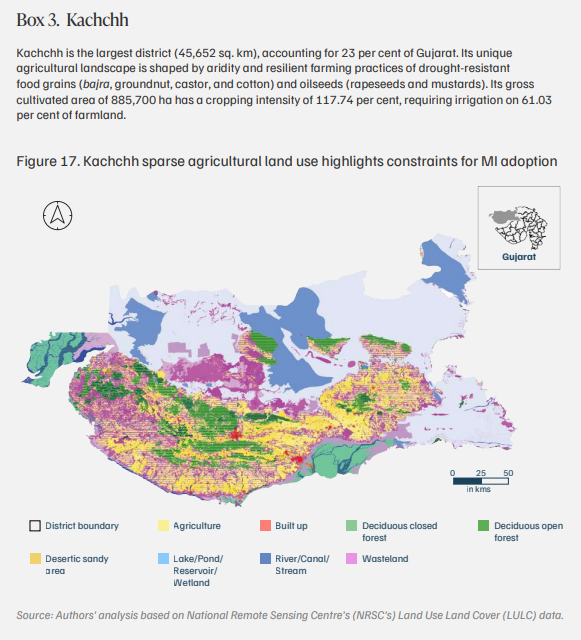
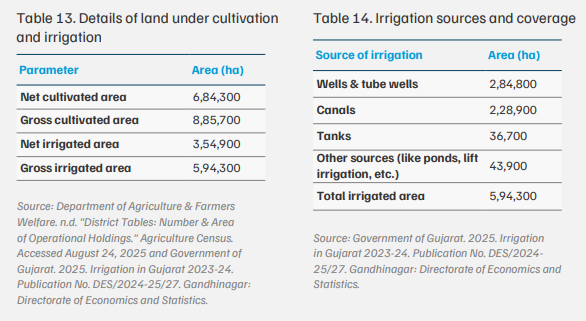
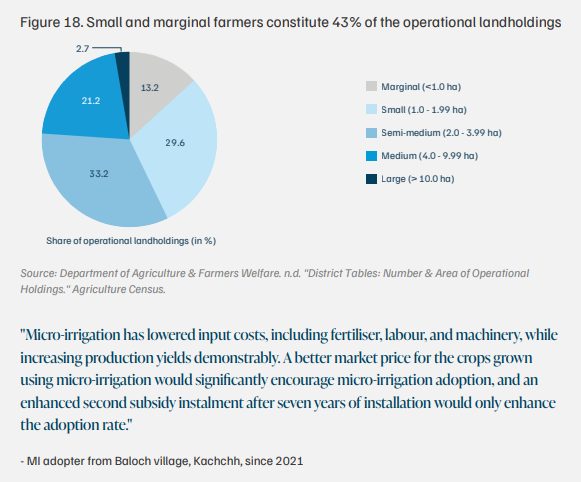
Environmental enablers
1. The district’s acute water stress and climatic profile strongly suggest a high potential for MI adoption in targeted pockets. With a mean annual rainfall of just 378.2 mm, the district falls squarely under semi-arid conditions (conventionally defined as less than 400 mm). A critical 91 per cent (approximately 345 mm) of this rainfall is concentrated between June and September (CGWB 2022a). This seasonal, low-volume precipitation translates to perennial water insufficiency for traditional rain-fed agriculture. Furthermore, the inherent erratic nature of the rainfall introduces an unacceptable level of risk and uncertainty for local farmers.
Kachchh’s groundwater system—comprising unconfined, semi-confined, and confined aquifers—faces high utilisation pressure due to a substantial dependence on the resource. With an annual net availability of 796.20 million cubic metres (MCM), derived from an estimated recharge of 838.11 MCM, the annual withdrawal of 631.69 MCM means significant extraction stress. This vulnerability is dramatically highlighted by extreme seasonal fluctuations in the water table, which ranges from 1.20 to 53.64 metres below ground level in the pre-monsoon period, and deepens alarmingly to approximately 98.80 m bgl post-monsoon, indicating localised unsustainable extraction and a critical need for making the shift to efficient MI technologies, wherever suitable, an urgent necessity for crop reliability and water resource security.
2. Localised good quality: The Bhuj region, having relatively good groundwater quality (EC < 2,000 μS/cm) acts as a key enabler. These pockets are ideal initial candidates for successful MI scheme implementation, providing model sites for scaling and demonstrating positive returns. Drip irrigation is increasingly being adopted in this context (Patel 2023).
Environmental barriers
1. The salinity and TDS issues in groundwater create significant operational barriers. About 60 per cent of the groundwater in western Kachchh is naturally highly saline (EC > 5,000 μS/cm). Such high salinity directly restricts crop choice and necessitates advanced, often costly, water treatment or specialised irrigation techniques. High levels of TDS (ranging from 200 to 2,200 mg/L) and ferrous content pose a critical operational challenge. The presence of high TDS often exceeding the permissible agricultural limit of 1,200 mg/L (Patel 2023) severely limits groundwater utility and necessitates expensive blending or treatment through pre-filtration systems involving multiple tanks for sustainable, prolonged agricultural use. Critically, these high TDS and associated mineral levels directly cause clogging and scaling within MI systems. This results in increased maintenance costs, a reduced lifespan for equipment, and compromised water distribution uniformity, thereby undermining the core efficiency gains of MI technology.
Individual-level enablers
1. Positive perception and peer-led knowledge: The existing, primarily informal channels for knowledge acquisition constitute a strong individual enabler for MI adoption in Kachchh. Learning through interactions with other farmers and suppliers, reinforced by accessible outreach like pamphlets and exhibition stalls, provides the necessary basic awareness and knowledge-building. Critically, this training mechanism has cultivated a key psychological enabler: the widespread perception that MI systems are ‘easy to use’, thereby lowering the individual farmer’s perceived risk. and accelerating the decision to invest in and adopt the technology.
2. The appeal of economic gain and efficient resource-use: Farmers consistently reported that MI delivers substantial economic benefits by increasing income through improved productivity, timeliness, and reduced cultivation costs. A key advantage highlighted was the reduction in labour costs, which is critical given the increasing expense driven by labour scarcity. Beyond direct savings, MI technology brings significant efficiency gains, allowing for faster irrigation of large fields and substantial time savings for farmers. Operationally, it facilitates better weed control, achieves high water-conservation, and lowers fertiliser usage. While farmers perceive an increase in agricultural production and overall economic gain, some noted the difficulty in precisely quantifying yield benefits.
Individual-level barriers
1. The current level of farmer proficiency in MI represents a critical technical barrier that limits the sustained efficiency and long-term success of the technology. While basic operational understanding is established through existing dissemination mechanisms, farmers lack the in-depth technical knowledge required for optimal system management under challenging conditions. The gap is acute in two core areas essential for maximising MI return on investment:
• System maintenance: Farmers struggle with effective management of clogging caused by the region’s high TDS and ferrous content. This technical deficiency leads directly to increased operational costs and reduced water distribution uniformity.
• Nutrient optimisation: Proficiency in fertigation remains low, preventing farmers from achieving the maximum yield benefits and optimal nutrient-use efficiency that MI systems are designed to deliver.
Community level enablers
1. Farming community adapting to salinity through shift to salt-tolerant crops: The adverse impact of saline groundwater on agricultural productivity and soil fertility in Kachchh has driven significant adaptive strategies among farming communities, characterised by a shift in crop selection and accelerated adoption of water-saving technologies. They have strategically pivoted towards cultivating salt-tolerant cash crops like castor and cotton (Kharif), mustard (Rabi), date palm (Horticulture) and moderate tolerant crops like groundnut, pearl millet, cluster bean, cumin, wheat, and pomegranate. This strategic crop adaptation acts as an enabler, allowing agriculture to persist despite the challenging water quality.
2. Social capital and trust as an enabler for MI adoption: The structured social influence and collective interaction among farming communities acts as a potential enabler for the adoption of MI technology. Organised community level water management is crucial for effective adoption and upgradation of technology; for instance, the use of automatic irrigation switches for night-time irrigation. Further, specific community level organisations, sehkari mandal (cooperative society), and the Indian Farmers Fertiliser Cooperative Limited actively engage farmers in discussions about water resource management and agricultural practices, which includes encouraging the adoption of MI. In this process, the involvement of local leaders has also strengthened adoption in some areas. Jambudi village demonstrates strong initial uptake (90 per cent).
Community-level participation is needed to build effective institutional support and adaptive policy frameworks for MI adoption.
Community level barriers
1. Gaps in formal community water-sharing and management structures: The absence of robust, formally recognised institutions at the village level hinders collective decision-making and the equitable allocation of shared resources (like wells or surface water). This lack of defined roles, responsibilities, and enforcement mechanisms requires cooperative resource governance.
Institution-level enablers
1. Efficient localised technical support: The GGRC-approved system of MI suppliers acts as a robust institutional enabler by significantly enhancing the physical access to technical support. This localised network ensures a timely and efficient response rate, with technical issues frequently resolved through local collaboration within a week. This efficient service delivery mechanism is critical for minimising system downtime, reinforcing farmer confidence, and sustaining the high-efficiency performance of MI systems in Kachchh.
2. Collective participation in institutional platforms for addressing common problems: Farmers’ active participation at institutional platforms like the panchayat to collectively address shared agricultural water challenges—such as declining water availability, labour scarcity, and the high cost of fertilisers—has transformed them into better decision-makers. This involvement in resolving common problems has cultivated a critical sense of ownership and trust in the resulting solutions and system, creating a positive feedback loop towards technology adoption and use. The public display of drinking water and groundwater recharge data in panchayat offices is a critical institutional enabler. This data transparency creates a sphere of influence in nearby villages, by raising awareness and providing social proof of positive policy results. This directly incentivises farmers to adopt similar water management and conservation practices.
Institution-level barriers
1. Limited service reach and timeliness in remote areas: Farmers, particularly in villages like Ratanpar, face a key challenge in accessing timely support from service providers for maintenance and repair, such as fixing damaged meters. The limited physical reach of these technical services to remote areas severely hinders efficient and continuous MI operations. This gap in responsive technical backup translates into increased downtime and financial losses for the farmer.
2. Infrastructure dependency restricting the duration of irrigation: The operational efficacy of the MI system is critically reliant on reliable electricity supply. The prevailing limited hours of electricity supply constitutes a major infrastructural bottleneck, directly restricting the pump operation time and, consequently, the duration for which irrigation can be practiced, thereby constraining crop production cycles and overall water savings.
3. Need to address policy related knowledge-gaps, and adopt more flexible policies: Due to financial uncertainty, farmers require institutional guidance for continued investment and system upgrades, particularly concerning the complexity of state top-ups to the central subsidy. Furthermore, enhancing communication on the structure and mechanism of inflation adjustments are essential steps to improve farmers’ trust and financial planning within the subsidy framework. There is a need for subsidies on essential components like disc filters and support for filter tank construction, to effectively address pervasive water quality issues, which are vital for system longevity.
4. Need for continuous improvement of system efficiency: To ensure the smooth functioning of the MI ecosystem and mitigate financial risk for all parties, there is a need to expedite financial disbursement to suppliers. This combination of institutional service delivery and energy infrastructure acts as a significant barrier, demanding targeted policy intervention to ensure the long-term, functional success of MI adoption.
5. Land ownership and documentation adds a layer to farmers’ investment in MI adoption: Much like in Banaskantha, the subsidy process in Kachchh is challenging for non-adopters, as well as women, due to land ownership and documentation issues. While women are deeply involved in farming and demonstrate practical technical knowledge of MI operation, social norms and limited land ownership restrict their ability to influence or participate in decisions on agriculture water use and technology adoption.
Individual farmer’s profile
Mr Lalji Govind Chavda is a farmer from Kandherai village, located in the Bhuj block of Kachchh. His household comprises four members, including two females, and has a landholding of 1.82 ha. His experiential account on transitioning to drip irrigation with tube well as the main source of water, and its implications on the changes in agricultural practices, crop productivity, and resource management, are reflected here.
• Transitioned to MI in 2023.
• Irrigated area: remains unchanged in summer due to drip adoption.
• Main crop cultivated: cotton in Kharif and Rabi, and chilli in summer (Table 15).
| Crop | Season | Cropped area (in ha) | Total production (kg) | Increase (%) | Amount sold (kg) | Selling price (INR/kg) | ||||
|---|---|---|---|---|---|---|---|---|---|---|
| Pre | Post | Pre | Post | Pre | Post | Pre | Post | |||
| Cotton | Kharif (monsoon) + Rabi (winter) | 1.82 | 1.82 | 1,092 | 1,602 | 46.70 | 4,000 | 6,000 | 60 | 60 |
| Chilli | Zaid (summer) | - | 0.80 | - | 2,210 | New crop with drip | - | 2,210 | - | 11 |
Source: Authors' analysis
Infrastructure and energy
• New borewell: Constructed in 2023 (INR 1,000,000; 650 ft depth).
• Energy costs: INR 10,000/month for electricity (flat rate, INR 8 per unit).
This research provides a detailed, multi-scalar analysis of MI adoption in Gujarat, combining state-level water-demand quantification, policy coherence assessment, and granular district-level case studies (Banaskantha, Rajkot, and Kachchh). The findings offer a strong evidence base for strategic scaling, aligning technology adoption with sustainable resource management goals.
Synthesis of findings
The analysis establishes that the necessity of MI is vital in Gujarat, driven by the substantial water intensity of key cash crops (like paddy and cotton) across seasons. This requirement is reinforced by a well-developed institutional framework, evidenced by the INR 80,268.5 million investment and the successful adoption on over 2.3 million ha. Policy coherence is central to this success, with schemes like ‘Per Drop More Crop’ effectively integrating MI into broader goals of groundwater conservation (ABY), energy security (PM-KUSUM), and horticultural growth (MIDH).
At the district level, adoption is determined by the interplay of four factors:
1. Economic drivers and individual agency: Across all districts, MI adoption is powerfully enabled by individual economic gains (reduced operational costs, labour savings, and enhanced income). Farmers who perceive high efficiency and reliability are more likely to adopt, a finding consistent with studies across the Global South (Šaponjić et al. 2025; Shrestha et al. 2018).
2. Community and social learning: High adoption is facilitated by strong community enablers such as peer-driven diffusion and social learning, particularly in Rajkot. Conversely, the absence of collective action mechanisms for water sharing remains a critical community barrier in other regions.
3. Environmental friction: While acute water stress necessitates MI (Banaskantha), complex environmental conditions pose significant barriers. In Kachchh, high salinity and total dissolved solids (TDS) cause equipment clogging and necessitate costly pre-filtration, fundamentally undermining the technology’s efficiency gains.
4. Institutional barriers: Despite targeted institutional support (GGRC), systemic barriers persist. The rigid requirement for formal land documentation and the erosion of subsidy value due to GST significantly limit access for genuine small, marginal, and land-leasing farmers, a challenge consistent with land tenure issues observed in Pakistan and Ethiopia (Yami and Snyder 2016). Furthermore, the lack of post-warranty support and accessible credit for farmer contributions impedes long-term system sustainability.
Policy implications
Addressing Jevons Paradox and water sustainability
The efficiency gains of MI, while substantial, present the risk of the Jevons Paradox, where resource efficiency leads to increased overall consumption (Birkenholtz 2016). Evidence from North Gujarat and other contexts (Israel, China) suggests that farmers often use savings to expand irrigated area or switch to more water-intensive crops. Avoiding this unintended consequence requires a shift from technology focused policy to system-level resource management. This necessitates:
• Empirical monitoring: Conducting long-term, objective assessments of system-level water and energy usage post-adoption, monitoring changes in crop choices and irrigation intensity.
• Regulatory balance: Designing policy mechanisms, incentives, and regulations that strategically balance efficiency gains with overall resource sustainability and groundwater recharge objectives.
Enhancing equity and access for smallholders
Small and marginal farmers, often limited by fragmented landholdings, low digital literacy, and high initial costs, face substantial barriers. To ensure equitable access and overcome structural constraints, the following steps are required:
• Group-based support: Leveraging existing farmer groups, cooperatives, or FPOs to facilitate collective learning, decision-making, and troubleshooting, thereby lowering individual risk.
• Accessible digital extension: Designing digital advisories to be hyper-local, voice-enabled, and integrated with field facilitation (Ragasa and Sayeed 2022). Mobile platforms can streamline farm documentation and subsidy processes for groups, addressing the literacy and confidence gaps observed in western and central India.
Streamlining institutional support and gender integration
The current institutional support needs to be optimised to address friction points identified in the case studies:
• Land and subsidy reform: The subsidy process must be made flexible to accommodate informal land-leasing and undivided family landholdings, which disproportionately restrict women’s participation and genuine smallholders’ access.
• Gender-sensitive programmes: While women are active MI operators, their limited decisionmaking authority must be addressed. Scaling initiatives must integrate gender-sensitive extension services and establish pathways for women’s inclusive leadership in water management (Doss 2018).
• Post-adoption support: Expediting financial disbursement to suppliers and establishing mechanisms for robust post-warranty technical support and affordable credit for maintenance and spare parts is crucial to ensure the long-term functional success and durability of MI systems.
In conclusion, the success of MI in Gujarat highlights that technology driven transitions must be integrated with robust institutional support, gender-sensitive programming, and adaptive monitoring frameworks. Future research must build on these qualitative insights to objectively assess adoption patterns, system-level water and energy outcomes, and financial sustainability, establishing the evidence base for comprehensive, system-wide policy enhancement.
Corresponding to these conclusions, we propose recommendation that were co-created with GGRC and the future scope of policy research and action in the subsequent section.
Our findings underscore the need for a multi-dimensional strategy to sustain the momentum of MI in Gujarat. To address the remaining barriers and leverage identified enablers, this section is divided into two strategic focal points. First, we outline crucial policy recommendations aimed at enhancing the adoption and operational effectiveness of MI. Second, we identify the scope of policy research and action, highlighting emerging areas where continued research and refined interventions can further strengthen the resilience of Gujarat’s agricultural water management.
Crucial policy recommendations for enhancing MI adoption and effectiveness that emerged from our analysis
1. Consider pairing the revision of subsidy structures for MI with technical upgradation to ensure greater equity for small and marginal farmers: Landholding size is a crucial factor in revising MI subsidy structures. Estimates of subsidy were based on a one-hectare land unit; recently, the requirement to revisit this criterion in the interest of the small and marginal farmers was envisaged, and revisions were exercised and implemented through meticulous effort. The revised structure now considers 0.4 ha as the base unit. This change acknowledges that farmers with holdings below 0.5 ha incur disproportionately higher costs for MI. These elevated costs stem from fixed-head unit expenses and technical specifications that needed upgrades. The previous subsidy structure reduced the effective subsidies from the intended 70 per cent to just 48 per cent for small farmers. This challenge for the farmers is in the process of being addressed through implementation of GGRC’s updated technical specifications, combined with restructuring unit cost calculations using 0.4 ha as the base unit, with all ceilings removed. This dual intervention would enable small and marginal farmers to achieve closer to the intended 70 per cent effective subsidy rate, while improving technical adequacy of systems. This unlocks the potential for adoption among Gujarat’s 2.018 million marginal farmers, who currently show only 11 per cent MI adoption compared to 96 per cent among large farmers. This targeted intervention prioritises the most underserved segment.
2. Implement better-designed incentive programmes to encourage re-adoption: The subsidy structure needs reform to accommodate re-adoption and system upgrades after seven years of use. Farmers face the challenge of reduced subsidy to 45 per cent for re-adoption, which is further reduced to 33 per cent on account of GST. They perceive it to be a risk in replacing or upgrading the system for continuing its usage. Drawing on farmer suggestions, our analysis recommends revising policy provisions to offer financial relief to support readoption, for continuous use of MI and adoption. The cases of Tamil Nadu and Uttar Pradesh would be relevant state references, where the 12 per cent GST is being absorbed by the state government to make re-adoption more affordable for farmers (Government of Tamil Nadu 2023). This should be complemented by strengthening institutional support for beneficiaries, enabling their continued use of MI.
3. Leverage technological innovation to address water quality challenges, strengthen system durability, and enhance user satisfaction: Utilising technological innovation is crucial for addressing major hurdles in the adoption of MI, especially in areas of Gujarat, where water quality and climatic conditions are considered among of the major issues. Higher concentrations of TDS in groundwater frequently result in emitter blockage and lowered system efficacy. The incorporation of disc filters, which offer enhanced filtration of fine particles relative to conventional screen filters, represents a significant improvement to resolve this issue. Disc filters are yet not mandatory, and can be considered in the subsidy. Technical issues, including valve breakages and PVC tube-cracking in cold weather, is yet not observed in Gujarat; therefore, it is not a concern. These considerations regarding physical durability of the system would be crucial for minimising frictional losses and leakages, leading to improved WUE and reduced maintenance costs. These targeted innovations collectively enhance farmer trust, extend system longevity, and markedly improve user satisfaction.
4. Establish community level involvement through mandali and self-help groups, and village-level cooperatives for integrated water management: Our findings indicate that across the selected three districts, there is potential for strengthening the community level support structure for enabling MI adoption, particularly for farmers with fragmented landholdings and limited water availability for irrigation. This makes it difficult for the marginal and small farmers to justify their individual investments in MI. Gujarat should consider establishing village-level cooperatives and self-help groups that can facilitate collective decision-making, joint purchasing of the equipment, and sharing of maintenance responsibilities. Such collective effort can further mediate water-sharing arrangements with neighbouring farmers, particularly for farmers having scattered farmlands. Further, it is crucial to encourage peer-to-peer learning, joint problem-solving, and availing complementary resources for MI.
This recommendation is aligned with the global recognition of the role of cooperatives in accelerating the 2030 Sustainable Development Agenda (International Cooperative Alliance 2025). To enable this recommendation, efforts focussed on women farmers are crucial for water management. Inspired by the specific needs of arid and semi-arid contexts such as Rajasthan, the implementation of ‘dampati (couple) training’ under PDMC for MI offers a promising avenue for inclusive capacity building. Further, the Rajasthan Water Sector Livelihood Improvement Project model introduced gender mainstreaming in participatory irrigation management through providing opportunities for women beneficiaries to participate and make decisions in different institutions, and inclusion of both men and women from a household as members of WUA enabled through the PIM Act of 2000 (CEEW and IWMI 2024). This strategy directly contributes to women’s empowerment by fostering joint knowledge acquisition and skill development, thereby strengthening their agency in agricultural management and promoting the widespread adoption of efficient irrigation technologies.
5. Consider the challenges with land and water resources shared within families, and land reforms for enhancing adoption: In Gujarat, land resource-sharing among individuals of a family (mostly brothers) is a socio-cultural practice. This sharing arrangement is an important consideration in the lack of adoption of MI. This is because uptake of smallscale irrigation is easiest by individual farmers with independent access to a water source (De Lange n.d.). The resource-sharing arrangement limits flexibility and independence of farmers’ decision-making. The farmers’ collective ownership brings them into the category of large landholding in the land record, while individually they operate small landholdings. To avail the subsidy for MI adoption as a small farmer, renewal of land records is a prerequisite, which is cited as a tedious process and requires negotiation within the resource-sharing individuals of the family. Therefore, developing mechanisms for undivided family landholdings would address a critical barrier to adoption. As one non-adopter suggested, for easier implementation a mechanism should be adopted to ensure individual land records mapping. Further, there is a need to identify a mechanism through which individual farmers can adopt MI without co-owners’ consent, to ease the process. It is also important to consider the ground reality of community composition and dynamics, and financial capacity, to contribute towards advancing a cluster-based approach.
6. Strengthen cluster-based initiatives to unite marginal and small landholders, enabling collective action for centralised water access in farmer groups: In regions consisting of fragmented landholdings and water scarcity, the individual adoption of MI frequently proves to be economically unfeasible. One viable approach is implementing collective action models, enabling small and marginal farmers to collectively access a centralised water source and shared management information system infrastructure. When people share infrastructure like bore wells, farm ponds, or solar-powered pumps, it can lower their individual capital costs, make better use of water, and support community led water governance. In addition to lowering installation expenses, it guarantees consistent water distribution, and enhances operational efficiency across adjacent plots. Policy intervention needs to leverage existing farmer collectives and establish farmer collectives wherever needed, offer capital subsidies for group-based systems, and guarantee technical support through the GGRC and KVK. Integrating this model into the national guidelines of PDMC would improve uptake in waterscarce regions, particularly where groundwater depletion and droughts are prominent issues. Structured collective models can introduce community oriented approaches for ensuring water and livelihood security.
7. Expand water management infrastructure: Establishing storage ponds (talavadi) emerges as a valuable recommendation, with a KVK official noting these could enable farmers to diversify their crops and fodder crops in February. These ponds allow farmers to store rainwater during monsoon, ensuring a reliable water source during the dry months. By improving the water availability, storage ponds help reduce the dependence on the unpredictable rainfall, and support livestock needs, thereby strengthening both crop and animal husbandry systems for the farmers.
8. Enhance farmers’ comprehensive technical knowledge by increasing the frequency of capacity building, carefully aligned with agricultural seasons and context-specific training needs: The technical knowledge on fertigation and troubleshooting complex issues like emitter-clogging needs to be strengthened. Drawing on farmers’ need for capacity building in Banaskantha, the periodicity of the training programmes in alignment with the regional cropping schedules would be immensely beneficial to them. Similarly, farmers in Kachchh, grappling with high levels of TDS, have stressed the importance of practical, handson training to effectively manage the water quality issue.
This recommendation resonates with the evidence from semi-arid context of Ethiopia, where technical knowledge, elevating education levels of farmers, and extension services acted as catalysts of MI adoption (Gebremeskel et al. 2017). In Gujarat, regional agricultural university training is enhanced by GGRC-led sessions, site visits, and technology demonstrations. By integrating local community champions into these programs, the initiative ensures that peer-to-peer knowledge supports formal technical education. The implementation of multi-tiered training programmes could be strengthened with the consideration of regional customisation to enhance agricultural practices. Delivery of these training programmes could further effectively utilise existing institutions like KVKs, and strengthen peer-to-peer learning networks. In this process, expertise of more of progressive farmers could be effectively leveraged by acknowledging more farmers as local champions of the community, and convince farmers for cluster approach.
9. Establish a monitoring, evaluation, and learning plan for tracking farm-level parameters: There is a need for a centralised and integrated dataset on the water-energy food linkages associated with MI. Further, there is a need to regularly record and track this dataset. The success of MI adoption is measured by three key parameters: crop diversification through seasonal selection, improvements in water conservation and source reliability, and economic outcomes—including production volumes, market pricing, and overall profit margins. Collection of such data will be helpful to understand trends, the effects of adopted policies, and future scope of improvements, and also help in accurately conducting scientific studies in future. Monitoring and evaluation needs to be conducted at regular intervals, and would be more effective when done at the end of each season.
10. Revise policy guidelines to recognise mini-sprinklers as a distinct MI technology: Mini-sprinklers were designed as cost-effective and water-saving options similar to drip irrigation. Their evolution in Gujarat was based on an assessment of farmer needs in interaction with suppliers. Therefore, it is crucial to consider mini-sprinklers as a distinct MI option, considering their operation and maintenance costs significantly influence farmers’ adoption decisions. The central government has approved converting sprinkler systems to drip irrigation after three years of use. However, a specific provision is needed for transitioning from sprinklers to mini-sprinklers, as farmers currently face a seven-year waiting period for this change.
11. Encourage farmers to transition from sprinkler to drip irrigation after three years of use, aligning with national PDMC guidelines: This policy update crucially requires robust communication and training strategies to ensure farmers are fully informed and can effectively utilise these new provisions.
12. Strengthen financial disbursement mechanisms is crucial to enhance efficiency of financial support for MI suppliers: This involves reducing delays in supply chains, thirdparty approvals, and banking processes, ultimately making subsidy access more efficient and farmer-friendly. While the transition to Direct Benefit Transfer through the Reserve Bank of India has streamlined some aspects, current transfer times still range from three to 15 days, indicating a need for further optimisation.
13. Make a more holistic approach to water technologies for agriculture systems by including complementary farming resources to ensure effectiveness and sustainability: For water management, there is a need to strengthen conservation initiatives and water harvesting. Promoting and incentivising organic farming for long-term soil health. These complementary farming resources would be crucial for making MI effective and sustainable, along with environmental sustainability, to support water and food systems.
14. Ensure policy aligns with ground realities: The mandatory seven-year waiting period for re-adopting subsidised MI poses a significant challenge, especially as some farmers’ experience system degradation due to wear and tear within three to five years, despite the stated seven-year lifespan. This particularly refers to the consent of the co-owners of the land and linked water resources. In tribal regions, the co-owners of a small landholding can go up to 100, and taking consent from everyone is difficult. Such ground realities require context-specific solutions where the applicant, Sarpanch, and supplier need to come together to take responsibility for the adoption of MI. Bridging this gap in understanding and provision requires comprehensive knowledge and awareness programmes, along with diligent monitoring and evaluation of MI performance, to ensure policies align with ground realities.
Advancing agricultural sustainability and water security requires strategic policy alignment with SDGs 6, 13, and 17. Our analysis focuses on improving MI adoption in water-scarce regions reliant on groundwater, which is common in pockets of the Global South. These recommendations from the semi-arid context of India can provide key lessons for improving policy coherence for water security and securing climate-resilient agriculture in the Global South region.
Scope of policy research and action
1. Deep dive into improving farmers’ digital access to knowledge regarding MI technologies and associated subsidy schemes: The complexity of mobile applications and the limitations on subsidy coverage for larger farmers impede access to subsidy schemes. Therefore, further policy research is required in understanding ways in which the user interface and functionality of digital technology (automation of MI, and mobile applications) can be simplified, considering varying levels of digital literacy. This could involve exploring simple user-friendly design principles, vernacular language support, and visual learning aids.
2. Understand specific needs for scaling adoption in tribal districts: To address the lower uptake of MI schemes and benefits in the tribal districts of Gujarat, there’s a crucial need for in-depth exploration into farmers’ choices and decision-making criteria. This research would investigate the unique socio-economic, cultural, and informational factors influencing their adoption (or non-adoption) of these technologies. The insights gained will be invaluable for informing and tailoring more effective policies and outreach strategies at both state and central government levels for sustainable agricultural water use in these regions.
3. Understand the water-food-energy interlinkage further through the quantification of water and energy savings from MI at the farm level: Considering the Jevons Paradox, it is critical to expand the study to include deep-dive analyses with adopters, utilising detailed water and energy consumption data. It would provide critical empirical evidence to inform water, energy, and agricultural policy more effectively.
This study examines why Gujarat, despite leading India in micro-irrigation, with 2.31 million hectares covered, has realised only 30 per cent of its potential. Through on-ground consultations with 250+ farmers across three districts, it identifies how subsidy redesign, community-led water governance, and context-specific technology choices can bridge the adoption gap for over 2 million marginal farmers, offering actionable lessons for semi-arid regions worldwide.
Gujarat’s success is built upon the strategic convergence of nine central and state policies. The core initiative, 'Per Drop More Crop', works in powerful synergy with the Atal Bhujal Yojana (which mandates MI in over-exploited groundwater 'dark zones' for conservation) and PM-KUSUM (which promotes solar-powered irrigation). This layered and integrated approach ensures that water efficiency directly contributes to energy security and agricultural productivity.
Despite high subsidies, several critical challenges hinder the scale-up of MI, especially for smallholders: (1)Land Documentation: Rigid mandates requiring the formal partition of undivided family lands effectively lock out genuine small and marginal farmers from accessing subsidies, as the entire family holding classifies them as "large farmers" on paper. (2) Financial Friction: The implementation of a 12 per cent GST significantly erodes the value of subsidies. For farmers replacing their systems after the standard 7-year lifecycle, the effective subsidy drops to roughly 33 per cent, discouraging sustainable re-adoption.(3) Water Quality Constraints: In districts like Kachchh, high Total Dissolved Solids (TDS ranging from 200 to 2,200 mg/L) and salinity cause severe emitter clogging, increasing maintenance burdens and reducing the lifespan of drip systems.
To unlock the remaining 70 per cent of Gujarat's MI potential, the report proposes highly targeted policy interventions: (1)Revising Subsidy Equity: Shift to a 0.4-hectare base unit for cost calculations and remove ceilings to ensure the state's 2.02 million marginal farmers actually receive their intended 70 per cent effective subsidy. (2)Absorbing GST for Re-adoption: Shield farmers from the 12 per cent GST to encourage system upgrades after the 7-year lifecycle, drawing on successful state models like Tamil Nadu and Uttar Pradesh. (3)Promoting Collective Action: Establish cluster-based models and village-level cooperatives to help farmers with fragmented landholdings share the high capital costs of infrastructure, such as shared borewells and solar pumps. (4)Technical Upgrades: Mandate or subsidize "disc filters" in high-TDS regions like Kachchh to combat severe emitter clogging and improve system durability
This study examines why Gujarat, despite leading India in micro-irrigation, with 2.31 million hectares covered, has realised only 30 per cent of its potential. Through on-ground consultations with 250+ farmers across three districts, it identifies how subsidy redesign, community-led water governance, and context-specific technology choices can bridge the adoption gap for over 2 million marginal farmers, offering actionable lessons for semi-arid regions worldwide.
The Indian Subcontinent and the Water CycleFrom Monsoon to Ocean

Water, Nature, Progress: Solutions for a New India
India and the GulfA New Strategy for Water, Energy, Food, and Ecosystem Security

Roadmap of the methodology to assess the climate co-benefits of the SUP ban in Tamil Nadu