Council on Energy, Environment and Water Integrated | International | Independent

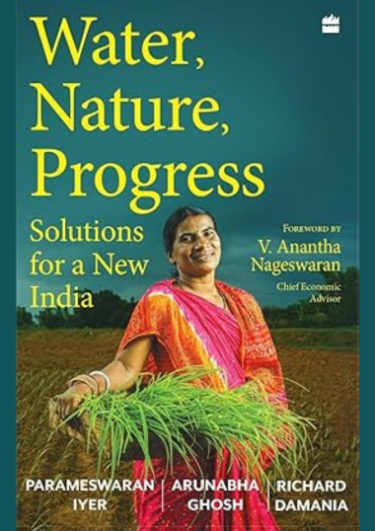
India faces an unprecedented water crisis, driven by climate variability, inefficient agricultural practices, and rapid urbanisation, with per capita water availability steadily declining. Rather than looking at water merely from an environmental or engineering perspective, Water, Nature, Progress: Solutions for a New India frames it as a critical macroeconomic variable that will determine India’s trajectory toward becoming a developed nation by 2047. While access to water has improved through initiatives such as the Jal Jeevan Mission and AMRUT, systemic inefficiencies and fragmented governance across the agricultural, industrial, and urban sectors remain severe constraints on economic growth.
The book advocates for a paradigm shift from traditional "blue water" extraction to the sustainable co-management of land and water ecosystems. It emphasises unlocking the hidden reservoir of "green water", projects used water in India from a pollution liability to a multi-billion-dollar wealth-generation opportunity through the reuse of treated used water, and advocates for addressing the critical water and sanitation gaps in peri-urban areas, often ignored as the administrative "missing middle". To achieve these, it suggests governance reforms, behaviour change promotion, and pricing reforms.
Supply-side solutions such as dams and storage infrastructure are capital-intensive, have a long gestation period, and often have limits to meet rising demand. Demand-side approaches-such as improving efficiency, reuse, and behaviour change offer more sustainable, and cost-effective solutions.
The Green Water Mission focuses on improving soil moisture and leveraging rainfall stored in soils (green water). Since a large share of water is held as soil moisture, improving its management can enhance agricultural productivity, reduce irrigation demand, and build climate resilience.
A circular water economy promotes treatment and reuse of used water, reducing dependence on freshwater sources. It can generate significant economic value, create jobs, and improve environmental outcomes while addressing urban water shortages.
Peri-urban areas often fall between rural and urban governance systems, leading to gaps in water and sanitation services. Targeted interventions can address these gaps through decentralised and community-managed solutions.
Water governance is fragmented across multiple ministries and levels of government, leading to coordination issues, low accountability, and inefficient management. Strengthening institutions and improving data systems are critical.
Behavioural interventions, such as awareness campaigns, incentives, and social norms, can significantly improve water use efficiency in households, agriculture, and sanitation without requiring large investments.
Appropriate pricing reflects the true value of water, encourages conservation, ensures the financial sustainability of utilities, and allows targeted subsidies for vulnerable populations.
Navigating India's Electric Mobility Transition:
Advancing Corporate Climate Action through Emissions Disclosures in India