Council on Energy, Environment and Water Integrated | International | Independent

CEEW
Aeshita Wilske Mukherjee, Former Consultant
Mousumi Kabiraj, Programme Associate
Nitin Bassi, Fellow and Team Lead, Sustainable Water
Oxford Policy Management Europe GmbH
Soumik Biswas, Official Team Lead
Nancy Okodoi, Sustainability Expert
Perspective Climate Group
Axel Michaelowa, Climate Change Mitigation Expert
Duska Sasa, Senior Climate Change and Environment Specialist
Ashwin Tomy, Consultant
GIZ India
Arun Poojary, Climate Change Advisor
Jasprit Kaur, Climate Change Advisor
Karpooram Pandian, Consultant
Vaibhav Rathi, Senior Advisor - Climate Change and Circular Economy & Deputy Team Lead
India’s sustainability transitions, driven by accelerating urban greening, are generating measurable climate benefits in addition to their primary environmental objectives. Such climate co-benefits (CCoBs) remain largely unquantified and are therefore not integrated into planning and reporting frameworks. Systematically assessing the CCoBs is critical to strengthen transparency, inform and improve climate planning and action, and align sectoral actions with national and state climate commitments.
The project “Development of Climate Co-Benefits Methodologies for Indian Circular Economy and Forestry Programmes” is implemented in collaboration with the Ministry of Environment, Forest and Climate Change (MoEFCC), Government of India, by GIZ India, under the Indo-German Support for Climate Action in India and the IKI Interface Project (CAP) of the International Climate Initiative (IKI). The technical support to the project is provided by a consortium comprising Oxford Policy Management Ltd (OPML), the Council on Energy, Environment and Water (CEEW), and Perspectives Climate Group. The project is supported by the Tamil Nadu Green Climate Company, which serves as the nodal agency for the state of Tamil Nadu. The project aims to develop standardised methodologies to quantify co-benefits from key Urban Forestry initiatives, such as the Green Tamil Nadu Mission.
Urban forestry initiatives enhance carbon sequestration, urban cooling, groundwater recharge, biodiversity, and flood regulation. This roadmap for Tamil Nadu provides structured pathways to institutionalise the assessment of climate co-benefits within urban forestry programmes. They define actionable roles for government agencies, Forest Departments, Urban Local Bodies, and private stakeholders; establish short-, medium-, and long-term mainstreaming strategies; and enable systematic capacity building and data-driven monitoring frameworks. By integrating climate co-benefit methodologies into existing state missions and regulatory frameworks, Tamil Nadu can advance evidence-based, scalable climate action that integrates environmental protection with sustainable urban forestry initiatives.
To simplify implementation, a user-friendly web-based tool has been developed to estimate co-benefits from mitigation and adaptation for urban forestry programmes, with minimal data inputs. The tool offers automated calculations, built-in default values, IPCC-linked references, emission factors and simple YES/NO methodological choices based on data availability. The tool is a practical application of the proposed methodologies for measuring CCoBs and is easy for stakeholders to use.
India’s accelerated urbanisation has resulted in significant ecological pressures, underscoring the role of urban forestry (UF) as a strategic intervention for enhancing environmental quality and climate resilience. National and subnational programmes, such as the Nagar Van Yojana (NVY) (2020), Maharashtra’s Majhi Vasundhara Abhiyan, and the Green Tamil Nadu Mission (GTNM), demonstrate government-led efforts to expand urban green cover, conserve biodiversity, and promote climate-resilient species suited to local agro-climatic conditions. While these interventions are not primarily framed as climate-oriented actions, they yield certain climate co-benefits (CCoBs) by contributing to greenhouse gas (GHG) mitigation and enhancing adaptive capacity through urban cooling, flood regulation, and the delivery of ecosystem services. The present project aims to develop methodologies for quantifying the co-benefits of mitigation and adaptation from urban forestry initiatives. Developed through a consortium-led, multi-stakeholder process, these methodologies aim to support the Ministry of Environment, Forests, and Climate Change (MoEF&CC) in mainstreaming CCoBs across various policies, in line with the climate co-benefit definition.
This project and the developed methodology consider climate co-benefits (CCoBs) as mitigation or adaptation benefits arising from initiatives not primarily designed with a climate-related focus but that target other areas, in this case, UF schemes. Mitigation benefits are generated through increased carbon sequestration, while adaptation benefits are seen in enhanced urban resilience, such as cooling effects, better stormwater management, and enhanced groundwater recharge that help cities cope with climate impacts. Furthermore, this methodology addresses only direct mitigation co-benefits—those that are measurable, quantifiable, and directly linked to project/programme activities.
The project “Indo-German Support for Climate Action in India and the IKI Interface Project” (CAP)” is supported by the International Climate Initiative (IKI) of the German Federal Ministry for the Environment, Climate Action, Nature Conservation and Nuclear Safety (BMUKN) and implemented by GIZ India under the overall guidance of the Ministry of Environment, Forest and Climate Change (MoEFCC), through a multi-tier governance and coordination structure. Implementation follows a phased approach that encompasses methodology development, pilot testing, validation, and capacity building for two thematic streams: urban forestry and circular economy. Pilot activities are undertaken in selected states, specifically Maharashtra and Tamil Nadu, in partnership with respective State Climate Change nodal departments, Forest Departments and Urban Local Bodies (ULBs).
Tamil Nadu has emerged as a frontrunner in implementing urban forestry through a strong policy and implementation ecosystem that aligns closely with climate mitigation and adaptation objectives. Under the Nagar Van Yojana (NVY), the state has secured approval for 10 projects between 2020–21 and 2023–24, covering a sanctioned area of approximately 435 hectares, reflecting a sustained commitment to expanding urban green spaces. Complementing NVY, the Tamil Nadu State Forest Policy (2018) provides a comprehensive framework that emphasises biodiversity conservation, climate change mitigation and adaptation through enhanced tree cover, water augmentation, restoration of degraded ecosystems, and inclusive forest governance with a focus on women and tribal communities.
Building on this foundation, the Green Tamil Nadu Mission represents a flagship, mission-mode intervention aimed at increasing the state’s forest and tree cover from 23.6 per cent to 33 per cent by 2030–31 through large-scale plantation of native, climate-resilient species tailored to agro-climatic zones. The mission is underpinned by robust monitoring systems, including geo-tagging of seedlings, mobile-app– 8 based nursery management, and regular departmental inspections, enabling scale with accountability. Given this strong institutional architecture, scale of implementation, and emphasis on data-driven monitoring, Tamil Nadu provides an enabling and mature context for piloting and mainstreaming a standardised methodology to assess climate co-benefits of urban forestry, particularly under the Green Tamil Nadu Mission and allied urban greening programmes.
The primary goal of the Roadmap is to embed a robust, standardised methodology for assessing climate co-benefits (CCoBs) within urban forestry (UF) programmes in Tamil Nadu, thereby ensuring accountability, transparency, and scalability of UF interventions in the state. It seeks to provide a structured framework through which state-level schemes, state missions, and sectoral policies can institutionalise the measurement and reporting of mitigation and adaptation cobenefits. Specifically, the roadmap will:
India’s accelerated urbanisation has resulted in significant ecological pressures, underscoring the role of urban forestry (UF) as a strategic intervention for enhancing environmental quality and climate resilience. National and subnational programmes, such as the Nagar Van Yojana (NVY) (2020), Maharashtra’s Majhi Vasundhara Abhiyan, and the Green Tamil Nadu Mission (GTNM), demonstrate government-led efforts to expand urban green cover, conserve biodiversity, and promote climate-resilient species suited to local agro-climatic conditions. While these interventions are not primarily framed as climate-oriented actions, they yield certain climate co-benefits (CCoBs) by contributing to greenhouse gas (GHG) mitigation and enhancing adaptive capacity through urban cooling, flood regulation, and the delivery of ecosystem services. The present project aims to develop methodologies for quantifying the co-benefits of mitigation and adaptation from urban forestry initiatives. Developed through a consortium-led, multi-stakeholder process, these methodologies aim to support the Ministry of Environment, Forests, and Climate Change (MoEF&CC) in mainstreaming CCoBs across various policies, in line with the climate co-benefit definition.
This project and the developed methodology consider climate co-benefits (CCoBs) as mitigation or adaptation benefits arising from initiatives not primarily designed with a climate-related focus but that target other areas, in this case, UF schemes. Mitigation benefits are generated through increased carbon sequestration, while adaptation benefits are seen in enhanced urban resilience, such as cooling effects, better stormwater management, and enhanced groundwater recharge that help cities cope with climate impacts. Furthermore, this methodology addresses only direct mitigation co-benefits—those that are measurable, quantifiable, and directly linked to project/programme activities.
The project “Indo-German Support for Climate Action in India and the IKI Interface Project” (CAP)” is supported by the International Climate Initiative (IKI) of the German Federal Ministry for the Environment, Climate Action, Nature Conservation and Nuclear Safety (BMUKN) and implemented by GIZ India under the overall guidance of the Ministry of Environment, Forest and Climate Change (MoEFCC), through a multi-tier governance and coordination structure. Implementation follows a phased approach that encompasses methodology development, pilot testing, validation, and capacity building for two thematic streams: urban forestry and circular economy. Pilot activities are undertaken in selected states, specifically Maharashtra and Tamil Nadu, in partnership with respective State Climate Change nodal departments, Forest Departments and Urban Local Bodies (ULBs).
Tamil Nadu has emerged as a frontrunner in implementing urban forestry through a strong policy and implementation ecosystem that aligns closely with climate mitigation and adaptation objectives. Under the Nagar Van Yojana (NVY), the state has secured approval for 10 projects between 2020–21 and 2023–24, covering a sanctioned area of approximately 435 hectares, reflecting a sustained commitment to expanding urban green spaces. Complementing NVY, the Tamil Nadu State Forest Policy (2018) provides a comprehensive framework that emphasises biodiversity conservation, climate change mitigation and adaptation through enhanced tree cover, water augmentation, restoration of degraded ecosystems, and inclusive forest governance with a focus on women and tribal communities.
Building on this foundation, the Green Tamil Nadu Mission represents a flagship, mission-mode intervention aimed at increasing the state’s forest and tree cover from 23.6 per cent to 33 per cent by 2030–31 through large-scale plantation of native, climate-resilient species tailored to agro-climatic zones. The mission is underpinned by robust monitoring systems, including geo-tagging of seedlings, mobile-app– based nursery management, and regular departmental inspections, enabling scale with accountability. Given this strong institutional architecture, scale of implementation, and emphasis on data-driven monitoring, Tamil Nadu provides an enabling and mature context for piloting and mainstreaming a standardised methodology to assess climate co-benefits of urban forestry, particularly under the Green Tamil Nadu Mission and allied urban greening programmes.
Objectives of the roadmap
The primary goal of the Roadmap is to embed a robust, standardised methodology for assessing climate co-benefits (CCoBs) within urban forestry (UF) programmes in Tamil Nadu, thereby ensuring accountability, transparency, and scalability of UF interventions in the state. It seeks to provide a structured framework through which state-level schemes, state missions, and sectoral policies can institutionalise the measurement and reporting of mitigation and adaptation cobenefits. Specifically, the roadmap will:
The methodology
A methodology to estimate mitigation and adaptation co-benefits from UF initiatives in India is designed to provide a standardised approach for estimating GHG removals (mitigation domain) and four adaptationrelated parameters, i.e., urban heat island reduction, improvement in groundwater recharge, flood and stormwater management and improved biodiversity.
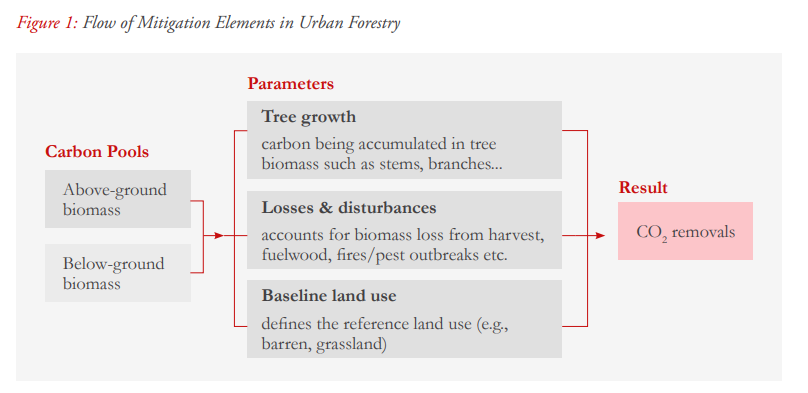
The process for the mitigation domain builds on international good practices (e.g. CDM, Verra, Gold Standard), adapted wherever feasible to align with India’s data, institutional, and policy environment. The methodology focuses on quantifying carbon removals in above-ground and below-ground biomass. The estimation is based on a planting unit (PU) approach, with CO2 removals calculated annually. Two pathways are offered, dependent on data availability:
Both approaches account for carbon sequestration as well as carbon losses due to harvest, fuelwood collection, and natural disturbances. It is essential to emphasise that the two pathways were designed to accommodate different data availability levels without placing an additional burden on stakeholders. However, the application of the methodology requires a certain minimum of data inputs (light MRV is necessary).
Baseline conditions—whether grassland, barren land, or shrubland—are conservatively defined, and leakage risks are considered negligible. For stakeholders, the methodology enables transparent, data-driven estimates of mitigation co-benefits, thereby strengthening the integration of urban forestry into planning, financing, and reporting systems.
The adaptation assessment framework for UF initiatives is designed to evaluate how increased tree and vegetation cover contributes to enhanced climate resilience in urban systems. Drawing on international best practices (e.g., the UNEP and IPCC AR6 frameworks, as well as urban resilience assessment tools) and aligned with India’s national and state climate priorities, the methodology identifies and quantifies adaptation co-benefits through measurable physical and socio-environmental indicators. After conducting a comprehensive literature review which is (U.S. Department of Agriculture, 2020), (Behera, et al., 2022), (Saha, 2017) (Cheung and Jim 2018) and (Safford, Larry, McPherson, Nowak, & Westphal, 2023), it was determined that four distinct parameters would be evaluated to gauge the climate co-benefits of urban forestry.
These parameters include Urban heat island reduction (cooling effect around the plantation site); improvement in groundwater recharge and quality (redirecting water across the land surface or injecting it directly into the subsurface); flood and stormwater management (the practice of managing the quality and quantity of water to prevent flooding, protect the environment, and preserve infrastructure); and Improved biodiversity of the region (establish green corridors to connect green areas and build an ecological network that connects two or more green spaces, creating a continuous network of habitat while providing benefits to locale), all viewed from the climate change adaptation perspective.
For stakeholders, the framework provides a structured means to integrate adaptation benefits into urban planning, climate risk assessments, and monitoring systems, thereby strengthening evidence-based decisionmaking. Table 1, presented below, summarises the parameters selected and the reasoning for their inclusion in assessing the climate co-benefits associated with promoting urban forestry.
| Parameter | Justification/Rationale for selection |
|---|---|
| 1. Urban heat island reduction (cooling effect around the plantation site) | Planting trees and increasing urban green spaces significantly mitigates the urban heat island effect by providing shade, reducing heat absorption, and increasing evaporation, ultimately lowering temperatures and creating Albedo effect where Vegetation has a higher reflectivity than urban surfaces, meaning it reflects more sunlight and absorbs less heat (Saha, 2017), (Safford, Larry, McPherson, Nowak, & Westphal, 2023). |
| 2. Improvement in groundwater recharge | Tree cover is known to have a favourable impact on local water availability, especially groundwater recharge, which in turn is important for improving resilience to the adverse impacts of climate change on hydrology (U.S. Department of Agriculture, 2020). |
| 3. Flood and stormwater management | It is a well-established fact that tree cover plays a crucial role in stormwater management by reducing runoff and soil loss, increasing infiltration, and thereby mitigating the risk of flooding (U.S. Department of Agriculture, 2020; Safford, Larry, McPherson, Nowak, & Westphal, 2023). |
| 4. Improved biodiversity of the region | Urban forests contribute to biodiversity by providing habitats for a wide range of species, thereby fostering ecological balance. Creating habitats for a variety of plants and animals, and by improving the connectivity between different forest patches (Behera, et al., 2022). |
Overall, by aligning with India’s NDC and state climate missions, the methodology serves as a credible framework for quantifying the contribution of urban forestry to national/ sub-national climate actions. The data metrics to measure each parameter are added in Annexure 1.
Approach to the development of the methodology
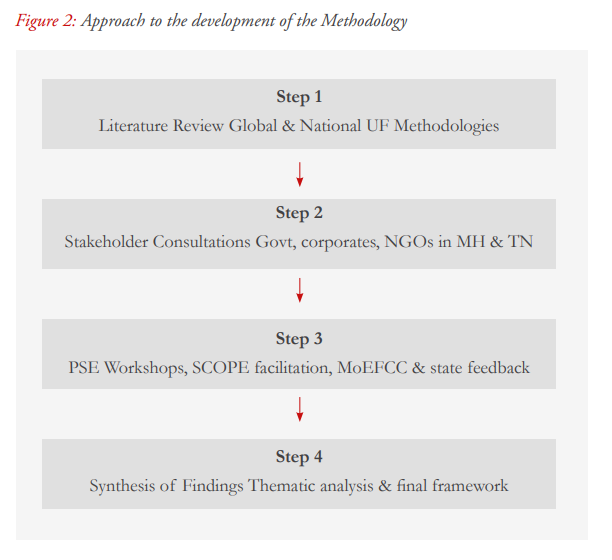
The methodology was developed through a systematic step-by-step process combining evidence, practice, and stakeholder validation. First, an extensive literature review of global and national approaches helped identify relevant frameworks and data parameters for assessing the co-benefits of mitigation and adaptation. This was followed by targeted stakeholder consultations in Maharashtra and Tamil Nadu with government agencies, research institutions, corporates, and non-government organisations (NGOs) to contextualise and refine the framework. Semi-structured interviews and field visits enriched the contextual understanding and practical relevance of the methodology. Next, regional workshops with Public Sector Enterprises (PSEs), across Goa, New Delhi, Kolkata, and Bengaluru, and facilitated by SCOPE, gathered practical feedback. The methodology was also presented to MoEFCC to seek their feedback and insights. Subsequently, state-level validation workshops were conducted with forest officials, municipal authorities, and other key stakeholders, including representatives of PSEs, to present the final methodology and assessment tool. Finally, insights were synthesised through thematic analysis, ensuring that the methodology is scientifically robust, operationally feasible, and consistent with national and state-level climate policy objectives.
Need for assessing climate-cobenefits of UF in Tamil Nadu
It is crucial to evaluate the CCoB of UF for climate change mitigation and adaptation in order to shape effective policies and attract financial support. Impacts such as carbon sequestration, urban heat reduction, flood and stormwater management, groundwater recharge, and biodiversity enhancement, when quantified, not only aid in ensuring that the climate-positive outcomes of the UF do not go unrecorded, are accounted, and reported but also enable policymakers to make informed decisions and justify investments in UF initiatives. Climate co-benefits measurement of ongoing urban afforestation projects and programmes help in strengthening implementation as well as reporting within the State Climate Action Plans and national climate missions. Thus, the methodology can be used by the state to build capacity of relevant stakeholders to undertake such assessment and data required for the same. Governments can also consider climate co-benefits accounting to contribute to reporting under the nationally determined contributions (NDCs). This also helps attract funding from multiple sources, including government schemes, philanthropic organisations, corporate social responsibility (CSR) programmes, and carbon markets.
Multiple stakeholder engagements were conducted in Tamil Nadu, followed by focused group discussions with key stakeholders, including Public Sector Enterprises (PSEs), to review the methodology, data metrics, and understand their existing monitoring systems. Additionally, field visits were conducted to selected sites, providing additional insights and thus strengthening the methodology.
Stakeholders involved
The diverse set of stakeholders consulted to achieve a comprehensive understanding of UF/plantation initiatives in the region/s were:
Government departments
Non-government organisations (NGOs)
Public Sector Enterprises (PSEs)
Through engagement with over 25 stakeholders, it provided insights into existing monitoring and data collection practices, gaps, and opportunities for embedding the CCoB of UF initiatives. The consultations also provided insights into the diverse approaches and challenges faced by both private sector organisations and government departments in UF initiatives. Participants emphasised the need for context-specific solutions, considering geographic, ecological, and socio-economic factors as well, in the methodology section. Issues such as land availability, maintenance, and monitoring challenges were consistently mentioned by multiple stakeholders, along with the importance of developing tailored methodologies for assessing co-benefits, including carbon sequestration, groundwater recharge, biodiversity enhancement, and others.
In addition, Training Needs Assessment (TNA) was also conducted with officials from over 50 Public Sector Enterprises (PSEs), such as Indian Oil Corporation Ltd. (IOCL), Oil and Natural Gas Corporation (ONGC), Steel Authority of India Limited (SAIL), etc. The assessment aimed at evaluating the capacities of PSEs to effectively monitor plantation-related projects and assess the CCoB impacts of these activities. Furthermore, TNA was also helpful in identifying existing knowledge gaps among stakeholders regarding the integration of monitoring methodologies into their existing projects and reporting. It was also realised that CCoBs—such as temperature gradation, improved biodiversity, carbon sequestration, and improved groundwater recharge—are crucial but often not well understood at various levels by officials and stakeholders involved in these initiatives.
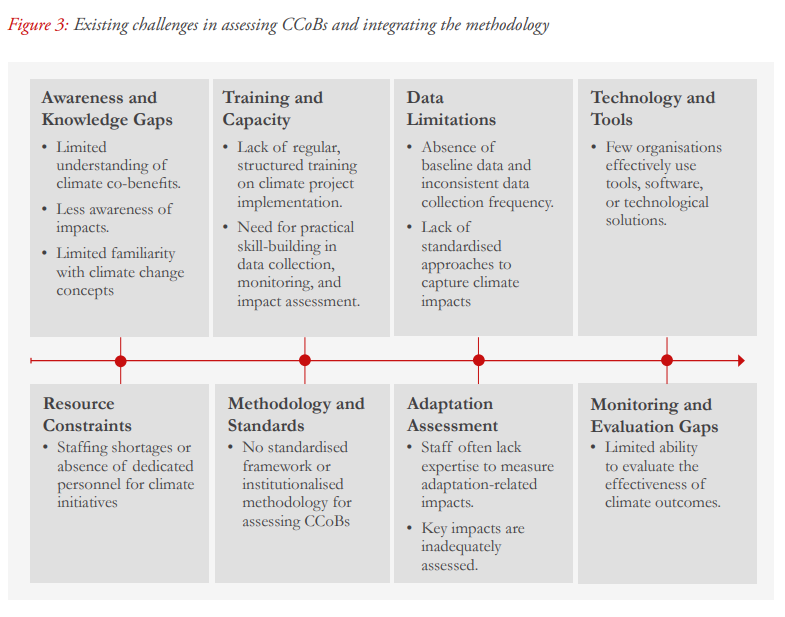
Existing challenges in assessing CCoBs and integrating the methodology
Based on several consultations, the key barriers observed towards implementing the CCoB methodology for urban forestry and plantation initiatives were:
Addressing these challenges will require dedicated capacity-building, resource allocation, standardised tools, and clear guidance to ensure the methodology can be effectively applied and sustained across organisations.
Opportunities for implementation and scaling
Stakeholder consultations in Tamil Nadu indicated significant interest by TN Green Climate Company and Green Tamil Nadu Mission in enhancing organisational capacity to implement the CCoB methodology. Participants during the state validation workshops such National Highway Authority of India emphasised the need for structured and regular training, favouring a combination of in-person workshops, on-site sessions, and practical demonstrations to deepen understanding of climate change concepts, data collection protocols, and impact assessment of plantation activities. There was also recognition of the value of online courses and periodic webinars to support ongoing skill development.
Furthermore, it is worth noting that the stakeholders expressed a willingness to integrate the methodology into existing urban forestry and plantation initiatives, perceiving it as a mechanism to strengthen monitoring, reporting, and evidence-based decision-making. Illustrative examples from organisations already undertaking impact-tracking practices demonstrated the potential for broader adoption and institutionalisation of the methodology across diverse projects. These observations highlight the readiness of organisations to adopt systematic approaches for assessing climate co-benefits, contingent upon targeted capacity-building and training support.
Learnings from the stakeholder engagement
The consultations underscored the need for strengthened inter-agency coordination to ensure coherence in data collection, monitoring, and reporting processes. They also highlighted the importance of maintaining contextual flexibility to accommodate regional ecological and institutional variations during implementation. Furthermore, the establishment of standardised reporting templates and clearly defined institutional mandates was identified as essential for ensuring consistency, comparability, and accountability in assessing and documenting climate co-benefits across urban forestry initiatives.
Theory of Change (ToC)
A Theory of Change (ToC) articulates the causal pathway through which an intervention is expected to achieve its objectives. It links what is put in place to what is done, what is produced, how behaviour or systems change, and the longer-term effects, while making explicit the assumptions and risks that must hold for the pathway to work. ToC starts from the problem statement and evolves further into these elements:
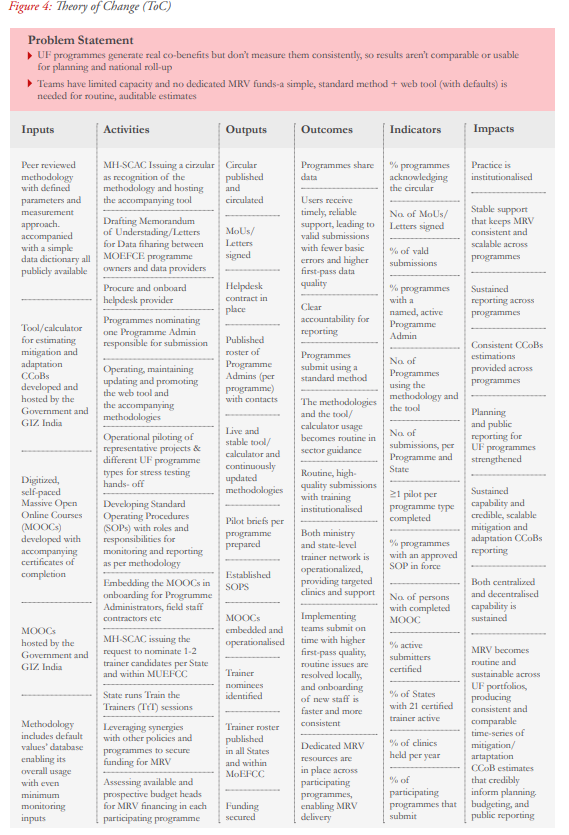
The particular ToC for UF is described in more detail below and presented with a diagram.
Problem Statement
Urban forestry (UF) schemes in Tamil Nadu—such as NVY and state missions—generate real mitigation and adaptation co-benefits, but these programmes were not designed around climate accounting. As a result, co-benefits are not measured consistently or comparably across owners and years, limiting their use in planning, budgeting, and national aggregation. Implementers face data and capacity gaps (e.g., missing baselines, uneven collection frequency, limited QA/QC), and most programmes have no dedicated MRV resources, which nudges practice toward ad-hoc or purely narrative reporting. At the same time, there is demand for a simple, standard method and tool that can work with light inputs (including defaults) and scale across diverse UF typologies (NVY blocks, avenues, campuses/CSR). The roadmap, therefore, addresses a clear “missing middle”: a robust yet practical methodology, versioned calculator, and operating model (roles, SOPs, helpdesk, training) that enable routine, auditable estimates of mitigation and adaptation CCoBs and their integration into sectoral policies.
Theory of Change for mainstreaming UF methodology
Inputs
The approach is anchored by MoEFCC and the state government designated departments for state climate action plans as the beneficiary and custodian of the methodology and the web-based tool/calculator (with an Excel equivalent). The methodology already defines parameters for mitigation and adaptation.
Around these technical assets sit the enabling conditions:
Activities
Based on the challenges and barriers for adopting the proposed climate co-benefit methodology, identified through stakeholder consultations conducted within this project, the following activities are proposed to facilitate its successful integration and should serve as a guiding framework. These interventions will require financial and infrastructure resources, as well as political will and coordination among various stakeholders. Some interventions can be implemented in the short term, while others may require a medium- to longterm commitment. Please note that the list of proposed activities is not exhaustive and can be further refined based on the local context.
Tamil Nadu Green Climate Company, the state nodal climate department, issues a circular (recognition and hosting). TNGCC issues a formal circular recognising the methodology and identifying the Government-hosted calculator as the reference platform for reporting mitigation and adaptation co-benefits. The circular announces the reporting window, provides the tool URL, and references the methodology document, relevant MOOC, and support channels, establishing a common standard and predictable cadence.
The state executes MoUs/letters for data sharing. The state and programme owners/data providers execute MoUs or letters that authorise the sharing of the minimum dataset, define its purpose and permitted use, specify roles and contacts, and set its validity/renewal—enabling routine annual submissions.
State nodal department activates the help desk. A state-level helpdesk (internal or contracted), that can provide relevant information on the submissions, tool, MOOC, etc, is being established and set up by the state nodal department.
Programme owners nominate Programme Administrators. Each participating programme nominates a Programme Administrator responsible for preparing files, conducting internal checks, submitting them within the reporting window, and retaining receipts. The state nodal department provides accounts, provides a brief onboarding note, and publishes a roster to ensure accountability.
State (TN Green Climate Company) operates and maintains the tool/ methodology/MOOC. State accepts the main role in operating, maintaining and promoting the methodology and the accompanying tool, as well as related MOOC.
The state nodal department and partners conduct operational piloting (readiness checks.) Operational piloting serves as a readiness check and aids in acceptance and scaling up the methodology for wider implementation across states. It entails short, end-to-end pilots in representative contexts (e.g., NVY blocks, roadside avenues, campuses/CSR) conducted by MoEFCC in collaboration with their partners. Lessons learned feed into SOPs.
Programme owners establish standard operating procedures (SOPs).Developing a Standard Operating Procedure (SOP) that outlines roles and responsibilities, quality control measures, and coordination protocols with all relevant bodies for measuring, monitoring, and reporting data according to the proposed methodology is a crucial activity. The latter will ensure consistent implementation, quality checks, and effective reporting.
There are some existing manuals or protocols developed by FSI/ICFRE comprising guidelines and instructions for data collection/ monitoring post plantation period including suggestive frequency, sampling guidelines for sample size and stratification, data collection methods. Implementing agency/ department can refer to existing data collection guidelines for collecting tree growth parameters for mitigation calculation. Sample Resource: Measurement of Forest Carbon Stocks for Capacity Building of State Forest Departments.
Embed MOOC in onboarding. The existing MOOC is included in onboarding for Programme Administrators and relevant staff. A short assessment/certificate is provided to evidence completion.
States and UF programmes run Train-the-Trainer (TtT) and clinics. States/UF programmes nominate 1–2 trainers to complete a focused Train-the-Trainer (TtT) session. Certified trainers provide brief hands-on clinics and advice, resolving routine issues locally and reducing helpdesk load. The latter also ensures long-term sustainability of the methodology/tool/MOOC.
Programme owners leverage policy/programme synergies for resourcing. The methodology is flexible, considering various data availability levels, and enables its use with minimal data input, relying on default factors in such cases. The minimum data input requires light MRV activities, and financial resources for the latter could potentially sit under existing programme budget provisions. The current budgets are hence reviewed to confirm the status of the available resources.
Programme owners identify new budget heads.In case existing UF programmes’ budgets do not entail financial resources for obtaining the minimum data input, or the decision is to apply a more reliable, field-based approach as per the methodology, Programme owners search for additional funding outside of the existing budgets.
Outputs
The near-term products are concrete and ready to use. The circular has been published; MoUs/letters for data sharing have been signed, and the helpdesk has been activated. A Programme Admin roster is published per participating owner, with access enabled. The methodology and the accompanying tool are live and stable. Pilot briefs, per programme type, document readiness are fed into the final SOP. Developed MOOC is embedded in onboarding processes, and TtT is performed, resulting in 1-2 skilled trainers per programme to support future submissions with a trainer roster published. Financial resources are allocated and secured, either for the light MRV serving minimum data requirements as per the methodology or for the field-based methodological approach.
Outcomes
With these outputs in place, programme owners submit on schedule during the submission window using a common, conservative method. Because the inputs are small (defaults-friendly) and support is available, first-pass validation improves, and routine issues are solved locally by trainers, reducing dependency on central support. The method and tool are referenced in sector/state guidance and SOP, with named roles and cadence becoming part of the way programmes operate. Over successive cycles, reporting becomes predictable and comparable across owners, and managers begin to use the numbers—however conservative—to shape siting/species choices, maintenance priorities, and disclosures. For adaptation, regular parameter tracking (kept to a minimum) is displayed alongside mitigation results, allowing portfolios to communicate both climate values simultaneously.
Impact
Practice is institutionalised. Despite staff turnover, the combination of SOP, local trainers, and MOOC provides reliable, auditable, and comparable annual estimates of co-benefits from mitigation and adaptation. The state roll-up under state nodal agencies such as TNGCC becomes timely and defensible, improving public reporting and planning credibility and making it easier to align UF investments with climate-relevant goals and finance. Over time, the steady visibility of co-benefits supports more evidence-informed budgets and protects essential maintenance and survival—without turning every UF programme into a climate project.
The ToC also includes 13 accompanying indicators, as shown in the diagram. Associated assumptions and risks are further elaborated in the next subchapter.
Assumptions
In implementing the proposed ToC, certain assumptions have been made to reflect the external conditions and internal factors that are expected to support the adoption and implementation of the ToC.
The effective integration and scaling of the CCoB methodology for UF and plantation initiatives requires coordinated action among a diverse range of stakeholders. Each group plays a distinct but complementary role in institutionalising the methodology, strengthening monitoring mechanisms, and ensuring the sustainability of outcomes.
| Stakeholder | Role | Potential Organisations |
|---|---|---|
| Policy and Regulatory Institutions |
|
Ministry of Environment, Forest and Climate Change (MoEFCC), Ministry of Housing and Urban Affairs (MoHUA), Tamil Nadu Environment Departments, municipal corporations, TNGCC, GTNM, Tamil Nadu Forest Department, etc. |
| Private Sector and CSR Entities |
|
Corporate and Public Sector Enterprises (PSEs) engaged in plantation and sustainability programmes such as SAIL, NTPC, JSW Foundation, etc. |
| Community-Based Organisations (CBOs) and Civil Society |
|
Local NGOs, residents' welfare associations (RWAs), youth groups, environmental collectives, etc. |
| Donors and Development Partners |
|
Multilateral and bilateral agencies such as the World Bank, GIZ, UNDP, and philanthropic foundations, etc. |
| Implementing Agencies |
|
Urban Local Bodies (ULBs), Smart City Special Purpose Vehicles (SPVs), State Forest Departments, others such as Say Trees, Nizhal, etc. |
| Technical and Research Institutions |
|
Indian Council of Forestry Research and Education (ICFRE), National Institute of Urban Affairs (NIUA), Indian Institute of Remote Sensing (IIRS), Anna University, Institute of Forest Genetics and Tree Breeding, Coimbatore; Forest Genetics Division, Coimbatore, Tamil Nadu Agricultural University (TNAU), etc. |
Interventions by stakeholders (Action Pathways)
For meaningful integration of the methodology, a phased approach is suggested for multiple stakeholders over short, medium and long-term time periods. Each phase aims to build the capacities of involved stakeholders, strengthen collaboration among departments and embed the methodology into practice.
| Stakeholder | Short-term (0–2 years) | Medium-term (2–5 years) | Long-term (5+ years) |
|---|---|---|---|
| Policy and Regulatory Bodies |
|
|
|
| Private Sector and CSR Entities |
|
|
|
| Community-Based Organisations (CBOs) and Civil Society |
|
|
|
| Donors and Development Partners |
|
|
|
| Implementing Agencies |
|
|
|
| Technical and Research Institutions |
|
|
|
Risks and mitigation strategies
| Potential Risks | Level of Risk | Mitigation strategies | Responsible Stakeholders |
|---|---|---|---|
| Organisations may be reluctant to embed the methodology into their existing reporting and monitoring frameworks despite training sessions. | Medium | A formal mandate/circular to be shared from the nodal department or ministry for the integration of methodology and ensuring institutional adoption. | Policy-makers; Nodal Implementing Agencies |
| Limited administrative capacities, differing local priorities, and expertise lead to limited adoption or poor data quality. | High | Integrate standardised protocols and formats with continuous technical handholding via local trainers and MOOC availability. | Policy-makers; State-level Nodal Agencies; Technical & Research Institutions |
| Limited coordination among various departments could lead to delays in implementation and effective reporting. | High | Formation of inter-agency working groups headed by the nodal department; conduct frequent meetings and alignment on objectives and timelines. | Policy-makers; State Departments; Implementing Agencies |
| Limited accountability leading to inconsistent tracking of progress across departments/ agencies. | Medium | Creating dedicated roles for monitoring, reporting, etc., within existing review systems. | Policy-makers; State Nodal Departments; Implementing Agencies. |
Source: Authors' compilation
Conclusion and way forward
The methodology developed to assess the co-benefits of UF activities provides a framework for quantifying several benefits of UF initiatives, including carbon sequestration, cooling effects, and others in Tamil Nadu. To this end, stakeholder consultations were a crucial phase, providing insights into both existing challenges, such as limited capacities, inadequate monitoring mechanisms, and limited application of tools, as well as opportunities to scale the adoption of the methodology through dedicated training and embedding it into existing schemes.
To meaningfully integrate the methodology and bring this into action, the immediate next steps must focus on building the capacities of the organisations and relevant stakeholders through workshops and online courses. It is also crucial to develop standard monitoring mechanisms and data collection protocols, as well as to conduct a pilot study at multiple sites. While in the medium term, it is crucial to integrate the methodology into city and state-level planning and reporting. Additionally, strengthen the interdepartmental coordination. However, to operationalise the methodology and scale its application in the long term in the state, it is necessary to institutionalise it into organisational and government policies that cater to climate change, and to develop and leverage partnerships for its dissemination and nationwide adoption.
Climate co-benefits refer to the mitigation or adaptation benefits generated by projects, schemes, or policies whose primary objective may not be to address climate change. These co-benefits can emerge in two broad ways. First, they may result from a climate-focused action that targets one dimension of climate action—mitigation or adaptation—and also generates positive impacts on the other. For example, a mitigation project aimed at reducing greenhouse gas emissions may also enhance climate resilience, thereby creating adaptation co-benefits, and vice versa. Second, climate co-benefits can arise from non-climate-oriented actions, where programmes designed to achieve objectives such as improving resource efficiency, strengthening forest management, enhancing agricultural productivity, promoting water security, or generating employment inadvertently contribute to climate mitigation or adaptation outcomes. In both cases, climate co-benefits represent the additional climate value created beyond the primary intent of the intervention.
The roadmap provides a phased strategy to institutionalise the Climate Co-benefits (CCoB) assessment methodology within Urban Forestry (UF) interventions, ensuring systematic measurement, reporting, and integration into planning processes.
The urban forestry methodology assesses a comprehensive set of climate co-benefit parameters spanning both mitigation and adaptation dimensions. It evaluates carbon sequestration, recognising the critical role trees play in absorbing carbon dioxide through photosynthesis and thereby reducing atmospheric greenhouse gas concentrations. It also examines urban heat island reduction, as increased tree cover and green spaces provide shade, lower surface and ambient temperatures, and enhance evapotranspiration, contributing to improved thermal comfort in cities. In addition, the methodology considers improvements in groundwater recharge, acknowledging that tree cover enhances infiltration and supports local water availability, which strengthens resilience to climate-induced hydrological stress. Flood and stormwater management is another key parameter, with tree systems helping to reduce runoff, prevent soil erosion, and mitigate flood risks. Finally, the methodology captures biodiversity enhancement, as urban forests create habitats, improve ecological connectivity, and support species diversity, thereby reinforcing overall ecosystem resilience.
Yes. The tool allows users to generate summary outputs and calculation sheets that can be downloaded for reporting, internal review, or submission to authorities.
Scaling Green Manufacturing in India
Assessing India’s Coal Mine Workers:

Roadmap of the methodology to assess the climate co-benefits of the SUP ban in Maharashtra
A Financier's Guide to Assessing Viability of Clean Energy-Powered Rural Livelihoods: