Council on Energy, Environment and Water Integrated | International | Independent

Suggested Citation: Ravindran Bhuvan, Rishabh Shandily, and Himanshu Dixit. 2025. Formalising Air Conditioner Technician Training and Certification in India for Climate-resilient Servicing. New Delhi: Council on Energy, Environment and Water.
The demand for cooling in India is rising rapidly and is expected to increase manifold in the coming decades. It is expected to that the penetration of room air-conditioners (RACs) will rise from 8 per cent to 40 per cent between 2017–18 and 2037–38, leading to the addition of nearly 500 million additional RACs in India’s building stock during this period. The India Cooling Action Plan (ICAP) acknowledges the role of servicing sector in sustainable use of RACs devices. The ability of the servicing sector to deliver sustainability gains for the RAC sector is significant – it can help deal with refrigerant overuse for servicing, and bring operational energy-efficiency closer to the designed benchmarks.
But how many skilled technicians does India require to deliver climate-friendly cooling? What is the cost of training and infrastructure required to skill and upskill this workforce? What can be done to ensure an effective and market-ready technician workforce? This study aims to answer these questions, and estimates the number of skilled technicians required to install, service, and repair the stock of RACs in India across the milestone years: 2030, 2037, and 2047.
The demand for cooling in India is rising rapidly because of rising temperatures and increasing urbanisation. The India Cooling Action Plan (ICAP) estimates an eleven-fold increase in the demand for space cooling, with penetration of room air-conditioners (RACs) rising from 8 per cent to 40 per cent between 2017–18 and 2037–38 (MoEFCC 2019). This means that nearly 500 million additional RACs (in a highgrowth scenario) are yet to be installed in India’s building stock during this period. Additionally, it is estimated that nearly 600 GW of additional power generation capacity is required to meet India’s stock of room air-conditioners (RAC) in 2050 (WEF 2019). The requirement of power to operate these units, and the use of high-global-warming-potential (GWP) refrigerants used for cooling, are sources of primary and secondary emissions that contribute to global warming.
The India Cooling Action Plan (ICAP) acknowledges the role of servicing sector in enhancing energy efficiency of RACs and preventing refrigerant leakages. It is estimated that regular servicing can curtail up to 50 per cent reduction in an air-conditioner’s performance (UNEP 2018). The servicing sector is also a source of up to 40 per cent of annual refrigerant demand in India (ICAP 2019). Thus, the ability of the servicing sector to deliver sustainability gains for the RAC sector is significant – it can help deal with refrigerant overuse for servicing, and bring operational energy-efficiency closer to the designed benchmarks.
But how many skilled technicians does India require to deliver climate-friendly cooling? What is the cost of training and infrastructure required to skill and upskill this workforce? What can be done to ensure an effective and market-ready technician workforce? This study aims to answer these questions, and estimates the number of skilled technicians required to install, service, and repair the stock of RACs in India across the milestone years: 2030, 2037, and 2047. It finds that India must skill around 2 million and 5.6 million RAC technicians by 2037 and 2047 respectively to deliver energy-efficient, climate-resilient cooling.
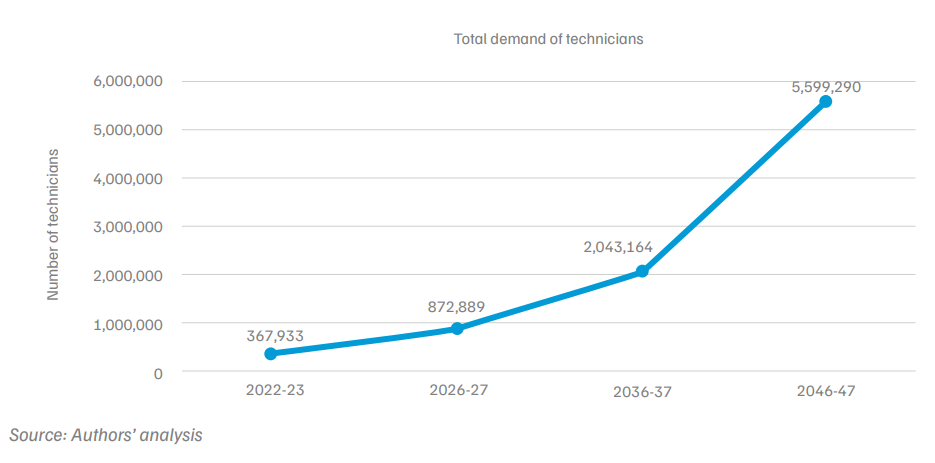
Figure ES1. Estimated demand of service technicians in RAC sector
With a view to create a trained and market-ready workforce of service technicians in the HVAC sector, and following our consultations with relevant stakeholders in the HVAC sector, we have arrived at the following recommendations.
The certification should also provide career progression opportunities for the technicians and should be integrated with employment opportunities in collaboration with the industry.
This study clearly shows that a huge number of technicians will be entering the workforce in the years to come, especially towards the later milestone year of 2037, with a large jump seen towards 2047. Advanced planning for the upgradation and execution of skilling program and budgeting will be key for policy makers and industry to ensure a market-ready skilled workforce, which can leverage the sustainability potential of sustainable cooling technologies as they develop. Alongside that, RAC users need to be made more aware about the adoption of good practices and periodic preventive maintenance. The demand for trained technicians from among RAC users will be a key market push for technicians to undergo training and certification, while securing better income.
Proper servicing and maintenance of RAC units can curtail up to 50 per cent degradation in its performance that happens with time. The servicing sector is also a source of up to 40 per cent of annual refrigerant demand in India. Thus, the ability of the servicing sector to deliver sustainability gains for the RAC sector is significant – it can help deal with refrigerant overuse for servicing, and bring operational energy-efficiency closer to the designed benchmarks.
The current requirement of skilled technicians in India is around 0.35-0.4 million, which will increase to 2 million by 2026-27, and around 5.6 million by 2046-47.
Yes, the good servicing practices are beneficial for the end-users. It improves the energy efficiency of RACs, reduces the possibility of refrigerant leakages, and enhance the life-span of RAC units. This results in significant savings in the operational cost of RACs.
Roadmap of the methodology to assess the climate co-benefits of the SUP ban in Tamil Nadu
Unlocking finance for NbS in Indian Cities
Locally-led Climate Action in the Global South
Roadmap of the methodology to assess the climate co-benefits of the SUP ban in Maharashtra
Towards Climate-resilient Indian Industries: