Council on Energy, Environment and Water Integrated | International | Independent

Suggested Citation: India Forum for NbS (2026). Unlocking Finance for Nature-based Solutions (NbS) in Indian Cities.
Climate Policy Initiative
Uma Pal, Parag Puri
WRI India
Nikhil John, Aarathi Kumar, Shruti Maliwar
CEEW
Shreya Wadhawan, Ritwika Mishra, Aryan Bajpai
Urban areas host 57 per cent of the global population and consume over 75 per cent of natural resources, while facing unplanned growth, inequality, climate risks, and pollution. In India, the urban population is projected to nearly double from 480 million in 2020 to 951 million by 2050, intensifying cities’ exposure to extreme heat, flooding, water stress, and air pollution. With more than half of future urban infrastructure yet to be built, urban nature-based solutions (NbS) present a critical opportunity to enhance resilience and livability while delivering co-benefits for health, livelihoods, and biodiversity and aligning with global sustainability goals.
Despite growing policy alignment and interest, financing for urban NbS in India remains limited and heavily reliant on public sources, with minimal private sector participation. This guidebook responds to this gap through a three-step framework to assess policy and regulatory readiness, leverage financial and business mechanisms, and improve project bankability and scalability. It is supported by a curated repository of nine global and Indian NbS case studies and stakeholder insights, showcasing practical financing instruments and blended approaches to enable replication and scaling across Indian cities.
Urban areas are emerging as focal points of environmental and socio-economic stress. They account for approximately 57% of the global population and over 75% of natural resource consumption, while facing mounting pressures from unplanned growth, inequality, climate risks, and pollution. In India, the urban population is projected to increase from around 480 million in 2020 to 951 million by 2050, significantly intensifying exposure to climate hazards such as flooding, heat stress, water scarcity, and air pollution across major cities including Delhi, Chennai, Jaipur, Lucknow, and Mumbai. With more than half of India’s future urban infrastructure yet to be built, current investment decisions will have long-term implications for resilience, service delivery, and environmental sustainability.
Urban Nature-based Solutions (NbS) offer a viable pathway to address these challenges by integrating ecological systems into urban planning and infrastructure. When effectively designed and implemented, NbS can deliver climate resilience outcomes alongside co-benefits for public health, livelihoods, and biodiversity, while supporting India’s commitments under national urban and climate policies and global frameworks such as the Rio Conventions. However, despite increasing policy recognition, investment in urban NbS remains limited. Financing is largely dependent on public sources, with constrained private sector participation and limited deployment of structured financial instruments—particularly in the Indian context.
This guidebook addresses the financing gap by focusing on how urban NbS can be made more investable and scalable in Indian cities. It presents a structured, three-step guidance framework to support stakeholders in (i) assessing policy and regulatory frameworks relevant to NbS, (ii) identifying and deploying appropriate financial and business mechanisms, and (iii) evaluating projects to strengthen bankability and financing readiness. The framework is complemented by a curated repository of nine global and Indian NbS case studies and stakeholder insights that illustrate practical financing instruments, blended approaches, and implementation models with relevance for Indian urban contexts.
This report is part of an 18-month research project on urban NbS finance in India, which is being collaboratively anchored by Climate Policy Initiative (CPI), WRI India and Council on Energy, Environment and Water (CEEW). This report titled, ’Unlocking Finance for Nature-based Solutions in Indian cities’ is part of a larger ongoing study, who’s preliminary results are being published at this stage to share early insights and findings that are particularly relevant to the current urban NbS financing ecosystem. The report is released in 2 parts that can be read separately or together for a more comprehensive understanding- as a guidebook and best practices repository; and an overview and early recommendations document.
While the guidebook offers an overview of the financial and regulatory frameworks for urban NbS, a further review of market conditions and a geography-specific policy framework that may influence the uptake of instruments needs to be conducted. Additionally, approaches to navigate institutional structures to mobilize financing using the mechanisms shared in this report remain to be identified. This will be crucial to understand how to enable a shift in investment behaviors and increase the share of investments that are directed towards urban NbS in India.
Progress on these fronts, including approaches to navigate institutional structures in Indian cities, will be advanced through the next stage of case study assessments in the study, which is scheduled for release in 2026.
Introduction to urban NbS: 57% of the global population resides in cities, consuming over 75% of natural resources1, facing a myriad of challenges ranging from unplanned development, poverty, inequality, and unemployment due to climate change and pollution (International Union for Conservation of Nature [IUCN], 2023). Indian cities are particularly at risk, with more than 80% of the urban population (Mohanty & Wadhawan, 2021) living in hazard-prone districts that face pressures of flood risk, water stress, water pollution, urban heat island (UHI) effect, and air pollution (Firstpost, 2021). Urban infrastructure in India faces severe climate-related damages, with projected losses of USD 5 billion by 2030 and USD 30 billion by 2070 from f loods, alongside rising heat risks. In many cases, nature-based Solutions (NbS)2 combined with physical infrastructure in green-grey approaches, it can increase development benefits, reduce lifecycle costs, contribute to carbon action, and improve environmental outcomes (World Bank, 2025). Implementation is also intrinsically linked to local economies- with the potential to create up to 32 million new jobs by 2030 (Jongman, et al.) through targeted investments. However, implementation at scale requires unlocking finance for urban NbS.
The state of global and domestic finance flows: According to UNEP’s State of Finance for Nature 2023, global finance flows in NbS currently stand at just USD 220 billion annually in 2023 (United Nations Environment Programme [UNEP], 2026). NbS finance flow will need to at least triple by 2030 and increase fourfold by 2050 to meet global climate change, biodiversity, and land degradation targets (Jongman et al., 2021). To meet global climate change, biodiversity, and land degradation targets, the finance flows must rise to at least USD 571 billion annually by 2030 (UNEP, 2026). However, despite the clear rationale for scaling NbS, the total volume of finance f lows to nature constitutes only 3% of total climate finance flows (Nature4Climate, 2024). Within that, only a limited proportion of NbS finance is currently channeled into urban areas. Additionally, as of 2023, public funds constituted 90% (USD 197 billion) of the total finance f lows in NbS, and private finance only a modest 10% (USD 23 billion) (UNEP, 2026).
One of the key limitations of private sector funding is the lack of, or lower risk-adjusted, f inancial return on investments. Many ULBs also struggle to engage investors due to weak creditworthiness, limited technical capacity, and a lack of bankable project pipelines. Additionally, the absence of standardized methodologies, clear guidelines, and the overall fragmented understanding of various investment mechanisms for financing NbS further hampers investments.
In India, climate action is primarily financed by domestic resources, with most NbS projects funded through government expenditure and a mix of grants and loans from domestic and international development finance institutions. NbS interventions heavily rely on public finance, indicating a significant disparity between government and private sector contributions. Unlocking f inance for urban NbS requires both optimization and catalytic use of public finance, and an increased share of investments from the private sector. This report situates urban NbS in India within the broader financial policy, regulatory, and institutional environment to identify suitable entry points for their adoption and scaling. Additionally, it provides an analysis of financing instruments to understand their potential and limitations for adaptability to the urban Indian context. Early recommendations include approaches to de-risk investments and deliver urban NbS at scale, and have been informed through the following activities:
Scope and approach of the research
This report is part of a larger ongoing study, which is still in progress. It is being published at this stage to share early insights and findings that are particularly relevant at this time. By releasing these preliminary results, we aim to provide valuable information to the field. At the same time, the whole study is still being conducted, ensuring that key developments are made accessible to the stakeholders without delay.
In addition, another complementary report is being published- Guidebook and best practices repository. Both reports can be read independently; however, when considered together, these reports offer a more comprehensive understanding of the landscape being studied. Both reports aim to enhance the understanding of the NbS policy and regulatory frameworks, and finance and business ecosystem, providing clarity on finance and business mechanisms that can support the delivery and scale of urban NbS.
NbS has been a key focus at recent global events such as COP 30, highlighting its role in adaptation and resilience initiatives. India has announced an intention to set up a country platform as a unified climate finance mechanism. This is an initiative to strengthen its commitment to integrate NbS for adaptation into urban development initiatives by setting shared priorities, aligning stakeholders, and driving national policy and sub-national strategies to support global adaptation efforts, facilitated by the Green Climate Fund (GCF) (Mongabay, 2025).
At a national scale, updated Nationally Determined Contributions (NDCs) and National Biodiversity Strategies and Action Plans (NBSAPs), along with central government schemes such as the Atal Mission for Rejuvenation and Urban Transformation (AMRUT), the Smart Cities Mission, and more recently, Mangrove Initiative for Shoreline Habitats & Tangible Incomes (MISHTI) have increasingly supported funding for NbS-related interventions. In parallel, several state governments, such as Tamil Nadu and Maharashtra, along with Urban Local Bodies (ULBs), have begun incorporating NbS components within municipal plans and budgetary frameworks, reflecting a broader shift towards nature-based urban development. Initiatives such as the Ministry of Environment, Forest, and Climate Change (MOEFCC) green credit program and the Security and Exchange Board of India (SEBI) Green and ESG Debt securities framework encourage resource mobilization from the private sector. Programs and platforms such as the Climate Project Preparation Facility (CPPF) by the National Institute of Urban Affairs (NIUA) and the Ministry of Housing and Urban Affairs (MoHUA) signal promising solutions to access a pipeline of climate-aligned, investment-ready urban projects. These actions provide the means to mainstream sustainable finance for accelerated climate action and direct funding towards urban NbS, presenting a growing array of investment opportunities.
However, while these efforts are welcome, limited awareness and institutional capacity, along with the inability to converge policies and schemes for urban NbS components (such as livelihood opportunities and capacity building efforts), are among the barriers that hinder investments (Ministry of Housing and Urban Affairs, 2025). An understanding of the global, national, financial, and city-level policies, regulations, and schemes relevant to NbS financing and implementation (coupled with improved institutional capacity) can guide the synergistic use of policies, regulations, and strategies for governance and unlocking finance for urban NbS at scale. An overview of the same is presented below:
In summary, India has a strong foundation of urban, nature, and infrastructure policies at the national, state, and city levels that can be leveraged for implementing NbS, but turning that potential into real impact will require greater policy coherence/ convergence, along with localized action for practical integration of NbS and cross-sectoral coordination.
As stated earlier, investments in urban NbS will need to increase at least 2.5 times to USD 571 billion annually by 2030 to meet global climate change, biodiversity, and land degradation targets. Investment needs for nature are estimated to be the highest in Asia, with an additional USD 167 billion required annually by 2030 (UNEP, 2026). To build momentum for NbS finance, actors must make the case that investing in activities that prevent future costs due to climate change impacts (rather than only generating immediate cash flows) can deliver long-term economic, f inancial, and social value for the communities and stakeholders involved. Furthermore, urban NbS is application-oriented and needs to be customized to complex and localized climate and socio-economic challenges. This requires coordinated efforts from different actors across all levels (supply, demand, and policy) and stages (concept development and technical assistance, implementation, maintenance, monitoring, and scale-up), through innovative financing models and iterative processes of dialogue and participation.
Table 1: Stakeholders for financing urban NbS
| Category | Stakeholder Group | Role in Development | Role in Financing |
|---|---|---|---|
| Supply-side | Multilateral & National Banks | Technical support & standards. | Loans, grants, risk mitigation. |
| International Climate Funds | Align projects with climate goals. | Concessional finance. | |
| Private Sector & CSR | Innovation. | ESG funds, green bonds. | |
| Philanthropies | De-risking & demonstrating bankability. | Early-stage, catalytic capital. | |
| Demand-side | NGOs & Civil Society | Community mobilization. | Channeling finances; advocacy. |
| Policy-side | Public Sector | Policy formulation; urban planning. | Seed funding; leverage private investments. |
There is no one-size-fits-all approach to designing urban NbS, as solutions can and should be developed for varied objectives (environmental, social, economic) in response to local needs and climate risks. Mapping stages of an NbS project with the financing cycle can help both developers and investors gain clearer insights into what to anticipate and how to respond at each step of the project lifecycle8. This alignment not only strengthens individual projects but also lays the groundwork for unlocking NbS finance more effectively across urban contexts.
Additionally, understanding the availability and access to innovative9 and credible financial mechanisms10 and business mechanisms11 can help attract both private and public capital investments across project stages (See figure 1 for the functioning of NbS financing and business ecosystem). Investments can be from multiple sources- public, private, or blended sources and through numerous financial instruments, including debt, equity, grants, and risk management tools that can operate independently or in combination (for risk reduction and management) (BioFin, n.a). Each instrument carries inherent risk-return profiles, structures, and incentives that vary based on the context, project type, and financing needs.
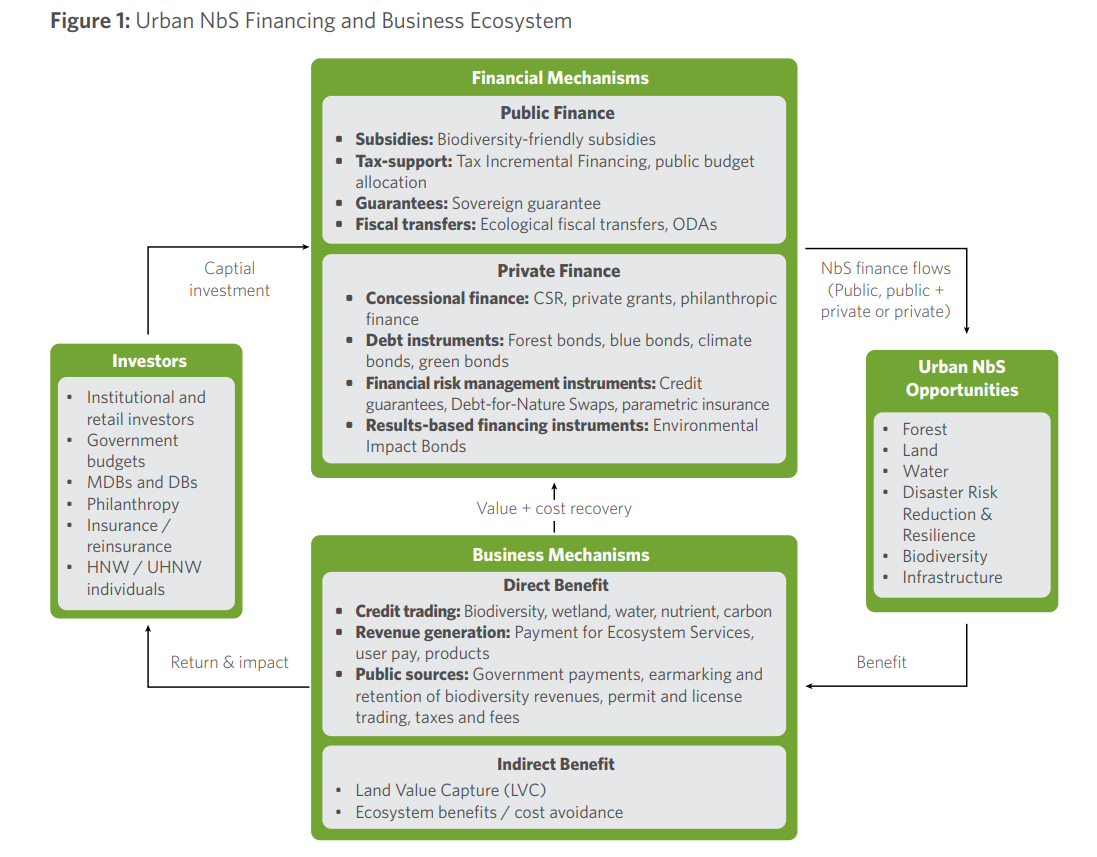
Adapted from Conservation Finance: Moving beyond donor funding toward an investor-driven approach and Financing Nature: Closing the Global Biodiversity Financing Gap report
However, the selection of appropriate and effective financial mechanisms from the growing list of consolidated, emerging, and non-traditional mechanisms (see Figure 2 for the catalogue of f inancial and business mechanisms) to fund urban NbS often poses a challenge for practitioners. This is usually due to the lack of contextual evidence, technical know-how, project management experience, fluency with project financing, and access to a supportive network of partners. Along with financing considerations, various factors such as the project type, local socio-economic and governance context, stakeholders, and the benefits the project sets out to deliver are crucial determinants. By showcasing how financial instruments can be tailored to meet diverse NbS needs, this study supports various stakeholders seeking to understand options available today to build climate resilience. Examples of various financial and business mechanisms for urban NbS interventions, highlighting their level of maturity/usage in the Indian context, are included in the diagram below. Such strategies can facilitate the flow of capital into urban NbS projects and improve the value proposition, including cost recovery mechanisms, over the life of the project. Please refer to the ‘Guidebook and Best Practices Repository’ research document for more information on these instruments.
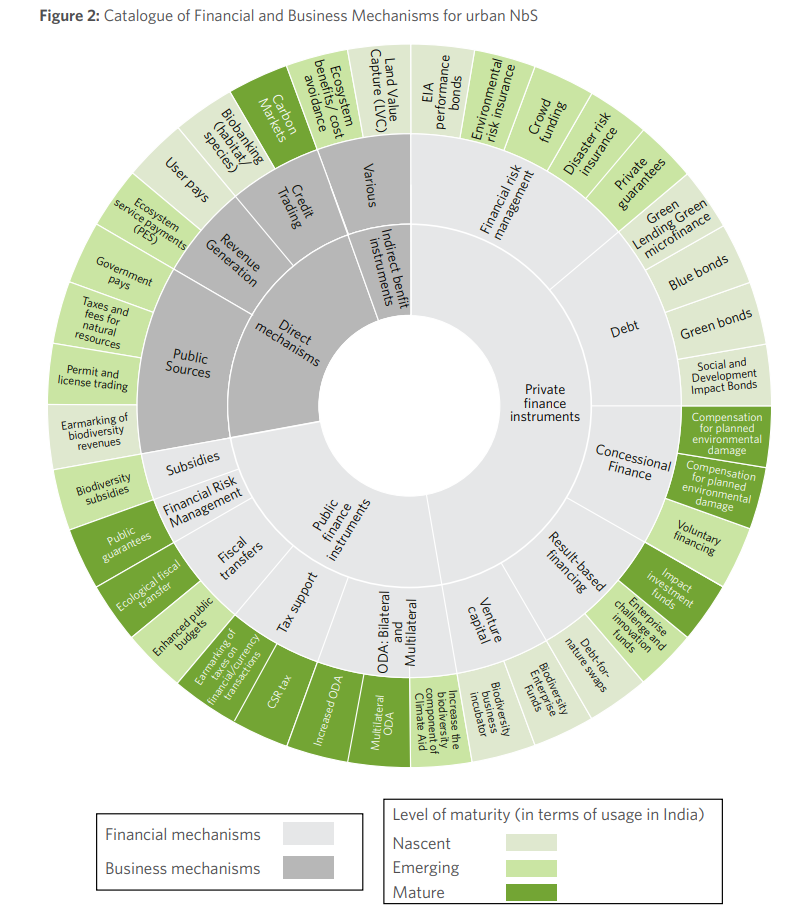
Source: Adapted from BIOFIN’s Catalogue of Finance Solutions and World Bank Group’s Financing Climate Adaptation and Nature-Based Solutions.
Please refer to the Guidebook and Best Practices Repository for definitions and applications of the instruments mentioned in this diagram.
In summary, multiple challenges deter the adoption and financing of NbS at scale, many of which lie at the intersection of existing market failures, inadequate policy push, and lack of benefit sharing between stakeholders and communities. While urban NbS financing and business mechanisms are gaining traction, unsubstantiated environmental claims or greenwashing due to the lack of standardization and guidance are further barriers to the implementation and scaling up of NbS (UNEP FI, 2024).
Despite these barriers, certain institutional, financial, and implementation-related success factors show promise to build scalable and sustainable NbS projects (Kleve K, 2025). These include early-stage efforts that focus on strengthening implementation teams, educating investors, piloting innovative models to demonstrate profitability, and recognizing that no single financing approach will suit all contexts.
In addition to identifying available financial and business mechanisms, a repository of best practices has been developed to provide evidence on the application of these mechanisms and leveraging success factors to de-risk investments. The potential of instruments such as green bonds, public–private partnerships (PPPs), blended finance, pooled funds, and insurance-based risk management to unlock finance for urban NbS has been analyzed through project examples in India and other geographies. The list of projects included here extends beyond the urban context, to also learn from mechanisms that were successful in mobilizing finance in peri-urban and rural areas. This is owing to the lack of sufficient evidence of innovative financing approaches for urban NbS. Four thematic areas were used to analyze the practices:
Further analysis offered insights into the relevance of these practices to the urban Indian context, highlighting qualitative and quantitative factors that contribute to innovation and scale. Some of the findings that emerged include the following:
In summary, this section aims to guide both the public and private sectors by identifying potential factors that have guided the flow of capital for urban NbS delivery. By exploring how different financial models and instruments are applied to other climate risks across contexts, this study can inform the selection, design, and management of similar financial instruments and approaches for climate resilience. For more information on the projects listed above, please refer to the ‘Guidebook and Best Practices Repository’ research document.
Early recommendations included in this section provide ways to tackle the barriers highlighted in previous sections and to strengthen the investment case for urban NbS. These are presented under four themes: (1) Improving the enabling environment for NbS, (2) Integrating NbS in project development, (3) Improving project bankability and feasibility, and (4) Diversifying f inancing sources.
Improving the enabling environment for NbS: Introducing reforms to make urban NbS more attractive to investors through certifications and standards that encourage innovation; securing land and carbon rights through long-term Memorandums of Understanding (MoUs) with governments; and integrated social support frameworks for financial literacy and risk mitigation through partnerships with local collectives.
| Improving the enabling environment for NbS | |
|---|---|
| Theme | Recommendations |
| Policy and regulatory support |
Incentives: Including reforms such as certification and standards to encourage innovation. These can leverage the existing policy and regulatory environment to bring out NbS considerations more explicitly. Due diligence: Developing processes that allow for data exchange, where funders could share information through standardized platforms and industry-specific data repositories to gain a more comprehensive understanding of climate risks. |
| Governance |
Long-term Government Agreements: Establishing long-term Memorandums of Understanding (MoUs) with governments, for example, to secure land and carbon rights critical for NbS projects with a carbon trading business model. |
| Knowledge and capacity |
Synthesis of learnings: Platforms to highlight the experiences of investors and project developers who have utilized financing methods from comparable sectors and geographies can provide valuable models to support urban NbS. The Global Innovation Lab for Climate Finance is an example that identifies, develops, and launches innovative finance instruments to drive private investment for action on climate change and sustainable development. Capacity building: Improving awareness of what NbS constitutes, including clear criteria and design and operational factors, to avoid risks such as maladaptation. Climate cells anchored with state/ city environment departments can bring on board urban experts to provide guidelines for NbS for adaptation. The Bruhat Bengaluru Mahanagara Palike (BBMP) launched the Climate Action Fellows program in 2024 to enhance the capacities of the Climate Action Cell and work on ward-level climate action plans. |
| Benefits to local communities |
Payout mechanisms for local community participation: Empowering and providing a corpus of resources to regional institutions such as Panchayats, Municipalities, and urban quasi-administrative bodies to strengthen access to NbS finance, improve governance processes, and assist in beneficiary identification and payout systems. |
Integrating NbS in project development (design, planning, and implementation phase): Integration of community knowledge in the design and planning stage; technical partnerships to support product development, innovation, and alignment with local and regional urban plans are examples that add significant value, overcoming investor concerns.
| Integrating NbS in project development (design, planning, and implementation phase) | |
|---|---|
| Design and planning | Prioritizing close collaboration: Collaboration and partnership with local communities is a fundamental aspect of bankable NbS projects, through approaches that are inclusive, integrating communities into project models. |
| Integrating biodiversity conservation and socio-economic outcomes: Recognizing the inherent connections between environmental and socio-economic outcomes and integrating methods to achieve desired outcomes in the design of NbS projects. | |
| Identifying viable alternative livelihoods: Employing a participatory approach to identify alternative livelihoods that deliver measurable benefits for both biodiversity and local communities. | |
| Implementation | Leveraging technical partnerships: Strengthening partnerships with relevant research institutions, academic organizations, and government agencies for support in product improvement, innovation, and alignment with local/ regional development plans. |
| Enhancing the commercial and technical capacities: Enhancing the capacity of project teams and continuous development of these competencies to design viable business models is critical to overcoming investor concerns. This also addresses barriers to project financing faced by emerging NbS enterprises. | |
Improving project bankability and feasibility: Improving project bankability and feasibility primarily involves comprehensive planning, rigorous risk assessment, transparent financial modelling, and strategic distribution of risks to build confidence with potential investors.
| Improving project bankability and feasibility | |
|---|---|
| Project structuring | Clarity in project design and financing structuring: Projects should be treated as infrastructure investments with transparent definitions of the problem, solution, benefits, timeline, execution strategy, responsible actors, and repayment mechanisms. A scalable national platform for project preparation is essential. NIUA with WRI India has launched the Climate Project Preparation Facility for adaptation and resilience projects, in addition to mitigation projects in Indian cities. This facility also equips Indian cities with the tools and technical expertise to prepare bankable climate adaptation projects. |
| Ring fencing to de-risk | Protecting assets: Segregating project funds from broader financial risks to minimize investment risk and increase confidence among institutional and private investors. Ring-fencing can be supported by development banks (e.g., NABARD, Green Bank) with public policy or grant banking as additional de-risking tools. |
| Adjusted Investment Expectations | Context-specific funding strategy and return expectations: NbS projects, especially in remote or ecologically critical areas, often require investors to accept lower returns, smaller investment sizes, and longer tenors due to operational challenges. |
| Intersectionality and co-benefit mapping | Cross-sectoral coordination: Integrating NbS principles across sectors, including healthcare funding, green job creation, and livelihoods, to maximize synergistic benefits like increased property values and improved public health. Equitable distribution of benefits. |
| Designing replicable business and finance models | Standards to structure sustainable finance: Designing NbS financing models with scalability and replicability across different urban local bodies (ULBs) by standardizing processes, roles, and data management. |
Diversification of financing sources: Diversification of financing sources is a strategy to reduce risk and build resilience by securing capital from multiple avenues (like loans, equity, grants, crowdfunding) instead of relying on just one, ensuring stability, flexibility, and consistent access to funds for operations, investments, and scale. It moves businesses beyond single-source dependency (e.g., just public funds) to build robust financial health.
| Diversification of financing sources | |
|---|---|
| Theme | Recommendations and stakeholder insights |
| Targeted public investments | Optimizing public funding: Promoting government investment in NbS, especially where market incentives are weak, resources are public goods, and for de-risking NbS investments. If there is no direct pathway to commercialization, developmental outcomes are important; city-level financial mechanisms, such as bonds, taxes, and other sources, become relevant. Indonesia has issued blue bonds for coastal protection, sustainable management of fisheries and aquaculture, marine biodiversity conservation, and mangrove rehabilitation, and Miami’s forever bonds aim at investing in ‘Parks and Recreation’ and ‘Storm Sewers’. |
| Grant funding and technical assistance | Catalytic public and concessional finance: Vital for early-stage NbS projects to reach a stage where they can sustain debt and equity financing alone. Lifecycle financing may progress from grants and concessional capital to outcome-based finance and carbon revenue. |
| Linking NbS Benefits with Revenue Sources |
Identify the financial value of NbS co-benefits for sustainable funding models: Innovative financing can connect water management benefits to land value taxes, property tax allocations, or tourism-linked revenue models. India’s Value Capture Financing Framework offers potential but is underutilized for NbS. Incorporate co-benefits through premiums instead of direct monetization: Identify ancillary revenue streams, such as transportation linked to NbS canal restoration, as opportunities to improve financial sustainability. Value chain creation: Developing value chains across the project lifecycle, providing diverse returns to governments, philanthropies (when commercial feasibility is lacking), and the private sector. |
While this research offers an overview of the financial and regulatory landscape for urban NbS, a review of market conditions and institutional structures for policy/ scheme convergence needs to be conducted. To address this, potential areas for research that will be undertaken in the coming months include the following:
NbS interventions in India heavily rely on public finance, indicating a significant disparity between government and private sector contributions. Some of the key reasons for low private sector investment and engagement in NbS are limited long-term visibility on investment outcomes, uncertain time horizons for economic returns to materialize, lack of standardized approaches for long-term impact evaluation, insufficient clarity and incentive on the policy and regulatory environment, weak risk-adjusted returns, and a limited understanding of successful and viable business and investment models for NbS.
Financial and business mechanisms serve as complementary frameworks essential for unlocking the potential of urban NbS. Financial mechanism focuses on evaluating the financial feasibility of an NbS project and making the case for capital allocation to unlock and direct finance toward urban NbS effectively. Such financing mechanisms can be from varied sources of financing- public, private, or blended sources and through multiple financial instruments, including debt, equity, grants, and risk management tools that can operate independently or in combination. Business mechanisms focus on how a project creates, delivers, and captures value and recovers costs by establishing clear value and return propositions for its proper recognition, communication, and monetisation.
Because limited creditworthiness and narrow revenue bases make it difficult for smaller ULBs to raise capital independently from debt-based instruments like green municipal bonds. Pooled financing and insurance-based mechanisms reduce individual fiscal stress and give such municipalities collective bargaining power to buy insurance for their assets from climate change induced risk.
Technical assistance and capacity building on know-how for writing strong proposals, raising funds, and tracking results are critical for enabling long-term NbS project agreements at different levels of government to support NbS at the planning stage. The framing of NbS projects around environment, climate, and sustainability are becoming key entry points and investment mandates that help connect NbS to sectors where funders and policymakers are already active, making it easier to build momentum.
Creative business mechanisms and cost recovery mechanisms like charging premiums, linking projects to new revenue streams (e.g., transport from restored canals), and ensuring that benefits are shared, especially with communities dependent on natural resources for their livelihoods enable monetisation of co-benefits, such as improved health, biodiversity, or community livelihoods. On the investment side, scale and structure matter. Investors weigh a project’s alignment with climate goals, government support, community risks, and whether it creates lasting assets. Tools like guarantees can make projects more attractive, while debt-based financing hinges on solid cashflow projections and measurable carbon outcomes.
Roadmap of the methodology to assess the climate co-benefits of the SUP ban in Tamil Nadu
Locally-led Climate Action in the Global South

Roadmap of the methodology to assess the climate co-benefits of the SUP ban in Maharashtra
Towards Climate-resilient Indian Industries: