Council on Energy, Environment and Water Integrated | International | Independent

Suggested Citation: Gupta, Ishita, Lalitha Ramalingan, Taveri Rajkhowa, Aryan Bajpai, Vanya Pandey and Shreya Wadhawan. 2026. Locally-led Climate Action in the Global South: Learning from Communities. New Delhi, India: Council on Energy, Environment and Water (CEEW).
Climate impacts are felt most acutely at the local level, yet climate action in India and across the Global South remains largely designed and financed through centralised, top-down systems. This limits local ownership, relevance, and the long-term sustainability of adaptation efforts, particularly for climate-vulnerable populations. Local institutions often face constrained decision-making authority, fragmented and unpredictable finance, limited technical capacity, and inadequate access to climate information, alongside weak inclusion of marginalised groups, resulting in short-term and poorly aligned interventions.
This study examines how locally led climate action (LLCA) can be operationalised and scaled in India through governance, institutional, and financial reforms. It reviews 75 community-based initiatives across 16 countries and documents 16 in-depth case studies to identify best practices for building climate resilience. For India, the study bridges local action with national ambitions by identifying systemic barriers and opportunities to shift from fragmented pilots to institutionalised, scalable models for resilience-building. Drawing on evidence from multilateral climate funds and national programmes, the study highlights three core design features for effective operationalisation of LLCA:
i.) devolved finance and decision-making,
ii.) inclusive and accountable local leadership, and
iii.) climate-informed local planning that integrates scientific and indigenous knowledge.
Evidence from South Asia shows that empowering community institutions, such as women’s groups, indigenous communities, and youth collectives, enables cross-sector coordination and sustains long-term resilience.
As climate impacts intensify across the Global South, the need to shift from centralised adaptation planning to locally driven climate action has become even more critical. Although global frameworks have advanced adaptation agendas, implementation remains fragmented, underfinanced, and insufficiently rooted in the lived realities of climate-vulnerable populations. This compendium on locally-led climate action (LLCA) consolidates global experience, identifies best practices, and outlines operational pathways for India and other developing countries to institutionalise community-led resilience within governance, finance, and planning systems.
Climate change impacts manifest locally, yet most adaptation efforts continue to be driven through centralised, top-down systems. Traditional community-based adaptation (CBA) initiatives enabled local participation but largely positioned communities as beneficiaries. As a result, these interventions only yielded sporadic, short-lived success, and humanitarian and project-based support rarely evolved into lasting capacity or institutional resilience.
Locally-led adaptation (LLA) marked a pivotal transition by embedding decentralisation and long-term capacity building into adaptation practice. Guided by the eight LLA principles, this approach sought to strengthen policy and institutional frameworks to enable sustained local-level interventions. However, challenges in scaling and replication limited its impact.
The LLCA framework builds on LLA by connecting disaggregated local efforts and operationalising adaptation at national and sub-national scales. It provides a practical pathway to design, plan, and implement local adaptation through three core features:
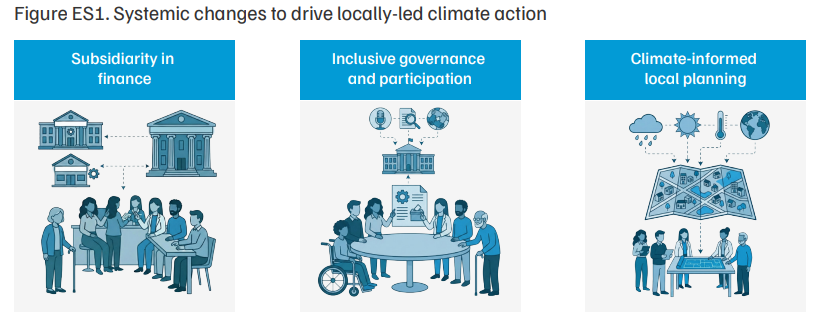
Source: World Bank. 2024. Locally-Led Climate Action: A World Bank Operational Approach.
This compendium consolidates lessons from over 75 LLCA-aligned initiatives across the Global South, offering a practical reference for policymakers, practitioners, funders, and community leaders.
Overall, the compendium positions LLCA as the next frontier for advancing India’s climate resilience and highlights viable strategies for translating global best practices into India’s policy and institutional contexts.
To ensure credibility and rigour, the study reviewed over 75 projects from the Global Environment Facility (GEF), Green Climate Fund (GCF), United Nations Development Programme (UNDP), and other multilateral development banks (MDBs) across 16 countries in Africa, Asia, Latin America and Oceania.
Projects were evaluated against indicators derived from the eight LLA principles and assessed using criteria such as community engagement, on-ground implementation, and scalability.
The analysis also highlights structural bottlenecks that constrain LLCA implementation in India, including rigid financing channels, participation that remains more symbolic than substantive, and limited use of localised climate information.
Global experiences demonstrate how LLCA principles translate into measurable resilience outcomes:
These examples illustrate the tangible benefits of subsidiarity, inclusivity, and locally grounded planning. The compendium distils such insights across the three LLCA design features, offering a consolidated set of good practices that can inform national- and state-level adaptation strategies.
The analysis yields actionable recommendations for embedding LLCA within India’s adaptation ecosystem:
Finance reforms
Governance reforms
Robust data systems
The compendium calls for a systemic shift from small-scale pilots to mainstreamed LLCA, and from communities as beneficiaries to co-leaders of India’s climate transition. Achieving this requires reimagining how local interventions can be aggregated and adapted to scale while preserving their local character.
It serves as an actionable reference for national and state governments, development agencies, and grassroots organisations to reform policies, scale up proven LLCA models, and embed local climate resilience in India’s governance, financing, and planning systems. The insights will feed into a broader study on operationalising LLCA in India and ultimately contribute to a framework for institutionalising local resilience in national policy and practice.
The compendium brings together examples from across the Global South where community-based climate actions have been implemented. It demonstrates how solutions become locally led when they are inclusive, context-responsive, and supported by decision-making authority with the people facing climate risk. It synthesises lessons for India and other countries to show what systemic-level changes are needed to operationalise locally led climate action and build climate resilience.
Climate change impacts are experienced locally, yet most adaptation efforts continue to be designed and delivered through centralised, top-down systems. Traditional community-based adaptation (CBA) created space for participation but largely treated communities as beneficiaries rather than decision-makers. The LLCA approach addresses this gap by proposing an operational pathway to devolve financial and governing authority to local institutions and communities, enabling them to shape priorities, make decisions, and lead implementation to address risks induced by climate change.
The compendium is intended for policymakers, state and district administrators, development practitioners, and research organisations working on climate governance, rural development, and resilience planning. Guided by the eight principles of locally led adaptation, the study provides insights into institutional, financial, and planning reforms that can inform policy design, strengthen programme architecture, and shape investment decisions where local actors take the lead in shaping priorities, accessing relevant climate information, and managing resources with autonomy to enable bottom-up climate action.
Roadmap of the methodology to assess the climate co-benefits of the SUP ban in Tamil Nadu
Unlocking finance for NbS in Indian Cities

Roadmap of the methodology to assess the climate co-benefits of the SUP ban in Maharashtra
Towards Climate-resilient Indian Industries: