Council on Energy, Environment and Water Integrated | International | Independent

Suggested Citation: Goel, Vaishvii, Gunjan Jhunjhunwala, and Akanksha Tyagi. 2026. Scaling Green Manufacturing in India: Recommendations for Jobs, Growth and Sustainability. New Delhi: Council on Energy, Environment and Water.
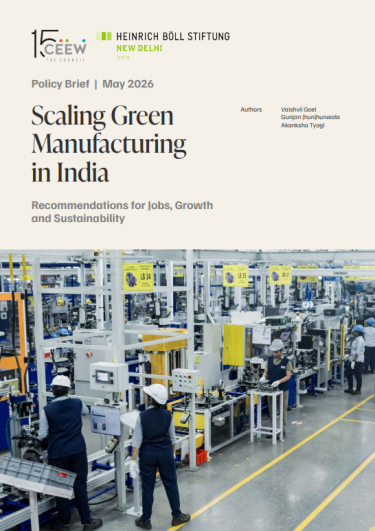
India's green economy, spanning energy transition, the circular economy, and the bio-based economy, holds the potential to generate over 48 million jobs, attract USD 4.1 trillion in investments, and unlock USD 1.1 trillion in market value by 2047. Building these sectors will allow India to enhance energy independence, economic security, and overall national sovereignty. Yet, realising this potential hinges on the country's ability to build robust manufacturing capabilities across these emerging green value chains.
Despite a strong policy push through instruments like the Production Linked Incentive scheme, India's manufacturing gains remain largely downstream-oriented. Structural challenges constrain the green manufacturing ecosystem. This policy brief examines five such systemic barriers: demand uncertainty, limited access to financial capital, import dependence for capital goods, the risk of technological obsolescence, and the low-cost competitiveness of domestically manufactured components. Drawing on stakeholder consultations, it offers actionable recommendations. The interventions will require coordinated action across ministries, regulators, and industry and the institutional agility to course-correct as global conditions shift.
India has consistently introduced policies and missions to boost manufacturing. Despite a strong policy focus, significant headwinds constrain India’s manufacturing abilities in key green economic sectors of renewable energy, circular economy, and the bio-based economy. These green sectors are instrumental in supporting the country’s ambition to become a developed nation by 2047 and its decarbonisation goals. A recently released CEEW (2025) report presented a USD 4.1 trillion market opportunity across thirty-six green opportunities, including electric mobility manufacturing, battery manufacturing, engineered bamboo products, bio-inputs, plastic waste recycling and so on. Building these sectors will allow India to enhance energy independence, economic security, and overall national sovereignty. Several of these opportunities, however, greatly rely on India’s ability to improve its manufacturing ecosystem.
In offering recommendations to capitalise on these opportunities, this policy brief finds that India must build manufacturing ability in the green economy by overcoming demand uncertainty, limited access to financial capital, import dependence for manufacturing equipment, the risk of technological obsolescence, and the low-cost competitiveness of domestically manufactured components.
Demand uncertainty deters long-term investments in green value chains, as it negatively affects innovation, growth, and productivity for firms (Bontempi et al. 2010; Fuss and Vermeulen 2011; British International Investment 2020). Multiple factors drive this uncertainty. Sudden policy shifts, such as the discontinuation of fiscal incentives, create an unpredictable environment and make manufacturers risk-averse. Higher unit costs of green products and continued subsidies for conventional alternatives also dampen adoption, which reinforces demand uncertainties. For example, in the bio-economy sector, feedstock variability affects product quality and escalates costs. This discourages consumers from switching to bio-based products (Jong et al. 2025).
Access to financial capital remains severely constrained for green enterprises. Banks rely on conventional risk assessment metrics, such as stable revenue streams and established track records, that most early-stage green manufacturers cannot demonstrate. For example, feedstock variability in bioenergy products makes it difficult for banks to reliably assess their viability (Renewable Watch 2023). Further, in the absence of a climate finance taxonomy, which can help in a shared understanding of ‘green’, lenders are hesitant (Outlook Business 2025). Green enterprises also struggle with accessing capital from the venture capitalists as they tend to prefer asset-light startups over heavy machinery-led businesses (Yale University 2022).
Heavy import dependence for the manufacturing machinery raises production costs, and lengthens lead times. India’s capacity to produce capital equipment is limited. For example, India’s dependence on imported polymerisation technologies and biomanufacturing machinery constrains the scale-up of bioplastics (Takshashila Institution 2025). Underlying these challenges are India’s low levels of research and development (R&D) (gross expenditure on R&D is 0.64 per cent of GDP, compared to 3.5 per cent in the United States), and limited private sector contribution. While India’s research outputs, such as patent applications, have increased, only a few translate into commercially viable products (Economic Survey 2025-26).
The risk of technological obsolescence discourages capital commitments. India is particularly vulnerable due to its heavy reliance on foreign intellectual property (IP). With approximately 90% of patented inventions concentrated in a few economies reluctant to share tech with developing nations (OECD 2025; Sajid, Zhang & Janjua 2024), Indian firms often settle for licensing agreements. This restricts India’s ability to independently advance the underlying technology. Additionally, low modularity of Indian Small and Medium Enterprises (SMEs) constrain the adoption of emerging technologies (IEEFA 2023).
Low cost competitiveness limits India’s integration into global value chains. In solar manufacturing, 56 per cent of the price difference between India and China is driven solely by bill-of-materials costs (Jain, Dutt and Chawla 2020). India’s low recycling rate of less than 20 per cent, vis-à-vis 70 per cent in Europe, restricts the domestic availability of secondary raw materials. Moreover, Indian MSMEs face a productivity gap compared to advanced economies and lag in adoption of emerging technologies that further reinforces low cost competitiveness (Deloitte 2025; WEF 2025; Economic Times 2025).
Strengthen demand through strategic procurement and financial incentives. India has done this in the past through the public procurement model for the UJALA scheme, unlocking economies of scale that brought prices down (PIB 2022). Similar models should be applied to emerging green sectors. Public procurement criteria should prioritise not just the lowest cost, but also innovation, circularity, and sustainability. Anchor investors should be attracted through strategic financial incentives. SImilarly, producers and consumers should be nudged to co-locate themselves through incentives such as favourable land prices and accelerated depreciation.
Expand access to capital through innovative financial instruments. Banks should collaborate with the RBI, Ministry of MSME, SIDBI, fintech companies and NBFCs to develop and test new financial products through regulatory sandboxes, utilising alternative data sources such as GST filings and transaction histories for creditworthiness assessment. The government must also finalise the Climate Finance Taxonomy. The BSE SME platform should create a dedicated segment for emerging green industries with relaxed eligibility criteria, such as the requirement for a minimum average operating profit before tax of INR 2 crore over the preceding three financial years.
Promote R&D and servitisation to reduce import dependence. India requires missiondriven institutional models, similar to the Biotechnology Industry Research Assistance Council (BIRAC), for the circular economy and energy transition sectors. These institutions can attract private sector investment in R&D, strengthen collaboration among industry, academia, and government, and accelerate the development of market-relevant products in emerging green industries. Simultaneously, the government should advance servitisation to enhance the competitiveness of Indian MSMEs, providing targeted support modeled on the Zero Defect Zero Effect (ZED) scheme.
Incentivise domestic IP ownership and promote adaptive manufacturing. Public procurement should introduce a dedicated category that gives top priority to indigenously designed and manufactured products, drawing inspiration from India’s defence procurement model. To improve plant modularity, the government should extend the Sangam: Digital Twin initiative to manufacturers in rapidly evolving value chains such as EV manufacturing (PIB 2025). The Manufacturing-as-a-Service (MaaS) model should be also be actively promoted, with the government onboarding and certifying MaaS providers near industrial clusters.
Enable a circular economy and industrial symbiosis to improve cost competitiveness. The government should develop a national traceability architecture, building on initiatives such as Battery Aadhaar, to enable material recovery at scale (PIB 2025). DPIIT should lead material flow analysis pilots in industrial clusters to promote industrial symbiosis, leveraging its expertise in designing industrial park assessments.
Ultimately, the effectiveness of these recommendations will depend on how institutional bodies and stakeholders ensure that these interventions are not implemented in silos, avoiding duplication of efforts and coordination failures. A mission-mode approach that aligns ministries, regulatory frameworks, resources and industry policy tools towards common objectives is essential. The green economy is no longer a secondary policy priority but a fundamental prerequisite for a globally competitive and resilient economy. By streamlining these efforts, India can simultaneously generate jobs, attract investments, build climate resilience, and strengthen its long-term economic sovereignty.
This policy brief focuses on manufacturing in sectors where the end products contribute to environmental sustainability — by reducing emissions, improving resource efficiency, or enabling circular material use. It does not focus on greening the manufacturing process itself.
The brief examines nineteen manufacturing-intensive value chains across three sectors of the green economy: energy transition (including solar, wind, battery, EV, and green hydrogen manufacturing), the circular economy (including e-waste, plastic waste, and lithium-ion battery recycling), and the bio-economy (including engineered bamboo, bio-residue-based packaging, biofuels, and bio-inputs).
Addressing systemic barriers that cut across multiple value chains generates far greater impact than solving for sector-specific challenges in isolation. Many of these barriers — such as low R&D intensity or limited access to finance — constrain growth across energy transition, circular economy, and bio-economy sectors simultaneously.
MaaS allows manufacturers to access machinery and production capacity on a subscription basis, eliminating heavy upfront investments. This helps SMEs avoid being locked into outdated technologies and improves their ability to adapt as green technologies evolve.
Servitisation is the integration of services into the manufacturing sector. It gives Indian manufacturers a competitive edge by providing services like predictive maintenance, which ensures smooth machine operations and lower maintenance costs.
Assessing India’s Coal Mine Workers:



Roadmap of the methodology to assess the climate co-benefits of the SUP ban in Maharashtra
A Financier's Guide to Assessing Viability of Clean Energy-Powered Rural Livelihoods: