Council on Energy, Environment and Water Integrated | International | Independent

Suggested citation: Urwa Tul Wusqa, Wase Khalid and Abhishek Jain. 2026. A Financier’s Guide to Assessing Viability of Clean Energy-Powered Rural Livelihoods: Insights from the DRE Livelihoods Financial Assessment Toolkit. New Delhi: Council on Energy, Environment and Water.
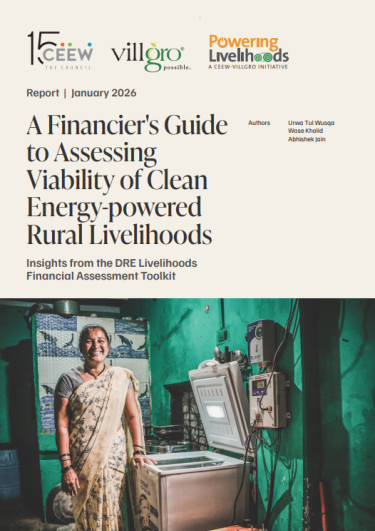
Decentralised renewable energy (DRE) - powered livelihood technologies are emerging as a critical lever for sustainable economic growth in India’s rural and peri-urban economy. From solar-powered dryers and cold storage systems to micro-horticulture processors and vertical fodder grow units, these technologies can significantly enhance productivity, reduce post-harvest losses, and diversify income streams for farmers and micro - entrepreneurs. Despite their potential and growing deployment, the sector remains constrained by limited access to affordable end-user finance - hindering its ability to scale commercially and sustainably.
This study addresses a central challenge facing the DRE livelihoods ecosystem: the disconnect between the economic potential of DRE technologies and the tools available to financiers for assessing their viability using standard frameworks. Unlike conventional lending for energy or infrastructure assets, financing DRE livelihood technologies requires close attention to how income is generated in practice. Returns are shaped by operational variables - asset utilisation, throughput, seasonality, and product mix - as well as market conditions such as price volatility. These parameters differ not only across technologies but also across user profiles and geographies. Such technology- and context-specific income drivers are not always captured in conventional credit appraisal processes. As a result, standardised assumptions can understate the opportunity that the sector represents.
This study introduces and draws insights from the Decentralised Renewable Energy Livelihoods Financial Assessment Toolkit, a decision-support instrument designed to complement existing lending and appraisal frameworks. Grounded in real-world data and informed by consultations with financiers, enterprises, policymakers, and end users, the toolkit enables a structured assessment of income potential and repayment capacity across different DRE livelihood use cases. By allowing financiers to adjust operational and market parameters, it supports more context-sensitive evaluation of viability.
The report synthesises findings and practical insights generated through the toolkit and sectoral engagement for five relatively mature DRE livelihood technologies: solar-powered dryers, solar-powered micro-horticulture processors, solar-powered vertical fodder grow units, solar-powered small refrigerators, and solar-powered cold storages. It demonstrates how income and risk profiles differ across technologies, ownership models, and operating conditions, and highlights why similar assets can perform differently in practice.
Overall, the toolkit and accompanying analysis aim to support more informed decision-making by financiers and stakeholders assisting end-users, strengthen the quality of loan applications and project design, and enable informed engagement across the financing and deployment ecosystem, thereby strengthening the pipeline of bankable DRE livelihood projects in India.
Decentralised renewable energy (DRE)-powered livelihood technologies, such as solar-powered dryers, solar-powered cold storage systems, and solar-powered vertical fodder grow units, have the potential to impact at least 37 million livelihoods in India (Jain et al. 2023). By 2047, scaling these solutions could create over 2.1 million full-time equivalent jobs and attract USD 160 million (INR 1,400 crore) in investments (Jain and Jhunjhunwala et al. 2025). With half a million units already deployed nationwide (Jain et al. 2023), the sector offers significant opportunities for commercially sustainable growth.
To date, however, a large share of these deployments have been supported through philanthropic funding and public subsidies–both of which have limited potential for scale. While subsidies play an important role in accelerating initial uptake, commercial deployment is critical for long-term sustainability and scalability. Given the high capital expenditure (CAPEX) and low operating expenses (OPEX) associated with DRE solutions, access to affordable finance is essential for enabling a self-sustaining and market-driven scale-up of DRE-powered livelihoods. Typical users of these technologies–farmers and micro entrepreneurs–are often unable to afford the upfront costs.
At present, affordable financing for DRE livelihood technologies remains constrained, primarily due to financiers’ limited familiarity with and confidence in the sector. For financing institutions, lending decisions are anchored in established credit appraisal and risk assessment frameworks. DRE solutions, however, require additional assessment of technology- and context-specific income drivers, such as asset utilisation, throughput, seasonal variation, or product-specific price dynamics—which impact users’ repayment capacity. Incorporating these parameters can strengthen viability assessments and lending decisions.
To catalyse end-user financing, it is therefore, essential to provide financiers’ with capacity-building support for screening loan applications of end-users, thereby bridging the existing awareness and confidence deficit in the sector.
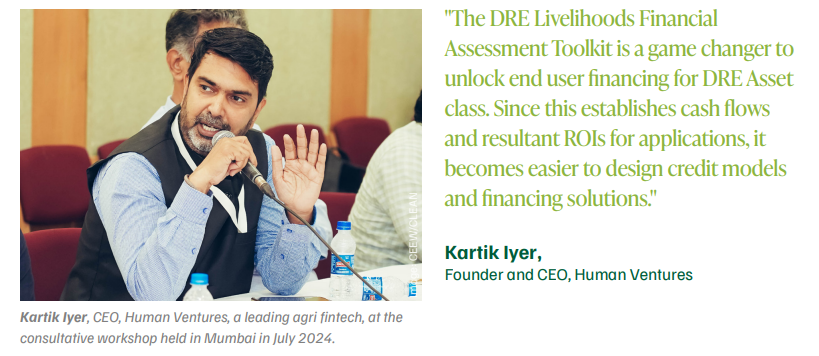
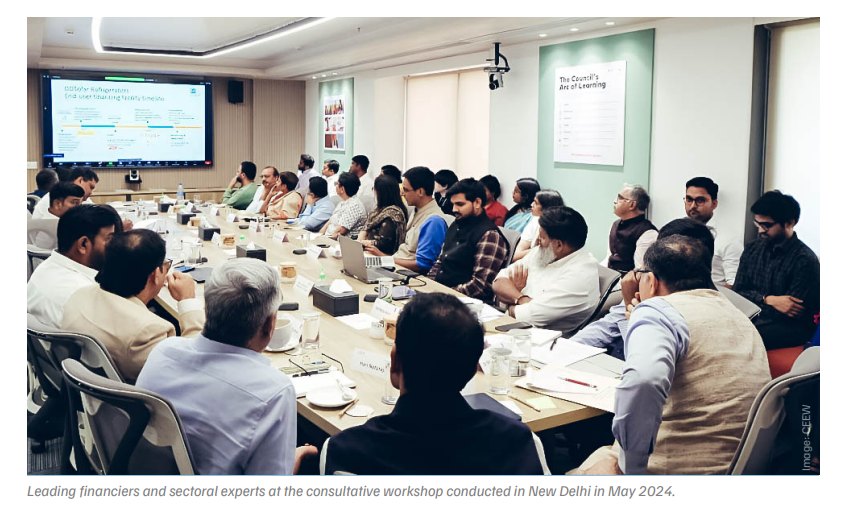
The DRE Livelihoods Financial Assessment Toolkit was developed to address this precise gap. Grounded in real data and informed through extensive consultations—including three workshops across New Delhi, Mumbai and Guwahati with over 25 financiers, technology enterprises, policymakers, social enterprises, and end users—the toolkit is a first of its kind decision-support instrument in the sector. It complements existing appraisal processes by assessing viability through systematic integration of technology and use-case specific income drivers.
In addition to crucial sectoral learnings, this report synthesises key findings and actionable insights from the DRE Livelihoods Financial Assessment Toolkit to support awareness and capacity building among financiers. It also serves as a guide for those stakeholders–including non-governmental organisations (NGOs), state rural livelihood missions (SRLMs), and social enterprises, among others–supporting end-users in business decision-making related to the adoption of DRE-powered livelihood technologies. Accordingly, the toolkit used in conjunction with the report seeks to achieve four primary objectives:
The toolkit currently focuses on five relatively mature2 DRE livelihood technologies:
At the heart of the toolkit is an income calculator that allows financiers and organisations supporting end users to project context-specific income for five DRE livelihood technologies. Instead of relying on generic assumptions, financiers and supporting organisations can assess income and loan serviceability by adjusting real-world parameters, including:
This shifts financing and business development decisions from technology skepticism to evidence-based assessment of income and repayment capacity.
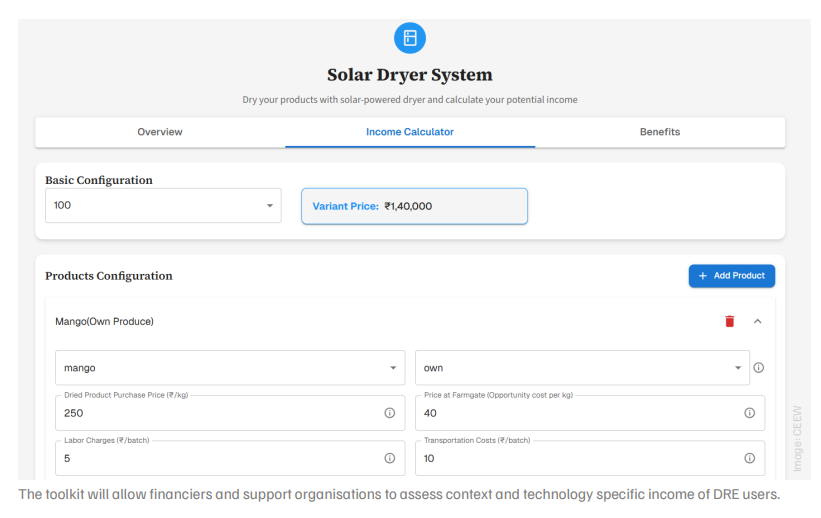
Given the nascency of the sector, financiers have limited evidence and experience to assess the economic potential of various DRE livelihood technologies. Similarly, many end users have limited awareness of how these technologies can translate into tangible economic benefits. The practical insights generated through the toolkit provide clarity on the economic potential and financial implications of financing and adopting these technologies across different use cases and user contexts. The toolkit responds to several questions commonly raised by financiers and end users, which are summarised in Table ES1.
Table ES1. The toolkit answers key questions for financiers and prospective users by highlighting quantitative, qualitative, and strategic drivers for financing and adopting DRE livelihood technologies
| Key questions asked | How the toolkit and report responds |
|---|---|
| What is the expected income generation from using a specific DRE livelihood technology in my context? | Enables end users/supporting organisations to project income based on inputs such as technology variant, scale, and local conditions. |
| How can I assess whether the generated income will be sufficient to service a loan for the technology? | Translates income projections into repayment feasibility under different scenarios. |
| Are there examples of microentrepreneurs successfully using DRE technologies? | Provides case studies illustrating how other users have leveraged affordable finance to enhance incomes and repay loans. |
| What are the key factors I need to consider before adopting a DRE livelihood technology? | Offers guidance on operational alignment (land, crops, market demand), technology-specific requirements, and qualitative factors like training, maintenance, and risk preparedness. |
Source: Authors' analysis
Undertaking a technology-wise analysis, this publicly accessible toolkit is intended for FIs and other sector stakeholders seeking data or information around income and loan serviceability assessment for various DRE livelihood solutions across different contexts. Beyond financing, the toolkit in conjunction with the report offers critical information that can be leveraged to support business planning for end users. It enables users to assess the income potential of adopting particular DRE products and to make informed business decisions. Further, they can draw insights from case studies of successful ventures supported through DRE technologies. Moreover, the report sheds light on the parameters that (i) financiers should look for in loan applications, and (ii) project promoters should focus on when assisting users in developing loan applications.
Quantitative parameters impacting the economic and financial viability of DRE livelihood technologies
Understanding the parameters that impact the economic and financing viability of DRE livelihood technologies is important for both financiers and users. This report delineates the key quantitative parameters affecting income across various DRE livelihood technologies, as summarised in Table ES2.
Table ES2. Asset utilisation and cost price structure are some of the key parameters impacting the viability of many DRE livelihood technologies
| Common parameters | Throughput (volume of raw materials processed or products stored per unit of time) Annual operational days Costs associated with raw materials and product processing/storage Prices of final products |
| Technology | Parameters |
| Solar-powered dryer | Dried matter proportion (percentage of dried produce obtained from processing fresh produce) Prices of dried products Raw material costs |
| Solar-powered micro horticulture processor | Output-to-input ratio (quantity of output processed from a given quantity of input) Prices of processed products Raw material costs |
| Solar-powered vertical fodder grow unit | Number of cattle fed Annual milking days Increase in milk yield (amount of milk produced by a dairy animal per unit of time) Milk prices Fodder tray price (for fodder-as-a-service models) Seed costs |
| Solar-powered small refrigerator | Selling prices of the refrigerated products Cost prices of the refrigerated products |
| Solar-powered cold storage system | Capacity utilisation Market arbitrage Service fee (where applicable) Opportunity costs (reflects the cost incurred by the end user in storing the produce for sale at a later date instead of selling it immediately) |
Source: Authors' analysis
These parameters include annual operational days, throughput (volume of raw materials processed or products stored), costs associated with raw materials and product storage (including packaging, labour, and transportation), and selling prices of final products, among others.
While several of these parameters are common across multiple DRE technologies, end-user income is also influenced by technology-specific factors. For instance, the economic and financial viability of solar-powered cold storage systems depends on parameters such as capacity utilisation, which indicates the percentage of the storage capacity in use to the total available capacity; market arbitrage, which reflects price differences of the products between the time of storage and sale; storage duration, which varies across various horticulture products; and service fees (for cooling-as-service models), which represent the price charged by the asset owner for providing cooling services to end users.
While quantitative analysis helps assess sufficiency of projected cash flows, qualitative considerations explain how operational realities influence those cash flows in practice. Loan evaluation for DRE livelihood technologies must, therefore extend beyond quantitative metrics determining financial viability. Qualitative considerations, such as product durability, reliable after-sales support, availability of user training, and risk-sharing through warranties or buy-back facilities, directly influence repayment reliability. We showcase field examples to demonstrate how DRE enterprises integrate such measures to reduce downtime, strengthen user confidence, and improve asset utilisation, thereby enhancing the economic viability of these technologies.
Financiers should consider:
In parallel, users must ensure that technologies are aligned with their operational realities. Assessing landholding, available crop types, end-product market demand, affordability, and profitability is essential. Equally important are access to training, reliable after-sales services, and risk preparedness, which together enable sustained usage, stronger income flows, and timely loan repayments.
Potential users should consider:
Together, these considerations explain why similar assets perform differently in practice and help identify applications where financing is more likely to succeed.
Pragmatic strategies to scale user financing for DRE livelihood technologies
While many challenges and risks associated with financing DRE livelihood technologies are similar to those encountered in lending to micro or nano enterprises, targeted strategies can significantly mitigate risk and improve access to finance.
Instruments such as buy-back arrangements, first loss default guarantees (FLDG), and PayAs-You-Go models further de-risk lending, support wider adoption, and help protect financier portfolios.
By providing essential insights and guidance derived from the toolkit to stakeholders at both ends of the financial spectrum, this report seeks to enable informed decision-making and support the integration of DRE livelihoods into India’s broader economic landscape. We also aim to engage with institutions such as the Bankers Institute of Rural Development (BIRD) and the National Institute of Bank Management (NIBM) to incorporate the tool into their curricula, thereby capacitating bankers at scale.
As a critical instrument to unlock the adoption of DRE livelihoods at scale, the successfulimplementation of the toolkit has the potential to drive inclusive growth, empower communities, and advance India’s net-zero ambitions.
Scaling Green Manufacturing in India
Assessing India’s Coal Mine Workers:

Roadmap of the methodology to assess the climate co-benefits of the SUP ban in Maharashtra