Council on Energy, Environment and Water Integrated | International | Independent

CEEW
Aishwarya Jain, Programme Associate
Akanksha Tyagi, Programme Lead
Priyanka Singh, Programme Lead
Nitin Bassi, Fellow and Team Lead, Sustainable Water
Gaurav Sahni, Senior Engagement Associate
Oxford Policy Management Europe GmbH
Soumik Biswas, Official Team Lead
Sushant Figueiredo, Circular Economy Expert
Nancy Okodoi, Sustainability Expert
Perspective Climate Group
Axel Michaelowa, Climate Change Mitigation Expert
Duska Sasa, Senior Climate Change and Environment Specialist
Ashwin Tomy, Consultant
GIZ India
Arun Poojary, Climate Change Advisor
Jasprit Kaur, Climate Change Advisor
Karpooram Pandian, Consultant
Vaibhav Rathi, Senior Advisor - Climate Change and Circular Economy & Deputy Team Lead
India’s sustainability transitions are generating measurable climate benefits in addition to their primary environmental objectives. Such climate co-benefits (CCoBs) remain largely unquantified and are therefore not integrated into planning and reporting frameworks. Systematically assessing the CCoBs is critical to strengthen transparency, inform and improve climate planning and action, and align sectoral actions with national and state climate commitments.
The project “Development of Climate Co-Benefits Methodologies for Indian Circular Economy and Forestry Programmes” is implemented in collaboration with the Ministry of Environment, Forest and Climate Change (MoEFCC), Government of India, by GIZ India, under the Indo-German Support for Climate Action in India and the IKI Interface Project (CAP) of the International Climate Initiative (IKI). The technical support to the project is provided by a consortium comprising Oxford Policy Management Ltd (OPML), the Council on Energy, Environment and Water (CEEW), and Perspectives Climate Group. The project is supported by the Tamil Nadu Green Climate Company, which serves as the nodal agency for the state of Tamil Nadu. The project aims to develop standardised methodologies to quantify co-benefits from the Single-Use Plastic (ban) under the Plastic Waste Management Rules, 2016.
The SUP ban reduces the corresponding plastic production, plastic waste, and associated emissions; decreases blockages in stormwater drains and pollution in water bodies; and creates jobs in the production of its alternatives. This roadmap for Tamil Nadu provides structured pathways to institutionalise the assessment of climate co-benefits from the SUP ban. They define actionable roles for government agencies, State Pollution Control Board, Urban Local Bodies, and private stakeholders; establish short-, medium-, and long-term mainstreaming strategies; and enable systematic capacity building and data-driven monitoring frameworks. By integrating climate co-benefit methodologies into existing state missions and regulatory frameworks, Tamil Nadu can advance evidence-based, scalable climate action that integrates environmental protection with the SUP ban.
To simplify implementation, a user-friendly web-based tool has been developed to estimate co-benefits from mitigation and adaptation from the SUP ban, with minimal data inputs. The tool offers automated calculations, built-in default values, emission factors and simple YES/NO methodological choices based on data availability. The tool is a practical application of the proposed methodologies for measuring CCoBs and is easy for stakeholders to use.
India introduced a “Single-Use Plastic (SUP) ban” under the Plastic Waste Management (PWM) Rules, 2016 and its amendments (Ministry of Environment, Forest and Climate Change MoEFCC 2018, MoEFCC 2021) at the central level, and many states are at different stages of implementing it. The PWM regulation prohibits the manufacture, import, stocking, distribution, sale and use of plastic sheet (<50u) and plastic bag (<50u) from 27th March 2018 onwards (MoEFCC 2018). The subsequent amendment banned manufacture, import, stocking, distribution, sale and use of other SUP items including ear buds with plastic sticks, plastic sticks for balloons, plastic flags, candy sticks, ice-cream sticks, polystyrene (Thermocol) for decoration; plates, cups, glasses, cutlery such as forks, spoons, knives, straw, trays, wrapping or packing films around sweet boxes, invitation cards, and cigarette packets, plastic or PVC banners less than 100 microns, stirrers from 1st July 2022 (MoEFCC 2021). The manufacture, import, stocking, distribution, sale and use of plastic carry bags (<75u) and plastic carry bags (<120u) are also prohibited from 30th September 2021 and 31st December 2022 respectively (MoEFCC 2021). Apart from the direct benefits of reducing plastic litter and lowering plastic production and consumption, the “SUP ban” has potential climate co-benefits. These include greenhouse gas mitigation co-benefits of switching from plastics to low-emission, non-plastic alternatives, and climate adaptation co-benefits such as prevention of water logging and flooding caused due to the choking of water bodies by plastics.
Climate co-benefits are benefits (mitigation or adaptation) that are generated from project/schemes/ policies that do not have a primary focus on the climate impacts. Climate mitigation co-benefit is defined as a benefit for mitigation or adaptation that are generated from project/schemes/policies that do not have a primary focus on addressing climate change.
The project “Development of climate co-benefit methodologies of Indian circular economy and forest programmes” is implemented under the overall guidance of the MoEFCC in collaboration with GIZ India, through a multi-tier governance and coordination structure. The primary objective of the project is to establish methodologies to assess the climate change mitigation and adaptation co-benefits derived from Circular Economy (CE) and forestry policies of India. The project follows a phased approach that encompasses methodology development, pilot testing, validation, and capacity building for two thematic streams: urban forestry and circular economy. Pilot activities are undertaken in selected states, specifically Maharashtra and Tamil Nadu, in partnership with respective Forest Departments and Urban Local Bodies (ULBs).
The state of Tamil Nadu has been a front runner in curbing plastic led pollution. Even before the national SUP ban, in 2019 the state had banned specific plastic products (Environment and Forests Department 2018). In an effort to encourage the use of alternatives, the state launched the flagship “Meendum Manjappai” (Back to yellow cloth bag) campaign in 2021 to revive the traditional use of cloth bags. Tamil Nadu also incentivises compliance through the “Manjappai Awards,” which recognises schools, colleges, and commercial establishments that that excel in promoting alternatives to plastic (Government of Tamil Nadu 2024). Building on its early successes, the state is uniquely positioned to quantify its efforts on implementation of the national SUP ban.
Under the context of the project, a methodology was developed to estimate the mitigation and climate adaptation co-benefits from the SUP ban that prohibits the manufacture, import, stocking, distribution, sale, and use of SUP items and promote switching to SUP substitutes that have a potentially lower environmental impact.
The primary goal of the roadmap is to embed a robust, standardised methodology for assessing climate co-benefits) within CE programmes in India, thereby ensuring accountability, transparency, and scalability of interventions in this sector. It seeks to provide a structured framework through which national schemes, state missions, and sectoral policies can institutionalise the measurement and reporting of mitigation and adaptation co-benefits. The roadmap is relevant agencies like MoEFCC and Central Pollution Control Board (CPCB) at national level and agencies like the Tamil Nadu Pollution Control Board, Tamil Nadu Green Climate Company among other state departments and urban local bodies at the state and local level, public or private sector enterprises, manufacturers and importers. Specifically, the roadmap will:
India introduced a “Single-Use Plastic (SUP) ban” under the Plastic Waste Management (PWM) Rules, 2016 and its amendments (Ministry of Environment, Forest and Climate Change MoEFCC 2018, MoEFCC 2021) at the central level, and many states are at different stages of implementing it. The PWM regulation prohibits the manufacture, import, stocking, distribution, sale and use of plastic sheet (<50u) and plastic bag (<50u) from 27th March 2018 onwards (MoEFCC 2018). The subsequent amendment banned manufacture, import, stocking, distribution, sale and use of other SUP items including ear buds with plastic sticks, plastic sticks for balloons, plastic flags, candy sticks, ice-cream sticks, polystyrene (Thermocol) for decoration; plates, cups, glasses, cutlery such as forks, spoons, knives, straw, trays, wrapping or packing films around sweet boxes, invitation cards, and cigarette packets, plastic or PVC banners less than 100 microns, stirrers from 1st July 2022 (MoEFCC 2021). The manufacture, import, stocking, distribution, sale and use of plastic carry bags (<75u) and plastic carry bags (<120u) are also prohibited from 30th September 2021 and 31st December 2022 respectively (MoEFCC 2021). Apart from the direct benefits of reducing plastic litter and lowering plastic production and consumption, the “SUP ban” has potential climate co-benefits. These include greenhouse gas mitigation co-benefits of switching from plastics to low-emission, non-plastic alternatives, and climate adaptation co-benefits such as prevention of water logging and flooding caused due to the choking of water bodies by plastics.
Climate co-benefits are benefits (mitigation or adaptation) that are generated from project/schemes/ policies that do not have a primary focus on the climate impacts. Climate mitigation co-benefit is defined as a benefit for mitigation or adaptation that are generated from project/schemes/policies that do not have a primary focus on addressing climate change.
The project “Development of climate co-benefit methodologies of Indian circular economy and forest programmes” is implemented under the overall guidance of the MoEFCC in collaboration with GIZ India, through a multi-tier governance and coordination structure. The primary objective of the project is to establish methodologies to assess the climate change mitigation and adaptation co-benefits derived from Circular Economy (CE) and forestry policies of India. The project follows a phased approach that encompasses methodology development, pilot testing, validation, and capacity building for two thematic streams: urban forestry and circular economy. Pilot activities are undertaken in selected states, specifically Maharashtra and Tamil Nadu, in partnership with respective Forest Departments and Urban Local Bodies (ULBs).
The state of Tamil Nadu has been a front runner in curbing plastic led pollution. Even before the national SUP ban, in 2019 the state had banned specific plastic products (Environment and Forests Department 2018). In an effort to encourage the use of alternatives, the state launched the flagship “Meendum Manjappai” (Back to yellow cloth bag) campaign in 2021 to revive the traditional use of cloth bags. Tamil Nadu also incentivises compliance through the “Manjappai Awards,” which recognises schools, colleges, and commercial establishments that that excel in promoting alternatives to plastic (Government of Tamil Nadu 2024). Building on its early successes, the state is uniquely positioned to quantify its efforts on implementation of the national SUP ban.
Under the context of the project, a methodology was developed to estimate the mitigation and climate adaptation co-benefits from the SUP ban that prohibits the manufacture, import, stocking, distribution, sale, and use of SUP items and promote switching to SUP substitutes that have a potentially lower environmental impact.
Objectives of the roadmap
The primary goal of the roadmap is to embed a robust, standardised methodology for assessing climate co-benefits) within CE programmes in India, thereby ensuring accountability, transparency, and scalability of interventions in this sector. It seeks to provide a structured framework through which national schemes, state missions, and sectoral policies can institutionalise the measurement and reporting of mitigation and adaptation co-benefits. The roadmap is relevant agencies like MoEFCC and Central Pollution Control Board (CPCB) at national level and agencies like the Tamil Nadu Pollution Control Board, Tamil Nadu Green Climate Company among other state departments and urban local bodies at the state and local level, public or private sector enterprises, manufacturers and importers. Specifically, the roadmap will:
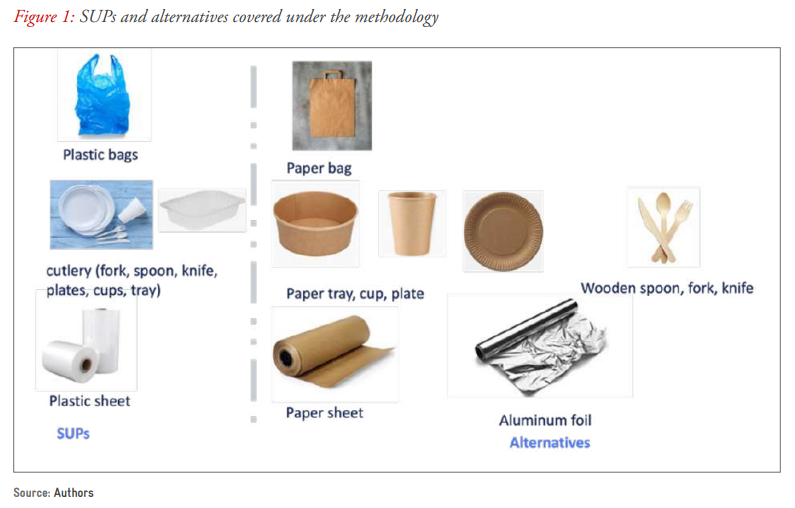
The scope of the methodology is limited to specific SUP banned by the Indian government under PWM Rules amended till date (MoEFCC 2018 and MoEFCC 2021). The entire life cycle of SUPs and its alternatives (i.e., such as extraction, refining, processing of petroleum products for producing plastic raw material, production of SUPs, production of alternative raw materials, production of alternatives, transport and end-of-life emissions) is considered for estimating the climate co-benefits. The specific SUPs and the alternatives considered in the methodology are illustrated in Figure 1. These alternatives should be comparable to SUPs in terms of quality and intended function, and like SUPs, should be designed for single use. The methodology shall not be used for calculation of carbon credits under domestic or international markets.
Climate mitigation co-benefits assessment
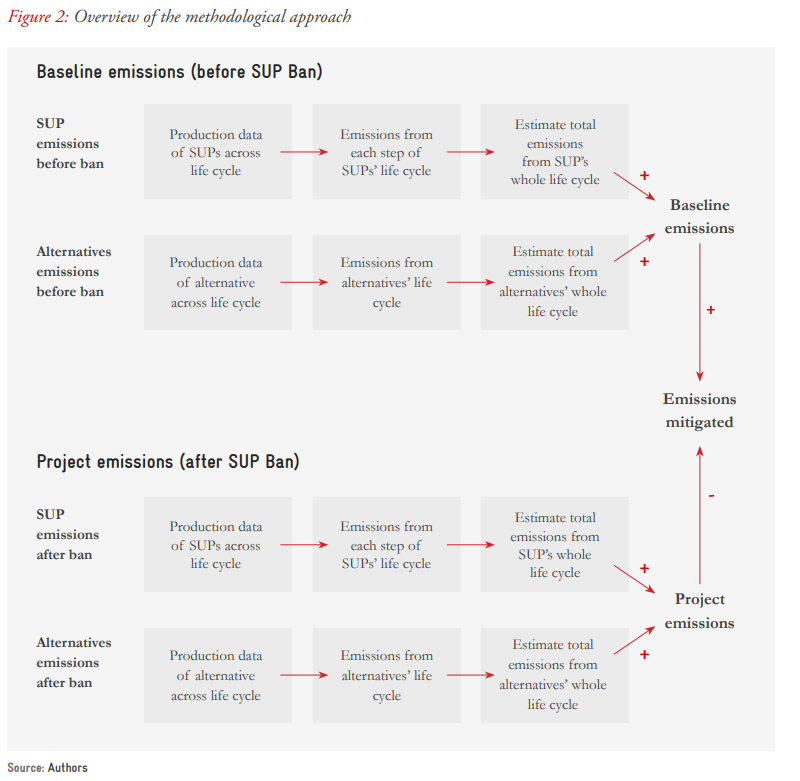
The methodology defines a baseline scenario and then an alternative scenario. Afterwards, by using the production quantity for SUPs and alternatives and their corresponding emission factors, the mitigation cobenefits can be determined. The entire process is outlined below in Figure 2
For the effective estimation of mitigation co-benefits from the transition to alternatives following the SUP ban, it is essential that certain parameters are consistently monitored and reported. Monitoring is fundamental to applying the methodology in practice and requires sufficient resources, technical capacity, and financial support. The methodology has been designed to strike a balance between obtaining accurate estimates of mitigation benefits and ensuring that monitoring remains practical and feasible for stakeholders. In this context, two categories of parameters are defined: parameters to be monitored (refer Annexure A), which involve data directly reported by manufacturers, importers, and regulatory bodies; and default parameters, which are derived from established scientific databases.
To streamline monitoring, the methodology applies a materiality threshold of 5%, meaning emission sources that collectively account for less than 5% of total estimated emissions may be excluded from calculations without affecting overall accuracy
The default factors are emission factors derived from secondary literature review, with priority first given to state specific literature, then national (Indian), regional (Asian), and finally international literature. Emission or default factors include the production of raw material, the manufacture of the product (SUP or alternative), and end-of-life for the identified SUPs and their alternatives. A tiered approach has been developed for assessing production emissions of SUPs to account for varying data availability at the ground level. The approach comprises three tiers: if the total weight of banned SUPs is available, Tier 1 emission factors are applied; if data on the weights of different polymer materials used for SUP production are available, Tier 2 emission factors are used; and if weight data for each specific banned SUP are available, Tier 3 emission factors are applied. For more details, refer to the SUP co-benefit methodology
The proposed methodology offers a flexible and robust framework for measuring climate co-benefits based on the data available on the ground. The accuracy of mitigation benefit estimations improves with the degree of data segregation and granularity. Conversely, when only limited datasets are available, the accuracy of the mitigation benefits calculated is reduced. The table below provides an overview of the various options available under this methodology. It also outlines the minimum parameters that need to be monitored and the corresponding approach to be followed for calculating climate co-benefits under each option.
Table 1 (Contd.):Overview of various options available within methodology
| Options | Parameters available/ Parameters to be monitored³ | Approach to calculate mitigation co-benefits |
|---|---|---|
| Option 1 | Segregated weight of SUP and alternatives in project and baseline scenario | Use the available parameters along with default emission factors (apply Tier 3 for SUP) to calculate mitigation co-benefits. |
| Option 2 | Segregated weight of polymer material (e.g., LDPE, PS) used to produce SUPs; and the segregated weight of alternatives in both project and baseline scenarios | Use the available parameters along with default emission factors (apply Tier 2 for SUPs) to calculate mitigation co-benefits. |
| Option 3 | Total weight of SUPs and segregated weight of alternatives in both project and baseline scenarios | Use the available parameters along with default emission factors (apply Tier 1 for SUPs) to calculate mitigation co-benefits. |
| Option 4 | Total Municipal Solid Waste (MSW) and percentage share of SUPs in MSW; segregated weight of alternatives in both project and baseline scenarios | Use the available parameters along with default emission factors to calculate mitigation co-benefits. |
| Option 5 | Total MSW for baseline and project scenarios; percentage share of SUPs in the project scenario; and segregated weight of alternatives in both scenarios | Use the available parameters, take city-specific default factor for SUP share in MSW in baseline and default emission factors to calculate mitigation co-benefits. |
| Option 6 | Segregated weight of alternatives in baseline⁴ and project scenario | Assume that the difference of alternatives in the both scenarios is the corresponding SUPs replaced due to the ban. Based on the default factors for the unit weight of each SUP and its alternative and using the default emission factor (apply Tier 3 for SUPs), the mitigation benefits are estimated |
Source: Authors
Based on the above analysis in Table 1 , it is clear that the prerequisite for applying the co-benefit methodology is that the weight of alternatives in both the baseline3 and project scenarios must be monitored. Building upon this foundation, the accuracy of the methodology can be progressively enhanced by incorporating additional parameters such as the annual MSW, the percentage share of SUPs in the MSW, and the weight of total SUPs, polymer materials, and segregated SUPs, depending on the financial resources and monitoring budget available.
Climate adaptation co-benefits assessment
Banning SUP can lead to various types of adaptation and resilience benefits such as reduced impacts from flooding, higher resilience of agricultural production due to improved soil quality, reduced impacts from lack of precipitation due to contamination of clouds by microplastics, etc. However, estimating these benefits is complex as they span a wide range of physical, social, environmental, and economic aspects across variable timescales. One approach to estimating adaptation benefits is calculating the avoided losses, which is the difference between the avoided direct and indirect damage to various systems (human, infrastructure, and nature) (EEA, 2023). This approach can also be applied to quantify the adaptation and resilience benefits of the SUP ban.
The following three parameters are identified to assess adaptation co-benefits, reflecting the increased climate resilience of urban ecosystems resulting from the SUP ban. These parameters were selected based on their direct linkage to urban resilience, data availability, and relevance to both local and national climate objectives. The methodology will compare the baseline year data and against the succeeding project year to assess the climate co-benefits.
Parameter 1: Reduced blockage in storm drains
Plastic waste scattered in the environment blocks storm drains and increases the risk of flooding. The ban’s reduction in the SUP will reduce this blockage, thereby increasing the climate resilience of urban infrastructure.
Parameter 2: Prevention of plastic from water bodies
SUP/plastic waste is disposed off in water bodies directly or indirectly. This contaminates the marine environment and its ecosystem and also enters the food chain and drinking water sources (Woods et. al). Reduction in the SUP due to the ban will prevent it from entering the water bodies.
Parameter 3: Contribution to climate resilience of vulnerable communities
The SUP ban would reduce the consumption of unnecessary and avoidable use of plastic. These can be substituted by sustainable alternatives, which would lead to employment in this sector. In this context, an assessment of employment will be undertaken along with the number of workers affected by the SUP ban to understand the sector’s adaptability.
Each parameter is linked with measurable indicators, data requirements and suggested data sources in the Annexure B, forming the basis for periodic monitoring and aggregation at city, state, and national levels.
Existing regulatory monitoring requirements and gaps
This section outlines the existing monitoring requirements and processes stipulated by government bodies for various stakeholders. To integrate the methodology within the policy framework, it is essential to first assess the existing monitoring, reporting, and verification (MRV) requirements and processes mandated by the government for SUPs. By conducting a comprehensive assessment of the current local MRV requirements and processes, a roadmap can be developed to integrate the climate co-benefit MRV requirements within the existing structures and align it with the prevailing reporting processes.
Following monitoring requirements are stated for different stakeholders from SUP producers to recyclers in PWM regulation amended till date (MoEFCC 2018, and MoEFCC 2021).
For a detailed list of data requirements under each Form (I, II, III, IV, V and VI), please refer to Annexure C.
A summary of all parameters currently being reported as per PWM regulation amended till date (MoEFCC 2018, and MoEFCC 2021), with respect to mitigation co-benefit methodology, is illustrated below in the Table 2.
| What parameter? | Who reports? | Reported to whom? | Which form is used? | Reporting frequency |
|---|---|---|---|---|
Archived data from earlier registrations, if available:
|
Plastic producer Importer, producer, and brand owner | SPCB | Form III Form I |
Once while seeking facility registration and while renewal of registration |
| Waste disposed type, and quantity, waste characterization certificate | Plastic waste recyclers and processors | SPCB | Form II | Once while seeking facility registration and while renewal of registration |
| Quantity of plastic waste received, Quantity of plastic waste used, Quantity of plastic waste processed, Quantity of plastic waste recycled, Quantity of inert or rejects sent for final disposal to landfill sites. | Plastic waste recyclers and processors | SPCB | Form IV | Annual before April 30th of each year |
| Quantity of plastic waste generated in ULB’s jurisdiction, Quantity of plastic waste collected in ULB’s jurisdiction, Quantity of plastic waste channelized for recycling, Quantity of plastic waste channelized for use, Quantity of inert or rejects sent to landfill sites. | ULB | SPCB | Form V | Annual before June 30th of each year |
| Quantity of plastic waste generated | SPCB | CPCB | Form VI | Annual before 31st July of each year |
Source: Authors
Based on Table 1 and Table 2 it is evident that there are certain gaps within the existing monitoring framework established by the PWM regulation regarding the parameters to be monitored and the frequency of monitoring. As discussed earlier, the minimum parameter that must be monitored for applying the climate co-benefit methodology is the quantity of alternatives used in both the baseline and project scenarios. Building upon this foundation, the accuracy of the estimated benefits can be enhanced by incorporating additional parameters such as the percentage share of SUPs in the annual generation of municipal solid weight, and the weight of total SUPs, polymer materials, and segregated SUPs, depending on the financial resources and monitoring budget available.
To effectively utilise the climate co-benefit methodology, it is therefore recommended that at least the annual weight of alternatives be monitored as a prerequisite for estimating climate co-benefits, while the additional parameters mentioned above is recommended to be measured progressively to enhance the accuracy and reliability of the estimations depending on the available budget and data.
Approach to develop the methodology
The methodology to assess the climate co-benefits, namely, mitigation and adaptation, was developed through a multi-stage process focused on ease of implementation while allowing for scientific rigour where needed. A comprehensive review of international and Indian studies on SUP bans was undertaken to identify the parameters and the methods with which the climate co-benefits can be assessed. This was followed by relevant stakeholder consultations, including pollution control boards, climate change cells, urban local bodies, and alternative manufacturers and plastic recyclers in Maharashtra and Tamil Nadu to gather practical insights and refine the methodology. Further, four regional workshops were also conducted with Public Sector Enterprises (PSEs) in New Delhi, Kolkata, Bangalore and Goa to evaluate the parameters, the data availability to estimate them and for training needs assessment (the “TNA workshops”). The approach also prioritised interoperability with existing waste management and climate reporting systems to ensure consistency, comparability, and scalability across regions.
Need for methodology to assess climate co-benefits of SUP ban
The methodology aims to quantify the climate co-benefits from the SUP ban. As a result, the methodology should be leveraged for targeted capacity building, equipping personnel with the technical expertise on how and what data metrics should be collected. By standardising this, the methodology can provide high quality output that directly links the SUP ban or the plastic reduction to ‘climate avoidance’. As this data collection process matures and achieves greater accuracy, the resulting outputs can be integrated into the Tamil Nadu State Action Plan on Climate Change (TNSAPCC), or any other state reporting framework.
Multiple consultations were conducted in Tamil Nadu with public and private stakeholders to discuss and refine the proposed methodology. These were followed by four regional workshops with Public Sector Enterprises (PSEs) to present the methodology, outline data requirements, explain estimation processes, and understand existing monitoring systems. The consultations offered valuable insights to simplify parameter assessment and highlighted key challenges faced by different stakeholders in implementing the methodology.
Stakeholders consulted
The following stakeholders were consulted to understand the supply chain of the banned SUP items from manufacturing to disposal, the major issues caused by them, their contribution to overall plastic manufacturing and waste generation, and the specific data availability in relation to it.
State departments such as TNPCB, Tamil Nadu Green Climate Company (TNGCC), and Micro, Small and Medium Industries Department:
They were integral in validating the methodology, selecting urban local bodies to pilot it, and collecting data from them.
Urban local bodies
Two pilot cities, Greater Chennai Corporation (GCC) and Coimbatore Municipal Corporation (CMC) were consulted to understand the current data availability and obtain sample data focused on SUP and its alternatives.
Private sector
Over 10 alternative manufacturers, recyclers and non-governmental organisations (NGOs) in Tamil Nadu were consulted to understand data availability with respect to SUP and their alternatives within the ecosystem and validate the methodology.
Public Sector Enterprises (PSEs)
Four regional training needs assessment (TNA) workshops were conducted with over 30 PSEs, including Bharat Heavy Electricals Limited (BHEL), Indian Oil Corporation Limited (IOCL), and Gas Authority of India Limited (GAIL). The workshops were to assess the capacities of the PSEs for implementing the methodology within their organisation (the “TNA workshops”). This was to understand existing data monitoring mechanisms with respect to SUP and their alternatives, since it is banned effectively within the PSE townships and institutions.
Existing challenges in assessing CCoBs and integrating the methodology
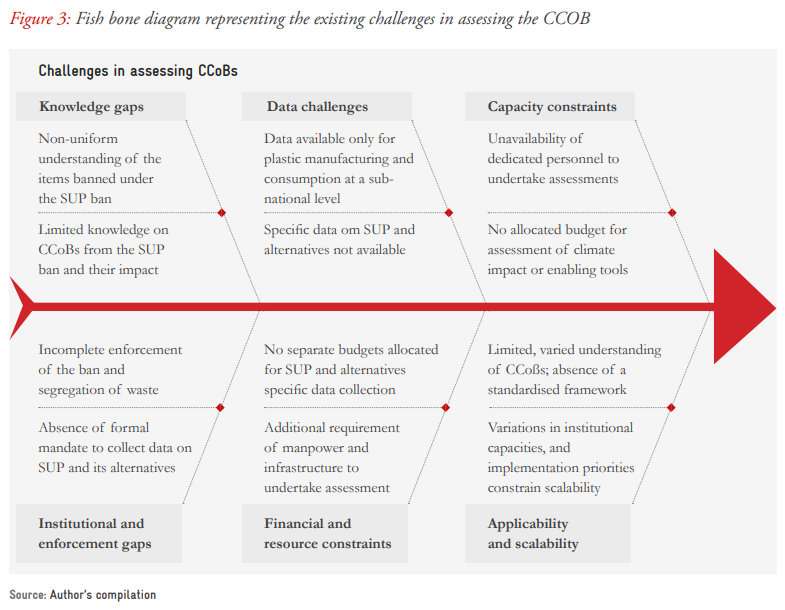
The methodology’s operationalisation will depend on addressing several systemic, institutional, and technical challenges. Based on the consultations mentioned in the earlier section, the following key barriers were identified to implement the methodology to assess climate co-benefits from the SUP ban:
Knowledge gaps: There is a non-uniform understanding of the items banned under the SUP ban. Further, there is limited knowledge on climate co-benefits from the SUP ban and their impact, particularly with respect to adaptation parameters such as increased urban resilience due to the lesser flow of SUP into stormwater drains and water bodies.
Institutional and enforcement gaps: There is an absence of formal mandate to collect data on SUP and its alternatives, through its supply chain and disposal. Additionally, implementation of the SUP ban for a few items remains a challenge at different levels.
Data challenges: Data is currently available only for plastic manufacturing and consumption at a subnational level, and its disposal in solid waste generation locally. This data is not available for SUP-banned items. Additionally, aggregated data is not available for the production and disposal of alternatives locally. In this context, baseline data on SUP and alternatives, including quantum, categories, and energy used required for the methodology, are not available.
Financial and resource constraints: The ULBs suggested that separate budgets would be required to facilitate separate SUP waste data collection from stormwater drains and water bodies through contractors, and infrastructure required, and for capacity building.
Capacity constraints: The TNA workshops6 suggested organisations often do not have dedicated staff to assess the climate co-benefits or budgets for monitoring and data analysis. Further, inadequate training and insufficient tools hinder reliable monitoring.
Applicability and scalability: Limited and varied understanding of climate co-benefits across institutions, combined with the absence of a standardised framework, particularly for assessing adaptation, restricts consistent application of the methodology. Variations in local data systems, institutional capacities, and implementation priorities across states further constrain scalability.
Opportunities for implementation and scaling
Despite existing challenges, the TNPCB and TNGCC along with GCC and CMC expressed a strong interest in adopting the methodology within their operations. Findings from the TNA workshops and consultations with GCC and CMC indicate that standardising data collection frameworks, ensuring adequate resource allocation, building staff capacity, enhancing technical skills, and establishing clear implementation procedures can enable CCoB assessment for the SUP ban at scale.
The stakeholders were willing to integrate the CCoB methodology into their existing initiatives on SUP ban and waste management, and increasing the use of alternatives to banned items, recognising its potential to improve monitoring and reporting. They also underscored the importance of institutionalising the methodology, periodic data collection and assessment. Further, in order to address the gaps in the capacities of personnel, training sessions for staff in sustainability and administrative departments focusing on methodologies for assessment are recommended. These should be in different formats, including in-person workshops, online sessions, and mentorship programmes, among others, at different frequencies depending on the requirements for continuous learning.
Additionally, linking the methodology with ongoing national digital initiatives, such as Swachh Bharat Mission dashboards and ESG disclosures of enterprises, could provide ready platforms for integration and visibility
This section of the report outlines the roadmap for integrating the proposed climate co-benefit methodology into Tamil Nadu’s state initiatives and India’s existing policy and institutional framework. Based on the assessments carried out in the earlier sections; evaluation of the current MRV framework, findings from stakeholder consultations, a Theory of Change (ToC) was developed with the goal for incorporating the methodology into existing framework.
A TOC is a comprehensive framework for planning, participation, and evaluation, which defines the logical steps needed to achieve a long-term goal (integrating methodology in this case). It involves analysing the problem statement, identifying the key barriers to change, and outlining the specific activities that need to be implemented. These activities are mapped to create a causal chain of outputs and outcomes that lead to the ultimate impact—integrating the co-benefits methodology into existing policy and decision-making processes. Based on this TOC, actionable recommendations will be provided for stakeholders at various levels—short-term, medium-term, and long-term.
Additionally, the section will also highlight the assumptions underlying the TOC, acknowledging the potential risks, uncertainties involved and propose strategies for mitigating these risks, ensuring that the integration process is both robust and adaptable to changing circumstances.
Theory of Change
As outlined earlier, the TOC provides a comprehensive framework for addressing the identified problems. TOC begins by clearly defining the problem statement and the barriers that hinder progress. The ToC will then outline the proposed interventions, followed by a mapping of the anticipated outputs, outcomes, and eventual impacts of these interventions. Additionally, the ToC will include the key performance indicators necessary for monitoring and evaluating the success of the roadmap.
Problem statement
India has launched policies aimed at promoting a circular economy, such as the single-use plastic ban. However, there is a lack of a structured framework for reporting climate co-benefits (mitigation and adaptation) achieved through such policies, resulting in missed opportunities to fully capture and report these benefits. Through the current project, a methodology has been developed to estimate the mitigation and adaptation co-benefits arising from the single-use plastic ban that needs to be integrated into the existing policy and institutional framework, complementing current MRV arrangements and roles to enable consistent reporting of climate co-benefits. Integrating it in this way would strengthen alignment across programmes and improve the usability of results for planning and disclosure. Without such integration, the potential for achieving broader, more sustainable development outcomes is being overlooked. Additionally, barriers such as a lack of coordination among stakeholders, policy gaps, data gaps, and infrastructural limitations, as well as limited understanding of proposed methodology, hinder progress. Therefore, there is a critical need for an approach or roadmap that embeds such a methodology, complementing and aligning with the existing frameworks and infrastructure. This approach should identify existing barriers to the adoption of the methodology, align it with existing frameworks, and leverage synergies from current stakeholders and resources to incorporate the proposed climate co-benefit methodology, thereby enabling effective reporting of the climate co-benefits from single-use plastic ban policy.
Barriers identified
Several critical barriers were identified in Section 3.2 at different levels during stakeholder consultations. For developing the TOC, the identified barriers are grouped as follow:
Institutional and policy barriers:
Capacity barriers
Proposed interventions (activities)
Based on the identified barriers for adopting the proposed climate co-benefit methodology, the following interventions are proposed to facilitate its successful integration. These interventions will require financial and infrastructure resources, political will, and coordination among producers, state and central governments, urban local bodies, and staff at waste disposal sites. Some interventions can be implemented in the short term, while others may require a medium or longer-term commitment, which will be outlined in a later section of the report. Please note that the list of proposed interventions is not exhaustive and can be further refined based on the local context and policy framework. These interventions are based on the general challenges and barriers identified through stakeholder consultations conducted within this project and should serve as a guiding framework.
Secure official endorsement
Obtain formal endorsement or recognition from national and state level (in the form of official notifications or orders) for the proposed methodology. This recognition is crucial for ensuring the legitimacy and smooth integration of the methodology.
Directions to producers, importers, waste collection and disposal centres
Based on the official notification, direct producers’ importers, waste collection and disposal centres provide data points annually as required by the methodology to relevant government agencies. This will help in building a robust database for monitoring and reporting climate co-benefits.
Financial and resource allocation
Investigate any opportunity to secure a dedicated budget for monitoring and reporting as per the climate co-benefits methodology within the existing SUP ban framework. Additionally, leverage synergies with complementary policies and programs such as the Swachh Bharat Mission and CE initiatives. These collaborations can help secure the necessary budget to strengthen infrastructure and ensure adequate manpower for effective monitoring, while also supporting capacity-building and training programs for staff.
Consider also leveraging public-private partnerships to support the scaling of required infrastructure and training programs. Secure financial support to address infrastructure gap, for segregating, sampling, measuring and reporting SUPs and alternatives.
Regular training and capacity building
Establish SOPs
Narrative for TOC
This section will provide a narrative on how the roadmap will work in practice and include a visual description of the TOC. Based on the barriers discussed earlier, a pathway will be outlined to explain how the proposed interventions (activities)—through their outputs and outcomes—will overcome these barriers and ultimately achieve the objective of demonstrating the broader climate benefits resulting from India’s single-use plastic ban. Additionally, the key indicators to be measured for evaluating the progress of the roadmap’s implementation will also be highlighted.
TOC for overcoming capacity barriers
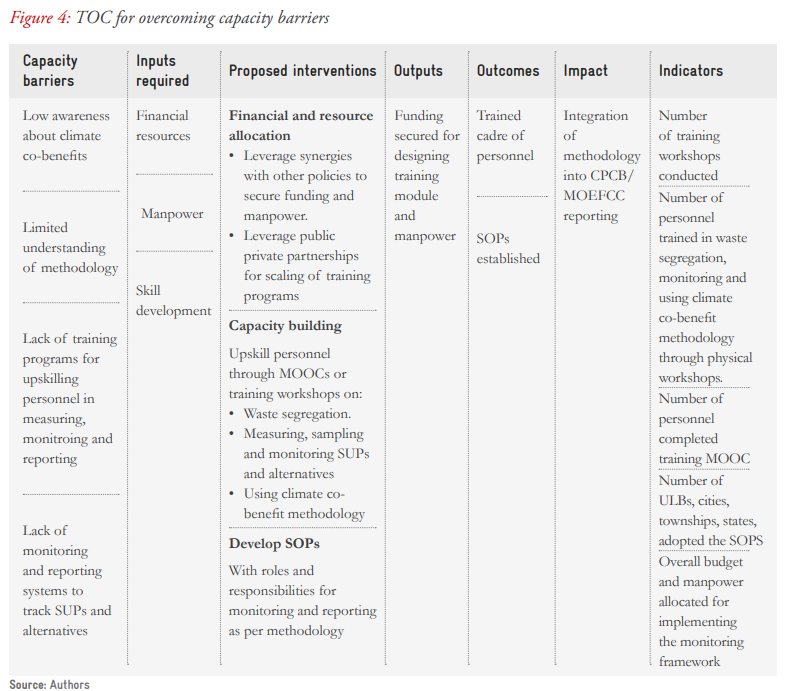
Figure 4 illustrates the TOC for overcoming the capacity barriers. The TOC starts with the identification of awareness barriers related to methodology. These include, low awareness about climate co-benefits; need for capacity building in monitoring; reporting aspects and using climate co-benefit methodology; and robust compliance with the requirement under the SUP Compliance Monitoring Module to monitor and report SUP use. To overcome these barriers, the inputs required are financial resources, manpower, and skill development. The proposed interventions are designed to feed these desired inputs so as to circumvent the barriers discussed.
Three interventions are proposed to overcome the awareness barriers. The first intervention focuses on addressing financial and resource allocation. A financial budget is required to design and conduct training programs aimed at building the capacity of personnel in waste segregation, sampling as per CPCB guidelines, and measuring, monitoring the parameters for climate co-benefit methodology. These training programs will help ensure that the expected co-benefits are properly reported. In addition to the budget, resources in terms of manpower and infrastructure are also required (discussed in subsequent TOC) to carry out monitoring, reporting, and verification according to the climate co-benefits methodology. This budget can be leveraged from state, central governments or ULBs by aligning with other policies, such as the Swachh Bharat Mission or circular economy initiatives, or by seeking funding from international donors. Further scaling of both the budget and manpower can be achieved through potential partnerships with public or private agencies (such as universities, think tanks, and public sector enterprises) in the form of Public-Private Partnerships (PPP).
The second intervention involves developing training programs, Training of Trainers (ToT), workshops, or MOOCs on waste segregation and waste sampling, in line with CPCB SOP. Additionally, capacity building should focus on measuring and monitoring the necessary parameters as per the climate co-benefits methodology. Finally, personnel should be trained on using the climate co-benefits methodology and tool/ calculator for measuring and reporting these co-benefits, utilizing the MOOC already developed within this project.
The third intervention involves the development of Standard Operating Procedures (SOPs) with clear roles and responsibilities for stakeholders, including importers, producers of alternatives and SUPs, personnel at waste collection, waste disposal, recycling centres, ULBs, MPCB, and CPCB officials. These SOPs will outline the process for data reporting, specifying what data needs to be monitored, data collection templates, who monitors the data, who reports the data, whom to report to, and frequency of monitoring and reporting. Additionally, quality assurance (QA) and quality control (QC) guidelines will be established for CPCB and MPCB officials to ensure the accuracy of the data reported. This process could be complemented by third-party checks to verify that the data reporting is indeed correct.
The immediate outputs expected from these interventions include securing the necessary budget and manpower to conduct proper monitoring and implement training programs. The long-term outcomes would involve a trained cadre of officials, from grassroots to ministry levels, skilled in waste segregation, measuring, sampling, monitoring, and reporting, and capable of using the climate co-benefits methodology. Additionally, the SOPs would be established. Building on these outcomes, the ultimate impact is that the methodology to be formally adopted and used by the Government of Maharashtra in its existing framework for reporting climate co-benefits resulting from the single-use plastic ban policy.
To effectively monitor that the envisioned TOC is implemented in practice, it is important to evaluate the progress through key performance indicators. The indicators for monitoring the progress of these proposed interventions include; overall budget and manpower allocated, the number of training workshops conducted, the number of personnel trained in various aspects of waste segregation, monitoring, reporting and using co-benefit methodology, and the number of ULBs, departments and organisations, that adopted the SOPs.
TOC for overcoming institutional and policy barriers
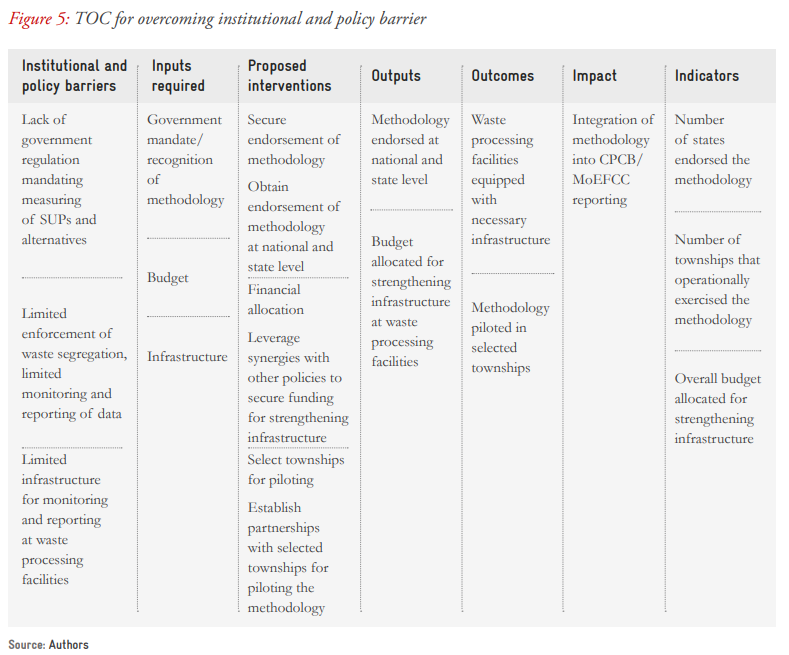
Figure 5 illustrates how institutional and policy barriers related to the adoption of climate co-benefits methodology are addressed. The TOC begins by identifying the key institutional and policy barriers. These include, lack of recognition of climate co-benefits methodology and their importance in robust monitoring and reporting of SUPs as required under the SUP Compliance Monitoring Module and their alternatives (from production to end-of-life); limited enforcement of waste segregation, and monitoring; and finally, limited infrastructure for undertaking monitoring and reporting at waste processing facilities in line with the co-benefits methodology. To overcome these barriers, the required inputs include government recognition of the climate co-benefits methodology and mandate to measure and monitor SUPs and alternatives. The proposed interventions are designed to address these barriers by ensuring the necessary inputs are in place.
Three key interventions are proposed to address institutional and policy barriers. The first focuses on obtaining official recognition of the climate co-benefit methodology to ensure wider acceptance and mandate data collection on SUPs and their alternatives across their lifecycle. As highlighted earlier, the minimum parameter to be monitored is the quantity of alternatives in both baseline and project scenarios. The methodology’s flexibility allows reporting of mitigation benefits based on available data and budget, with accuracy improving as more parameters—such as annual MSW generation, SUP share in MSW, and weights of total and segregated SUPs—are included. The second intervention emphasizes allocating budget to strengthen the infrastructure (space and equipment for waste segregation, sampling, etc) needed for effective monitoring and reporting. In addition to this, the budget will be required for manpower for conducting monitoring, and capacity building the personnel in monitoring and reporting (already highlighted in previous TOC). The third intervention involves piloting the methodology in cities. The results of these piloting exercises can then be analysed, disseminated, and promoted to encourage broader adoption across the state.
The immediate outputs expected from these interventions include the methodology being endorsed at national and state level, and the methodology operationally piloted in cities. The long-term outcome would involve the allocation of budget for the required infrastructure needed for the monitoring and reporting framework (budget for capacity building covered in previous TOC). The main outcome would include a larger uptake among cities, and other states. Building on the latter, the ultimate impact would be the formal adoption and usage of the methodology by the Government of Maharashtra as part of their existing framework for reporting climate co-benefits resulting from the single-use plastic ban policy.
To ensure effective monitoring and implementation of the envisioned TOC, it is important to evaluate progress through KPIs. The indicators for monitoring the progress of these proposed interventions include the overall budget allocated for strengthening infrastructure, and the number of cities and states that have endorsed the climate co-benefits methodology.
Assumptions
Risks and mitigation strategies
At the same time, there are certain risks that could hinder the successful integration of methodology into the existing monitoring framework. Identifying and addressing these risks is essential for the successful execution of the initiative. The table below outlines the key assumptions, risks, the corresponding mitigation strategies and responsible stakeholders. The following risks have been identified in Table 3, along with their corresponding mitigation strategies to ensure the methodology’s effective implementation:
| Potential Risks | Level of Risk | Mitigation strategies | Responsible Stakeholders |
|---|---|---|---|
| Low enforcement of the SUP ban As observed during stakeholder consultations, for a few items SUP ban is not completely enforced. |
Medium | Promote stronger coordination between government agencies, local authorities (ULBs), NGOs, and communities to increase awareness of banned SUPs and ensure stronger compliance. | ULBs, TNPCB, CPCB, MoEFCC |
| Low enforcement of waste segregation Complete enforcement of waste segregation in wet and dry waste is required. For effective implementation of the climate co-benefit methodology, it is essential that alternatives are at least segregated and measured in both the baseline and project scenarios. Where budgets allow, higher accuracy in estimating mitigation benefits can be achieved by monitoring annual MSW generation and the percentage share of SUPs in MSW. Additionally, personnel on ground may not be fully aware of alternatives and banned SUPs, making identification difficult. |
Medium | To address this, sufficient budget, manpower, and equipment for waste segregation, sampling, and weighing must be provided. In addition to strengthening the enforcement of waste segregation, efforts should also focus on raising awareness about the banned SUPs, and benefits of the using the methodology to ensure its effective implementation. | Training institutes, CPCB, MoEFCC, TNPCB, ULBs (particularly the Solid Waste and Storm Water Drain Departments), Personnel at waste collection, processing facilities |
| Lack of accurate data Due to the above reasons there is limited availability of accurate data |
High | Enforce waste segregation and SUP ban regionally. Implementing the methodology using the standardised sampling strategies. | Implementing agencies such as ULBs (particularly the Solid Waste and Storm Water Drain Departments), contractors, and Smart City Mission SPVs |
| Lack of recognition for the methodology by state and national government and PSEs Official recognition of the methodology at national level and by government of Tamil Nadu. |
High | Engaging stakeholders at both the national and regional levels will be essential to promote the methodology’s benefits and demonstrate its necessity for effective implementation. | MoEFCC, CPCB, TNPCB |
| Limited capacity building and coordination between agencies Limited technical capacity among staff and lack of coordination between relevant departments could affect the proper implementation and interpretation of the methodology. |
High | Integrate standardised curricula and formats with technical handholding via trainers and MOOC, ensuring it goes beyond box-ticking, with periodic evaluations of its effectiveness. Further, designate an agency responsible for spearheading the assessment with support from other departments. |
Implementing agencies such as ULBs, TNPCB Technical institutes and universities |
| Lack of a dedicated budget for monitoring and reporting from government funds: Securing a dedicated budget for the monitoring and reporting framework aligned with the methodology is critical to its successful implementation. |
Medium | Efforts should be to investigate existing funding sources within SUP ban and other CE schemes, alongside exploring potential funding from international donors and public-private partnerships for piloting methodology in townships. | MoEFCC, Ministry of Finance, CPCB, international donors |
Source: Authors' compilation
By proactively addressing these risks and implementing appropriate mitigation strategies, the adoption and effectiveness of the methodology can be significantly enhanced.
An ecosystem approach is necessary to implement the CCoB methodology effectively and at scale. Stakeholders from public and private sectors, along with community and research-based organisations have diverse roles to play for long-term assessment and sustainable impact of the methodology.
| Stakeholder | Role | Potential Organisations |
|---|---|---|
| Central and state agencies (policymakers) |
|
Ministry of Environment, Forest and Climate Change (MoEFCC), Ministry of Housing and Urban Affairs (MoHUA), Central Pollution Control Board, Department of Environment and Climate Change, TNGCC, TNPCB, etc.. |
| Implementing government bodies |
|
ULBs, particularly the Solid Waste and Storm Water Drain Departments, Smart City SPV, TNPCB, TNGCC, MSMEs and Department of Industries and Commerce, etc. |
| Private organisations |
|
Corporate and Public Sector Enterprises (PSEs) engaged in manufacturing alternatives and taking initiatives such as SUP ban and use of alternatives. |
| Civil Society Organisations (CSOs) or NGOs |
|
Regional water bodies-cleaning foundations such as Bay of Life Foundation, plastic waste management organisations such as Hand in Hand India |
| Technical and research institutions |
|
National Institute of Urban Affairs (NIUA), institutes on climate change, universities, etc. such as Anna University |
| Donors and development partners |
|
Multilateral and bilateral agencies such as the World Bank, GIZ, UNDP, and philanthropic foundations etc. |
Source: Authors' compilation
Interventions by stakeholders (Action Pathways)
| Stakeholder | Short-term (0–2 years) | Medium-term (2–5 years) | Long-term (5+ years) |
|---|---|---|---|
| Central and state agencies (policymakers) |
|
|
|
| Implementing government bodies |
|
|
|
| Private organisations, CSOs or NGOs |
|
|
|
| Technical and research institutions |
|
|
|
| Donors and development partners |
|
|
|
Source: Authors' compilation
Conclusion and way forward
The successful implementation of the climate co-benefits assessment methodology will depend on a shared commitment from all stakeholders to institutionalise a consistent and transparent process in Tamil Nadu The roadmap outlines a clear approach supported by actionable steps, identifies key challenges, and defines roles to ensure accountability and coordination. The methodology can evolve from a pilot exercise into a robust state and national framework by addressing the highlighted risks through targeted capacity building, data harmonisation, and continuous evaluation. Embedding CCoB assessments into decision-making will not only strengthen evidence-based climate action and Tamil Nadu’s reporting on climate but also enhance India’s leadership in integrating environmental and developmental goals. In the long term, scaling this framework across sectors beyond plastics—such as waste management, circular economy, and sustainable production—can establish a unified approach to assessing climate co-benefits across India’s environmental programmes.
Climate co-benefits refer to the mitigation or adaptation benefits generated by projects, schemes, or policies whose primary objective may not be to address climate change. These co-benefits can emerge in two broad ways. First, they may result from a climate-focused action that targets one dimension of climate action—mitigation or adaptation—and also generates positive impacts on the other. For example, a mitigation project aimed at reducing greenhouse gas emissions may also enhance climate resilience, thereby creating adaptation co-benefits, and vice versa. Second, climate co-benefits can arise from non-climate-oriented actions, where programmes designed to achieve objectives such as improving resource efficiency, enhancing agricultural productivity, promoting water security, or generating employment inadvertently contribute to climate mitigation or adaptation outcomes. In both cases, climate co-benefits represent the additional climate value created beyond the primary intent of the intervention.
The roadmap provides a phased strategy to institutionalise the Climate Co-benefits (CCoB) assessment methodology from the SUP ban under the Plastic Waste Management Rules, 2016, ensuring systematic measurement, reporting, and integration into planning processes.
The SUP ban methodology assesses both climate mitigation and adaptation impacts across multiple parameters. It estimates net emission reduction due to the SUP ban implementation from reduced lifecycle emissions associated with the extraction of its raw materials, production, and disposal, while also considering the additional emissions generated from production and disposal of its sustainable alternatives. The methodology further quantifies adaptation co-benefits, including the reduction of blockages in stormwater drains, since SUPs constitute a significant share of plastic waste that clogs drainage systems, causing urban flooding. Similarly, it accounts for the prevention of SUP entering into water bodies, given that plastic marine litter is responsible for 92 per cent of entanglement and ingestion cases, and decreases marine ecosystem resilience to climate change. Additionally, the methodology captures employment generation in the sector of sustainable alternatives to the banned SUPs, as the shift creates new livelihood opportunities that can enhance the climate resilience of vulnerable communities.
Organic Waste Circular Economy for Viksit Bharat
How Can India Tackle Air Pollution with an Airshed-level Approach?
Roadmap of the methodology to assess the climate co-benefits of the SUP ban in Maharashtra
How Construction Activities Affect Urban Air Pollution:
Monitoring Crop Residue Burning Better: