Council on Energy, Environment and Water Integrated | International | Independent


Suggested citation: Ignatious Sneha, Rishikesh P, Mohammad Rafiuddin. 2025. Monitoring Crop Residue Burning Better: Moving Beyond Fire Counts. New Delhi: Council on Energy, Environment and Water.
Crop Residue Burning (CRB) is a major contributor to air pollution in the Indo-Gangetic Plain (IGP) region during winter months, particularly in October and November. Satellite-based active fire counts and burnt area are two widely used remote sensing metrics to monitor CRB. However, these methods have some limitations. Coarser spatial and temporal resolutions, as well as obstructions due to smoke and clouds, result in data loss. Moreover, these methods do not differentiate between partial burning and complete burning incidents. These limitations lead to an underestimation of CRB. An accurate estimation of CRB helps evaluate the effectiveness of its mitigation policies. Moreover, it helps in the creation of accurate emission estimates that are fed into air quality models such as Delhi’s Air Quality Early Warning System (AQEWS). Therefore, it is important to assess the effectiveness of the remote sensing methods in detecting CRB incidents and their ability to differentiate between partially and completely burnt fields.
The study analysed the effectiveness of two remote sensing-based methods - active fire counts and burnt area - in monitoring CRB. It analysed the effectiveness of satellite-borne sensors such as the VIIRS and MODIS in detecting CRB incidents. A burnt area algorithm combining two burnt area indices - Burnt Area Index for Sentinel-2 and Tasseled Cap Brightness Index (TBI) was developed to assess its ability to detect burnt fields. The study also explored the ability of this burnt area algorithm to differentiate between partially burnt and completely burnt fields.
Crop residue burning (CRB) is a global concern with far-reaching environmental and public health implications. It releases greenhouse gases (GHGs), damages soil, causes air pollution, and places a significant burden on both the environment and human health (Ali et al. 2024). Despite these harmful effects, CRB remains a common method for clearing fields due to factors such as practicality, tradition, and perceptions regarding pest control. It is prevalent across countries such as Mexico, the United States, Brazil, China, and India (World Bank n.d.).
India generates around 754 million tonnes of crop residue annually, of which 228 million tonnes are surplus (MNRE n.d.). Punjab alone produces about 20 million tonnes of crop residue annually from paddy cultivation (PIB 2023b). Paddy is the leading kharif crop in Punjab, sown on around 30 lakh hectares, accounting for nearly 60 per cent of the state’s area. Farmers manage the straw generated after paddy harvest in three ways: in-situ management, ex-situ management, and burning. In-situ methods involve incorporating the straw back into the soil using machines such as the Happy Seeder and Super Seeder (Erbaugh et al. 2024). Ex-situ methods manage straw outside the fields, converting it into value-added products (ICAR 2021).
However, due to the challenges associated with these methods—such as financial constraints, limited availability of machinery, and misconceptions about the productivity impacts of residue management methods—a large share of farmers continue to practice burning. It offers the cheapest and quickest way of clearing stubble within the short window between harvest and rabi crop sowing (Erbaugh et al. 2024). This practice remains a significant contributor to air pollution in the Indo-Gangetic Plain (IGP) region, particularly during the months of October and November (Jethva et al. 2019; Lin and Begho 2022). For example, CRB contributes up to 35 per cent of PM2.5 in Delhi during the peak burning period (Govardhan et al. 2023).
Farmers burn stubble in two ways–completely or partially (Gupta 2010). In complete burning, the entire leftover straw is set on fire, whereas in partial burning, only the loose straw left after running the harvester is burnt (Kumar et al. 2015; Gupta 2010; Kemanth et al. 2024). A 2022 study found that about 58 per cent of Punjab’s farmers practised in-situ methods, but more than half of them also practised partial burning before using machines to clear their fields (Kemanth et al. 2024).
To curb CRB, the Punjab state government banned the practice in 2013 (NGT 2023). The National Green Tribunal (NGT) also prohibited it in 2015 (PIB 2019). The Union government has also introduced various schemes and issued directives to promote the use of crop residue management (CRM) machines and ex-situ management.
Crop residue burning tracking uses satellite data or on-ground observations, with satellites offering a faster and more practical option. Satellite-borne instruments such as the Visible Infrared Imaging Radiometer Suite (VIIRS) and the Moderate Resolution Imaging Spectroradiometer (MODIS) detect active fire incidents. Burnt area measurement using satellite imagery from Sentinel-2, Landsat, and other sources, or derived from MODIS and VIIRS observations, is another monitoring method. Deploying personnel on the ground and recording CRB incidents manually is labour-intensive.
Remote sensing–based methods have limitations like coarse spatial and temporal resolution, inability to see through fog, smoke, clouds, etc. Moreover, farm characteristics can change rapidly, and if the satellites pass after they change, the sensors may fail to record burning. More importantly, fire count and burnt-area methods capture the extent of CRB to a limited degree–they do not reveal whether the detected fields are burnt partially or completely.
In India, the Indian Space Research Organisation (ISRO) monitors CRB. It uses fire-count data from the VIIRS onboard the Suomi National PolarOrbiting Partnership (SUOMI NPP) and the MODIS onboard the Aqua and Terra satellites (CAQM 2021a). The National Remote Sensing Centre (NRSC) of the ISRO computes burnt area using the Mid-Infrared Burn Index (MIRBI) and publishes bulletins (NRSC-ISRO 2022). However, these burnt area data are not publicly available.
According to official fire-count data, Punjab recorded around 10,000 active fire incidents in the 2024 kharif season (CREAMS n.d.). This is the lowest since 2018, when fire counts in the state exceeded 55,000 (Kurinji and Prakash 2021). However, experts dispute these figures, arguing that farmers burn stubble after the satellite has passed overhead (NASA 2025; Misra et al. 2025). Taking cognisance of these concerns, the Supreme Court (SC) instructed the Union government and the Commission for Air Quality Management in National Capital Region and Adjoining Areas (CAQM) to obtain data from additional satellites such as the Geostationary Korea Multi-Purpose Satellite-2A (GEO-KOMPSAT-2A). Additionally, the CAQM ordered intensified patrolling during the late evening hours to monitor incidents of bypassing satellites (CAQM 2025).
This results in an inaccurate estimation of the extent of CRB. This, in turn, leads to lower emission estimates and inaccuracies in air-quality models that rely on these emission estimates for inputs. Uncertainties in both fire counts and burnt-area estimates also lead to uncertainties in understanding the effectiveness of CRB mitigation policies.
In this study, we evaluate the following questions:
We used very-high-resolution satellite imagery from the archived images available on Google Earth Pro from Maxar as the ground truth data. Of all the archived images available on Google Earth Pro between 2019 and 2025, we could only identify a region in Sangrur district, where the images were available for two consecutive days. We counted the number of fields burnt from the images and compared it with those detected by VIIRS and MODIS.
We used an algorithm that combines two indices, the Burnt Area Index for Sentinel-2 (BAIS2) and the Tasseled Cap Brightness Index (TBI), to compute burnt area from openly available Sentinel-2 imagery. We used the very-high-resolution imagery from Maxar across multiple regions in Punjab as the ground truth data to compute the accuracy of our burnt area algorithm. We propose first-of-their-kind methods to differentiate between partially and completely burnt fields. They rely on the hypotheses that either a threshold exists to differentiate between the two types of fields reliably or the number of pixels detected in a partially burnt field is lower than that in a completely burnt field.
While the algorithm performs well in accurately detecting burnt fields and pixels, our study has certain limitations. Missing data due to the fiveday revisit time of Sentinel-2, loss of data due to clouds and smoke, the exclusion of fields managed through in-situ methods under unburnt fields, misclassification of irrigated fields as burnt fields, and the inability to differentiate between partially and completely burnt fields, even at a very high resolution, are the limitations of this study.
Our analysis of very-high-resolution satellite imagery from two consecutive days, obtained for a selected region of 74 sq km, shows that the satellite-borne fire-counting sensors detect only a portion of the fires observed in the imagery. We identified 169 burnt fields over the selected region over two days. However, the sensors could detect only seven fire incidents on these days.
Our analysis of an alternative method for monitoring CRB, including the computation of burnt area, shows that the burnt area indices BAIS2 and TBI can differentiate between burnt and unburnt fields. We observed that a combination of BAIS2 and TBI performs well with the fewest false positives. It could detect the burnt pixels with an accuracy of 75 per cent. After testing two methods to separate partially and completely burnt fields, we conclude that it is challenging to differentiate between them. Based on our learnings from the study, we recommend the following:
Crop residue burning (CRB) is a global concern with far-reaching environmental and health impacts. It exacerbates soil erosion (Lin and Begho 2022) and reduces soil fertility by removing essential nutrients and microorganisms. It also impairs crop health (Abdurrahman et al. 2020). CRB releases harmful pollutants, such as carbon dioxide (CO2), carbon monoxide (CO), and particulate matter (PM), into the atmosphere (Pinakana et al. 2024), which impact public health adversely (TERI 2021).
Globally, farmers burn an estimated 450 million tonnes of crop residue each year (CCAC 2023). The United States ranks third in greenhouse gas (GHG) emissions from crop residues (Pinakana et al. 2024). Brazil burns about 3.2 million tonnes of rice straw annually (G. Singh et al. 2021). In Indonesia, approximately 45 million tonnes of crop residue are burnt annually (Andini et al. 2018), whereas 100 million tonnes are burnt in China (Li et al. 2022).
According to the Sardar Swaran Singh National Institute of Bio-Energy, India generates around 754 million tonnes of crop residue annually–of which 228 million tonnes is surplus (MNRE n.d.)–mainly from crops such as rice, wheat, and sugarcane. India is the second-largest riceproducing country in the world (USDA 2025), and Punjab is the fourth-largest rice-producing state in the country (UPAg, DoAFW n.d.). Farmers in Punjab predominantly follow a two-crop cycle, growing wheat during the rabi season (November–April) and paddy during the kharif season (May–October) (Kingra et al. 2017). Paddy cultivation spans approximately 31 lakh hectares (3.1 million hectares) in Punjab, yielding around 20 million tonnes of paddy straw annually (NGT 2024).
Crop residue management (CRM) methods encompass both in-situ and ex-situ approaches. In in-situ management, the stubble is incorporated back into the soil using machines such as the Super Seeder and Happy Seeder (Dhaliwal n.d.; Singh et al. 2024). In ex-situ management, the stubble gets transported off the farm and finds use in facilities such as compressed biogas (CBG) plants and thermal power plants to generate value-added products, including biogas and electricity (ICAR 2021). However, a significant proportion of farmers continue to burn straw in the field (PIB 2024). Misconceptions associated with reduced productivity from CRM machines, fears of pest attacks, the short 20–25 day window between the harvest and sowing of the rabi crop, and the higher operating costs of CRM machinery contribute to this practice (ICAR 2021; Kemanth et al. 2024). This practice of burning is a leading contributor to the increased levels of air pollution in the Indo-Gangetic Plain (IGP) region during the winter months. For instance, CRB contributes up to 30–35 per cent of Delhi’s PM2.5 during peak burning period (Govardhan et al. 2023).
To curb CRB, the central and state governments have introduced a range of schemes and measures. A brief chronology of the measures is as follows:
Despite these efforts, Punjab recorded around 10,000 active fire incidents in 2024 (ICAR 2024). The actual number may be significantly higher, as many farmers may have started to burn stubble after the satellites pass (NASA 2025; Misra et al. 2025). Recent studies claim an increase in the adoption of in-situ machinery to manage fields, with approximately 58 per cent of farmers in Punjab adopting it in 2022. However, nearly half of them also practised partial burning before using the CRM machines (Kemanth et al. 2024). In the case of partial burning, only the loose straw left behind on the field after running the harvester is burnt; however, in the case of complete burning, all post-harvest straw is set on fire (Kumar et al. 2015; Gupta 2010; Kemanth et al. 2024).
Authorities deploy field officers and utilise two remote sensing–based metrics–active fire counts and burnt area–to monitor CRB incidents (Hindustan Times 2023). Deploying personnel on the ground and manually recording burnt fields is labour-intensive. Therefore, remote sensing methods are highly feasible. The two metrics are as follows:
Several uncertainties are associated with remote-sensing methods:
These limitations result in an underestimation or overestimation of CRB. This, in turn, has significant consequences:
The CAQM monitors CRB incidents using a protocol developed by ISRO (CAQM 2021b). However, as discussed earlier, farmers may have started to burn after satellite overpasses to avoid detection. Therefore, it is crucial to understand the extent to which satellite-borne sensors detect active fires and whether burnt area can complement or substitute for fire counts in monitoring CRB. It is also equally important to determine whether burnt area–based methods can capture partially burnt fields and differentiate them from completely burnt fields.
Through this study, we aim to:
Our analysis focuses on Punjab during the post-kharif harvest period, when farmers typically burn paddy residue.
We used openly available VIIRS data and very-high-resolution satellite imagery to assess the extent to which CRB incidents get captured by satellite-borne sensors. Alongside, we also used Sentinel-2 multispectral imagery to develop an algorithm based on spectral indices to estimate the burnt area.
We obtained fire-count data from the VIIRS instrument onboard the SUOMI NPP satellite and the MODIS instrument onboard the Aqua and Terra satellites. To identify burnt and unburnt fields for training and validating the algorithm, we relied on openly available very-high-resolution archived imagery from Maxar Technologies available on Google Earth Pro. We applied our algorithm to band data from the multispectral sensor onboard the Sentinel-2 satellites (NASA n.d.b).
Assessing the ability of satellite-borne sensors to capture crop residue burning incidents
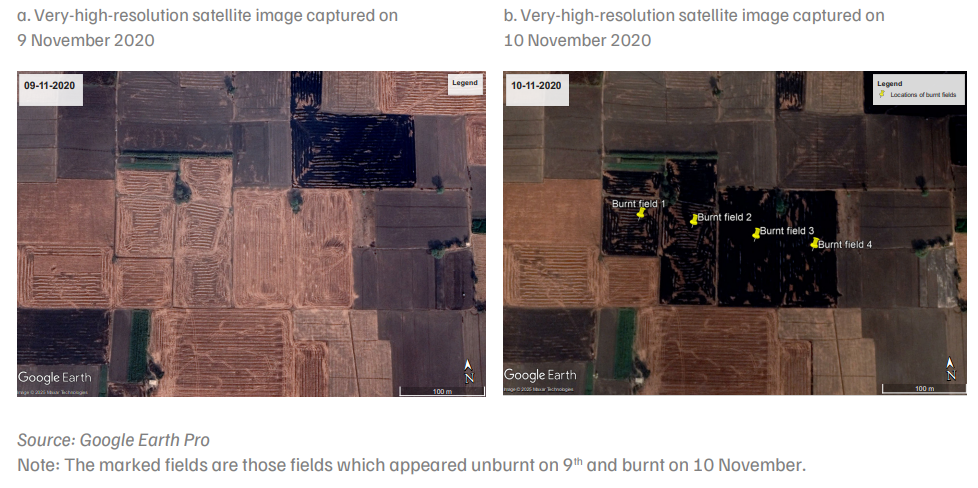
We identified a region of approximately 74 sq km in Sangrur where Google Earth Pro images were available for two consecutive days–9 and 10 November 2020. Images from the two successive days helped us identify the fields that were initially unburnt but were burnt on either of the two days. If a field that appeared unburnt appears black on the second day’s image, it implies that the field was set on fire during the interval between the image acquisition times. Among archived images available on Google Earth Pro between 2019 and 2025, we could only identify this region in Sangrur with such consecutive-day coverage.
We then visually identified the fields that were unburnt on the first day and burnt on the second day. We considered a field burnt if it appeared black or grey in the image on the second day but not on the first. An unburnt field appears golden-yellow or green in the images. Figure 1 illustrates fields from both dates over a subset of the study region, along with the fields we identify as burnt. We also obtained the locations and fire counts detected by the VIIRS instrument (at all confidence levels) over the selected region. The MODIS instruments did not capture any active fire incidents over this region on these two days. We then compared the number and locations of burnt fields identified through imagery with the active fires detected by VIIRS.
Figure 1. Very-high-resolution satellite imagery obtained for two consecutive days help identify fields burnt on each day
Algorithm
Our algorithm involved applying burnt area indices to Sentinel-2 imagery to distinguish between burnt and unburnt fields. We focused on two indices–BAIS2 and TBI–and applied them to the Sentinel-2 band data to assess their ability to detect burnt fields and differentiate between completely and partially burnt fields. While BAIS2 is an ash and charcoal sensitive index which uses spectral characteristics of the red edge and short wave infrared bands of Sentinel-2, TBI is a brightness index which measures the brightness of a surface. Deshpande et al. assessed the separability index to evaluate how well different burnt area indices differentiated burnt and unburnt pixels. The study found that the separability index of BAIS2 and TBI is higher than that of indices such as MIRBI, Normalised Burn Ratio (NBR), etc (Deshpande et al 2022).
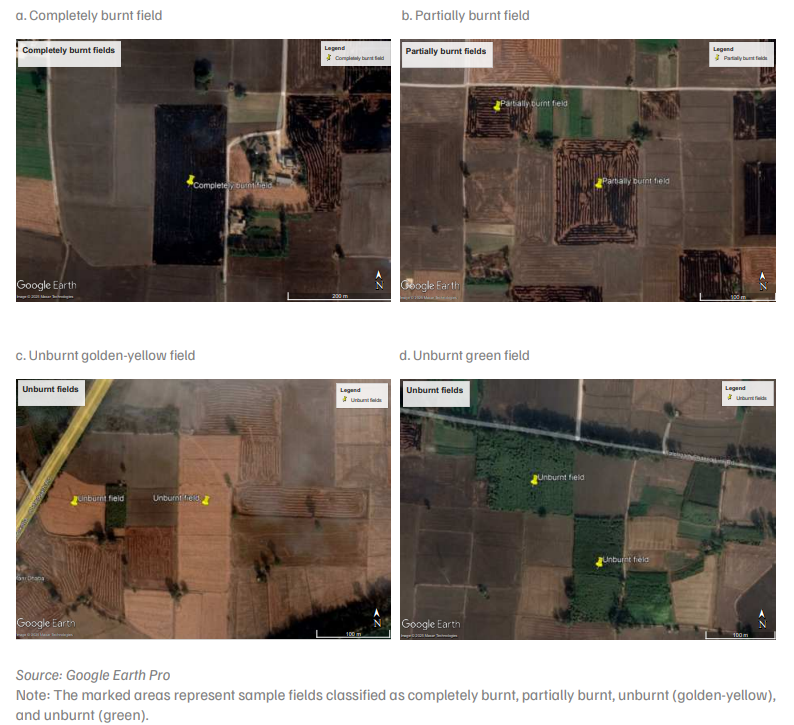
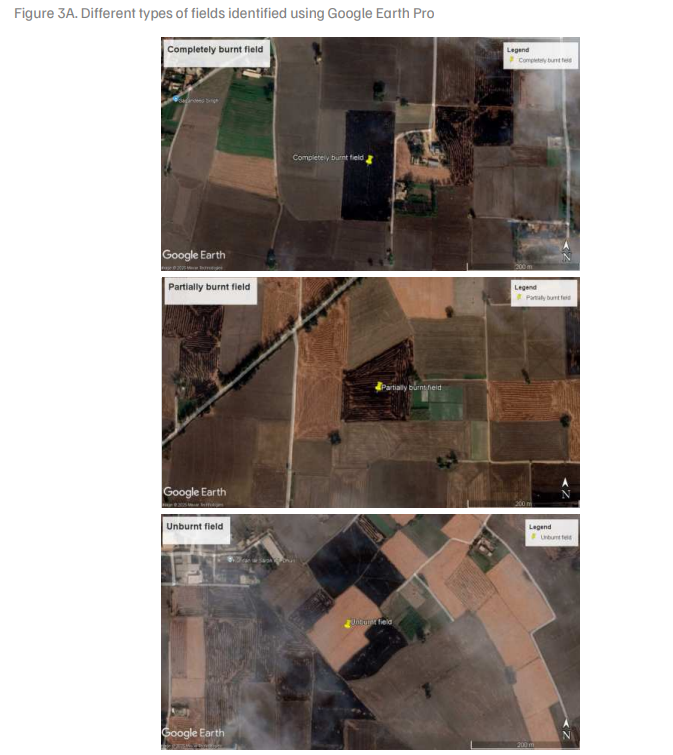
We obtained very-high-resolution satellite imagery from Google Earth Pro for dates where Sentinel-2 data are also available. We could only identify four such dates between 2019 and 2025 in Punjab during the peak burning season (between 15 October and 30 November). For the training dataset, we identified a ~220-sq km region in Sangrur where very-high-resolution imagery from Google Earth Pro and Sentinel-2 multispectral satellite imagery were available on the same date (10 November 2020). Using this imagery, we visually classified fields as partially burnt, completely burnt, and unburnt. A completely burnt field appears entirely black in the images. However, a partially burnt field appears black, interspersed with regularly spaced goldenyellow patches along its length, corresponding to the unburnt residue that is later incorporated into the soil using CRM machines. We mark two types of fields as unburnt: the ones that appear golden-yellow and those that appear green. We excluded in-situ managed fields from the unburnt category, as these were challenging to identify reliably from satellite imagery. Figure 2 illustrates the different field types.
Figure 2. In very-high-resolution satellite imagery, a completely burnt field appears entirely black, while a partially burnt field shows black areas interspersed with regularly spaced golden-yellow patches
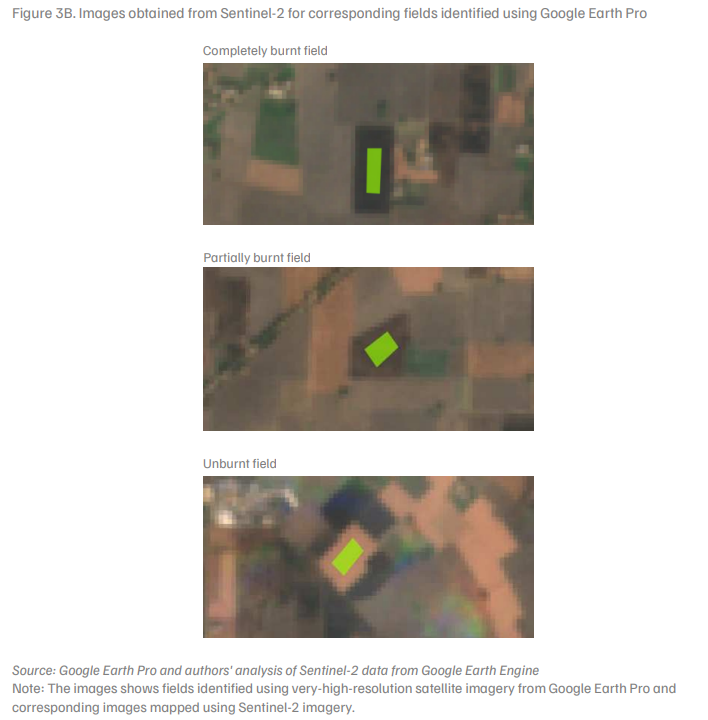
We then mapped these fields onto Sentinel-2 imagery using Google Earth Engine (GEE). We extracted the pixels from within these fields by drawing polygons within corresponding field boundaries using the Polygon drawing tool (or ‘Draw a shape’) available on GEE. We avoided the pixels along the edge of the field boundaries to prevent the inclusion of pixels from neighbouring fields. Figure 3 illustrates the sample polygons that we drew on GEE to extract the pixels. We then applied BAIS2 and TBI to the Sentinel-2 band data for these pixels. Annexure 1 explains the formula behind these indices and the spectral bands used to compute them.
Figure 3. Burnt area indices were computed from Sentinel-2 pixels for fields mapped using very-high-resolution imagery
Thereafter, we analysed the histograms of BAIS2 and TBI for pixels from unburnt, partially burnt, and completely burnt fields to identify the thresholds that could potentially separate these categories. We tested the performance of BAIS2 and TBI separately as well as together. For this, we analysed the histograms of burnt and unburnt field pixels as discussed in Deshpande et al. (2022) and set the thresholds based on percentiles. Deshpande et al. (2022) set the 5th and 95th percentiles of the indices as the lower and upper thresholds to avoid overlapping pixels and outliers. However, we did not cap the index values at both ends. The theoretical minimum value of TBI is zero (Annexure 1), corresponding to a perfectly black field. The BAIS2 value of burnt scar ranges between −1 and 1, and it is between 1 and 6 for active fires (Alcaras et al. 2022). Therefore, a cap on the BAIS2 values might cause the algorithm to miss fields that are actively burning. Hence, we did not cap the maximum value of BAIS2 or the minimum value of TBI.
Setting the thresholds
Our analysis of the BAIS2 and TBI values for different types of fields in the training dataset shows that both indices can potentially distinguish between unburnt and burnt fields. Figure 4 shows the histograms of BAIS2 and TBI of completely burnt, partially burnt, and unburnt pixels.
Figure 4. Tasseled Cap Brightness Index (TBI) and Burnt Area Index for Sentinel-2 (BAIS2) can potentially separate unburnt, partially burnt, and completely burnt fields
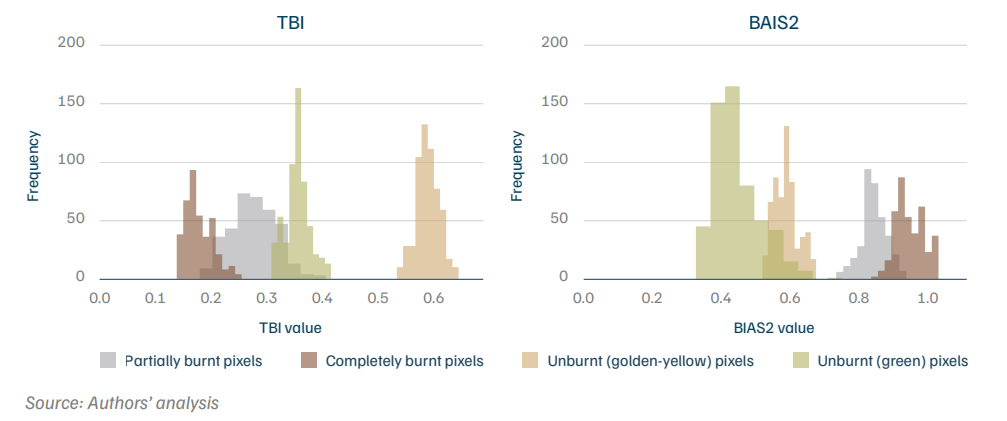
However, as Figure 4 shows, TBI values for green and burnt fields overlap, while BAIS2 values for golden-yellow and burnt fields lie close together. To test whether combining thresholds improves classification, we analysed BAIS2 and TBI jointly rather than individually. Deshpande et al. (2022) also used a combined approach, capping the values of these indices between the 5th and 95th percentiles. In our case, we selected the threshold values – T1, T2, and T3 based on the index values obtained for partially burnt fields, ensuring that our algorithm captured both partially and completely burnt fields. Table 1 lists the thresholds used.
Table 1. Thresholds tested in this study to distinguish between burnt and unburnt fields
From the training dataset, we identified the values of these thresholds. We have summarised the values in Table 2.
Table 2. Values of the thresholds identified from the training dataset
| Threshold | Threshold value |
|---|---|
| Threshold 1 (T1) | BAIS2 >= 0.78 |
| Threshold 2 (T2) | TBI <= 0.34 |
| Threshold 3 (T3) | BAIS2 >= 0.78 TBI <= 0.34 |
Source: Authors' analysis
To validate the algorithm’s performance, we identified a test region in Punjab where the image dates of the very-high-resolution imagery from Google Earth Pro coincided with Sentinel-2 multispectral imagery. Suitable images were available for 29 October 2021, covering Hoshiarpur and Jalandhar. We then applied threshold T3 to 10 randomly selected villages across this region, which spans an area of approximately 28 sq km. Within these fields, we marked burnt fields and their field boundaries, extracted the pixels from within the fields, and created subsets of partially burnt, completely burnt, and unburnt fields. In total, we identified 287 burnt fields and 95 unburnt fields across the 10 villages. Of the 287 burnt fields, we could only clearly identify 72 completely burnt fields and 190 partially burnt fields.
We analysed the performance of the algorithm using two criteria:
Table 3. The confusion matrix used for computing performance metrics
| Observed | |||
|---|---|---|---|
| Number of burnt pixels | Number of unburnt pixels | ||
| Detected | Number of burnt pixels | True positive (TP) | False positive (FP) |
| Number of unburnt pixels | False negative (FN) | True negative (TN) | |
where,
True positives are the burnt pixels correctly detected as burnt by the algorithm.
False negatives are the burnt pixels incorrectly classified as unburnt.
False positives are the unburnt pixels incorrectly classified as burnt.
True negatives are the unburnt pixels correctly classified as unburnt.
Source: Authors’ compilation
Table 4. List of performance metrics used in the study
| Metric | Description | Formula | Range of values |
|---|---|---|---|
| Accuracy | The model's ability to correctly detect burnt and unburnt pixels. | (TP + TN) / (TP + FP + FN + TN) | 0–1 Higher is better |
| True positive rate (TPR) | The algorithm’s ability to correctly classify a burnt pixel as burnt. | TP / (TP + FN) | 0–1 Higher is better |
| False positive rate (FPR) | The algorithm’s tendency to detect an unburnt pixel as burnt. | FP / (FP + TN) | 0–1 Lower is better |
| False negative rate (FNR) | The algorithm’s tendency to classify a burnt pixel as unburnt. | FN / (TP + FN) | 0–1 Lower is better |
| F1 score | How well the algorithm identifies a burnt pixel. | 2TP / (2TP + FP + FN) | 0–1 Higher is better |
| Matthews correlation coefficient (MCC) | The algorithm’s ability to correctly classify burnt and unburnt pixels. | (TP×TN - FP×FN) / √(TP+FN)×(TP+FP)×(TN+FP)×(TN+FN) | -1–1 1 represents perfect prediction |
| Cohen’s kappa (k) | Similar to MCC; uses all four metrics – TP, FP, FN, TN. | (Po-Pe)/(1-Pe) Po = (TP+TN)/(TP+TN+FN+FP) Pe = (((TP+FN)×(TP+FP) )+((FN+TN)×(FP+TN))) / (TP+TP+FN+FP)2 |
-1–1 Higher is better |
Source: Authors’ compilation
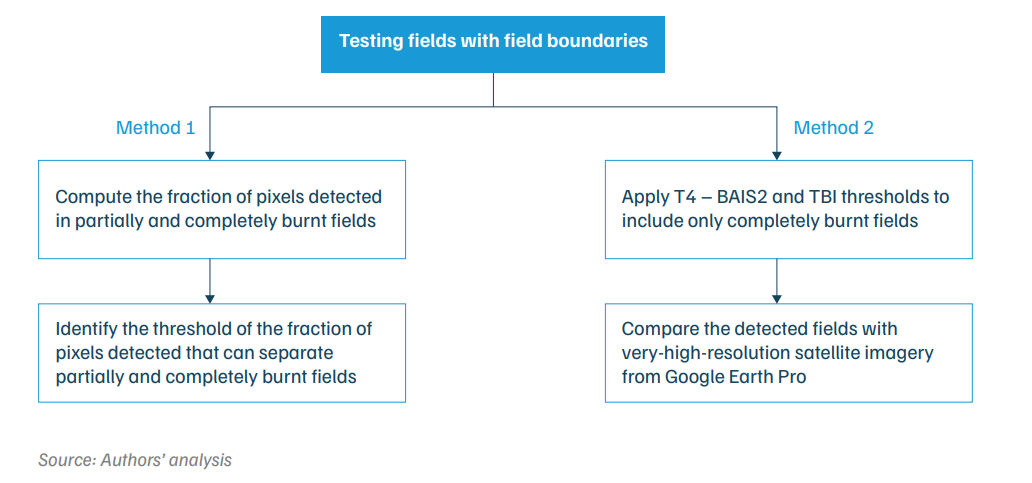
To assess the algorithm’s ability to differentiate between partially and completely burnt fields, we computed the percentage of pixels detected in each field type. We hypothesised that the number of pixels detected by the algorithm in a partially burnt field should be lower than in a completely burnt field. We tested this hypothesis using two approaches: one threshold combination designed to detect both partially and completely burnt fields and another designed to detect only completely burnt fields.
Figure 5. Threshold T4 includes only completely burnt pixels
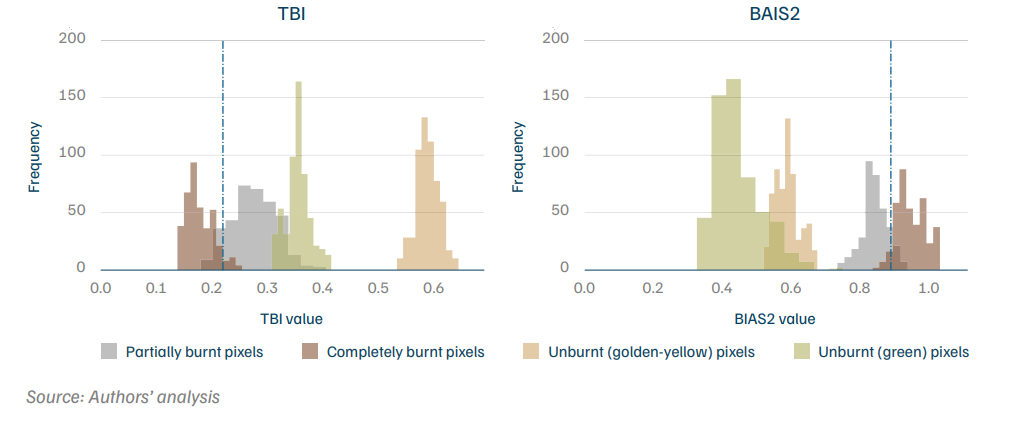
Figure 6. An overview of the data and methodology
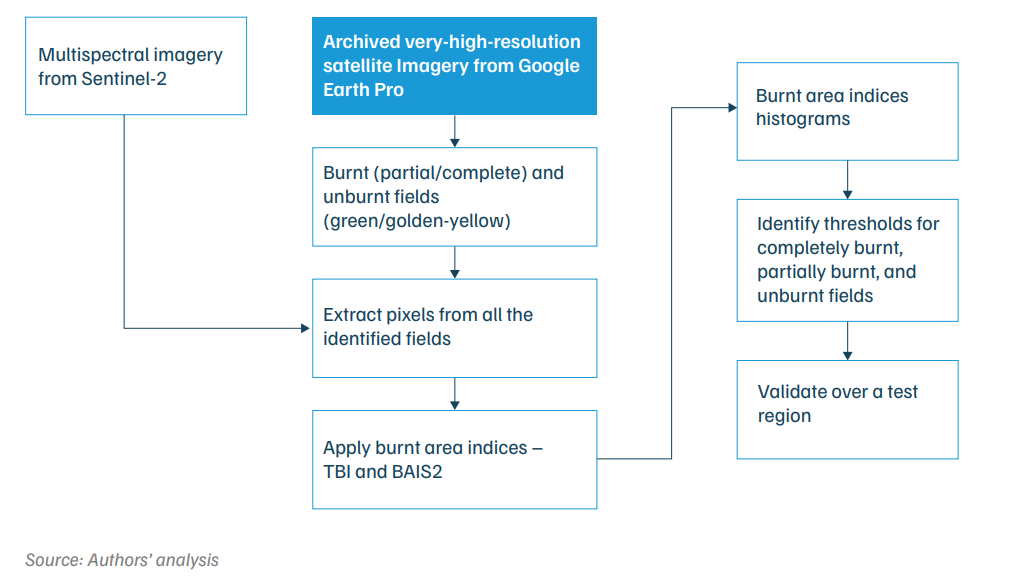
Figure 7. An overview of the methodology adopted for differentiating partially and completely burnt fields
Burnt area indices are satellite data-based indicators that detect burnt fields by identifying changes in field characteristics before and after burning.
Satellite-borne sensors can only detect active fires during the overpass. Coarse spatial and temporal resolution, obstruction due to clouds and smoke, are also challenges associated with remote sensing-based CRB monitoring.
In complete burning, the entire leftover straw after harvesting is set on fire, whereas in partial burning, only the loose straw left after running the harvester is burnt.
An accurate estimate of the extent of CRB helps assess the effectiveness of CRB mitigation policies. It will also help improve the emission estimates from CRB. In turn, this will lead to improvements in the performance of air quality models that run on these estimates.
Organic Waste Circular Economy for Viksit Bharat
How Can India Tackle Air Pollution with an Airshed-level Approach?
Roadmap of the methodology to assess the climate co-benefits of the SUP ban in Tamil Nadu

Roadmap of the methodology to assess the climate co-benefits of the SUP ban in Maharashtra
How Construction Activities Affect Urban Air Pollution: