Council on Energy, Environment and Water Integrated | International | Independent

Suggested citation: Tiwari, Poojil, Neera Majumdar, and Arunabha Ghosh. 2025. Local Grids to Global Power: India's Energy Transition. New Delhi: Council on Energy, Environment and Water.
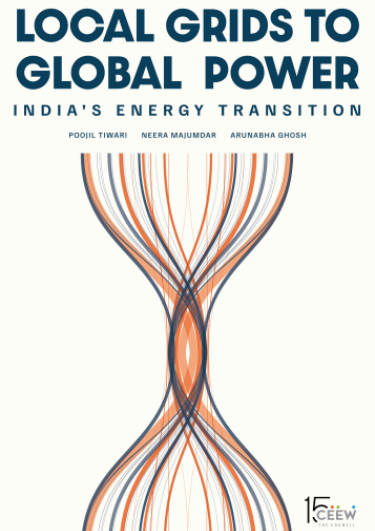
The first-of-its-kind data book on the world’s largest clean energy transformation. India’s energy transition is rewriting the global growth story. With 1.45 billion people, it’s the fastest-growing major economy and a nation aiming for net-zero emissions by 2070. This data-driven chronicle captures how India is electrifying every home, scaling renewables from megawatts to gigawatts, and pioneering fuels of the future like green hydrogen. From solar villages to smart grids, digital subsidies to global alliances, India is showing that decarbonisation and development can go hand in hand. Local Grids to Global Power reveals the numbers, the networks, and the new geopolitics of clean energy — and how a country’s choices could determine the planet’s climate future and give a blueprint for the Global South.
The energy transition underway in India is not just a sustainability or resilience imperative, but a growth strategy.
With 1.45 billion people, it is the world’s most populous country1, the fastest-growing major economy2, and the current third-largest emitter3. At the 26th Conference of Parties in Glasgow in 2021, India committed to achieving net-zero emissions by 2070. This is a transition that could move over a billion people into a sustainable, low-emissions future and give the planet a fighting chance to stay warming within 2°C above preindustrial levels.
In 2015, when the Sustainable Development Goals were adopted, India had the world’s largest population without access to electricity.4 Today, its household electrification programme has reached 28 million people in just 18 months since 2017.5 Cleaner cooking fuels now reach almost all households, reducing both carbon emissions and indoor air pollution.6 India’s digital revolution—one of the cornerstones of its development strategy—is also cutting emissions. As hundreds of millions gained access to mobile phones and data, government services went online, including those delivering green energy subsidies directly to citizens. Smart meters now enable utilities to deliver electricity more efficiently and bill them correctly, while green appliances such as super-efficient ceiling fans are helping households reduce consumption.7 As a result, India has cut the emissions intensity of its GDP by 36 per cent between 2005 and 2020.8 All this, while becoming the world’s fourth-largest installer of renewable energy capacity.9
The scale of India’s clean energy build-out has been remarkable. In 2010, the country had less than 20 megawatts (MW) of solar power capacity; today it has over 127,000 MW.10 Wind capacity has risen from 9,400 MW in 2008 to more than 53,000 MW.11 Nuclear power contributes another 8,700 MW12, with the country ramping up its ambitions with the announcement of a National Nuclear Mission in 2025, which aims to scale this up to 100,000 MW by 2047.13 Collectively, non-fossil sources now account for more than 50 per cent of India’s installed capacity.14
India is attempting what few countries have done: provide affordable clean energy to hundreds of millions, clean up one of the world’s largest energy systems, and become an economic and industrial powerhouse — all at once. Yet, industries today receive less than 20 per cent15 of their energy from electricity. Heavy industries still require fuels for high-intensity operations, which cannot be met by electricity alone.16 For this, the country is placing a strategic bet on fuels of the future such as green hydrogen. Approved in 2023 with an outlay of nearly USD 2.4 billion, the National Green Hydrogen Mission targets five million tonnes of green hydrogen production per year by 2030.17
India’s ambitions extend beyond its borders. It helped found the International Solar Alliance, the Coalition for Disaster Resilient Infrastructure, and the Global Biofuels Alliance — global partnerships for clean energy and climate adaptation. Through the One Sun, One World, One Grid initiative, India envisions linking renewable-rich regions across Asia, the Middle East, and Africa through high-voltage transmission networks.18 By 2040, 85 per cent of global energy demand will come from emerging economies in these regions.19 However, we are hard-pressed to findn in 2025, the world that signed the Paris Agreement a decade ago in 2015. Developed countries are projected to collectively emit around 3.7 GtCO2e more in 2030 than their stated reduction goals.20 Even if they achieve net zero by 2050, they will consume 40–50 per cent of the carbon budget left to keep the increase in warming within 1.5°C of pre-industrial levels.21
The clean energy transition can also expand energy access. Decarbonisation does not mean compromising economic growth. And much of the developing world will not gradually transition its energy systems, but leap into a sustainable future. New Delhi is providing a blueprint for how this can happen.
Please scroll left to right
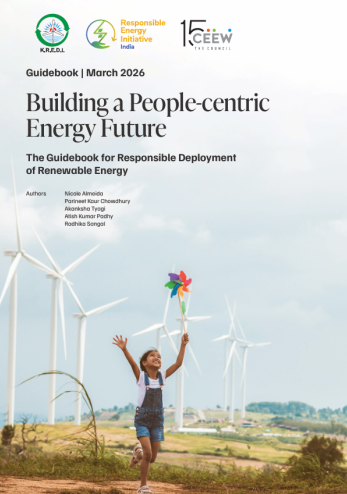
Building a People-centric Energy Future:
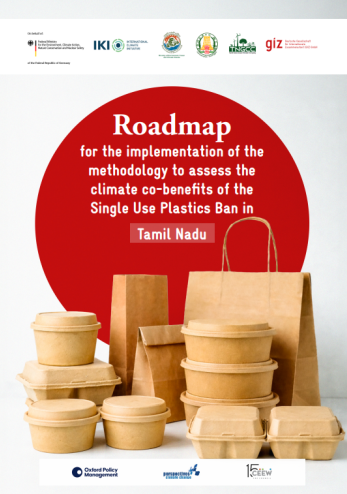
Roadmap of the methodology to assess the climate co-benefits of the SUP ban in Tamil Nadu

Roadmap of the methodology to assess the climate co-benefits of the SUP ban in Maharashtra
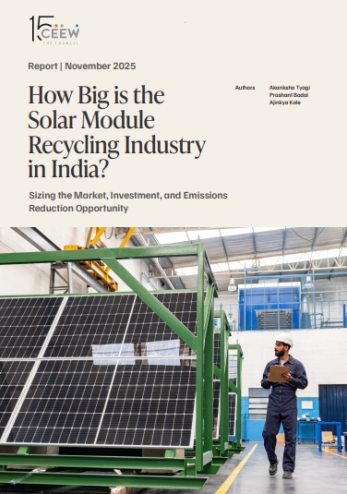
How Big is the Solar Module Recycling Industry in India?
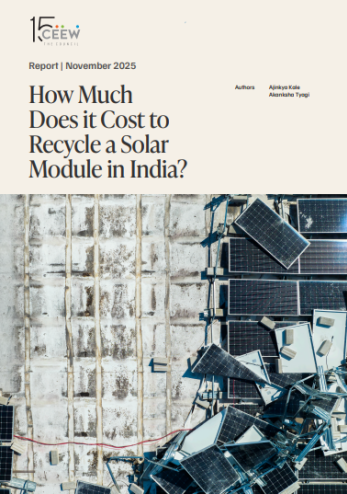
How Much Does It Cost to Recycle a Solar Module in India?