Council on Energy, Environment and Water Integrated | International | Independent

Suggested citation: Almeida, Nicole, Parineet Kaur Chowdhury, Akanksha Tyagi, Atish Kumar Padhy, and Radhika Sangal. 2026. Building a People-centric Energy Future: The Guidebook for Responsible Deployment of Renewable Energy. New Delhi: Council on Energy, Environment and Water and Responsible Energy Initiative India
The accelerated deployment of renewable energy (RE) deployment is essential for India to meet its target of net zero emission by 2070. However, the RE sector today faces significant challenges with regards to land availability and managing the social and environmental impacts of large-scale projects on local communities, livelihoods, and biodiversity. Proactive management of these impacts is necessary for developers to build a social license to operate and derisk their projects.
While several international frameworks exist to assess and manage these social and environmental impacts, they often lack the local context Indian developers need to operationalise them.
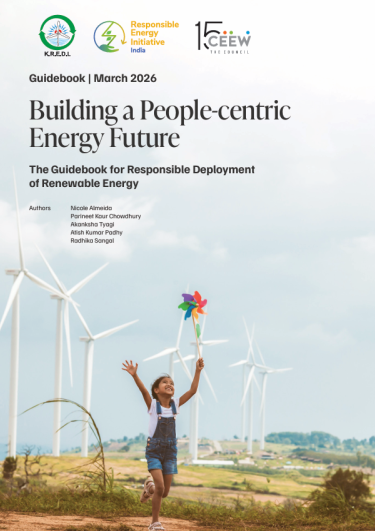
Building a People-centric Energy Future: The Guidebook for Responsible Deployment of Renewable Energy, developed by CEEW as part of the Responsible Energy Initiative (REI) India, provides a practical, step-by-step manual for RE developers, engineering, procurement and construction (EPC) companies, and contractors involved in RE project deployment to manage social and environmental impacts across the entire lifecycle of a RE project.
The Guidebook moves beyond mere legal compliance and provides a model of RE deployment that is both people-centric and ecologically-positive. It recommends responsible activities to manage impacts across four key themes—land, people and ecology, business responsibility and environment and biodiversity.
As India accelerates its renewable energy (RE) deployment to meet climate goals, the sector faces a critical challenge: rising on-ground concerns regarding land availability, and the potential adverse impact of RE projects on people’s livelihoods and the surrounding environment. It is particularly true for large-scale RE projects that require significant land, often impacting the livelihoods of local communities, and biodiversity. If not proactively managed, these impacts can lead to social and ecological challenges, potentially slowing RE deployment.
While several social and environmental impact assessment frameworks are available from various international agencies , they are often difficult to implement thoroughly by RE project developers due to lack of local context and linkage with different phases of the RE project. Hence, more actionable guidance is needed for the RE sector so developers can plan their projects in a manner that avoids any adverse impact on people and the environment.
The Guidebook for Responsible Deployment of Renewable Energy, developed by the Council on Energy, Environment and Water (CEEW) as part of the Responsible Energy Initiative (REI) India, serves as a practical, step-by-step manual for RE projects to manage their social and environmental impact. Inspired by the standard documents available such as Equator Principles, IFC performance standards, Asian Development Bank’s Environment and Social Framework, Equitable Origin’s EO100, Clean Energy Buyers Institute’s Beyond the Megawatt, Securities and Exchange Board of India’s Business Responsibility and Sustainability Reporting and others, it provides actionable guidance to move beyond mere legal or financial compliance towards a model of deployment that is people-centric and ecologically positive. This approach also ensures RE projects advance both climate action and biodiversity conservation in tandem, serving multiple environmental goals simultaneously.
The Guidebook’s target audience includes RE developers, engineering, procurement and construction (EPC) companies, and contractors involved in RE project deployment, such as detailed project report (DPR) consultants, impact assessment agencies, and land aggregators. It provides specific activities organised across four key themes:
The activities in the Guidebook are organised into four parts – as per the project deployment cycle, ensuring responsibility is embedded from conception to closure. These four phases are:
The Guidebook also helps companies self-evaluate and chart a path for continuous improvement. Users can evaluate their performance in a project based on the responsible activities implemented. Performance is divided into four levels:
By adopting this Guidebook, RE developers can mitigate project risks and secure a social licence to operate. It will also help them make their projects more investor-friendly by building necessary systems within the organisation.
Responsible deployment of RE is not a choice but an imperative. It offers a synergistic pathway to meet climate, developmental, and biodiversity goals simultaneously, transcending the perceived trade-off between these priorities.
The target audience includes RE developers, engineering, procurement and construction (EPC) companies, and contractors involved in project deployment. Other users include detailed project report (DPR) consultants, impact assessment agencies, and land aggregators who manage the intersection between project needs, local communities, and ecosystems.
The Guidebook advocates for low-impact siting during the pre-feasibility phase. This involves using tools like SiteRight to identify land with minimal environmental and social impacts.
The Guidebook outlines a formal grievance redressal mechanism (GRM). This includes setting up a Grievance Redressal Committee with community and NGO representation, appointing an environment and social (E&S) officer as a focal point, and providing accessible channels like WhatsApp or toll-free hotlines in local languages to resolve disputes fairly
The E&S officer serves as the primary liaison between the project and the community. Their responsibilities include overseeing ESIA and ESMMP formulation, acknowledging and tracking grievances through the GRM, and ensuring that contractors comply with social and environmental obligations throughout the project lifecycle.
The Guidebook encourages moving beyond one-time payments to landowners towards a more inclusive model. This includes livelihood restoration plans for landless laborers and grazers, earmarking technical and non-technical jobs for locals, and creating self-sustaining community development funds.
Developers must plan for decommissioning at least 1–1.5 years in advance. This includes technical evaluations for land restoration, sending damaged modules to authorised recyclers as per E-Waste Management Rules, 2022, and exploring second-life applications for panels, such as powering local community centers or schools.
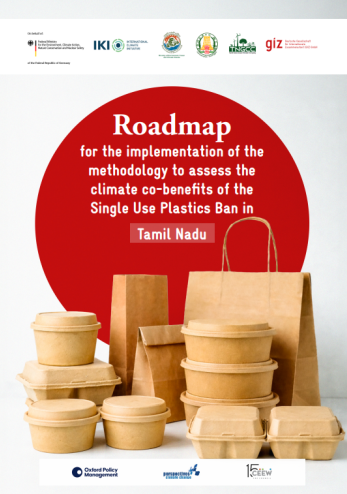
Roadmap of the methodology to assess the climate co-benefits of the SUP ban in Tamil Nadu

Roadmap of the methodology to assess the climate co-benefits of the SUP ban in Maharashtra
How Big is the Solar Module Recycling Industry in India?
How Much Does It Cost to Recycle a Solar Module in India?