Council on Energy, Environment and Water Integrated | International | Independent


Context: Air quality enforcement in India focuses on and incentivises reducing numbers on the air quality index (AQI), which captures only ambient pollution levels.
Key insights: This enforcement strategy does not account for the composition of emission sources causing air pollution, and leads to inefficient allocation of resources.
CEEW recommendation: Assess air quality outcomes through verifiable on-ground actions and incentivise it with performance-based grants.
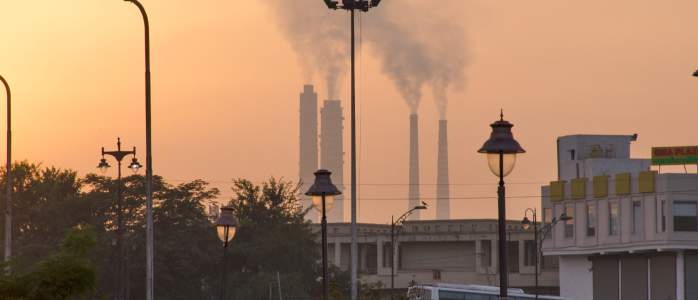
India’s early and intensifying summer heatwave is exposing a familiar double burden: extreme temperatures alongside the persistently poor air quality round the year. As cities like Delhi record soaring temperatures alongside unhealthy air quality episodes—triggering measures such as GRAP Stage I—the limits of India’s current air quality response are becoming increasingly visible. Whenever faced with deteriorating air quality, enforcement agencies respond with a familiar set of responses: smog guns deployed at major intersections, water sprinklers at pollution hotspots or blanket bans on construction activities. These measures do little to reduce the emissions that are actually driving air pollution, not for want of intent or capacity, but because of how air quality has been understood in public discourse. We use the air quality index (AQI) as an easy-to-communicate version of ambient air pollution concentration levels, and our enforcement focuses on reducing that number. But the AQI cannot tell us which sources are responsible for the pollution during a particular period, and that gap is where our actions might need some tuning.
Concentration of a given pollutant in the air on a given day is a function of multiple factors: emissions generated within the city, emissions from outside the city but within India, emissions from neighbouring countries, and meteorological conditions such as wind and rainfall. Of these, only local emissions fall within a city administration's control. This is why current funding and performance structures need to change: both the Finance Commission and the Ministry of Environment, Forest and Climate Change could link performance-based grants to states, municipalities, and urban local bodies on verifiable actions on emission sources, not just air quality indicators. This will allow regulators to be rewarded for what they can actually control.
Let’s take the example of Delhi-NCR, a region that often determines the national discourse on air pollution. Multiple emission inventories and source apportionment studies consistently point to a familiar set of dominant contributors: transport, industry, stubble burning, and road dust. Together, these sectors account for more than 90 per cent of the region’s total emission load. These emissions arise from identifiable sources and activities, making them responsive to direct regulatory action. Existing frameworks like GRAP have moved in this direction but remain episodic and AQI-triggered rather than anchored in sustained source-level accountability.
This clarity offers a real opportunity. Directing enforcement and performance incentives towards transport, industry, and residential combustion, which collectively dominate the emissions profile in most non-attainment cities, would ensure tangible emissions reduction. Currently, more than two-thirds of the National Clean Air Programme funds have been allocated to road dust management, which offers visible, quick reduction in AQI but limited long-term impact.
Reorienting governance structures to reward verifiable action on dominant emission sources would make enforcement more effective, accountable, and durably connected to real air quality gains. There are two governance shifts that can accomplish this.
First, shift enforcement from AQI outcomes to actions that directly reduce emissions at source. Instead of holding agencies solely responsible for ambient air quality, relevant regulatory and implementing bodies could mandate what can be verified, audited, and sustained. Consider how cities manage roads: they do not ask municipal departments to “improve road quality indices”; they mandate zero potholes, track compliance, and reward performance. Air quality governance needs a similar recalibration: a shift from headline (AQI) numbers to enforcing concrete actions on the ground.
Consider industrial sources, particularly small and medium boilers operating on coal or low-quality biomass. Rather than episodic inspections or seasonal bans, enforcement could mandate clearly defined outcomes: time-bound installation of certified air pollution control devices (APCDs), transition to cleaner fuels, or phased shutdown of non-compliant units. Compliance can be assessed through physical inspections and automated systems, such as continuous emission monitoring systems (CEMS).
Similarly, at construction sites, instead of blanket bans during high-pollution episodes, enforcement could shift to targeted interventions throughout the year. A pilot study by the Council on Energy, Environment and Water (CEEW) at a construction site in Gurugram shows that a small subset of activities, such as excavation and earthwork, accounts for the majority of dust emissions. Instead of halting all construction activities based on AQI triggers, regulators could restrict only high-emission activities while allowing other low-emission activities to proceed under dust-mitigation norms, such as water sprinkling and speed limits on vehicles at construction sites.
Second, reward the enforcement of verifiable actions with concrete incentives. Agencies that demonstrate sustained progress could receive greater budgetary allocations from Finance Commission grants and NCAP funds. Furthermore, these high-performing agencies should be granted greater operational autonomy, including streamlined regulatory clearances, flexible fund redirection toward local priorities, and simplified reporting cycles. Persistent non-compliance by agencies could trigger escalating consequences: mandatory public disclosure, withheld Finance Commission and NCAP grants, and, where warranted, central intervention by a KPI-driven action plan with direct oversight of state-level enforcement machinery. A CEEW study found that when LPG distributors are assessed against concrete obligations, including home-delivery coverage, refill availability, and service reach, and those actions are financially supported, compliance improves and measurable gains follow. The lesson for air quality enforcement is the same: define the action, fund it, and verify it.
Finally, what unites these measures across sectors is not their novelty but their enforceability. They focus on actions within institutional control, enable transparent progress tracking, and make accountability tangible. Air quality governance lacks neither data nor diagnostics. What it lacks at this point is an enforcement architecture that translates evidence into obligations. Moving from outcome-chasing to action-based accountability is a governance imperative. Air pollution cannot be governed like a weather variable; it must be governed like infrastructure through planning, implementation, and maintenance.
Sankalp Kumar is a Programme Associate, Abhishek Dhiman is a Programme Lead, and Abhishek Kar is a Non-Resident Fellow at the Council on Energy, Environment and Water (CEEW). Send your comments to sankalp.kumar@ceew.in







Add new comment