Council on Energy, Environment and Water Integrated | International | Independent

Context: India’s push for clean air increasingly relies on market-based mechanisms that reward verified emission reductions rather than only compliance.
CEEW Analysis: By directly capping emissions, using real-time data and rewarding cost-effective emission cuts, the Emissions Trading System (ETS) offers India a uniquely scalable and locally relevant market-based mechanism to cleaner urban air.
Key Insight: ETS can become a critical national urban air management mechanism with stronger data systems, wider sectoral coverage, and increased institutional capacity.
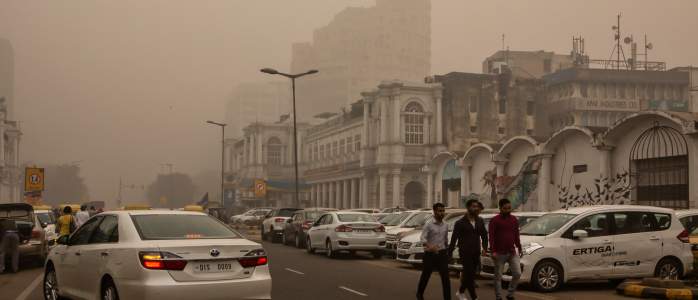
In its journey towards becoming the fourth-largest economy in the world, India has had to balance rapid economic growth with environmental conservation. Urbanisation, rising energy demand, and expanding mobility have contributed to increased pressure on air quality, particularly in cities. To keep pace with economic development, India’s environmental governance has continued to adapt and expand. Flagship initiatives such as the National Clean Air Programme (NCAP), Bharat VI fuel standards, Pradhan Mantri Ujjwala Yojana (PMUY), and industrial reforms in the National Capital Region (NCR) have contributed to gradual improvements in air quality across multiple sectors. However, these measures remain administratively driven, relying on government funding and enforcement by state agencies. An important alternative mechanism to address air pollution is market-based tools that reward verified emission reductions and innovation.
Market-based mechanisms (MBMs) represent this strategic shift, offering industries the flexibility to reduce emissions cost-effectively while supporting economic growth. In India, MBMs take three primary forms: Renewable Energy Certificate (REC), energy efficiency trading and emissions trading. The energy efficiency trading includes the Perform, Achieve and Trade (PAT) scheme, which sets energy-use reduction targets for energy-intensive industries, allowing excess savings to be traded as certificates. The REC enables renewable energy producers to earn and trade certificates to help meet their Renewable Purchase Obligations (RPOs).
The latter is the Emissions Trading System (ETS), which limits total emissions for certain sectors and allows companies to buy or sell permits, enabling cleaner firms to benefit by using less and selling excess permits. It is important to distinguish between carbon trading systems, which regulate greenhouse gas emissions such as CO2 to meet long-term climate goals, and air-pollutant ETS, which target local and regional pollutants such as particulate matter (PM), sulphur dioxide (SO2), and nitrogen oxides (NOx) to deliver near-term air-quality and public-health benefits. While ETS regulates emissions at the source rather than ambient concentrations directly, sustained reductions in primary pollutants and PM precursors can significantly lower ambient PM2.5 exposure, particularly in densely populated urban and industrial clusters.
ETS has been a particularly effective tool in India to manage air pollution since it directly targets pollution, sets quantifiable limits and uses price signals to reward cleaner firms. This system offers Indian cities a scalable pathway for sustained air-quality gains through transparent, incentive-led regulation that lets them earn as well.
An ETS sets a cap on total emissions and allocates emission permits to participating industries. At the end of the compliance period, each entity must hold enough permits to match its verified emissions or face penalties for non-compliance. Entities that emit less can sell their surplus permits, while higher emitters must buy additional ones. This structure ensures total emissions within the prescribed limit while rewarding cost-effective innovation. In India, air-pollutant ETS currently covers selected industrial sectors, targeting the industrial boilers used in textile, pharma and pulp and paper units, through regional pilots such as Surat and Ahmedabad. Carbon trading under the Indian carbon market is expected to begin early this year, with energy-intensive sectors such as power, steel, cement, aluminium, fertilisers, and refineries.
Figure 1 illustrates the core functioning of ETS, from setting an overall emissions cap to monitoring, trading, and periodic tightening, highlighting how market incentives are used to achieve emission reductions cost-effectively.
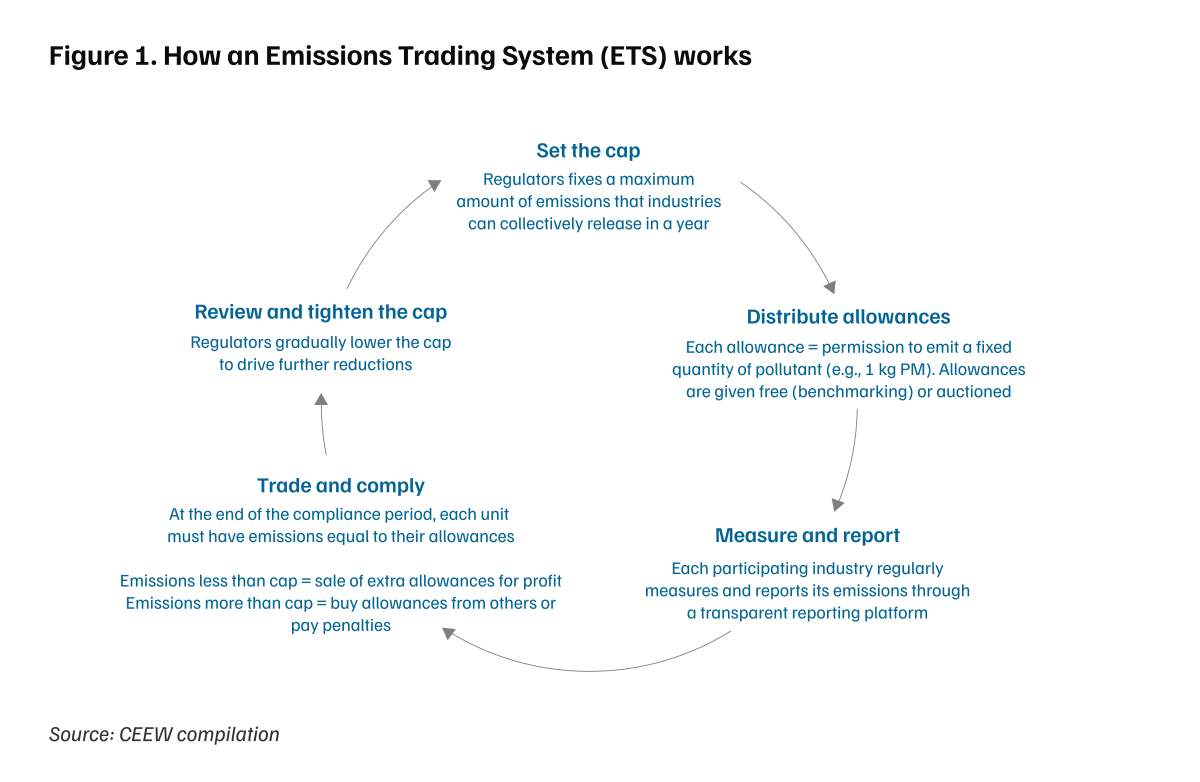
Figure 2 illustrates the importance of market-based regulation. The same level of pollution reduction can be achieved at a lower cost when firms are allowed to trade emission permits instead of following uniform mandates.
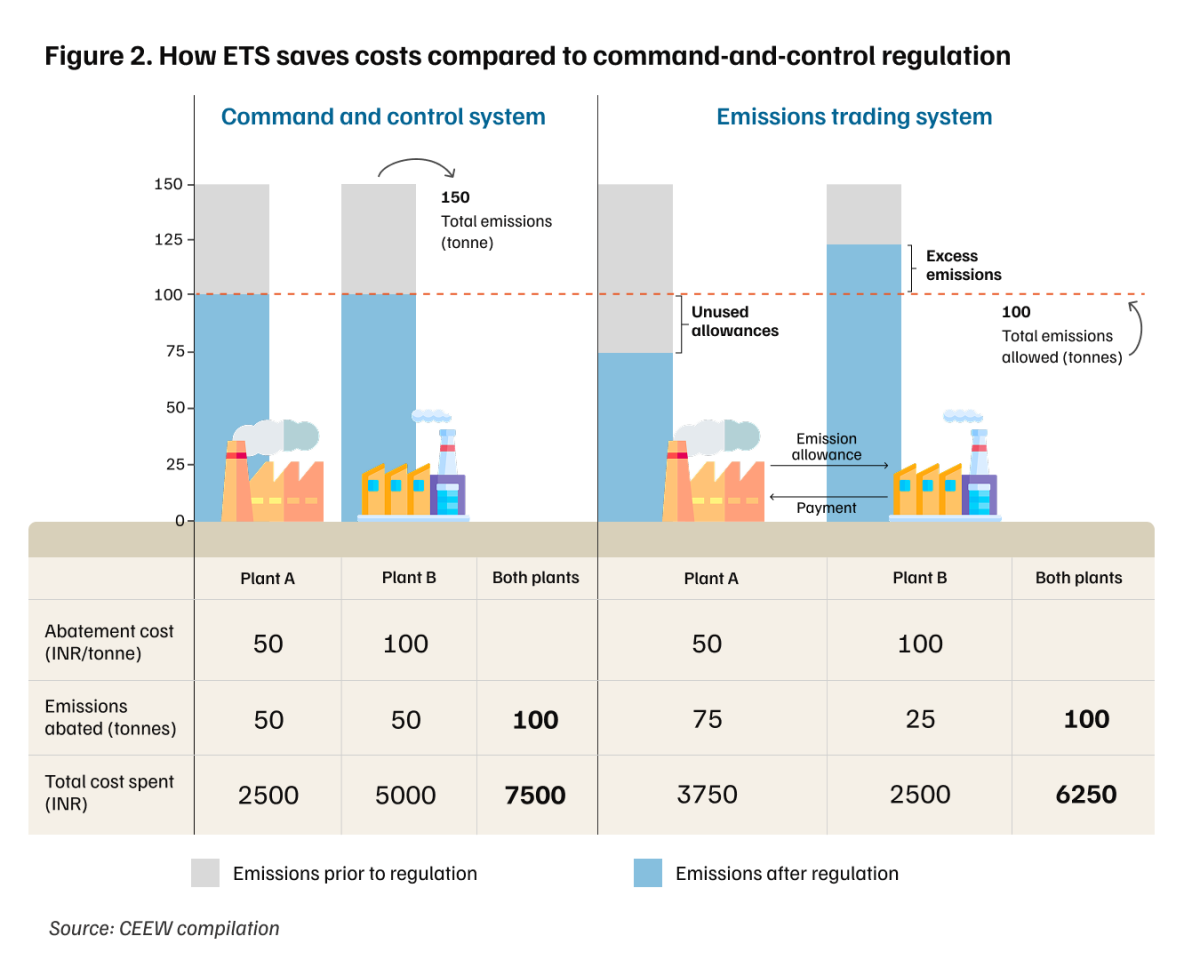
Note: Under command-and-control, both plants have to abate 50 tonnes each. Plant A spends 2,500 (at 50/tonne), and Plant B spends 5,000 (at 100/tonne), totalling 7,500. Under ETS, Plant A abates 75 tonnes at a cost of 3,750, as it has a lower abatement cost, and Plant B abates only 25 tonnes at a cost of 2,500, totalling 6,250. The same 100-tonne reduction is achieved, but ETS saves 1,250.
For over 40 years, evidence from global ETS implementations has demonstrated reductions in SO2, NOx, and particulate matter (PM), achieved more cost-effectively than conventional regulations.
In keeping with global best practices in ETS, the Gujarat Pollution Control Board (GPCB) launched India’s first PM-based ETS in Surat in 2019. It was an innovative city-level model that directly tackled urban air pollution management. The scheme capped total PM emissions for industrial clusters and allocated tradable permits backed by continuous emissions monitoring systems (CEMS) data. CEMS are instruments installed on industrial chimneys or stacks that continuously measure and record pollutant concentrations and transmit real-time data to a central database.
For the pilot, GPCB mandated 318 large coal-burning units to install CEMs. Of these, 162 units were randomly assigned to the ETS group, while the remaining 155 units served as a control group governed by traditional emission standards.
GPCB, in consultation with the Market Oversight Committee, established an overall emission cap based on the regulatory particulate emission standard of 150 mg/Nm3. Approximately 80 per cent of this cap was distributed as tradable permits, based on each unit's size and emission potential. At the end of each compliance period, units with emissions exceeding their permits were required to purchase additional allowances or face penalties proportional to their shortfall. The system initially operated at 280 tonnes/month and currently has a cap of 170 tonnes/month.
The pilot demonstrated strong compliance, as all units operated within the total permitted emissions through a mix of reductions and permit trading. The ETS group achieved 20–30 per cent lower PM emissions and an 11 per cent reduction in total abatement costs compared to the command-and-control group. This outcome was underpinned by six years of preparatory work (2014–2019) led by GPCB, in close collaboration with researchers from EPIC-India, J-PAL South Asia, and EPoD-India. This groundwork encompassed the installation of CEMS, the development of data validation and assurance protocols, and sustained capacity-building for both regulators and industry. The Surat ETS has since gained international recognition and was selected as a finalist for the 2025 Earthshot Prize in the "Clean Our Air" category.
In parallel, at the national level, the Carbon Credit Trading Scheme (CCTS) was launched in 2024 to create a unified national carbon market. It allows trading of verified carbon credits, each representing one tonne of CO2-equivalent emissions reduced or avoided. Credit prices will be determined by market demand and supply, allowing firms flexibility in how they meet compliance targets. While still early in implementation, its impact will become clearer as participation and trading volumes increase.
While the success of the Surat ETS offers clear evidence that market-based air-quality management can work in India, scaling such a model will require plugging certain gaps:
India must focus on institutional readiness, data credibility, and inclusive market design:
If supported by credible measurement systems and institutionally grounded implementation, ETS can move beyond city pilots to serve as a national-level scheme for cleaner urban air. Scaling ETS beyond Surat, supported by hyperlocal emission inventories, transparent data verification, and coordinated governance and technical guidelines from the Ministry of Environment, Forest and Climate Change (MoEFCC) and the Ministry of Housing and Urban Affairs (MoHUA), can pave the way for city-wide systems that eventually target major pollution sectors such as industries, transport, and construction. A phased, data-driven expansion—from industrial clusters to regional systems targeting SO2 and NOx, rather than PM—can help India build a credible, scalable, and self-sustaining clean-air market that complements traditional regulation and improves air quality management.
Sunita Patra is a Programme Associate and Chirag Bhimani is a Senior Consultant at the Council on Energy, Environment and Water (CEEW). Send your comments to sunita.patra@ceew.in.





Comments
OsYQ
Mon, 03/16/2026 - 03:52
ohFw
OsYQ
Mon, 03/16/2026 - 03:52
ohFw
OsYQ
Mon, 03/16/2026 - 03:53
ohFw
OsYQ
Mon, 03/16/2026 - 03:53
ohFw
OsYQ
Mon, 03/16/2026 - 03:53
ohFw
OsYQ
Mon, 03/16/2026 - 03:53
ohFw
OsYQ
Mon, 03/16/2026 - 03:53
ohFw
OsYQ
Mon, 03/16/2026 - 03:53
ohFw
OsYQ
Mon, 03/16/2026 - 03:53
ohFw
OsYQ
Mon, 03/16/2026 - 03:53
ohFw
Pages
Add new comment