Council on Energy, Environment and Water Integrated | International | Independent

Context: While GRAP formally considers meteorological and weather forecasts, its action remains largely AQI-based, responding to short-term air quality fluctuations and operating with limited monitoring coverage.
Challenge: GRAP’s reliance on AQI creates uncertainty through frequent shifts in restrictions and overlooks emission sources, limiting its ability to identify and address the drivers of pollution.
CEEW’s recommendation: Align GRAP implementation with emission sources and strengthen data systems through forecasting, hotspot-focused action, and improved citizen participation.
In May 2026, the Commission for Air Quality Management in the National Capital Region and Adjoining Areas (CAQM) invoked Stage I of the Graded Response Action Plan (GRAP) across Delhi-NCR, after the air quality slipped into the ‘poor’ category. This recent enforcement highlights the persistent, year-round nature of the region’s air quality crisis, which was exacerbated in the winter of 2025 when authorities enforced Stage III and IV of the GRAP for 46 days, a 10-day increase from 2024. These stages impose stringent restrictions, ranging from online schooling and work-from-home advisories to bans on construction and vehicle use. While GRAP formally considers forecasts, its implementation remains largely air quality index-triggered and insufficiently linked to source contribution forecasts, hotspot-level data, and pre-emptive sectoral action. GRAP mandates are implemented in four stages, but these stages are neither successive nor consistent, making the system far from consistently reliable. However, this non-linearity is not an inherent flaw. The problem is not that GRAP stages change; it is that frequent imposition and withdrawal without a clear source-linked rationale creates uncertainty for businesses, schools, construction firms, enforcement agencies, and citizens.
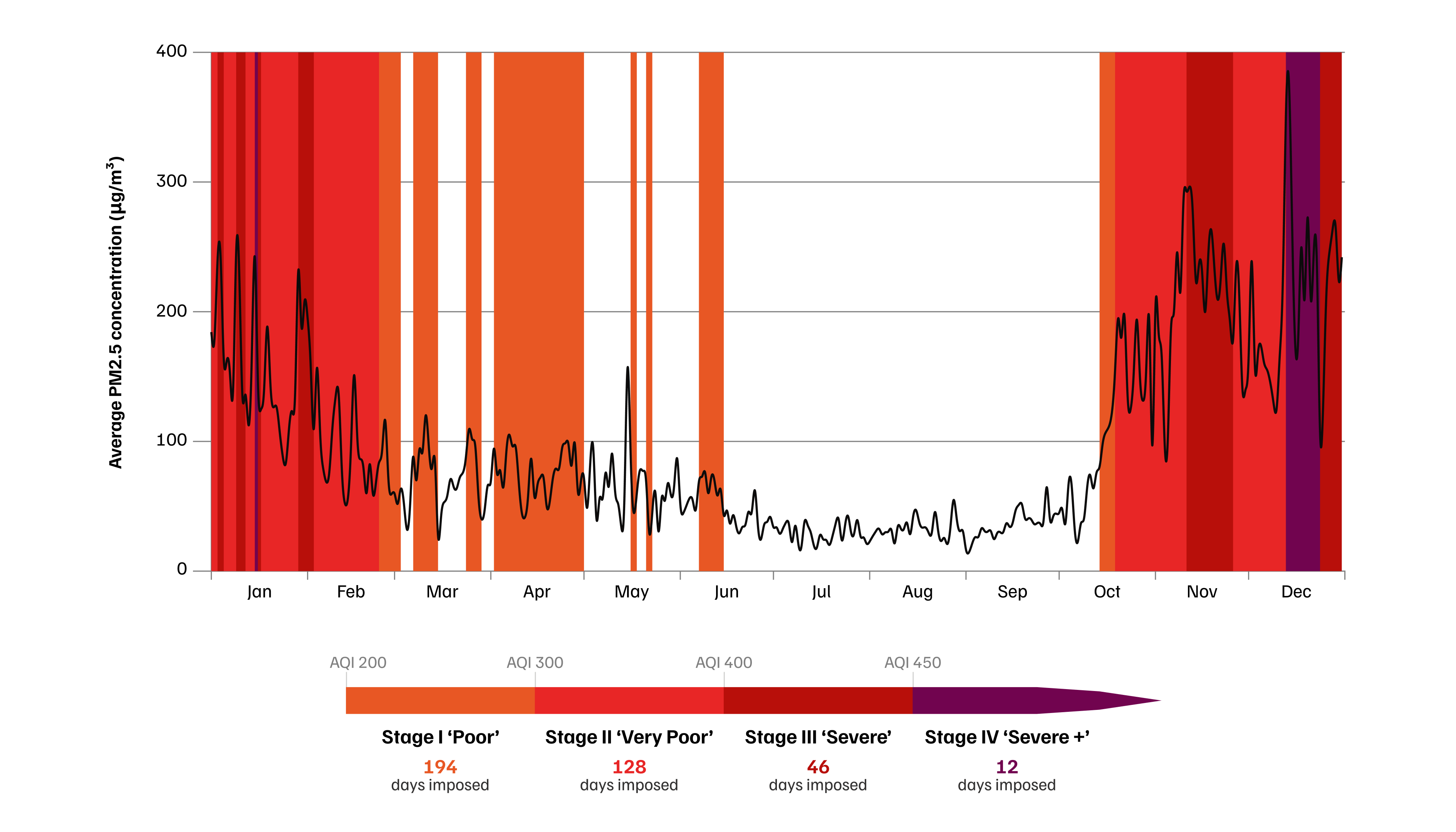
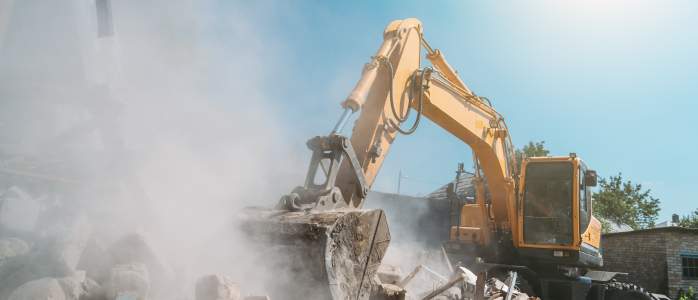
Authorities may impose or revoke the restrictions depending on AQI fluctuations, without accounting for underlying emission sources. For example, when AQI levels improve, authorities may relax restrictions from the more stringent GRAP Stage III to the less stringent Stage I or II. This allows construction activities to resume, which continue to generate dust emissions (Figure 1). As these emissions accumulate, air quality deteriorates again, triggering the reimposition of stricter GRAP measures.
Figure 1. GRAP stage III was imposed six times in 2025, following AQI peaks, and was frequently revoked when air quality levels improved
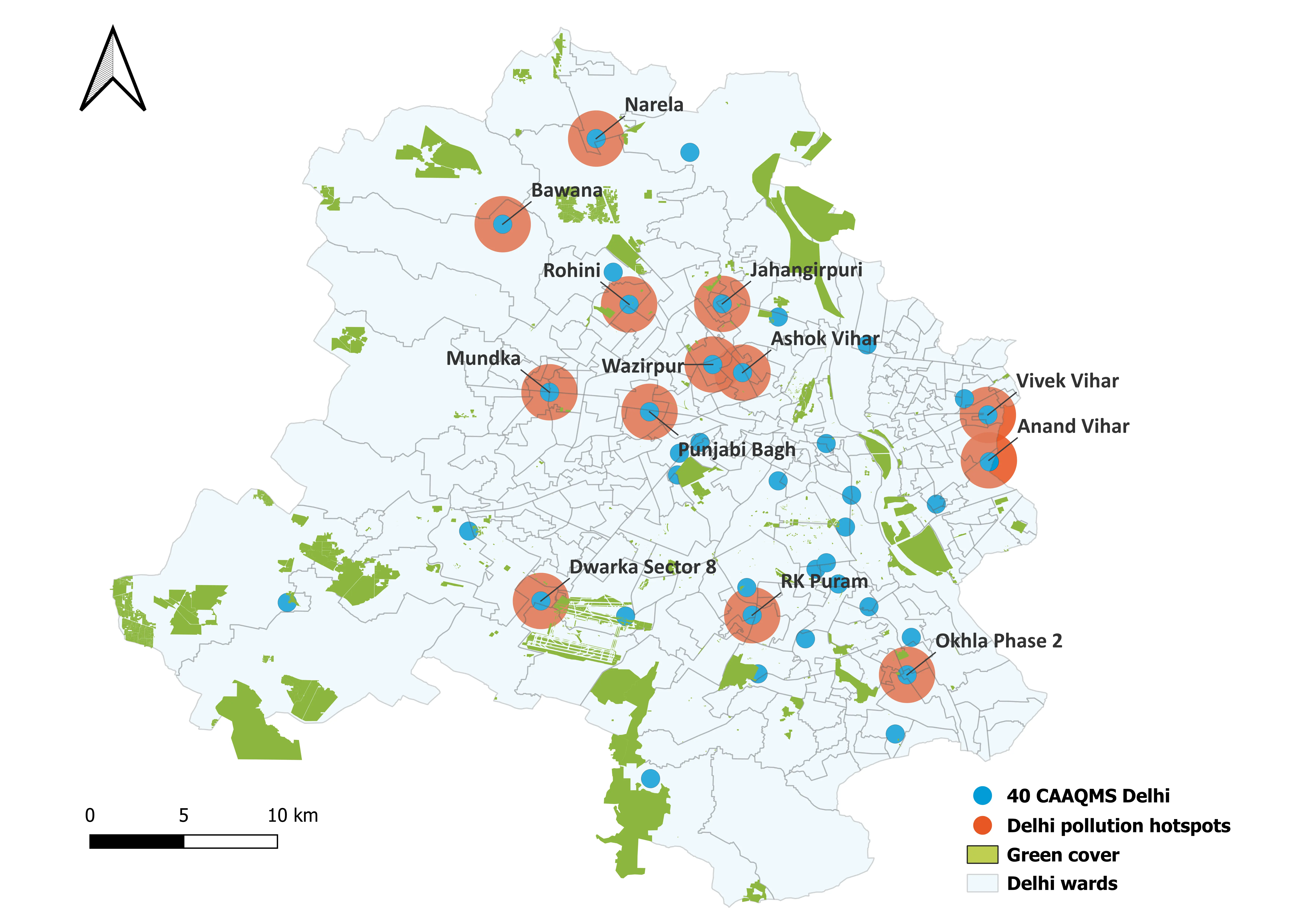
Although GRAP is a systematic action plan, its effective enforcement is also contingent on the comprehensiveness of real-time AQI data recorded by monitoring stations. It is estimated that only 34.5 per cent of Delhi's total area is covered under the air quality monitoring network, which limits the ability to apply uniform, city-wide restrictions. According to the Central Pollution Control Board’s (CPCB) AQ monitoring network installation norms, a city with over 5 million people requires 12 Continuous Ambient Air Quality Monitoring Stations (CAAQMS). Based on this, Delhi, with a population of 21.8 million, needs ~52 such CAAQMS under a population-based interpretation of CPCB norms; however, CAQM’s newer grid-based approach points to a need for 60 stations. Delhi currently operates at around 40 (Figure 2). Recently, the Commission for Air Quality Management in the National Capital Region and Adjoining Areas (CAQM) directed the installation of 60 monitoring stations (six of which are already planned), with one station per 25 sq. km. This expansion aims to improve spatial coverage and provide more granular, real-time air quality data.
However, expanding coverage needs to be complemented by a more extensive and locally connected air quality monitoring network by integrating both reference-grade monitors and alternative reliable monitoring technology. This will help strengthen decision-making, increase public trust, and improve the effectiveness of policy measures. For example, while the Delhi government has mandated the use of low-cost air quality monitors at construction sites, the data from these devices is not used to evaluate air quality anomalies in and around these sites.
A standard deployment of AQ monitors at construction sites can help link construction activities to local air quality levels and improve understanding of emission patterns. If deployed strategically across all the sites, such monitors can also form an extended network to identify pollution hotspots and support better assessment of sector-wise contributions across different regions. Integrating data from low-cost sensors with readings from CAAQM stations can improve spatial coverage and enable real-time, localised tracking of particulate matter, especially in areas with limited station coverage.
Figure 2. Delhi requires around 52 CAAQMS under population-based CPCB norms (or 60 under CAQM’s grid-based approach), but currently operates with only 40 stations
GRAP needs to be predictable to be effectively enforceable and credible. In this context, we propose three actionable recommendations to strengthen its implementation and enable more targeted and sustained air quality management.
First, GRAP implementations could be proactive. GRAP restrictions are mostly reactive and are invoked only after AQI levels have already exceeded the prescribed thresholds. For example, GRAP Stage II applies to an AQI range of 301–400, meaning it should be triggered as soon as levels cross 300. In practice, however, GRAP II has often been invoked only when AQI reaches 350 or above, well into the stage's range rather than at its onset. In fact, in 2025, on 13 out of 17 occasions, GRAP stages were invoked only after the AQI had climbed well past the threshold for that specific stage. Instead of waiting for air quality to worsen and then imposing emergency bans, authorities should use air quality forecasts to act in advance. This would allow targeted, sector-specific measures such as restricting pollutant-intensive construction activities, limiting the movement of polluting vehicles, and strengthening checks on open burning before pollution levels peak.
A study by CEEW shows that forecasts capture pollution trends with 84–91 per cent prediction accuracy and provide decision-makers with a range of mitigation plans. For instance, if forecasts indicate a spike in particulate matter levels, authorities can strengthen or automate compliance monitoring through targeted vehicle restrictions, intensify street cleaning, or tighten construction controls before pollution peaks. Forecasts can also guide the timing of lifting restrictions, preventing premature withdrawal of restrictions when poor air quality is expected to persist. Integrating forecast source contributions and forecasts of pollution peaks into GRAP can help authorities act early and more precisely, reduce economic disruptions, improve air quality, and keep the public informed through social media.
Second, strengthen compliance monitoring in pollution hotspots. Delhi's pollution episodes follow predictable seasonal and diurnal patterns. Switching activities on and off based on short-term AQI level differences creates regulatory uncertainty, halts routine life, disrupts economic activity, and does not affect long-term, year-round emissions control. In 2018, the Department of Environment, Government of NCT of Delhi, identified 13 major air pollution hotspots based on high PM10 and PM2.5 levels recorded at nearby CAAQMS stations. Additionally, detailed source inventorisation was also conducted across 24 priority areas in the city.
It was found out that pollution in these hotspots is mostly driven by local and area-specific sources such as construction dust, road dust resuspension, waste burning, vehicular emissions, and traffic congestion, rather than uniform city-wide emissions. Delhi needs a seasonal, hotspot-level pre-GRAP control plan, one that operates before emergency thresholds are breached, rather than waiting for “severe” pollution levels to trigger action. Authorities should implement sector-specific GRAP measures for fixed periods in these areas. Fixed, time-bound restrictions such as limiting high-dust construction activities, controlling the movement of older than BS-IV vehicles, and strengthening monitoring campaigns for open stubble burning will aid in effective pollution reduction. Such planned measures would allow regulators, sectoral stakeholders, and the public to prepare in advance, unlike sudden, unannounced prohibitions, and lead to more consistent pollution reductions.
As shown in Figure 1, pollution levels peak mainly during winter and remain relatively lower in summer. This calls for stricter and more consistent measures during high-pollution months, while allowing relatively lighter interventions during periods of lower pollution. Seasonal, fixed restrictions on pollution-prone activities can ensure continuous monitoring and control, leading to more stable and long-term improvements in air quality.
Third, strengthen enforcement through citizen participation. Public awareness and participation remain among the weakest links in GRAP's effectiveness. While the plan expects behavioural changes during pollution spikes, inconsistent enforcement reduces public trust and limits cooperation.
Despite ongoing government interventions, a significant barrier is the lack of awareness about public grievance redressal mechanisms. Digital platforms like the Green Delhi App, MCD 311, and SAMEER are vital tools that empower citizens to report local environmental violations, such as road dust or open waste burning, directly to the authorities. However, their use is limited due to smartphone dependence, inconsistent resolution timelines, and insufficient public promotion. By actively promoting these reporting tools, authorities can encourage more people to participate. This will help citizens report issues, point out gaps in infrastructure, and demand better action for improved air quality.
Greater government transparency and citizen engagement are necessary to ensure the success of GRAP's interventions. Regular forecasts shared on social media and health advisories can nudge people to avoid unnecessary travel, wear masks, or limit car use. These small individual actions help lower personal exposure and reduce overall pollution levels. Sustained public engagement, backed by reliable information and responsive systems, can improve compliance, enhance accountability, and make GRAP exponentially more effective over time. Ultimately, GRAP cannot substitute for year-round emission control. Sustained improvement in Delhi’s air quality requires a parallel, permanent programme of action: expanding public transportation, clean fuel adoption, ensuring industrial compliance, controlling dust, ending open waste burning, and strengthening regional coordination across the NCR. However, by shifting towards source-based, hyperlocal, and pre-emptive action, GRAP can become a much more credible and effective emergency-response framework when the city needs it most.
Mohammed Sahbaz Ahmed is Research Analyst, Prince Sant is Consultant, and Arpan Patra is Programme Associate at the Council on Energy, Environment and Water (CEEW). Send your comments to mohammed.ahmed@ceew.in.




Add new comment