Council on Energy, Environment and Water Integrated | International | Independent

Suggested citation: Neog Kangkanika, Ankita Borah, Vanshika Shah, and Suparana Katyaini. 2025. Adapting Agricultural Water Resources Management for a Changing Climate: Pathways to Climate-resilient Agriculture. New Delhi: Council on Energy, Environment and Water.
The agricultural sector is the largest consumer of water globally, accounting for 70 per cent of water withdrawals; in India, it accounts for an even higher share of 76 per cent of the country’s total water use (Chaturvedi et al. 2020). In India, agricultural water management faces complex challenges with interconnecting issues related to water, food, and energy. In this context, implementing integrated water resources management (IWRM) principles in agriculture has the potential to strengthen water governance by recognising, valuing, and managing water in a holistic way (Meran, Siehlow, and von Hirschhausen 2020). However, with climate change, there are “large uncertainties in future projections", and water availability is expected to change (Ludwig, van Slobbe, and Cofino 2014, 236). Therefore, principles of climate change adaptation (CCA) need to be integrated, enabling India to develop synergistic approaches that simultaneously improve water-use efficiency in agriculture and enhance resilience against climate change impacts.
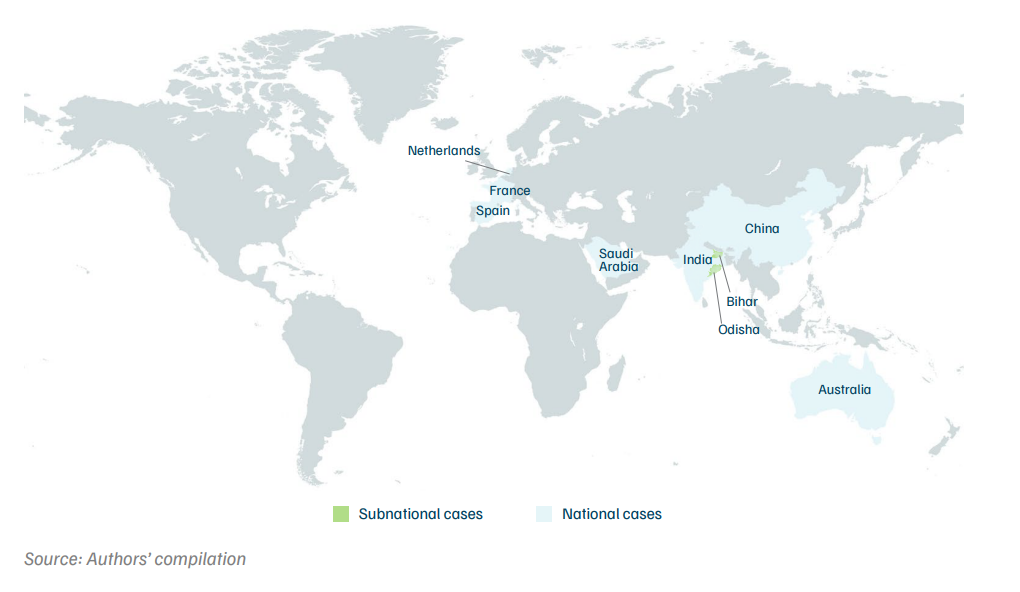
This report analyses the policy narratives of 16 policy instruments from India, including subnational policies from Bihar and Odisha, and 6 from other countries –Australia, China, France, Netherlands, Spain, and Saudi Arabia– where IWRM plays a prominent role in agricultural water management. The analysis focuses on the following IWRM and CCA goals assessed through 16 sub-elements and 59 keywords to understand the best practices and draw valuable lessons from the selected policy instruments:
Based on the analysis, our findings highlight key priorities across the national and subnational policies, offering opportunities for sharing insights and cross-learning on how IWRM and CCA can be integrated to support water management in agriculture.
Having said this, there is strong recognition for the need to prioritise the IWRM and CCA goals given the particular context of the region, while also offering practical strategies and lessons applicable across various settings, promoting cross-country learning and collaboration.
The agricultural sector is the largest consumer of water globally, accounting for 70 per cent of water withdrawals; in India, it accounts for an even higher share–76 per cent of the country’s total water use (Chaturvedi et al. 2020). In India, agricultural water management faces complex challenges in terms of water supply and demand, the agricultural market, and fragmented water governance. Despite surface irrigation investments, Indian agriculture heavily relies on groundwater due to its decentralised ease of access (supply-side) and is plagued by low water productivity (demand-side) and skewed incentives favoring water-intensive crops (marketside). Further, interconnected issues related to water, food, and energy require an integrated governance approach to manage these challenges effectively. In this context, implementing integrated water resources management (IWRM) principles in agriculture has the potential to strengthen water governance by valuing, and managing water in a holistic way (Meran, Siehlow, and von Hirschhausen 2020). Traditionally, IWRM does not account for the impacts of climate change; instead, it takes a ‘long-term approach’ and assumes ‘stationarity’–i.e., that natural systems are stable over time and past patterns in water availability and climate can predict future conditions (Ludwig, van Slobbe, and Cofino 2014). With climate change, this assumption no longer holds; there are “large uncertainties in future projection” and water availability is expected to change (Ludwig, van Slobbe, and Cofino 2014, 236).
Integrating climate change considerations into agricultural water management would enable India to develop synergistic approaches that simultaneously improve water-use efficiency in agriculture and enhance resilience against climate change impacts.
In this regard, principles of climate change adaptation (CCA) include several critical dimensions that can enable the effective implementation of IWRM, taking into account the impacts of climate change. It requires integrating climate adaptation into socioeconomic and environmental policies and actions, by involving political, social, economic, and administrative entities, as well as stakeholders such as local communities, civil society organisations, and public and private sectors, through a “country-driven, gender-responsive, participatory and fully transparent approach” (UNFCC 2022).
The IWRM framework promotes coordinated processes that integrate various disciplines, resources, policies, and stakeholders through a scientific approach and democratic water management governance. This framework is optimal for the integration of CCA due to their shared goals, such as sustainable development, public participation, and social justice. The 2030 Agenda for Sustainable Development further highlights the importance of IWRM for achieving the United Nations’ Sustainable Development Goals (SDG), particularly SDG 6 and Target 6.5, which calls for the implementation of IWRM at all levels, including across borders, by 2030.
This report analyses the status of policy narratives of 16 policy instruments from India and 6 from other countries where IWRM plays a prominent role in agricultural water management. These are Australia, China, France, Netherlands, Spain, and Saudi Arabia. The Indian case is explored at the national as well as the state level, covering policies from Bihar and Odisha.
The analysis focuses on the following IWRM and CCA goals assessed through 16 sub-elements and 59 keywords to understand key narratives and draw valuable lessons from the selected policy instruments.
Figure ES1. Policy analysis across 16 policies from national and subnational cases
Our findings indicate that the narratives in the water management policies chosen emphasise integration. The uniqueness of the subnational policies is their focus on community-driven integration and water-led climate adaptation in the agricultural sector, while national-level policies place a greater emphasis on mitigation. Environmental sustainability, participatory water management, and social equity are common themes; we found a marked emphasis on marginalised groups and gender roles in Indian policies. We recognise the need to prioritise these goals given the particular context of the region while also offering practical strategies and lessons applicable across various settings, promoting cross-country learning and collaboration.
Figure ES2. IWRM and CCA elements provide a lens through which to analyse national and subnational level policies
| IWRM & CCA key elements | National-level policies | Subnational-level policies |
|---|---|---|
| Integrated approach |
|
|
| Climate change considerations |
|
|
| Environmental sustainability |
|
|
| Economic efficiency |
|
|
| Social equity |
|
|
Source: Authors’ analysis
We suggest the following key policy recommendations based on the analysis:
The study covers selected policies, while there is scope for future research to include a comprehensive range of policies across various sectors. A more comprehensive approach should incorporate policies that target different points in the agricultural value chain and recognise the interrelations between IWRM and CCA goals and sub-outcomes for a more holistic perspective.
Agriculture consumes significant water globally, accounting for 70 per cent of water withdrawals (FAO 2017). In India, its share of water withdrawals is even higher, at 76 per cent (Chaturvedi et al. 2020). Agricultural water management in India is complicated by water supply and demand, agricultural markets, and various governance considerations. From the supply-side perspective, groundwater has become farmers’ most sought-after irrigation source despite India making significant surface irrigation infrastructure investments over the decades. Currently, 40 percent of water used for irrigation comes from groundwater sources (Qin et al. 2024). Even among 23.14 million minor irrigation schemes in India, almost 95 per cent are schemes drawing groundwater (Ministry of Jal Shakti 2023), a climate-vulnerable resource (Pandian 2023). From a demand perspective, Indian agriculture has low water productivity driven by low water-use efficiency. A Council on Energy, Environment and Water (CEEW) study from 2020 finds that if agricultural practices such as micro-irrigation and mulching are implemented, and policy reforms like water auditing and volumetric pricing are adopted, almost 20 per cent of irrigation water can be saved in 2030 following a moderate water-saving strategy. It further argues that, by 2050, up to 47 per cent of irrigation water can be saved if a rigorous water-saving strategy is followed (Chaturvedi et al. 2020). From a market perspective, even though minimum support prices (MSPs) have been set for 22 crops (MoAFW 2024), in practice, only crops like wheat, rice, and sugarcane are assured procurement (Tiwari 2020), creating highly skewed incentive structures in favour of these water-intensive crops. Finally, agricultural water governance is plagued by resource nexus challenges, wherein the governance of water, food, and energy inevitably conflict. These issues necessitate a holistic and integrated governance approach (Orimoloye 2022).
In this context, integrated water resources management (IWRM) can be an effective framework for structuring agricultural water management. “Integrated Water Resources Management (IWRM) is a process which promotes the coordinated development and management of water, land and related resources in order to maximise economic and social welfare in an equitable manner without compromising the sustainability of vital ecosystems and the environment.” (GWP 2011). IWRM aims to balance the three pillars of “social equity”, “economic efficiency”, and “environmental sustainability” (Ben-Daoud et al. 2021). The IWRM framework presents a holistic approach that aims to integrate resource issues (like land and soil; surface water and groundwater), various disciplines and stakeholders, policies, and bottom-up and top-down approaches (Biswas 2008).1 It promotes coordinated processes that unite various stakeholders, use scientific data and tools for sound judgment, and emphasise democratic governance.
Although IWRM has guided water management for decades, its effectiveness as a comprehensive land and water-use management tool, particularly in the agricultural sector, is gradually receiving greater recognition (Roy, Oborne, and Venema 2009). One of the first and commonly cited examples of IWRM is from 1933, when the Tennessee Valley Authority (TVA) was created to oversee multiple functions, including navigation, flood control, power production, erosion control, recreation, and public health (Meran, Siehlow, and von Hirschhausen 2020). The TVA initiative incorporated many aspects of what is now known as IWRM, emphasising comprehensive planning for natural resource use while balancing economic, social, and environmental goals. During the International Conference on Water and the Environment (ICWE) in Dublin, Ireland, the concept was formally included in the Dublin Statement on Water and Sustainable Development, and it was subsequently adopted on 31 January 1992. The Dublin Statement highlighted the mismanagement and scarcity of global water resources, which posed further threats to sustainable development, environmental protection, human health and welfare, food security, industrial growth, and ecosystem stability. It introduced four guiding principles that now serve as the foundation of IWRM (SIWI 2020).
The four guiding principles that form the foundation of IWRM (SIWI 2020) are:
Since IWRM provides comprehensive solutions for sustainable development, its application is especially relevant in resource-dependent sectors like agriculture, where water supply and quality, land management, and women’s participation are crucial (Roy, Oborne, and Venema 2009).
Traditionally, IWRM does not take into account the uncertainties posed by climate change present today. IWRM takes a ‘long-term approach’ based on ‘stationarity’. This assumes that natural systems are stable over time and past patterns in water availability and climate can predict future conditions (Ludwig, van Slobbe, and Cofino 2014). However, with climate change, this assumption no longer holds, and there are “large uncertainties in future projection” (Ludwig, van Slobbe, and Cofino 2014, 236). This lack of stability gives rise to new uncertainties in managing physical systems and different stakeholders’ behaviours. Recently, water management policies and practices has begun focusing on acknowledging and managing these uncertainties to improve decisionmaking (Ludwig, van Slobbe, and Cofino 2014).
Climate change adaptation (CCA), therefore, becomes a crucial framework to be integrated into water management, particularly agricultural water management. It refers to “adjusting practices, processes and capital in response to the actuality or threat of climate change, as well as responses in the decision environment, such as changes in social and institutional structures or altered technical options that can affect the potential or capacity for these actions to be realized” (Adger, et al. 2007).
The approval of Agenda 2030 for Sustainable Development by the United Nations in 2015 established a comprehensive framework for global sustainable development efforts (Sam Kutesa et al. 2015). Within this framework, IWRM and CCA are recognised as crucial components contributing to SDGs. Specifically, IWRM aligns with SDG 6, which aims to ensure the availability and sustainable management of water and sanitation for all, while CCA aligns with SDG 13, which focuses on taking urgent action to combat climate change and its impacts. In the context of SDG 6, target 6.5 emphasises the implementation of IWRM at all levels by 2030, including through transboundary cooperation where appropriate (Giupponi and Gain 2017). Jonch-Clausen (2007) suggests that IWRM should be made a focal point in adaptation policies just as how clean energy is emphasised in mitigation efforts.
Several dimensions are critical to enable the effective implementation of IWRM. These dimensions are:
A significant component of the enabling environment is policy instruments, comprising national, state, and local-level laws and policies that constitute the “rules of the game” and are critical to driving change on the ground level (GWP and INBO 2009; World Water Council 2023).
Similarly, several dimensions drive the effective implementation of CCA. It requires the integration of adaptation into socioeconomic and environmental policies and actions and emphasises the engagement of political, social, economic, and administrative entities and stakeholders, including local communities, civil society, and public and private sectors, through a “countrydriven, gender-responsive, participatory, and transparent approach” (UNFCCC 2022).
Both CCA and IWRM aim to promote sustainable development and share key objectives like public participation, information sharing, and social equity (He 2013; GWP-C 2015). The integration of CCA and IWRM into agricultural water management could offer valuable opportunities for sharing insights and exchanging knowledge, especially regarding how these approaches can support one another.
While the SDGs and other similar global agendas have established priorities and provide direction, policy instruments, such as laws or plans, guide the implementation of various concepts like IWRM and CCA through well-defined text. Hence, a systematic assessment of current policies is necessary. This is the first step toward understanding the applicability and utility of IWRM and CCA in agricultural water management. In this report, we investigate broader sectoral policies, laws, and plans. However, we refer to them as ‘policies’ to align with international conventions and facilitate effective communication with global research, policy, and practice communities.
Based on the outlined goals of IWRM and CCA (mentioned in Table 1), this report systematically assesses subnational policies in India and key national cases in the global context to collate learnings on how IWRM and CCA can be integrated in water management in agriculture.
Our objectives are as follows:
The report employs narrative analysis to understand IWRM and CCA narratives in the selected policy instruments and highlights recommendations for future policy action (Rose 2004). It examines significant policies from seven countries, including India. These cases reflect a global water governance reform paradigm and offer valuable insights for integrating IWRM and CCA into agricultural water management. In addition, we analyse subnational Indian policies from two Indian states. We hope that this analysis would enable cross-learning at different levels regarding the policy initiatives of other countries without focusing on their differences (Fritsch and Benson 2019; Rose 2004).
We employ a framework (detailed in Table 1) that integrates IWRM principles and CCA goals to assess agricultural water management. This framework provides a structured approach for evaluating how effectively policies align with these combined IWRM and CCA goals. By systematically organising and prioritising these goals, the framework aids in identifying strengths, gaps, and areas for improvement, supporting better decision-making and promoting integrated, sustainable water resource management. We developed the framework by defining and describing five common goals for IWRM and CCA based on their definitions, identifying elements within each key goal, and establishing keywords for each.
Table 1. The IWRM and CCA goals assessment framework has five key goals
| Key goals | Description | Elements | Keywords |
|---|---|---|---|
| Integrated approach | Draws from multi-sectoral, multi-disciplinary, multi-level governance, and multi-stakeholder perspectives and achieves integration across various dimensions: use, demand, the environment, and people (ENTIRE 2014) | integrated, IWRM | integrated, IWRM |
| Climate change considerations | Integrates climate action in the form of assessing risks and carrying out adaptation and mitigation activities within the water resource management framework (Ludwig, van Slobbe, and Cofino 2014) | adaptation, mitigation, risk | adaptation, resilience, adapt, climate change, mitigation, emission, sequestration, carbon capture, greenhouse gas, GHG, risk |
| Environmental sustainability | Protects water resources and associated ecosystems (Conradin 2019) | sustainable resource management, water, soil, forest, energy | water, soil, microbial, land, forest, non-timber forest products, timber, resource management, resource use, resource efficiency, efficiency, conservation, energy |
| Economic efficiency | Maximises benefits for as many users as possible while making the best use of the limited available water and financial resources. This includes price as well as social and environmental costs and benefits (GWP 2024) | income, productivity, water as an economic good | income, profit, returns, productivity, economic, tariff, pricing |
| Social equity | Ensures equal access to adequate quantity and quality of water for the sustenance of human wellbeing, for all users, especially those that are marginalised and poorer user groups (GWP 2024) | gender, other interest groups, participatory | gender, women, woman, female, scheduled caste, SC, scheduled tribes, ST, small holder, marginal farmer, minority group, small farmer, marginal, small-scale producer, poor, indigenous, rural, equity, farmer producer organisation, FPO, water user association, WUA, cooperative, self-help group, SHG, participatory |
Source: Authors’ compilation
Next, for policy analysis, we used NVivo, a qualitative data analysis software. The keywords defined in Table 1 were used to code the information to identify policy priorities to understand their alignment with the goals. Substansive reading of the policies were carried out to critically extract learnings for the integration of IWRM and CCA into agricultural water management.
We selected policy instruments for this IWRM and CCA analysis that were introduced between 2001 and 2024. This timeframe was selected because the year 2000 marked the adoption of the Millennium Development Goals (MDGs) by the United Nations with commitment by all member states, which brought increased global attention to water resource management and sustainable development. Given the overlapping concerns between IWRM principles and the MDGs, 2001 is a relevant starting point for examining how these principles were incorporated into policy. From the early 2000s, there was growing recognition globally of the impact of climate change and the need for adaptation strategies. By including policies from 2001 onwards, we can analyse how climate change considerations have been progressively integrated into water management policies over time.
For national case studies
To select national policy instruments from other countries, we used the SDG 6.5.1 reporting portal. SDG 6.5.1, which measures the degree of IWRM, is a well-documented and monitored SDG. Progress against this indicator is measured on a scale of 0 to 100 (‘implementation not yet started’ to ‘fully implemented’). We sourced this data from the IWRM Data Portal maintained by the UNEP-DHI Centre on Water and Environment in partnership with the United Nations Environment Programme (UNEP) and the Global Water Partnership (GWP).
The portal hosts more than 190 national reports on SDG indicator 6.5.1 (reported across three years – 2017, 2020, and 2023). We used data from the latest round of reporting in 2023. The data primarily comprised self-reporting on IWRM implementation assessed through a survey questionnaire filled by a National SDG 6.5.1 focal point during a national workshop. Finally, UNEP aggregates, assesses, and verifies the data, which is then hosted on the portal.
Using the scores from 2023, which covered 183 countries, we identified 47 countries that performed ‘high’ and ‘very high’ in IWRM implementation. These 47 countries are grouped based on the geographic regions defined under the United Nations Statistics Division (UNSD) into the following seven SDG regions: Sub-Saharan Africa, Northern Africa and Western Asia, Central and Southern Asia, Eastern and South-Eastern Asia, Latin America and the Caribbean, Oceania, and Europe and Northern America. We selected high-performing countries with the most agricultural land in each region: Australia, India, China, France, and Saudi Arabia. Using our discretion, we added two other countries from the UNSD SDG region of Europe and Northern America, Spain and the Netherlands, which are known for their exemplary water management. Both these countries have high-performing IWRM programmes and more than 50 per cent of their total land is agricultural land.
Table 2 provides context regarding IWRM implementation categories, future water stress in 2030 under the business-as-usual (BAU) scenario, and existing climate change impacts. Next, for each of these countries, we selected the primary water policy instrument as reported in their SDG 6.5.1 reports (Table 2).
Table 2. Countries with high-performing programmes and the impact of climate change highlight the need to integrate IWRM and CCA to promote sustainable agricultural water management
| Country | IWRM implementation category, 2023 | Agricultural land (% of total land (World Bank 2021)) | Future water stress in 2030 under the BAU scenario (Luo et al. 2015) | Climate change impacts | Policies selected for analysis |
|---|---|---|---|---|---|
| Australia | High | 47 | High | A warming climate, year-to-year rainfall variability, increase in the intensity of rainfall, increase in extreme fire weather, increased sea surface temperatures, sea-level rise, reduction in snow depth, reduction in rainfall in some parts, decrease in the number of tropical cyclones (Climate Change in Australia 2021) | National Water Initiative, 2004 (Australian Government 2004); Water Act, 2007 (Australian Government 2007); National Groundwater Strategic Framework, 2016–26 (Australian Government 2016) |
| China | High | 55 | High | Increased frequency of heatwaves, glacier retreat, strong warming in the northern regions, significant reduction of cold days in winter, frequent extreme droughts, increased risk of summer flooding, decreased wheat yields, longer potential growing seasons (Piao et al. 2010) | The Water Law of the People’s Republic of China, 2002 (Government of China 2002) |
| France | Very high | 52 | Medium to high | Reduced summer stream flows, decline in snow mass (Dayon et al. 2018), increasingly frequent and severe heat waves, greater precipitation variability, increased exposure to cyclones (IEA 2022) | Law on Water and Aquatic Environments 2006 (Government of France 2006; Chiu 2019; ICID n.d.) |
| India | High | 60 | High | Extreme heat, changing rainfall patterns, increasing droughts, overexploited groundwater, glacier melt, sea-level rise, water stress (World Bank 2013) | National Water Policy, 2012 (Ministry of Water Resources 2012); Draft Water Resource Framework Bill, 2016 (Ministry of Water Resources 2016) |
| Netherlands | High | 53 | Medium to high | Increase in extreme temperatures, higher precipitation on the coasts, frequent heavy showers, increased water temperatures and earlier growth of blue algae, sea-level rise, soil salinisation (PBL Netherlands Environmental Assessment Agency 2012) | Delta Programme, 2024 (Government of the Netherlands 2023) |
| Saudi Arabia | High | 80 | Very high | Reduced precipitation, high evapotranspiration and loss of soil moisture, increased wind speeds in some regions, higher surface runoff, reductions in deep aquifer recharge (Chowdhury and Al-Zahrani 2013) | National Water Strategy, 2030 (MEWA 2019) |
| Spain | Very high | 52 | High | Warmer temperatures and reduced precipitation, reduction in total water resources, decrease in runoffs, high water stress (Estrela et al. 2012) | Water Law, 2001 (Ministerio de Medio Ambiente 2001) |
Source: Authors’ compilation
For subnational case studies
For this report, we delve into policy instruments from two states – Bihar and Odisha. Both these states, situated in Eastern India, count among the top ten climate-vulnerable states in terms of climate sensitivity and adaptive capacity (Mohanty and Wadhwan 2021; IIT Mandi, IIT Guwahati, and IISc 2020). These states are predominantly agrarian, with 77 per cent of the population engaged in agriculture in Bihar and 60 per cent in Odisha (Jeet, Ahmed, and Kumari 2020; Government of Odisha 2019). The average landholding size in both states (0.4 hectares in Bihar and 0.9 hectares in Odisha) is below the national average (1.08 hectares) (MoAFW 2019), indicating the dominance of small and marginal farmers. In Odisha, 62 per cent of the farmland relies on monsoon rains, despite 21 droughts and 33 rainfall deficits recorded over 50 years, including a severe drought in 2015, which affected 27 of 30 districts (Das and Mishra 2017). Similarly, Bihar faces erratic weather, with 19 districts recording a 20–53 per cent rainfall deficit in 2024. As India’s most flood-prone state, 73–76 per cent of Bihar’s area and 28 of 38 districts are at flood risk (Khan 2024).
Table 3. Bihar and Odisha exhibit high vulnerability across multiple dimensions, including climate change, livelihoods, health, and environment
| Indicators | Source | Bihar (%) | Odisha (%) |
|---|---|---|---|
| Population engaged in agriculture | Jeet, Ahmed, and Kumari (2020); Government of Odisha (2019) | 76 | 60 |
| Average land holding size | Government of Odisha (2020b) | 0.39 ha | 0.95 ha |
| Districts with high exposure to climate change | Rao et al (2019) | 78 | 10 |
| Districts with high vulnerability to climate change | Rao et al (2019) | 3 | 47 |
| Districts with high historical hazards | Rao et al (2019) | 22 | 30 |
| Districts with high future hazards | Rao et al (2019) | 84 | 87 |
| Districts with high intensity of climate change risk | Rao et al (2019) | 62 | 63 |
| Stunting | MoHFW (2021) | 43 | 31 |
| Wasting | MoHFW (2021) | 23 | 18 |
| Underweight | MoHFW (2021) | 41 | 30 |
| All women aged 15-49 years who are anaemic | MoHFW (2021) | 64 | 64 |
| Area with low nitrogen | MoAFW (n.d.) | 59 | 84 |
| Area with low phosphorus | MoAFW (n.d.) | 2 | 25 |
| Area with low potassium | MoAFW (n.d.) | 2 | 9 |
| Area with organic carbon deficiency | MoAFW (n.d.) | 32 | 56 |
| Stage of groundwater development* | Central Ground Water Board (2024) | 46 | 48 |
*The stage of ground water development is a ratio of annual groundwater extraction and net annual groundwater availability in percentage.
Source: Authors’ compilation
The policy instruments selected for our deep-dive analysis include each of these states’ primary water, agriculture, and climate change policy instruments. We selected the water policies in each state as they serve as their foundational documents on water governance. Further, given our focus on agricultural water management, we selected each state’s major agriculture policy instruments–the Fourth Agriculture Roadmap, 2023, in Bihar and the Samrudhi Agriculture Policy, 2020, in Odisha. Finally, we selected both states’ state action plans on climate change (SAPCC). In 2009, the central government directed the state governments to draft SAPCCs in line with the National Action Plan on Climate Change (NAPCC) (Gogoi 2019). Both Bihar and Odisha subsequently developed their SAPCCs. The details of all the selected policy instruments are provided in Table 4.
Table 4. Six policy instruments covering water, agriculture, and climate change were selected from Bihar and Odisha
| State | Policies selected for analysis | Primary policy objective |
|---|---|---|
| Bihar | Bihar State Water Policy, 2010 | Establish a “benign water and sanitation policy” to foster social, political, economic, and environmental harmony through integrated, multidisciplinary approaches, emphasising water security (Government of Bihar 2010) |
| Bihar | Bihar State Action Plan on Climate Change, 2015 | “Build resilience through development” (Government of Bihar 2015) |
| Bihar | Fourth Agriculture Roadmap 2023–28 | Address agriculture challenges to promote food and nutritional security, inclusive development, priority-based public and private investments, fostering convergence between stakeholders, etc. (Government of Bihar 2023) |
| Odisha | State Water Policy of Orissa, 2007 | Establish the fundamentals of equitable and judicious use of water for human welfare, the survival of life, and sustained and balanced state growth (Government of Orissa 2007) |
| Odisha | Samrudhi Agriculture Policy, 2020 | Sustainably harness agricultural potential to consistently improve farmers’ welfare and income while ensuring nutritional security (Government of Odisha 2020) |
| Odisha | Odisha State Action Plan on Climate Change, 2021–30 | Based on current and future vulnerabilities, identify and prioritise adaptation/mitigation strategies and refine region-specific action plans (Government of Odisha 2021) |
Source: Authors’ compilation
This section presents the key findings on best practices and learnings derived from analysing national policy instruments, and subnational policy instruments focusing on the states of Bihar and Odisha. The results are categorised into two main areas: first details the best practices and learnings identified within national-level policy instruments, examining their overarching design, implementation effectiveness, and impact scalability. Second offers a deeper, analysis of the subnational policy instruments in Bihar and Odisha, highlighting successful, context-specific approaches, and drawing transferable lessons regarding policy adaptation, local governance effectiveness, and stakeholder engagement within varied state contexts.
This section provides a comprehensive summary of our analytical findings regarding selected national-level policy instruments. Our assessment specifically evaluates the extent to which these instruments demonstrate an integrated approach, integrate climate change considerations, uphold principles of environmental sustainability, optimize for economic efficiency, and promote social equity.
At what water governance scale do these seven countries operate?
Water governance varies by region and context, but understanding its scale is crucial. Table 5 provides an overview of how different countries manage their water resources, listing key governmental agencies and their scale of operation. Studying these governance structures can shed light on various approaches to handling water issues and promoting sustainable, integrated water management techniques for adaptive agriculture worldwide.
Table 5. Most of the high-performing IWRM countries use river basins as their unit for water management
| Country | Who governs water? National/federal/state/provincial governments and their roles | Scale of governance |
|---|---|---|
| Australia | In Australia, the national government sets policies and leads legal reform for sustainable and productive water resource management. However, state and territorial governments handle water management within their own regions. Several organisations, including the National Water Grid Authority and the Murray–Darling Basin Authority, share the responsibility of administering water resources (Australian Government 2022). | State; river basin |
| China | Chinese water governance combines unified management across governance levels and sub-sectors, wherein the Ministry of Water Resources and provincial and municipal authorities oversee various aspects of water management. China’s central government essentially controls and supervises the country’s water resources. The Changjiang Water Resources Commission and the Yellow River Conservancy Commission are two of the seven significant river and lake basin commissions that China has established to monitor the management of water resources in its largest river and lake basins (Li et al. 2020; He 2020) | River basins; administrative regions |
| France | At the federal level, the Ministry for the Ecological and Solidarity Transition engages in negotiations at the European and international levels, drafts national laws and regulations, and ensures its enforcement. Basin-level organisations help gather data, plan, collect fees, and provide financial support to local authorities and project managers. Local governments, businesses, farmers, and associations are responsible for making investment decisions related to water management (Ministry for the Ecological and Solidarity Transition, International Office of Water, and French Water Partnership 2019). | River basins |
| India | In India, at the national level, the Ministry of Jal Shakti (formerly the Ministry of Water Resources) is in charge of creating and carrying out water-related policies and programmes. State governments also have jurisdiction over water resources within their respective states. River basin organisations (RBOs) have been established through specific acts (e.g., the Brahmaputra Board), tribunal rulings under the Inter-State Water Disputes Act (1956), and state agreements (e.g., the Upper Yamuna Board). However, most RBOs operate with a top-down, bureaucratic structure, lack stakeholder participation, and are plagued by political resistance and funding shortages, all of which hinder their effectiveness (Raju and Taron 2019). | State |
| Netherlands | Responsibility for water management in the Netherlands is vested with the Rijkswaterstaat or the Directorate-General for Public Works and Water Management (the executive branch of the Ministry of Infrastructure and Water Management). This body is responsible for the management of major water bodies, such as the sea and rivers, while district water boards manage regional waters, such as canals and polder waterways. The provinces are responsible for translating the national water policy into regional measures. Under the Soil Protection Act 1951, the responsibility of managing groundwater quality is also vested with the provinces (Government of Netherlands 2013; Government of Netherlands 2015). | River basins; district water boards |
| Saudi Arabia | Environmental, water, and agricultural matters come under the purview of the Ministry of Environment, Water and Agriculture (MEWA). It provides irrigation water through wells and dams, manages irrigation and drainage-related projects, and plays a vital role in distributing irrigation water to encourage the efficient utilisation of these resources (Fanack Water 2021). | Central |
| Spain | In Spain, water governance is complex and involves multiple authorities at different levels of government. The Ministry for the Ecological Transition and the Demographic Challenge (Ministerio para la Transición Ecológica y el Reto Demográfico, MITECO) formulates the national water policy and oversees its implementation (Smart Water Magazine 2024). At the regional level, autonomous communities manage intra-regional river basins for irrigation and water allocation; regulate mineral waters, thermal springs, and fishing; oversee infrastructure development; and implement environmental protection legislation at the basin level (López, Martín and Alcácer 2008; Font and Subirats 2010). | River basins |
Source: Authors’ compilation
Further, we assessed how well national water policy instruments align with IWRM and CCA goals. The aim is to gain a deeper understanding of how diverse policy instruments follow IWRM and CCA principles on a global level. Figure 1 illustrates whether the policies are goal-blind (red), goalaware (light orange), goal-driven (green), or goal-responsive (blue).
Figure 1. All policies are geared towards achieving environmental sustainability as a goal
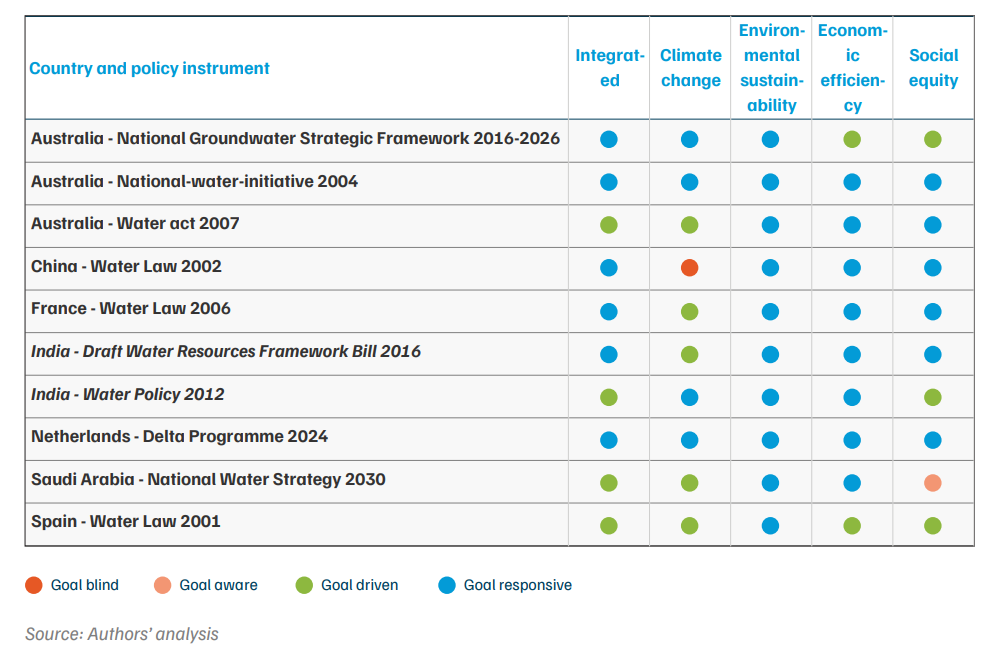
The following are our major findings from the analysis:
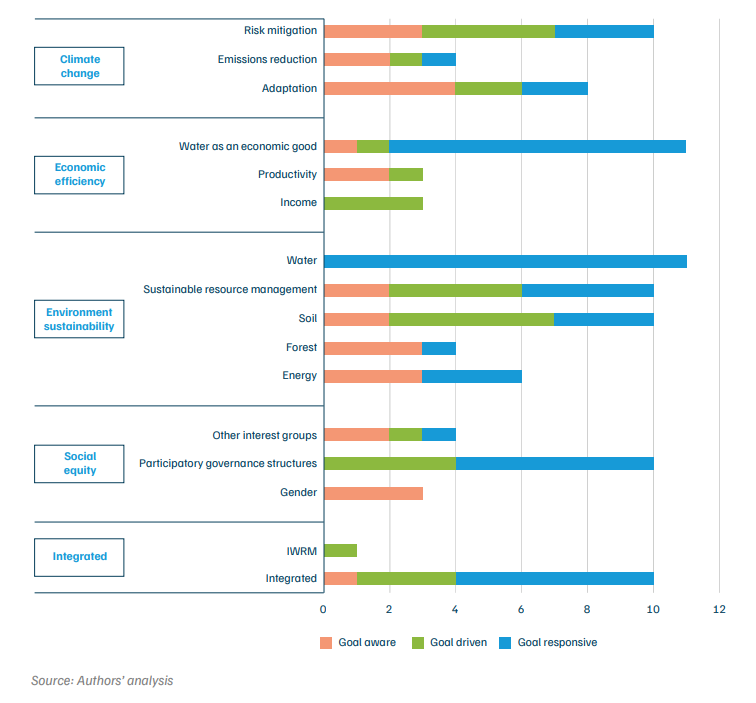
In this section, we look at each objective to identify best practices and learnings within the selected policy instruments. We also assess the number of policies classified as goal-aware, goaldriven, and goal-responsive (Figure 2).
Figure 2. Multidimensional lens is essential to examine the policy instruments to IWRM and CCA principles
Integrated approach
Climate change considerations
Environmental sustainability
Economic efficiency
Social equity
We analysed how various policy instruments in Odisha and Bihar align with the goals of IWRM and CCA. Figure 3 illustrates whether the policies are goal-blind (red), goal-aware (light orange), goal-driven (green), or goal-responsive (blue).
Figure 3. All the selected policies were geared towards achieving environmental sustainability as a goal
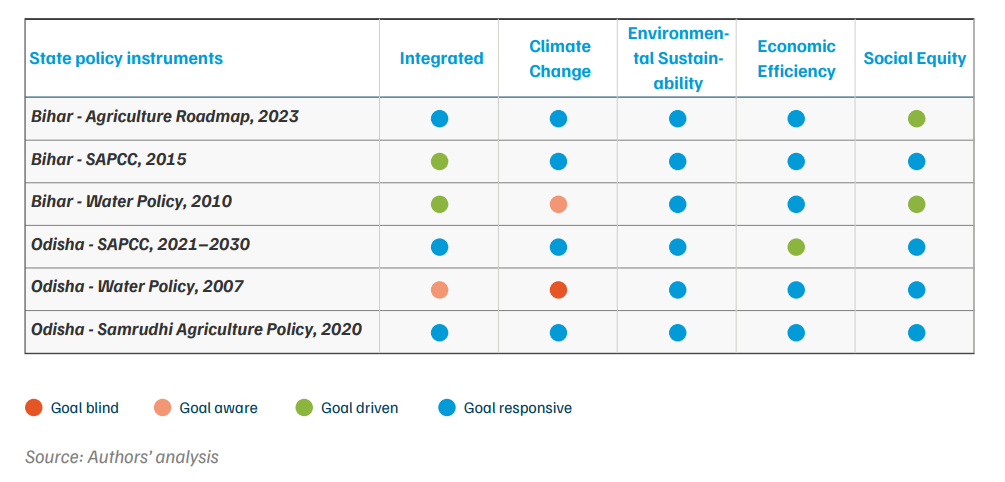
The following are our major findings from the analysis.
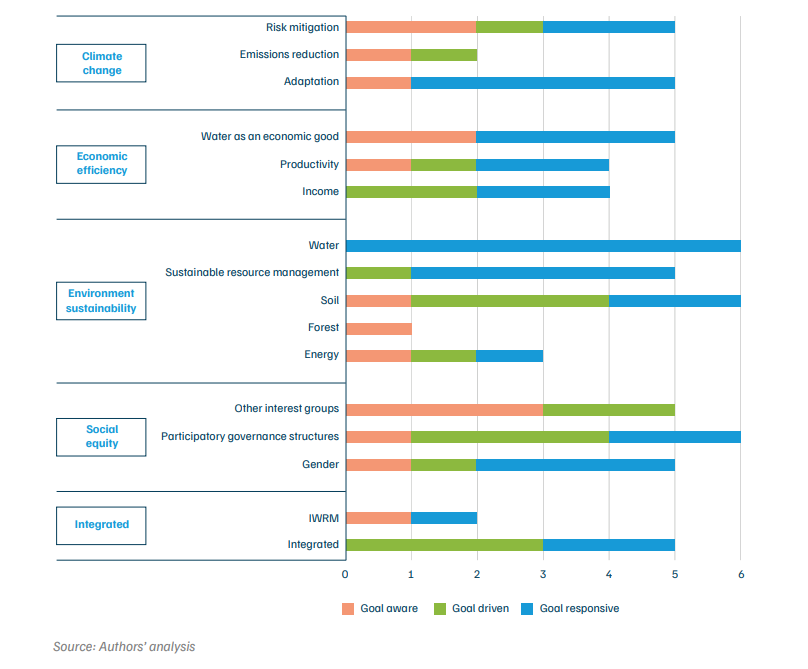
We delved further into each objective to explore best practices and learnings from subnational policy instruments related to agriculture, water, and climate change. Additionally, we analysed the proportion of policies categorised as goal-aware, goal-driven, and goal-responsive, as illustrated in Figure 4.
Figure 4. All policies are goal-responsive towards the sub-element ‘water’
Integrated focus
Climate change considerations
Environmental sustainability
Economic efficiency
Social equity
The following section highlights the overall findings from the analysis:
A narrative analysis of national and subnational policy instruments with a focus on IWRM and CCA goals highlights some important insights.
In conclusion, while this analysis sheds light on important aspects of incorporating IWRM and CCA goals in policies related to agriculture, water, and climate change, there are still several unexplored avenues for further research and action. Adopting a holistic and broad approach that includes more international case studies can lead to a comprehensive understanding of the connections between agriculture, water, and climate change as well as help develop solutions for different states across India, based on their respective contexts.
The following section presents a series of targeted, actionable recommendations across three critical domains: policy and governance, technological and infrastructure investment, and farmlevel and community practices. These recommendations are designed to foster the principles of IWRM and CCA, promoting water-use efficiency, and secure equitable water access for the agricultural sector in the face of a rapidly changing climate. Successful adaptation requires not just incremental adjustments, but a strategic, coordinated transition supported by enabling policy frameworks and significant investment in both modern and nature-based solutions.
To effectively bridge the identified gaps in water governance, the analysis of how well national and subnational policies are aligned with IWRM and CCA goals highlights opportunities for transitioning towards a comprehensive and adaptive approach. A key insight is that policy goals are prioritised differently depending on their scale, mandates, and specific contexts. To substantiate, Indian state-level policies often focus on community-driven adaptation within the agricultural systems, while national policies globally tend to emphasise mitigation and broader environmental sustainability.
Policy action towards bridging the gaps would require attention in the entire policy process covering updation of the existing national and state water policies to reflect current and projected climate risks, and also ensuring their periodic review and revision. Policies must adopt an integrated approach, fostering cross-sectoral collaboration and broad stakeholder participation, including vulnerable communities. Emphasising adaptation strategies that yield mitigation co-benefits, integrating water productivity interventions, and implementing flexible water tariffs are vital steps towards sustainable water management. Furthermore, embedding a gender perspective and establishing inter-ministerial committees at both national and subnational levels will ensure holistic policy formulation, resource alignment, and conflict avoidance. Ultimately, robust monitoring, evaluation, and learning frameworks, with public transparency and community engagement, are essential to ensure continuous improvement and the long-term resilience of India’s water resources in a changing climate.
To enable this, future research must broaden its scope to continuously integrate the evolving scientific understanding of water resources and climate change, alongside tracking the dynamic policy landscape for time-sensitive assessments. Furthermore, policy research would greatly benefit from exploring best practices and case studies from other relevant geographies to inform adaptive water resources management for a changing climate and growing farms.
Traditionally, IWRM ignores climate change uncertainties, relying on a ‘long-term approach’ based on ‘stationarity’, assuming natural systems are stable and past water and climate patterns predict the future. This assumption no longer holds due to climate change, which introduces large uncertainties in projections. This is where integrating the principle IWRM in the goal of CCA gives a structured approach for evaluating how effectively national and subnational policies is performing.
The IWRM and CCA framework has five key goals: adopting an integrated approach through multi-sectoral, multi-level governance; incorporating climate change considerations by assessing risks and implementing adaptation; ensuring environmental sustainability by protecting water resources and ecosystems; promoting economic efficiency by optimising scarce water and financial resources; and advancing social equity by guaranteeing equal water access for all, especially marginalised and vulnerable groups.
To select national case studies, we used SDG 6.5.1 reporting data, which tracks IWRM implementation globally. From 183 countries, we shortlisted 47 high performers. We then chose those with significant agricultural land: Australia, India, China, France, and Saudi Arabia, and added Spain and the Netherlands for their exemplary water management practices and policies.
One way the study finds is that gender perspectives can be included in water resource management by adopting gender-responsive strategies that address disparities and ensure women’s participation in agriculture and water governance. Examples include Bihar and Odisha’s SAPCC frameworks. This requires capacity building on gender issues, incorporating legal and socio-cultural dimensions, and developing sex-disaggregated databases for effective monitoring, assessment, and long-term equality.
Adaptation is the central focus of Bihar and Odisha’s policies, while mitigation is considered only as a co-benefit. The SAPCCs, Odisha’s Agriculture Policy (2020), and Bihar’s Agriculture Roadmap (2023) prioritise building adaptive capacity in vulnerable sectors like water and agriculture. Odisha’s SAPCC, for instance, proposes expanding hydrometry networks, improving water-use efficiency, conducting audits, and better pricing. Mitigation benefits emerge indirectly through these adaptation-led strategies.
Water, Nature, Progress: Solutions for a New India
Cattle and Community in a Changing Climate
Understanding Trends in Dietary Diversity in India: