Council on Energy, Environment and Water Integrated | International | Independent

Suggested citation: Sudan, Mehak and Vishwas Chitale. 2025. Strengthening Climate Resilience through the Global Goal on Adaptation. New Delhi: Council on Energy, Environment and Water.
Adaptation, an increasingly urgent response to climate change, has long faced both political and technical hurdles. Historically, competing with mitigation, it gained equal footing only with the adoption of the Paris Agreement (2015), which established the Global Goal on Adaptation (GGA) under Article 7.1. The GGA has the following three collective aims: to enhance adaptive capacity, strengthen resilience, and reduce vulnerability to the impacts of climate change.
For several years, progress on operationalising GGA lagged due to political sensitivities and methodological complexity. A breakthrough came in 2021 with the launch of the Glasgow-Sharm el- Sheikh work programme, which laid the foundation for the UAE Framework for Global Climate Resilience adopted at COP28. Building on this, the UAE-Belém work programme was established to develop a set of indicators to measure progress towards the objectives of the GGA.
These indicators, which are expected to be adopted at COP30 in Belém, will, for the first time, allow countries to systematically assess and report adaptation progress, thereby linking global ambition to local implementation. In this paper, we explore how the GGA can be translated into nationally relevant action, what its operationalisation may look like, what challenges may hinder its progress, and what solutions can improve the process. The constraints faced by developing countries, including multiple competing priorities, fragmented project-based funding, overstretched administrations, and limited institutional continuity, contribute to limited technical reporting capacities and data challenges, which risk slowing progress. Addressing these challenges requires both technical solutions and long-term programmatic support and political commitment.
Our analysis is anchored on the premise that the indicators are not an end in themselves. Rather, they must be used as a catalyst for greater, accelerated, and fairer adaptation action. The following are the four key messages of our analysis:
Adaptation, an increasingly urgent response to climate change, has long faced both political and technical hurdles. Historically, competing with mitigation, it gained equal footing only with the adoption of the Paris Agreement (2015), which established the Global Goal on Adaptation (GGA) under Article 7.1. The GGA has the following three collective aims: to enhance adaptive capacity, strengthen resilience, and reduce vulnerability to the impacts of climate change.
For several years, progress on operationalising GGA lagged due to political sensitivities and methodological complexity. A breakthrough came in 2021 with the launch of the Glasgow-Sharm el-Sheikh work programme, which laid the foundation for the UAE Framework for Global Climate Resilience adopted at COP28. Building on this, the UAE-Belém work programme was established to develop a set of indicators to measure progress towards the objectives of the GGA.
These indicators, which are expected to be adopted at COP30 in Belém, will, for the first time, allow countries to systematically assess and report adaptation progress, thereby linking global ambition to local implementation.
In this paper, we explore how the GGA can be translated into nationally relevant action, what its operationalisation may look like, what challenges may hinder its progress, and what solutions can improve the process. The constraints faced by developing countries, including multiple competing priorities, fragmented projectbased funding, overstretched administrations, and limited institutional continuity, contribute to limited technical reporting capacities and data challenges, which risk slowing progress. Addressing these challenges requires both technical solutions and long-term programmatic support and political commitment.
Our analysis is anchored on the premise that the indicators are not an end in themselves. Rather, they must be used as a catalyst for greater, accelerated, and fairer adaptation action. The following are the four key messages of our analysis:
The operationalisation of the GGA represents a pivotal opportunity: to make adaptation measurable, comparable, and actionable at scale. Achieving this will require aligning global frameworks with national planning, mobilising sustained and reliable finance, and building institutional systems which ensure that adaptation efforts are both effective and enduring.
Adaptation has long been acknowledged as a crucial long-term response to climate change, though it is only recently that the global attention and political momentum it has received have significantly increased (Wubet 2024). Within multilateral climate processes, adaptation has historically been overshadowed by mitigation for a multitude of reasons. Some challenges that adaptation has faced over the years pertain to its definition, its priority status relative to mitigation, and concerns about the broader implications of such prioritisation, particularly in areas such as finance and responsibility-sharing (Klein et al. 2017). With a growing body of adaptation research, the Sixth Assessment Report (AR6) of the Intergovernmental Panel on Climate Change (IPCC) has provided conceptual and technical clarity on adaptation and offers a more refined definition that highlights adaptation as a process and situates it explicitly within natural and human systems. The AR6 defines adaptation as follows: “in human systems, the process of adjustment to actual or expected climate and its effects, in order to moderate harm or exploit beneficial opportunities. In natural systems, the process of adjustment to actual climate and its effects” (IPCC 2023). This definition underscores the need to understand the outcomes and impacts of adaptation efforts and provides an essential foundation for continued scholarly and policy engagement on adaptation to advance dialogue and shape implementation.
On the political front, while remnants of these challenges persist in current debates in some evolved ways, there has been a marked shift in the positioning of adaptation in recent years, from being situated at the margins of climate policy discourse to taking centre stage. This shift is, in part, due to the increasing relevance of adaptation solutions in ensuring that vulnerable communities and ecosystems are better protected from rising temperatures and extreme weather events, which have increased multi-fold in the last two decades (WMO 2025).
COP30 marks the 10th anniversary of the Paris Agreement, which also marks ten years since the Global Goal on Adaptation (GGA) in Article 7 (A7), reflecting the shared commitment to enhancing adaptive capacity, strengthening resilience, and reducing vulnerability to the impacts of climate change while setting out linkages between the GGA and mechanisms such as adaptation communications (AdComms), the Global Stocktake (GST), and national adaptation plans (NAPs) (UNFCCC 2015). All of these reinforce the need to understand the outcomes and impacts of adaptation efforts.
While the international climate community has been increasingly focused on the operationalisation of the GGA, overall progress has been slow. It was not until 2021, at COP26, that a significant milestone was reached with the establishment of the two-year-long Glasgow-Sharm el-Sheikh (GlaSS) work programme, which provided a platform for Party and non-Party stakeholders to engage in dialogue on how to advance and measure progress on the GGA (Beauchamp and Józefiak 2023). The GlaSS work programme culminated in the adoption of the UAE Framework for Global Climate Resilience (UAE FGCR) at COP28 in Dubai, which outlines 11 targets (7 thematic targets and 4 iterative targets) to be achieved by 2030 under the GGA (paragraphs 9 –10, decision 2/CMA.5). The UAE-Belém work programme on indicators was also launched under the UAE FGCR to identify and develop indicators to assess progress towards the GGA objectives. The UAE-Belém work programme builds on the 11 targets related to the adaptation cycle, with a final set of indicators expected to be agreed upon at COP30 in Belém.
Over the next five years, between 2025 and 2030, the Paris Agreement’s ‘ratchet mechanism’ – the cycle of increasing ambition and transparency – will enter a new phase. Parties are expected to submit their third round of nationally determined contributions (NDC 3.0), informed by the outcomes of the first GST in 2023, before the COP30 in 2025. The next round of Biennial Transparency Reports (BTRs) in this timeframe is due in 2026 and 2028, which will help track progress and provide the input data for the second GST (2027–2028), which, in turn, will guide the preparation of NDC 4.0 (in 2030). Hence, the ideal outcome of the GGA process is not just the measurement of progress on the adaptation objectives of A7, but also the creation of a unified international framework that 1) informs the GST to assess collective adaptation progress and future guidance, 2) enables Parties to align national adaptation priorities with global efforts by recognising the local and context-specific nature of adaptation interventions and the role of non-state actors therein, and 3) allows for voluntary reporting without creating additional reporting burdens for the Parties (paragraph 16, decision 2/ CMA.5).
The expected adoption of the indicators will, therefore, help Parties connect their local and/or national adaptation actions to global climate resilience goals and transform the GGA from a broad vision into a measurable, trackable, and financeable framework. This will, in turn, pave the way for further discussions and debates on capacity building for implementation and reporting at different scales.
In this paper, we contribute to the discussion on bridging global goals and national adaptation efforts by specifically reflecting on the operationalisation of GGA indicators and the capacities that will be needed for successful reporting to ensure a meaningful outcome1 . Next, we explore the key themes for capacity building in reporting, regional collaborations (in Section III), and the role of national statistical offices (NSOs) and custodian agencies (in Section IV). The paper concludes with a summary of the key takeaways.
Adaptation is inherently transversal, spanning multiple policy arenas, scales, and sectors, which introduces complexities beyond technical considerations and risks perpetuating structural problems (Goodwin and Olazabal 2025). As adaptation practice(s) are still evolving and maturing, adaptation reporting remains equally fragmented.
The UAE-Belém work programme on indicators, therefore, provides a ‘shared language’ that cuts across varying scales and actors. This shared language will provide a pathway for Parties to streamline their current actions. For example, NAPs are designed to be iterative medium- to long-term planning instruments for integrating adaptation priorities in national development planning; they function as domestic policy roadmaps and as internationally recognised instruments that demonstrate the commitment of the Parties and guide resource allocation.
As of August 2025, 63 NAPs from developing countries have been submitted, with the majority coming from Africa, followed by Asia-Pacific and Latin America (NAP Global Network 2025). NAP Trends, an initiative of the NAP Global Network, shows that there are some observable characteristics. For example, all the submitted NAPs identify priority sectors, and the top three sectors are agriculture, crops, livestock, and/ or food security (97 per cent), health (92 per cent), and water and/or sanitation (89 per cent). While each Party has discretion in the formulation of its NAPs, the emergence of common priority sectors and strategies underscores an overlap in global priorities and the importance of a shared language (Wilkinson et al. 2021; Tashi et al. 2025).
The 11 targets adopted at COP28 (paragraphs 9-10, decision 2/CMA.5) recognise this overlap and demarcate 7 priority thematic targets and 4 iterative dimensional targets, which reflect these priorities. For instance, the three aforementioned sectors are listed as GGA targets under targets 9b, 9c, and 9a, respectively. Additionally, 73 per cent of the submissions include a monitoring, evaluation, and learning (MEL) framework, 68 per cent include implementation strategies, and 63 per cent outline the costs of adaptation actions and the interventions required, which are all reflected in targets 10d, 10c, and 10b, respectively. Approximately 86 per cent of the submitted NAPs reference the UN’s Sustainable Development Goals (SDGs) and 60 per cent reference the Sendai Framework for Disaster Risk Reduction – two key frameworks, among others - upon which the potential final list of GGA indicators is based (UNFCCC 2025).
NAPs are, therefore, an increasingly important document for referencing GGA targets, outlining approaches for MEL, and aligning national planning and adaptation action priorities with global targets in the initial years of the GGA operationalisation (Wilkinson et al. 2021; Tashi et al. 2025). This is primarily to ensure the harmonisation of current efforts, as opposed to the introduction of new elements that may obstruct the expected progress on adaptation efforts. The approach of using a shared language is therefore useful in harmonising existing priorities and actions for global progress, particularly by bridging technical data and political processes, thereby enabling comparability across contexts.
However, NAPs are only one of the planning tools at the disposal of Parties. The implementation of such plans ultimately determines their relevance in mainstreaming adaptation efforts, which rely on levers such as finance, technology, and capacity building. The progress on implementation under the UNFCCC is captured in other instruments, such as NDCs, AdComms, NCs, and BTRs, which allow for greater flexibility and autonomy in aligning indicator reporting (Wilkinson et al. 2021). For reporting, BTRs are particularly well-suited to support iterative learning – their biennial cycle aligns with the 2030 timeline of the GGA targets, enabling insights into Parties’ reporting on the indicators. In addition, the mandated 2028 review of the modalities, procedures, and guidelines for the BTRs provides a timely opportunity to refine adaptation reporting in line with GGA targets and indicators.
Embedding GGA targets and indicators in national systems will help channel information more effectively from the national to the global level, thereby strengthening the assessments of adaptation action and support through the GST (Figure 1). This would involve 1) linking GGA targets with national adaptation planning, as relevant to national circumstances; 2) integrating, where relevant, GGA indicators in national MEL systems in collaboration with national and local stakeholders; and 3) periodic reporting on GGA indicators through UNFCCC instruments (Lamhauge and Duluk 2025).
Figure 1. The national iterative adaptation process and UNFCCC reporting instruments
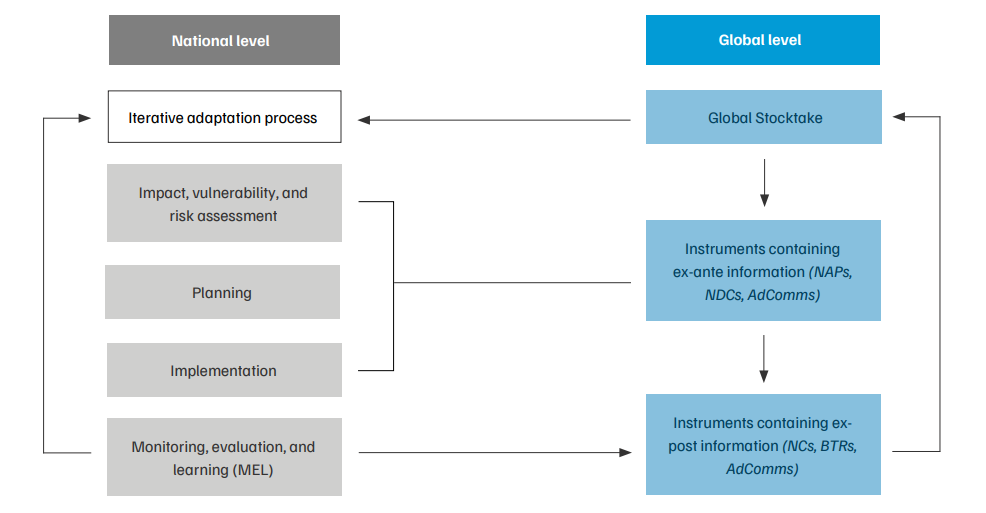
Source: Lamhauge and Duluk (2025)
As different countries experience climate change effects differently and are vulnerable to such effects in different ways, flexibility in the contextualisation of indicators and their reporting is crucial to encourage solutions that reflect local realities and the particular needs of vulnerable people (Tashi et al. 2025). Developing countries, in particular, face multiple competing priorities, often resulting in overstretched administrations. Additionally, fragmented project-based funding and the absence of long-term programmatic support are persistent challenges in ensuring adequate coherence, coordination, and institutional continuity among adaptation actions and capacities built, including for planning and reporting.
A key consideration in the GGA reporting process will be whether national data is adequately representative of global progress. The list of GGA indicators stands to be negotiated before being adopted; however, approximately 80 per cent of the indicators on the latest proposed list builds on existing international frameworks, need to be refined in terms of their adaptation relevance, while the remaining are either newly proposed indicators or have limited reporting coverage (UNFCCC 2025). While GGA indicators are not intended to replace national indicators, they can encourage vertical and horizontal alignment and offer a structured approach for tracking progress. In all cases, operationalising the GGA indicators will necessitate capacity building for data systems and reporting, particularly in developing countries.
Greater regional collaboration is a key enabler to help address some of the aforementioned challenges, particularly for Parties with shared or similar structural constraints, geographical characteristics, transboundary linkages, climatic zones, vulnerabilities, and potentially matched capacities in some cases. By pooling resources, fostering knowledge exchange, and promoting greater consistency across countries, regional collaboration can reduce duplication, enhance efficiency, and increase collective capacity.
As the proposed indicators have been adapted from existing frameworks, the lessons learned are also arguably transferable. The SDG framework offers a useful precedent in this regard. SDGs reporting uses an iterative approach that allows for continuous improvement, resulting in 70 per cent of the indicators being operational and 68 per cent of the indicators having good data coverage, as of 2024 (Lamhauge and Duluk 2025). The SDG framework also demonstrates how regional cooperation has been leveraged across diverse contexts, from North–South initiatives (Alam 2022) and polar regions (Shijin et al. 2023), to Asia (Bhutia 2021; Chaturvedi 2021; Kumar and George 2021), the Gulf Cooperation Council region (Al-Saidi 2021), and Africa (Valensisi and Karingi 2018), as well as across multiple sectors (Amaya and Lombaerde 2021; Monyei et al. 2022; Pandey and Asif 2022). Comparable lessons can inform the GGA process, given that its proposed indicators are adapted from existing frameworks and transferable across contexts.
The IPCC AR6 also recognises regional governance as a critical layer for adaptation, particularly in the context of shared, transboundary risks. This is well illustrated by the following context-specific cases.
Such cooperation allows for the use of shared methodologies, the exchange of best practices, and capacity development. Regional institutions, such as multilateral development banks (MDBs), intergovernmental organisations (IGOs), UNFCCC Regional Collaboration Centres (RCCs), civil society organisations (CSOs), and other non-state actors also play an important role in aggregating data and advancing the idea of a ‘regional goal on adaptation,’ ensuring that progress is contextualised to lived realities. MDBs are well-positioned to support regional efforts to mobilise finance to address shared vulnerabilities, such as those faced by mountainous or coastal communities. RCCs, IGOs, and CSOs are also crucial in leading research efforts, developing thematic expertise, disseminating knowledge, supporting multi-governance coordination, and addressing any existing gaps. These actors are also critical in ensuring that the actions of non-Party stakeholders/non-state actors are complementary and feed into Party actions and reporting. While each actor (Party or non-Party) has a specific role to play in the process, such platforms require stronger institutional support as well as predictable and reliable financing to realise their full potential. Improving data collection, technical capacity, and coordination, while engaging communities, is essential for developing sustainable, effective adaptation strategies (Tashi et al. 2025).
One challenge that is faced globally at different adaptation governance levels is the lack of legal and institutional mandates, resulting in fragmented coordination. The lack of comprehensive, localised data collection systems and the absence of baseline data in some cases have also hampered the ability to track adaptation progress (Malik and Ford 2025; Tashi et al. 2025).
Reporting effectively at the national and global levels requires effective coordination, and NSOs are potential leaders for national coordination. To ensure that the GGA does not fall victim to the challenges mentioned above, NSOs need clear legal and institutional mandates, adequate resources, and continuous training to coordinate adaptation data systems effectively. For effective coordination, they would ideally also need to coordinate with national focal points, liaise with relevant ministries, and have exposure to UNFCCC processes to better understand its mandates.
To achieve coordination, NSO staff require specialised and institutional training and line departments require statistical training to strengthen their ability to support NSOs. Knowledge-sharing mechanisms and capacitybuilding initiatives for line department officials who report sectorally are also essential. At the global level, custodian agencies and technical organisations must provide guidelines, support capacity building, and foster peer exchanges to enable NSOs and nationally notified statistical organisations to fulfil this role effectively.
With the expected agreement on and adoption of the GGA at COP30, its operationalisation will require focused efforts on capacity building, strengthening MEL frameworks, and clarifying how the GGA indicators can be aligned with national and international reporting processes. Advancing the GGA is crucial for strengthening accountability, improving the effectiveness of climate finance, and unifying adaptation efforts (Wilkinson et al. 2021).
The interconnected nature of climate adaptation efforts and sustainable development objectives underscores the importance of integrating adaptation measures with broader development agendas to achieve holistic outcomes. Therefore, operationalising the GGA indicator set will require tackling several challenges, including but not limited to:
Given the Party-driven and voluntary nature of the GGA, the success of the process of developing a standardised global progress assessment will be underpinned by the ambition and feasibility of the indicators. The operationalisation of the expected set of indicators and solutions to the anticipated challenges can be improved through the following key measures.
Ultimately, the GGA indicators are one component of the Paris Agreement’s architecture and must be embedded within existing UNFCCC reporting systems and institutional mandates. The adoption of the GGA indicators will likely be followed by a transition operationalisation phase during which Parties, individually and collectively, will explore how the indicators align with national priorities and established UNFCCC reporting processes (OECD 2025). Regional collaboration in this operationalisation will play a key role in easing burdens and building capacity. Ideally, this should include coordinating adaptation actions at all governance levels and among all stakeholders to coproduce multisectoral solutions. Developed countries are expected to lead with full transparency and increased financial commitments, while developing countries are expected to enhance their reporting systems and ambition. This cycle will reinforce the Paris Agreement’s five-year report-review-enhance ‘ratchet mechanism’, leading to progressively stronger global climate action. We must remind ourselves that the indicators are not an end in themselves, but a vehicle for greater ambition and implementation of adaptation actions.
Roadmap of the methodology to assess the climate co-benefits of the SUP ban in Tamil Nadu
Unlocking finance for NbS in Indian Cities
Locally-led Climate Action in the Global South

Roadmap of the methodology to assess the climate co-benefits of the SUP ban in Maharashtra