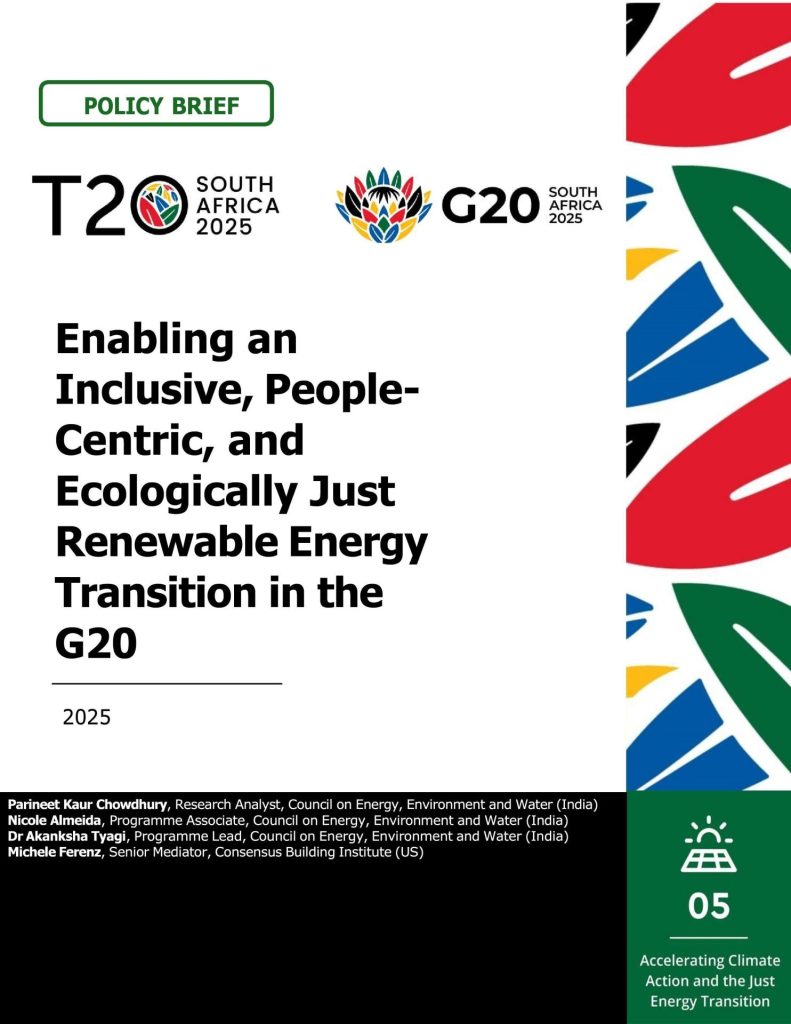
Policy Brief
Enabling an Inclusive, People-Centric, and Ecologically Just Renewable Energy Transition in the G20
Parineet Kaur Chowdhury, Nicole Almeida, Akanksha Tygai, Michele Ferenz
October 2025 | Energy Transitions
Authors
- Parineet Kaur Chowdhury, former Programme Associate, Council on Energy, Environment and Water
- Nicole Almeida, Programme Associate, Council on Energy, Environment and Water
- Akanksha Tyagi, Programme Lead, Council on Energy, Environment and Water
- Michele Ferenz, Senior Mediator, Consensus Building Institute
Overview
This policy brief advances the current G20 agenda by providing actionable recommendations to operationalise a just and inclusive energy transition. We discuss the role of the G20 and actions required, such as encouraging companies to select sites that have a low impact on people and the environment, introducing frameworks for benefit sharing, the use of social and ecological criteria in bid selection and G20's role in unlocking responsible finance. We also share best practices from G20 countries in people-centric renewable energy deployment to disseminate learnings for policymakers.
Key Highlights
- The rapid, large-scale deployment of Renewable Energy (RE) is causing concerns in communities over local rights, land access, and ecosystem integrity, which often leads to costly project delays and cancellations.
- The G20 Brazil Leader's Declaration of 2024 endorsed 10 voluntary principles for Just and Inclusive Energy Transitions, covering areas such as energy planning, social dialogue and participation, social protection, policy inclusiveness, and sustainable, inclusive economic growth. In practice, however, the majority of these principles are not yet consistently followed on the ground.
- To operationalise these principles, we propose the following recommendations:
- The G20 countries should empower responsible and low-impact site selection for renewable energy projects. This can be achieved through the development of high-quality, accessible, and comprehensive databases that detail biodiversity hotspots, protected areas, and endangered species. This should be complemented by dialogue with communities and local government on site selection, along with reforms in land governance, such as the digitisation of land records.
- The G20 nations should establish clear regulatory frameworks that support diverse benefit-sharing models, such as business models where locals co-own RE projects, where employment is earmarked for locals and where project profits can be used for community development activities. The G20 leaders should also build a vision on what the highest level of ambition in responsible renewable deployment might look like.
- The G20 should promote the establishment of non-price criteria in project tendering and bidding. The non-price criteria should include requirements of comprehensive environmental and social mitigation plans, benefit-sharing mechanisms, evidence of low-impact siting and others.
- The G20 should adopt concrete measures to unlock dedicated funding for responsible activities. Specifically, the G20 ought to establish a pooled fund designed to both pilot and scale up models of responsible renewable energy development. This action will deliver essential early-stage financial support to developers who commit to inclusive and equitable practices.
"Building on the G20's 2024 commitment to a just and inclusive energy transition, the time is now to move from principles to practice. This brief provides actionable strategies such as low-impact siting, benefit-sharing frameworks, and the inclusion of non-price criteria in tendering processes, among others, to scale responsible renewable energy deployment - keeping people and the environment at the core of the clean energy transition.”