Other Publications
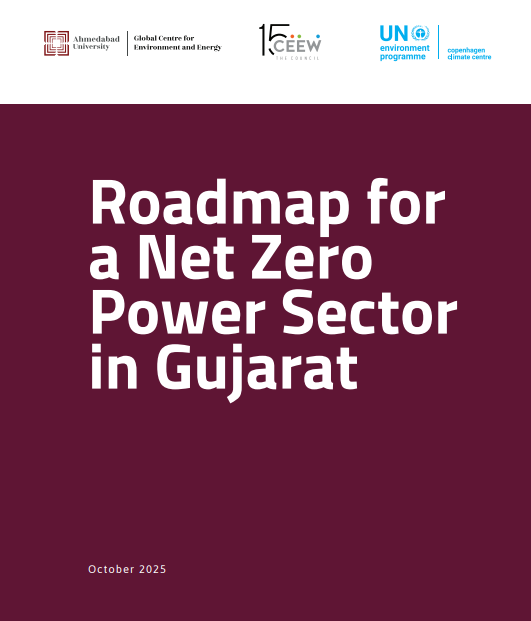
Roadmap for a Net-Zero Power Sector in Gujarat
Aman Malik, Rishabh Varma, Varadharajan Venkatesh
October 2025 | Low-carbon Economy
Overview
The power sector is the crucial to Gujarat’s net zero transition. In 2023, energy accounted for nearly 68% of the state’s total emissions, with electricity generation alone contributing 66.8 MtCO₂e. Moreover, with ambitious plans to become a $3.5 trillion economy in 2047 electricity demand is only going to increase significantly.
The Roadmap for a Net Zero Power Sector in Gujarat is a companion report to the larger report on Assessment of Net Zero Scenarios for Gujarat (2025). It combines scientific modeling (using GCAM and LEAP), stakeholder consultations, and barrier analysis to identify actionable short-, medium-, and long-term measures in the power sector for Gujarat reach net-zero. The report has been jointly prepared by the Global Centre for Environment and Energy (GCEE) at Ahmedabad University and the Council on Energy, Environment and Water (CEEW), with support from UNEP Copenhagen Climate Centre.
Electricity demand in Gujarat is expected to rise nearly fivefold between 2025 and 2045, driven by rapid growth in state’s economy and large-scale electrification in industry and buildings sectors. Achieving net-zero will require this electrification to be driven primarily by solar and wind. While renewable energy already accounts for about 32% of Gujarat’s total power generation in 2024, deepening the transition will demand a massive scale-up of capacity alongside stronger policies, infrastructure upgrades, and financing mechanisms. The roadmap sets out clear targets and enabling measures to ensure Gujarat not only meets its growing electricity needs but do so while aligning itself for a low-carbon future.
Beyond emissions reduction, the roadmap highlights co-benefits such as green job creation, improved energy security, and alignment with Gujarat’s Viksit Gujarat@2047 vision of becoming a $3.5 trillion economy. It also underscores the importance of addressing barriers like land and water constraints, grid integration challenges, financial risks, and policy misalignments- to ensure a just and inclusive transition.
What the roadmap provides:
- Targets and milestones for the Power Sector
- Key actors and agencies involved in implementing the roadmap
- Guidance and policy recommendations for key stakeholders
- Finance and enabling conditions, including infrastructure
Key Findings
- Electricity demand growth: Gujarat’s electricity demand is expected to increase almost fivefold between 2025 and 2045 from 160 TWh to 685.5 TWh, with industry and buildings accounting for the largest shares.
- Solar and wind dominated generation mix: By 2045, solar and wind will dominate the power sector, contributing 60.5% and 23.5% of generation respectively in line with a net-zero visit. Coal’s share falls to just 3% by 2045, with no new coal power plants built after 2030.
- Installed capacity expansion: Total installed capacity could reach 537 GW by 2045 under the Net Zero pathway, with 98% from renewable sources. Solar alone will account for 71% of capacity. An estimated battery storage capacity of 59 GW will be essential to accommodate these renewable energy shares in 2035.
- Emissions trajectory: Power sector emissions decline from 66.8 MtCO₂e in 2020 to 19.5 MtCO₂e by 2045, a 70% reduction compared to the 2020 level.
- Investment costs: Power sector and related infrastructure will cost around 798 thousand crore rupees between 2030 and 2035, and around 598 thousand crore rupees between 2025 and 2030. This includes cost of solar, wind, 4 hours battery backup, and Transmission & Distribution.
- Green jobs from solar and wind: Transitioning to renewable energy could generate between 3.8 and 6 million new jobs by 2045. However, fossil fuel job losses may result in a net reduction of ~381,000 jobs, highlighting the need for just transition policies.
- Barriers to scale-up: Key challenges include land and water constraints, variability of solar and wind, delayed power purchase agreements, misalignment of central and state policies, limited grid infrastructure, and dependence on imported materials for storage and manufacturing.
- Mitigation measures: The roadmap recommends hybrid projects to optimise land use, advanced forecasting and storage solutions to manage variability, targeted subsidies and green bonds to improve financial viability, harmonised policies for stability, and capacity-building programs to develop a skilled workforce.
“By 2045, Gujarat’s power sector will be almost entirely renewable, with solar and wind providing more than 80% of generation. This transformation is not just about clean energy—it’s about building resilience, creating millions of green jobs, and positioning Gujarat as a leader in India’s net zero journey.”