Other Publications
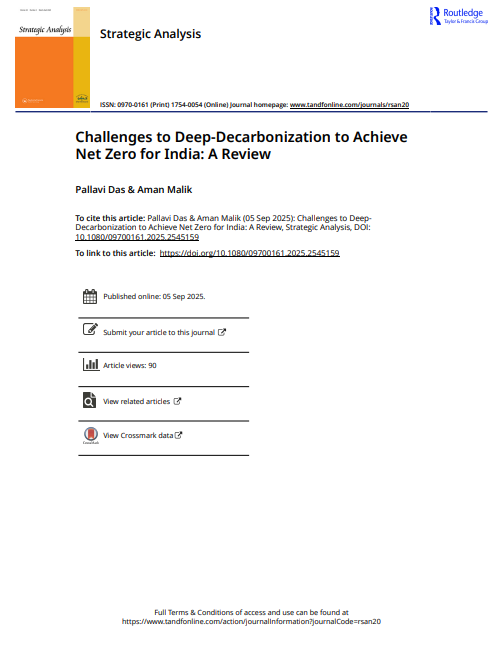
Challenges to Deep-Decarbonization to Achieve Net Zero for India: A Review
Pallavi Das and Aman Malik
September 2025 | Low-carbon Economy
Overview
Achieving net-zero emissions is essential to limiting global warming, and India’s role is critical given its size, developmental needs, and rising energy demand. This article reviews recent academic and grey literature to identify key challenges to deep decarbonization in India, with a focus on the near term. It introduces a conceptual framework that groups these barriers into three broad categories: techno-economic, governance and institutional, and socio-economic and political economy. Within this structure, it analyses sector-specific obstacles in power, industry, and transport. The review highlights cost and financing barriers, regulatory and institutional limitations, and complex socio-political trade-offs. The article concludes by identifying opportunities for targeted interventions and outlines research and policy gaps that need urgent attention to ensure India’s transition to net zero aligns with its development priorities.
Key Highlights
- Techno-economic challenges - Decarbonization faces techno-economic barriers, including high costs of clean technologies, limited financing, and slow adoption. In the power sector, challenges include expensive energy storage and grid upgrades, in the transport sector costs of EVs and poor charging infrastructure is a challenge while for the industry sector struggles with immature, costly options like green hydrogen and CCS, hindering large-scale emission reduction efforts.
- Governance and institutional challenges: Governance and institutional challenges hinder decarbonization due to weak coordination and limited capacity. In the power sector, discom losses, rigid PPAs, and distorted tariffs persist. Reforms in market design, tariff structures, and stricter enforcement of RPOs and FGDs are essential for rapid transformation.
- Socio-economic and political challenges: Socio-economic and political challenges include ensuring international climate equity, adequate finance, and a just transition that safeguards vulnerable communities. India’s coal dependence creates resistance to change, while renewable jobs can’t fully replace coal employment. Critical mineral security and rising consumerism further complicate achieving equitable, sustainable decarbonization pathways.
"India’s decarbonization is a balancing act—advancing clean energy while safeguarding jobs, equity, and development for a nation still on its path to prosperity."