Council on Energy, Environment and Water Integrated | International | Independent

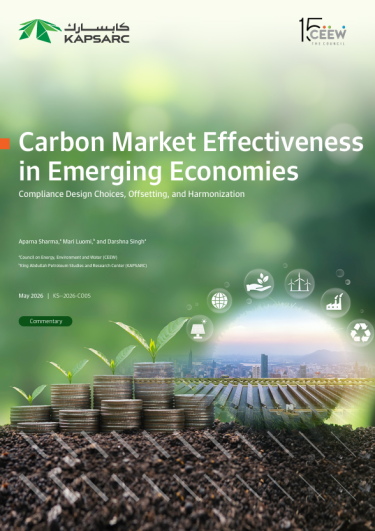
This paper examines how emerging economies can design effective emissions trading systems (ETSs), drawing on insights from a KAPSARC-CEEW workshop and a comparative analysis of China, India, Viet Nam, and Türkiye. It finds that these systems benefit from alignment with national development goals and generally adopt phased implementation, often beginning with intensity-based targets, free allocation, and limited coverage to balance economic and environmental goals. Over time, ETSs tend to evolve toward greater stringency, broader sectoral scope, and improved market functioning through iterative learning. A central finding is that robust monitoring, reporting, and verification systems are essential for effective ETSs. The paper also evaluates the role of offsetting, using carbon credits from outside the ETS scope, highlighting their potential to enhance flexibility while cautioning against risks to environmental integrity. Finally, it underscores the growing influence of global dynamics, including carbon border measures and market cooperation, in shaping domestic carbon market strategies. Overall, ETS effectiveness depends on adaptive, context-specific design rather than a single universal model.
An ETS is a market-based mechanism that caps emissions and allows entities to trade allowances or credits. It is important for emerging economies because it enables cost-effective emissions reductions while supporting economic growth, particularly in contexts where development and industrial expansion remain priorities
ETSs in emerging economies tend to be phased, intensity-based, and initially limited in scope, reflecting the need to balance emissions reduction with economic growth. Over time, these systems evolve toward greater stringency, broader coverage, and improved market functioning.
Robust MRV systems ensure data accuracy, transparency, and compliance, forming the backbone of credible carbon markets. Without strong MRV, carbon markets risk weak enforcement, low trust, and poor environmental outcomes.
Pilot phases and prior mechanisms help build institutional capacity, data systems, and market readiness. They allow policymakers to test design features and refine systems iteratively before full ETS implementation.
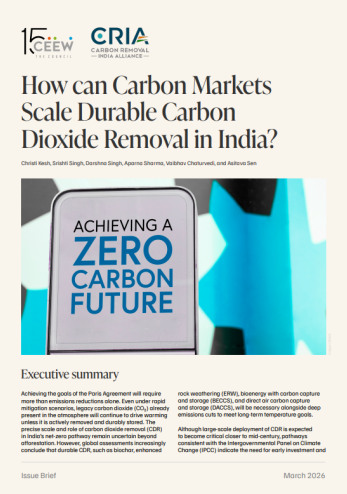
How can Carbon Markets Scale Durable Carbon Dioxide Removal in India?

Sustainable rice cultivation in India
Roadmap for a Net-Zero Power Sector in Gujarat

EU Carbon Border Adjustment Mechanism
Challenges to Deep-Decarbonization to Achieve Net Zero for India: A Review