Council on Energy, Environment and Water Integrated | International | Independent

Suggested Citations: Sharma, Swati, Pallavi Das, Vaibhav Chaturvedi, and Ankur Malyan. 2025. Sustainable Rice cultivation in India. New Delhi: Council on Energy, Environment and Water.
India, the world’s largest rice exporter and second-largest producer, relies heavily on this staple crop, which accounts for 40 per cent of national food grain output and supports over 60 per cent of the population. However, climate change and extreme weather events are increasingly disrupting production—recent events have already reduced yields by 5–6 per cent in major rice-growing states—posing serious threats to both livelihoods and food security. At the same time, rice cultivation itself is a source of greenhouse gas emissions, making it essential to transform the sector so that it is both resilient to climate impacts and aligned with mitigation goals.
This study examines adoption of sustainable rice cultivation techniques to reduce emissions from rice cultivation as well as its increased resilience for top 12 rice-producing states. It highlights resilience strategies including crop calendar adjustments, resource conservation practices, land-levelling technologies, zero tillage, mechanisation, among others. Achieving climate resilient and low-carbon rice production in India will require a region-specific, technology-enabled, farmer-centred approach supported by strong institutional coordination.
India is the second-largest producer of rice, and its largest exporter. This staple crop accounts for 40 per cent of the nation’s food grain production and sustains over 60 per cent of the population (MoAFW 2021a, Ramachandran 2006, Pathak 2019). However, climate change and extreme weather events pose a critical threat to safeguarding rice cultivation and food security. Recent catastrophic climate events have ravaged paddy production by 5–6 per cent in key states like Punjab, Haryana and Uttar Pradesh, escalating the need for immediate action (V. Gupta 2022).
While rice cultivation is impacted by climate change, it is also a source of emissions that contribute to climate change. Up until now, the focus has been on the energy sector as the largest contributor to emissions; however, as climate impacts are on the rise, all sources of emissions are being analysed to mitigate climate change. Recognising the contribution of the agriculture sector and rice cultivation as an emitter, it is important that the future of the sector is made resilient to the impacts of climate change, and it produces limited emissions. Therefore, sustainable rice cultivation will need robust adaptation and mitigation measures against the escalating impacts of climate change.
In this study, we reviewed the emission intensity in the top-12 rice-producing states in India and the potential of these states to adopt sustainable alternative methods, such as direct-seeded rice (DSR), system of rice intensification (SRI), alternate wetting and drying (AWD), drip irrigation (DI) and short-duration cultivars (SDC). Further, we also reviewed the potential methods and strategies, such as adjustments to the crop calendar, resource conservation techniques like laser land levelling, no-tillage practices and crop diversification, among others, for high resilience of rice so that there are limited yield losses due to climate change.
Figure ES1. Emission-income correlation across states
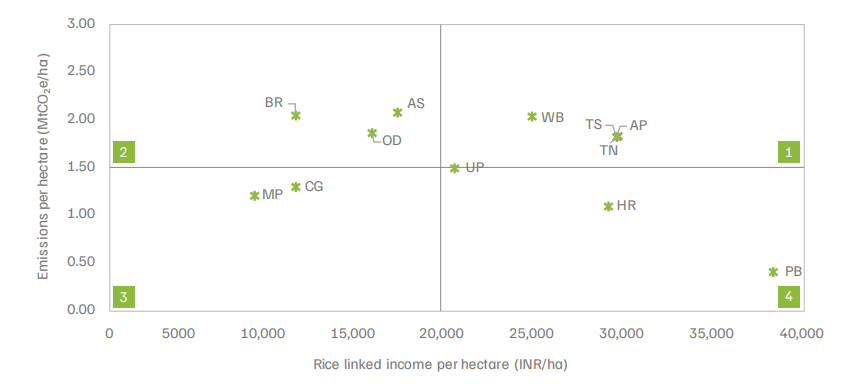
Source: Authors’ analysis based on average yield and MSP declared by government of India, and emissions calculated using IPCC 2006 guidelines (all data for 2009).
Note: 1) AS = Assam, AP = Andhra Pradesh, BR = Bihar, CG = Chhattisgarh, HR = Haryana, MP = Madhya Pradesh, OD = Odisha, PB = Punjab, TN = Tamil Nadu, TS = Telangana, UP = Uttar Pradesh, WB = West Bengal.
2) The minimum rice-linked income is calculated based on the reported production of rice and the minimum support price declared by the government. The actual income may vary based on the trade.
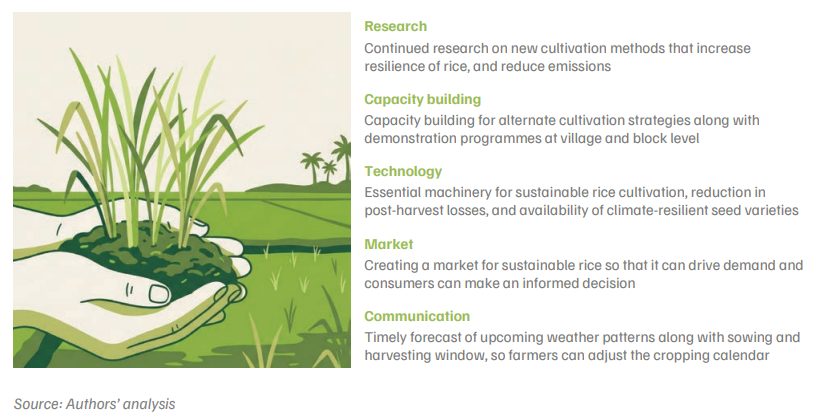
Sustainable rice production must promote practices and varieties that both lower emissions and strengthen resilience to climate change. This requires expanded research on methods such as DSR, AWD, SRI, DI, and SDC—especially region-specific studies—to better understand their mitigation potential and practical challenges as noted in Figure ES2. Farmers need targeted training, demonstrations, and success stories to build confidence in these approaches, along with improved access to essential technologies. Clear and timely updates on weather forecasts, crop advisories, and government incentives is equally important to support timely decision-making. Creating consumer demand through labelling of sustainably produced rice can further encourage sustainable rice production at the farm level. As a major staple in India, rice must transition to climate-smart and low-emission production which will require coordinated action from farmers, extension agencies, governments, and the private sector.
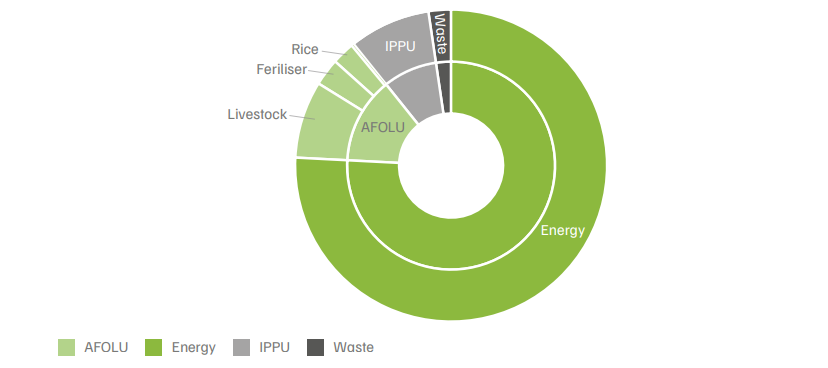
In recent years, climate change has created havoc with rising disasters and extreme events such as floods, cyclones and droughts, among others. And while countries have set emission reduction and net-zero targets, worldwide emissions continue to rise. Traditionally, the focus has been on the energy sector, which accounted for 75 per cent of India’s total emissions (MoEFCC 2021). However, as impacts increase, all sources of emissions, such as the Agriculture, Forestry, and Other Land Use (AFOLU) sector, the Industrial Processes and Product Use (IPPU) sector, and the waste sector, are being investigated, and natural and geological sinks are being explored to mitigate carbon reaching the atmosphere.
Figure 1. Sector-wise greenhouse gas (GHG) emissions of India
Source: MoEFCC. 2021. India: Third Biennial Update Report to the United Nations Framework Convention on Climate
Change. Ministry of Environment, Forest and Climate Change, Government of India.
The agriculture sector is dependent on monsoons, making it vulnerable to climate change even while it emits. About 5–10 per cent of total paddy production has been destroyed in the states of Punjab, Haryana, and Uttar Pradesh (UP) due to extreme climate events in 2022 (V. Gupta 2022). As the backbone of the rural economy, the sector employs 70 per cent of rural households, of which 82 per cent are small and marginal farmers (FAO 2024). With rising climate impacts, the sector needs to move towards sustainability so that there is a reduction in yield loss, increased farmer incomes, and a reduction in emissions from the sector.
As a staple crop in India, rice accounted for 74.6 kg of rural and 56.7 kg of urban per capita consumption annually (Ramachandran 2006). Moreover, rice contributes to 40 per cent of India’s food grain production and is consumed by more than 60 per cent of the population as a staple food (Pathak 2019). Further, India is the world’s second-largest producer and largest exporter of rice, with a production of 118 million tonnes in 2019–20 (MoAFW 2021a). This signifies the pivotal role that rice plays in the Indian economy, as it supports livelihoods, ensures food security as well as bringing in export forex.
From the emissions perspective, rice emissions in India stand at 73.43 million tonnes carbon dioxide equivalent (CO2e), compared to energy emissions at 2,374 million tonnes (MoEFCC 2021). Research efforts in the country show that a few cultivation strategies hold methane reduction potential, bringing with them improved resource efficiency, lower cost of cultivation, and higher productivity (Pathak and Aggarwal 2012).
This study focuses on the impact of emission mitigation measures on rice cultivation under various methods such as alternate wetting and drying (AWD), change in fertilisers, and change in seed variety etc. It also talks about the various adaptation strategies that will be required so that rice cultivation can remain resilient to the impacts of climate change.
Rice is conventionally grown in flooded soils as it can tolerate anaerobic conditions. Furthermore, the advantages of flooded soils include minimal weeds and irrigation needs, availability of nutrients like phosphorus, iron, manganese, silicon, and potassium, and consequently, less need for fertilisers (Kundu 2016).
Under flooded conditions, rice emissions occur when methanogen bacteria react with the organic matter present in the soil to produce methane gas (Conrad 2020).
Organic matter in anaerobic soil → CO2 + CH4
Methane emissions from the paddy field are contingent on the duration for which the soil remains under water (anaerobic condition). Further emissions also depend on the area under cultivation, irrigated area, and irrigation regime (Vasudha Foundation 2019) as well as soil type.
Table 1. Types of rice cultivation regimes and their status in India
| Type of land | Type of cultivation land | Type of rice water regime | Description | Area under regime in India (%) |
|---|---|---|---|---|
| Upland | Upland | Upland | Fields do not ever experience prolonged flooding. | 13.02 |
| Lowland | Rainfed | Flood-prone | During the rainy season, the water level may rise by 50 cm in the fields. | 5.9 |
| Drought-prone | Every farming season experiences dry spells. | 33.19 | ||
| Deepwater | During the growing season, floodwater rises to more than 50 cm for a sizeable portion of the time. | 3.19 | ||
| Irrigated | Continuous flooding | During the rice-growing season, fields are always submerged in water and are only dried out for harvest. | 15.89 | |
| Single aeration | During the rice-growing season, fields are constantly submerged in water and are only dried out once before harvest. | 16.44 | ||
| Multiple aeration | During the growing season, fields are aerated more than once. | 12.42 |
Source: MoEFCC. 2021. India: Third Biennial Update Report to the United Nations Framework Convention on Climate Change.
Ministry of Environment, Forest and Climate Change, Government of India.
In India, rice is predominantly produced in 12 states: West Bengal, Uttar Pradesh, Punjab, Telangana, Odisha, Chhattisgarh, Tamil Nadu, Andhra Pradesh, Bihar, Madhya Pradesh, Haryana, and Assam. These 12 states collectively produced more than 100 million tonnes (MT) of rice on 36.5 million ha of land in 2019–20; the other 16 MT were produced across other regions (MoAFW 2021a).
West Bengal, Uttar Pradesh, and Punjab are the top three rice producers, contributing more than 34 per cent to the total rice production (MoAFW 2021a). Across states, there has been an improvement in rice productivity over time. However, Punjab leads the states in productivity with a yield of 4366 kg/ ha, followed by Andhra Pradesh and Tamil Nadu. Chhattisgarh, Odisha, and Bihar are the tail-enders, having rice productivity 50 per cent lower than Punjab.
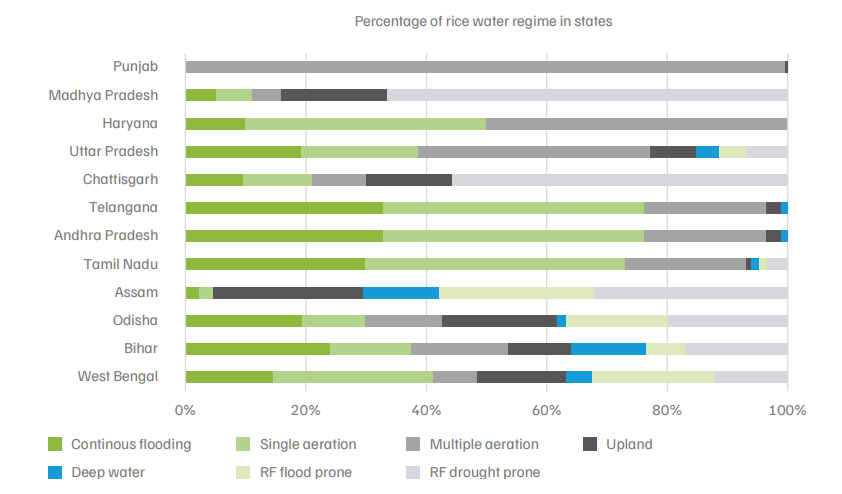
Rice emissions vary across states due to differences in soil type as well as irrigation regimes (Figure 2), among other things. Eastern states like Bihar and West Bengal fall under the lower Gangetic plains and have alluvial and loamy soil. They receive an average rainfall of 100–200 cm per year with a groundwater depth of 2–10 metres below ground level (mbgl). The water retention quality of these types of soil is high, and therefore, rice cultivation occurs under deepwater, flood-prone, and continuous flooding irrigation regimes, which easily facilitate the anaerobic reaction by methanogen bacteria over a longer time duration and release emissions. Similarly, the northeastern state of Assam falls under the East Himalayan agro-climatic zone, with red loamy and alluvial soil, which has high water retention; it experiences rainfall above 200 cm and has a shallow water table of 2–5 mbgl (NITI Aayog 2024).
Figure 2. Rice water regimes across 12 rice cultivating states
Source: Pathak, H, A Bhatiya, N Jain, and P.K Aggarwal. 2010. Greenhouse Gas Emission and Mitigation in Indian Agriculture.
Andhra Pradesh, Tamil Nadu, and Telangana fall under the southern plateau, a semi-arid region, receiving 50– 100 cm rainfall and ground water table of 2–20 mbgl. While they have red and yellow loamy soil, they receive comparatively less rainfall. Hence, a major portion of the rice cultivation area falls under continuous flooding and single aeration irrigation regimes. Therefore, these states feature in the middle of the emission spectrum of the top-12 rice-producing states (Bansal 2024).
North-western states like Punjab and Haryana emit less methane despite having a 99 per cent irrigation rate. They fall under the agro-climatic zone of the trans-Gangetic plain with sandy and loamy soil (P.K. Gupta et al. 2009). They have a low soil organic carbon content, and the lowest water retention rate (Gogoi, Baruah, and Gupta 2008). They receive an average rainfall of 70–125 cm, and have a deep water table at 10–40 mbgl before the monsoons. Hence, the major portion of rice cultivation area falls under the multiple aeration regime, which has the lowest emission factor. However, these states pump more and more groundwater into the field to make it suitable for rice cultivation.
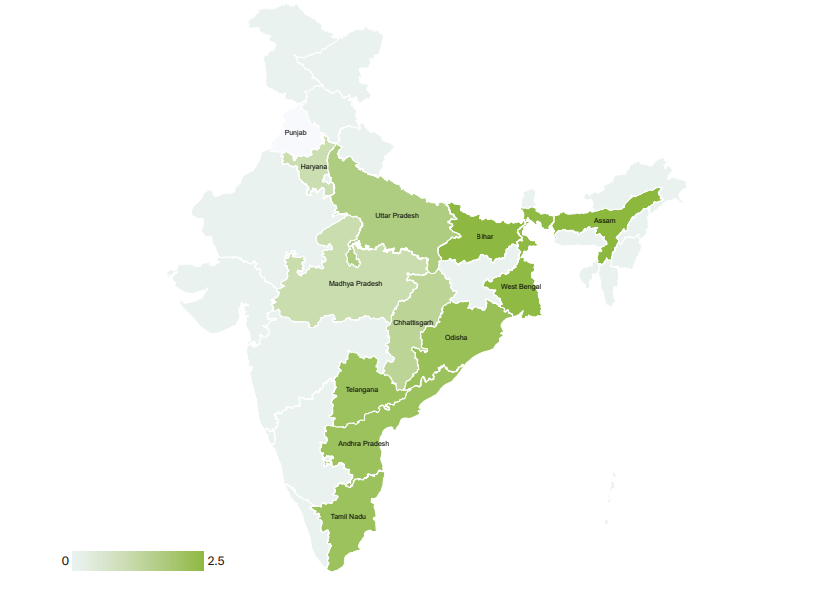
Based on the rice emission trends of the selected 12 states, taken from the GHG platform report, the eastern states of Assam and West Bengal have the highest emissions per hectare, followed by Odisha and Bihar, together contributing to 42 per cent of total rice emissions in the country (Figure 2). The soil quality, annual rainfall and depth of the water table impact the high emissions from these states.
Figure 3. Assam, West Bengal, and Bihar contributed highly to the emissions per hectare (CO2e) in 2019
Source: Authors’ analysis
Note: The issue brief only considers methane emission from rice cultivation represented as CO2e using GWP.
Conventional rice cultivation under irrigated condition involves land preparation, puddling to create a mud-like soil consistency, seedbed preparation for germination, transplanting seedlings into the main field after repeated puddling, and meticulous water management. This technique is not only waterinsensitive, but also time-consuming. Practising the conventional method of sowing over a long period of time has caused issues, such as dwindling of water tables, labour shortages during peak seasons, and declining soil health (Kaur and Singh 2017). This necessitates an alternate establishment strategy to ensure rice yield and natural resource sustainability.
Moreover, sustainable rice cultivation should ensure that interests of small-scale farmers and communities that depend on rice for food and income are safeguarded.
A few alternative rice cultivation methods have been established, which could help mitigate emissions while increasing yield and reducing labour requirements during the peak season, thus resulting in improvement in food security and farmers’ income. The alternative rice cultivation strategies that have the potential to reduce emissions include direct-seeded rice (DSR), system of rice intensification (SRI), alternate wetting and drying (AWD), and replacing urea with ammonium sulphate as noted in Table 2.
Table 2. Alternative rice cultivation strategies along with their economic implications
| Strategy | Description | Benefits | Challenges |
|---|---|---|---|
| Alternate wetting and drying (AWD) | The drying and re-flooding of the rice field is done regularly. Depending on the soil type, the number of days of non-flooded soil in AWD might flow from one to more than ten. |
|
|
| Direct-seeded rice (DSR) | Farmers directly sow the seeds in well-levelled and moist soil and there is no requirement for nursery preparation. |
|
|
| Short-duration cultivars/special variety | The early maturing plants have less root biomass and therefore low methane flux. The proportional rise |
|
|
| System of rice intensification (SRI) | Seedlings are transplanted at the two-leaf stage, at the rate of one plant per hill with ample space(25 × 25cm) between them on a well-levelled and fertile soil; AWD is used as the irrigation method. |
|
|
| % change in cost of cultivation per ha | % change in yield per ha | % change in farmers' income per ha | Region of the study | References |
|---|---|---|---|---|
| Reduces cost of pumping | 17.5% increase (south India) 5–13% decrease in Indo-Gangetic Plains |
4.7% decrease (UIGP) | Telangana, Tamil Nadu Upper Indo Gangetic Plain (UIGP) and Lower Indo Gangetic Plain (LIGP) |
Richards and Sander 2014; Hadi, Inubushi, and Yagi 2010; Kumar and Rajitha 2019; LaHue et al. 2016; Reddy Kakumanu, Reddy Kotapati, et al. 2018; Oo et al. 2018; Pathak and Aggarwal 2012; Thanakkan and Selvaraj 2020 |
| Decreased by 26–51% | 8–15% increase | 10–12% increase in north India
24–75% increase in south India |
Bihar, Telangana Karnataka, UIGP and LIGP, Andhra Pradesh |
Susilawati et al. 2019; Farooq et al. 2011; Malabayabas, Templeton, and Singh 2012; Bhushan et al. 2007; Nirmala, Waris, and Pandurangan 2016; Pathak and Aggarwal 2012; Reddy Kakumanu, Reddy Kotapati, et al. 2018; Thanakkan and Selvaraj 2020 |
| 0.3% increase | 41% increase | 41% increase | Assam | Gorh and Baruah 2019; Jain, Pathak, and Bhatiya 2004; Nirmala et al. 2021 |
| Decreased by 13–23% | 5–86% increase | 21–69% increase
12% decrease (UIGP) |
Telangana, Kerala, Odisha UIGP, LIGP, Karnataka, Andhra Pradesh, Bihar |
Andrea Mboyerwa 2018; Durga and Kumar 2013; Jain et al. 2013; Er, Ahmad, and Manaf 2021; Riyo 2019; Styger and Uphoff 2016; Reddy Kakumanu, Reddy Kaluvai, et al. 2018; Meesala and Rasala 2022; Pathak and Aggarwal 2012; Adusumilli and Bhagya Laxmi 2010; Behera et al. 2013; Thanakkan and Selvaraj 2020 |
| Strategy | Description | Benefits | Challenges |
|---|---|---|---|
| Urea with other chemical fertilisers² | Using ammonium sulphate (AS) fertiliser instead of urea results in significant reduction in methane flux during the cultivation period. |
|
|
| Drip/ sprinkler irrigation | Water is delivered by drip irrigation using pipes, tubing emitters or sprinklers at ground level. Drip irrigation eliminates evaporation and runoff by using low pressure and ground level irrigation |
|
|
Source: Authors’ compilation
Note: The list does not represent all the rice emission mitigation strategies. However, these are the most popular and commonly used strategies across geographies. Other methods such as laser land-levelling exist.
We can observe from the table that alternate cultivation methods reduce emissions and have several other benefits such as water savings, low labour requirement, and low fertiliser requirement. They also increase farmers’ income in terms of cost savings as well as additional income due to an increase in yield.
As per India’s Third Biennial Update Report, currently, 0.03 Mha area is under SRI cultivation, while 0.041 Mha is under DSR.
| % change in cost of cultivation per ha | % change in yield per ha | % change in farmers' income per ha | Region of the study | References |
|---|---|---|---|---|
| Increased by 2–4% in case of AS | No effect | None | New Delhi | S.K. Malyan et al. 2017; Fageria, dos Santos, and Moraes 2010 |
| Increase initial cost | Increase by 12–30% | Increase by 15% | Haryana, Punjab, Tamil Nadu | Pathak and Aggarwal 2012; Thanakkan and Selvaraj 2020; Soman P. 2018 |
According to India’s Third National Communication to the United Nations Framework Convention on Climate Change (UNFCCC), the agriculture sector accounted for emissions amounting to 421 MtCO2. The rice emissions were 73.4 MtCO2, 17.4 per cent of the total. Therefore, it is important to analyse the emission mitigation potential of the alternate cultivation strategy described in the previous section.
Table 3 showcases the emission reduction potential of top rice-producing states using alternate cultivation methods. Based on the literature review, two to three strategies have been mentioned against a state, representing the mitigation potential against each method. DI, SI, DSR, and AWD can be applied to irrigated areas, while SDC can be used in rainfed regions, as it is difficult to control irrigation water in flood-prone and deep water regions.
Table 3. State-wise methane emission reduction potential for alternative rice cultivation techniques
| 2019 emissions | 2030 emissions projected* | Alternative cultivation strategy | Emission reduction potential from literature | Projected emissions if cultivation strategy is adopted** | Reference | |
|---|---|---|---|---|---|---|
| Assam | 4.98 | 4.47 | SDC | 52.6% | 2.119 | Gogoi, Baruah and Gupta 2008 |
| Andhra Pradesh | 4.08 | 3.55 | SRI | 26.8% | 2.597 | Duvvuru and Motkuri 2013 |
| Bihar | 6.34 | 5.00 | DSR | 35.0% | 3.247 | Pathak et al. 2010; Parthasarathi et al. 2019 |
| 6.34 | 5.00 | SRI | 22.5% | 3.872 | ||
| 6.34 | 5.00 | AWD | 40.0% | 2.997 | ||
| 6.34 | 5.00 | DI | 78.0% | 1.099 |
| State | 2019 emissions | 2030 emissions projected* | Alternative cultivation strategy | Emission reduction potential from literature | Projected emissions if cultivation strategy is adopted** | Reference |
|---|---|---|---|---|---|---|
| Haryana | 1.59 | 1.83 | DSR | 35.0% | 1.192 | Pathak et al. 2010; Parthasarathi et al. 2019 |
| 1.59 | 1.83 | SRI | 22.5% | 1.421 | ||
| 1.59 | 1.83 | AWD | 40.0% | 1.100 | ||
| 1.59 | 1.83 | DI | 78.0% | 0.403 | ||
| Odisha | 7.21 | 8.27 | AWD | 74.0% | 2.150 | Mohanty et al. 2017 |
| Punjab | 1.23 | 1.28 | DSR | 35.0% | 0.832 | Pathak et al. 2010; Parthasarathi et al. 2019 |
| 1.23 | 1.28 | SRI | 22.5% | 0.992 | ||
| 1.23 | 1.28 | AWD | 40.0% | 0.768 | ||
| 1.23 | 1.28 | DI | 78.0% | 0.282 | ||
| Tamil Nadu | 3.23 | 4.80 | AWD | 57.10% | 2.058 | Oo et al. 2018 |
| 3.23 | 4.80 | DSR | 16.60% | 4.002 | Thanakkan and Selvaraj 2020 | |
| 3.23 | 4.80 | SRI | 26.80% | 3.512 | Thanakkan and Selvaraj 2020 | |
| 3.23 | 4.80 | DI | 69% | 1.507 | Thanakkan and Selvaraj 2020 | |
| 3.23 | 4.80 | DI | 78% | 1.056 | Parthasarathi et al. 2019 |
| State | 2019 emissions | 2030 emissions projected* | Alternative cultivation strategy | Emission reduction potential from literature | Projected emissions if cultivation strategy is adopted** | Reference |
|---|---|---|---|---|---|---|
| Haryana | 1.59 | 1.83 | DSR | 35.0% | 1.192 | Pathak et al. 2010; Parthasarathi et al. 2019 |
| 1.59 | 1.83 | SRI | 22.5% | 1.421 | ||
| 1.59 | 1.83 | AWD | 40.0% | 1.100 | ||
| 1.59 | 1.83 | DI | 78.0% | 0.403 | ||
| Odisha | 7.21 | 8.27 | AWD | 74.0% | 2.150 | Mohanty et al. 2017 |
| Punjab | 1.23 | 1.28 | DSR | 35.0% | 0.832 | Pathak et al. 2010; Parthasarathi et al. 2019 |
| 1.23 | 1.28 | SRI | 22.5% | 0.992 | ||
| 1.23 | 1.28 | AWD | 40.0% | 0.768 | ||
| 1.23 | 1.28 | DI | 78.0% | 0.282 | ||
| Tamil Nadu | 3.23 | 4.80 | AWD | 57.10% | 2.058 | Oo et al. 2018 |
| 3.23 | 4.80 | DSR | 16.60% | 4.002 | Thanakkan and Selvaraj 2020 | |
| 3.23 | 4.80 | SRI | 26.80% | 3.512 | Thanakkan and Selvaraj 2020 | |
| 3.23 | 4.80 | DI | 69% | 1.507 | Thanakkan and Selvaraj 2020 | |
| 3.23 | 4.80 | DI | 78% | 1.056 | Parthasarathi et al. 2019 |
Source : Author’s analysis
Note: Note: 1)The table represents only the studies from the top 12 rice-producing states of India (except MP and CG).
2) For future emissions projections of rice, we obtain historical trends of absolute increase/decrease of area under rice cultivation between 2018 and 2024, and then project the same trend into the future to 2030. For Telangana alone, where the area under rice cultivation has seen a sharp rise, we limit area under rice cultivation to 24 per cent, which is highest among states. We also assume future shares of cultivation practices to remain same as 2009, received from Pathak et al. 2010.
3) We make a simple assumption that 100 per cent of area will shift to this option to estimate the emissions reduction potential. In reality, the potential will be lower if only a fraction of this area actually shifts to the given option.
4) AWD = alternate wetting and drying; DSR = direct-seeded rice; SRI = system of rice intensification; DI = drip irrigation.
We have made the following observations based on available technologies for rice cultivation as noted in Table 3.
In developing nations like India, agriculture is one of the most price- and income-sensitive sectors. The contributing factors are the current lower income of the farmers, high investment requirements and lack of skills for modern techniques, and higher dependencies on natural factors. In this section, we highlight the correlation between income and emissions from rice cultivation across states (refer to Figure ES1). The schematic describes minimum rice-linked income per hectare of rice cultivation land on the x-axis, and the emissions per hectare of rice cultivation land on the y-axis .The x-axis variable represents the ratio of minimum rice income (which is calculated based on the reported production of rice and the minimum support price declared by the government) and the rice cultivation area, whereas the y-axis variable is the ratio of the emissions from rice within a state and land under rice cultivation.
From Figure ES1, we can observe that the first quadrant has mainly southern states (plus West Bengal) that have high income and high emissions per hectare. The second quadrant has eastern states with low income and high emissions. In the third quadrant are central states with low income and low emissions, while in the fourth quadrant are northern states with low emissions and high income. The target is to therefore move most states towards the green zone (fourth quadrant), where they may emit less, but ensure that farmer incomes are not hit.
To safeguard food security amidst the prevailing climate change challenges, it is imperative to sustain agricultural production to meet the escalating demands of a growing population. Unfortunately, the adverse effects of climate change have significantly hampered rice cultivation across various growth stages, primarily due to abiotic factors like erratic rainfall, prolonged droughts, devastating floods and extreme temperatures. Projections indicate that global climate change is expected to lead to a substantial decline of almost 51 per cent in rice cultivation and production by the end of the century (Hussain et al. 2020). According to another projection, rainfed rice yields in India are expected to decline by 20 per cent by 2050 and 47 per cent by 2080, unless adaptation measures are adopted, while irrigated rice yields are expected to decline by 3.5 per cent and 5 per cent, respectively (MoAFW 2023). A few adaptation strategies to make rice climate-ready are as follows:
Adjusting the cropping calendar: To some extent, farmers can adjust to climate change by modifying crop rotations, planting dates, or cultivars with varying growth durations. In order to mitigate yield fluctuation, planting dates should be adjusted to limit the adverse impacts. This can help in improving the yield by 7–15 per cent (Challinor et al. 2014; Wassmann et al. 2009; Swain and Thomas 2010; Rymbai and Sheikh 2018). According to Wang (2020), yield improvement due to adjustment of crop calendar can be improved by 15–20 per cent in northwest India, 5–10 per cent in the middle Ganges river plain, and a significant improvement of 10–30 per cent in states like Bihar, West Bengal and Tamil Nadu with a double rice rotation system. The strategy should be implemented with due consideration to state-specific topography and crop suitability, as it may lead to some disadvantages. For example, the Preservation of Subsoil Water Act, 2009, implemented in Punjab, resulted in a narrow sowing window for subsequent crops after paddy sowing. Additionally, potential hindrances for farmers must be addressed, such as the availability of resources like seeds and fertilisers, timely market access for selling produce, and adequate space for crop rotation. Ensuring a wellplanned crop calendar shift is crucial to accommodate the new growing cycles, and to maintain soil health and productivity in the relocated areas.
Resource conservation techniques (RCTs): These include techniques that improve resource- or inputuse effectiveness and offer instant, observable, and provable economic benefits, like lower production costs; lesser need for water, fuel, and labour; and timely crop establishment leading to higher yields. Adopting RCTs, which reduce adverse environmental impacts, especially on small- and medium-scale farms, can dramatically increase rice yields in heatand water-stressed situations. Zero tillage (ZT) is one resource-conserving technique that rice-wheat farmers can use to seed wheat earlier following the rice harvest, allowing the crop to head and fill the grain before the arrival of hot pre-monsoon weather.
Reduce waste: According to research in Karnataka, the total yield loss of paddy caused by weeds, infections, and pests is estimated to be 16.2 per cent of the production. The predicted total post-harvest paddy loss is 6.87 per cent. Mechanisation of postharvest operations (thrashing, winnowing, transport and storage), development of rural infrastructure, and effective disease- and pest-control mechanisms have the potential to prevent these losses (Kannan et al. 2013).
New variety of cultivars: Improving genes to provide greater resistance to rice crop is one strategy for addressing the challenge of global warming. Plant breeders have recommended choosing cultivars with small leaves, low leaf area per unit ground, high harvest index, and heat tolerance during reproductive development in order to facilitate adaptation to a high CO2 and high temperature environment. Farmers in India now have access to five rice varieties, of which three—Sukkha Dhan 6, CR Dhan 801, CR Dhan 802— are tolerant to both drought and submergence (Bin Rahman and Zhang 2022), while the Sahbhagi Dhan variety is drought-tolerant, and Swarna Sub1 is floodtolerant. The International Rice Research Institute has released more varieties for high salt and poor soil quality (IRRI 2018).
The projected decline in rice production underscores the urgency for implementing adaptation strategies. Implementing these measures ensures sustained agricultural productivity and fosters resilience and adaptability in the face of evolving climatic conditions in all the states, safeguarding the crucial rice crop and the livelihoods of millions of farmers in India.
Sustainable rice production must involve cultivation of rice that ensures lower emissions as well as higher resilience to the impacts of climate change. Some of our recommendations to support sustainable rice cultivation are as follows.
Continued research on new cultivation methods that increase reliance of rice and lower emissions: There is a noticeable deficiency of regional/statespecific literature regarding the methane emission reduction potential of DSR, AWD, SRI, DI and SDC. Although a slim body of literature exists on the benefits of alternative rice cultivation techniques, more experimental plots at different agroecological zones are required for a comprehensive understanding of the benefits and challenges of these methods.
Building farmer’s capacity for sustainable practices: Awareness regarding alternative rice cultivation techniques is required, along with dedicated capacity building and demonstration programmes. These must be set up at village and block levels for better dissemination. Farmers learning the process must be made aware of success stories of the various different techniques so that they gain confidence.
Bridging the technology gap: Essential machinery for sustainable rice cultivation includes drum seeder for direct seeding, laser land-levellers for uniform field surfaces and efficient water management, mechanised equipment for post-harvest operations to reduce losses, village-level storage facilities to preserve harvested rice, and controlled irrigation systems for optimal water usage, as well as distribution of climate-resilient seed varieties. Access to these technologies is crucial for both mitigation and adaptation strategies, promoting water conservation, minimising post-harvest losses, and enhancing overall crop efficiency.
Bridging the communication gap: Timely forecast of upcoming weather patterns regarding heat waves and rainfall should be broadcasted at the regional level, along with an advisory regarding sowing and harvesting windows. This will allow the farmers to adjust their crop calendar and adapt better to climate change. Moreover, benefits or an incentive structure regarding government schemes for promotion of these alternate cultivation strategies must be communicated effectively.
Creating a market for sustainable rice: There is a need to create consumer demand for sustainable rice. It can create the push required to adopt the mitigation techniques at the farm level. One way is to label the sustainably produced rice so consumers can make informed choices and contribute towards the decarbonisation of agriculture.
As one of the major staple crops in India, rice cultivation needs to move towards building resilience against the impacts of climate change, and reducing emissions, so that the country is able to meet the food demand sustainably. Therefore, coordinated efforts from farmers, agricultural extension workers, national and state governments, as well as private sector players, are essential to ensure the adoption of sustainable and climate-smart strategies for rice cultivation.
Rice emissions occur because flooded fields create oxygen-free soil conditions that allow microbes to produce emissions during organic matter decomposition.
Methods like DSR, SRI, AWD, drip irrigation, and short-duration cultivars reduce emissions and improve resilience.
How can Carbon Markets Scale Durable Carbon Dioxide Removal in India?
EU Carbon Border Adjustment Mechanism
Roadmap for a Net-Zero Power Sector in Gujarat
Challenges to Deep-Decarbonization to Achieve Net Zero for India: A Review