Council on Energy, Environment and Water Integrated | International | Independent

Context: As climate extremes intensify, nature-based solutions (NbS) are emerging as powerful but undervalued tools for protecting lives, livelihoods and ecosystems.
CEEW Analysis: NbS such as mangroves, wetlands, and restored floodplains provide climate mitigation, flood protection, groundwater recharge and economic value, yet remain severely underfinanced and excluded from core climate infrastructure.
Recommendations: Recognising NbS as critical infrastructural assets, expanding its allocated funds, conducting holistic evaluations and strengthening South-South cooperation can help expedite global climate adaptation.
From deadly typhoons in Southeast Asia to unprecedented drought warnings in Iran and tornadoes flattening entire towns in Brazil, 2025 has delivered a barrage of climate extremes. With global temperatures projected to make it one of the three hottest years on record, these events confirm that the world is no longer facing isolated disasters but a systemic failure to adapt. Yet the global response continues to lag. As COP30 enters its final stretch in Belém—on the edge of the world’s largest rainforest—adaptation has gained unprecedented visibility, with new alliances announced on locally led resilience, mangrove protection, and forest stewardship. Still, Nature-based Solutions (NbS) remain underfunded, undervalued, and treated as add-ons rather than core infrastructure for resilience. The world is recognising that adaptation is urgent, but it has yet to recognise that nature is one of its most powerful tools.
Nature-based solutions (NbS) encompass a broad range of strategies that utilise natural processes and ecosystems to reduce flooding, sequester carbon, preserve biodiversity, and enhance living standards by providing fresh air, clean water, among other benefits. Every major climate summit or corporate net-zero pledge acknowledges the importance of NbS. Yet few specify how they will be financed, integrated into development, or monitored for outcomes. This risks turning NbS into a tick-box term, useful for green branding but disconnected from real adaptation. More worryingly, NbS are often framed narrowly as carbon sinks: forests that store emissions or mangroves that offset corporate footprints. This misses their real power. NbS are not only about carbon; they are about storing safety, water, and livelihoods.
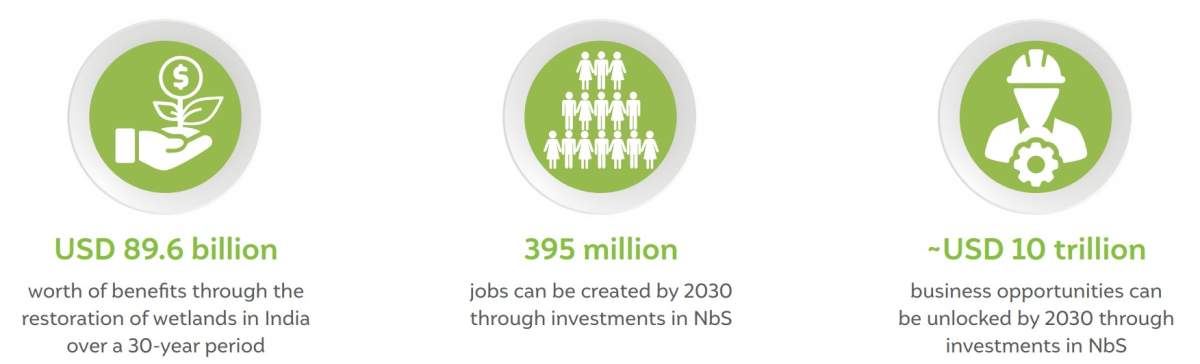
A mangrove buffer, for instance, can absorb storm surges as effectively as a concrete seawall—at a fraction of the cost—while preventing more than USD 65 billion in property damages and reducing flood risk for about 15 million people annually. Wetlands cool urban heat islands, recharge groundwater, and deliver nearly USD 90 billion worth of benefits in India each year. Forested catchments regulate rainfall, stabilise soil, and ensure hydrological balance.
In short, NbS offer climate mitigation, adaptation, economic value, and social protection—all at once.
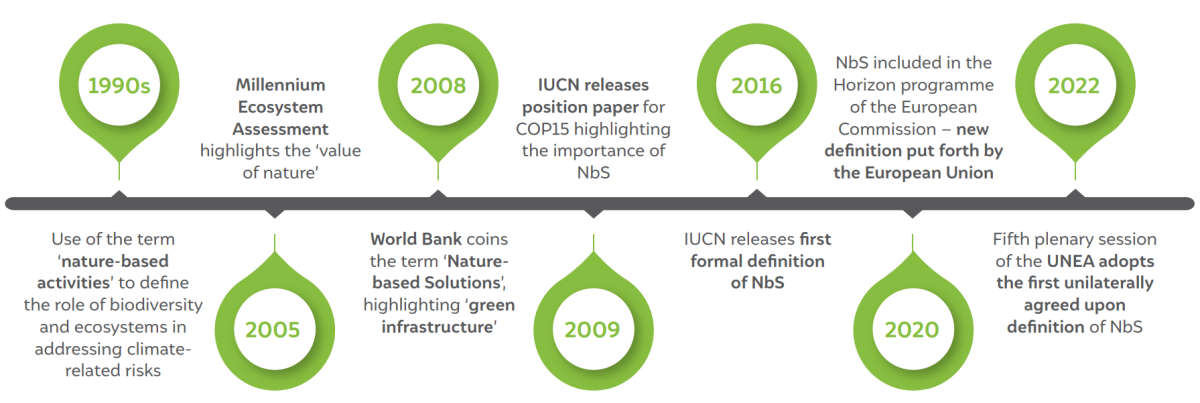
Figure 1: The evolution of nature-based solutions through global conferences and reports
Source: CEEW
Despite this, global finance tells a familiar story of neglect. Adaptation receives less than 10 per cent of total climate finance, and NbS just a fraction of that. The United Nations Environment Programme finds that of the USD 7 trillion mobilised globally for climate finance in 2022, only USD 200 billion went to NbS. Developed countries pledged under the Glasgow Climate Pact to double adaptation finance from 2019 levels by 2025, yet contributions stood at USD 32.4 billion in 2022.
This gap is not merely financial; it is fundamentally unjust. Communities that have contributed the least to global emissions are being asked to adapt with the least support, often through fragmented, short-term projects unable to withstand the pressures of compounding climate shocks. There are several global examples that signal a shift: China’s Sponge Cities programme, which redesigns urban landscapes to absorb and reuse rainwater; the Netherlands’ Room for the River initiative, which restores floodplains instead of confining rivers; and India’s own experiments with mangrove restoration in Mumbai and wetland rejuvenation in Chennai. But these efforts will remain symbolic unless NbS is integrated into the core of economic decision-making, not just conservation or CSR programmes.
First, reframe NbS beyond carbon. Mangroves, forests, wetlands, and grasslands must be recognised as critical infrastructure assets–reducing disaster risk, improving health, and generating green jobs. The World Economic Forum estimates that 395 million jobs could be created globally by 2030 through sustained NbS investment. Chennai’s Sembakkam Lake restoration demonstrates how it has reduced flooding, improved groundwater recharge, and created livelihoods for women’s self-help groups managing solid waste. Adaptation metrics must count lives protected, amount of water retained, or flood risk reduced, not just tonnes of carbon stored. Recognising NbS as “resilience assets” will help attract mainstream infrastructure financing.
Figure 2: The benefits of investing in nature-based solutions
Source: WEF. 2020. New Nature Economy Report II: The Future of Nature and Business. Cologny, Switzerland: World Economic Forum
Second, mainstream climate finance for NbS. The Green Climate Fund, Adaptation Fund, and emerging Loss and Damage mechanisms should earmark dedicated budgets for nature-based projects. Governments can catalyse investment through blended finance, sovereign guarantees, and outcome-based payments. A recent study by the Council on Energy, Environment, and Water (CEEW) highlights how such mechanisms can mobilise private capital for adaptation. India's Mangrove Initiative for Shoreline Habitats and Tangible Incomes (MISHTI), launched under the Green Credit Programme, represents a significant step forward, as it links public finance with private participation in coastal restoration. Such mechanisms can be replicated across ecosystems and countries.
Third, strengthen South–South cooperation. Cities across the Global South are already innovating: rain gardens and bioswales in Kochi, urban forest corridors in Nairobi, and riverbank restoration in São Paulo. Building structured South–South learning platforms could help replicate such models faster and at lower cost. Partnerships between India’s ClimateSmart Cities Alliance and Brazil’s Sustainable Cities Programme, supported by global networks such as the EU’s Sponge Cities initiative or US wetland restoration consortia, could accelerate knowledge exchange and financing pipelines.
Finally, measure what matters. Valuing NbS means going beyond ecological indicators to quantify co-benefits: resilience, livelihoods, biodiversity, and cultural services. A unified valuation framework, building on India’s Natural Capital Accounting and Valuation of Ecosystem Services (NCAVES) project, can strengthen the economic case for policymakers and financiers. When the economic value of flood protection by Mumbai’s mangroves or groundwater recharge from Chennai’s wetlands is measured, nature moves from an afterthought to a budget priority.
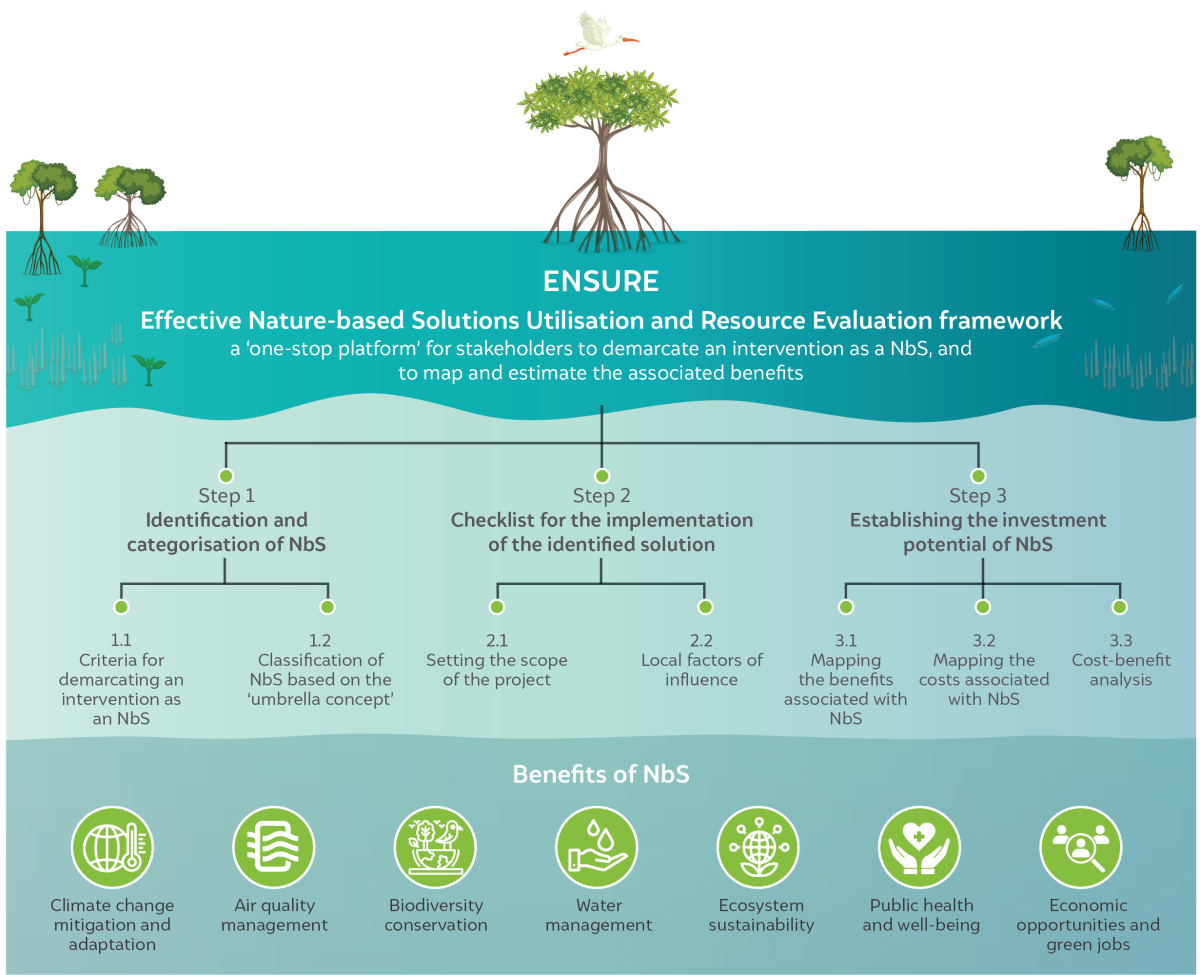
Figure 3: CEEW’s ENSURE toolkit - a unified framework for mapping and estimating the benefits of nature-based solutions in the Global South
Source: CEEW
As COP30 draws to a close in Brazil—the first COP in the Amazon and perhaps the last in the Global South for years—the stakes could not be higher. Countries like India, Brazil, and Indonesia, custodians of vast ecosystems and home to billions of vulnerable people, have a unique opportunity: to ensure that nature-based solutions are recognised not as optional extras but as a central pillar of global climate finance and adaptation.
Shreya Wadhawan is a Programme Associate at the Council on Energy, Environment and Water (CEEW). Views are personal. Send your comments to shreya.wadhawan@ceew.in.


Comments
onlinecasino
Tue, 02/03/2026 - 14:38
Loan watch, players on
統一獅
Sat, 02/21/2026 - 19:53
太平年2026 白宇周雨彤年代励志历史大剧
wfjbfsgtc
Sat, 02/28/2026 - 12:31
Nature is the missing link in
Caça-níqueis2026
Tue, 03/17/2026 - 03:47
PG Soft 2026: quem tá
yemifexk
Thu, 03/19/2026 - 07:17
Nature is the missing link in
vkxosvzyfz
Thu, 03/26/2026 - 11:41
Nature is the missing link in
Add new comment