Council on Energy, Environment and Water Integrated | International | Independent

Context: The Global Goal on Adaptation (GGA), established under Article 7 of the Paris Agreement, aims to ‘enhance adaptive capacity, strengthen resilience and reduce climate vulnerability’.
Challenge: The GGA is currently being operationalised through the UAE-Belém work programme on indicators, which runs the risk of data prioritisation over adaptation action, burdening countries with tedious reporting mechanisms and limited resources to deliver on action.
Streamlining climate adaptation: The National Adaptation Plans (NAPs) are one way of translating global indicators into national priorities, modifying adaptation goals according to their local contexts, budgets and implementation systems.
CEEW’s recommendations: The GGA framework to be negotiated at COP30 in Brazil should remain outcome-focused, context-sensitive, and supported by finance, technology and capacity-building, with greater support to developing countries.
Recognising that climate-induced disasters are already surpassing earlier scientific predictions in both magnitude and intensity, rendering millions of people vulnerable to acute food and water insecurity, Parties to the Paris Agreement have increasingly shifted their focus towards climate adaptation.
The Global Goal on Adaptation (GGA) was established and adopted under the Paris Agreement in 2015. There was limited progress until 2021, when the two-year-long Glasgow-Sharm el-Sheikh (GlaSS) work programme was established. This culminated in the adoption of the UAE Framework for Global Climate Resilience (UAE FGCR) at COP28 in 2023. The framework outlines 11 targets for the GGA and has also launched the UAE-Belem Work Programme on GGA indicators to track and measure progress towards the eleven targets outlined.
The work programme has produced a final list of 100 potential indicators through the efforts and time devoted by experts over the course of 2024 and 2025, with guidance provided by Parties. With the final list of potential 100 indicators expected to be negotiated further and adopted at COP30, it is important to recall that indicators are a means to drive ambition, not an end in themselves. As adaptation narratives gain momentum, it is imperative to ensure that they do not divert attention from implementing concrete adaptation actions. Reporting under the indicator framework should not become an additional administrative burden for developing countries, nor should it reduce adaptation into a reporting exercise. The central concern lies with the employability of these indicators by Parties to accelerate progress on adaptation.
Parties have been prioritising adaptation efforts through their national and sub-national adaptation planning strategies tailored to their respective contexts and their specific vulnerabilities and capacities. Popular amongst these at the national scale is the long-established mechanism of the National Adaptation Plan (NAP) under the United Nations Framework Convention on Climate Change (UNFCCC). The NAP serves both as a domestic planning instrument, guiding resource allocation for actions aligned with national development priorities, and as an international document that demonstrates Party commitment and signals ambition on adaptation.
As of 16 October 2025, 66 Parties have submitted their NAPs. NAP Trends, an initiative of the NAP Global Network, highlights certain patterns in thematic priorities. As shown in Figure 1, nearly all submitted NAPs identify priority sectors, with agriculture and food security (97 per cent), health (92 per cent), and water and sanitation (89 per cent) ranking the highest. While each Party has discretion in formulating its NAPs, the convergence of priority sectors and strategies underscores shared vulnerabilities, global priorities and vocabularies in adaptation planning.
Figure 1: Common thematic priorities identified in NAPs submitted as of 16 October 2025.
Beyond sectoral priorities, NAPs are increasingly incorporating monitoring, evaluation, and learning (MEL) frameworks (73 per cent), implementation strategies (68 per cent), and costing mechanisms (63 per cent). Many also reference the Sustainable Development Goals (SDGs) (86 per cent) and the Sendai Framework for Disaster Risk Reduction (60 per cent)—two foundational global frameworks that have informed the design of the GGA indicators.
This alignment of national adaptation planning efforts with the global adaptation architecture is encouraging as it reflects a growing shared language around adaptation outcomes and demonstrates readiness among Parties to engage with the GGA in meaningful ways.
The 11 targets adopted at COP28 under the UAE Framework for Global Climate Resilience also recognise and echo the top NAP priorities. The targets demarcate seven priority thematic targets and four iterative dimensional targets, and the top three priority sectors of agriculture, health, and water, as mentioned above, are reflected as GGA targets under the thematic targets 9b, 9c and 9a, respectively. The MEL framework, implementation strategies, and the costing of adaptation actions and interventions required, are also reflected under the iterative dimensional targets 10d, 10c and 10b, respectively. The relationship between NAPs and the GGA is thus mutually reinforcing.
In essence, NAPs function as one source to domestically plan and embody the GGA indicators for greater streamlining. They translate global adaptation targets into national goals, whether through climate-resilient agriculture, urban flood management, or heat-health action plans—and establish mechanisms to track progress over time. While the GGA defines global ambition and provides the architecture for measuring and monitoring global progress, the NAPs actualise that ambition with national planning, budgeting, and implementation processes.
This alignment is deliberate, reflecting the evolution of the adaptation regime. The GGA was never intended to impose new obligations, but rather to synthesise and amplify existing national efforts. In this sense, NAPs are the operational arms of the GGA, while the GGA indicators form the evaluative framework that assesses collective progress and impact.
Together, they represent a two-way feedback loop between policy design, implementation, and global assessment. With the draft list of 100 indicators, Parties are now navigating how best to translate global ambition into national action. The true success of the GGA will depend on whether these indicators drive progress where it matters most: on the ground.
However, for the NAPs and the GGA to interact effectively, the indicators must be clearly defined, context-sensitive, and politically legitimate. Ambiguity in definitions or overlap between indicators risks undermining their utility and credibility. For example, the term “climate resilience” itself is susceptible to various interpretations, ranging from infrastructural robustness to social adaptability. Establishing precise and shared definitions will therefore be fundamental for Parties to accept, operationalise, and report against these indicators.
Additionally, indicators must allow for country-specific particularities as adaptation is inherently dependent on local context. They must uphold the principle of Common but Differentiated Responsibilities and Respective Capabilities (CBDR–RC), reflecting countries’ diverse capacities and development priorities. Indicators must not serve as a backdoor for transferring responsibility or for introducing mitigation or loss-and-damage metrics into the adaptation domain.
The strength of the GGA lies in its potential to enable Parties to “speak a common language” on adaptation that is unencumbered by borders, sectors, and methodologies. Thus, the indicators are not just measurement tools; they are political instruments for greater accountability and coordination.
By translating national-level progress into globally applicable metrics, the GGA framework can inform and track collective progress and guide future ambition cycles. However, this will only be effective if the indicators remain anchored in outcomes, rather than outputs.
Take, for instance, an indicator tracking the number of people covered by early warning systems. On its own, this metric risks being purely quantitative. But, when coupled with qualitative data—such as evidence that early warnings lead to reduced mortality or economic loss—it becomes a meaningful measure of adaptive capacity that could encourage knowledge exchange and replicability.
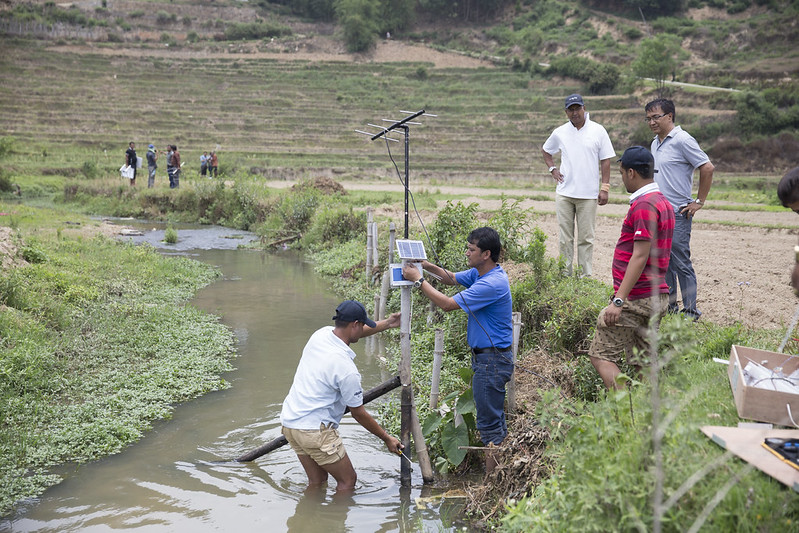
Caption: Regional hands-on training on community-based flood early warning systems.
Source: ICIMOD/CC
This focus on monitoring adaptation outcomes over outputs can also be complemented by Earth observation technologies, including satellite-based remote sensing, which have conclusively demonstrated their ability in measuring progress towards the SDGs, such as SDG 15: Life on Land. Integrating such technologies into the GGA indicator framework could enhance consistency, transparency, and verification while reducing reporting burdens. At the same time, Parties must recognise the capacity asymmetries in accessing and using these tools. Developing countries will require enhanced Means of Implementation (MOI), especially finance, technology transfer, and capacity building, to effectively engage with and benefit from the indicator framework.
The overarching risk of the indicator process is that it may become a technocratic exercise, splitting already constrained resources between reporting and adaptation action. The Sendai Framework, for example, has witnessed uneven progress, partly because of limited resources, weak policy integration, insufficient financing, data gaps, poor local implementation, growing climate and systemic risks, fragmented governance, and persistent social inequalities. The GGA cannot afford to repeat this pattern; documentation and implementation need to take place simultaneously.
To remedy the risk of stagnancy, the UAE Framework for Global Climate Resilience (UAE FGCR) provides a valuable roadmap linking indicators directly to implementation. It suggests that key components such as early warning systems, critical and resilient infrastructure, and vulnerability and risk assessments should be prioritised as early deliverables by 2027. These elements will help bridge the gap between indicator tracking and real-world transformation.
However, adaptation success ultimately depends on predictable finance. Developed countries must lead with full transparency and enhanced financial commitments, while developing countries continue to strengthen their reporting and implementation systems. Linking global assessments to scaled-up financial flows would make the indicator framework truly consequential.
At their core, the GGA indicators should not result in just a statistical exercise—they are a political endeavour aimed at mobilising collective ambition and action for adaptation. Indicators are instruments of governance and diplomacy as much as they are of data and measurement. They should inspire and incentivise adaptation efforts, not merely document them.
The process must, therefore, remain anchored in the principles of equity, inclusivity, and transformation. Indicators should also illuminate adaptation gaps and not penalise those least responsible for the climate crisis. They should facilitate convergence between science and policy, allowing Parties to communicate progress in a shared yet contextualised manner.
As the UAE-Belém work programme advances, Parties have the unique opportunity to create a framework that balances robust data with meaningful insights. Ensuring that this process remains rigorous and balanced in its adoption and operationalisation would effectively set a precedent for enhanced global cooperation in achieving progress for challenges that often exist at local scales. Achieving this will require a sustained focus on clarity, capacity, and commitment.
Cooperation on climate adaptation has become indispensable in a time of geopolitical turbulence. Within this context, the development of indicators for the GGA represents a pivotal moment in the evolution of global climate governance. However, the real test of success will not lie in the comprehensiveness of the indicator list but in the actions and outcomes it catalyses.
To ensure this, six key priorities have to be addressed:
GGA indicators are not the destination; they are the compass. The task ahead is to ensure that this compass points us towards tangible adaptation outcomes: resilient communities, secured livelihoods, and ecosystems that can withstand the inevitable storms.
Mehak Sudan is a Consultant, and Dr Vishwas Chitale is a Fellow at the Council on Energy, Environment and Water (CEEW). Send your comments to mehak.sudan@ceew.in








Comments
Leonardo
Thu, 02/05/2026 - 02:52
After I originally left a
Leonardo
Thu, 02/05/2026 - 02:52
After I originally left a
Dedra
Sun, 02/08/2026 - 00:07
I love what you guys are up
Dedra
Sun, 02/08/2026 - 00:07
I love what you guys are up
Add new comment