Council on Energy, Environment and Water Integrated | International | Independent

Suggested Citation: CEEW and RCUES Lucknow. 2026. How States can Build Capacity for Urban Mobility Officials: Learnings from Uttar Pradesh. New Delhi: Council on Energy, Environment and Water.
| CEEW | RCUES |
|---|---|
| Samradh Singh Chauhan | Anuj Kumar Jha, IAS |
| Sunaina Chauhan | Alka Singh |
| Sourav Dhar | Himanshu Chandra |
| Himani Jain | Priyansha Singh |
India is urbanising at a rapid pace, with more than 600 million people projected to live in its cities by 2036. This transition is driving unprecedented changes in the mobility ecosystems of thousands of Indian cities. Currently, the transport sector is the third-largest CO2 emitter in India, with road transport accounting for over 90% of those emissions. Moreover, the transport sector's dominant contribution to India’s severe year-round air pollution is evidenced by its contribution to PM2.5 emissions, ranging from 18% in Prayagraj and 27% in Indore to as high as 35% in Pune and 40% in Bengaluru. Beyond emissions, the sector faces a "triple crisis" of record-breaking road fatalities, extreme congestion, and economic productivity losses.
While India’s Nationally Determined Contributions (NDCs) and Net-Zero 2070 goals necessitate a shift toward public transport and vehicle electrification, a significant governance and capacity gap exists at the implementation level. There is currently no standardised, dedicated capacity-building program to equip the thousands of state and municipal officials with the technical and financial expertise required for integrated planning. Although urban transport is a State Subject under the Indian Constitution, its functions are fragmented across siloed agencies—such as Urban Development Departments, Transport Departments, and Traffic Police, etc., each operating from limited functional perspectives.
This study addresses this gap by conducting a cross-cutting training needs assessment. By leveraging Uttar Pradesh’s diverse urban tiers and multi-agency landscape as a case study, we aim to identify the training needs of urban mobility officials concerning their functional roles and develop an integrated on- duty capacity-building programme proposal. This framework aims to move beyond ad-hoc training toward a legally empowered, institutionalised system of continuous upskilling to manage transport demand and achieve sustainable urban mobility at scale. We conducted this study in collaboration with the Regional Centre for Urban and Environmental Studies (RCUES), Lucknow, a premier capacity-building institution under the Ministry of Housing and Urban Affairs (MoHUA).
No state in India currently has a dedicated capacity-building programme for its urban mobility officials. As part of the central government efforts, there have been past initiatives within the schemes of JnNURM, AMRUT, and the Smart Cities Mission, etc., having integrated capacity building, but the efforts remain largely piecemeal. The World Bank’s SUTP project made significant strides by training hundreds of officials and developing specialised toolkits; however, these were often restricted to senior leadership or tied to specific project timelines.
A capacity-building programme in any field must rely on a strong understanding of the training needs of individuals and organisations. Thus, a scientific training needs assessment (TNA) becomes the first step towards framing a capacity-building programme. Gujarat and Madhya Pradesh have earlier carried out TNA for urban transport officials. However, in both studies, only municipal body officials from four smaller cities were surveyed. There is a lack of research on capacity-building programmes focusing on urban mobility as a whole.
As part of this study, we conducted in-person training needs assessment (TNA) surveys involving over 330 government officials specifically working on urban mobility in 17 cities of UP. These cities have a population ranging from 3 to 30 lakh, and their urban mobility interventions are overseen by 6-7 major government agencies. The key findings of the study are:
We recommend establishing a state-level urban mobility capacity-building unit within the Urban Development Department of Uttar Pradesh, overseen by a sanctioning committee chaired by the Principal Secretary, to monitor programmatic progress.
Urban mobility is a dynamic and complex discipline that encompasses various fields, such as public transportation planning, congestion management, emission standards/regulations, street design and road safety. With the worsening impact of climate change and rapid evolution in technology, a new era of urban mobility planning is emerging, featuring alternative fuel technologies (electric/hydrogen/hybrid vehicles), mobility as a service (MaaS), data-driven mobility (integrated with digital infrastructure), etc. City or local government agencies are the closest entities to citizens, and best suited to ensure seamless, safe, affordable, and sustainable mobility for all. However, cities in India currently lack a dedicated capacity-building programme for their urban mobility officials. Urban infrastructure schemes/programmes— present and past—have enabled capacity building, but these efforts remain fragmented and project-based. The World Bank’s Sustainable Urban Transport Project was a pioneering initiative in India’s urban transport transformation; however, it provided training for only 450 urban mobility officials across India (World Bank 2019). CEPT University, which is an esteemed centre of excellence in urban transport under the Ministry of Housing and Urban Affairs (MoHUA), conducted a training programme titled ‘Leaders in Urban Transport Planning and Management’ (CRDF, n.d.), which trained approximately 250 participants and was limited to senior officials.
The absence of dedicated capacity building within the urban mobility sector in India leads to various negative externalities. The transport sector alone accounts for 11 per cent of India’s greenhouse gas (GHG) emissions (Kamboj et al. 2022). Throughout the year, the majority of India experiences severe air pollution and, in Prayagraj, Indore, Pune, and Bengaluru, transportation is responsible for 18 per cent, 27 per cent, 35 per cent, and 40 per cent of PM2.5 pollution, respectively (Urban Emissions 2017). India records the highest road fatalities in the world annually (Biswas 2025). Three of the top five most congested cities in the world are in India (TOM TOM 2024). One of the main reasons for this situation is that, in the Indian context, ‘urban transport’ is not explicitly classified as a constitutional subject under any of the three tiers of government (central, state, and local). It is rather intertwined with urban development, which is a state subject (Verma et al. 2021; NITI Aayog 2021). In the absence of a single agency planning and managing urban mobility in Indian cities, the subject is addressed by multiple government organisations/agencies from their own functional perspectives, which fragments capacity building in the sector. The National Urban Transport Policy (NUTP) 2006 emphasised that capacity building should be aimed at all the individuals working with the state transport departments, municipal corporations, metropolitan development authorities, traffic police, environmental authorities, transport corporations, public works departments, and so on. Through this study, we aim to identify the training needs of urban mobility officials concerning their functional roles and develop an integrated on-duty capacity-building programme proposal.
We partnered with the Regional Centre for Urban and Environmental Studies (RCUES), Lucknow, to carry out this study in India’s most populous state, Uttar Pradesh (UP). UP constitutes 12 per cent of India’s urban population, and is aspiring to become a trillion-dollar economy in the coming years, necessitating further and rapid urbanisation (Radhakrishna 2022). To improve its urban mobility ecosystem, the state is already investing in metro rail systems, electric buses, street redevelopment, intelligent traffic management systems, and urban planning schemes. We conducted in-person training needs assessment (TNA) surveys involving over 330 government officials specifically working on urban mobility in 17 cities of UP. We gathered various datasets from the officials through the surveys, including their profiles, awareness of government initiatives, and training needs.
The 17 cities included in this study were chosen based on the presence of a municipal corporation and the implementation of urban mobility projects through ongoing central/state government initiatives. These cities have a population ranging from 3 to 30 lakh, and their urban mobility interventions are overseen by different government agencies with overlapping jurisdictions and responsibilities. We identified and mapped all the government agencies directly or indirectly involved in performing one or more functions of urban mobility, and this is charted out in ES Figure 1.
Figure ES 1. Government agencies working on urban mobility in UP and their functional overlaps
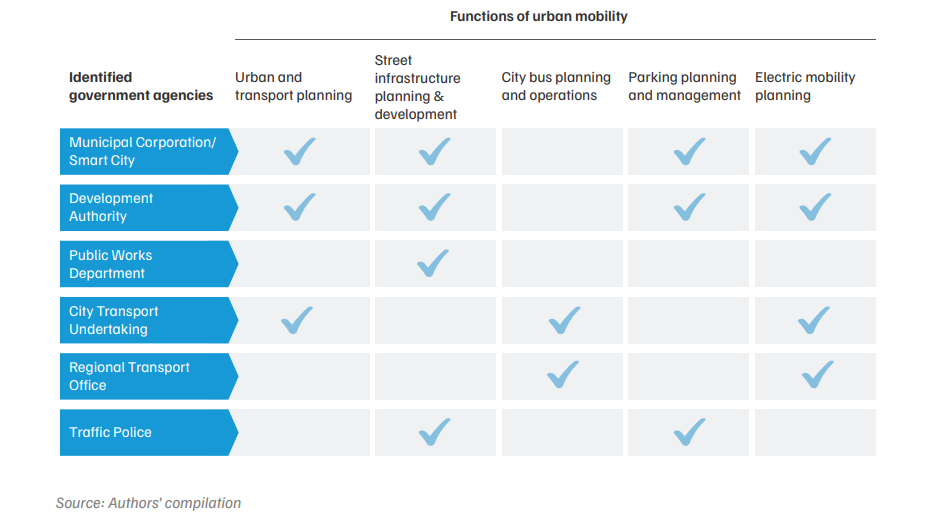
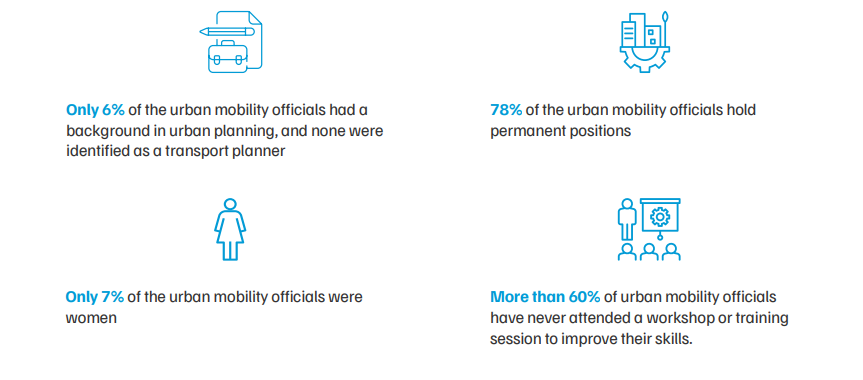
Table ES 1. Knowledge-based themes and sub-themes identified as ‘very high priority’ by all surveyed officials
| Knowledge- based themes |
Urban and transport planning |
Street infrastructure planning and design |
Electric mobility planning |
Parking planning |
Bus transportation planning |
|---|---|---|---|---|---|
|
Sub-themes
|
Transit-oriented development (TOD) | Safe intersection design | Route selection, operations planning and scheduling of the e-bus fleet | Developing parking policy | Service-level benchmarking for bus systems |
| Growth forecasting and scenarios | Complete street design | Introduction to electric mobility | Parking standards and guidelines | Last-mile connectivity to buses | |
| Compact city planning | Road network planning | Charging infrastructure network planning | Developing area-based parking strategies | Integrating bus transport with paratransit |
Source: Authors' analysis
Table ES 2. Skill-based themes and sub-themes identified as ‘very high priority’ by all surveyed officials
| Skill-based themes |
Project planning and communication |
Interpersonal skills | Functional skills |
|---|---|---|---|
| Sub-themes | Preparation of project proposals, procurement, and contracting | Conducting and managing traffic and urban transport surveys | Leadership and team-building |
| Project management | Mapping skills (GIS) | Human resource management | |
| Information, education and communication (IEC) | Transport modelling |
Source: Authors' analysis
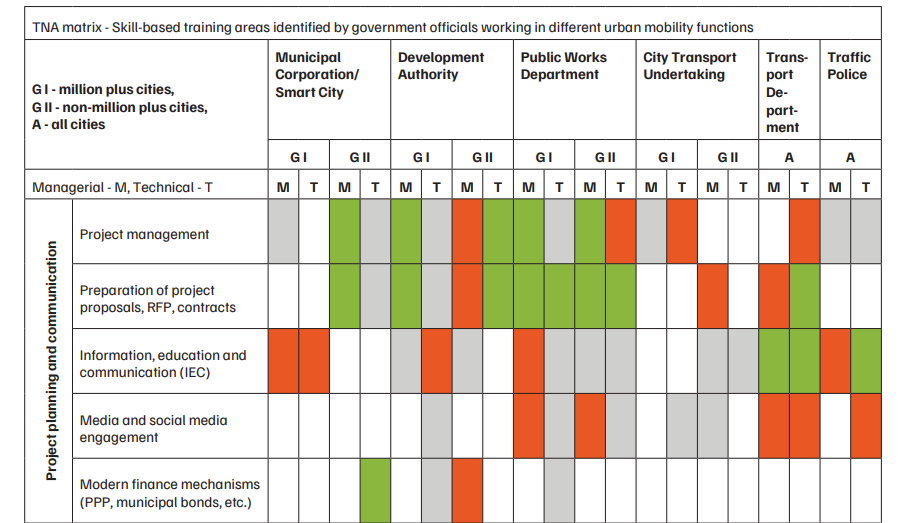
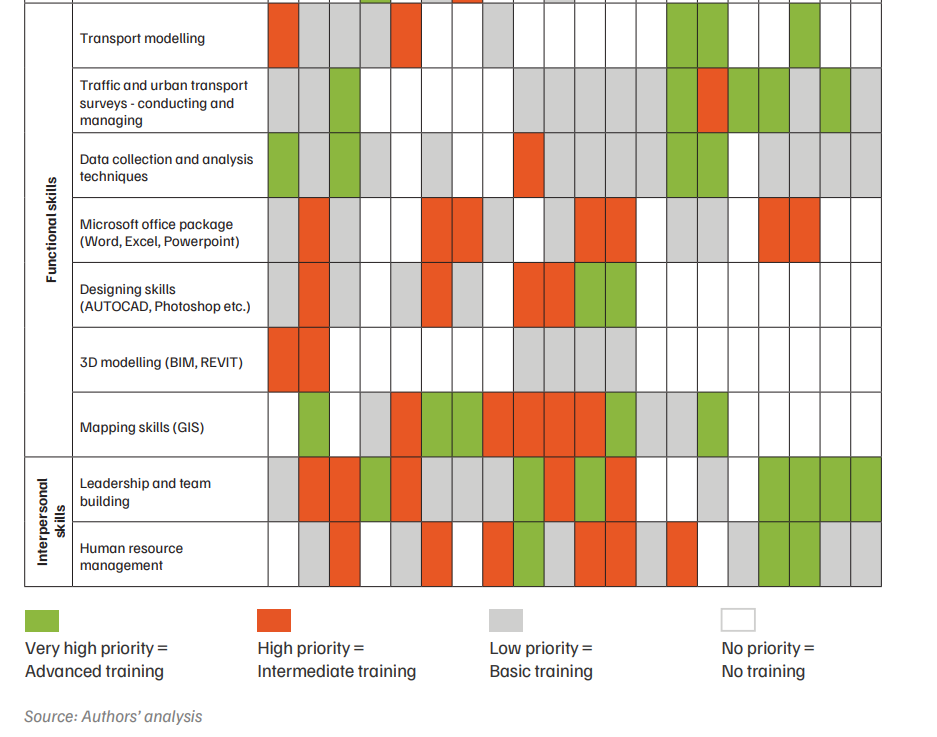
Table ES 1 and ES 2 emphasise the top three training areas recognised as ‘very high priority’ by all the 337 surveyed officials. However, because various agencies manage different urban mobility functions, and many of these roles overlap, we developed a TNA matrix (Figure ES 2.) showing identified training areas that cut across different agencies. With the aim of promoting collaborative training practices, the TNA matrix will be instrumental in planning for urban mobility training initiatives that contribute to the broader objectives of sustainable mobility. Additionally, it will enhance intergovernmental agency coordination and optimise resources.
The training needs are divided into two broad categories of ‘knowledge-based’ or ‘skill-based’ training areas. The results were categorised as Group I and Group II, based on the population of the cities, with Group I representing million-plus cities, and Group II, non-million-plus. The survey respondents were classified as managerial or technical staff based on their roles and responsibilities. jurisdictions and responsibilities. We identified and mapped all the government agencies directly or indirectly involved in performing one or more functions of urban mobility, and this is charted out in Figure ES 1.
Figure ES 2. Government officials from different agencies seek to learn about similar topics, emphasising the need for inter-agency collaboration and unified capacity-building
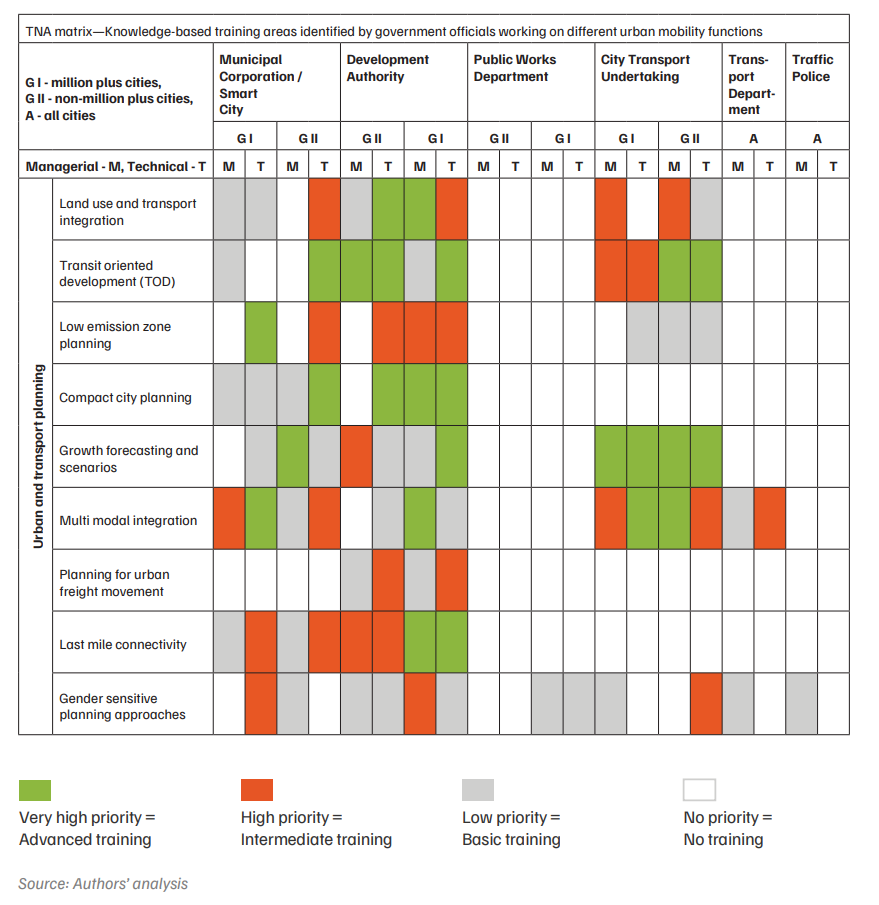
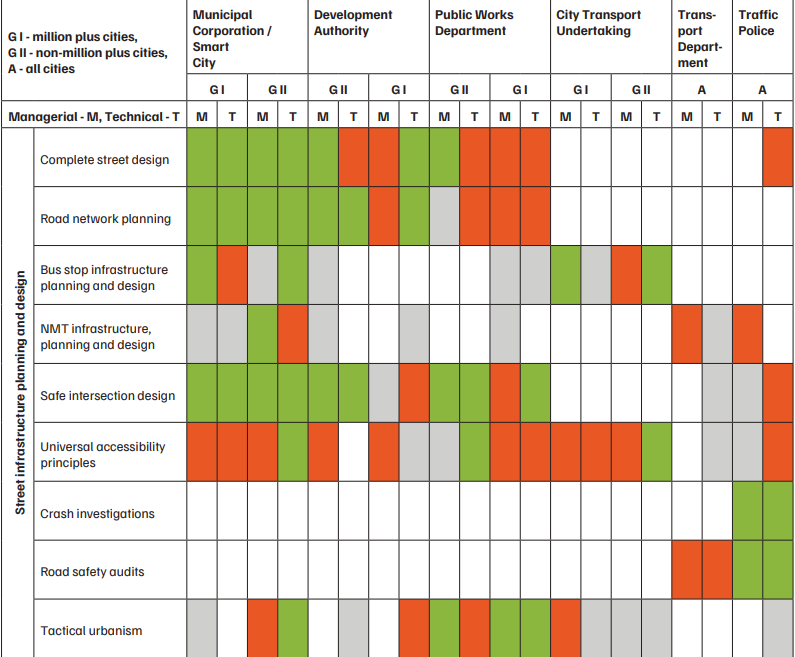
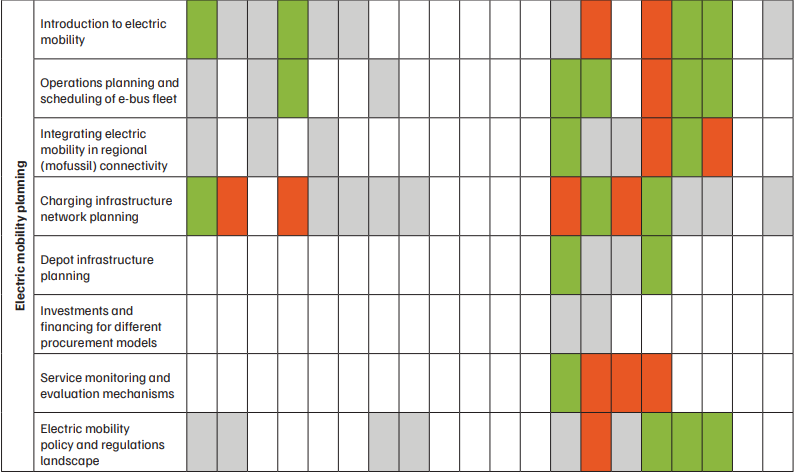
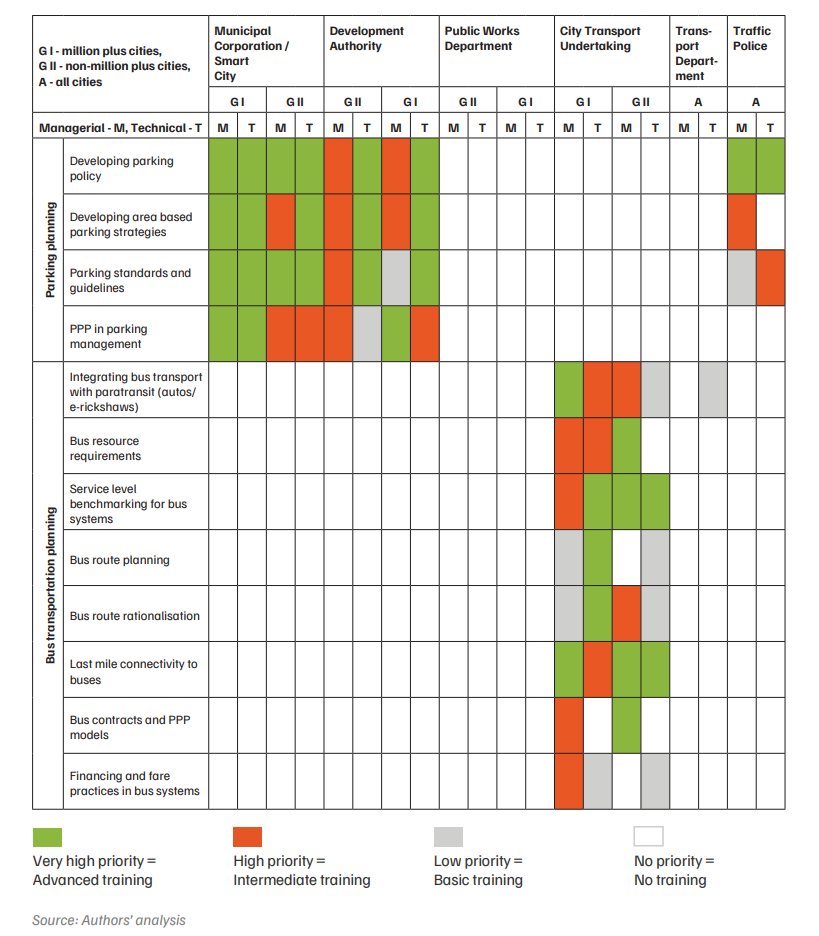
Figure ES 3. Besides knowledge-based skills, there is a high demand for project planning, functional and interpersonal skills
A key finding of our study is the limited availability of planning professionals in the field of urban mobility in Uttar Pradesh. The state must recruit more urban and transport planners across levels of project planning and implementation. Moreover, adding more number of women in roles within this sector can provide valuable perspectives on planning urban mobility from a woman’s point of view. Our study clearly also indicates that government officials involved in urban mobility in UP require continuous capacity building across multiple areas. Thus, we recommend a state-level capacity-building programme dedicated to improving the urban mobility ecosystem in the state. This programme aims to bridge the gap between technical advancements in the field and the operational skills of officials responsible for planning and managing urban mobility functions.
While national missions provide important directional/guidance-based training, they are often project-linked and time-bound. Urban transport is a state subject and a state-level unit within the Urban Development Department/other relevant department ensures that upskilling is continuous and institutionalised, addressing the specific legislative, geographical and technical nuances of states.
Uttar Pradesh serves as a "microcosm" of India. It features a wide variety of city tiers—from mega-cities like Lucknow and Kanpur to rapidly growing Tier-2 and Tier-3 towns—and a complex web of agencies (Development Authorities, Municipal Corporations, and Smart City SPVs). A framework that works in the diverse institutional landscape of UP can be effectively scaled across other Indian states.
The study’s focus is primarily cross-cutting in nature, meaning it brings officials from different departments (Transport, Police, Urban Development, PWD) into a shared learning ecosystem. This fosters a unified "functional perspective," ensuring that a road engineer and a traffic planner are working toward the same sustainability goals rather than competing objectives.
The programme proposal is designed for a broad spectrum of "urban mobility functionaries." This includes technical staff (engineers and planners), administrative leadership (Chief Planners and Executive Officers), and para-statal officials (from Metro Rail corporations and Smart City SPVs). By targeting multiple levels of the hierarchy, the study ensures that sustainable policies don't get "lost in translation" between senior leadership and ground-level execution.
Can Indian Highways Support Zero-Emission Trucking?
India On The Move:Stories of people driving the bus sector
How can India Accelerate Electric Three-wheeler Adoption?
How can India Make the Electric Three-wheeler Transition Gender-inclusive?