Council on Energy, Environment and Water Integrated | International | Independent

Suggested citation: Pradhan, Shanal, and Deepa Janakiraman. 2020. Impact Evaluation of Climate Change Mitigation Policies for the Manufacturing Sector in Gujarat. New Delhi: Council on Energy, Environment and Water.
This study, part of The Council’s ongoing work under GHG Platform India and supported by the Shakti Sustainable Energy Foundation, assesses eight policies and mitigation actions undertaken in the Indian state of Gujarat’s manufacturing sector. Gujarat has implemented numerous policies on its manufacturing sector with little or no significant impact on greenhouse gas (GHG) mitigation. The study aims to sensitise stakeholders across government, industry, academia, and civil society groups, about the impact of policies and mitigation actions on reducing GHG emission intensity in the manufacturing sector. Further, it recommends the state government on whether ongoing mitigation efforts need to be continued, adjusted, or expanded, or if additional policy measures need to be implemented.
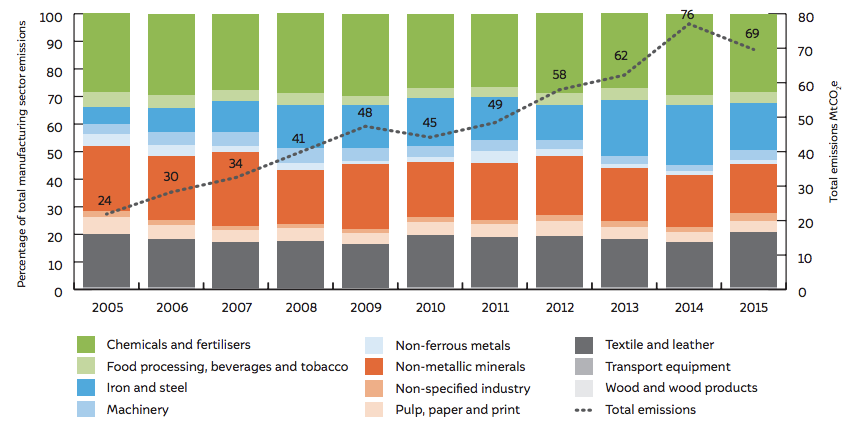
Emission trends of industries in Gujarat increased from 24 to 69 MtCO2e in 2005–2015
Source: Author's analysis
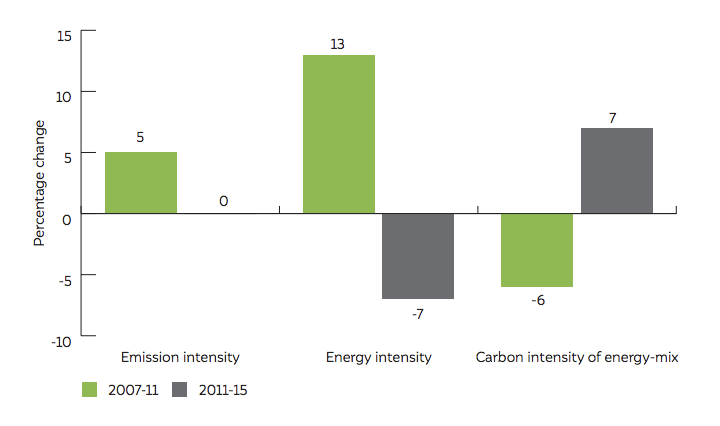
Intensity trends compared between 2007–2011 and 2011–2015 shows improvement in emission and energy intensity in the second period(2011-2015), implying the impact of major policies during this period, whereas carbon intensity of the energy mix shows an increasing trend
Source: Author's analysis
In the last decade, subnational governments in the country have increased their involvement in climate action. This is integral to India achieving its climate goals, as ultimately, state governments are responsible for implementing policies on the ground. It is crucial to assess whether policies implemented at the state level have made a meaningful impact, particularly in terms of their ability to realise the co-benefits from climate action. It is challenging to measure the effects of such policies on greenhouse gas (GHG) emissions, as their pathway is not always direct. Further, such a study would require consistent timeframes of assessment and baseline assumptions. Thus, such assessments generate poor quality data, which in turn leads to greater uncertainty in the results. This study attempts to initiate a process of systematically evaluating the policies impacting industries at the subnational level. As such, this study will add significant value to the literature, as it analyses industrial policies from a GHG mitigation perspective, as well as other indicators such as the delivery of resources to support implementation (input indicators) and policy administration activities (activity indicators).
Polices and mitigation actions are evaluated using a framework that assesses them according to three parameters: input, activity, and GHG impact. The mitigation policies and actions considered in the evaluation are primarily those that directly or indirectly impact GHG emissions. Market-based mechanisms like the Perform, Achieve and Trade (PAT) Scheme and the Clean Development Mechanism (CDM) have been considered in the assessment, as they have a direct impact on reducing emission intensity in the manufacturing sector. These mechanisms have been categorised as GHG emission mitigation instruments.
For polices and mitigation actions that are still being implemented, GHG impacts are assessed till 2018. However, cumulative GHG reductions are provided for the period 2005–2015. For instance, the Rooftop Solar (RTS) scheme was implemented in 2012, but the cumulative GHG emissions that were reduced as a result of the scheme is estimated only till 2015 to account for the assessment period.
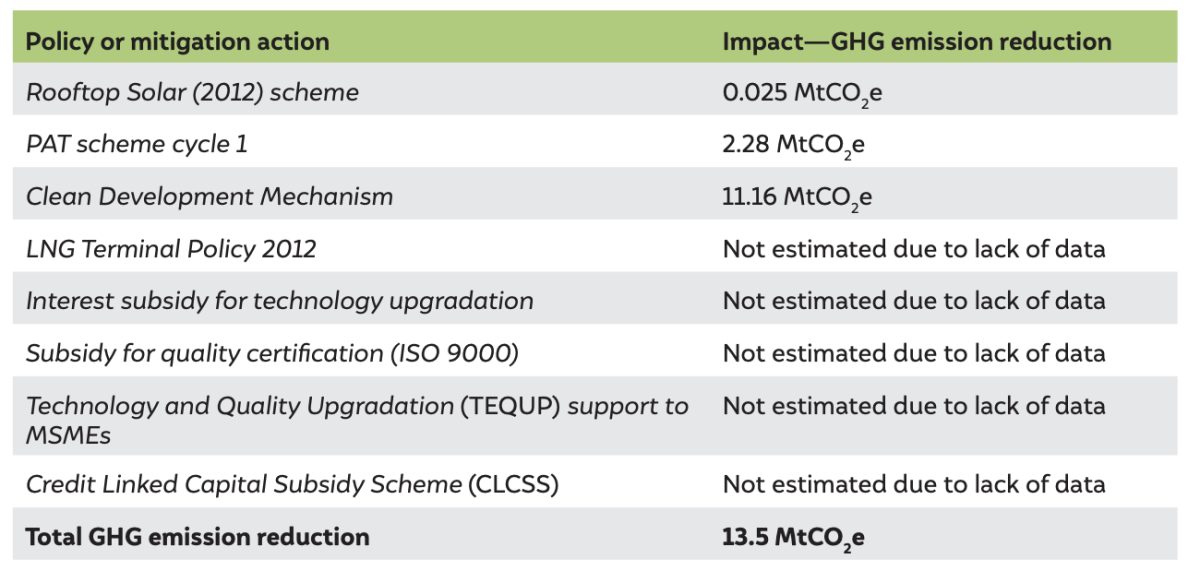
Of the eight polices and mitigation actions assessed, GHG reduction impacts have been estimated for three of them: the RTS scheme, PAT scheme, and voluntary participation of industries under the CDM. Overall, an estimated 13.5 MtCO2e of GHG emissions were reduced from as a result of these three polices and mitigation actions, as assessed between 2005 and 2015.
The emission reductions are provided for the different time periods in which the schemes were implemented. There was an estimated 0.02 MtCO2 e reduction in emissions because of the industrial RTS scheme, which was implemented in 2012; emission reductions are estimated for 2012–2015. The implementation of PAT scheme cycle 1 (2012–2015) resulted in a nearly 2.28 MtCO2e reduction in emissions. Further, in 2005–2015, CDM projects from Gujarat contributed to 11.16 MtCO2e reduction in emissions.
Manufacturing schemes like Technology and Quality Upgradation (TEQUP) support to micro, small, and medium enterprises (MSMEs), the Credit Linked Capital Subsidy Scheme (CLCSS), and subsidies towards quality certification (ISO 9000) indirectly contributed to GHG mitigation (GoG 2016–2017; PIB 2019). However, due to the unavailability of information, emission savings were not estimated.
Most of the GHG mitigation arises from polices and mitigation actions following 2010. For instance, RTS scheme is assessed till 2015, and the PAT scheme cycle 1 falls between 2012–2015. Hence, despite the rising intensity of emissions from industries in 2005–2011, mitigation actions have effectively reduced the energy intensity of the sector during the latter half.
Coal remained the dominant source of energy while natural gas penetration levels were low in Gujarat even with the introduction of the LNG Terminal Policy 2012. The lack of sustained supply of cheap domestic gas has been a serious bottleneck in expanding gas-based production capacities, especially in energy-intensive sectors like iron and steel (Sen 2015). Currently, there are only two operational gas-based production facilities in the country: Essar Steel (Surat Hazira) and JSW (Dolvi and Vijayanagar).
A three-year moving average trend of the emission intensity, energy intensity, and carbon intensity of the energy mix indicates that the energy intensity of the sector increased by 13 per cent in 2007–2011. It subsequently decreased by 7 per cent 2011–2015, which happens to be when most of the policies and mitigation actions were operational. However, the reduction in the energy intensity during the second half of the assessment period (2011–15) was offset by an increase in carbon intensity in the energy mix. This marginally impacted emission intensity levels. The carbon intensity in the energy mix indicated a six per cent reduction in 2007–2011 but a seven per cent increase in 2011–15.
Although we have been able to quantify the emission reduction resulting from polices and mitigation actions, the impact on the entire manufacturing sector was not discernible. For instance, mandatory energy-saving targets like the PAT scheme have been successful in mitigating GHG emissions, but its coverage was limited to large energy consumers, as identified under the Energy Conservation Act of 2010 (Amendment). The cumulative emissions avoided from PAT scheme cycle 1 represented only about 1 per cent of the cumulative emissions for the period. Table 11 provides a snapshot of the policies and mitigation actions that have been assessed.
Table 11 A total of 13.5 MtCO2e was mitigated by the policies and mitigation actions assessed
Source: Authors’ analysis
Reducing the existing thresholds by 30–40 per cent will unlock further potential in improving energy efficiency while avoiding a significant rise in transaction costs per unit of energy targeted (Biswas, Janakiraman, and Ganesan 2019). However, its impact on emission intensity may not be proportional, as already identified by the study. Even if energy-intensive sectors like iron and steel, cement, ammonia, and petrochemicals achieve best-in-class energy efficiency levels within the next 10 years, the cumulative emissions from these sectors between 2010 and 2050 would represent 13 per cent of the global carbon budget under the 2 degrees scenario (Biswas, Ganesan, and Ghosh 2019). Thus, this highlights the need for policy actions that aim for deep decarbonisation of the industrial sector.
RTS trends indicated a rapid deployment in the industrial sector, especially between 2017 and 2018, supported by net-metering regulations and revised guidelines on installation timelines. The fact that about 23 per cent of the energy demand of the industrial sector is met by electricity indicates the considerable potential for GHG mitigation under the RTS scheme.
Incentivising a transition to low-carbon energy sources will unlock greater emission reduction potential alongside reduced air pollution. However, coal remains the primary fuel, catering to the majority of the manufacturing sector’s energy needs, and uptake of natural gas in the sector has largely been limited to two sectors—chemical and fertiliser and petroleum refineries (including petrochemicals). One of the major concerns for industries is the poor availability of a cheap and sustained supply of natural gas. In order to incentivise a transition to a cleaner energy mix, the prices of fuels need to reflect the true cost of their environmental impact. One such intervention could be levying a lower tax or rebate on natural gas and increasing the tax on polluting fuels in order to ensure no additional burden on the state exchequer.
Of all the policies and mitigation instruments evaluated, CDM has been able to achieve the largest emission reduction. This clearly reiterates the potential of a carbon market to reduce the emission footprint of the manufacturing sector. However, we have to inculcate key learnings from the CDM and the PAT scheme to design an effective market-based programme eliminating some of the known bottlenecks like target setting to incentivise continual improvement and the high transaction costs associated with project validation and M&V.
Recently, the Gujarat Pollution Control Board even piloted an emission trading scheme to control particulate matter pollution in a selected industry cluster in the Surat region by allotting permits. Within this scheme, the industries can trade with one another to settle their allotted permit balance (GPCB 2020). Gujarat is the first state in the country to pilot such a scheme; it would further benefit the state to extend the scheme to cover GHG emissions as well. This presents an opportunity for Gujarat to be the leading industrialised state in India, both in terms of economic output and sustainable manufacturing practices.
CO₂ Pipeline Network for Carbon Capture and Storage in India
Bharat Cleantech Manufacturing Platform: Green Hydrogen Indigenisation Pathways
What is Fuelling India’s Road Transport Sector?
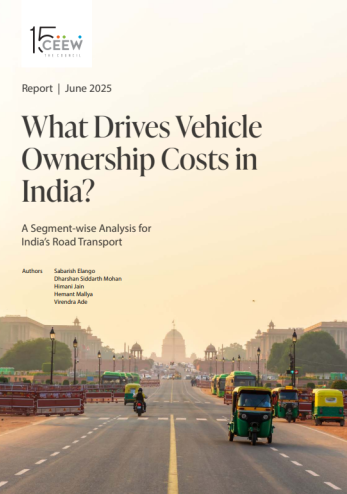
What Drives Vehicle Ownership Costs in India?
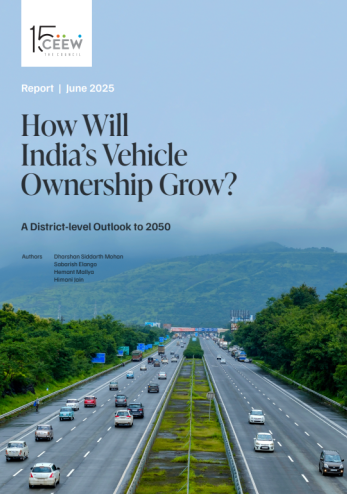
How Will India’s Vehicle Ownership Grow?