Council on Energy, Environment and Water Integrated | International | Independent

Suggested citation: Aggarwal, Jhalak, Saeeduddin Faridi, Pushpa Sharma, and Ravi Shankar Prasad. 2026. How South Asia’s Energy Transition Can Respond to Global Disruptions: Regional Stakeholder Perceptions. New Delhi: Council on Energy, Environment and Water.
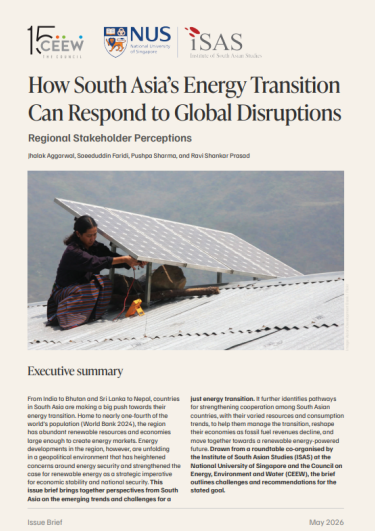
Energy transition is not peripheral to the climate discourse, but central to shaping global outcomes. However, rising geopolitical conflict, competition, and challenged trust continue to undermine climate and energy diplomacy. Energy transition is a multifaceted, intricate challenge that requires a gradual shift in the global energy system from dependence on fossil fuels to renewable energy sources, and plays a critical role in combating climate change and achieving sustainable development goals.
From India to Bhutan and Sri Lanka to Nepal, countries in South Asia are making a big push towards their energy transition. Home to nearly one-fourth of the world’s population (World Bank 2024), the region has abundant renewable resources and economies large enough to create energy markets. Drawn from a roundtable co-organised by the Institute of South Asian Studies (ISAS) at the National University of Singapore and the Council on Energy, Environment and Water (CEEW), this summary brief brings together perspectives from South Asia on the emerging trends and challenges for a just energy transition. It further identifies pathways for strengthening cooperation among South Asian countries, with their varied resources and consumption trends, to help them manage the transition, reshape their economies as fossil fuel revenues decline, and move together towards a renewable energy-powered future.
From India to Bhutan and Sri Lanka to Nepal, countries in South Asia are making a big push towards their energy transition. Home to nearly one-fourth of the world’s population (World Bank 2024), the region has abundant renewable resources and economies large enough to create energy markets. Energy developments in the region, however, are unfolding in a geopolitical environment that has heightened concerns around energy security and strengthened the case for renewable energy as a strategic imperative for economic stability and national security. This issue brief brings together perspectives from South Asia on the emerging trends and challenges for a just energy transition. It further identifies pathways for strengthening cooperation among South Asian countries, with their varied resources and consumption trends, to help them manage the transition, reshape their economies as fossil fuel revenues decline, and move together towards a renewable energy-powered future. Drawn from a roundtable co-organised by the Institute of South Asian Studies (ISAS) at the National University of Singapore and the Council on Energy, Environment and Water (CEEW), the brief outlines challenges and recommendations for the stated goal.
Energy transition is not peripheral to the climate discourse, but central to shaping global outcomes. However, rising geopolitical conflict, competition, and challenged trust continue to undermine climate and energy diplomacy. Energy transition is a multifaceted, intricate challenge that requires a gradual shift in the global energy system from dependence on fossil fuels to renewable energy sources, and plays a critical role in combating climate change and achieving sustainable development goals. It encompasses explicit transitions, such as alterations in energy sources and distribution systems, as well as implicit transitions, including changes in energy security, geopolitics, and governance (Prajapati et al. 2025). Recent global challenges, supply chain disruptions, and energy price shocks have spurred a greater urgency to reinforce the need for resilient, diversified, and domestically anchored energy transition pathways. For instance, the Indo-Pacific Economic Framework (IPEF), launched in 2022, initially held promise as a platform for advancing clean energy cooperation in the region, with many Southeast Asian countries starting to align their strategies with the framework’s energy ambitions. But the endeavour has since lost momentum. And then there is the weakening cooperation among some of the largest emitters. However, despite these shifts, countries continue to demonstrate collective commitment to strengthening multilateral climate action. For instance, at the 30th Conference of the Parties (COP30) last year, many countries submitted enhanced emission reduction targets, advanced the Baku to Belém Roadmap towards mobilising USD 1.3 trillion, and initiated two complementary roadmaps: Roadmap for Transitioning Away from Fossil Fuels in a Just, Orderly and Equitable Manner and Roadmap for Halting and Reversing Deforestation and Forest Degradation by 2030 (UNFCCC 2025). This reaffirms trust and signals sustained commitment to the Paris Agreement.
These developments are unfolding in a context where structural economic and geopolitical considerations are increasingly shaping climate and energy decisions. Ongoing geopolitical developments have intensified concerns around energy security, emphasising renewable energy as a strategic imperative for economic stability and national security. The discourse is mainstreamed, impacting and shaping decisions across the pillars of strategy, politics, economics, and financial markets. The need to transition away from traditional fossil energy sources is no longer challenged, but the discussion revolves around the transition’s pace, scale, and implementation, with equity as the foundational principle. This is particularly more evident in Asia, where rapid economic growth, rising energy demand, and increasing climate vulnerability intersect. South Asia, in particular, has demonstrated a growing commitment to this transition, responding with a mix of policy innovation, market mechanisms, and regional collaboration. However, progress remains uneven and, at times, insufficient to meet the scale of the challenge.
Amidst heightened geopolitical tension and stress on international cooperation, it is imperative to understand what solutions are investable and scalable; where fault lines are emerging (political feasibility, integrity concerns, finance and competitiveness); and how climate action is being tied to economic, energy and security narratives. Equally important is the need to draw lessons from ongoing experiences, not only identifying what works but also understanding the limitations, trade-offs, and contextual realities that shape outcomes.
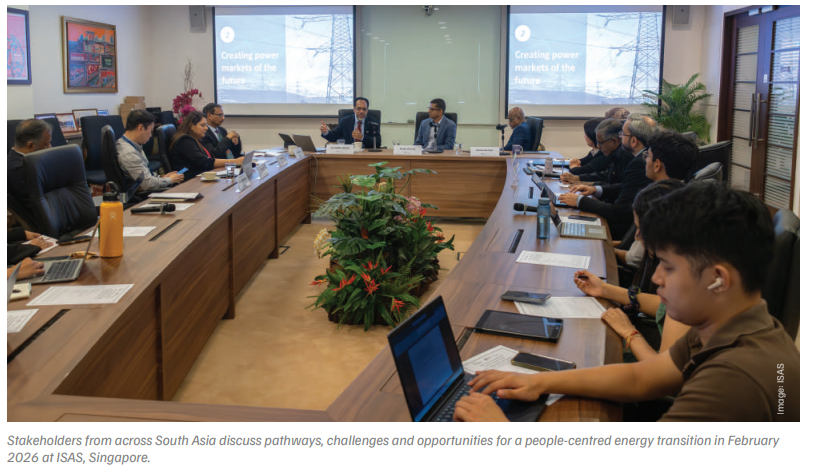
The following insights are drawn from a roundtable co-organised by the Institute of South Asian Studies (ISAS) at the National University of Singapore and the Council on Energy, Environment and Water (CEEW), bringing together perspectives from South Asia1 on its energy transition, including the trends, challenges, and opportunities, and pathways for strengthening regional cooperation to facilitate the region’s shift towards a credible renewable energypowered future.
Asia is at a critical juncture in its energy transition, with growing renewables (34 per cent) but continued reliance on traditional sources of energy (Lolla 2025). The region currently accounts for over 80 per cent of global coal generation in 2025 (Ember 2026). Southeast Asia alone has added 25 GW of coal-based capacity in the past five years, accounting for 42 per cent of total additional electricity generation, reflecting the scale of legacy dependence (Cornot-Gandolphe 2016). But at the same time, clean electricity is beginning to scale meaningfully, where renewables now meet over one-third of electricity demand growth in Southeast Asia (IEA Southeast Asia Energy Outlook 2024), with solar emerging as the fastest-growing source.
India is driving the majority of global solar and wind expansion, rapidly adding capacity and balancing both growth and decarbonisation. China alone added 500 GW of renewable capacity last year-equivalent to the entire US electricity market while India and its other neighbours have developed market-based deployment mechanisms distinct from the feed-in tariff models favoured by the West (Nagaraj 2026). India’s first solar tender in 2010 marked the beginning of a commercially self-sustaining model that requires no regulatory hand-holding (NVVN 2010), and ASEAN countries are converging on a similar trajectory. In Vietnam, Indonesia, and the Philippines, coal remains deeply embedded in power systems due to industrial demand and long-term contracts, even as renewables gain momentum.
These examples show that the region is in transition and a real shift is underway, and energy security is now emerging as the dominant strategic interest across South Asia and ASEAN. This shift is as commercially driven as it is political: solar and wind are now the cheapest forms of renewable energy in over 90 per cent of electricity markets, making the clean energy transition economically inevitable (Dardour et al. 2025).
Emerging markets are undergoing multiple, simultaneous energy transitions, which are unlike the traditional pathways and binary transitions that are discussed more often. Ten years ago, India had the largest number of people without electricity, but India has achieved near-universal household electrification, with reports suggesting over 99 per cent of households had electricity access by 2021 (PIB 2018). The Saubhagya scheme significantly accelerated this. India is undergoing four transitions—traditional to modern sources of energy (energy demand is substantially rising, with a focus on ensuring access and affordability), rapid urbanisation (patterns of energy demand shifting from rural to urban areas), growth of sustainable energy infrastructure (conventional fuels need to be secured and newer fuels need nurturing and support to scale up), and deeper integration into energy markets (developing countries’ energy demands are getting embedded in global energy markets, impacting how they operate and reshaping supply chains).
Examples from emerging markets in the region show similar trends. Nepal’s energy transition is based on its hydropower potential, which accounts for 90 per cent of electricity generation (IHA 2025). Nepal exports its surplus electricity to India through bilateral agreements and is positioning itself as a major player within the broader South Asian power market. Bhutan is another energy player with a focus on hydropower, producing almost 100 per cent of its electricity from renewable sources (Ministry of Energy and Natural Resources, Government of Bhutan 2022). This reflects a transition pathway where clean energy supports economic growth and fiscal revenues instead of just replacing fossil fuels domestically. Sri Lanka aims for 70 per cent renewable electricity by 2030 and has accelerated its transition with large-scale rooftop solar initiatives like ‘Soorya Bala Sangramaya’, which allows households to become energy producers (Sri Lanka Ministry of Power and Energy 2025). In addition, investments in upgrading the grid and diversifying LNG are boosting system resilience. There is a dual need to reduce import dependence while expanding renewables to improve energy security and economic stability. This highlights how South Asia’s transition is different, resource-driven, context-specific, but increasingly interconnected.
Given their current priorities, countries cannot afford sequential energy transitions and must pursue multiple transitions simultaneously. India is also pushing ahead with electrification in transport, particularly two‑wheelers and three‑wheelers, reducing oil demand. This shift reflects a broader structural change in how transitions are unfolding- faster, better distributed, and increasingly shaped by falling technology costs, policy innovation, and new business models. These transitions are being driven not only by climate considerations but also by energy security, economic competitiveness, and domestic development priorities. The growth is evident across the region, demonstrating a leapfrog where countries are not following traditional pathways and instead adopting mature, cost-competitive, cleaner technologies often at earlier stages. This is what is meant by ”the beginning”. While the direction is clear, the next stage is complex, one that requires deep structural reforms, grid transformation, financing at scale, and managing the political economy of transition, among other things.
Examples from emerging markets in the region show similar trends. Nepal’s energy transition is based on its hydropower potential, which accounts for 90 per cent of electricity generation (IHA 2025). Nepal exports its surplus electricity to India through bilateral agreements and is positioning itself as a major player within the broader South Asian power market. Bhutan is another energy player with a focus on hydropower, producing almost 100 per cent of its electricity from renewable sources (Ministry of Energy and Natural Resources, Government of Bhutan 2022). This reflects a transition pathway where clean energy supports economic growth and fiscal revenues instead of just replacing fossil fuels domestically. Sri Lanka aims for 70 per cent renewable electricity by 2030 and has accelerated its transition with large-scale rooftop South Asia, home to almost a quarter of the world’s population, is an engine of action for Asia and the global economy. The fragmented governance, skewed finance flows, and deep vulnerabilities in the region make coordinated action both challenging and essential. To put this in perspective, nearly half of South Asia’s total population (or nearly 800 million people) live in future climate change hotspots (World Bank 2018). The region is expected to face an average annual economic loss of USD 160 billion by 2030 and witness over 40 million climate migrants by 2050 (ADPC 2025). Additionally, in 2026, South Asia is projected to remain the fastest-growing emerging market and developing economy (EMDE) region, yet its economic growth is expected to slow to 6.3 per cent (down from approximately 7 per cent in 2025) due to energy market disruptions (World Bank 2026). The region’s energy choices and trends over the next decade will set the scale and shape the trajectory of the global energy transition.
The region is endowed with untapped renewable energy resources that can be utilised if traded among the South Asian countries to generate a greater scale of benefits for South Asia. However, its energy production is still primarily based on fossil fuels and unevenly shaped by different resources, priorities, and natures of political economy , which shows that there is no singular pathway to transition. The role of traditional sources of fuel, and consequently the pace and nature of their phase-down, varies significantly across economies. Nepal and Bhutan’s energy systems are dominated by hydropower. For Bhutan, where renewables (primarily hydropower) account for nearly 100 per cent of the electricity generated, the challenge is not initiating the energy transition, but sustaining and optimising it (UNESCAP 2022).
Sri Lanka sits at an intermediate stage, having set an ambitious target of 70 per cent renewable electricity by 2030 (Ministry of Environment 2025), yet navigating significant fiscal constraints, import dependence on oil and LNG, and grid infrastructure gaps that slow the pace of deployment. In contrast, India’s climate story is anchored in the power of institutional strengths. Its experience with market instruments, finance models, and sectoral strategies—proven at scale—offers replicable pathways to help other countries accelerate decarbonisation, build resilient infrastructure, and commercialise new low-carbon technologies. Bangladesh faces challenges with gas- and oil-based generation, compounded by acute climate vulnerability as one of the world’s most flood-exposed economies. In these contexts, energy transition is closely linked to domestic challenges and political factors. Therefore, a one-size-fits-all approach cannot be effective and feasible. Each country’s starting point, including its fuel mix, budget, and political situation, should shape its path. This requires different pathways (with relevant learnings from each other) that connect climate goals with development needs. Recognising and addressing these differences will be crucial to achieving a fair and sustainable transition throughout the region.
Countries in South Asia are grappling with many challenges, both external (changing global order and systemic transformations) and internal (transmission loss, technology development, improving energy efficiency, high costs, and dependence on traditional fossil fuels). Even so, the region is emerging as an engine of solutions and innovation. In this light, coordinated efforts are crucial to help the region navigate the challenges, balance ambition, resilience, and development, and unlock opportunities for an equitable, growth-aligned energy transition, offering practical insights for the Global South and beyond.
The energy transition challenges in South Asia are deeply and fundamentally financial, structural, and political, and vary across countries at different stages of development. Financing costs and perception risks continue to increase for developing countries. This is compounded by several structural and governance impediments, such as transmission bottlenecks, grid‑integration constraints, and regulatory uncertainty. Clean energy supply chains remain highly concentrated as well, particularly for critical minerals, components, and manufacturing, creating dependencies and vulnerabilities. This also raises complex political trade-offs between energy and people’s land, lives, and livelihoods. Addressing these interlinked challenges holistically is essential for sustained renewable growth during this decade of leapfrog. Four key challenges in South Asia’s path towards energy transition are listed below.
South Asia faces a complex trilemma: high-cost, high-risk, and massive-scale capital needs. Spending patterns remain very uneven, with many economies struggling to mobilise capital for energy infrastructure and scale up. Currency depreciation, higher interest rates, and short-term loans have made it more difficult to access and service debt. The result is a perverse inversion: the cheapest technologies in the world are deployed most slowly where they are needed most urgently. A World Bank study estimated that South Asia would need USD 1,390 billion to add 750 GW of electricity generation during 2015–2040 (Hazra 2026). Building this energy infrastructure (power projects, transmission inter-connections) requires a large capital outlay. South Asian countries do not have adequate financial resources for the development of these projects and have to seek support from international donors and multilateral funding agencies, amongst competing domestic constraints and priorities. Private sector participation remains limited, largely due to concerns over bankability, political stability, and returns. Thus, inadequate financial resources and a lack of developed capital markets in most South Asian countries act as major barriers. This gives rise to a fundamental asymmetry where renewable technologies are becoming cheaper globally, but in South Asia the cost of capital continues to determine who can transition quickly, and at what scale. Addressing this gap is therefore central to unlocking the region’s clean energy potential.
The finance challenge is compounded by deeper bottlenecks in electricity markets, infrastructure, and governance systems. For example, in India, stateowned distribution companies (discoms) suffer from high technical and commercial losses. This reduces their revenue and weakens their ability to sign longterm power purchase agreements for renewable energy. In Bangladesh, electricity subsidies have increased significantly in recent years. The rise in imported LNG and oil-based generation has put more pressure on finances, often causing delays in payments to independent power producers. In Nepal, transmission issues and limited grid flexibility hinder seasonal power exports and efficient use of resources. Likewise, in Sri Lanka, infrastructure problems have slowed the integration of renewable energy, despite its ambitious targets. Limited cross-border electricity trade and fragmented regional power markets stop South Asia from making the most of its resource strengths (hydropower in Nepal and Bhutan, solar in India, and wind potential in coastal areas). These structural constraints together slow down renewable energy integration and underline the need for coordinated changes in institutions and markets.
As per a recent CEEW analysis, manufacturing capacities of technologies and their sub-components are highly concentrated in a few geographies. Four economies dominate 70 per cent of solar exports and 80 per cent of wind components, a concentration too risky to sustain (Tyagi et al. 2023). In addition, many countries, particularly those with lower incomes, have a highly skewed import mix across solar, wind and lithium-ion batteries; this skew has only increased over the last decade (2012-2021). Such inadequate domestic manufacturing capacity and high supply chain concentration pose a major challenge to South Asia’s energy transition. Additionally, the region faces challenges from razor-thin profit margins and uncertainties associated with domestic demand. This not only creates structural dependencies on a few external suppliers for critical technologies and inputs, but also exposes the region to price variations, supply chain disruptions and trade restrictions, all of which slow deployment and project costs.
The expansion of and transition to renewable energy bring forth a varied set of social challenges. This includes delays in for the construction of large-scale solar and wind parks, as well as displacement, and disruption of agrarian and common-pool resource systems. In many cases, affected communities, who are the first to be impacted, are treated as stakeholders rather than rights-holders, with limited participation in planning, compensation, or benefit-sharing mechanisms. This gap in recognition and distributive justice frequently leads to local resistance, project delays, and heightened investor uncertainty. Gender impacts are also under-recognised, with women disproportionately affected through loss of access to biomass-based livelihoods, water resources, and informal agricultural incomes. This reality highlights the urgent need to plan for a people-centric just energy transition. A recent CEEW study, ‘Building a Green Economy for Viksit Bharat: New Opportunities for Jobs, Growth and Sustainability in India’, noted that circular economy strategies in India alone can generate nearly 50 million jobs and USD 4 trillion in investment opportunities by 2047 (Jain et al. 2025). Realising such opportunities will define how effectively South Asian countries integrate equity, reskilling, and inclusive planning into their energy transition strategies, ensuring that growth is both sustainable and socially just. The engagement at the community level is important. Transparent land acquisition, fair compensation, and strong social safeguards are the foundations for successful and inclusive clean energy projects.
This policy brief offers four recommendations that can help South Asia optimise its energy transition efforts and chart a joint path to resilience. This includes each building future-ready power markets, and erecting interdependent global value chains, and using the gains of the digital revolution to catalyse the energy revolution.
How to Equitably Scale Up Finance for the Loss and Damage Fund
Asian century in motion:ASEAN, India, and the new world order
Energy transitions amid an economic transformation