Council on Energy, Environment and Water Integrated | International | Independent

Suggested Citation: Manimaran, Mohana Bharathi, Sumit Prasad, and Aanvi Sharma. 2025. Ten Years of Paris Agreement: A Stocktake of Cooperative Climate Initiatives. New Delhi: Council on Energy, Environment and Water.
Ten years since the adoption of the Paris Agreement, we see COPs evolving into a platform where formal transgovernmental negotiations coexist with voluntary, multi-actor initiatives. Cooperative climate initiatives are emerging as a defining feature of COPs, with more than 475 initiatives launched, engaging over 40,000 businesses, investors, local governments, and multilateral organisations. While the Paris Agreement has built accountability through mechanisms such as the GST and BTRs, no equivalent framework exists for cooperative initiatives. This absence of systematic tracking has meant that many initiatives capture attention at their launch but fail to demonstrate sustained progress. Bridging this gap, this issue brief analyses over 200 such initiatives and unpacks the landscape of cooperative climate initiatives over the past decade, from the adoption of the Paris Agreement at COP21 in 2015 to COP29 at Baku in 2024.
The 30th Conference of Parties (COP30) in Belém, Brazil, signals a critical inflexion point in global climate diplomacy. Marking the 10th year of the adoption of the Paris Agreement, it is the first COP to be convened after a full turn of the Paris Agreement’s ambition cycle.
Over this last decade, cooperative climate initiatives have consolidated into a prominent feature at COPs, alongside the formal negotiations on states’ commitments in the form of Nationally Determined Contributions (NDCs) and other COP processes. Between 2015 and 2025, more than 475 such initiatives were launched, engaging over 40,000 businesses, investors, local governments, and multilateral organisations (de Moraes 2025). These initiative-related announcements during COPs often overshadow formal negotiation outcomes, gain tremendous traction, and are increasingly viewed as a major pillar of global efforts to address the challenges of climate change.
Despite the third updated iteration of NDCs1 by countries, and the surge in cooperative initiatives, the current interventions have put the world on course for a temperature increase of 2.6–3.1°C over the course of this century (UNEP 2024). Clearly, the urgency for effective collaborative action has never been greater. Mechanisms like the Global Stocktake, alongside Biennial Transparency Reports (BTR) and the BTR review processes, are attempting to ensure monitoring and progress-tracking of commitments made directly under the Paris Agreement, and listed on the COP agenda, to varying degrees of success. However, any comprehensive progress-tracking of the parallel cooperative initiatives and pledges made by countries and various other actors at the COPs is yet to emerge. While some initial attempts towards this have offered useful insights, these efforts have been limited in their scope, covering specific actors focused on mitigation, without offering overarching insights that could inform the future structuring of climate initiatives.
This issue brief systematically unpacks the landscape of cooperative climate initiatives, and sheds light on the trends, coalitions, structural elements, and factors affecting their progress over the past decade, i.e., since the adoption of the Paris Agreement at COP21 in 2015, to COP29 at Baku in 2024. The brief examines 203 of the 475+ such initiatives with national governments as key actors, including in leadership (the full list of initiatives can be found in the Annexure).
Unpacking cooperative climate initiatives: A decadal snapshot
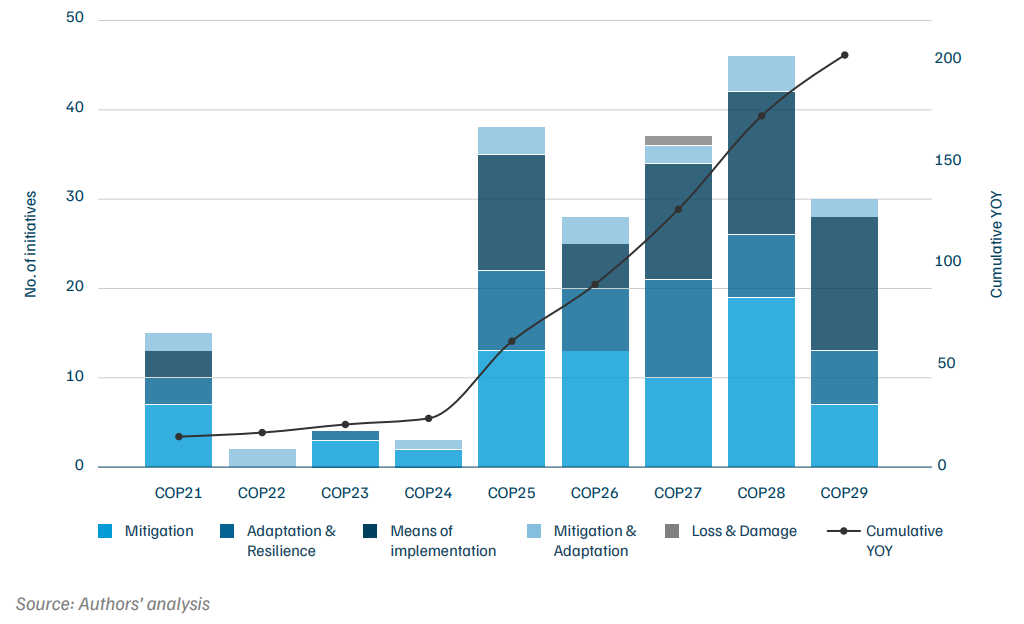
Figure ES1. Cooperative initiatives show an increasing trend over the last decade
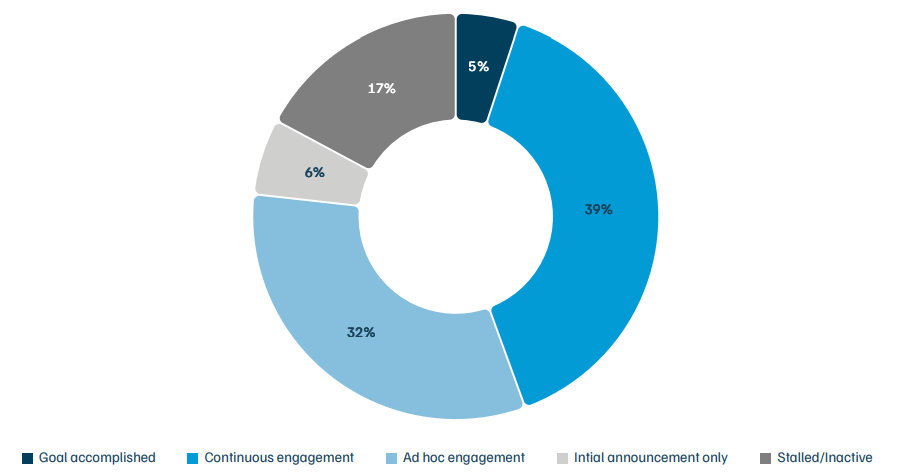
Out of the 203 initiatives assessed over the last decade, around 5 per cent of the initiatives have accomplished their stated goals, while 39 per cent of initiatives show continuous engagement. Given the long timeframes required to achieve goals, showing continuous engagement with periodical target updates is a considerable measure of an initiative’s progress.
Concomitantly, our analysis also shows that all initiatives have stated goals, but nearly 53 per cent of the initiatives do not have a clearly defined target. Further, while around 53–55 per cent of initiatives have organisational and monitoring arrangements, barely 28 per cent have a budgetary allocation for their functioning.
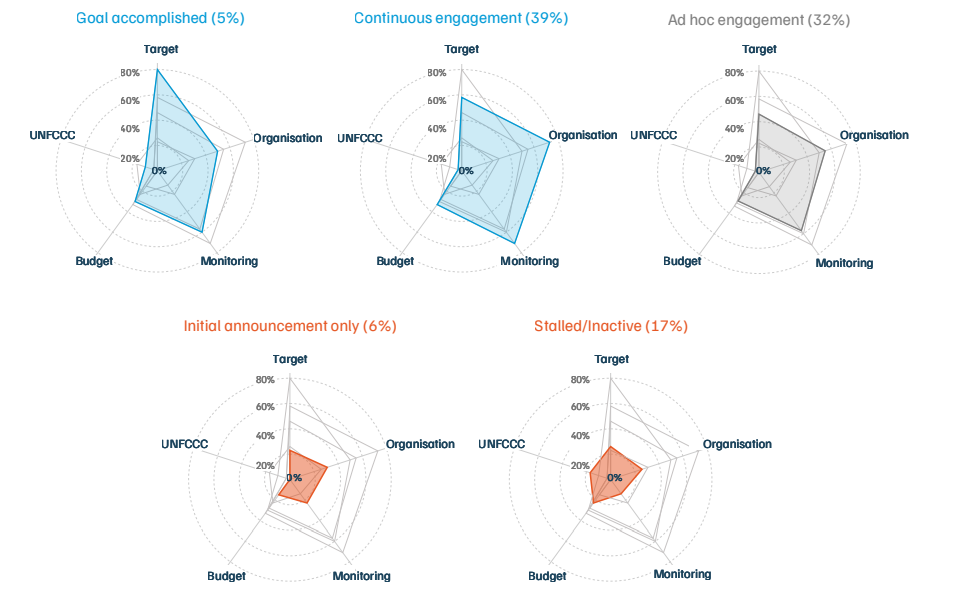
Reading the two analysis together, we find that initiatives with robust integration of structural elements such as targets, organisational and monitoring engagements, and budget allocation are showing better progress. In fact, most initiatives that have accomplished their goals started with clear targets. Similarly, initiatives with continuous progress generally have organisational and monitoring arrangements, unlike the stalled initiatives.
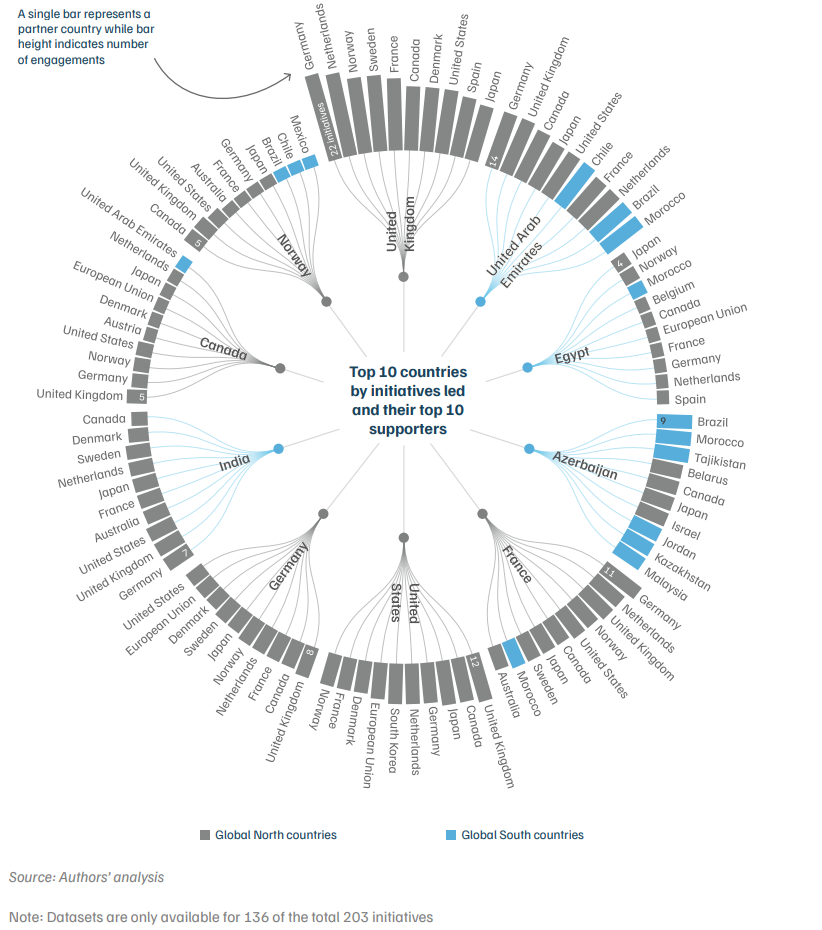
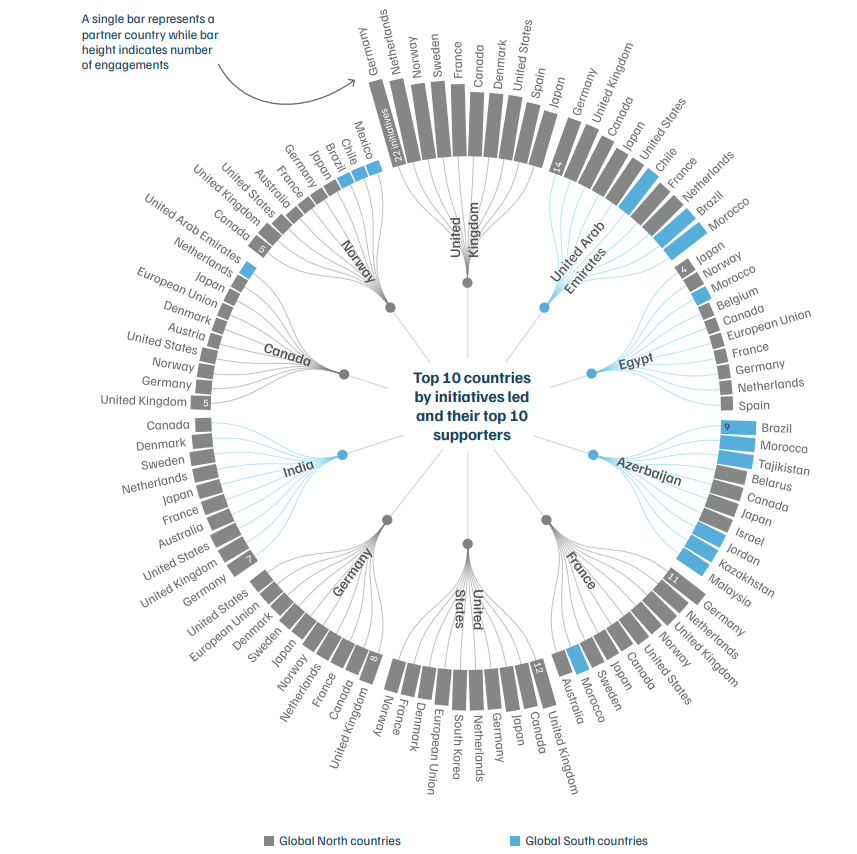
Figure ES2. Global North leads in collaborations, even in initiatives led by Global South
Mapping coalitions: The leaders and their partners
The annual Conference of the Parties (COPs) convened by the UNFCCC has, over the last ten years, evolved from a forum for negotiation to serving as an international platform for various stakeholders to collaborate and form coalitions, exchange knowledge and best practices, and shape bilateral and multilateral diplomacy.
Since the adoption of the Paris Agreement at COP21 in 2015, alongside the official COP agenda, cooperative climate initiatives have emerged as an increasingly prominent feature of the COP process. These initiatives are voluntary, multi-actor collaborations designed to foster intergovernmental partnerships, and catalyse climate action that extends beyond the capacities of individual governments.
Between 2015 and 2025, more than 475 such initiatives have been launched, engaging over 40,000 national and subnational government entities, intergovernmental organisations (IGOs), multilateral development banks (MDBs), private investors, industry, and NGOs (de Moraes 2025). These initiatives span sectors such as energy, transportation, finance, environmental conservation, and adaptation. By bringing together diverse actors and sectors, these initiatives embody the spirit of orchestration, and provide an opportunity to demonstrate ambition, leadership, and innovation, without the constraints of the negotiation process.
More recently, these initiative-related announcements by the Presidency and other key actors have begun to overshadow formal negotiation outcomes. They gain tremendous traction and are increasingly viewed as a key pillar of global efforts to broaden the base of actors involved in addressing the challenges of climate change. Notably, the Global Climate Action Agenda was framed as the ‘fourth pillar’ of the Paris Agreement, alongside national pledges, the financing package, and the negotiated agreement (Kuyper, Linnér and Schroeder 2018).
While the Global Stocktake process, alongside Biennial Transparency Reports and BTR review processes, are aimed at monitoring and tracking the progress of commitments made within the Paris Agreement and listed on the COP agenda, there is no comprehensive process or platform to track the progress of these parallel initiatives and pledges. Without appropriate measurability and accountability, much of the progress promised by these initiatives remains far from reach. Efforts in this direction, particularly in tracking the progress of initiatives, have been reflected in the literature. These include analyses of non-state actor led initiatives (Chan, Falkner, et al. 2015), examining the determinants of effectiveness in mitigationoriented initiatives (Michaelowa and Michaelowa 2017), and the more recent assessment of the progress of intergovernmental initiatives in reducing emissions (Forner and Diaz 2023). While these offer useful insights, they are limited by their scopes covering specific actors or focus areas, and do not offer overarching findings that can inform the structuring and efficacy of climate initiatives.
Building on this line of research, this issue brief systematically unpacks the evolving landscape of cooperative climate initiatives over the past decade from 2015, i.e., COP21 in Paris, to 2024, i.e., COP29 at Baku. It also sheds light on the trends, structural elements, and factors affecting their progress. Out of the 475+ initiatives that have emerged over these years, this issue brief examines 203 initiatives that have national governments as a key actor in leadership or participation, and analyses data from the literature review of key information sources such as the COP Presidency portal, websites corresponding to the respective initiatives, the Global Climate Action Portal (GCAP) compilation, and the annual yearbooks of the Highlevel Champions.
Over the past decade, international climate action has evolved into a symbiotic process that splices intergovernmental processes, i.e., those furthered within the COP agenda, with transnational cooperative initiatives, i.e., those fostered by the Parties to the Convention, and nonstate actors, i.e., cities, regions, firms, investors, and civil society. This section unpacks this landscape to present a snapshot of major trends, structures, actors, and themes.
Since the Chilean Presidency’s COP25 in Madrid in 2019, voluntary initiatives have registered a notable rise (see Figure 1). Prominent initiatives targeting specific areas of action, such as the Cool Coalition, the Clean Air Initiative, and other transgovernmental ones such as LEAD IT, trace their origins to the 2019 Climate Action Summit hosted by the UN Secretary-General António Guterres.
COP28, hosted by the United Arab Emirates (UAE) in Dubai in 2023, sustained this momentum, registering the most initiatives (46) among all the COPs, well-suiting its record of being the largest COP hitherto (McSweeney and Viisainen 2024). Despite a minor dip, the latest COP at Baku, hosted by Azerbaijan, still racked up about 30 initiatives, twice as many as COP21. COP22, COP23 and COP24 did not see much mobilisation.
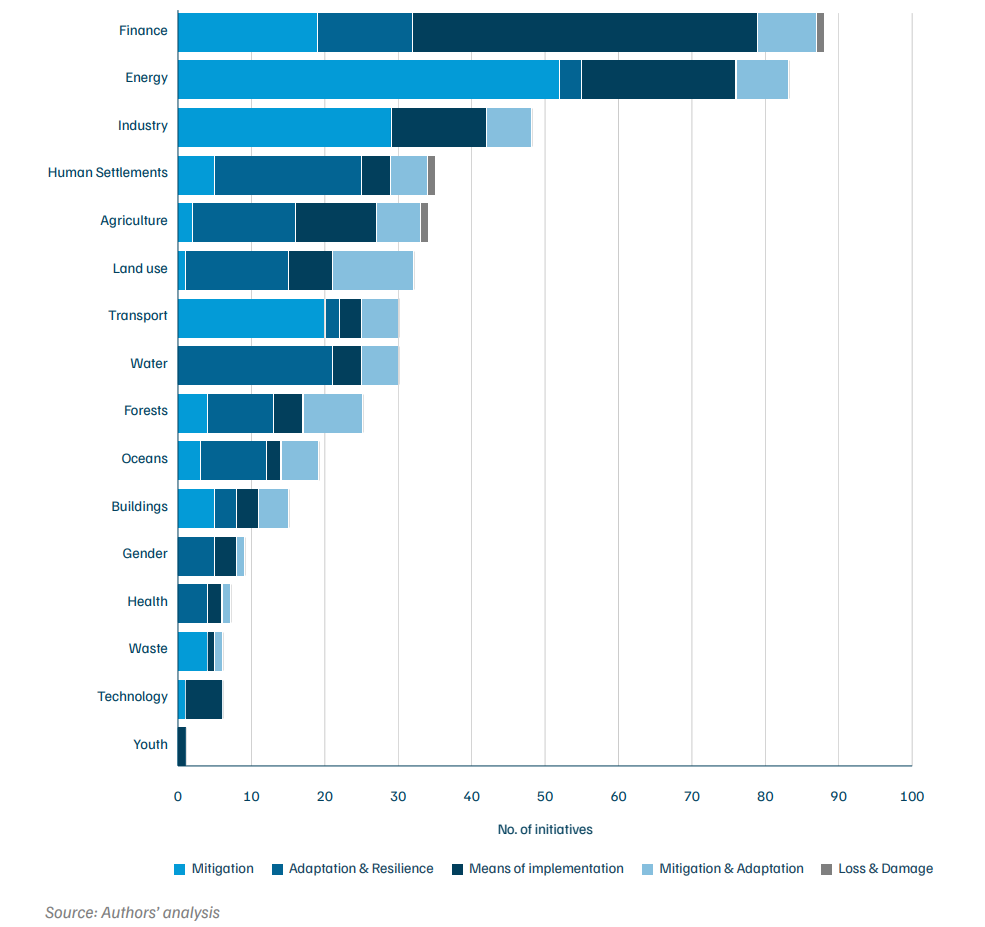
While broadly climate focus is grouped into five categories— Mitigation, Adaptation, Loss and Damage, Means of Implementation (MoI), and crosscutting mitigation and adaptation—the specific thematic areas pertain to a much larger list of 16 themes (see Figure 2). These are energy, industry, transport, buildings, agriculture, forests, land-use, oceans, water, waste, health, finance, human settlements, gender, youth and technology.
Figure 1. Cooperative initiatives show an increasing trend over the last decade
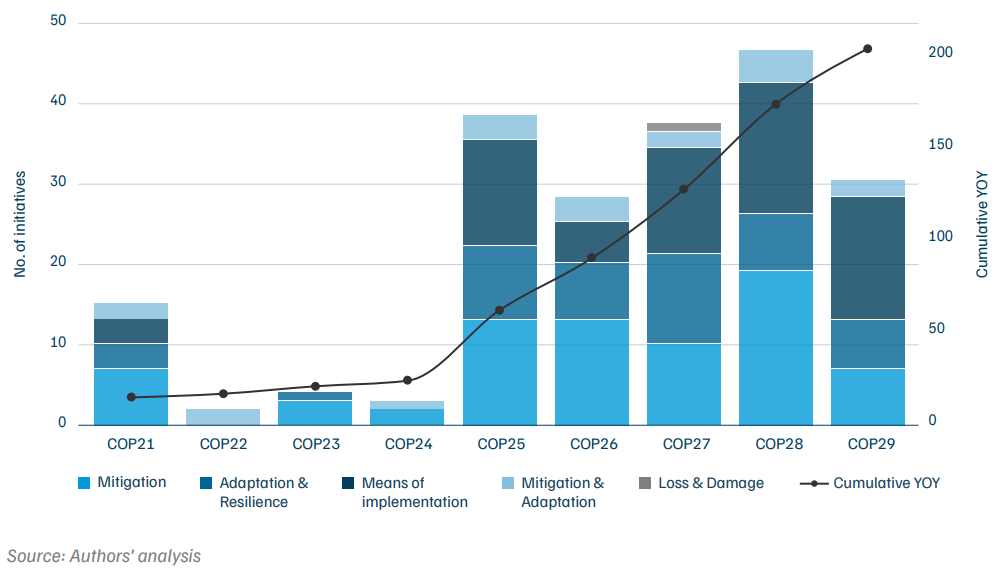
Across the COPs, mitigation has remained the predominant focus, with about 36 per cent of all initiatives aimed at emission reduction and allied areas of action. High emissions and hard-to-abate priority sectors such as energy, industry, transport, and buildings are also the prominent mitigation-driven sectors. On the other hand, focus on adaptation-only initiatives remains low, with only 21 per cent of initiatives tagged to it. Human settlements, water, agriculture, land-use, and forests correspond to thematic focus areas that prioritise adaptation. The cross-cutting areas of mitigation and adaptation are most concentrated in the thematic focus areas of land-use and forests, with over 30 per cent of initiatives tagged to these. Loss and Damagefocused initiatives featured only at COP27.
Since COP25 in 2019, there has been a notable increase in initiatives focused on MoI, adding up to 32 per cent of initiatives focused on aspects of support related to finance, technology, and capacity building. But for over a third of these support initiatives the specific thematic target area remains unclear. Gender and health also have increasing cross-cutting engagement with initiatives across mitigation, adaptation, and MoI aimed at integrating and mainstreaming these focus areas. Youth reflects a similar pattern, albeit to a much smaller extent. Leveraging technological innovation to foster climate outcomes is an emerging trend from the recent COPs in Dubai and Baku.
Figure 2. Mitigation-driven sectors emerge as the predominant thematic focus area across initiatives, while focus on Loss and Damage is almost negligible
Based on the literature, the important structural elements of initiatives include: goals, targets, organisational arrangements, monitoring engagements, budget allocation and UNFCCC affiliation (Chan, et al. 2014, Chan, et al. 2015, Michaelowa and Michaelowa 2017, Cogswell and de Zoysa 2025). Among these structural elements, all initiatives have stated goals, and over half have organisation and monitoring arrangements. However, over 53 per cent of the initiatives do not have a clearly defined target, and barely 28 per cent of them have budgetary allocation.
Figure 3. Notable rise in participation of wide range of actors from COP25, spurred by the UN Climate Action Summit in 2019
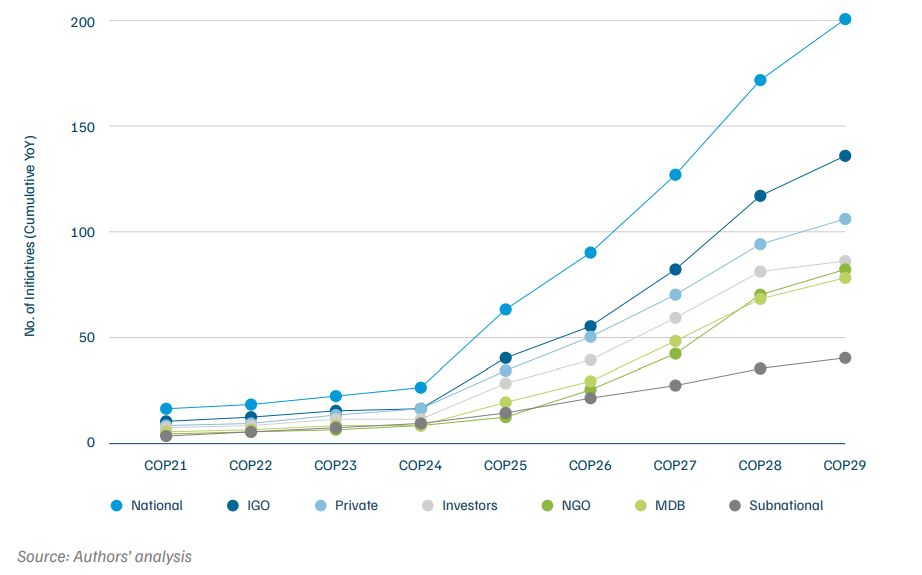
The primary actors in our analysis are national governments. Other major actors include IGOs, MDBs, investors, private entities, and subnational entities (see Figure 3). These actors also register a sharp rise in engagement since COP25. Importantly, while 50–80 per cent of adaptation and mitigation actions are expected to be subnational (UNDP 2009), engagement at the subnational level remains low, with subnational governments’ participation in barely a fifth of all initiatives. Further, MDBs and investors have limited engagement despite their catalysing role in mobilising finance for climate action.
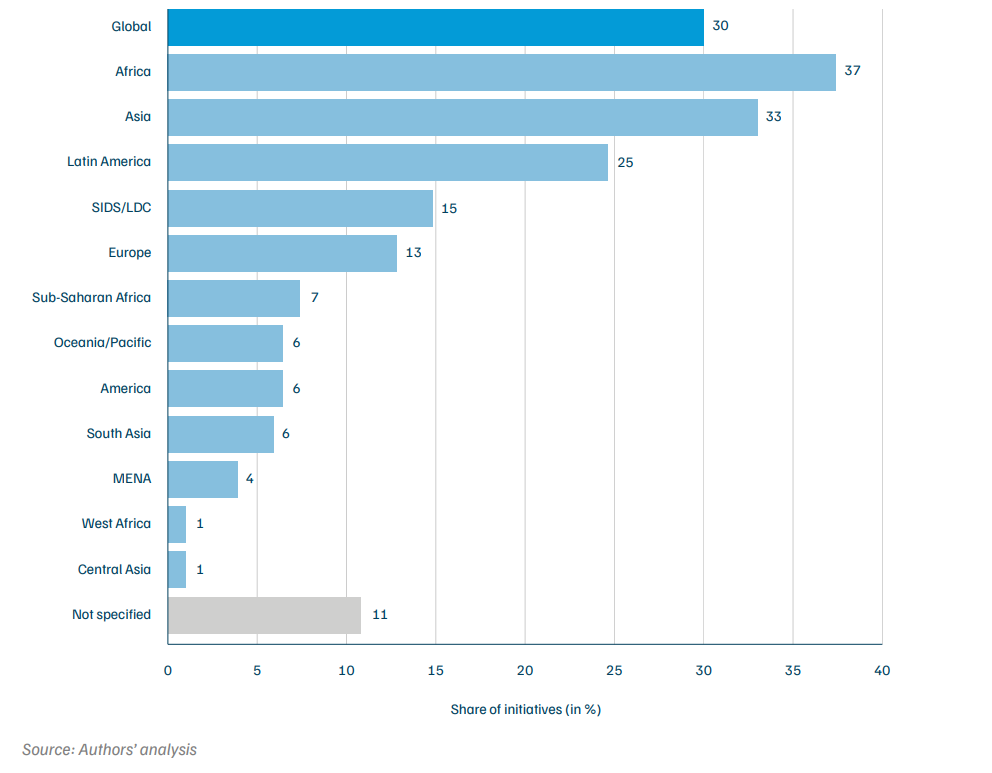
In terms of regions, the initiatives are spread across geographies; most target more than one region or are global (see Figure 4). Therefore, while many initiatives appear to target Africa (37 per cent), Asia (33 per cent), and Latin America (25 per cent), these are clubbed with Global North regions. In fact, standalone initiatives exclusively targeting Global South regions across Africa, Asia, and Latin America make up less than a third of all 203 initiatives assessed.
Figure 4. Over 40% of initiatives are global or lack a defined target region, highlighting the need for greater regional specificity
It is important to reflect on these initiatives beyond their actors, geographies, and themes, and understand their current progress by analysing the following grouped stages:
Figure 5 shows that 44 per cent of initiatives show progress by either achieving their goals or showing continuous engagement in the form of regular and periodic updates. Over a fifth of all initiatives are either stalled/inactive, or have no update since their initial announcements. About 32 per cent of initiatives show only ad hoc engagement, despite some resource allocation and activity.
Figure 5. Many initiatives show progress, but over one-fifth remain stalled or unupdated since launch
Source: Authors’ analysis
Figure 6. Initiatives with robust integration of structural elements are showing better progress
Source: Authors’ analysis
A deeper observation of the status of these initiatives in Figure 6 reveals an interesting finding - initiatives that have robust integration of the structural elements (goals, targets, organisational arrangements, monitoring engagements, budget allocation, and UNFCCC affiliation), have advanced the furthest.
This observation is further elucidated in looking at each stage of delivery as a whole. Goal accomplished initiatives demonstrate strong integration across most structural elements, supported by clear targets, monitoring systems, and institutional arrangements, enabling them not only to meet stated goals, but also to initiate additional phases of work. Likewise, continuous engagement initiatives exhibit considerable organisational and monitoring arrangements, which allow them to maintain steady progress. Ad hoc engagement initiatives show only partial integration across the structural elements of organisational and monitoring arrangements and budgetary allocation, resulting in their sporadic activity. In contrast, initiatives that show only initial announcements or are stalled barely have the structural underpinnings required for implementation. Notably, 80 per cent of initiatives that have accomplished their goals had clear, delineated targets, i.e., defined quantum, direction, and timeline. Similarly, over 70 per cent of initiatives with continuous engagement have organisational and monitoring arrangements, in contrast to initiatives that are stalled, wherein only 14 per cent have monitoring arrangements.
Taken together, these observations highlight that the integration of organisational and monitoring arrangements, budget allocation, and setting clear targets are critical differentiators, separating initiatives that demonstrate goal achievement and continuous progress from those that stagnate or fail to advance beyond symbolic announcements.
Combating climate change demands collective global action, and this section maps the central actor integrating the efforts across the collectives—national governments. Usually, countries play to their strengths, and as lead actors, they strive for more inclusive engagements, bring on board major countries, amplify the pooling of resources, and leverage individual expertise to further collective goals.
Table 1 highlights how top 20 countries are placed in terms of the reach of their initiatives, approximated via the number of initiatives they have (a) led; (b) the number of participant countries they were able to mobilise; and (c) the number of initiatives they themselves have participated in.
Table 1. Mapping top 20 countries on cooperative climate initiatives
| Countries | (a) Initiatives led | (b) Participants mobilised (on avg)* | (c) Initiatives participated in* |
|---|---|---|---|
| United Kingdom | 33 | 40 | 92 |
| United Arab Emirates | 18 | 69 | 45 |
| Egypt | 17 | 34 | 28 |
| Azerbaijan | 16 | 46 | 33 |
| France | 14 | 43 | 71 |
| United States | 13 | 35 | 61 |
| Germany | 13 | 17 | 88 |
| India | 8 | 47 | 30 |
| Canada | 6 | 23 | 74 |
| Norway | 6 | 19 | 70 |
| Netherlands | 6 | 35 | 64 |
| Costa Rica | 5 | 72 | 52 |
| Chile | 5 | 63 | 50 |
| Colombia | 5 | 39 | 43 |
| European Union | 5 | 52 | 30 |
| Japan | 4 | 33 | 63 |
| Sweden | 4 | 13 | 57 |
| Morocco | 4 | 38 | 52 |
| Brazil | 4 | 13 | 46 |
| Denmark | 3 | 13 | 58 |
*Datasets are only available for 136 of the total 203 initiatives
Source: Authors’ analysis
Expectedly, mostly countries that have hosted COPs have also led the most initiatives. Among them, the United Kingdom leads with 33 initiatives. It has also mobilised a significant number of countries and has participated in the maximum number of initiatives. The UAE’s record of having hosted the largest COP is reflected here too, with the highest mobilisation (69 countries on average) compared to other COP presidencies.
Notably, while developed countries like the United States and Germany have led a considerable numbers of initiatives, they have mobilised a lower number of countries compared to Presidency countries. In fact, the Presidencies mobilise more than one-and-a-half times as many participant countries on average (see column b in Table 1). This highlights the critical role of the COP Presidency as a key orchestrator in transgovernmental climate action. This observation is most obvious in the case of Chile, which hosted the COP25 Presidency in Madrid with logistical support from Spain—the number of countries mobilised far exceeds the initiatives it led. Costa Rica’s mobilisation patterns are also different: it records high mobilisation, but mostly from much smaller countries in the Latin American region. On the other hand, the European Union (EU), despite leading relatively fewer initiatives, registered higher mobilisation—reflecting its convening power within the multilateral system. However, there are outliers to this pattern: Egypt and Morocco, despite hosting COPs, registered modest reach in initiatives.
A pattern emerges upon reflecting on the key partnering countries for each initiative-leading country (see Figure 7): developed countries mainly participated in each other’s initiatives, which also lack balanced participation from prominent Global South countries. Even in initiatives led by Global South countries, prominent participants were Global North countries.
Further, from the Global South, along with the UAE and Azerbaijan, India has emerged as an important player. Despite not hosting a COP in the last decade, India has led eight initiatives and holds a record of over 47 countries mobilised on average, at par with the Presidencies’ mobilisation average. Notably, with over 121 participating countries, the treaty based International Solar Alliance (ISA), co-founded by India and France at COP21, records one of the highest mobilisations by one initiative.
Figure 7. Global North leads in collaborations, even in initiatives led by Global South
Source: Authors’ analysis
Note: Datasets are only available for 136 of the total 203 initiatives
So far, our analysis has unpacked the landscape of cooperative climate initiatives in the past decade, and identified key factors influencing them to inform the future structuring of initiatives. To take forwards the findings from this research, COP30 in Belém marks an inflexion point in global climate diplomacy. It will be the first COP convened after a full turn of the Paris Agreement’s ambition cycle, and will see the third round of Nationally Determined Contributions (NDC 3.0), expected to be more ambitious than the second set. It also promises to continue promoting the voluntary cooperative initiatives as the ‘fourth pillar’, bringing together a wide range of actors to complement the official work of the Paris Agreement.
The following recommendations based on our analysis could inform the future of cooperative climate action:
In conclusion, this stocktake has shown that while cooperative initiatives have expanded rapidly since COP21 in Paris, and illustrate the promise of hybrid multilateralism, they are structurally fragmented, and progress remains uneven. Too often, they mirror the COP agenda instead of supplementing or complementing it. To transform initiatives into credible instruments of action, accountability must be embedded as a core principle, and orchestration must shift from symbolic to effective.
The COP Presidency is the country hosting the annual UN Climate Conference. It leads agenda- setting, builds consensus among Parties, and mobilises countries for cooperative action. Presidencies act as key orchestrators of global climate diplomacy, shaping negotiations and launching initiatives that complement the Paris Agreement’s long-term goals.
Cooperative climate initiatives are voluntary partnerships among governments, organisations, and non-state actors. They accelerate climate action beyond national commitments through collaboration on mitigation, adaptation, finance, and technology. Examples like the International Solar Alliance and Cool Coalition show how collective action complements formal UNFCCC processes.
The Global Climate Action Agenda, framed as the fourth pillar of the Paris Agreement, promotes voluntary multi-actor initiatives that complement official negotiations. It mobilises diverse actors—governments, businesses, and civil society—to advance climate solutions, ensuring that implementation matches ambition across sectors and countries beyond COP discussions.
Actors include national and subnational governments, international organisations, multilateral development banks, investors, private companies, and NGOs. Their collective engagement drives innovation, finance, and implementation.
Orchestration refers to leadership and coordination—typically by COP Presidencies or lead countries—guiding and aligning climate initiatives. Participation mobilised measures the number of countries or actors engaged in these initiatives.
How South Asia’s Energy Transition Can Respond to Global Disruptions
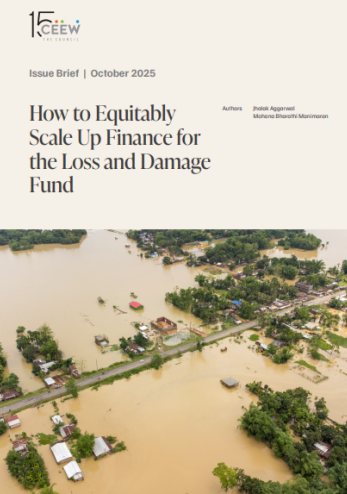
How to Equitably Scale Up Finance for the Loss and Damage Fund
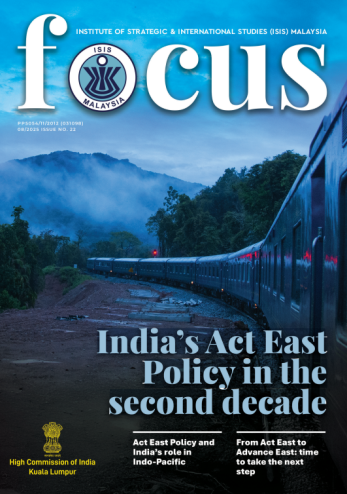
Asian century in motion:ASEAN, India, and the new world order
Energy transitions amid an economic transformation