Other Publications
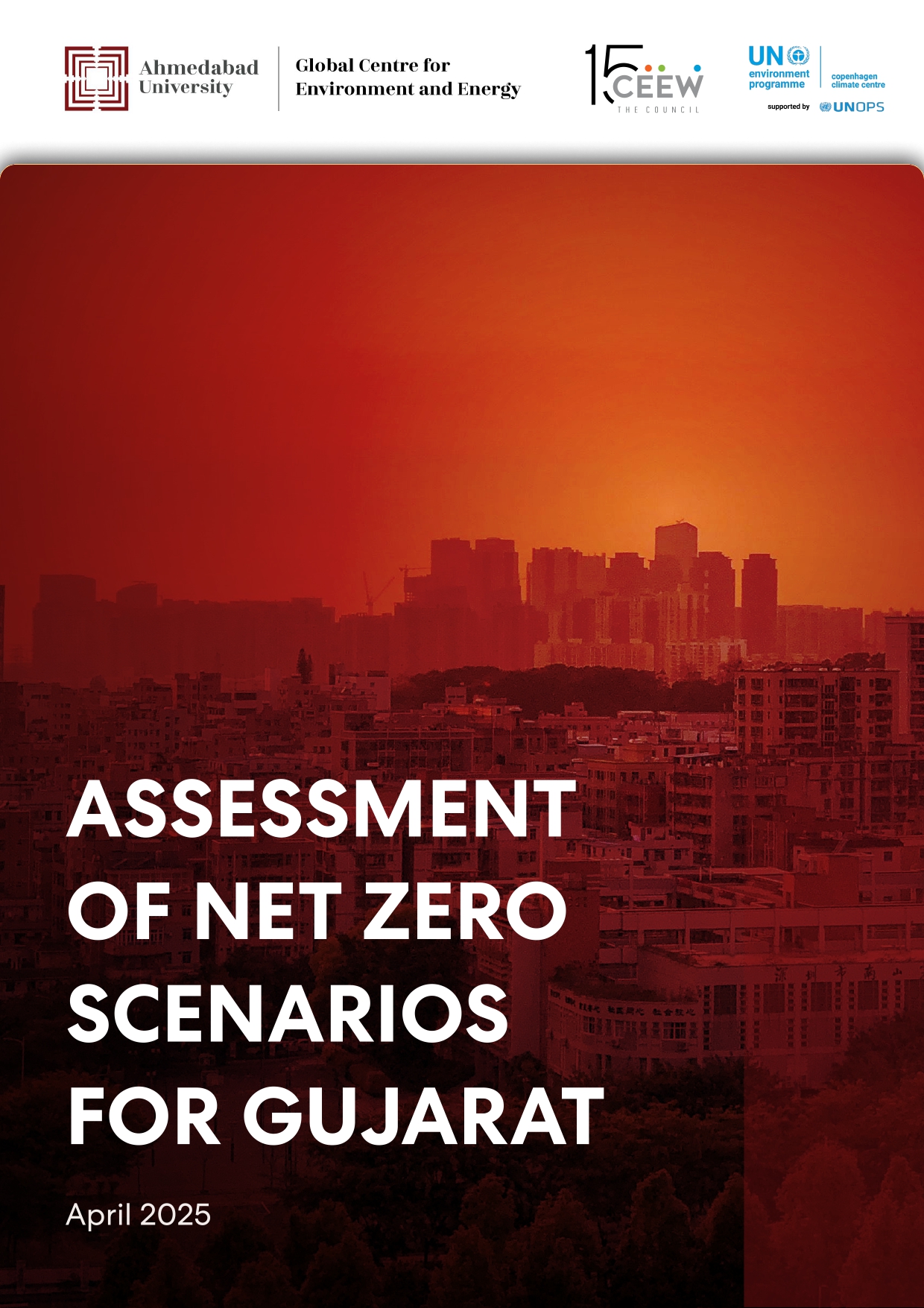
Assessment of Net Zero Scenarios for Gujarat
Aman Malik, Rishabh Varma, Vaibhav Chaturvedi, Joy Rajbanshi
April 2025 | Low-carbon Economy
Overview
India announced at COP26 in 2021 that it aims to achieve net zero carbon emissions by 2070, setting a long-term vision for addressing climate change. However, reaching this target requires action at both the national and state levels. In this context, this report - a joint effort by Global Centre for Environment and Energy at Ahmedabad University and CEEW, offers a detailed roadmap to align the state's climate ambitions with lndia's net zero targets.
According to the Viksit Gujarat@2047 vision document, the state aims to grow its economy from $259 billion in 2021–22 to $3.5 trillion by 2047, leading to more than an eightfold increase in per capita income between 2020 and 2050. This, along with urbanisation rising from 48% to 73% during this time is expected to significantly raise energy demand and consequently emissions across all sectors – transport, industry, and residential and commercial use. A commitment to net zero, therefore, would imply Gujarat to chart out low-carbon growth pathways without compromising its economic and developmental prospects.
This report analysis two alternate net zero scenarios for Gujarat: (i) a Net Zero Conventional Scenario and (ii) a Net Zero Structural Shift Scenario, both aiming for Gujarat to achieve net zero in 2070. It uses two modelling tools – the Global Change Analysis Model (GCAM) and Low Emissions Analysis Platform (LEAP) to estimate outcomes under each scenario. These are compared with a reference scenario to assess the scale and nature of transformation required. The analysis also draws on the most recent greenhouse gas emissions inventory for the state and a review of historical trends, ongoing policies, and initiatives.
The report recommends sectoral and economy-wide targets for both the near and long term, aligned with Gujarat’s 2070 net-zero goal. The power sector is expected to decarbonise first, requiring 140 GW of solar and wind capacity by 2030 and 600 GW by 2050. Cumulative investments in electricity generation between 2020 and 2070 are estimated at INR 55 lakh crore in the reference scenario, rising to INR 74 lakh crore in the net-zero pathway -a 35% increase, excluding storage and grid infrastructure.
In Industry, stringent energy efficiency measures could reduce emissions by 3.4 MtCO₂ in 2040. Electrification must rise from 18% in 2020 to 83% by 2070, while green hydrogen will be essential for hard-to-abate sectors, subject to cost and infrastructure availability. In transport, electrification - particularly of two- and three-wheelers will lead the transition, with electric vehicles expected to account for 50–100% of the sector by 2070.
At the economy-wide level, Gujarat must reduce its emissions intensity by 51% by 2030 (relative to 2015) to remain on a net-zero trajectory.
The report also highlights the broader co-benefits of a net zero transition, such as improved air quality, health benefits, green job creation, and enhanced economic resilience. However, it underscores the need to carefully navigate trade-offs, including land-use challenges, energy affordability, and ensuring a just transition for communities reliant on fossil fuel industries. By addressing these complexities, Gujarat aims to provide a replicable model of inclusive and equitable climate action for other regions to follow.
Key Findings
- Gujarat witnessed a 62 per cent rise in energy sector GHG emissions between 2010 and 2022, with the industry sector contributing to almost half of the total share. Without intervention, energy emissions could increase 5–6 times by 2070 compared to 2020, driven primarily by the industrial sector.
- Net-zero transition drives large-scale electrification across Gujarat’s economy. Achieving net zero will require widespread electrification of the industry, transport, and building sectors, alongside the use of green hydrogen for high-temperature industrial processes produced using renewable electricity. By 2070, electricity consumption under the net-zero scenario is 1.5–2 times higher than the reference case and nearly 25 times that of 2020. Electricity generation must increase 14-fold from 2020 levels. However, after 2050, Gujarat’s domestic renewable energy potential, especially solar, becomes insufficient to meet demand. As a result, by 2070, nearly 40% of electricity will need to be imported from other states.
- Decarbonising industry requires a major shift to low-emissions technologies. In the next decade, enhanced energy efficiency and electrification of low- and medium-temperature processes will be key. Over the long term, as hydrogen production costs fall and high-temperature heat remains difficult to electrify, alternative fuels like green hydrogen will become critical. Electrification’s share in industry is projected to rise from 18% in 2020 to 83% by 2070. Stringent efficiency measures could cut emissions by 3.6 MtCO₂ in 2040 compared to the reference scenario. Broader structural changes—such as a growing services sector or a shift to less energy-intensive industries like automobiles and semiconductors—can also help ease both supply- and demand-side decarbonisation challenges.
- Solar and wind installations dominate total power sector investments in the future: To align with India’s net-zero goals, Gujarat will need approximately 100 GW of solar and 43 GW of wind capacity by 2030, increasing to 275 GW of solar and 93 GW of wind by 2040. This exceeds Gujarat's current target of 100 GW of renewable energy by 2030. Cumulative investment in electricity capacity additions from 2020 to 2070 is estimated at INR 55 lakh crore in the reference scenario, rising to INR 74 lakh crore in the net- zero scenario - a 35% increase. Note that this does not include investments in Battery Energy Storage Systems (BESS) and transmission & distribution (T&D) infrastructure.
- Green hydrogen could be a clean fuel alternative: Green hydrogen will be a clean fuel alternative for industry sub-sector areas that are not easy to shift to electricity as well as for shipping, aviation, The demand for green hydrogen within the state could also be an economic opportunity for Gujarat to become a manufacturing hub that caters to hydrogen needs within and outside the state. However, scaling up green hydrogen will require investments in R&D, pilot projects, and the creation of infrastructure for the transportation and storage of green hydrogen.
- The future of transport is electric: As charging infrastructure improves, transport decarbonisation will primarily occur through vehicle electrification, especially as electricity becomes cleaner. In the near term, e2Ws and e3Ws drive this shift, with e4Ws and e-buses playing a smaller role. Over time, as technical 3 and infrastructure challenges are resolved, e4Ws and e-buses gain market share. However, electric heavy-duty vehicles like trucks may face limitations due to charging time, battery size, and highway infrastructure.
- Modals shift are also critical - Improving rail and port connectivity can reduce freight emissions, while compact urban planning, better public transport, and walkable cities can cut passenger transport emissions and deliver co-benefits.
- The Commercial and Public Services sector is the fastest-growing energy demand sector. Energy use in both residential and commercial buildings increases, with the latter rising faster due to rapid floorspace expansion. Residential cooking energy demand declines significantly by 2070, driven by efficient stoves, cleaner fuels, and a complete phase-out of biomass before mid-century. However, cooling demand surges nearly 52-fold due to rising incomes, floorspace, and air conditioner usage. While building energy efficiency improves, these gains are outpaced by growth in demand for space, services, and appliances.
- Residual emissions of ~98–112 MtCO₂ will remain even in 2070, requiring additional offsets beyond the study’s scope such as CCS in industry, increased forest cover, or behavioural interventions.
“To be net zero ready, Gujarat needs to significantly scale up additions in solar and wind capacity – of the order of 140 GW in 2030 and 600 GW by 2050. This will provide a solid foundation to the state’s
decarbonisation pathway, most of which will happen through electrification in industry, transport, and building sectors. The increase in renewable energy needs to be accompanied by increase in storage and transmission and distribution infrastructure.”