Council on Energy, Environment and Water Integrated | International | Independent

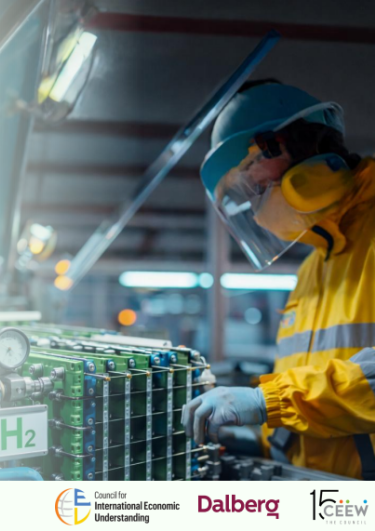
Suggested citation: CIEU, Dalberg, and CEEW. 2026. Bharat Cleantech Manufacturing Platform: Green Hydrogen Indigenisation Pathways—Accelerating an Aatmanirbhar, Green and Viksit Bharat. New Delhi: Council for International Economic Understanding and Dalberg.
India’s cleantech supply chains remain heavily import-dependent, with 65–70 per cent of the green hydrogen value chain relying on imports. As the country pursues an ambitious target of producing 5 million tonnes per annum (MTPA) of green hydrogen by 2030 under the National Green Hydrogen Mission (NGHM), indigenising the electrolyser manufacturing ecosystem is critical for achieving energy security, industrial self-reliance, and net-zero ambitions.
This report, developed under the Bharat Cleantech Manufacturing Platform by the Council for International Economic Understanding (CIEU), Dalberg Advisors, and the Council on Energy, Environment and Water, outlines indigenisation pathways for the green hydrogen value chain in India. It maps the current landscape of domestic value addition (DVA), identifies sector-wise gaps across demand, R&D, raw materials, capital equipment, workforce, and financing, and proposes actionable strategies to raise the DVA in electrolyser manufacturing from 36 per cent today to 59 per cent by 2030.
The report estimates that achieving this indigenisation target would require approximately INR 8,400 crore in total government investment by 2030, while generating import bill savings upwards of INR 9,000 crore, creating up to 92,000 direct jobs, and unlocking an annual domestic electrolyser market potential of up to INR 99,000 crore.
Demand Outlook to 2030
By 2030, we estimate India’s green hydrogen demand could reach between 1.2–3.4 million tonnes per annum (MTPA), combining domestic consumption and export-oriented production. Domestic demand is projected to reach 0.6–1.6 MTPA, driven primarily by early adoption in refining, green ammonia substitution in fertilizer manufacturing, blending in city gas distribution, and pilots in hard- to-abate sectors like steel and chemicals. Export-linked demand including for green ammonia exports, bunkering and other international uptake arrangements could add another 0.6–1.8 MTPA contingent on domestic manufacturers’ ability to secure long-term contracts in global markets, and sustain prices discovered through recent SECI tenders.
Translating this into electrolyser capacity, we estimate that India will require electrolyser installations of approximately 10–28 GW by 2030. This capacity deployment will be shaped by the pace at which early projects for green hydrogen take off and achieve financial closure, the success of the PLI schemes for manufacturing within green hydrogen, and the evolution of offtake mechanisms under the National Green Hydrogen Mission.
Value Chain Structure, Cost Stack, and Domestic Value Capture
India currently captures value in balance of plant (BoP) manufacturing and system integration, leaving much on the table when it comes to the electrolyser stack and its critical components. Across alkaline and PEM electrolysers, balance of plant forms 68–76% of total electrolyser costs. Domestic firms have experience in undertaking metal fabrication for these balance-of-plant components (e.g., frames, vessels, piping) and integrating off-the-shelf components (e.g., control or SCADA systems) with the core electrolyser stack. Despite these strengths, components like power electronics and sensors remain import dependent.
Beyond BoP, key stack components like membranes and diaphragms, electrodes, catalysts, bipolar plates, and porous transport layers account for 24–32% of total electrolyser cost and are both material and IP-intensive. Even though they represent a smaller share of total electrolyser cost, these components are the locus of upstream innovation and technology differentiation. Domestic value addition is negligible across most stack components. As a result, India’s current domestic value addition is around 35% for electrolyser systems, depending on the final configuration and the extent of BoP localisation.
Table 1: Green Hydrogen Value Chain and Current Domestic Value Capture
| Key Components | Membrane | Electrodes | Porous Transport Layer | Bipolar Plates | Balance of Plant |
|---|---|---|---|---|---|
| Cost Contribution — Alkaline | 5% | 11% | 4% | 4% | 76% |
| Cost Contribution — PEM | 6% | 16% | 7% | 3% | 68% |
| Current DVA (approx.) | ~0% | ~0% | ~0% | ~15% | ~45% |
| Current Manufacturing Presence | Non-existent | Non-existent | Nascent porous transport layer manufacturing | SS plate blanking, stamping; gold coating of SS roll | Strong pumps, vessels, power systems |
| Critical Value Chain Dependencies | Zirconium dioxide; Nafion membranes; R2R casting machines | Platinum, Iridium; Electrode coating/sintering tools | Titanium powder; PAN resin; Nickel foam | High-grade SS/Titanium sheet | H2-grade compressors, dryers, storage; Power electronics and sensors |
Source: Dalberg analysis; Expert consultations. Note: While renewable energy contributes over half of green hydrogen costs and is covered under the solar sector, this section focuses on the electrolyser stack.
Manufacturing Footprint: Current Base, Announcements, and Gap to 2030
India’s existing electrolyser manufacturing footprint is set to expand and will be able to serve the projected green hydrogen demand. Existing electrolyser manufacturing capacity in the country stands at approximately 2.1 GW/year. The existing manufacturing base is well positioned to serve the approximately 9.8 GW of installed electrolyser capacity needed in 2030 to meet the projected demand for green hydrogen production in the conservative scenario. Additionally, approximately 26 GW/year of electrolyser manufacturing capacity has been announced, of which approximately 3 GW/year is expected to come up under the PLI scheme.
However, over 90% of the announced manufacturing capacity is yet to begin construction and focus is skewed towards assembly rather than stack localisation. The announced capacity coming online could result in overcapacity compared to the likely demand for green hydrogen in 2030. Given the weak demand signal, the entire announced capacity is unlikely to come online. Further, the announced manufacturing plants are expected to continue to rely on imported membranes, catalyst coatings, and other key stack elements via technology partnerships from international suppliers. While this pipeline could establish India as a large electrolyser assembly hub, without targeted incentive to deepen stack manufacturing, the sector risks locking into an assembly-led pathway with continued dependence on imported embedded value.
Bottlenecks to Scaling Domestic Manufacturing
Despite strong policy intent under the National Green Hydrogen Mission, India’s green hydrogen manufacturing ecosystem remains constrained by a set of interlinked bottlenecks that collectively raise costs, delay scale-up, and weaken incentives for deep localisation. Slow and uncertain demand growth limits the ability of manufacturers to commit to capital-intensive investments in electrolyser stacks and components. Fragmented R&D and dependence on imported materials and equipment constrain domestic learning and technology absorption. Together, these challenges risk locking India into an assembly-led manufacturing pathway.
Demand and Market Architecture
R&D and Product Innovation
Upstream Raw Materials and Critical Inputs
Capital Equipment and Infrastructure
Talent and Workforce Development
Financing and Taxation
The NGHM was launched in January 2023 with an outlay of INR 19,744 crore up to FY 2029–30. It aims to make India a global hub for green hydrogen production by establishing domestic manufacturing capacity for electrolysers, incentivising green hydrogen production, and supporting R&D across the hydrogen value chain.
As of 2025, India has only 0.3 MTPA of green hydrogen production capacity that is active and commissioned. An additional 0.4 MTPA is planned or under construction, and 11.2 MTPA has been announced but is yet to start construction. For these announced projects to meet the 2030 deadline, construction would need to begin by 2027, as commissioning typically takes around three years.
Domestic value addition refers to the share of component costs that are indigenised, meaning the portion of costs from processes or parts that can be manufactured locally. Currently, electrolyser components are predominantly (60–80 per cent) imported and only assembled domestically. Increasing DVA from the current 36 per cent to the targeted 59 per cent by 2030 would reduce India’s import dependence, lower costs through localised supply chains, and create significant domestic employment in manufacturing.
The main types are Alkaline, Proton Exchange Membrane (PEM), Anion Exchange Membrane (AEM), and Solid Oxide Electrolyser Cell (SOEC). India is primarily focusing on Alkaline and PEM electrolysers, which are expected to comprise approximately 80 per cent and 15 per cent of total capacity by 2030, respectively. SOEC and AEM are still at nascent stages and are not expected to contribute significantly to the 2030 electrolyser capacity.
CO₂ Pipeline Network for Carbon Capture and Storage in India
What is Fuelling India’s Road Transport Sector?
What Drives Vehicle Ownership Costs in India?
How Will India’s Vehicle Ownership Grow?
How can CCUS Decarbonise India’s Industrial Sector?