Policy Brief
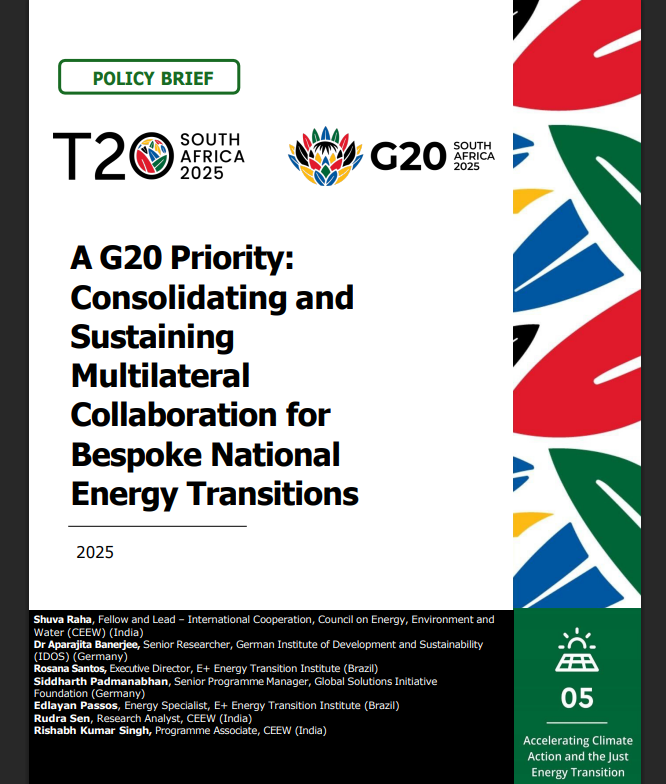
A G20 priority: Consolidating and sustaining multilateral collaboration for bespoke national energy transitions
Shuva Raha, Rudra Sen, Rishabh Kumar Singh
October 2025 | International Cooperation
Authors
- Shuva Raha, Fellow and Lead – International Cooperation, Council on Energy, Environment and Water (CEEW)
- Dr Aparajita Banerjee, Senior Researcher, German Institute of Development and Sustainability (IDOS)
- Rosana Santos, Executive Director, E+ Energy Transition Institute
- Siddharth Padmanabhan, Senior Programme Manager, Global Solutions Initiative Foundation
- Edlayan Passos, Energy Specialist, E+ Energy Transition Institute (Brazil)
- Rudra Sen, Research Analyst, CEEW
- Rishabh Kumar Singh, Programme Associate, CEEW
Overview
This policy brief discusses how developing countries should continue leveraging the G20 and UNFCCC platforms while improving South–South and North–South cooperation, amid a combative geopolitical scenario, to 1) quantify their finance, technology, and capacity needs for transition and adaptation; 2) ensure – and enhance – finance flows; 3) develop or acquire appropriate at-scale technologies blending modern and traditional expertise; and 4) shape bespoke national energy transition pathways that best suit their developmental priorities and resources.
Key Highlights
- The G20 should focus on consolidating and sustaining multilateral collaborations and partnerships to deliver bespoke national energy transition pathways that take into account local contexts, developmental priorities and implementation capabilities.
- With over 60 developing countries spending more on servicing their debt obligations instead of essential developmental areas their financial ability to invest in energy transitions is significantly limited in the absence of international assistance.
- Multilateral organisations and initiatives are being undermined by certain developed countries with the implementation of protectionist and inward-looking policies.
- G20 needs to re-examine the Common Framework for Debt Treatments to include provisions for debt cancellation that is necessary to create fiscal room to prioritise investment in capital-intensive clean energy infrastructure.
- G20 must foster a "coalition of the willing members" to catalyse energy transitions and facilitate the deployment of co-developed and context-appropriate technologies that reflect local contexts and align with developmental priorities.
- South Africa needs to maximise the impacts of its G20 Presidency through cross-pollination of ideas and initiatives in forums like the UN's Fourth Financing for Development Conference and Brazil’s COP30..
"The focus is on consolidating, strengthening, and utilising existing G20 initiatives – instead of proposing new structures – to maintain continuity of ideas and implementation, thus maximising the impact of South Africa’s presidency."