Council on Energy, Environment and Water Integrated | International | Independent

Suggested citation: Kumar, Sunil, Vibhuti Chandhok and Rishabh Jain. 2025. Making India a Hub for Critical Minerals Processing. New Delhi: Council on Energy, Environment and Water.
Critical minerals are now central to India's industrial growth, energy, and national security. To develop a self-reliant supply chain of critical minerals will require strengthening India's processing ecosystem - not just as an industrial requirement but as a strategic imperative - essential for reducing import dependence and ensuring energy security.
This report offers a comprehensive assessment of India's present capacity in processing critical minerals. It focuses on 15 critical minerals - including lithium, cobalt, nickel, rare earths, and graphite - selected from the 30 identified by the Ministry of Mines in June 2023. The study maps natural occurrences of critical minerals, analyses commercial processing routes worldwide, and evaluates India's midstream (processing and refining) capabilities. In doing so, it identifies the main roadblocks, proposes practical solutions, and suggests clear strategic interventions built on three pillars: building institutional capacity, strengthening the existing mining and metallurgy ecosystem, and enhancing competitiveness.
Countries across the globe are facing the impacts of climate change, and to reduce its effects, the transition to clean energy technologies, such as batteries, solar photovoltaics, wind energy, etc., has become necessary. Critical minerals are essential for India’s energy transition and are commonly defined as ‘minerals that are necessary inputs for national economic goals and have serious risks that threaten the supply chain’s resilience’ (NBR 2022). Additionally, critical minerals are building blocks for many strategic sectors, including defence, aerospace, and electronics, thus underscoring their multidimensional economic and technological importance. India already possesses a foundational infrastructure and institutional memory for the mining and processing of bulk minerals such as iron, aluminium, lead, zinc, etc., which can be further strengthened and strategically developed to support the growing needs of critical minerals processing.
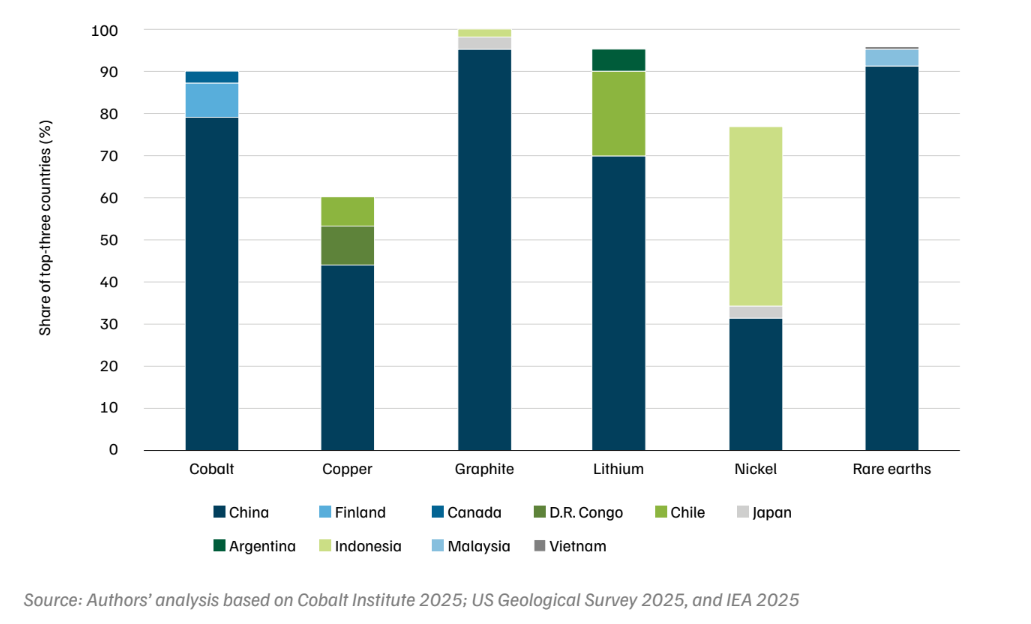
Critical minerals are found only in a handful of countries with limited availability, and the supply chain of these minerals is also highly concentrated in a few countries. China, for example, dominates in processing critical minerals like lithium, cobalt, graphite, rare earth elements and copper, as shown in Figure ES1. China is responsible for more than 90 per cent of global rare earth processing, 95 per cent of graphite processing, and 79 per cent of refined cobalt production. India is not among the top three producing countries for many of these critical minerals relevant for clean energy transition technologies and the defence sector. It remains dependent on imports for nearly all of its lithium, cobalt, and nickel requirements1 (Ministry of Mines 2023). Moreover, the global landscape is moving towards a more calculated, security-driven approach to resource management, which makes India’s existing supply chain vulnerable to significant geopolitical and economic risks, such as trade barriers, as well as recent restrictions on the supply of minerals such as rare earths (CSIS 2025).
Figure ES1. Share of the top three countries in the processing of critical minerals (2024)
India’s ambitious trajectory to achieving Net-Zero by 2070 entails energy independence and carbon neutrality that hinge critically on large-scale deployment of clean energy technologies like solar, wind and batteries. Recognising the strategic importance of critical minerals, policy decisions governing them have gained substantial momentum since India’s G20 presidency in 2023. After successful negotiations on critical minerals during the G20 Energy Transition Working Group, the Ministry of Mines amended the Mines and Minerals (Development and Regulation) Act (MMDR) to ease the process of critical mineral block auctions, followed by the launch of the National Critical Mineral Mission in January 2025, with a budget of INR 34,300 crore (approximately USD 4 billion) over seven years from FY 2024–25 to 2030–31. One of the important action points of the recently launched National Critical Mineral Mission is the development of four processing parks where existing capabilities should be leveraged. The government has allocated a budget of INR 500 crore (approximately USD 58 million) for the same. The mission aims to secure a long-term, sustainable supply of critical minerals and strengthen India's critical minerals value chains, encompassing all stages from critical mineral exploration, mining, beneficiation and processing, and recovery from end-of-life products.
While India remains dependent on imports for several critical minerals such as lithium, nickel, cobalt, etc., this evolving policy landscape and auction of critical mineral blocks present a timely opportunity to focus on the development of domestic processing capabilities. India already has the opportunity to emerge as a key player in the processing of critical minerals given that it has a well-developed mining industry and significant technological know-how in mineral processing, owing to its expertise in base metals, including iron, aluminium, copper, and zinc, thus providing a strong base in mineral processing. The existing capabilities provide a strong foundation to expand into the processing of critical minerals, and with these advantages, India holds significant potential to become a global player in the processing of critical minerals. To achieve this, it is essential to assess the current capabilities and gaps in India’s mineral processing landscape.
This report aims to provide an in-depth analysis of India's capabilities in the processing of critical minerals, and proposes potential strategic action steps to strengthen and develop domestic capabilities. To this end, we have covered the following aspects:
We expect the report’s findings to help the government and industry stakeholders in informed decision-making to develop India’s critical minerals processing capabilities.
Naturally critical minerals rarely occur in pure form; they are found in association with other valuable or non-valuable minerals/rocks in deposits. These naturally occurring minerals require processing after mining. The processing of any mineral includes a combination of physical and chemical operations to extract a high-purity element or compound, suitable for industrial applications. The naturally occurring deposits/ore and their commercial processing route of all the 15 minerals analysed in this report are shown in Table ES1.
Table ES1. Commercial processing routes of the critical minerals based on their naturally occurring ores and deposits
| S No | Critical mineral | Ore/Deposit type | Processing route |
|---|---|---|---|
| 1 | Cobalt | Copper-cobalt sulphide and oxide deposit | Roasting → Leaching → Solvent extraction → Precipitation |
| Nickel-cobalt laterite deposits | Leaching → Precipitation → Solvent extraction → Electrowinning | ||
| Nickel-copper-cobalt sulphide deposits | Smelting → Leaching → Solvent extraction → Electrowinning | ||
| 2 | Copper | Copper sulphide deposits | Smelting → Converting → Refining |
| Copper carbonate and oxide deposits | Leaching → Solvent extraction → Electrowinning | ||
| 3 | Graphite | Natural graphite | Froth flotation → Leaching |
| Synthetic graphite | Devolatilisation → Tar distillation → Graphitisation | ||
| 4 | Lithium | Spodumene, pegmatite deposits – hard rock | Calcination → Leaching → Precipitation → Carbonation |
| Brine | Precipitation (impurity removal) → Solvent extraction → Electrolysis → Carbonation | ||
| 5 | Molybdenum | Molybdenite, copper sulphide deposits | Roasting → Aluminothermic reduction |
| 6 | Nickel | Pentlandite, nickel sulphide deposits | Smelting → Converting → Froth flotation → Refining |
| Limonite, nickel-cobalt laterite deposits | Leaching → Precipitation → Solvent extraction → Electrowinning | ||
| 7 | Niobium | Pyrochlore and columbite-tantalite deposits | Leaching → Solvent extraction → Calcination Aluminothermic reduction → Refining |
| 8 | Platinum Group Elements (PGE) | Copper sulphide deposits | Smelting → Converting → Pressure leaching → Solvent extraction |
| 9 | Rare Earth Elements (REE) | Monazite, placer deposits | Chemical treatment → Solvent extraction → Ion exchange → Metallothermic reduction → Zone melting |
| Carbonatite and ion-adsorption clays | Leaching → Solvent extraction → Hydrometallurgy | ||
| 10 | Silicon | Quartz, silica sand | Carbothermic reduction |
| 11 | Tin | Cassiterite, placer deposits | Smelting → Refining |
| 12 | Titanium | Ilmenite and rutile, placer deposits | Leaching → Hydrolysis → Purification → Calcination |
| 13 | Tungsten | Scheelite and wolframite, Skarn deposit | Leaching → Solvent extraction → Crystallisation Calcination |
| 14 | Vanadium | Vanadiferous titanomagnetite deposits | Roasting → Leaching → Solvent extraction → Calcination → Aluminothermic reduction |
| 15 | Zirconium | Zircon sand, placer deposits | Fusion with NaOH → Leaching → Solvent extraction → Calcination → Magnesiothermic reduction |
|
|
|||
| Source: Authors' analysis | |||
India has fundamental knowledge of processing bulk minerals because of its existing mining industry and decades of experience in processing some critical minerals. Copper concentrate, for example, is processed through the pyrometallurgical route of smelting and refining, yielding high-purity copper metal.
Seven out of 15 critical minerals can be processed in India at a commercial scale. The seven - copper, graphite, rare earth elements, silicon, tin, titanium and zirconium - are being processed using primary sources at a commercial scale in India, though natural resource deposits are available for all 15 critical minerals. Domestic natural resources of some critical minerals, such as tin and copper, are of low grade, making processing less economically competitive compared to those available for import.
Though basic processing capabilities exist, there is limited access to critical minerals of the required purity for use in clean technologies. India has limited processing capabilities for clean technology minerals such as graphite, titanium, rare earth elements and tin. The purity of these minerals required for clean technologies is not easily achievable. This represents an opportunity to develop more sophisticated extraction and refining technologies in India to produce pure elements or compounds suitable for targeted applications. This requires robust linkages between industries involved in the processing of critical minerals and component manufacturers in strategic sectors like clean energy, defence, and electronics. Government policies such as the Production-Linked Incentive (PLI) scheme aim to bridge this gap by incentivising local production, but cross-ministerial coordination is essential for these policies to be effective.
India is collaborating with other countries to reduce dependency on China. The government is actively collaborating with international partners such as Argentina, Australia, Japan, South Korea, and USA to enhance India’s capabilities and reduce dependency on China. Khanij Bidesh India Limited (KABIL), for example, acquired five lithium blocks in Argentina through an Exploration and Development Agreement with CAMYEN, a stateowned company in January 2024. China currently dominates the sector not just because of its processing capability but also because of its well-integrated downstream industries that consume highly pure critical minerals.
What are the current roadblocks in establishing a domestic mineral processing sector?
India has immense potential to build a robust critical minerals processing industry, considering the growing market for clean energy products such as solar PV, wind turbines, energy storage, and hydrogen electrolysers. However, to unlock its full capacity, it must address key gaps in technology, operations, and market dimensions.
These interlinked challenges must be addressed to develop a critical minerals processing ecosystem in India that supports clean energy transition, strengthens supply chains, and may position the country as an important force in this sector.
Forward-looking government initiatives have cultivated significant momentum and optimism in India’s critical mineral landscape. Our analysis indicates the need for additional measures to fully capture the existing opportunity to bring both jobs and growth in this sector. We have identified three strategic areas of priority for industry leaders and policymakers, represented in Table ES2.
Based on these strategic priorities, we provide eight recommendations designed to address the existing gaps highlighted in the report and enhance the scale, efficiency and competitiveness of India’s mineral processing industry.
Table ES2. Strategic priorities will enable the advancement of India’s mineral processing industry
| Building capacity | Strengthening existing ecosystem | Enhancing competitiveness |
|---|---|---|
|
|
|
| Source: Authors' analysis | ||
India stands at a crucial juncture in its journey to competitively develop a critical minerals processing industry. While several challenges exist, a well-coordinated strategy encompassing international collaboration, domestic capability building, and a forwardlooking whole-of-government approach with appropriate policy measures can unlock India’s full potential in this space. By addressing the structural and strategic challenges, India can reduce its dependence on imports, secure a sustainable supply chain of critical minerals, and enhance its industrial competitiveness.
Critical minerals are the bedrock of the technologies that shape our modern world, serving as indispensable resources for economic stability and national security in an increasingly digital and climate-focused era. These minerals are vital across crucial sectors such as renewable energy, defence, telecommunications and mobility—areas poised to drive the next wave of national growth. Each mineral holds a unique role in facilitating energy transition and supporting strategic industries. For instance, lithium, nickel, and cobalt are the backbone of lithium-ion batteries that power everything from smartphones to electric vehicles. Rare earth elements like neodymium, praseodymium, dysprosium, samarium and terbium enable high-strength magnets that are crucial for wind turbines. Silicon is fundamental to solar cell production and semiconductor manufacturing, which feeds into the telecommunications and electronics sectors. In defence, minerals such as titanium, tungsten, vanadium and rare earth elements are critical for cutting-edge weaponry and advanced aerospace systems.
To effect India’s commitments to cut emissions intensity by 45 per cent below 2005 levels by 2030 and achieve 50 per cent of its electric power from non-fossil fuel sources (PIB 2023a), clean energy technologies will be increasingly important. Critical minerals are the raw materials required for these technologies. Thus, India’s ambitions to become a self-reliant, technologically advanced nation require a secure, sustainable, and resilient supply of critical minerals. They are key to driving economic growth and leading India towards an era of innovation and energy independence.
Critical minerals are the foundation of the modern economy, yet their supply chain is highly concentrated (CEEW, IEA, UC-DAVIS and WRI 2023). China, for instance, led in the mine production of key critical minerals in 2024, including natural graphite (79 per cent), rare earth elements (69 per cent), tungsten (83 per cent) and vanadium (70 per cent). In the same year, Indonesia led in nickel mine production, accounting for a 59 per cent share, while Australia accounted for a 37 per cent share of global lithium mine production (US Geological Survey 2025).
The processing and refining of critical minerals globally are even more concentrated, amplifying global dependence on one country—China. In 2024, the nation accounted for 79 per cent of refined cobalt and 44 per cent of refined copper. China also accounted for the processing of 91 per cent of global rare earth elements, and 70 per cent of refined lithium production in the same year (Cobalt Institute 2025; US Geological Survey 2025; IEA 2025).
Nations around the world are prioritising the domestic supply security of these minerals to reduce reliance on imports, taking strong policy actions, as mentioned in Table 1 below. These strategies reflect a growing trend toward resource protectionism, where nations aim to secure critical minerals and capture more value by integrating deeper into global supply chains. We have analysed approximately 180 policies across 20 countries and found that 23 of them focus on initiating action for the processing of critical minerals. Among these, the United States, Australia, Indonesia, and Canada are leading with targeted support for domestic processing.
Table 1. Countries across the globe are focusing on building capabilities in critical minerals processing
| Country | Policy (Year) | Specifics on critical minerals processing |
|---|---|---|
| USA | Inflation Reduction Act (2022) | The IRA supports critical minerals processing projects through expanded loan guarantees and appropriations, removing innovation requirements to ease financing, and accelerate domestic refining and recycling activities. |
| Australia | Future Made in Australia Plan (2024) | The plan includes a USD 7 billion production tax incentive to promote the processing and refining of critical minerals, alongside USD 1.2 billion in strategic project funding and feasibility studies for shared processing infrastructure. |
| Russia | Update on Mineral Strategy (2050) | Russia's updated mineral strategy (to 2050) emphasises improving the processing of scarce mineral resources to meet industrial needs, and reduce import dependence. It focuses on enhancing geological exploration and refining capabilities aligned with updated strategic raw materials. |
| Country | Policy (Year) | Specifics on critical minerals processing |
|---|---|---|
| UK | Critical Mineral Strategy (2022) | This strategy focuses on boosting domestic refining and manufacturing capabilities to maximise value along the critical minerals supply chain. The emphasis is on cutting-edge research and innovation in refining, with goals to enhance sustainable and transparent mineral processing. |
| Japan | Critical Mineral Subsidy Programme (2023) | The programme provides grants covering up to 50 per cent of costs for smelting and refining projects of key critical minerals, including lithium-ion battery materials, rare earths, and semiconductor-related minerals. It also supports technology development and recycling efforts within mineral processing. |
| Canada | Critical Minerals Research, Development and Demonstration (2021) | The initiative allocates USD 192.1 million in federal funding to support the advancement of innovative processing technologies within the critical minerals sector. |
Source: Authors’ analysis based on US Department of Energy 2022; Gov. of UK 2023; Gov. of Canada 2021, and IEA 2025
In its mission to strengthen critical minerals supply chains, India has already taken significant steps. In 2023, 30 critical minerals were identified by the Ministry of Mines, followed by the Mines and Minerals (Development and Regulation) Act (MMDR) amendment, which selected 24 critical and strategic minerals, and empowered the central government to auction blocks of these minerals (Ministry of Mines 2023a). Recently, in the Union Budget of 2025, a dedicated amount of INR 16,300 crore was allocated to the National Critical Mineral Mission, one of whose eight components is critical minerals processing. This shows India’s commitment to strengthening domestic mineral processing and refining, thereby consolidating domestic mineral supply chains. Thus, it is evident that critical minerals would be at the centre stage of India’s policy landscape.
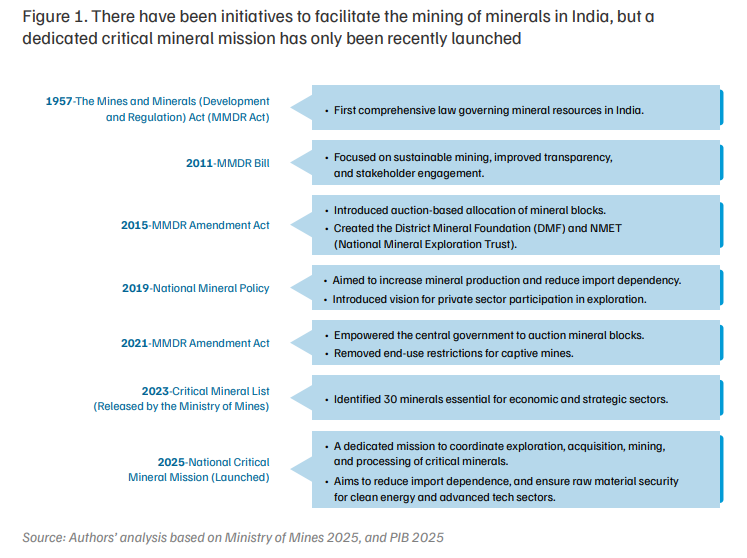
Currently, India relies heavily on imports to meet its critical mineral needs, making it vulnerable to market fluctuations and supply disruptions. The lack of domestic production has led to import dependence on minerals such as lithium, cobalt, nickel and vanadium entirely, which results in significant economic and strategic risks (Ministry of Mines 2023b). With the launch of the National Critical Mineral Mission and the first tranche of offshore mineral blocks, many more critical minerals block auctions will follow. Additionally, organisations such as Khanij Bidesh India Limited (KABIL), Coal India Limited and Oil India Limited are looking for critical mineral resources overseas. After detailed exploration, some of these blocks will go online for mine production and metal extraction in the upcoming years, fundamentally creating an opportunity to focus on developing critical minerals processing and refining capabilities.
India’s efforts to build domestic processing capabilities would not only strengthen its resilience, but also position the nation as a competitive alternative in the global supply chain, potentially making it a leader in the critical minerals landscape. The economic impact of these domestic critical minerals processing capabilities extends beyond immediate applications. Domestic processing of critical minerals would support India’s high-growth sectors, contribute to job creation, facilitate India’s transition to a decarbonised economy, and maximise domestic production and manufacturing capabilities in sustainable technologies and other strategic sectors. Thus, there is a pressing need to accelerate efforts towards domestic processing capabilities.
With decades of experience producing refined steel, aluminium, copper, zinc, and rare earth elements, India has the fundamental knowledge of mineral and metallurgical processing technologies. This advantage, along with lower labour costs, makes it one of the ideal locations for investments in critical minerals processing. However, significant efforts are required to build a resilient and secure critical minerals supply chain. By mapping India’s existing supply chain and processing capabilities through this study, we seek to lay out a clear path to develop a sustainable processing industry in India. Through our analysis, we have tried to bring up strategic actions to strengthen domestic production and minimise reliance on imports.
As we move toward a clean energy future, it is essential to analyse where we stand, identify the gaps, and find opportunities in India’s current mineral processing capabilities. This report focuses on 15 critical minerals—cobalt, copper, graphite, lithium, molybdenum, nickel, niobium, the platinum group of elements, rare earth elements, silicon, tin, titanium, tungsten, vanadium, and zirconium—which are essential for clean energy technologies, defence, aerospace, and other strategic sectors. While some of these critical mineral blocks have been auctioned for further exploration and mining, others are important for India’s clean energy transition and industrial growth.
The next section begins with an overview of methods for processing critical minerals, highlighting the techniques that are commonly used to process raw ore and produce pure elements or compounds. Next, we look into mineral deposits, their processing routes and the supply chain of the selected critical minerals. Following this, the report evaluates India’s position in the critical minerals processing landscape, mapping existing capabilities and identifying key bottlenecks and opportunities for growth. Finally, the report concludes with actionable recommendations for strengthening processing capabilities to reduce import dependence, and create a resilient domestic supply chain of critical minerals.
To maintain a focused approach and keep our research crisp, we have analysed the primary processing techniques of naturally occurring raw materials of these critical minerals, with some focus on the recovery of critical minerals as by-products, or from secondary sources. However, the report also highlights deep rooted challenges and policy constraints that need to be addressed, and proposes strategic interventions to potentially position India as a global leader in the processing of critical minerals.
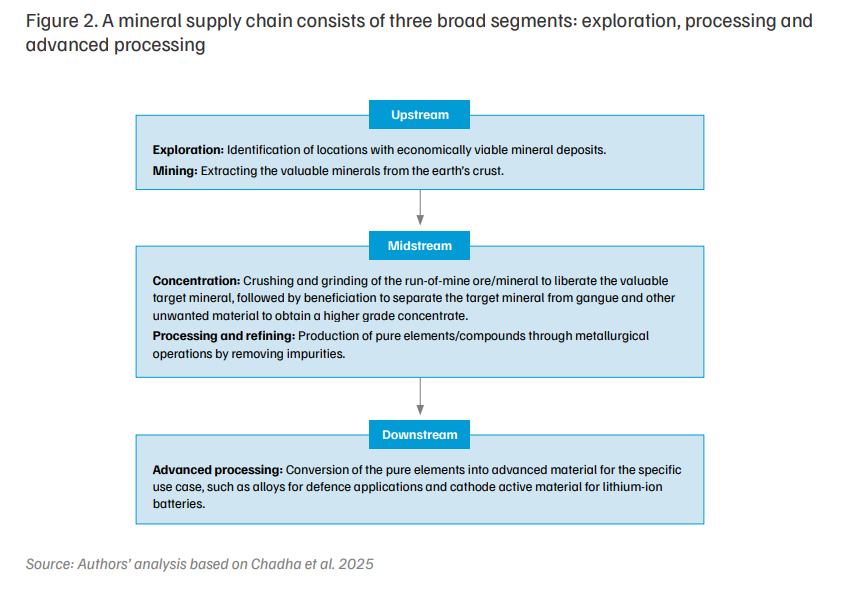
Critical minerals processing is the essential stage that converts raw (run-of-mine) ore/mineral into usable material by removing impurities and recovering valuable minerals. This step is positioned midstream of the overall mineral supply chain (Figure 2), connecting the upstream mineral exploration-mining operation with downstream advanced metallurgical processes that convert the purified critical minerals into advanced material for specific industries, such as electric vehicles, energy storage and defence.
Most critical minerals are not evenly distributed in the earth’s crust in their pure form. Instead, they occur naturally as a part of mineral deposits, often associated with other valuable or non-valuable minerals. For instance, copper is found with other critical minerals such as nickel, cobalt, platinum group elements (PGEs) and molybdenum in sulphide deposits. Similarly, monazite, a rare earth mineral, is found in placer deposits with titanium and zirconium minerals, which are also critical.
The concentration of different minerals in their respective deposits also varies across geographies. For example, lithium concentration differs between brine deposits in Chile (0.14 per cent average) and spodumene in Australia (1–3 per cent), while the newly discovered lithium deposit in Jammu and Kashmir has an average concentration of 583 parts per million (ppm) (VINACHEM 2022; Geoscience Australia 2023; Ministry of Mines 2023c). Similarly, the concentration of graphite varies from 5 to 80 per cent, depending on the deposit type (Indian Bureau of Mines 2024a).
Other than the valuable minerals, the rest of the raw ore includes unwanted impurities, mostly rocks and silica particles, commonly known as gangue, which are removed by processing these minerals. The varying concentrations of the target mineral because of – complex texture or association of various phases, and fine dissemination of target mineral – in the mineral deposits affect the processing complexity and cost of production. Typically, the deposit with a lower concentration of the target mineral requires a multi-step, complex processing approach to achieve the desired purity of the final product, resulting in an increase in the production cost.
This section explores common methods used to process these naturally occurring minerals, focusing on the key methods, such as comminution, beneficiation and processing of concentrates to obtain valuable products. Broadly, comminution and beneficiation fall under mineral processing, and the subsequent processing of concentrate is technically known as extractive metallurgy. The processes involved in extractive metallurgy are further classified as hydrometallurgy and pyrometallurgy, with some minerals requiring a combination of both. A general processing route of critical minerals is represented in Figure 3, and the common steps are defined below.
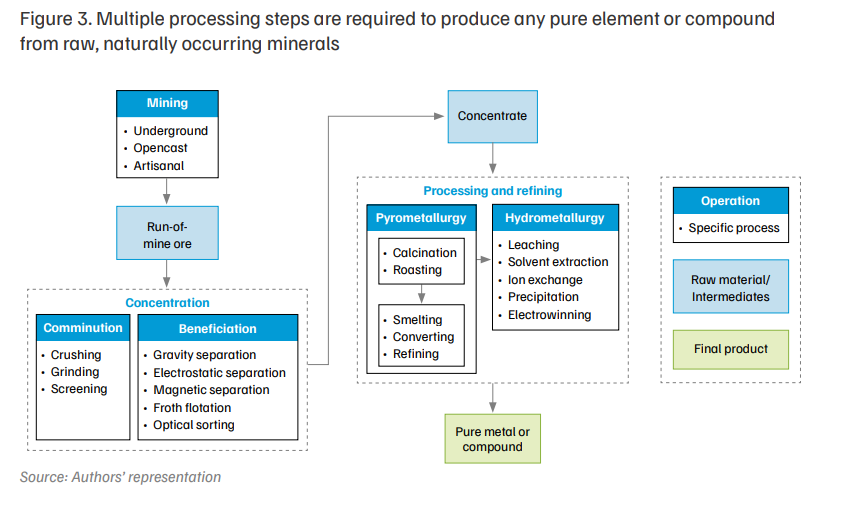
This step is employed after the mining of raw ore/mineral. It improves the grade or quality of the ore by removing nonvaluable gangue and minerals such as quartz, feldspar, micaceous minerals, rock, etc., from valuable target minerals by utilising the difference in their physical properties.
Comminution involves reducing the size of run-of-mine ore/minerals to liberate valuable minerals. Its processes include:
Beneficiation separates valuable minerals from impurities (gangue), yielding a concentrate with a higher concentration (grade) of the desired valuable material. Some of the common beneficiation techniques include:
The concentrate obtained after mineral processing serves as feed for extractive metallurgy, wherein the valuable minerals/elements are extracted economically through metallurgical operations. The common metallurgical processes are discussed below in brief:
Pyrometallurgy involves converting the ore or concentrate at high temperatures, to segregate and recover the desired metal in a usable metal or compound form in one phase, while rejecting impurities, known as slag. In most instances, both phases are molten state because of high temperature operations. Some of the most common pyrometallurgical techniques involve:
Hydrometallurgy involves converting the ore or concentrate particles by dissolving the ore in a suitable aqueous medium at room temperature, or applying heat in some operations, to separate the waste and generate pure solution of the target mineral. Finally, the desired metal or its compound is precipitated from the solution through chemical or electrolytic means. Some of the common hydrometallurgical operations include:
Understanding the current status of global supply chains of critical minerals is important, especially from the perspective of geological distribution, availability of reserves, and technological expertise involved in processing. In this section, we highlight mineral-wise deposits of the select critical minerals, examining the nature of their deposits (such as primary or secondary sources), and their association with other minerals. This section also dives deep into industrial processing technologies, including mineral beneficiation to extractive metallurgy, and provides insights into global supply chains.
Cobalt, a silver-grey metal with a high melting point and ferromagnetic properties, is commonly used in superalloys and batteries because of its high energy density and stability.
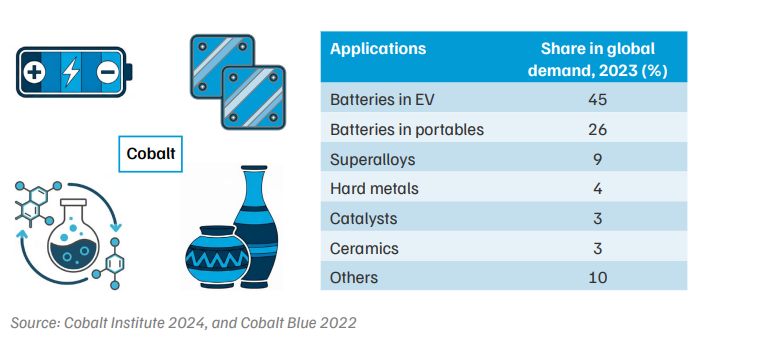
Cobalt is never found in a pure form. Naturally, it is associated with elements like copper, nickel, iron, zinc, and platinum group of elements (PGEs). The major deposits which are exploited for commercial cobalt extraction are listed in Table 2.
Table 2. Different deposits of cobalt and their locations
| Cobalt deposits | Countries | Cobalt grade (%) |
|---|---|---|
| Sedimentary copper-cobalt sulphide and oxide deposits | D. R. Congo and Zambia | 0.2–1 |
| Nickel-cobalt laterite deposits | Australia, Indonesia, and the Philippines | 0.05–0.15 |
| Magmatic nickel-copper-cobalt deposits | Australia, Russia, Finland, USA, and Canada | 0.02–0.11 |
Source: Authors’ analysis based on Dehaine et al. 2020
Due to its lower concentration (0.02–1 per cent) in mineral deposits, most cobalt is produced as a by-product of copper and nickel. According to the Cobalt Institute (2022), 60 per cent of cobalt is mined during copper mining, and 38 per cent comes from nickel mining. Cobalt recovery from its deposits requires a complex, multi-step processing route, customised according to the type of deposit being processed, and the desired product purity.
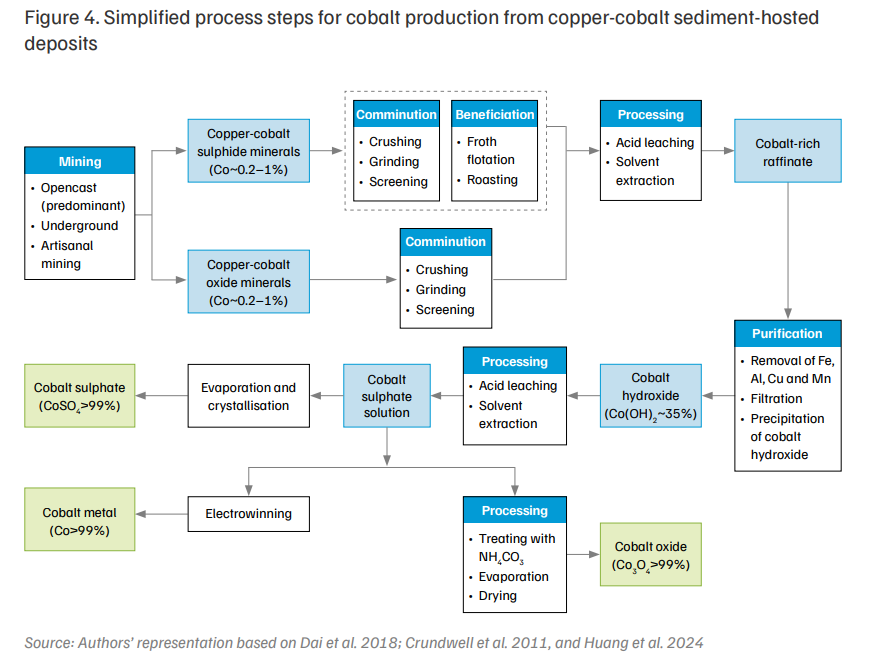
For copper-cobalt sediment-hosted deposits, typically, the processing steps involve leaching, solvent extraction, and electrowinning to yield high-purity cobalt. First, the ore is crushed, ground and concentrated through froth flotation, then roasted to convert sulphides to oxides, which are then leached with sulphuric acid. After purification, cobalt and copper are separated through solvent extraction and cobalt is precipitated as cobalt hydroxide, which is further refined for the production of battery-grade cobalt compounds (Dai et al. 2018).
During refining, cobalt hydroxide undergoes leaching, impurity removal and crystallisation to produce battery grade cobalt sulphate or cobalt oxide, as shown in Figure 4. Electrowinning from cobalt sulphate completes the process, yielding metal of over 99 per cent purity, essential for battery materials (Crundwell et al. 2011).
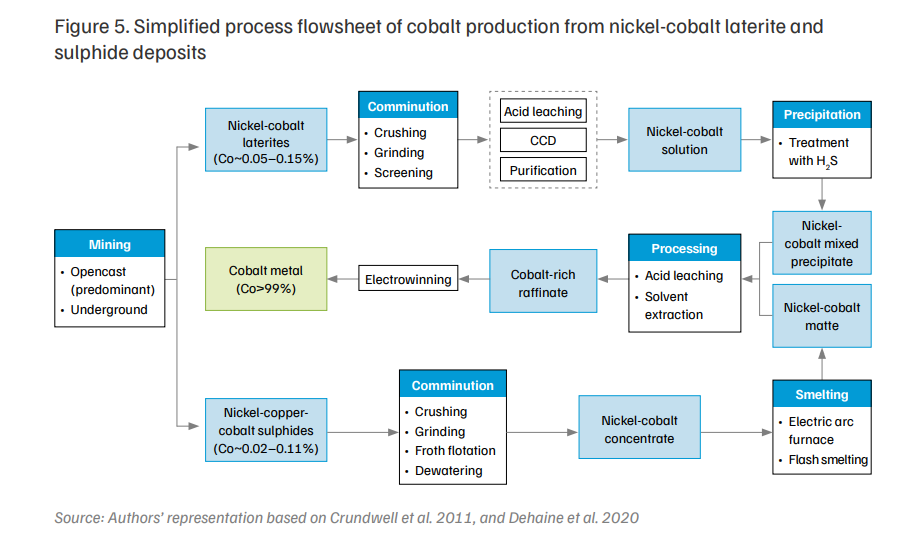
Cobalt production from nickel-cobalt laterite deposits is achieved through high-pressure acid leaching (HPAL). In this hydrometallurgical process, the pre-concentrated limonite ore is leached with sulphuric acid in an autoclave under high pressure and temperature, achieving 95 per cent cobalt recovery in the leach liquor. The solution is purified, and cobalt is separated by treating it with hydrogen sulphide, forming a mixed nickel-cobalt sulphide precipitate. This precipitate is further acid leached; cobalt and nickel are separated via solvent extraction, and cobalt is electrowon to achieve over 99.95 per cent purity. Alternatively, purified cobalt may be processed into powder or briquettes, as shown in Figure 5.
In the case of cobalt production from nickel-copper-cobalt sulphide deposits, the concentrate is smelted, producing a nickel-cobalt matte, further refined by acid leaching in the presence of oxygen. Solvent extraction is used to separate nickel, leaving a cobalt-rich solution. Finally, cobalt is either electrowon to produce cobalt metal or treated to produce cobalt powder, yielding an overall cobalt recovery rate of approximately 40 per cent (Dehaine et al. 2020).
Cobalt’s supply chain is concentrated in a few countries. As per US Geological Survey estimates, the mine production of cobalt was estimated to be 290 kt in 2024, with D. R. Congo being the leading producer, contributing 76 per cent. Indonesia was the secondlargest producer, and together, these two countries accounted for over 86 per cent of the global cobalt mine production (US Geological Survey 2025). The total production of refined cobalt was nearly 224 kt in 2024, with China being the leading producer of refined cobalt, accounting for 79 per cent (Cobalt Institute 2025). However, China’s cobalt reserves account for only 1.88 per cent of the global figure, and the nation is dependent on imports of more than 90 per cent of cobalt raw materials (Huang et al. 2024)
Copper is a reddish-brown metal known for its ductility, excellent electrical and thermal conductivity, and corrosion resistance. It is the third-most-used industrial material after steel and aluminium, mainly used in various construction and electrical applications.
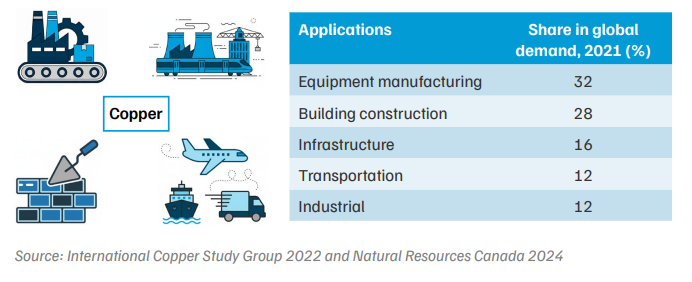
Copper occurs naturally in the earth’s crust in various deposits, and approximately 90 per cent of the copper ores are found in sulphide form (Pietrzyk and Tora 2018). The rest are found in carbonate and oxide deposits, and rarely as pure metallic copper. Most copper is commercially produced from sulphide deposits, prominently from chalcopyrite ore. Other minerals of copper include bornite, chalcocite, azurite and malachite. In the sulphide deposits, copper remains associated with other valuable minerals, including nickel, cobalt, molybdenum and selenium, and is recovered as a by-product during copper processing (Indian Bureau of Mines 2024d).
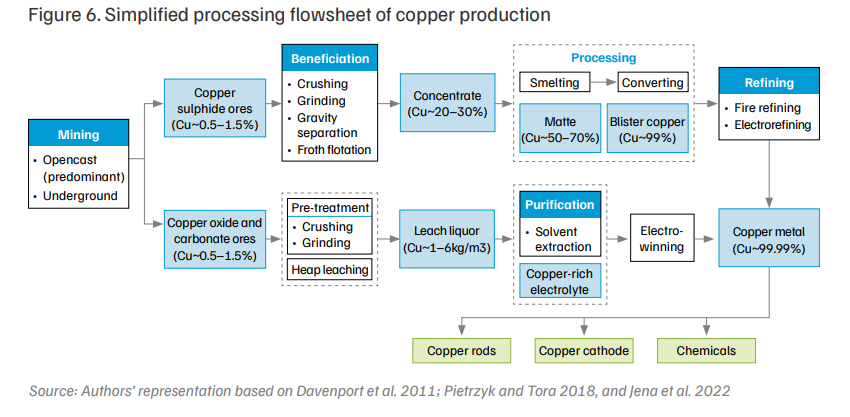
The copper production route varies depending on the copper deposit and its concentration. Copper production from sulphide ores primarily relies on a series of pyrometallurgical processes, accounting for 80 per cent of primary copper production. Initially, the ore undergoes comminution and beneficiation to yield a copper concentrate with a copper content of 20–30 per cent (Jena et al. 2022). The concentrate is then smelted and converted in a Pierce Smith Converter to remove iron and sulphur, forming blister copper (99 per cent copper). Finally, blister copper is refined through fire and electrorefining, yielding high-purity copper suitable for electrical use (Davenport et al. 2011).
In contrast, copper production from oxide, carbonate and chalcocite ore follows a hydrometallurgical route, and accounts for the remaining 20 per cent. After crushing and beneficiation, dilute sulphuric acid is applied to ore heaps, dissolving copper into a leach liquor, a process known as heap leaching, as shown in Figure 6. This solution (leachate), containing one to six grams of copper per litre, is purified through solvent extraction. The resulting copper-rich electrolyte undergoes electrowinning, producing high-purity copper suitable for industrial applications (Davenport et al. 2011).
Copper reserves are distributed globally. However, the majority of reserves are in South America and the Australian continent. According to the US Geological Survey, out of the 980 million tonnes of global copper reserves, Chile possesses the largest, accounting for 19 per cent, followed by Peru and Australia, with each nation possessing 10 per cent of copper reserves. Chile also leads the mine production of copper, accounting for 23 per cent in 2024 out of 23 million tonnes. D. R. of Congo and Peru come next, contributing 14 per cent and 11 per cent, respectively. China dominates refined copper production, accounting for 44 per cent of the global 27 million tonnes in 2024, followed by D. R. Congo and Chile, contributing 9 per cent and 7 per cent respectively (US Geological Survey 2025).
Graphite, a stable form of carbon with a greyish-black appearance, is soft to the touch and highly conductive to heat and electricity. Because of its chemical inertness, it is used in batteries, lubricants and metallurgical operations. In Lithium-ion batteries, graphite is used in anodes, enhancing its thermal stability and efficiency, and it can constitute up to 17–20 per cent of a battery’s weight. There are two types of graphite: synthetic and natural.
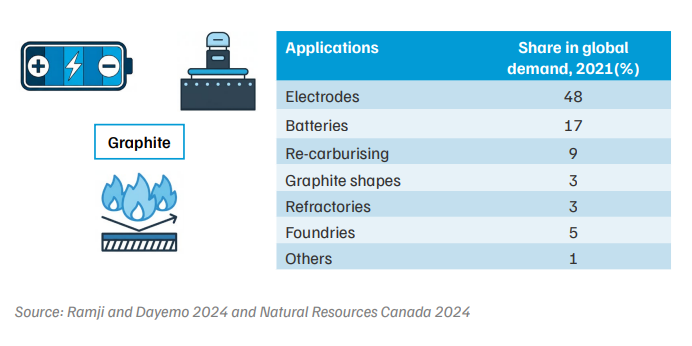
Natural graphite is commonly associated with metamorphic rocks, and is often found with other minerals such as quartz, calcite, and micas. Graphite is naturally produced as flaky and amorphous graphite, and artificially, as synthetic graphite. Flaky and synthetic graphite is considered suitable for battery applications, and synthetic graphite holds 80 per cent of the market share for battery anode material (IEA 2024b). The mined natural graphite contains carbon in the range of 5–80 per cent, depending on the type of deposit, and the lower-grade run-of-mine ore is processed to improve graphite grade and remove impurities. Synthetic graphite is produced from residual oils and coal tar, accounting for 66 per cent of the total graphite supply in 2021 (Natural Resources Canada 2024b).
Upon mining, natural graphite processing begins with the crushing and grinding of run-ofmine ore to prepare fine particles for froth flotation. In this process, kerosene is used as a collector, methyl isobutyl carbinol (MIBC) as a frother, and sodium silicate as a depressant, producing a concentrate with up to 97 per cent graphite (Tsuji 2022). For higher purity, processes such as reverse flotation, electrostatic separation, air classification, acid or base leaching may be employed at high temperatures (about 500°C). This involves treating the concentrate with sodium hydroxide, which forms water-soluble silicates removed by leaching to yield a graphite grade above 99 per cent (Jara et al. 2019; Chelgani et al. 2016).
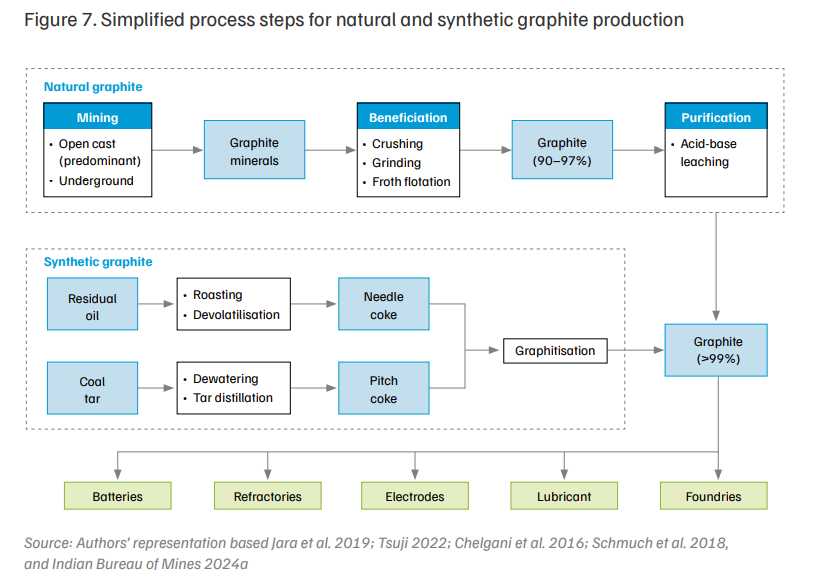
Synthetic graphite production involves transforming petroleum residual oil and coal tar into high-purity graphite through multiple heating stages. Residual oil from crude oil refineries undergoes coking to yield green petroleum coke, which is further heated in a rotary kiln to produce calcined petroleum coke with up to 99.5 per cent carbon. However, through this process, only a small fraction—needle coke—achieves the purity and structure needed for battery applications. Alternatively, coal tar from the coke-making process is distilled and then heated at high temperatures to form pitch coke. Both needle and pitch coke undergo graphitisation, heating to 2600–3300°C, to obtain graphite with over 99 per cent purity.
China dominates the global graphite supply chain. In 2024, China was responsible for 79 per cent of graphite production out of 1.6 million tonnes, and the top-three countries - China, Madagascar and Mozambique - accounted for nearly 90 per cent of global graphite production. While the graphite reserves are somewhat more diversified, China still leads with 28 per cent of graphite reserves, followed by Brazil with 26 per cent out of a total of 290 billion tonnes. The top-five countries hold 77 per cent of global graphite reserves (US Geological Survey 2024t). For refined spherical graphite, suitable for battery anodes and produced through spherodisation of purified natural graphite, China dominates with 99 per cent of the market share, highlighting the concentration of battery grade graphite supply (IEA 2024).
Graphite is used to manufacture monocrystalline silicon solar cells for solar photovoltaic (PV) modules. Monocrystalline silicon solar cells are produced from silicon ingots grown through the Czochralski process, where seed silicon is drawn slowly upwards from a bath of melted polysilicon by a Czochralski puller from a crucible. During this process, crucibles are heated by ‘hotzone’ to temperatures of 1,500°C (Mersen 2024). Hotzone materials are made of various kinds of graphite (ESIA 2024), such as isostatic graphite, graphite felt, hard felt, graphite, soft felt, etc. Isostatic graphite, produced by isostatic moulding, is predominantly used in hotzones due to its physical and chemical properties, such as high chemical stability, thermal conductivity, and mechanical strength (Liu et al. 2024)
Solar PV is the largest application area for isostatic graphite. With the predicted increase in global solar manufacturing capacity to around 1,300 GW by 2028 (Joshi 2024), the demand for isostatic graphite is expected to increase. While Adani Solar has announced plans for a 2 GW manufacturing capacity of monocrystalline silicon ingot (Yuen 2024), domestic demand for isostatic graphite does not exist as Czochralski pullers and their crucible manufacturing are concentrated in China (ESIA 2024).
Isostatic graphite is a crucial consumable in producing crystalline silicon ingots and wafers from polysilicon. A thousand tonnes of isostatic graphite is required per one GW of a completely integrated solar PV manufacturing supply chain, from polysilicon to module (ESIA 2024). Currently, India’s solar module manufacturing capacity is 89.8 GW (Mercom Capital Group 2024, 2025). Hence, indigenising this entire module manufacturing capacity would require 89,800 tonnes of isostatic graphite supply
Lithium is a soft, silver-grey metal known for its reactivity, high specific heat and conductivity. Predominantly used in high-energy-density lithium-ion batteries for electric vehicles, it is also used in ceramics, glass, lubricants, air treatment, aluminium smelting and pharmaceuticals.
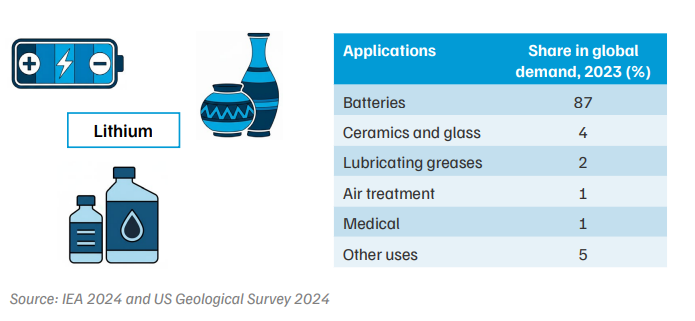
In the earth’s crust, lithium is associated with other alkali and alkaline elements, such as sodium, potassium, magnesium and aluminium. Several deposits of lithium have been identified, listed below in Table 3. However, most lithium is commercially extracted from pegmatite deposits (hard-rock deposits), which host spodumene and lepidolite minerals. Spodumene, a lithium aluminium silicate mineral, is currently the main mineral in lithium production. In 2023, hard rock contributed approximately 63 per cent of the global lithium supply (IEA 2024a). Brines are chloride salt lakes formed underground, containing 200 to 2,000 parts per million (ppm) of lithium and other elements such as potassium, sodium, boron and magnesium. Lithium clay deposits are another potential lithium source, forming 7 per cent of global lithium resources, and processes are being developed across the globe to recover lithium (Zhao, Wang and Cheng 2023a).
| Lithium deposits | Countries | Lithium grade (%) |
|---|---|---|
| Pegmatite deposits | Australia, USA, Canada, Zimbabwe, and China | 0.5–3 |
| Closed-basin brines | Australia, Indonesia, and the Philippines | 0.05–0.2 |
| Lithium clay deposits | Mexico, Siberia, USA, and India | 0.05–1.8 |
Source: Authors’ analysis based on Marcinov et al. 2023, and Zhao, Wang and Cheng 2023
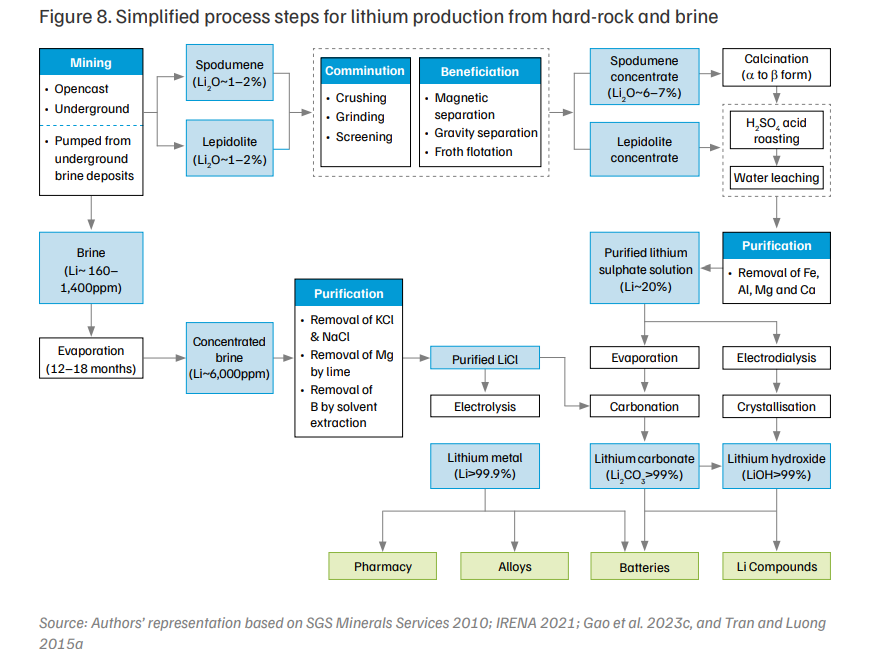
Lithium production from spodumene begins with comminution, followed by beneficiation to obtain a concentrate with 6–7 per cent lithium oxide (SGS Minerals Services 2010). The concentrate undergoes high-temperature (950–1100°C) calcination (also known as decrepitation), making it amenable to sulphuric acid leaching. After calcination, the material is acid-roasted at 250–300°C and then water-leached. The leach solution is then purified by adding lime and sodium carbonate to eliminate impurities. The purified solution evaporates, followed by sodium carbonate addition, resulting in the precipitation of lithium carbonate with over 99 per cent purity (Gao et al. 2023b).
Lithium extraction from brine involves evaporating lithium-rich brines in large ponds for 12–18 months, to concentrate lithium to 6 per cent by weight. During evaporation, impurities settle down, and the concentrated brine undergoes purification through hydrometallurgical treatment, to remove magnesium and boron, as shown in Figure 8. Finally, the lithium chloride solution is either electrolysed to produce lithium metal, or treated with sodium carbonate to precipitate lithium carbonate, achieving over 99 per cent purity for industrial applications (Cabello 2021; Tran and Luong 2015a).
The global supply chain of lithium is concentrated just in a few countries, with the majority of reserves being possessed by just four countries—Chile (31 per cent), Australia (23 per cent), Argentina (13 per cent) and China (10 per cent) out of 30 million tonnes. Australia leads in hard-rock mining, accounting for 37 per cent of the 0.24 million tonnes of global lithium supply in 2024. The next two countries are Chile, which dominates in brine production, holding 20 per cent of the global lithium supply, and China, which produces both hard-rock and brine. These three countries hold 74 per cent of global lithium mine production (US Geological Survey 2025). China leads the refining of raw lithium materials, accounting for 59 per cent of the total in 2022 (LTRC 2022). It processes the lithium minerals and brines mined locally, and the imported hard-rock concentrate from Australia and Africa. According to the International Energy Agency (IEA), China is expected to dominate lithium refining and hold 60 per cent of refining capacity by 2030 (IEA 2024a).
Lthium-ion batteries (LIBs) are used for electric vehicles (EVs), consumer electronics and grid-scale energy storage. The market of LIBs has been growing exponentially and is expected to continue to do so. Various chemistries are available for LIBs, each with a different application: Lithium Cobalt Oxide (LCO), Lithium Manganese Oxide (LMO), Lithium Nickel Manganese Cobalt Oxide (L-NMC), Lithium Iron Phosphate (LFP), etc. Currently, India does not manufacture cathode materials, but Altmin and Himadri Chemicals have announced plans to start manufacturing cathode materials at giga-scale by 2030 (EVreporter.com 2023, 2024).
Recently, LMFP battery chemistries have been considered to replace LFP due to their higher energy density than LFP and lower price than NMC (EY 2024). According to projections based on the current scenario, the Indian market is expected to be led by NMC-622, NMC-811 and LFP chemistries, with the share of LFP slowly increasing due to the deployment of grid-scale BESS (CEEW 2023). To cater to the growing battery demand, the requirement for lithium in India will increase, and alternative chemistries, such as sodium-ion batteries (SIBs), have a long way to go before making any significant impact on the lithium demand for batteries.
Molybdenum is a silver-white transition metal with the ability to enhance strength, toughness and hightemperature stability. It is mostly used as an alloying agent in stainless steel and titanium alloys.
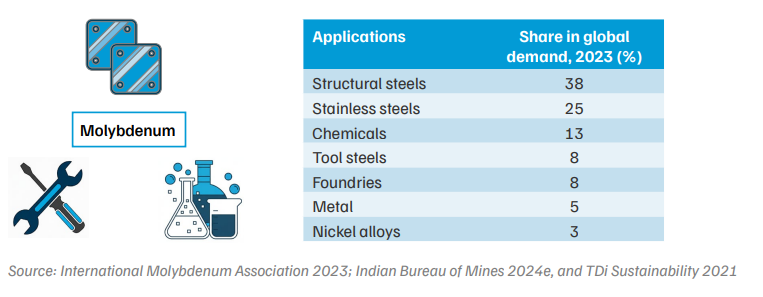
Molybdenite (MoS2 ) is the primary ore exploited at an industrial scale for molybdenum extraction. However, two-thirds of global production comes as a by-product from porphyry copper sulphide deposits, with the remaining produced through primary molybdenite ore mining, predominantly in China. The concentration of molybdenum in its deposits, considered viable for extraction, ranges from 0.01 to 0.25 per cent (TDi Sustainability 2021; Indian Bureau of Mines 2024e).
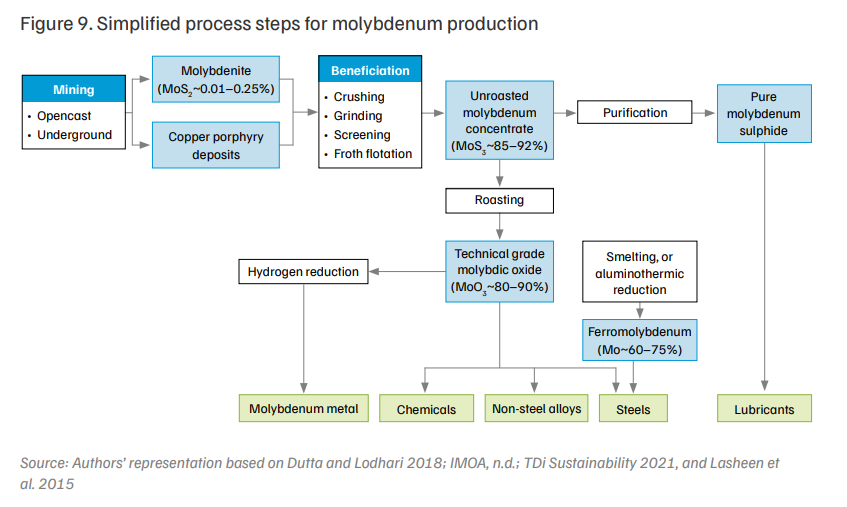
Typically, molybdenum production from primary ore involves comminution and beneficiation via froth flotation, followed by roasting. In copper-molybdenum ores, copper is separated from molybdenum by leaching with ferric chloride. The resulting concentrate, unroasted molybdenum concentrate (UMC), typically has a molybdenite content of around 85–92 per cent and is roasted at 500–650°C in rotary or multiple-hearth kilns, to obtain technical-grade molybdic oxide (TGMO) (Lasheen et al. 2015). This marketable product is further processed based on the application requirements in steelmaking, non-steel alloys, and chemicals (TDi Sustainability 2021), as shown in Figure 9. Molybdenum is also recycled; recycled molybdenum constitutes nearly 30 per cent of the global supply of the metal (US Geological Survey 2024d). Molybdenum gets recycled during old and new steel scrap recycling; there are no separate processes for recycling it.
Like other critical minerals, the supply chain of molybdenum is also concentrated in a few nations. In 2023, the global mine production of molybdenum was estimated to be 260 thousand tonnes, and 85 per cent of molybdenum mining was concentrated in the top-four countries—China, Peru, Chile and USA—which possess 85 per cent of global production. Total global estimated reserves are be 15 million tonnes (US Geological Survey 2025). China holds a dominant position in the molybdenum supply chain, as it accounted for 81 per cent of global ferromolybdenum production in 2021, 42 per cent of molybdenum mine production in 2024, and possesses 39 per cent of global reserves (European Commission 2023b; US Geological Survey 2025).
Nickel is a silver-white metal with a high melting point, excellent strength, corrosion resistance and oxidation stability at elevated temperatures. Known for its ability to form alloys, nickel is mostly used in stainless steel and NMC batteries.
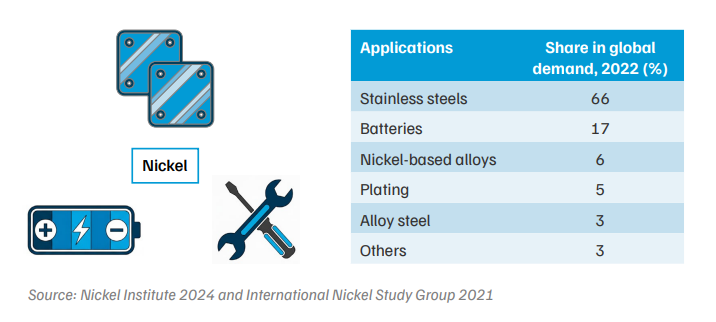
Nickel is the fifth-most-abundant element in the earth’s crust by weight, with an average concentration of 68–80 ppm. It is naturally associated with iron, copper, cobalt, magnesium, and aluminium. Commercially, it is extracted from laterite deposits and sulphide deposits. According to the International Nickel Study Group (INSG), 40 per cent of nickel resources are in sulphide deposits, and 60 per cent are in laterite deposits (Zevgolis and Daskalakis 2022; International Nickel Study Group 2021; Henckens and Worrell 2020a).
Table 4. Different deposits of nickel and their locations
| Nickel deposits | Countries | Nickel grade (%) |
|---|---|---|
| Nickel laterite deposits | Indonesia, New Caledonia, the Philippines, and Australia | 1–1.6 |
| Nickel sulphide deposits | Russia, Canada, China, and Australia | 0.2–2 |
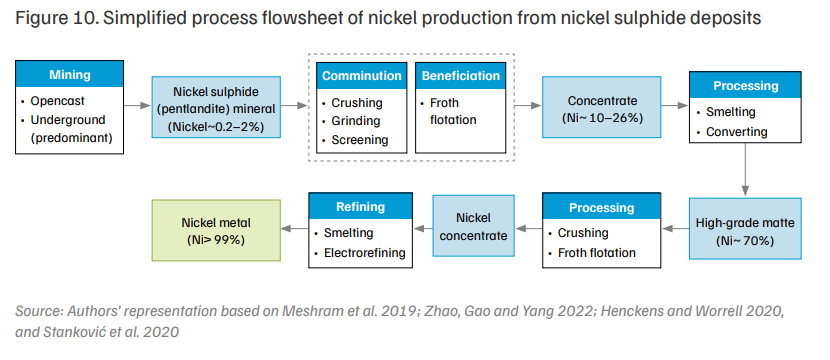
In sulphide deposits, the nickel grade is 0.2–2 per cent, with pentlandite being the principal commercially exploited mineral. After mining, the sulphide ore is crushed, ground, and sent to the beneficiation facility to improve the nickel grade in the concentrate by subjecting the ore particles to magnetic separation, gravity separation, and froth flotation. Finally, nickel concentrate is produced with 10–26 per cent nickel content, and is processed via the pyrometallurgical route of smelting, converting and refining (Zhao, Gao and Yang 2022; Meshram et al. 2019), as shown in Figure 10.
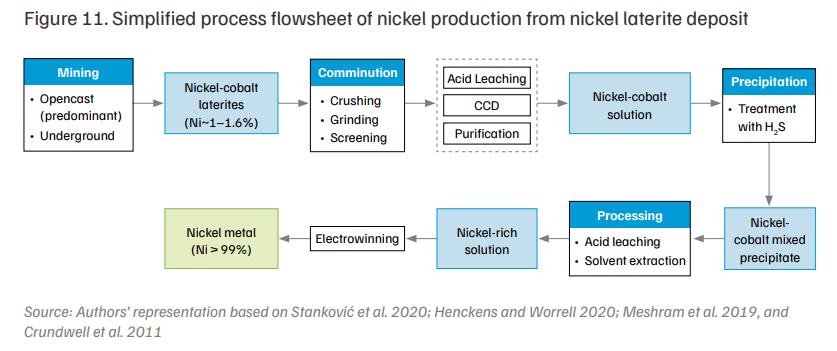
The nickel grade in the laterite deposits is 1–1.6 per cent. The principal minerals are limonite, which has high iron content and low magnesium, and garnierite, which has high magnesium and low iron content. In contrast to the sulphide ores, nickel laterite concentrates, containing nickel in the range of 3–5 per cent, are processed via the hydrometallurgical route (Figure 11), involving processes such as leaching, counter-current decantation, solvent extraction and electrowinning (Stanković et al. 2020; Henckens and Worrell 2020b; Meshram et al. 2019b).
A few countries dominate nickel reserves and production, and Asia is the leading continent in the supply chain. As per US Geological Survey, the global nickel reserves are estimated to be more than 130 million tonnes in terms of metal content in 2024. Indonesia alone holds 42 per cent of global nickel reserves. The top-three countries—the other two being Australia and Brazil—have more than 70 per cent of nickel reserves. In 2024, the global mine production of nickel was estimated to be 3.7 million tonnes, with Indonesia being the leading producer, contributing 59 per cent. The Philippines and Russia were the second- and third-largest producers, and together, these countries accounted for 74 per cent of the global nickel mine production (US Geological Survey 2025). The total production of refined nickel was more than 3.1 million tonnes, with Indonesia being the leading producer, accounting for 37 per cent. China was the second-largest producer of refined nickel, accounting for 27 per cent (British Geological Survey 2024a).
Niobium is a lustrous grey metal known for its high melting point, low density and superconducting properties. Primarily used in High-Strength Low-Alloy (HSLA) steels for construction and automotive use, niobium enhances its strength and corrosion resistance.
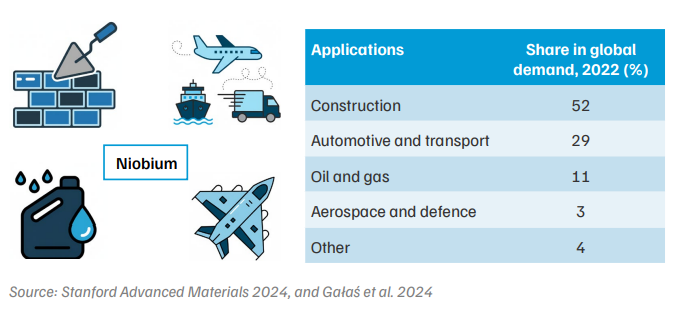
Although niobium is found in many minerals, only two niobium-containing minerals are economically viable to extract: columbite-tantalite, which can contain up to 76 per cent niobium pentoxide (Nb2 O5 ) and pyrochlore, with up to 71 per cent Nb2 O5 . One of the largest pyrochlore deposits is in Araxá, Brazil, which is the world’s main source of niobium globally, and is operated by the Companhia Brasileira de Metalurgia e Mineração (CBMM) (Pereira et al. 2022). Since niobium is found close to the surface, it is mined through open-pit mining methods, using heavy machinery like bulldozers and dump trucks.
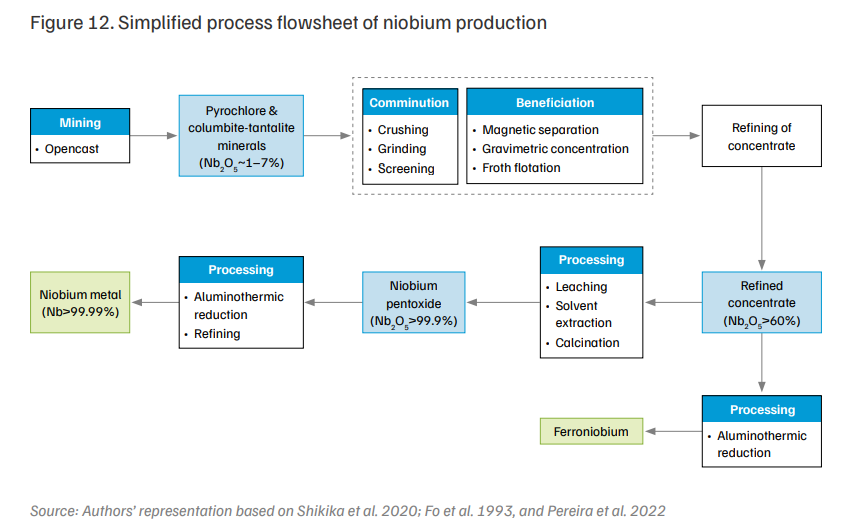
For high-strength low-alloy (HSLA) steel production, pyrochlore is processed into ferroniobium, while niobium hydroxide is produced from columbite-tantalite minerals. Ferroniobium production starts with comminution, followed by beneficiation, involving magnetic separation, gravimetric concentration and froth flotation, yielding a niobium oxide concentrate with approximately 55–60 per cent niobium. The concentrate undergoes refining in an electric arc furnace using coal or coke as reducing agents to remove impurities such as phosphorus and sulphur. The final aluminothermic reduction step requires aluminium powder, iron scrap, and refined concentrate to produce ferroniobium, which contains about 65 per cent niobium, and is formed into ingots for industrial applications (Shikika et al. 2020a; Fo et al. 1993).
For applications which require niobium pentoxide, the concentrate is subjected to an acidleaching process, initially with sulphuric acid, followed by hydrofluoric acid to dissolve residual particles, as shown in Figure 12. Solvent extraction isolates niobium ions from leach liquor, and hydrated niobium pentoxide is precipitated with ammonia. After filtration and calcination, the resulting niobium pentoxide reaches a 99.9 per cent purity, which is essential for electronics and other specialised industries. Niobium metal is produced through further refining, involving aluminothermic reduction of niobium pentoxide to yield molten niobium, which is cooled and cast into ingots. For nuclear and aerospace applications, additional purification via electron beam melting removes impurities to achieve over 99.99 per cent purity (Pereira et al. 2022).
According to the US Geological Survey, Brazil dominates the niobium supply chain, holding 94 per cent of the estimated global 17 million tonnes of niobium reserves. This nation also leads the mine production of niobium, contributing 90 per cent in 2024, and 88 per cent of refined niobium in 2021. Canada is the second-largest global player in the niobium supply chain, with 9.4 per cent of global reserves, accounting for 6 per cent of mine production in 2024, and 10 per cent of refined production in 2021 (US Geological Survey 2024g; European Commission 2023c).
The platinum group elements (PGEs)—platinum (Pt), palladium (Pd), rhodium (Rh), iridium (Ir), osmium (Os) and ruthenium (Ru)—are high-melting, silver-white metals known for heat resistance and catalytic properties
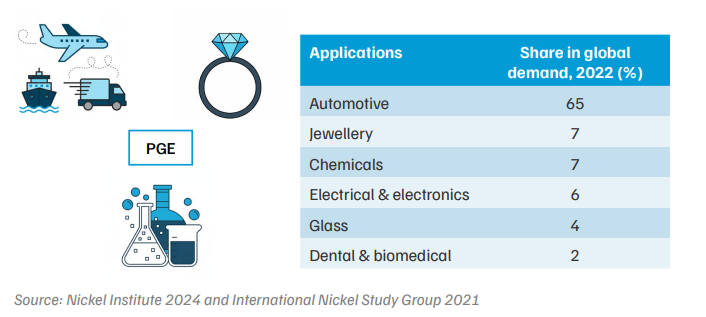
Platinum group elements (PGEs) are rarely found in their pure elemental form, and are often associated with sulphides and arsenides in chalcopyrite, iron pyrites and pentlandite deposits. These elements are extracted commercially from chalcopyrite deposits, wherein PGE concentrations range from 5 to 15 ppm. These minerals are deep-seated, and generally mined through underground mining (Thethwayo 2018; US Geological Survey 2017).
The PGEs begin with comminution at the mine site, where crushing and grinding operations liberate PGE and copper particles. Following this, beneficiation involves gravity separation and froth flotation, yielding a concentrate with 60–90 per cent PGE recovery (Hughes et al. 2021). This concentrate then undergoes smelting, producing molten matte, containing iron, sulphur and base metals, which are removed in a converting process. Next, the base metals, such as copper and nickel, are removed through hydrometallurgical methods, leaving a PGErich residue, as shown in Figure 13. Finally, PGEs are recovered by subjecting the residue to pressure acid leaching, solvent extraction, and melting to reach 99.9 per cent purity, ready for industrial use (Nose and Okabe 2014; Thethwayo 2018).
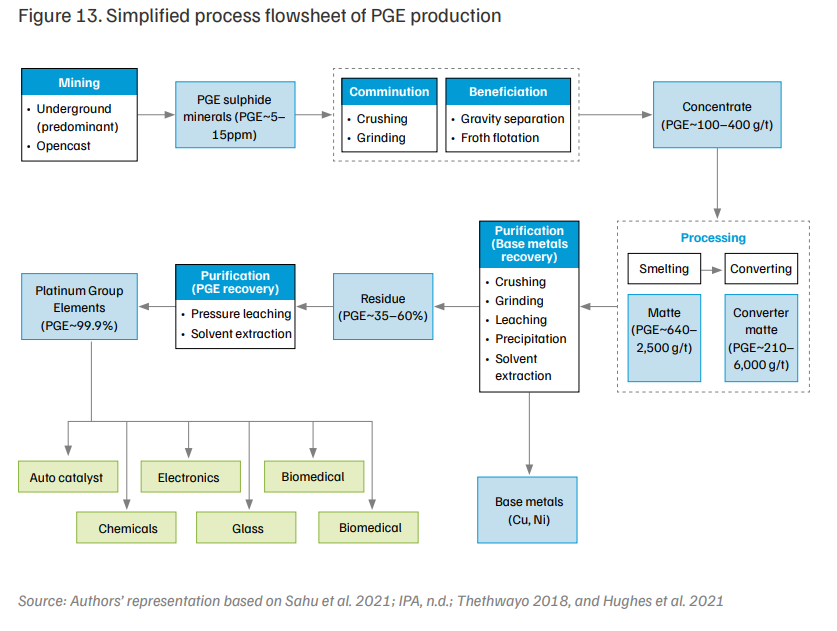
The primary production of PGEs from their deposits is a lengthy process with high production costs, which results in these being expensive elements. This process has several challenges, such as huge electricity requirements for the comminution and smelting operations. The smelting operation requires high temperatures (~1,500–1,650°C), which causes premature refractory lining failure due to excessive heat and inadequate cooling mechanisms, leading to disruption in operation and loss of production. Removing unwanted elements during the purification of converter matte and producing highly pure PGEs is also a complex process, and needs technical expertise (Thethwayo 2018).
The production of PGEs is highly concentrated in South Africa at the Bushveld complex, which contains two veins of PGEs, known as Merensky and Upper Group 2 (UG2) reefs—the largest global deposits of PGEs. South Africa alone holds 78 per cent of global PGE reserves (out of 81,000 tonnes), and contributed to 71 per cent of platinum production (out of 170 tonnes) in 2024. Russia was the leading palladium producer in 2024, accounting for 39 per cent out of 190 tonnes, and holds 20 per cent of global PGE reserves. Russia and South Africa accounted for 77 per cent of palladium production in 2024 (US Geological Survey 2025).
Rare earth elements (REEs) are a collection of 17 silver-white metals, including 15 lanthanides (elements from lanthanum to lutetium), plus yttrium and scandium. Based on atomic weight, natural abundance and similarities in their chemical properties, they are divided into light REEs (LREEs) and heavy REEs (HREEs). Known for their unique properties, REEs are essential in high-tech and defence applications.
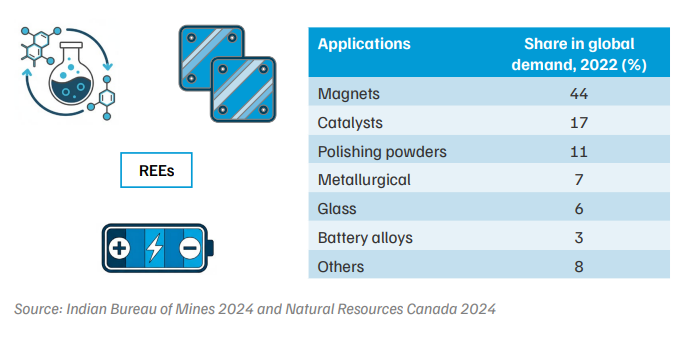
Rare earth elements are uncommon in nature in their pure form, and a limited number of deposits globally are being exploited to extract them. Bastnaesite, monazite, mixed ore containing bastnaesite, xenotime and monazite minerals and ion-adsorption clays are the mineral deposits from which REEs are extracted commercially.
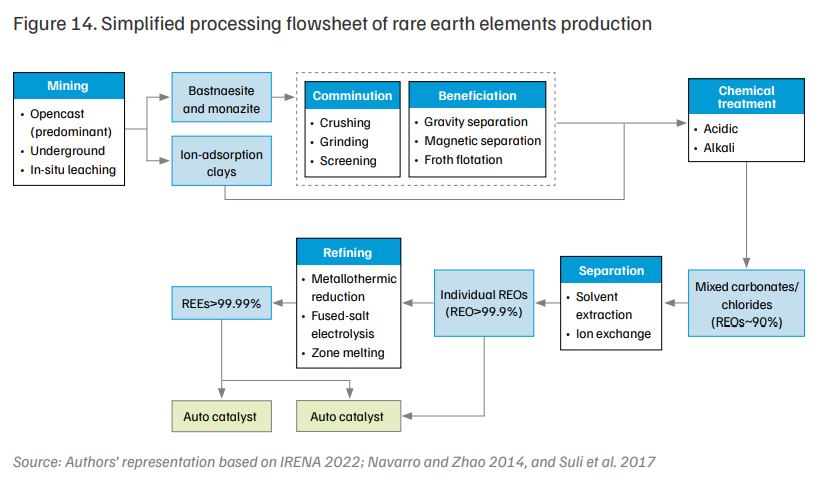
Rare earth element production processes vary significantly, depending on the mineral type and its associated impurities. This diversity requires different processing routes with tailored parameters to maximise efficiency and recovery. Generally, processing of a rare earth ore involves a combination of hydrometallurgical and pyrometallurgical techniques, wherein the REE-bearing concentrate obtained after the comminution and beneficiation step undergoes acid or alkaline treatment, yielding a solution of mixed carbonates or chlorides. Extraction of the HREEs from the ion-adsorption clays includes leaching with sodium chloride solution in acidic media, or a solution of ammonium sulphate.
This solution is subjected to multiple solvent extraction or ion exchange processes to separate the individual rare earth oxides (REOs) with a purity of more than 99 per cent. Once separated, the REOs are further reduced and refined to achieve REE purity levels exceeding 99.99 per cent, often through metallothermic reduction, fused-salt electrolysis, or zone melting (Suli et al. 2017; Navarro and Zhao 2014), as represented in Figure 14.
The global supply chain of REEs is concentrated in a few countries. Out of an estimated 90 million tonnes, the top five countries hold 90 per cent of global reserves, with China alone accounting for 49 per cent. China is a dominant player in REE production, contributing 69 per cent of the global figure in 2024. China, USA, and Myanmar were together responsible for 89 per cent of the 0.39 million tonnes of global rare earth mine production in the same year (US Geological Survey 2025). Regarding refined REE production, China alone accounted for 88 per cent in 2021, while Malaysia and India accounted for 7 per cent and 2 per cent, respectively (European Commission 2023d).
Critical minerals in wind turbines mainly involve REEs in permanent magnets, which are used in wind turbine generators and gearboxes. Permanent magnets make it possible to have small, light, space-saving designs for the gearboxes of wind turbines (Gielen and Lyons 2022). Permanent magnets use neodymium (Nd) and praseodymium (Pr) to improve their magnetic strength, whereas dysprosium (Dy) and terbium (Tb) improve their susceptibility to demagnetisation, especially at high temperatures (Verma et al. 2022). A typical permanent magnet for a wind turbine comprises 28.5 per cent Nd, 4.4 per cent Dy, 1 per cent boron and 66 per cent iron. Permanent Magnet Synchronous Generators (PMSGs) are highly used in offshore turbines requiring Nd and Dy, with 216 kg/MW Nd and 17 kg/MW Dy (Verma et al. 2022). Permanent magnet drive systems dominate the offshore market, whereas induction generator drive systems, which don’t employ permanent magnets, are slightly more dominant in the onshore wind sector (IRENA 2022).
Rare earth minerals are sufficiently abundant today to meet the future demand of a wind industry that only represents a fraction of their end uses. From 2023 to 2030, the demand for Chinese wind energy Rare Earth Permanent Magnets (REPM) may fall by 14 per cent CAGR for onshore installations, and grow by only 4 per cent for offshore installations. By 2030, China is forecast to account for only 19 per cent of wind energy REPM demand, against 64 per cent in 2023. Given the average REPM grade and Pr, Nd, Dy, and Tb content assumptions, the global non-China wind energy sector will require a cumulative 30,000 tonnes of rare earth materials by 2030 (GWEC 2023).
Assessments have been conducted to evaluate whether the current metals and minerals production capacity is sufficient in India for the short-term, considering 140 GW wind energy production by 2032, and long-term potential, considering 695.5 GW wind energy production (Verma et al. 2022). The production of REEs Nd and Dy with purity required for the application of wind turbines is currently not done in India. Hence, Indian wind turbine manufacturers are dependent on imported materials.
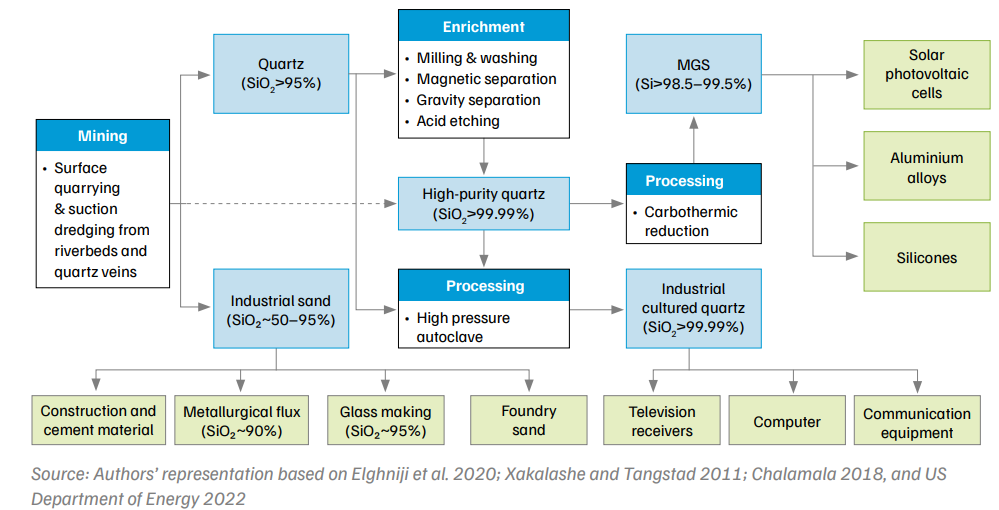
Silicon is the second-most-abundant element in earth’s crust, primarily found as silicon dioxide in quartz and silica sand. Known for its hardness and metallic lustre, silicon finds diverse applications based on purity and particle size, including in electronics, high-purity quartz-based optical fibre, and solar cells.
In nature, silicon is commonly found scattered across the Earth’s surface as silicon dioxide (SiO2 ), also known as quartz and silica sand. Quartz is a very common mineral and is often associated with a wide variety of other minerals, including feldspars, micas, amphiboles, calcite, and zeolites. Based on the grade and particle size, silicon has many applications in different sectors. For instance, industrial sand is used in construction and cementing material, foundries, glass, filtration systems, abrasives, and as flux in metallurgical operations. Industrial cultured quartz is manufactured in autoclaves at high pressure and temperature, especially for electronic applications. The process includes natural quartz (also known as lascas) and a solution of sodium hydroxide or sodium carbonate as raw material, with some additives such as deionised water and lithium salts, and used in communication equipment, computers and receivers.
High-purity quartz (HPQ) is obtained by multiple stages of physical and chemical processing of naturally occurring translucent crystalline silica and has more than 99.99 per cent SiO2 content. It is used in optic-fibre cables, crucibles, and the production of metallurgical-grade silicon, which has industrial uses, including in aluminium alloys, silicones, photovoltaic cells and ferrosilicon (US Geological Survey 2024a).
High-purity quartz is the raw material used to produce metallurgical-grade silicon (MGS). First, quartz is enriched by washing, crushing, magnetic separation and acid etching, to raise its purity to 99.99 per cent SiO₂. Then, MGS production occurs through carbothermic reduction in a submerged-arc furnace at about 2,000°C, where quartz reacts with carbon sources like coke and charcoal. This process yields molten silicon, later refined and solidified to achieve 98.5–99.5 per cent purity, as shown in Figure 15 (Ali et al. 2018; Elghniji et al. 2020; Boussaa et al. 2018).
Figure 15. Simplified process flowsheet of silicon production
Global estimates for quartz reserves and production are not available. However, quartz is widely distributed across countries such as the United States, Australia, Brazil, Canada, China, India, and Russia (US Geological Survey 2024b). In 2024, global silicon metal production was estimated at 4.6 million tonnes, with China dominating with a share of 84 per cent. Brazil and Norway followed, contributing 4 per cent and 3 per cent, respectively. As for ferrosilicon, production was estimated to be about 5.1 million tonnes, with China, Russia, and Brazil as the top producers, accounting for 69 per cent, 9 per cent, and 4 per cent of the global share, respectively (US Geological Survey 2025).
Box 4. Use of silicon in solar PV
Silicon-based solar photovoltaic (PV) technology had a market share of 97.5 per cent, while thin-film technologies had a market share of 2.5 per cent as of 2023 (Fraunhofer ISE 2024). This highlights the importance of silicon in the solar PV supply chain. Metallurgical grade silicon (MGS) is 98 per cent pure and needs to be purified to be used in solar PV; it is ground up and injected into a Fluidised Bed Reactor (FBR) to produce trichlorosilane gas, which is used as a feedstock for the Siemens process (Xakalashe and Tangstad 2011a). Siemens process takes place in a Siemens reactor, where current is passed through a U-shaped silicon seed in the presence of trichlorosilane gas, which undergoes Chemical Vapour Deposition (CVD) to form solid silicon. This results in the formation of polysilicon, which has a purity of 9N silicon (99.999999999 per cent).
Polysilicon is thus formed by breaking it down into smaller pieces, loading it up into a crucible, and melting it down to form a polysilicon bath at temperatures of 1,500°C. Monosilicon ingots are formed around a seed silicon crystal dipped into this bath and pulled slowly upwards using a Czochralski puller. This process is called the Czochralski process (ITRPV 2024). Monocrystalline silicon ingots, thus formed, are further sliced into wafers using diamond-coated wire saws, which are further processed to form solar cells, and assembled into solar modules. As it is such a cornerstone of the solar PV manufacturing process, the scaling up of the latter will lead to higher demand for silicon in the future.
Global silicon demand from solar PV was 390 kt in 2020, and is projected to be between 452 and 810 kt by 2040 (IEA 2021). Despite the abundance of raw material for silicon in the form of quartzite, due to high capital expenditure, operational expenditure, and technological knowledge required, polysilicon production does not exist in India. Solar PV module and cell manufacturers are dependent on imported wafers. While Adani Solar has announced a 2 GW ingot and wafer manufacturing capacity (Yuen 2024), it utilises imported polysilicon and has halted previously announced polysilicon manufacturing plans (Jacobo 2024).
Tin (with the chemical symbol Sn from its Latin name stannum) is a soft, silver-white metal known for its chemical inertness, formability and low melting point (232°C). These properties make it suitable for various applications, including alloys, packing materials and solders.
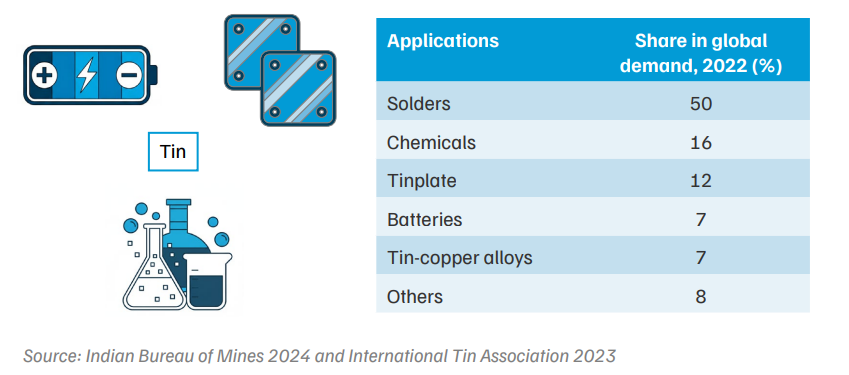
In nature, about 80 per cent of tin reserves are available in placer deposits. Cassiterite is the primary mineral from which most tin is commercially extracted, while stannite is another mineral. Cassiterite theoretically contains 78.7 per cent of tin. Tin ore, on the other hand, typically contains 1 per cent tin due to associated impurities, such as iron, silicon, niobium, tantalum, zirconium, scandium and tungsten.
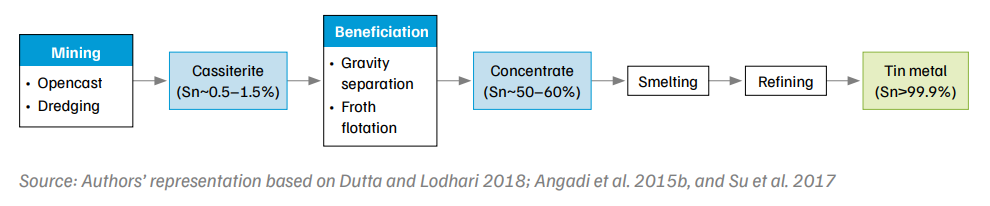
Tin production involves pyrometallurgical operations that convert raw cassiterite ore into high-purity tin, which is essential for industrial applications. First, the ore undergoes pretreatment steps like magnetic separation, roasting, and acid leaching, as cassiterite often occurs in placer deposits where comminution is unnecessary (Su et al. 2017). Following pretreatment, gravity separation and flotation produce a tin concentrate with up to 60 per cent purity and a recovery rate of around 70 per cent (Angadi et al. 2015a), as shown in Figure 16. This concentrate is smelted in furnaces with solid reductants and fluxes, achieving about 99 per cent purity. Finally, the remaining impurities are removed via crystallisation or vacuum distillation, yielding tin with over 99.95 per cent purity (Dutta and Lodhari 2018).
Figure 16. Simplified process flowsheet of tin production
Global supply chain of tin
Compared to other critical minerals, tin reserves and mine production are relatively welldistributed globally, notably in Asian countries such as China, Myanmar and Indonesia. However, in downstream processing, the supply chain becomes increasingly concentrated in China. According to the US Geological Survey, China holds 24 per cent of the world’s tin reserves, followed by Australia, which has 15 per cent out of 4.2 million tonnes. In 2024, China also led global tin mine production, contributing 23 per cent out of 0.3 million tonnes, followed by Indonesia with 17 per cent (US Geological Survey 2025). Tin smelting is even more concentrated, with China alone responsible for 52 per cent of global tin smelter production, followed by Indonesia and Peru (British Geological Survey 2024b).
Titanium is a silver-grey, lightweight metal known for its high strength-to-weight ratio and excellent corrosion resistance, even at elevated temperatures. Over 90 per cent of globally produced titanium is used as a pigment, enhancing opacity and brightness in paints and plastics.
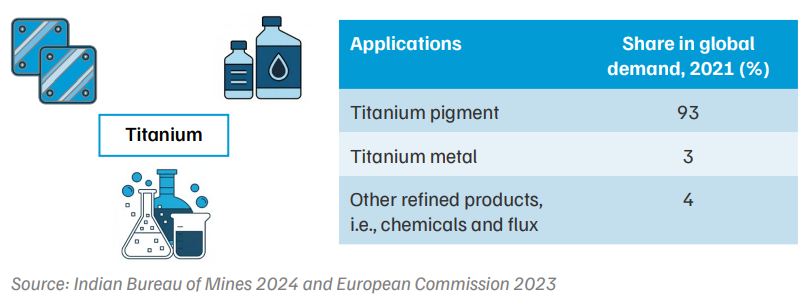
In nature, titanium is found to be associated with iron and vanadium. Ilmenite and rutile are the two primary minerals, and the majority of titanium is obtained from ilmenite, which typically contains 45–60 per cent titanium dioxide (TiO2 ). In contrast, rutile contains up to 95 per cent TiO2 (Zhang et al. 2011a). Both of these minerals are found in the placer deposit in beach sand, along with other heavy minerals such as zircon and monazite. Beach sand is mined through dredging, and beneficiated through an array of physical separation processes to obtain valuable minerals (Indian Bureau of Mines 2024i).
Ilmenite is obtained after the beach sand is beneficiated and processed further based on the application and grade requirement. The hydrometallurgical route is employed to obtain TiO2 from rutile and ilmenite. There are two methods of titanium dioxide production—the chloride process and the sulphate process—as shown in Figure 17. Globally, 60 per cent of TiO2 is produced via the chloride route, and the sulphate route is mostly used in China (Sampath et al. 2023). Natural and synthetic rutile and titanium slag are processed via a thermo-chemical route, known as Kroll’s process or Hunter process, to obtain titanium metal.
Figure 17. Simplified process flowsheet of titanium production
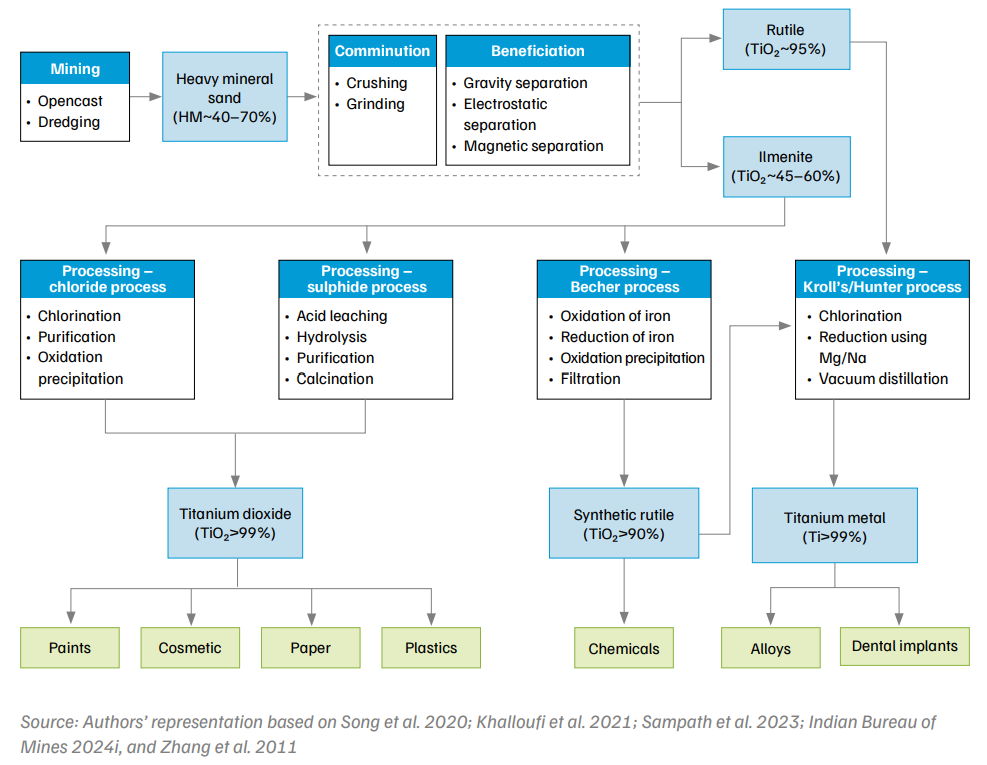
According to the US Geological Survey, out of 510 million tonnes of global ilmenite reserves, Australia holds 35 per cent, followed by China, accounting for 22 per cent of ilmenite reserves, and 37 per cent of mine production in 2024. In midstream processing, the supply chain becomes more concentrated in China, with an installed pigment production capacity of 56 per cent, and titanium sponge production capacity of 63 per cent. In 2024, this nation accounted for 69 per cent of global titanium sponge production, followed by Japan and Russia, with shares of 17 and 6 per cent, respectively. Australia leads the rutile mine production, accounting for 44 per cent in 2024, and has the highest reserves (76 per cent) of natural rutile (US Geological Survey 2024o, 2024m).
Tungsten (with chemical symbol W for its old name, wolfram) is a greyish-white metal known for its electrical and thermal conductivity and low thermal expansion. Its primary applications include tungsten carbide for cutting tools, ferrotungsten for high-speed steels and superalloys, and tungsten compounds for dyes and inks.
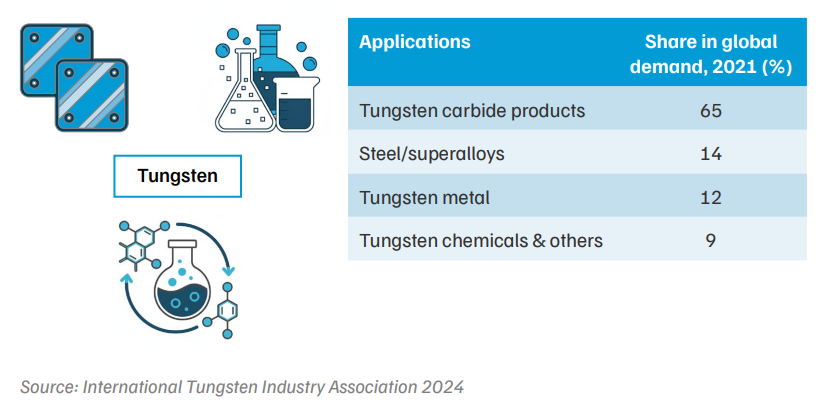
Scheelite and wolframite are the two minerals, found in skarn and porphyry deposits (Surya et al. 2023), typically containing tungsten oxide (WO3 ) in the range of 0.1–1 per cent, and primarily mined through underground mining methods for the commercial production of tungsten.
The current commercial process of tungsten ore processing begins with comminution, followed by pre-concentration, with X-ray and gravitational sorting for scheelite, and optical or hand sorting for wolframite. The beneficiated scheelite concentrate, achieved via gravity separation or froth flotation, reaches up to 65 per cent WO₃. In comparison, wolframite undergoes gravity and magnetic separation to yield a concentrate with over 30 per cent WO₃ (Das et al. 2023; Yang 2018). Further processing and refining involve digestion/leaching of tungsten concentrate, purification of the obtained solution, and then crystallisation to obtain ammonium para tungstate (APT), which is the marketable product and raw material to produce tungsten carbide, compound, and metal (Shemi et al. 2018).
Figure 18. Simplified process flowsheet of tungsten production
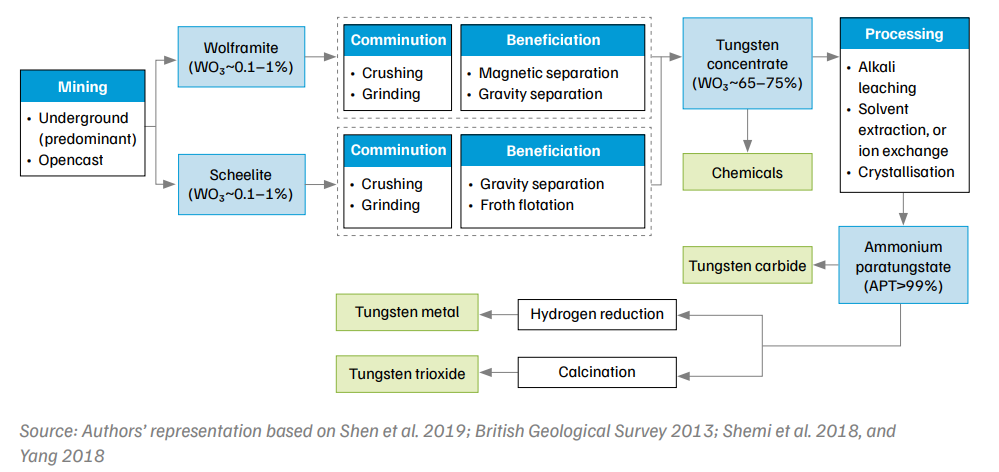
China dominates the supply chain of tungsten. As per the US Geological Survey, global tungsten mine production was estimated at 81,000 tonnes in 2024, with China accounting for 83 per cent, followed by Vietnam and Russia with less than 4 per cent and 2 per cent contribution, respectively. Globally, tungsten reserves are estimated at 4.6 million tonnes, with 52 per cent of these reserves located in China. Other countries with substantial reserves include Australia (12 per cent) and Russia (9 per cent) (US Geological Survey 2024p).
Vanadium is a hard, silver-grey transition metal known for its malleability and ductility. Primarily used in the steel industry as ferrovanadium, it enhances the strength and wearresistance of steel, comprising over 90 per cent of its applications.
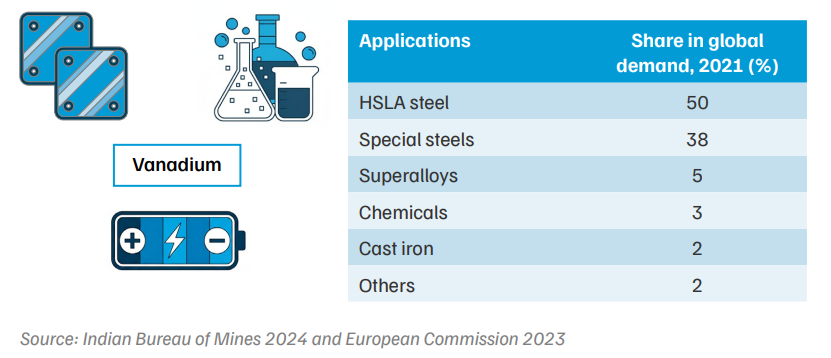
Vanadium is found naturally in several minerals, such as patronite, vanadinite, carnotite, and roscoelite (Indian Bureau of Mines 2024g). Vanadiferous titanomagnetite deposits are exploited for most commercial vanadium production globally, and vanadium is produced both as a primary resource and a by-product. Most vanadium is obtained as a co-product or byproduct of iron and steel production, wherein vanadium is recovered from the slag generated during the smelting of magnetic iron ore. The remaining vanadium is obtained from secondary sources such as red mud from aluminium processing, and spent catalysts in petrochemical processes.
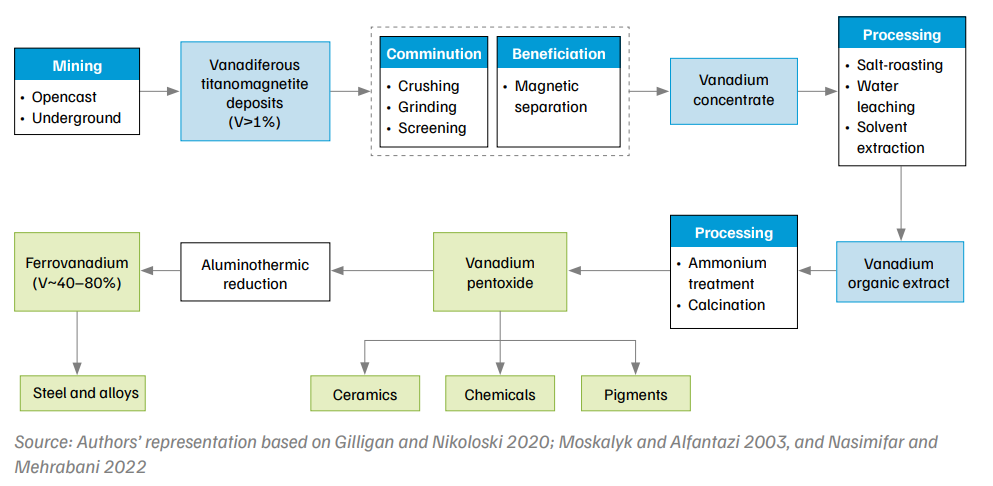
Vanadiferous titanomagnetite, with more than one per cent vanadium pentoxide (V2 O5 ) content by weight, is commonly used as a primary source of vanadium. During processing, the concentrate obtained after beneficiation is salt-roasted at 800–1,000°C, commonly with sodium carbonate, making vanadium soluble for leaching (Gilligan and Nikoloski 2020). After leaching solvent extraction, vanadium from impurities is isolated. Finally, the vanadium precipitates as ammonium polyvanadate, which is calcined to produce V₂O₅. This V₂O₅ is further reduced to ferrovanadium, as shown in Figure 19 (Nasimifar and Mehrabani 2022).
Ferrovanadium is one of the marketable products. Depending on the use case, it contains 40–80 per cent vanadium, and is obtained from iron and steel slag through the pyrometallurgical route of reduction and refining. Additionally, ferrovanadium is produced by the aluminothermic reduction of vanadium pentoxide (Moskalyk and Alfantazi 2003).
Figure 19. Simplified process steps for vanadium production
According to the US Geological Survey, the global reserves of vanadium are estimated to be 18 million tonnes, mostly distributed across Australia, Russia, and China, with their respective shares of 47 per cent, 28 per cent and 23 per cent, respectively. China dominates vanadium production, contributing 70 per cent out of 100,000 tonnes of global mine production in 2024, followed by Russia and South Africa (US Geological Survey 2024q). China also leads global refined vanadium production, having contributed 59 per cent in 2019, followed by the European Union and South Africa at 9 per cent each.
Zirconium is a silver-grey element known for its hardness, tensile strength and heat resistance. Because of these properties, it is used in pumps, valves, and piping in the chemical industry.
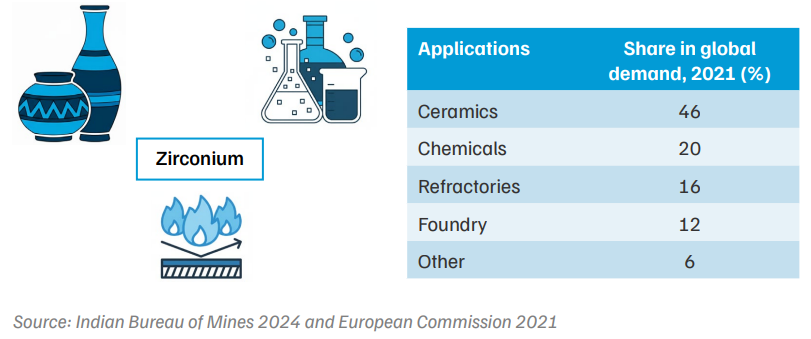
Zirconium is found in various deposits, but is primarily extracted from two minerals: zircon and baddeleyite. Most zirconium—around 97 per cent—comes from zircon found in heavy minerals, which also contains other minerals like ilmenite, rutile, leucoxene, monazite and garnet in different amounts.
The heavy minerals are usually mined using dredging techniques. Then, the sand is beneficiated using screening, magnetic and electrostatic separation, and froth flotation, to extract zircon-rich sand as a by-product or co-product of rare earth and titanium minerals, typically containing 63–66 per cent zirconium oxide (Indian Bureau of Mines 2024b; ZIA 2019), as shown in Figure 20. This sand is then refined for applications in ceramics and foundries, where further crushing and chemical treatment prepare it for market use.
Zirconium is fused with sodium hydroxide to produce zircon, which is suitable for leaching. Zirconium and hafnium—similar in properties—are then separated via solvent extraction using kerosene-based extractants. Zirconium nitrate is precipitated as zirconium hydroxide, calcined to form zirconium dioxide, and purified through reduction with magnesium, followed by vacuum treatments (Xu et al. 2015; Dutta and Lodhari 2018).
Figure 20. Simplified process steps for zirconium production
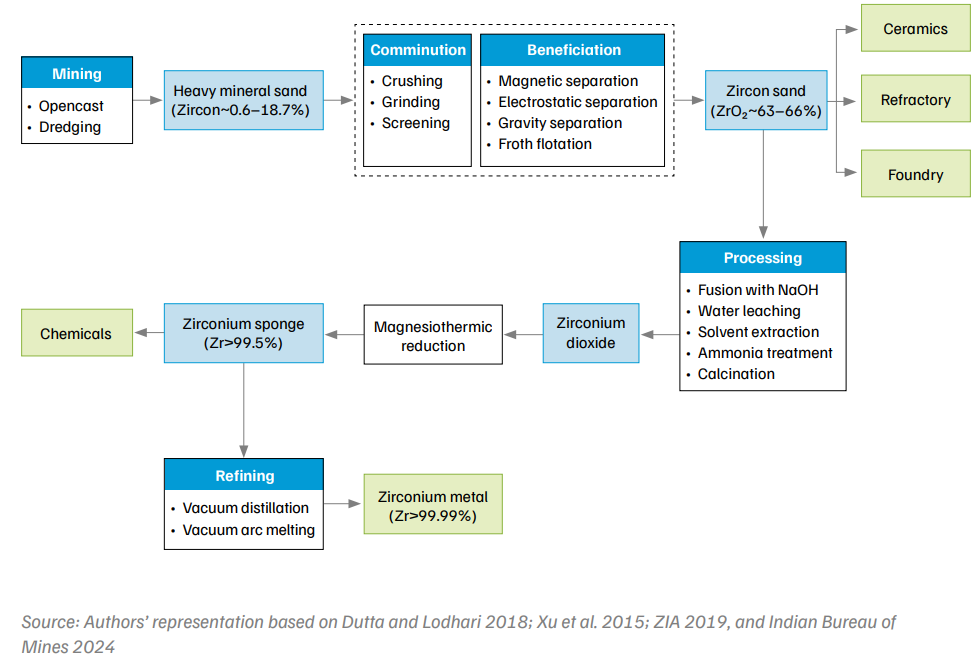
The zirconium supply chain is concentrated in a few countries. Out of 70 million tonnes of zirconium reserves, 79 per cent are available in Australia, followed by South Africa, which accounts for 8 per cent. Australia also leads in producing zirconium mineral concentrates globally, accounting for 33 per cent out of 1.5 million tonnes produced in 2024, followed by South Africa and Mozambique, with a share of 20 and 11 per cent, respectively (US Geological Survey 2025).
As India accelerates its clean energy transition, the demand for critical minerals such as cobalt, copper, graphite, lithium and nickel is expected to rise significantly. Given the high import dependence on these minerals, building a stable and resilient supply chain is necessary for long-term technological and industrial growth. While domestic mineral exploration efforts are expanding, strengthening capabilities in processing critical minerals is equally important to reduce vulnerabilities.
India has a diverse geological landscape that hosts several minerals in varying concentrations and mineralogical complexities. Out of the 15 critical minerals analysed in this study, seven are currently produced domestically at different industrial scales, as shown in Table 5. While some critical minerals, such as copper and REEs, have established processing infrastructures, others, like tin and silicon, face significant challenges regarding scale of operation and lack of technology.
| S. No. | Mineral | Processing technology | Products |
|---|---|---|---|
| 1 | Copper | Pyrometallurgy (smelting, converting and refining) | Copper rods, copper electrodes, wires |
| 2.1 | Natural graphite | Beneficiation (froth flotation and leaching) | Graphite fines (60-95% fixed carbon) and graphite flakes |
| 2.2 | Synthetic graphite | Pyrometallurgy (devolatilisation, tar distillation, graphitisation) | Graphite electrodes, carbon products used in metallurgical operations, and graphite equipment |
| 3 | Rare earth elements | Hydrometallurgy (chemical treatment, solvent extraction) | Rare earth oxides |
| 4 | Silica sand and quartz (silicon) | Various process routes based on product or applications | Glass, ferroalloys, refractories, foundry |
| 5 | Tin | Pyrometallurgy (smelting and refining) | Tin metal |
| 6 | Titanium | Mixed (acid leaching, hydrolysis, purification and calcination) | Synthetic rutile, titanium pigment |
| 7 | Zirconium | Mixed (alkali treatment, solvent extraction and calcination) | Zircon sand, zirconium sponge metal, zirconium alloys |
Source: Authors' analysis
An assessment of India’s current standing in critical minerals processing is essential to identify gaps, opportunities and challenges within the domestic supply chain of critical minerals. This section provides an analysis of the existing domestic capabilities in the mining, processing and refining of the selected critical minerals. Additionally, it highlights the technological and structural roadblocks, as well as opportunities for domestic value addition. We have ordered the minerals in three parts for clarity, wherein first, we discuss those minerals that are currently mined and processed in India (Table 5). Next, we cover the minerals that are essential for clean energy technologies but are not produced from primary sources. Finally, the list includes those critical minerals that are important for other strategic sectors and have domestic resources, but are not mined or processed in India.
Copper
As of 2020, India’s total copper ore resources are estimated to be 1.66 billion tonnes, of which 163.89 million tonnes are reserves, which are distributed in the states of Madhya Pradesh (73 per cent), Rajasthan (22 per cent) and Jharkhand (5 per cent). The mine production of copper ore in India was estimated to be 3.5 million tonnes in 2021–22, which is quite small considering the reserves, and shows potential to expand through detailed exploration. The production of copper concentrate was estimated to be 114,400 tonnes, and production was done in Madhya Pradesh (57 per cent) and Rajasthan (43 per cent) (Indian Bureau of Mines 2024c).
India has a well-developed copper industry with decades of experience in mining and production of copper concentrates. The nation’s total installed smelting capacity is 1.028 million tonnes per annum (MTPA). There are two major companies involved in copper primary production, Hindalco Industries (under the Aditya Birla Group) and Sterlite Industries (under the Vedanta Group). Hindalco and Sterlite are private companies with installed smelting capacities of 0.5 MTPA and 0.4 MTPA, respectively. These private companies rely on imported copper concentrates and concentrate from Hindustan Copper to produce cathodes of copper and other products in India (Indian Bureau of Mines 2024c).
India is heavily dependent on the import of copper ore and concentrates, as domestic copper concentrate production caters to less than five per cent of domestic requirements because of the low grade of copper reserves. More than one million tonnes of copper ore and concentrates (HS Code 2603) were imported in 2021–22, mainly from Chile (37 per cent), Argentina (20 per cent), Peru (12 per cent) and Australia (11 per cent). In addition, the primary route of copper domestic production contributed to 46 per cent of domestic needs in 2021, and the rest came from recycling new or old scrap (IISD 2024).
Table 6. Examples of Indian organisations involved in copper processing and technology development
| Organisation | Area of work |
|---|---|
| Hindalco Industries Limited | With installed smelting capacities of 0.5 MTPA, Hindalco Industries uses the flash-smelting technique for copper processing. It relies on imported copper concentrates, as well as that from Hindustan Copper to produce cathodes and other products. |
| CSIR-IMMT, Bhubaneswar | Prepared a basic engineering package for a copper production plant of 12,000 tonnes per annum using copper oxide ores from the Democratic Republic of the Congo. The institute has also successfully demonstrated copper recovery from deep-sea nodules at a scale of 500 kg per day, through technology developed in-house. |
| Kutch Copper Limited | Adani Enterprises is setting up a copper plant with a capacity of 1 MTPA in two phases in Mundra, Gujarat. |
Source: Authors' analysis based on Indian Bureau of Mines 2024c; Hindalco 2024, and Adani Group 2022
Graphite
India possesses three per cent of the world’s graphite reserves (US Geological Survey 2024e), and it produces both flaky and amorphous graphite, primarily used to make graphite crucibles, refractory bricks, and carbon brushes, after the beneficiation of run-of-mine ore. One of the challenges in the beneficiation of graphite is improving the recovery of flaky graphite without damaging the graphite flake structure. This is crucial because of its huge industrial demand due to its ability to have high thermal conductivity, stability, and lubrication properties (Indian Bureau of Mines 2024a).
The estimated graphite reserves in India are 8.56 million tonnes, as of 2020, found in Tamil Nadu (36 per cent), Odisha (33 per cent) and Jharkhand (30 per cent). The remaining resources are estimated to be 203.6 million tonnes, as per the latest update from the national mineral inventory database. Graphite production in 2021–22 was estimated to be 57,000 tonnes. Tamil Nadu was the leading graphite-producing state in India, accounting for 63 per cent, with the rest coming from Odisha (Indian Bureau of Mines 2024a).
Despite domestic graphite production, India imports both natural and synthetic graphite. Synthetic graphite (HS code 3801) is imported from countries such as China (50 per cent), Germany (15 per cent), the United Kingdom (9 per cent) and Poland (6 per cent). Natural graphite (HS code 2504) is imported from Madagascar (44 per cent), China (33 per cent) and Mozambique (11 per cent) (Ministry of Commerce and Industry 2024). India was the largest importer of synthetic graphite and third largest importer of natural graphite after China and Germany in 2022 (Ramji and Dayemo 2024). In 2021–22, India imported synthetic graphite worth USD 109.08 million, nearly double the value of its exports. By 2023–24, imports became 2.6 times compared to exports the same year, and having increased by 42 per cent compared to 2021–22. The import value of natural graphite has increased by nearly 9 per cent (Ministry of Commerce and Industry 2024).
Table 7. Examples of Indian organisations involved in graphite processing and technology development
| Organisation | Area of work |
|---|---|
| Epsilon Advanced Materials | Produces synthetic graphite from coal tar pitch, which is further used as a high-purity anode material for lithium-ion batteries. Synthetic graphite is almost 58 per cent of lithium-ion battery material. |
| Graphite India Limited | Produces synthetic graphite, speciality carbon, and other graphite-based products that have applications in the steel, non-ferrous metal production, solar, semiconductor, chemical, glass, and quartz industries. They employ a multi-step process for producing graphite electrodes, which are 90 per cent pure and made from petroleum coke. |
| CSIR-IMMT Odisha | Developed a method to maximise the recovery of flaky/natural graphite (a starting material for producing spherical graphite) during the beneficiation process, which is crucial for meeting the increasing demand for high-quality graphite. The developed process is high-yielding and cost-effective, allowing recovery of larger quantities of this valuable resource. The technology is currently licenced and ready for commercialisation. |
Source: Authors' analysis based on Epsilon Carbon 2024; Graphite India Limited 2024, and ISTI 2024
The US Geological Survey estimates India has the fourth-largest global reserves of REEs and was the sixth-largest producer of these minerals in 2023 (US Geological Survey 2024b). The estimated monazite resources are 12.73 million tonnes as of 2021, found in several coastal states in India, with the top three being Andhra Pradesh, Odisha and Tamil Nadu (Indian Bureau of Mines 2024k). These monazite minerals are available in the beach sand, in concentrations of 0.01–1.4 per cent, with other critical minerals titanium and zirconium (Singh et al. 2024; Anitha et al. 2020).
Beach sand is mined by IREL (India) Limited and Kerala Minerals and Metals Limited (KMML). Processing of monazite is led by IREL through hydrometallurgical routes, including chemical treatment and solvent extraction, at its facilities in Odisha (OSCOM) and Kerala (RED), to produce neodymium-praseodymium (Nd-Pr) oxide, essential for rare-earth magnets used in offshore wind turbines, electronics, and EVs, along with other compounds of lanthanum and cerium.
Table 8. Examples of Indian organisations involved in REE processing and technology development
| Organisation | Area of work |
|---|---|
| CSIR-NML Jamshedpur | Developed a technology to extract REEs from electronic waste, including neodymium-iron-boron (NdFeB) magnets, through solvent extraction and selective leaching. It focuses on recovering REEs like neodymium, praseodymium, and dysprosium for use in wind turbines, EV motors, and other applications, contributing to sustainable resource management. |
| CSIR-IMMT Bhubaneswar | Developed processes for recovering REEs from spent magnets and is currently advancing the technology readiness level of this process in its pilot plant. To further support these research initiatives, the institute is developing critical pilot-scale infrastructure, including a molten salt electrolysis system for converting REE oxides to metals, and a 200-stage mixer-settler solvent extraction plant for REE separation. |
| Bhabha Atomic Research Centre (BARC) | Developed an integrated hydrometallurgical process to recover REE such as neodymium, praseodymium, and dysprosium from scrap computer hard disks and NdFeB magnets, achieving over 99 per cent purity and 95 per cent recovery. This technology is now transferred to IREL for demonstration in Bhopal. |
Source: Authors' analysis based on CSIR-NML 2024b, and BARC 2023
Box 5. Roadblocks in the domestic REE supply chain
Despite having the fourth-largest reserves of REEs globally, India’s REE supply chain faces several challenges and holds vast potential for self-sufficiency. The domestic REE value chain is underdeveloped, especially in midstream and downstream stages, leading India to rely heavily on imports for value-added products like rare earth magnets. The state-owned IREL (India) Limited currently dominates the sector, and is well-positioned to lead this transformation, but can further enhance its operations to fully leverage India’s REE reserves, which are currently underutilised—only 0.042 per cent of the reserves are mined annually (CEEW, IEA, UC-DAVIS and WRI 2023).
Rare earth elements’ processing and metal extraction are capital-intensive, energy demanding, and environmentally challenging, as they generate toxic byproducts. Monazite processing, for example, requires specialised handling due to its thorium content, which can reach up to 12 per cent. It necessitates facilities capable of managing radioactive waste, which adds significant complexity and costs, as strict safety measures and specialised disposal facilities are mandatory. Moreover, separating REEs like neodymium and dysprosium from other elements such as lanthanum and cerium is technologically complex due to very similar physical and chemical properties, therefore involving multiple stages of solvent extraction and ion exchange processes for their individual separation and achieving high purity.
Silicon
India has substantial silica resources in the form of quartz and silica sand. As of 2015, the total estimated resources of quartz and silica sand were 3,907.95 million tonnes, with 647.53 million tonnes classified as reserves.
Silica mining in India is carried out manually through the opencast method, particularly in states like Rajasthan, Andhra Pradesh, Odisha, Maharashtra and Gujarat. The domestically produced silicon resources are primarily used in industries such as glass, foundry, ferroalloys, refractories, and building materials (Indian Bureau of Mines 2023).
According to the US Geological Survey, India has the capacity to produce ferrosilicon, and 60,000 tonnes produced in 2023 (US Geological Survey 2024c). Polysilicon manufacturing facilities have been announced in India, but none have been established yet.
Tin
India has significant resources and some reserves of tin, but domestic production remains extremely limited, making India heavily reliant on imports. As per the latest data (from 2020), India has reserves of 2,101 tonnes, and the remaining resources are 83.72 million tonnes of tin ore. These resources are found in Haryana (83 per cent) and Chhattisgarh (16 per cent). Mine production is only done in Chhattisgarh, and in 2021–22, approximately 26 tonnes of tin concentrate were produced. India has the capability to produce tin metal as well. Precious Minerals and Smelting Limited has a smelter in Chhattisgarh, which produced 4.9 tonnes of tin metal in 2021–22 (Indian Bureau of Mines 2024d).
However, domestic tin production is negligible (less than 1 per cent) compared to apparent consumption, and India is almost entirely dependent on imports for tin requirements. In 2023–24, India imported tin and its alloys (HS code 80) worth USD 338.9 million, threefourths of which were from Indonesia and the remaining from the likes of Singapore, Malaysia, Switzerland and China (Ministry of Commerce and Industry 2024).
In India, most tin is currently used in the packaging industry, solders, automobiles and batteries, and this demand is expected to continue. However, India’s per capita consumption of tin is quite low at 0.49 kg compared to developed countries (8–12 kg) and even developing economies like China (4.75 kg) (Indian Bureau of Mines 2024d). This highlights a significant growth potential for tin demand in India. Some companies involved in the domestic tin supply chain are Hindustan Tin Works Limited, Jindal Steel Works Limited, Mumbai, and CSIR-Central Electro Chemical Research Institute, Karaikudi.
Table 9. Examples of Indian organisations involved in tin processing and technology development
| Organisation | Area of work |
|---|---|
| Hindustan Tin Works | Manufactures corrosion-resistant cans using a multi-stage process, starting with cupping and deep drawing tinplate sheets into desired shapes. The cans are welded using high-frequency electric resistance techniques, then leak-tested, varnished, and lacquered for enhanced durability and food safety. |
| Jindal Steel Works (JSW) | Produces tinplate under the brand JSW Platina, using continuous annealing. The process involves heating cold-rolled steel sheets in a controlled atmosphere, followed by cooling to improve ductility and formability. The steel is then electroplated with tin to create a high-quality, corrosion-resistant tinplate that is suitable for use in food and non-food packaging. |
| CSIR-CECRI, Karaikudi | Developed a cost-effective electro-refining process to recover tin from low-purity soldering dross. Pure tin is extracted at the cathode using mixed alloy sheets as anodes and controlled electrochemical potential, improving its usability for electronics and food industries. |
Source: Authors' analysis based on Hindustan Tin Works 2024; JSW Steel Works 2024, and CSIR-CECRI Karaikudi 2024
Tin plays a crucial role in electronics and semiconductors, primarily due to its use in soldering electronic components. With the ongoing Industrial Revolution 4.0, these industries are set to expand significantly, leading to an increase in consumption worldwide. Moreover, tin is being explored in emerging technologies, such as a potential anode material in lithium-ion batteries, and other energy storage systems. It is also being tested as a heat-storage medium in solar farms, and as a thermoelectric material to convert stored heat into electricity. Potential applications of tin include its use in hydrogen generation, fuel cells, carbon capture and water treatment, highlighting its expanding role in next-generation technologies.
Titanium
India has significant titanium reserves, and the capacity to produce titanium pigment and titanium sponge domestically. According to US Geological Survey estimates, India has the third largest ilmenite reserves in the world (with 12 per cent) and the second largest rutile reserves (with 13 per cent). India also has a titanium pigment production capacity of 91,000 tonnes and a titanium sponge production capacity of 500 tonnes (US Geological Survey 2024d).
Two companies—IREL (India) Limited and Kerala Minerals & Metals Limited (KMML)—are involved in the mining of beach sand. Ilmenite production was 391,000 tonnes in FY 2021–22, while rutile production was 13,000 tonnes. These minerals are produced mainly in the states of Odisha, Kerala, and Tamil Nadu (Indian Bureau of Mines 2024e). Present domestic titanium metal production is negligible. The majority of titanium minerals, such as rutile and ilmenite, are converted into titanium dioxide pigment or titanium sponge and used by the chemical industry, welding electrode industry, or for R&D purposes in defence labs (DRDO 2024; Indian Bureau of Mines 2024e).
Table 10. Examples of Indian organisations involved in titanium processing and technology development
| Organisation | Area of work |
|---|---|
| Travancore Titanium Products Limited (TTPL) | Produces titanium dioxide pigment using the sulphate process. Ilmenite is reacted with sulphuric acid to form titanium oxysulphate, which is further processed into titanium dioxide. The pigment has applications in paints, cosmetics, pharmaceuticals, and other industries. |
| CSIR-IMMT Bhubaneswar | The institute is working in collaboration with Australia's national science agency, CSIRO, to develop technology for the recovery of titanium dioxide from titanium minerals and vanadium-bearing titanium minerals of Indian origin. |
Source: Authors' analysis based on TTPL 2024, and PIB 2024
Zirconium
India has substantial zircon resources, and the ability to extract and process zircon from heavy minerals and deposits. As per the latest data (2020), the country’s zircon reserves are estimated at 669,400 tonnes, with an additional 1.6 million tonnes of remaining resources (PIB 2024). These are primarily located in the coastal states of Andhra Pradesh, Tamil Nadu and Kerala. IREL (India) Limited and Kerala Mineral and Metals Limited (KMML) are involved in the mining of heavy minerals, with zircon as a co-product.
As of 2019–20, the combined installed capacity for zircon production was 39,000 tonnes per year. However, actual domestic production in the same period was 15,600 tonnes, with IREL contributing about 74 per cent and KMML the rest (Indian Bureau of Mines 2024e). In addition to domestic production, India also imports zirconium ores and concentrates (HS code 261510). In FY 2023–24, India imported USD 168.39 million worth of these materials, with major suppliers being Indonesia (34 per cent), Australia (20 per cent), Malaysia (13 per cent) and South Africa (13 per cent) (Ministry of Commerce and Industry 2024).
Table 11. Examples of Indian organisations involved in zirconium processing and technology development
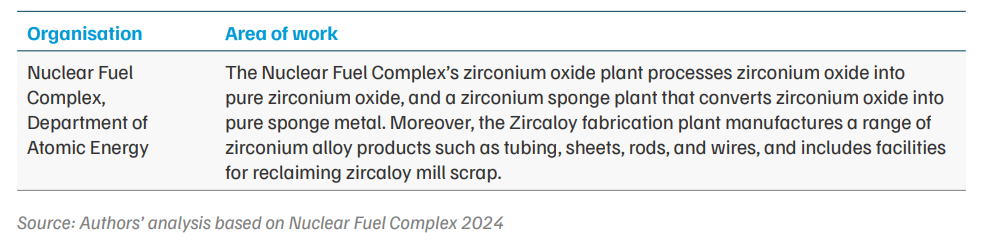
Cobalt
India does not have cobalt reserves, and the remaining ore resources are 44.9 million tonnes, found in the states of Odisha (69 per cent), Jharkhand (20 per cent) and Nagaland (11 per cent) (Indian Bureau of Mines 2024b). In Odisha, cobalt is present in nickel laterite deposits. Additionally, in other deposits in Karnataka and Maharashtra, which have been put on auction, cobalt is in the range of 12–353 ppm (Ministry of Mines 2024). In India, cobalt is not produced from primary resources, and most of the country’s domestic needs for cobalt are met by imports from the United States, Netherlands, Japan, Belgium, China, and Norway. However, some companies in India, such as LOHUM Cleantech Limited, recover cobalt from secondary sources and produce cobalt compounds of industrial-grade purity.
According to the India Mineral Yearbook 2022, the total refining capacity of cobalt in India is about 2,060 tonnes. Hindustan Zinc Limited is also exploring the possibility of recovering cobalt from zinc purification cake. They have developed a lab-scale process for recovering cobalt, generating cobalt sulphate crystal with a 60 per cent purity, and 50 per cent recovery (NITI Aayog 2023).
Table 12. Examples of Indian organisations involved in cobalt technology development
| Organisation | Area of work |
|---|---|
| CSIR-NML, Jamshedpur | Developed a process to recover cobalt from discarded lithium-ion batteries of mobile phones. The research focus is on cobalt recycling, which leads to 46 per cent less energy consumption than primary processing, and a 40 per cent reduction in water use than primary processing. |
| CSIR-IMMT, Bhubaneswar | Developed a technology to produce cobalt from secondary resources such as lithium-ion battery (LiB) black mass, cobalt mixed hydroxide precipitate (MHP), and copper oxide ores from the Democratic Republic of the Congo. Additionally, the institute has piloted cobalt recovery from alternative resources, including deep-sea nodules, at a scale of 500 kg per day, and chromite overburden at a rate of 10 tons per day. |
Source: Authors' analysis based on CSIR-NML 2024a and Meshram et al. 2020
Lithium reserves are unavailable in India, and there is no primary production. As a result, imports meet nearly all domestic lithium requirements. In FY 2023–24, USD 33.41 million of lithium (HS code 850650) was imported, and the top-three import sources were Hong Kong (33 per cent), China (27 per cent), and Singapore (10 per cent) (Ministry of Commerce and Industry 2024).
However, efforts to explore new lithium deposits are underway in different states, including Jharkhand, Odisha and Rajasthan. Recently, two deposits have been discovered—one is in Jammu and Kashmir, with 5.9 million tonnes of lithium resources in the clay form of deposits, with an average lithium grade of 583 ppm (PIB 2023b; Ministry of Mines 2023c), while another is in Karnataka, with 1,600 tonnes of lithium resources (PIB 2024a). In addition, the government is also taking necessary steps actively to boost the domestic supply chain. A lithium block in Chhattisgarh, with 10–2,000 ppm lithium content, has already been auctioned (Business Standard 2024), and the Jammu and Kashmir lithium block, with aluminous laterite mineral, is expected to be reauctioned after further exploration. Khanij Bidesh India Limited (KABIL) is playing a key role in sourcing lithium from abroad; it acquired five lithium brine blocks in Argentina (PIB 2024b), and obtained a non-invasive permit to explore lithium (The Hindu 2024). This organisation is also looking to acquire more lithium blocks in Argentina, Chile, and Australia (PIB 2024d).
The domestic lithium industry is nascent and primarily focused on producing lithium compounds for use in pharmaceuticals, soldering, and automobile welding. The emerging uses of lithium in clean energy technologies present a huge opportunity for expanding lithium refining and domestic battery manufacturing capabilities.
Table 13. Examples of Indian organisations involved in lithium processing and technology development
| Organisation | Area of work |
|---|---|
| Neogen Chemicals Limited | Imports lithium carbonate and uses it to manufacture various lithium salts such as bromide, chloride and molybdate. The imported lithium carbonate undergoes basic processing steps such as filtration, ion exchange and precipitation, in the presence of various solvents, to remove impurities. High-purity electrolyte lithium hexafluorophosphate (LiPF6) is also manufactured. The technology licence for the same has been obtained by partnering with a Japanese company, MU Ionic Solutions. |
| Altmin Private Limited | Produces lithium-ion battery materials. Altmin has partnered with the International Advanced Research Centre for Powder Metallurgy and New Materials, to produce cathode active materials in India. This collaboration aims to enhance self-reliance in producing key battery materials, specifically focusing on lithium ferrous phosphate (LFP), essential for manufacturing advanced lithium-ion batteries used in electric vehicles (EVs) and grid applications. |
| Bhabha Atomic Research Centre | BARC researchers obtained lithium carbonate of intermediate purity (~85 per cent) from its minerals processing division in Hyderabad. The lithium hydroxide obtained is of >99.9 per cent purity and a yield of >98 per cent, which is evident in the efficiency of the process. It can also be scaled up and is reproducible at the industrial level. The process is indigenous to India, and various government grants have backed the project. |
Source: Authors' analysis based on Neogen Chemicals 2024a; Altmin 2023, and BARC 2023
Establishing a lithium supply chain in India faces several significant challenges. The lithium resources in Jammu and Kashmir are currently at the inferred G3 stage, meaning further exploration is necessary to determine the viability of economically extracting these reserves. Based on global trends, the process from discovery to the start of production can take an average of 16.5 years (The World Economic Forum 2022). Additionally, rising lithium imports signal the growing severity of the challenge, with the value of Liion battery imports surging from USD 384.6 million in 2018–19 to USD 2.8 billion in 2022–23 (East Asia Forum 2024). Compounding this issue, China dominates 60–70 per cent of the global lithium refining capacity, and holds a substantial share of the world’s lithium reserves. If India fails to obtain enough raw materials, either from domestic sources or through imports, the scarcity of lithium could hinder production in downstream areas of the battery supply chain, especially cathode manufacturing (ORF America 2024).
India’s opportunity in this scenario lies in substantially investing and establishing lithium refineries domestically. Developing lithium refineries in India is essential for taking advantage of current import opportunities, and preparing the country to utilise its domestic lithium reserves. By investing in refining infrastructure now, India can establish a strong industry capable of processing locally sourced lithium in the future. Four states—Andhra Pradesh, Gujarat, Odisha and Tamil Nadu—have been identified as ideal sites for lithium refineries due to their existing chemical processing facilities and proximity to ports. These states fall within the Petroleum, Chemicals & Petrochemicals Investment Regions (PCPIRs), which aim to facilitate the growth of chemical industries (NITI Aayog 2023b). India’s strategic trade agreements, especially with Australia, place the nation in a favourable position to import lithium concentrates for local use or export. The Australia-India Strategic Research Fund provides grants to bolster collaboration on critical minerals processing, recycling and tailings reclamation, which could supply India with vital raw materials and technologies.
Nickel
In India, nickel is not produced from primary sources, and almost the entire demand is catered to by imports, mainly from the Netherlands, Norway, the UAE, and Japan. As of 2020, domestic nickel reserves are unavailable; the remaining resources are estimated to be 189 million tonnes of nickel ore. Odisha alone accounts for 93 per cent of resources, and the rest are found in Jharkhand and Nagaland (Indian Bureau of Mines 2024f). In Odisha, the resources are nickel laterites, containing nickel in the range of 0.2–1.4 per cent, along with iron, copper, aluminium, and magnesium (Misra and Bhatnagar 1965).
Although there is no primary production of nickel in India, some companies and national labs, such as Vedanta Nico, Hindustan Copper Limited, LOHUM Cleantech Private Limited, and CSIR’s Institute of Minerals and Materials Technology (IMMT), have developed the capability to produce nickel as a by-product, and recover it from secondary sources.
Table 14. Examples of Indian organisations involved in nickel processing and technology development
| Organisation | Area of work |
|---|---|
| Vedanta Nico | Produces 99.8 per cent-grade nickel metal, and derivatives like battery grade and technical-grade nickel sulphate. It processes imported nickel-mixed hydroxide precipitate to create nickel sulphate used in electroplating, nickel catalysts, and lithium-ion batteries. Battery-grade nickel sulphate is key for EVs, and Vedanta Nico has secured long-term contracts with international EV players. |
| LOHUM Cleantech Private Limited | Recycles lithium-ion battery waste to recover 99.5 per cent pure battery grade nickel sulphate and carbonate, using its patented hydrometallurgy technology (NEETM). This supports the circular economy in battery materials. |
| CSIR-IMMT, Bhubaneswar | Developed a technology for the recovery of nickel from chromite overburden, successfully demonstrating the process at a scale of 10 tons per day. Additionally, CSIR-IMMT has also developed technology to extract nickel from copper refinery electrolyte, an industrial effluent, with a pilot scale demonstration. |
Source: Authors' analysis based on Vedanta Limited 2024; Lohum 2024, and Indian Bureau of Mines 2024
Molybdenum
Molybdenum is not produced in India from primary sources, and domestic requirements are mostly met through imports. Reserves of molybdenum are also not available. However, molybdenum is found to be associated with copper, lead, and zinc ores, with concentrations in the range of 0.0045–0.14 per cent. The total resources of molybdenum in India are estimated to be 27.2 million tonnes as of 2020, concentrated in three states—Tamil Nadu (66 per cent), Madhya Pradesh (29 per cent) and Karnataka (5 per cent) (Indian Bureau of Mines 2024e).
Table 15. Examples of Indian organisations involved in molybdenum processing and technology development
| Organisation | Area of work |
|---|---|
| Defence Metallurgical Research Laboratory | The DMRL, a DRDO institute, developed a pilot plant for producing high-purity molybdenum disilicide ($MoSi_2$) from molybdenite ore and silicon. Due to their high temperature and oxidation resistance, $MoSi_2$-based materials are used in turbines, missile nozzles, and industrial applications. |
Source: Authors' analysis based on Indian Bureau of Mines 2024
Niobium
The domestic resources of niobium in India are estimated to be 282 million tonnes as of 2024, all of which are in Gujarat (Government of India 2024), and the data on niobium production from primary sources is unavailable. Despite this, India is dependent on imports of ferroniobium. In FY 2023–24, India imported ferroniobium (HS code 72029300) worth USD 155.7 million from Singapore (62 per cent), Brazil (27 per cent) and Canada (6 per cent). Almost similar trade was reported the previous year (Ministry of Commerce and Industry 2024).
Table 16. Examples of Indian organisations involved in niobium processing and technology development
| Organisation | Area of work |
|---|---|
| Metallurgical Products India Limited | Manufactures high-purity speciality chemicals, including 99.95 per cent niobium pentoxide (Nb₂O₅), used to produce niobium carbide, master alloys, and superalloys. Niobium pentoxide can also be reduced to create pure niobium or alloys for superconductivity and industrial applications. The company produces aluminothermically reduced niobium, which is used for niobium-based ingots and alloys in the aerospace, nuclear, and steel industries. |
Source: Authors’ analysis based on MPIL 2024
Platinum group of elements
Reserves of PGEs are unavailable in India, and the available resources are estimated to be 20.92 tonnes of metal content, according to the latest data (2020), across the states of Odisha (68 per cent), Uttar Pradesh (16 per cent), Tamil Nadu (8 per cent) and Karnataka (7 per cent). Domestic requirements are met through imports—mainly from the UK, South Africa, Germany and the USA—because of the absence of domestic mining and processing (Indian Bureau of Mines 2024j).
Table 17. Examples of Indian organisations involved in PGE processing and technology development
| Organisation | Area of work |
|---|---|
| Hindustan Platinum | Refines, fabricates, and recycles platinum group metals (PGMs) like platinum, palladium, ruthenium, and rhodium for pharmaceuticals, electronics, and jewellery industries. Using advanced hydrometallurgical and pyrometallurgical techniques, it achieves purities exceeding 99.95 per cent. The company also serves as an NABL-accredited metal purity testing lab, and produces industrial-grade platinum catalysts for fuel cells and medical applications. |
| CSIR-CSMCRI, Gujarat | Developed cost-effective methods to recover palladium chloride from spent silica, achieving 100 per cent recovery without hazardous solvents. The process preserves silica's structure, enabling recovery of valuable byproducts like phthalocyanine ligands and silica, and has been commercialised for industrial use. |
Source: Authors' analysis based on Hindustan Platinum 2024 and CSIR-CSMCRI 2024
Tungsten
In India, tungsten reserves are unavailable, and the total resources are estimated to be 89.43 million tonnes, containing 144,650 tonnes of tungsten oxide (WO3 ) content, as per the latest national mineral inventory data (2020). The majority of these resources are found in four states: Karnataka (41 per cent), Rajasthan (27 per cent), Andhra Pradesh (17 per cent) and Maharashtra (11 per cent). As per the India Mineral Yearbook 2022, no domestic production of tungsten ore or concentrate occurred in FY 2020–21, and all of India’s tungsten requirements were met through imports (Indian Bureau of Mines 2024l).
Table 18. Examples of Indian organisations involved in tungsten processing and technology development
| Organisation | Area of work |
|---|---|
| Rapicut Carbides Limited | Manufactures tungsten-carbide components for aerospace and defence industries, using advanced powder metallurgy and precision grinding. The components are then shaped with high-precision grinding and EDM. These high-hardness, durable components are used in mining, manufacturing, aerospace, and defence, for cutting tools and wear-resistant parts. Raw materials are sourced from United Wolfram Pvt. Ltd. |
| United Wolfram Private Limited | Produces a range of tungsten and cobalt products, including tungsten oxide, ammonium para tungstate, and tungsten carbide powder. Tungsten, known for its hardness and high melting point, is used in aerospace, defence, and automotive applications, such as turbine blades and cutting tools, including diamond cutting. |
| Defence Metallurgical Research Laboratory | The DMRL, in collaboration with CSIR-NML and CSIR-IMMT, has developed processing technologies for extracting tungsten metal from Hutti Gold Mines tailings containing 0.02 per cent $WO_3$, and tungsten alloy scrap with 90 per cent tungsten content. These processes have been successfully demonstrated at a pilot scale, with benchmarking conducted to assess the quality and performance of the recovered tungsten. |
Source: Authors' analysis based on Rapicut Carbides 2024, and United Wolfram 2024
Vanadium
Reserves of vanadium are not available in India. However, the total resources of vanadium ore are estimated to be 24.63 million tonnes, as per the latest data (2020). These resources are found in Karnataka (79 per cent), Odisha (20 per cent) and Maharashtra (1 per cent). Data on the domestic production of vanadium is not available. However, the India Bureau of Mines has reported lab-scale studies and the establishment of pilot plants for vanadium recovery (Indian Bureau of Mines 2024g). India is dependent on imports of vanadium ores and concentrates and ferrovanadium. In FY 2023–24, USD 930,000 worth of vanadium ores and concentrates (HS code 26159010) were imported, mainly from Germany, Russia, and the UAE, and while ferrovanadium worth USD 30.4 million was imported from South Korea, Russia, and Japan (Ministry of Commerce and Industry 2024).
Box 8. Scope of future demand for vanadium
The global demand for vanadium is closely tied to the steel industry, particularly high-strength and highspeed steel. According to Vanitec, as the steel market is expected to grow steadily at a rate of 1.5–1.7 per cent annually, vanadium demand will likely follow suit, and the global vanadium demand will range between 127,500 and 173,800 tonnes by 2031, which is nearly double the current annual production levels (Vanitec 2022). Additionally, demand for vanadium in vanadium redox flow batteries (VRFBs) is predicted to rise significantly—VRFB installations are projected to reach 32.8 GWh annually by 2031. By 2033, VRFBs could account for around 17 per cent of vanadium consumption, a notable increase from 3 per cent in 2021 (US Geological Survey 2024).
Table 19: Examples of Indian organisations involved in vanadium technology development
| Organisation | Area of work |
|---|---|
| National Aluminium Company Limited (NALCO) | Extracts vanadium from vanadium sludge generated as a by-product during alumina production (Bayer process). Through extensive research, NALCO has explored the recovery of vanadium from various Bayer liquors to enhance resource utilisation, reduce waste, and improve alumina production efficiency. |
| Reliance Industries Limited (RIL) | Has developed an eco-friendly process to extract vanadium from gasifier slag, designed for low temperatures and minimal costs. Initially successful at the laboratory level, it is now being scaled up for pilot testing. |
Source: Authors' analysis based on NALCO 2014 and 2024, and RIL 2023
In addition to the challenges highlighted while discussing individual critical minerals, our analysis through stakeholder interactions, literature review, and visits to research labs reveals some insights and challenges that are common across multiple critical minerals, influencing India’s supply chains and technological capabilities. The following inferences highlight broader issues, such as limitations in processing technologies, infrastructure gaps, import dependence, and emerging opportunities that must be addressed to strengthen India’s critical minerals ecosystem.
Limited domestic technological knowhow in processing critical minerals
India’s mining industry predominantly relies on pyrometallurgical techniques for the processing of raw ores, which are well-established for bulk minerals such as iron, copper and lead. In contrast, hydrometallurgical processes, which are preferred for low-grade and complex ores, like most of the critical minerals, remain underdeveloped. Currently, processing at commercial scale through the hydrometallurgical route is limited to some elements, such as zinc, uranium, and REE production in India, whereas globally, it is widely used for the processing of nickel, cobalt, lithium, and copper ores, which are absent in India.
A major limitation is the lack of domestic expertise in commercial-scale hydrometallurgical processes, such as solvent extraction, ion-exchange, high-pressure acid leaching, etc. India’s challenge is compounded by the nature of ore bodies with moderate scale resources, and quite obviously, the stages involved for getting a high-purity final product are always less economical compared to international prices. This technological gap in hydrometallurgy limits the domestic capability of critical minerals processing. Without further advancements in process development, specifically in hydrometallurgical techniques, India risks falling behind in the global critical minerals supply chain, and remaining dependent on imports for highpurity refined metals essential for clean energy technologies and other relevant sectors.
The processing technology of any critical mineral requires precise control over operational and thermodynamic parameters, such as temperature, pressure, pH, and electrode potential, along with the concentration of reagents used for any specific process, to ensure optimal refined metal recovery and overall process efficiency. While India possesses a strong foundation in mineral processing, the existing techniques were primarily designed for processing bulk minerals, which are generally present in higher grades in comparatively lesscomplex ore chemistry than what is observed in ores containing critical minerals.
As a result, the existing processing techniques lack the adaptability needed for critical minerals, which often exist in low-grade, polymetallic complex deposits, since the efficiency of these processes depends on fine-tuning operational parameters based on the mineralogical composition of ores. For example, the optimisation of the flotation process for the beneficiation of graphite ores is challenging to produce high-purity, battery grade, flaky graphite. Similarly, monazite processing requires solvent extraction and ion exchange techniques at a commercial scale to produce pure rare earth elements, and the technical capability does not exist in India.
India possesses established mineral processing capabilities, yet its existing expertise and infrastructure remain underutilised for critical mineral refining. While many fundamental processing techniques are common across minerals, several existing industrial-scale processes in India could be leveraged for critical mineral refining. For instance, technical-grade molybdenum oxide production involves roasting, as shown in Figure 9, requiring scrubbers to control sulphur dioxide emissions—a technology already used in India’s zinc industry for sphalerite processing, which could be used for the domestic processing of molybdenum. Similarly, India has expertise in precipitation and carbonation techniques used in calcium carbonate production, comparable to lithium carbonate processing, as shown in Figure 8.
The cost of critical minerals processing rises with increase in purity. In the absence of economies of scale and advanced technologies, etc., achieving the desired purity of a critical mineral is challenging. For example, producing high-purity silicon is essential for solar panels, but comes at a higher cost. While some Indian manufacturers are capable of producing metallurgical-grade silicon, further refining it to the 9N (99.9999999 per cent) purity required for solar applications and 11N purity for semiconductor applications involves additional processing steps, significantly increasing production costs.
In India, this expertise of achieving high-purity elements from primary raw ores of critical minerals at commercial scale is currently limited. The above example illustrates how Indian manufacturers are less competitive in producing clean technology-relevant-grade mineral products. The same situation exists in other industrially relevant critical minerals, such as graphite, rare earths, etc., where the high-purity mineral requirements of domestic industries are fulfilled through imports.
Several critical minerals are present in the waste generated by the existing mining industry, such as mine tailings, metallurgical slag, and coal fly ash. These can be recovered, reducing dependency on primary resources. However, due to a lack of awareness, technological capability and policy regarding critical mineral recovery from secondary sources, these are being dumped in mine fills, leading to inefficient resource utilisation and increased environmental impact. Efforts to recover the minerals at the lab and pilot scale are already underway. For example, Hindustan Zinc Limited has developed a process to recover cobalt oxide from purification residue with a purity of approximately 60 per cent (NITI Aayog 2023). However, a dedicated policy for recovering critical minerals from mine tailings on a commercial scale is missing.
Inadequate mining and processing ecosystem to make mineral processing commercially viable
India has organisations such as CSIR-IMMT, CSIR-NML, BARC, and other technical universities that have made advancements in lab-scale processing techniques. However, scaling these into commercially viable technologies remains a challenge severely impeded by the low quality of ores of critical minerals available in the country. There is a limited number of dedicated pilot plants for process validation at a commercial scale, which also hinders industrial adaptation. This disconnect between academic research and private-sector investment has resulted in the slow adoption of the processing technologies required for processing minerals with complex ore chemistry. Limited institutional memory for critical mineral R&D exists in India, as it has only recently been a subject of conversation. Now, with INR 1,500 crore allocated to the mineral processing through different components in the National Critical Minerals Mission, there is an urgent need to strategise how these funds can be effectively utilised for advancing R&D in the critical mineral sector.
Dependence on imported processing equipment and chemical reagents
India’s mining sector relies heavily on imports of specialised equipment and chemical reagents, which increases costs, supply chain vulnerabilities, and dependence on foreign suppliers. Most processing and refining techniques, especially for critical minerals, require high-precision machinery, such as autoclaves for high-pressure acid leaching (HPAL), solvent extraction units, ion-exchange resins, and electrowinning cells, which are primarily imported from China, Japan, and European countries. This dependence hampers India’s ability to rapidly scale-up domestic refining capacity, because of long lead times and logistical challenges associated with these imports.
Additionally, key reagents essential for mineral beneficiation and refining, such as organic extractants for solvent extraction, lithium carbonate precursors, rare earth separation chemicals, and high-purity acids for leaching, are not manufactured at scale in India. For example, China dominates the global supply of solvent extraction reagents used in REE and cobalt refining, making India’s processing sector highly vulnerable to geopolitical disruptions and price volatility
Forward-looking government initiatives have cultivated significant momentum and optimism in India’s critical mineral landscape, starting in 2023 and following G20 negotiations in India, which actively discussed this issue in the Energy Transition Working Group. However, our analysis indicates the need for additional measures to fully capture the existing opportunity. Further targeted efforts can open up new avenues, paving the way for economic growth and new jobs, while achieving the dual aims of access to critical minerals and energy security. We have identified three priority strategic areas for industry leaders and policymakers, represented in Figure 21.
Based on these strategic priorities, we provide eight recommendations designed to address the existing gaps highlighted in the previous sections, and enhance India’s mineral processing industry’s scale, efficiency and competitiveness.
Figure 21. Strategic priorities will enable the advancement of India’s mineral processing sector
| Building capacity | Strengthening existing ecosystem | Building competitiveness |
|---|---|---|
|
|
|
Source: Authors’ analysis
India must prioritise research and development into advanced, sustainable processing technologies for critical minerals. This is essential to improve domestic mineral processing capabilities and mineral recovery efficiencies.
For nickel and cobalt primary production, particularly from India’s low-grade laterite resources, hydrometallurgical methods such as HPAL should be a key area of research. The following actions are recommended:
For lithium, India should prioritise developing tailored technologies from its diverse deposits, including hard-rock deposits in Chhattisgarh, clay deposits in Jammu and Kashmir, and brine blocks acquired overseas.
In the case of copper, India may explore a hydrometallurgical approach for processing its low-grade copper ores, which are already used for 20 per cent of global primary copper production from copper oxide and carbonate ore. This could significantly reduce its dependence on imported copper ore and concentrates.
Tapping energy efficiency of primary processing for increasing competitiveness
India must prioritise the development of energy and water technologies for the primary processing of critical minerals. Many of these processes are inherently resource-intensive because of the lower grade of target critical minerals in their ore deposits, making them economically and environmentally challenging.
For instance, processing lithium from hard rock and clay deposits, which India predominantly possesses, requires at least nine times more energy and twice as much water as brine processing, and 65 per cent of global lithium is in brine deposits (Gao et al. 2023a). This is due to processing steps, such as calcination, performed at high temperatures (~1,100°C) (Aichelin 2024).
Therefore, to make domestic lithium processing robust and profitable, it becomes critical for India to optimise these energy intensive processes, and focus on decreasing the number of intermediate processing steps, thereby reducing the overall costs, increasing energy efficiency, and reducing water use. This would also make Indian materials less emissionintensive, thus becoming a low-carbon alternative to developed countries for exports (as developed countries are devising policies with stringent emission norms to import critical raw materials).
Furthermore, processing could also be made less energy intensive by using alternative technologies to substitute conventional energy-intensive processing methods. For example:
National research institutions, particularly CSIR laboratories and academic institutes in the mineral and metallurgy domain, should take the lead in conducting focused research and developing energy efficient technologies for the processing of critical minerals.
India must prioritise the processing of secondary resources and proper tailings management to transform the tailings and industrial waste into valuable critical mineral supplies, supporting domestic production, and reducing import dependency.
For example, cobalt can be recovered from the purification waste generated during zinc processing.
Similarly, the recovery of vanadium from steel slag, fly ash, and bauxite residues presents a high-potential opportunity.
Copper tailings, generated during copper-ore beneficiation, are another potential resource containing 0.05–1 per cent molybdenum, 0.05–0.1 per cent selenium, 0.1–0.2 per cent nickel and trace amounts of cobalt and platinum group elements (Weng et al. 2022).
Tailings obtained during REE ore processing contain thorium, and can be repurposed as feedstock for India’s nuclear energy sector with dedicated effort towards technology development, turning a costly waste challenge into an energy resource. Likewise, tungsten, which has an underdeveloped domestic recycling infrastructure, presents an opportunity for secondary processing through hydrometallurgical extraction.
The government must take initiatives and form dedicated policies to make the processing of tailings lucrative and profitable for the industry. At the same time, robust government support—financially and in legal parameters—should be arranged to create a win-win situation for the industry to utilise tailings to recover critical minerals. This could be considered an aid to a sustainable environment and low carbon emissions. Through secondary processing, India can reduce environmental impact and enhance resource efficiency.
Strengthening infrastructure across processing facilities for minerals can bolster the efficiency of India’s mineral processing industry, reduce processing costs and maximise recovery from domestic ores. One way of making infrastructure more robust is by co-locating mineral processing plants with already established facilities in India to leverage shared infrastructure and overlapping chemical or physical separation processes.
For example, molybdenum is predominantly obtained as a by-product in copper mining operations.
Similarly, zirconium and titanium are primarily extracted from minerals like zircon (ZrSiO₄) and ilmenite (FeTiO₃), while rare earth elements (REEs) are often found in monazite. These minerals coexist with heavy mineral sand.
Achieving efficient co-processing of critical minerals would require upgrading equipment installations in existing facilities, and developing new infrastructure. A budget of INR 500 crore has already been allocated for the development of Critical Minerals Processing Parks in India (Ministry of Mines 2025), and this presents a significant opportunity to incentivise different states to develop new processing infrastructure that could process critical minerals with similar technologies.
The NCMM also emphasised the establishment of dedicated Centres of Excellence and Processing Parks to strengthen India’s critical minerals processing capabilities. The existing institutes or a new institute may be formed, where a pilot plant could be established to scale, and beneficiation and processing technologies would be developed for different critical minerals. The focus should be on the utilisation of domestic ores with variable complexity, by modification of existing international practices. The institute may also support the establishment of beneficiation and processing plants. In the beginning, the public-private partnership model could be adopted with a heavy government subsidy, which would be slowly withdrawn.
Infrastructure development must be strategically planned, and certain states in India would definitely benefit. However, there is a requirement to promote the importance and awareness of mineral processing within different states. Based on our research, different factors such as the availability of multimodal transport networks (such as international ports, railways and highways), and reliable and affordable utilities (especially water and power), would be very important. Additionally, states such as Tamil Nadu, Maharashtra and Karnataka, which already have companies working in component manufacturing relying on critical minerals, will have an edge in the establishment of processing infrastructure, considering the offtake market.
India must strategically pursue global partnerships and technology transfer in key areas, with the objective to strengthen its mineral processing capabilities, gain access to raw materials and technologies, and enable value addition within India.
A model for such a partnership is the recent collaboration between IREL (India) Limited and Kazakhstan’s Ust-Kamenogorsk Titanium and Magnesium Plant (PIB 2024c). This Indo-Kazakh joint venture, IREUK Titanium Limited, aims to beneficiate low-grade ilmenite into high-grade titanium feedstock, creating jobs in India and boosting foreign exchange through export agreements (PIB 2024c). Such partnerships enhance raw material security, reduce import dependency and increase India’s capability in the titanium value chain.
India already has the capabilities to process monazite and produce REEs. However, monazite mainly contains LREEs and HREEs obtained chiefly from ion-adsorption clay deposits in Asian countries like China, Myanmar, and Laos. Leveraging their existing expertise in REE processing, Indian companies should focus on developing HREE processing technology and collaborate with governments and industries in these countries to extract HREEs. Indian organisations like IREL, KMML, and KABIL may lead these efforts and use their expertise to establish advanced processing facilities domestically.
Already existing international partnerships provide valuable models for such collaborations.
More focus should be given to direct technology transfer through facilitating plant establishment in India, ensuring a raw material supply chain, and purchasing end products by the government, providing foreign investors a fair percentage of the profit. This is needed because critical minerals are not being produced in India, and the nation has established raw material deposits for the critical minerals.
Additionally, the route of Free Trade Agreements should be actively explored which can help Indian companies for better access to resources or uninterrupted access to markets.
India must create and implement a strategically designed stockpiling programme for critical minerals to strengthen the domestic supply chain, and support its energy transition goals. This is important to manage risks related to supply disruptions, geopolitical tensions, and price volatility.
India may draw valuable insights from global leaders such as Japan, South Korea, the US and China, which have a stockpiling strategy, or are in the process of implementing one.
India’s critical minerals stockpiling strategy should be phased and demand-driven, which would align with the rising demand for critical minerals, along with the growth of domestic critical minerals processing, and midstream manufacturing industries in clean energy technologies. A dedicated body under the supervision of the Ministry of Mines should be formed to identify key minerals for stockpiling based on demand projections, strategic defence requirements, supply chain vulnerabilities, price volatility, and geopolitical risks.
Additionally, ownership for stockpiles should be given to public sector undertakings (PSUs) managing specific minerals like Hindustan Copper Limited (for copper) and IREL (for REEs), as highlighted in section 4.1 of this report.
India also should keep a substantial amount of processed critical minerals specifically needed for defence and the space industry as a part of the country’s security planning. The amount to be available in the domestic market can be decided each year, depending on the situation. Secondly, a ban on the export of raw material (primary, as well as some secondary) and concentrate should be implemented immediately for all critical minerals, and these should be a part of stockpiling planning.
The stockpiling programme should also include location assessments (whether the location of stockpiles should be near ports or mines or a mix of both), market assessments, and emergency response exercises to address vulnerabilities and refine strategies (CEEW, IEA, UC-DAVIS and WRI 2023). By adopting international best practices and tailoring them to domestic needs, India can establish a robust stockpiling programme to hedge against the aforementioned risks and vulnerabilities.
As India is poised to advance its critical mineral processing capabilities, building a skilled workforce is essential to meet industry needs, specifically in process development, industrial design and engineering. Launching targeted internships and apprenticeships for STEM students enrolled in relevant educational streams under the Prime Minister’s Package announced in the FY 2023–24 Union Budget would provide the upcoming workforce with essential hands-on experience (PIB 2024e). There have been several examples of such initiatives in the past.
To enhance R&D capacity and reduce dependency on foreign expertise, India should tap into its global scientific diaspora. In addition, at least 50 Indian and Indian-origin researchers are employed by the world’s top-10 academic institutions focused on mineral mining and processing (QS Quacquarelli Symonds Limited 2025). The Government of India should provide lucrative opportunities to Indian-origin researchers abroad to set up their labs in domestic research institutions. A way to do this could be by coming up with a dedicated policy on creating new critical mineral R&D clusters in both tier-1 and tier-2 cities, so that the research network is spread out across the nation rather than just in metropolises, where currently most of the prestigious research institutes exist.
A similar practice has been observed in other nations, where they have incentivised the ‘homecoming’ of researchers in strategic sectors from universities and labs abroad (Hannas et al. 2024).
The recently launched Atal Innovation Mission (AIM) 2.0 has also come up with provisions such as a Deeptech sandbox and an industrial accelerator programme, aimed at increasing the industry’s involvement in scaling up technologies at higher technology readiness levels (>6), including those in the mineral mining and processing sector.
Moreover, the One Nation One Subscription initiative by the Government of India provides open access to at least eight platforms, such as Springer and Elsevier, thereby making coveted journals in mineral mining and processing technologies and mineral economics accessible (PSA 2024).
More such initiatives would encourage R&D in mineral processing, as well as catapult academia-industry partnerships, strengthening practical skill development. Through these collective efforts, India can equip its workforce to meet the demands of the critical minerals processing industry, ensuring a ready workforce to support national self-reliance and technological progress in the critical minerals sector.
Transparency in the global processed mineral supply chain is crucial for attracting investment, reducing market uncertainties, and enabling fair pricing mechanisms (Harwood and Ratcliffe 2023). For India, attracting global investment, reducing mineral leakages from its ecosystem, and building trust among stakeholders is essential. India can transform its critical minerals sector into a globally competitive ecosystem by addressing challenges such as asymmetrical information regarding the movement of imported minerals in the domestic critical mineral supply chain. The quantum of usage of minerals and the scrap generated from them needs to be tracked on a real-time basis. More clarity is required on product standardisation for domestically processed minerals to make them viable for mineral trading on the London Metal Exchange.
Thus, to reduce mineral leakages from the domestic mineral supply chain, there is a need for a comprehensive transparency framework, which may include verification processes for suppliers and buyers, and real-time or periodic tracking of mineral supplies.
Learning from these initiatives, India can develop a dedicated portal tailored to its critical minerals landscape. The portal should integrate databases to track mineral trade, identify mineral grades in specific components, and raise awareness among different stakeholders.
Transparency in the critical minerals supply chains would also help in better policymaking, such as facilitating targeted trade laws, subsidies and incentives enabled by granular supply chain data. This will also build trust between stakeholders and investors, enhance collaboration between mining experts and investors, and increase domestic and foreign investment in the mining sector.
As India moves towards a clean energy revolution and industrial growth ambitions, there is a need to strengthen the processing capabilities of critical minerals that fuel modern technologies. Due to the concentration of global mineral processing and dependence on a few countries, India has an underlying opportunity to build its domestic capability in mineral processing, and become a global leader in the mineral processing industry. India already has an established mining industry, fundamental knowhow of mineral processing technologies, and a huge number of young talent that can form a skilled workforce. However, much needs to be done for India to become a cog in the wheel of global mineral processing.
By focusing on the research and development of emerging and innovative technologies targeted to the domestic as well as imported mineral deposits; enhancing the energy efficiency of existing technologies and modifying them to process the critical minerals deposits; global collaborations for technology and knowledge transfer; improved participation of private sector and through skill development, India can lay the foundation for a robust critical mineral processing industry, consequently decreasing the import dependence, and increasing the exports of processed critical minerals thereby potentially becoming a global leader in critical minerals supply chains.
This will also help in domestic job creation and technological innovation, potentially positioning India as a hub for sustainable technologies. To make this vision a reality, the country needs a unified strategy that aligns policymakers, industry, and academia to build a robust critical minerals sector in India.
India’s goal of achieving Net Zero by 2070 and installing 500 GW of non-fossil capacity by 2030 depends on scaling clean energy technologies. These require large volumes of high-purity critical minerals. Without domestic processing capabilities, India will remain import-dependent, exposing its energy transition goals to global price shocks, trade restrictions, and supply disruptions. Building processing capacity ensures a reliable raw material base for India's solar, wind, battery, and hydrogen industries.
A a robust critical minerals processing industry will secure India's clean energy supply chains, catalyse domestic manufacturing in high-growth sectors, create new jobs, and reduce import dependence. It will also strengthen India’s resilience to global supply shocks and position India as a competitive player in global critical mineral value chains.
India has decades of experience in processing bulk minerals like iron, aluminium, copper, and zinc. Seven out of 15 critical minerals analysed in this study - copper, graphite, rare earth elements, silicon, tin, titanium, and zirconium - are processed domestically at a commercial scale. However, India lacks the capability to produce the ultra-high purity grades required for clean energy and defence applications, and remains import-dependent.
India faces cross-cutting gaps - limited advanced processing know - how, underdeveloped R&D - commercialisation linkages, inefficient recovery from mine tailings and secondary sources, lack of economies of scale, shortage of skilled manpower, and fragmented policy oversight. These constraints prevent India from moving beyond basic beneficiation to high-purity refining required for clean energy industries.
Advancing Solar Cell Manufacturing in India
Establishing a Sodium-ion Battery Ecosystem in India
State of the Sector: Critical Energy Transition Minerals for India
Strengthening India's Clean Energy Supply Chains