Council on Energy, Environment and Water Integrated | International | Independent

Problem: Nearly one-fifth of India’s electricity goes to irrigation at heavily subsidised tariffs—creating a fiscal burden (over INR one lakh crore in FY23), cross-subsidies for C&I users, and cash-flow stress for discoms.
Opportunity: PM-KUSUM enables decentralised, daytime solar for agriculture via feeder-level and pump-level routes—cutting discom losses, stabilising rural supply, and enabling cost-reflective tariffs.
CEEW Analysis: Maharashtra’s plan to solarise 30 per cent of agri-feeders (16 GW) could reduce subsidy outlay by INR 4,500 crore annually, discom power-purchase costs by INR 10,000 crore, lower C&I tariffs by INR 1–1.5/kWh, and shrink irrigation emissions by about 25 per cent.
Reality check: Uptake is uneven—Component B has progressed faster; Components A and C lag due to land, tariff viability, DCR costs, financing, approvals, and grid limits.
What will unlock scale: State-led design and delivery; viable tariffs; steady farmer engagement; grid upgrades (e.g., via RDSS convergence); and easier, blended finance with payment security.
Nearly one-fifth of India’s electricity is consumed for irrigating farms at heavily subsidised tariffs. The latter has played an important role for farm livelihoods and national food security, but it also imposes a huge fiscal burden on states (over INR one lakh crore in FY23) and a cross-subsidy burden on commercial and industrial (C&I) electricity users. Power distribution companies (discoms) are also hit by delayed agricultural subsidy payments by state governments. Can turning to the sun help India service its farms with affordable, clean and daytime power supply? And can this also be an opportunity to reform agricultural tariffs and make them cost-reflective, with all stakeholders feeling better off?
This is the third part of a four-part blog series exploring India’s evolving power tariff landscape (read Part 1 here, Part 2 here, and Part 4 here). This installment reflects on how solarisation of agricultural power demand under PM KUSUM can facilitate tariff reform for the benefit of farmers, discoms, and a cleaner energy future.
Reforming how electricity is supplied to India's farms has been a long-standing policy ambition that has proved difficult to achieve. The barriers are not just technical (inadequate grid infrastructure) but also embedded in the political economy of the states, and in the need to consider the economic vulnerability of farmers. Measures like universal metering of agricultural connections, intended to improve subsidy accounting and reduce distribution losses, have been slow to take hold. In Karnataka, for example, pumpsets of up to 10 HP received a government subsidy of around INR 20,095 crore and a 40 per cent cross-subsidy of roughly INR 4,075 crore in FY24, yet only a quarter of agricultural connections were metered. Without this basic visibility, targeting subsidies effectively or moving towards more cost-reflective tariffs is near impossible.
Similarly, proposals such as Direct Benefit Transfer for electricity subsidies, while sound in theory, often stumble over the implementation challenges. These include high transaction costs involved for farmers for registration, administrative processes and the possibility of exclusion of certain beneficiaries. All of this unfolds in a sector where electricity for agriculture is more than a utility and is part of a long-standing social contract between the state and the farmers. This illustrates the urgency for developing strategies and solutions that can navigate these entrenched challenges and the complexities of the power sector in India's federal polity.
Launched in 2019, the Pradhan Mantri Kisan Urja Suraksha evam Utthan Mahabhiyan (PM-KUSUM) was designed to solarise agricultural power demand while giving discoms the flexibility to tailor implementation to local conditions (e.g. network grid conditions or land availability). It has three components:
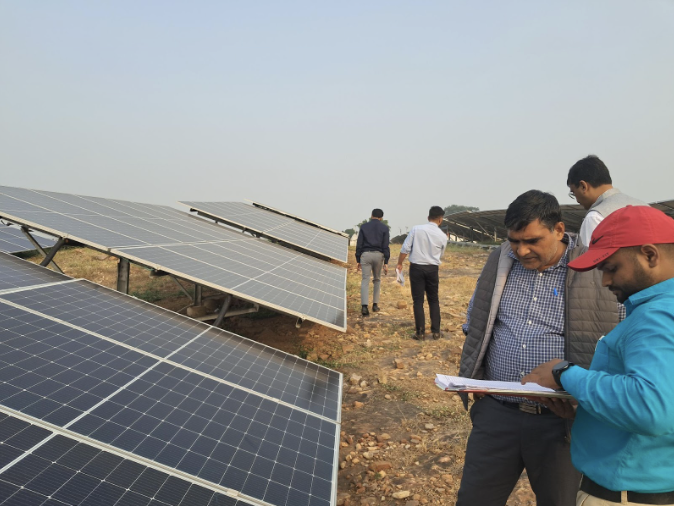
Component A plant in Jat Behror, Rajasthan. Credit: Authors.
The scheme offers a fiscally prudent and politically feasible pathway, reducing discom losses, lowering the subsidy burden, and providing farmers with reliable, clean daytime power.
Maharashtra, for instance, expects to commission 16 GW distributed solar capacity by 2026 to solarise its agri-demand, which could:
Yet implementation remains uneven. Table 1 shows that while Component B has seen relatively strong uptake, with two-thirds of the sanctioned capacity installed, the rest of the components have yet to take off, even six years into the scheme.

Based on the Council on Energy, Environment and Water (CEEW)’s consultations with different stakeholders—discoms, the Ministry of New and Renewable Energy (MNRE), State Nodal Agencies (SNAs), farmers and developers—the following bottlenecks emerged:
States such as Madhya Pradesh, Maharashtra, and Rajasthan have already taken progressive steps to address some of these issues through targeted initiatives.
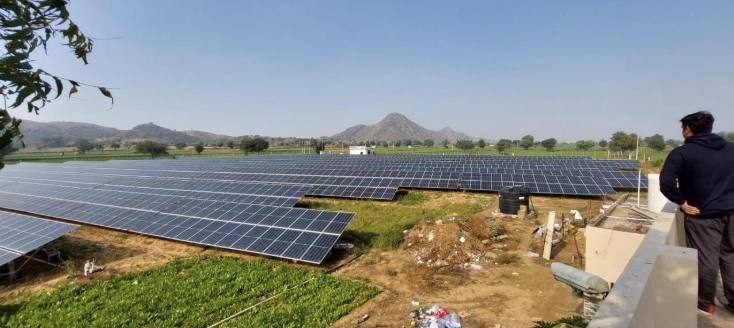
From a field visit to a Component C plant in Madhya Pradesh which faced multiple grid related challenges. Credit: Authors.
Table 2 outlines how Maharashtra, Rajasthan, and Madhya Pradesh are pushing agricultural solarisation to accelerate project commissioning under Components A and C under both PM-KUSUM and state schemes. These initiatives aim to address land, credit, commissioning, and grid-related challenges in a structured and state-led manner. They also offer important lessons for other states to adapt to their context and overcome scheme implementation hurdles.
Agricultural solarisation under PM-KUSUM has the potential to cut discom losses, ease subsidy burdens, improve farmer incomes, and decarbonise rural electricity supply, but its mainstreaming demands structural change in how it is implemented. Central guidelines must give way to state-led design and delivery that reflects local realities in land availability and readiness of the distribution grid. Additionally, tariff-setting processes must be recalibrated to reflect the economics of decentralised solar so that they are viable for developers and farmers. This will require deeper coordination between regulators, discoms, and implementing agencies, alongside a deliberate shift in farmer engagement from sporadic outreach to sustained engagement.
At the same time, to address grid integration issues, additional investment will be required for substation upgradation through improved convergence with other schemes such as the Revamped Distribution Sector Scheme (RDSS). Finally, financing must become more accessible and blended, particularly for small farmers and local developers, through concessional credit, guarantees, and payment security mechanisms. If these shifts occur, agricultural solarisation can evolve into a central pillar of India's tariff reform and rural energy security, turning from a subsidy challenge into a catalyst for cleaner, more resilient growth in the farm sector.
Bharat Sharma is Programme Associate, Richik Bandyopadhyay is Senior Engagement Associate and Disha Agarwal is Senior Programme Lead at the Council on Energy, Environment and Water (CEEW).