Council on Energy, Environment and Water Integrated | International | Independent

Problem: Climate extremes are worsening gaps in access to safe water and sanitation, disproportionately increasing risks, time burdens, and dignity losses for women.
CEEW analysis: With over 40 per cent of Indian districts facing high to very high climate-induced water, sanitation, and hygiene (WASH) risk, climate-resilient infrastructure is critical for equitable access.
Recommendation: Strengthen gender-responsive and climate-resilient WASH by improving gender-disaggregated data availability, undertaking hyper-local risk assessments, and embedding women in decision-making processes to reduce risk.
The brunt of inadequate drinking water, sanitation, and hygiene (WASH) services is borne disproportionately by women. Yet the progress on Sustainable Development Goal (SDG) 6 targets on WASH is unsatisfactory. As of 2024, 2.2 billion people across the globe lacked access to safely managed drinking water services, and 3.4 billion people lacked safely managed sanitation (Figure 1). In households without access to improved drinking water sources within premises, women and girls bear the primary responsibility for water collection, travelling long distances to fetch safe water. Climate extremes, such as floods and droughts, further accentuate the challenge of access to safe water and sanitation, making women more vulnerable and at risk.
We explain this complex attribution by taking an example: In 2019, 47 per cent of women in India were exposed to droughts, compelling women to travel long distances to collect water for domestic consumption. This physical toll not only causes significant personal frustrations but also creates an economic opportunity cost, as the time spent fetching water prevents women from engaging in the non-farm labour essential to rural household finances. For example, in India, the estimated cost of lost productivity due to time spent accessing WASH facilities is about INR 10 billion per annum.
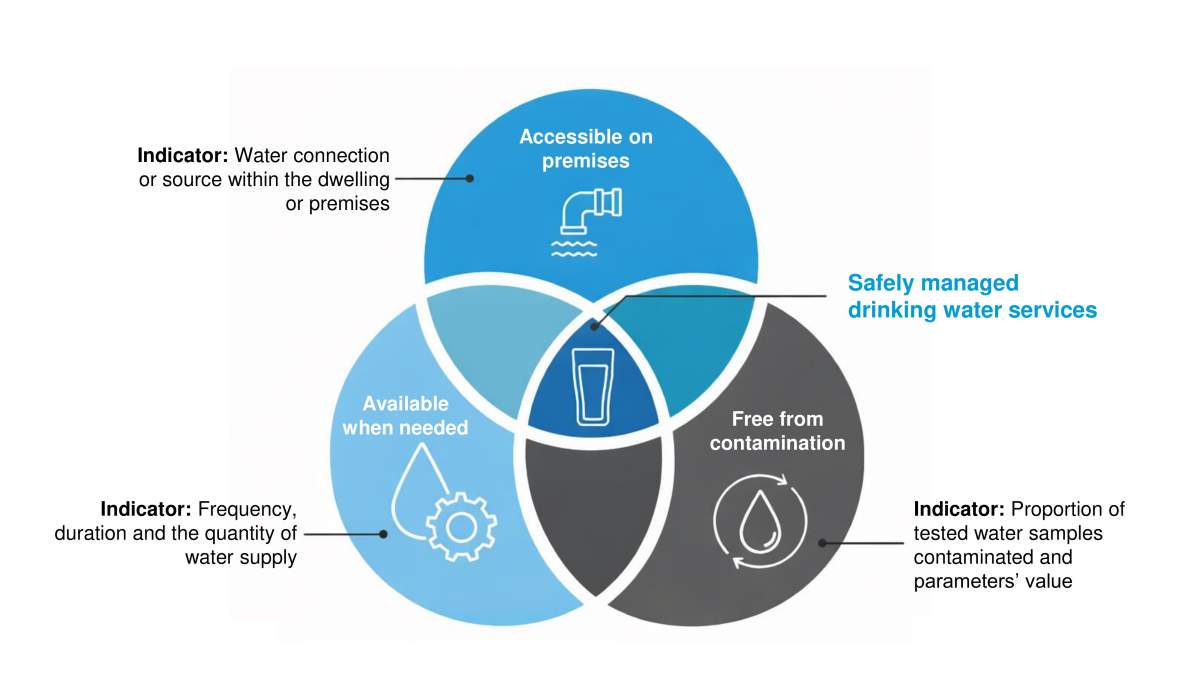
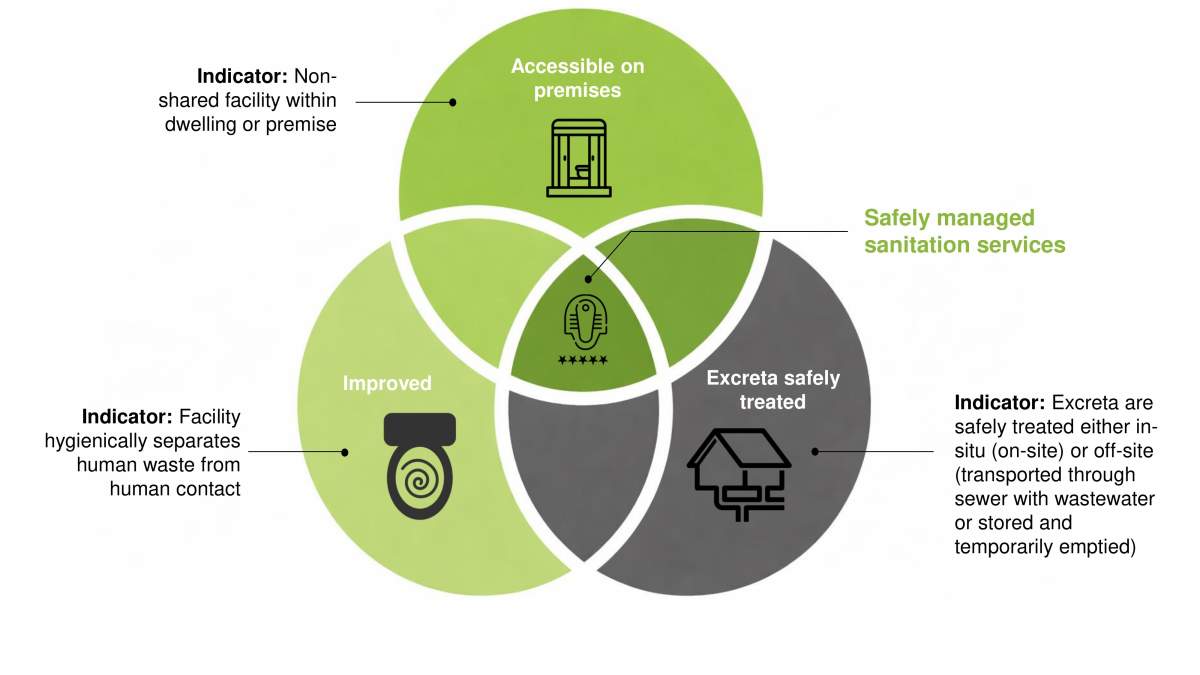
Figure 1. Safely managed drinking water and sanitation services go beyond the improved facilities to include criteria such as accessibility, reliability, and safe treatment
Not surprisingly, the recently agreed-upon 59 voluntary indicators on the Global Goal on Adaptation (GGA) by member states at COP30 in Belem, Brazil, include five specific indicators on WASH (Figure 2), with overall nine water-related indicators, which is the maximum under a particular thematic sector.

Figure 2. The GGA indicators have established a clear linkage between climate adaptation and resilient WASH infrastructure and services
Out of the WASH-related GGA indicators, the government of India has responded to scaling WASH facilities within households through various programmes undertaken in mission mode, such as the Jal Jeevan Mission, Swachh Bharat Mission, and the Atal Mission for Rejuvenation and Urban Transformation. However, these programmes do not explicitly consider how gender and climate change exacerbate unequal access to WASH services. As highlighted in GGA WASH indicators, taking cognisance of such intersectional issues is important for building adaptation and climate-sensitive WASH systems.
India is one of the most at-risk countries for climate change-induced extreme events, including floods, cyclones, and droughts. According to analysis by the Council on Energy, Environment and Water (CEEW), 80 per cent of India's population lives in regions vulnerable to these extreme events.
The increasing frequency and intensity of such extreme events lead to infrastructural and service-delivery failures in the WASH sector, heightening women's vulnerability largely due to physical hardship and financial impacts.
Thus, there is a need to strengthen the WASH sector against climate calamities and their related gendered vulnerabilities. In such pursuits, climate-induced risk assessments are an important first step to identify and prioritise risk hotspots.
In 2024, CEEW conducted a climate-induced risk assessment of WASH, adopting an interdisciplinary lens that combined the hydrological, climatological, social, institutional, economic, health, and gender dimensions. It computed the pan-India risk index to the WASH sector using the Intergovernmental Panel on Climate Change's fifth assessment report (AR5) framework, where risk was determined by the interaction of hazard, exposure, and vulnerability.
After a systematic review of 97 carefully selected studies and consultations with experts, 53 assessment indicators were identified, refined, and adapted to the Indian context, 30 of which helped capture gendered and other vulnerable identities. To ensure a gender-responsive lens, the stakeholder consultations included gender experts, with one-third of the participants being women. These 30 indicators were broadly divided under the categories of hazard (6), exposure (2), and vulnerability (22). Amongst these, the hazard indicators record climate change-induced events like floods, droughts, changes in rainfall patterns, heat waves, and cyclones.
Our findings suggest that more than 40 per cent of districts in India are either at very high or high climate-induced risk to WASH systems. The pockets of very high risk to WASH services are concentrated in nine states that include Uttar Pradesh, Tamil Nadu, Bihar, Telangana, Gujarat, Maharashtra, Punjab, Rajasthan, and parts of Karnataka. The districts in the high-risk category are dispersed among seven states, including Uttar Pradesh, Bihar, Madhya Pradesh, Tamil Nadu, Maharashtra, Telangana, and Gujarat. The most vulnerable were the households having basic access to WASH services, where women play an important role in ensuring domestic water security.
Such a hyper-local assessment provides granular-level information for designing interventions to strengthen WASH systems and for prioritising regions that need more attention and resources. These efforts will not only improve SDG 6 targets on WASH but will also contribute to the attainment of SDG 5 on gender equality, SDG 10 on reduced inequality, and SDG 13 on climate action.
Interdisciplinary climate-induced risk assessments need to be mainstreamed across all administrative levels, i.e. country, district, sub-district, and village or city. These assessments, when determined by various socioeconomic factors such as gender, class, and caste, will help guide the appropriate allocation of resources and budgets to priority regions where risk is high to very high. This, in turn, would help build the climate resilience of the WASH sector and address the multifaceted challenges faced by women.
Strengthening datasets is fundamental to the successful implementation of such granular risk assessments. The following points exemplify the need for reliable data at the micro level.
For WASH services to be truly gender-responsive across all geographies, meaningful participation of women and girls must be ensured in governance and decision-making. Such engagements become even more important in the context of climate change, as the differential burden on women’s access to WASH in the changing climate makes their representation essential for developing effective, climate-resilient WASH solutions that address the specific gendered impacts.
Gujarat demonstrates how gender-inclusive institutional reforms are operationalised at the grassroots level. During our field visits, we discovered that women-led self-help groups (SHGs) were actively engaged in strengthening WASH-related activities, including the collection of water user and sanitation charges, sensitising villagers on timely user charge payments and water conservation, and identification and reporting of leakages in the water distribution network to gram panchayats. These efforts have contributed to more efficient and accountable water service delivery and have also encouraged greater participation of women within the community.
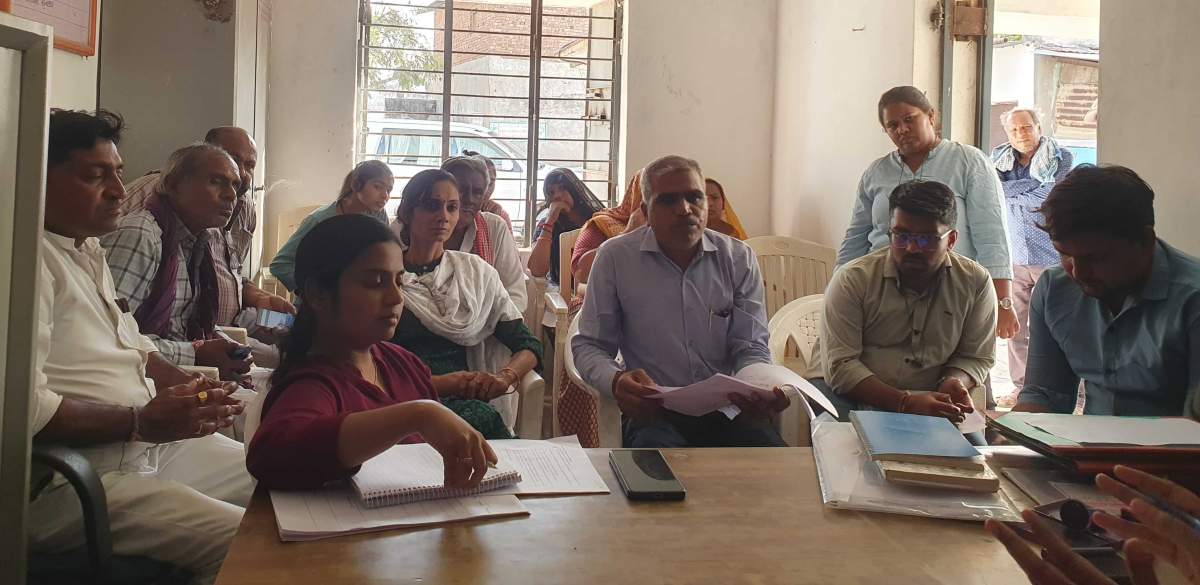
CEEW’s Soorya K. K. (left) with the village's ex-sarpanch and SHG members discussing their roles in water supply management in a village of Mehsana district, Gujarat.
India has already mandated that women's representation in Panchayati Raj Institutions (PRIs) should be at least one-third of the seats. Over time, recognising the need for greater inclusivity, 20 states in India, including Gujarat, increased this provision to 50 per cent. The Gujarat Panchayat Act, 1993, has also mandated that one-tenth of the total seats in PRIs shall be reserved for socially and educationally backward classes, of which nearly half shall be reserved for women belonging to these classes. This is an encouraging move as it provides a platform for women to have their voices heard.
Gujarat even leads in promoting women’s representation in pani samitis. Pani samitis, also called village water and sanitation committees, are institutions constituted by gram panchayats to plan, implement, manage, own, operate, and maintain the village water supply system. The Government of Gujarat launched the Mukhya Mantri Mahila Pani Samiti Protsahan Yojana in 2014, wherein an incentive of INR 50,000 is given to 150 mahila pani samitis—samitis that have at least 70 per cent female members—each year. Such initiatives help encourage women’s participation in local water governance and, notably, as of 2025, the state has around 500 pani samitis with 100 per cent women membership, while over 1,900 pani samitis have women constituting more than 70 per cent of their membership. To fully leverage the power of these opportunities, deeper fundamental reforms are needed in the social fabric, such as promoting gender equality through education curricula or gender budgeting across development schemes, including climate-resilient and safely managed WASH systems.
Soorya K K is a Research Analyst and Ekansha Khanduja is Programme Lead at the Council on Energy, Environment and Water (CEEW). Send your comments to soorya.kk@ceew.in.