In brief
-
Context: For the successful transition from diesel to zero-emission trucks, logistics service
providers (LSPs) must be brought into conversation with the clean freight market.
-
CEEW’s Analysis: High upfront costs, limited vehicle models and inadequate charging
infrastructure reveal the gap between market offerings and operational needs.
-
Way Forward: Simplifying ZET ownership, fostering industry partnerships, and launching
pilot initiatives can ease LSPs into adopting and accelerating the ZET transition.
Despite comprising only 2–3 per cent of India’s total vehicle stock, predominantly diesel- powered medium and heavy-duty trucks (MHDTs) contribute to nearly 70 per cent of greenhouse gas and particulate matter emissions. This disproportionate environmental impact necessitates the transition to zero-emission trucks (ZETs), which could cut CO₂ emissions by up to 70 per cent by 2050 and reduce lifetime fuel costs by 46 per cent. Recognising this potential, India has designated ten highway corridors for ZET adoption, supported by the PM Electric Drive Revolution in Innovative Vehicle Enhancement (PM E- DRIVE) fund.
Besides truck drivers and the government, logistic service providers (LSPs) play a pivotal role in this transition. India’s highly fragmented trucking sector—with nearly 30 million small fleet operators, each owning just one to five trucks and comprising about 80 per cent of the industry—relies heavily on LSPs for coordination and fleet management. Given their influence on operational and procurement decisions, it is important to understand and respond to the needs and demands of LSPs. Yet, any conversation with LSPs must be grounded in market reality.
How do LSPs perceive ZET adoptions?
To gauge the attitude of LSPs towards the adoption of ZETs, researchers from the Council on Energy, Environment and Water (CEEW) surveyed 100 LSPs along the Delhi-Agra highway (NH44), assessing their needs, preferences, barriers, enablers (human resources and socioeconomic parameters) and policy expectations.
The survey provided critical insight into the uncertainty surrounding ZETs. Nearly three- fourths of LSPs were either opposed or hesitant towards ZET adoption, with only the remaining 19 per cent expressing readiness to adopt ZETs in the next three years. Several key issues prevent an enthusiastic ZET transition.
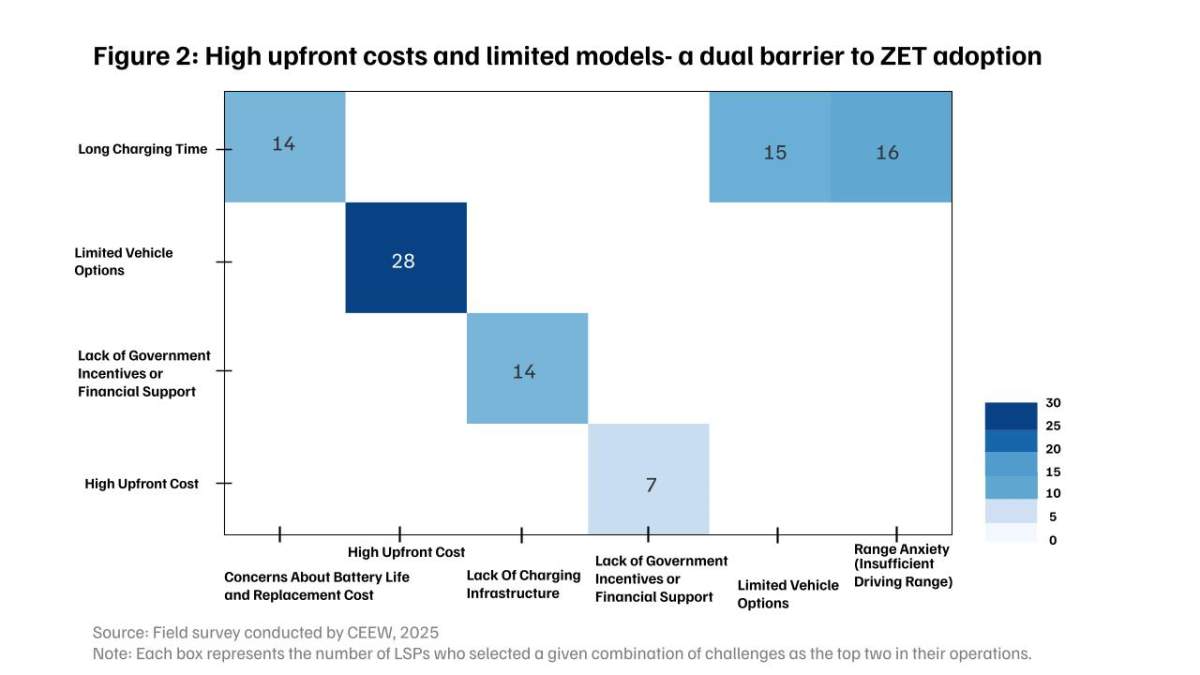
High upfront costs and limited suitable models create mutually reinforcing barriers for LSPs. Beyond upfront costs, over one-third of LSPs highlight better highway charging infrastructure as one of the most critical supports required for ZET adoption. Long charging time, range anxiety, and insufficient government incentives further exacerbate the demotivation (Figure 2). There are no straightforward solutions to the intertwined challenges of technological reliability, usability and infrastructure, and the situation becomes even more complex once market realities come to play.
Is there a misalignment between LSP preferences and market expectations?
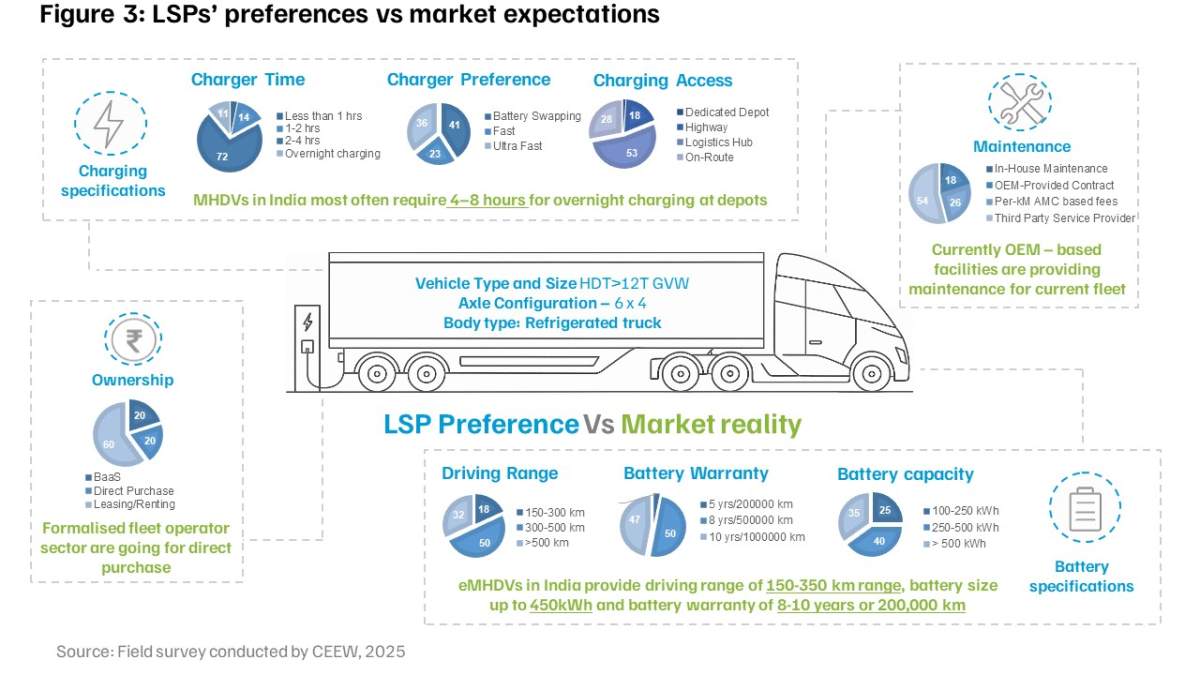
When asked about their current expectations for electric vehicles (Figure 3) as a prerequisite for fleet transition, the responses of LSPs reveal the following misalignments between market offerings and operational needs:
- High battery range and warranty expectations
50 per cent of LSPs expect a travel range of 300–500 km. To support this, 75 per cent prefer battery capacities above 250 kWh, with 40 per cent specifically seeking 250–500 kWh, and others want even higher capacities. The existing e-MHDT models in the market fall short of these expectations, offering a range of 150–350 km with battery capacities up to 450 kWh.
Reliability matters as well—half prefer an 8-year/500,000 km warranty, with some even favouring 10 years or 10 million km, highlighting their need for longer lifetime and extended warranty period compared to the current warranty of 6 years or 6 million km.
- Fast and accessible charging infrastructure
72 per cent of LSPs prefer charging times of 2–4 hours, pointing to a strong demand for fast-charging infrastructure, compared to the current 4–8 hours of charging at depot stations or logistics hubs. While over half favour charging at logistics hubs, 46 per cent prefer in-transit or en-route options, such as public highway stations. 41 per cent are open to battery swapping. As for charging power requirements, 45 per cent prefer 200–350 kW, while 43 per cent prefer options above 350 kW.
- Features and capabilities that reflect real operational needs
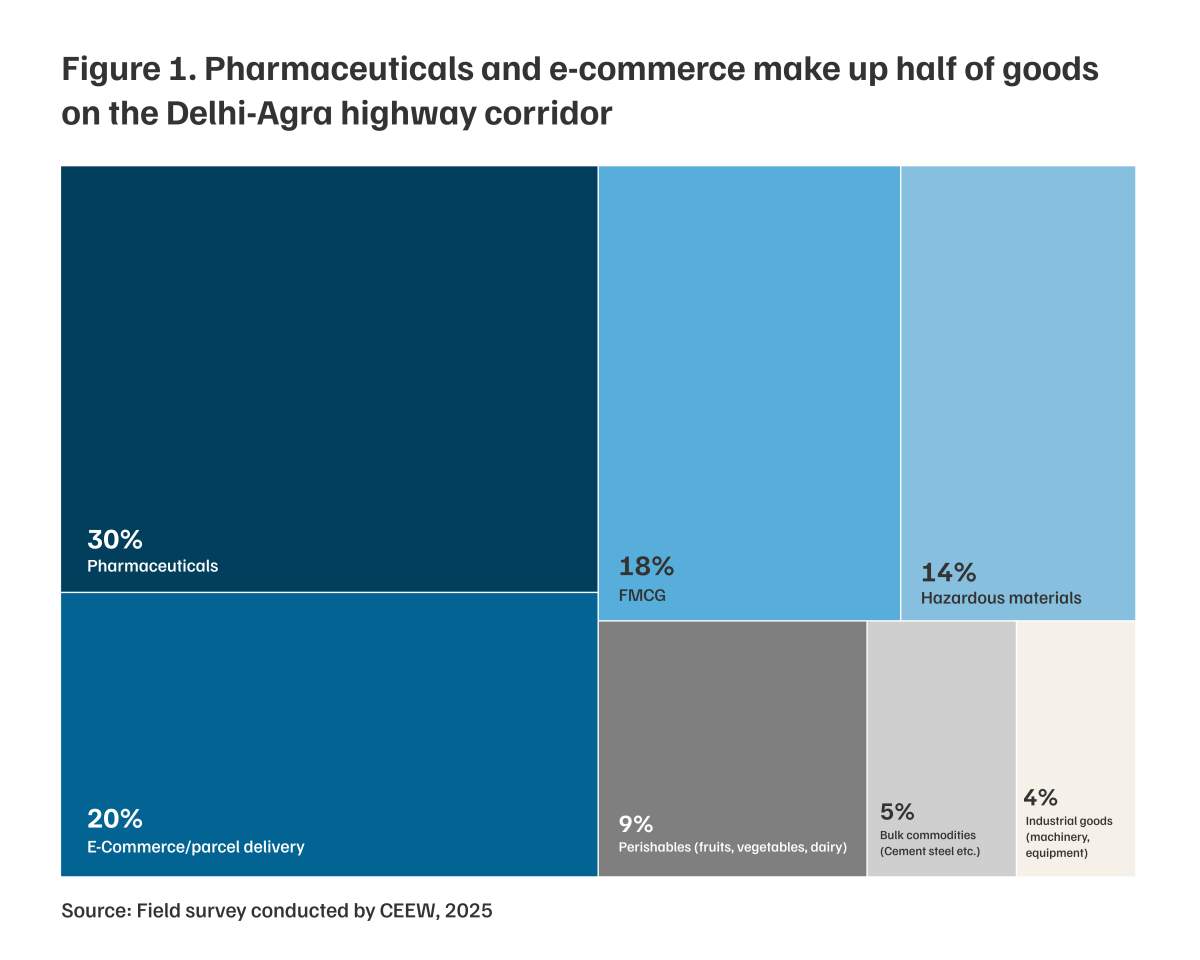
Over half of LSPs want heavy-duty trucks with 6x4 configurations and 12,000 kg payloads. 65 per cent prefer refrigerated trucks, in line with 52 per cent of the cargo being perishables or pharmaceuticals (Figure 1). However, the market primarily offers lower-payload electric trucks in the heavy-duty segment, with limited options for cold-chain logistics. There is a need for customizable options that are suited to LSP requirements.
What can be done to bridge the gap and facilitate a smooth transition?
- Lowering upfront costs and making ownership easier through flexible and asset-light ownership models: Considering battery accounts for 83 per cent of an electric truck’s total upfront cost, alternative ownership models like Battery-as-a- Service (BaaS) and battery swapping present significant opportunities. Around 60 per cent of LSPs favour leasing or renting options, which can be complemented by building strategic partnerships with manufacturers or fleet operators to share capital costs, spread operational costs, and lower maintenance costs. These models offer greater flexibility, easier technology upgrades, and lower capex. When paired with reliable warranties and service, they can help build confidence and accelerate ZET’s adoption.
- Building the charging infrastructure along highway corridors through partnerships: An effective charging infrastructure needs wider coverage, higher charger capacity, improved accessibility and enhanced reliability. The PM E-DRIVE scheme allots ₹346 crore for supporting development of Combined Charging System II (CCS-II; min 240 KW) fast-charging charges along highway corridors, but excludes cost-effective options such as retrofitting or upgradation. Likewise, placing chargers at existing stations or Oil Marketing Companies (OMCs) can cut land costs, capitalise on existing amenities and enhance accessibility.
- Pilot electric trucks along predictable routes with recurring demand: Pharmaceuticals, FMCG, and perishable goods comprise over half of the freight moved across the Delhi–Agra highway corridor. These commodities are typically less bulky, time-sensitive, and are moved in high volumes, making them ideal for electric trucks. Our survey also echoes this, with refrigerated and agro-logistics emerging as strong candidates, validating the need for ZET pilots in these segments. Use-cases characterised by predictable routes, high utilisation rates, and recurring nature of trips, especially 6×4 configuration HDTs, must be prioritised.
- Industry collaboration for innovation: To scale ZETs, OEMs must lead collaborative partnership investments (e.g. REEL-Milince and ElaadNL) to build hubs, and promote standardisation and interoperability. Battery and charging companies also play a key role, as shown by ChargeZone–Tata and Jio–BP tie-ups. There is a need for systemwide efforts to leverage India’s IT and digital infrastructure to synthesise travel demand, freight movement models, Global Navigation Satellite System (GNSS) tolling, and Unified Logistics Interface Platform (ULIP) framework. This can support smarter, data-driven planning to build India's ZET charging infrastructure in future.
The transition to zero-emission trucking will be defined by both technology and confidence. These come from dependable warranties, predictable performance, and accessible charging along India’s freight arteries. By fostering partnerships across government, industry, and technology players, India can decarbonise its freight sector while also building a resilient logistics backbone that supports sustainable economic growth. Empowering LSPs to lead this shift can transform zero-emission trucks from a climate ambition into a commercial reality: making clean freight not just possible, but profitable.
Shubhi Vaid is Research Analyst, Ritika Sen is Research Analyst and Neerav Sharma is Programme Associate at the Council on Energy, Environment and Water (CEEW).








Add new comment