Council on Energy, Environment and Water Integrated | International | Independent


Context: The Delhi government has mandated the installation of anti-smog guns on high-rise buildings to control road and construction dust.
CEEW Analysis: An assessment of around 58,000 buildings finds limited coverage on Delhi roads, high costs and poor alignment with pollution hotspots.
Key Insight: Anti-smog guns can only serve as supplementary tools, not substitutes for systemic dust-control measures.
Recommendations: Delhi must prioritise building a robust and effective dust pollution mitigation system by analysing operational costs, PM reduction efficiency and logistical challenges.
For the first time, Delhi has a comprehensive Air Pollution Mitigation Plan for 2025 that outlines a wide range of strategies across sectors. Among these measures is a set of actions focused on managing road dust and resuspension. The plan recommends using sprinklers, portable anti-smog guns, and mechanical road sweepers to reduce resuspended dust, particularly PM10.
Among dust mitigation technologies, there is limited evidence on the effectiveness of the anti-smog gun (ASG) technology. These guns spray fine, nebulised water in the form of mist through high-pressure propellers into the air, creating a rain-like effect. This process increases the mass of suspended air particles, causing them to settle down. It is similar to how rainfall brings down pollutants and clears the sky, but in this case is limited only to the area where water is sprayed. Here, we discuss whether anti-smog guns are effective in Delhi winters, given their high operational and maintenance cost.
There are two types of anti-smog guns: those equipped with coarse nozzles, which are typically used at construction sites, and those with finer nozzles, which are more effective for controlling airborne particles in urban areas. In urban anti-smog guns, water is utilised at a rate of 40 to 250 litres per minute and has a throw distance range between 30–100m, covering an area of 27000–31000 sq.m.
During the winter months, when the ASGs would primarily be in use, road dust accounts for about 15 per cent of ambient PM2.5. However, the recent report on the National Clean Air Programme (NCAP) spending shows that around 64 per cent of the available funds are allocated to road dust mitigation. Recently, Delhi has also invested around INR 13.53 Cr. in road dust-related measures, much of which goes towards procuring technologies like ASGs, mechanical sweepers, etc. Given their high operational and maintenance costs, these measures must undergo rigorous scientific evaluation, particularly in view of the ongoing focus on dust control.
On 29th May of this year, the Delhi government’s Department of Environment and Forests passed administrative orders that mandated the installation of anti-smog guns on high-rise buildings—commercial complexes, malls, hotels, office buildings, and educational institutions—with a height of G+5 floors and above or exceeding a built area of 3,000 sq.m. It is important to highlight some key aspects of these orders. Anti-smog guns are intended to “suppress dust, which is the dominant source of air pollution in Delhi.” It further states that “the use of anti-smog guns has been recognised as an effective measure for suppressing airborne dust and particulate matter,” and that large-scale replication of such systems “could have a favourable impact on air quality.” It also emphasises that “anti-smog guns thus play a feasible role in managing localised air pollution.” However, while anti-smog guns could be one of the several measures the city needs to reduce air pollution, these should not be the primary choice.
The Council on Energy, Environment and Water (CEEW) evaluated the potential number of facilities and costs associated with the deployment of anti-smog guns and other such devices at the scale envisioned in the May order. This preliminary analysis could be considered alongside scientific evidence on the efficacy of these interventions before mandating large-scale implementation.
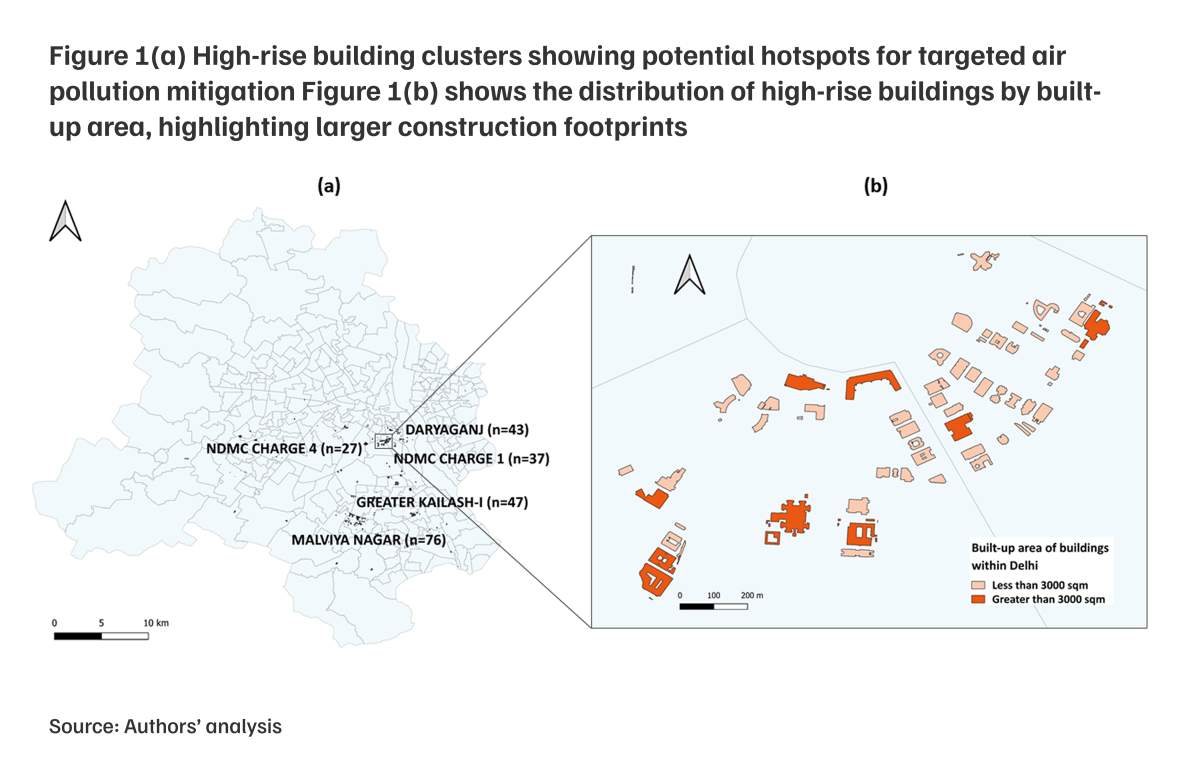
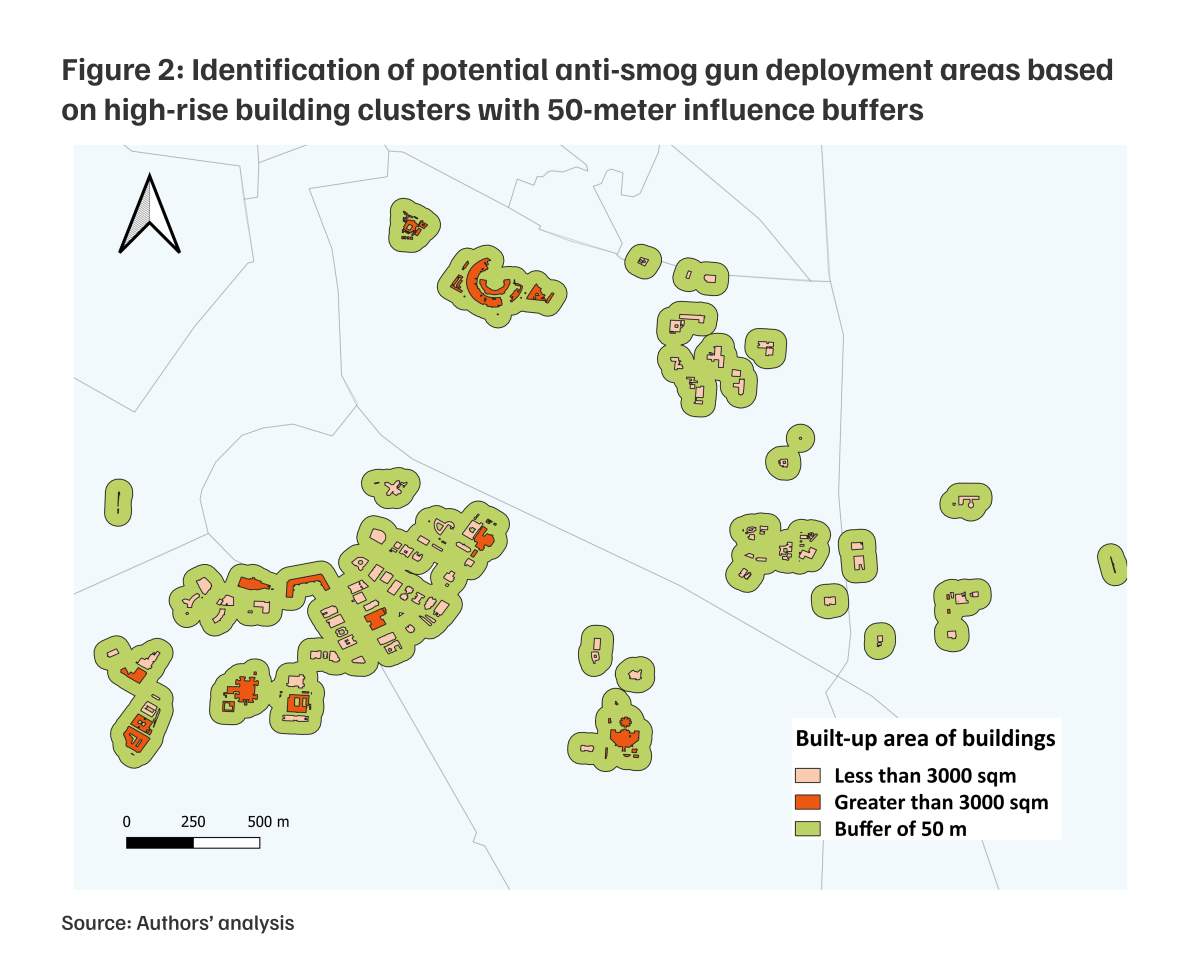
Based on our analysis, there are ~58,505 buildings (both residential and commercial) across New Delhi. Applying filters based on building classification (as per the draft master plan) and height (G+5 and above), 452 buildings qualified as high-rises under the directive. Based on the guidelines issued for the specific numbers of anti-smog guns to be installed, we identified at least 84 to have a built-up area of 3,000 sq.m. or more. However, this number likely represents a lower bound, as some premises may collectively exceed the 3,000 sq. m threshold but are registered as individual buildings, creating uncertainty about how the directive’s criteria apply.
The building clusters and their coverage highlight major spatial gaps
Beyond coverage and efficacy, the anti-smog gun mandate could also face several on-ground challenges:
To ensure that dust-control technologies deliver cost-effective results, Delhi should adopt a transparent and standardised evaluation framework of these available technologies. The framework could include the following criteria:
Technologies with simpler, more robust operational requirements—and lower risk of misuse or neglect—should be favoured. Monitoring systems and institutional accountability reforms also remain important enablers but should be assessed separately, as they are not pollution-mitigation technologies themselves. The priority for technology deployment should be clear: invest in solutions that deliver the greatest and most reliable PM2.5 reductions per unit cost with minimal operational friction.
Delhi’s commitment to cleaner air is commendable, but real impact demands targeted, optimised, and evidence-based solutions. Unless the city strikes a balance between intent, impact, infrastructure, and institutional readiness, these measures risk falling short or even exacerbating other challenges. Prioritising long-term investments and accountability will ensure that pollution control efforts are not just visible but also effective.
Arpan Patra is a Programme Associate, Mohammed Sahbaz Ahmed is a Research Analyst, and Karthik Ganesan is a Fellow and Director, Strategic Partnerships at the Council on Energy, Environment and Water (CEEW).