Council on Energy, Environment and Water Integrated | International | Independent

Suggested Citation: Rahman, A., Sharma, B., Mallik E V, Tunga, A., Bandopadhyay, R., Chandra, H., Jha, A. K., Dutta, P., Garg, R., & Agarwal, D. 2026. Scaling Solar Power for Irrigation in India: Lessons from PM-KUSUM Components A and C-FLS. Winnipeg: International Institute for Sustainable Development.
India's Pradhan Mantri Kisan Urja Suraksha evam Utthaan Mahabhiyan (PM-KUSUM) scheme, launched in 2019, set out to expand solar-powered irrigation, increase farmers' income by enabling them to become energy producers, and reduce agricultural power subsidy burdens on states. Its cumulative target of ~35 GW of solar capacity by March 2026 sits at the intersection of India's rural electrification goals and its national target of 500 GW non-fossil capacity by 2030.
Components A and C-FLS — covering decentralised solar power plants on farmers' land and feeder-level solarisation of existing grid-connected agriculture pumps — are the most innovative and complex elements of the scheme. Yet as of December 2025, they have achieved only 7% and 34% of their targets respectively. A research consortium of IISD, CEEW, and CSTEP conducted extensive fieldwork across Madhya Pradesh, Rajasthan, Tamil Nadu, and Karnataka — visiting 11 solar plant sites, surveying ~20 developers, and consulting individually with 30 developers, 40 farmers, and 30 government officials — to understand why, and what can be done.
This report distils the key barriers, state-level innovations, and actionable recommendations to strengthen PM-KUSUM's remaining phase and inform the design of future solar irrigation schemes in India and comparable agrarian economies worldwide.
The Government of India introduced the Pradhan Mantri Kisan Urja Suraksha evam Utthaan Mahabhiyan (PM-KUSUM) scheme in 2019 to expand access to solar-powered irrigation, increase farmers’ income by enabling them to become solar energy producers, and reduce the agricultural power subsidy burden on states. The scheme aims to add cumulatively about 35 GW of solar capacity by March 2026 , contributing to the national target of 500 GW of nonfossil capacity by 2030. The scheme has three components:
Components A and C-FLS are novel in their design and generated much interest among states due to their potential economic and social benefits. However, both components have suffered low uptake, with only 7% and 34% achievement, respectively, against targets. A consortium of the Council on Energy, Environment and Water (CEEW), the Centre for Study of Science, Technology and Policy, and International Institute for Sustainable Development (IISD) has been working to identify and overcome barriers to the implementation of these two components.
This report summarizes key learnings from offering technical assistance in Madhya Pradesh, Rajasthan, Tamil Nadu, and Karnataka. Research in this report is based on solar plant visits, surveys with developers, individual consultations with 30 developers, 40 farmers, and 30 government officials across the key states and focuses on
Our research revealed strong benefits for power distribution companies (DISCOMs), farmers, and governments from implementing PM-KUSUM. Surveys and engagements show farmers benefiting from a reliable daytime power supply through solarized feeders. Farmers who leased their land for solar power plants received an average of INR 30,000 per acre in annual income; landowners who invested in developing solar power plants received an estimated average return of 11%–16% on investment. We quantified benefits to states and DISCOMs from solarizing agricultural demand through a tool called the Tariff Analysis and Cost-Benefit Tool for Solarizing Irrigation (TACTS). For example, Rajasthan was projected to save INR 2,543 crores in 25 years (on a net present value [NPV] basis) from solarizing 10% of its demand due to lower power purchase costs. To bring these numbers into perspective, these savings are equivalent to 12.47% of the state’s agricultural subsidies for the financial year (FY) 2022–23. Evidence of such benefits is already emerging from Maharashtra, where the DISCOM forecasts a reduction in power procurement costs in the coming years. PM-KUSUM is also creating employment benefits—studies estimate 4.32 full-time equivalent jobs per MW, suggesting approximately 31,872 jobs from installations to date under Components A and C-FLS.
PM-KUSUM is set to conclude in March 2026, and the Union and state governments are deliberating on the shape of the next phase, alongside the possibility of new state-led initiatives. While overall deployment has fallen short of targets, deployment has sharply accelerated in the past 2 years, with more than 40 GW of capacity tendered under the two components. State-level experiences point to a steep learning curve, with several states scaling up implementation.
A critical implementation challenge in PM-KUSUM is that it introduces a new business model. Traditionally, DISCOM’s solar power procurement involved either utility-scale solar plants or rooftop solar plants. But PM-KUSUM is different. The capacity of individual PMKUSUM plants sits between the two—smaller than typical ground-mounted plants, but much larger than typical rooftop plants, requiring high capital investment. While these plants resemble utility-scale projects in terms of procedural requirements, such as land identification and right-of-way clearances, having to undertake these processes for every project substantially increases logistical costs on a per-megawatt basis. Consequently, established players from both rooftop and utility-scale segments are not easily attracted to PM-KUSUM.
For DISCOMs, the processing of PM-KUSUM applications resembles rooftop solar, involving a large number of small projects that require speedy application processing. At the same time, the points of injection of these plants are the rural distribution grid, which is technically weak and sometimes unstable in many states, unlike transmission-connected utility-scale solar or relatively robust urban networks typical for rooftop systems. Thus, PM-KUSUM requires DISCOMs and state administrations to fundamentally rethink their internal processes and grid operations.
The following section outlines the key barriers and recommends solutions that policy-makers can consider to maximize benefits under PM-KUSUM and for the design of future programs.
Barrier: Scheme design constraints
Consultations revealed that constraints on plant size, grid connections, and tendering requirements hindered state and developer interest. The distinction between models Component C-IPS and C-FLS itself restricts states to specific models.
| Solutions | Agents |
|---|---|
| Rationalize the grid components into a single broad and flexible component with defined core objectives, allowing states ample room to experiment with different models. | Ministry of New and Renewable Energy (MNRE) |
| Encourage states to innovate and tailor the scheme to local circumstances by providing greater flexibility; provide advisories and cross-learning rather than prescriptive guidelines. | MNRE |
Barrier: Low awareness and confusion about the scheme among farmers
Our survey showed limited awareness of the scheme among farmers due to poor outreach by the states and confusion about the components due to its nonintuitive naming.
| Solutions | Agents |
|---|---|
| Adopt component names that reflect the underlying objectives. It would be even more helpful if MNRE could enable and encourage states to adapt the components' names to local languages. | MNRE and state governments |
| Incentivize states to use their agricultural knowledge and extension service network to reach out to farmers. | MNRE and state governments |
Barrier: Tariff viability
Improving tariff viability for developers is among the easiest measures states can take to accelerate the scheme. Our tariff analysis of 66 State Electricity Regulatory Commission (SERC) orders shows a mismatch between SERC calculations and market conditions in four key parameters—capital cost, operations and maintenance (O&M) costs, land lease rent, and grid availability.
| Solutions | Agents |
|---|---|
| Adopt competitive bidding without a ceiling tariff wherever possible. Solar tariffs are already very competitive compared to other sources and may no longer need to be capped. | Forum of Regulators and SERCs |
| Link tariffs to robust market data if the states prefer prefixed tariffs. Allow for locational and temporal variations by indexing the tariff to a reputable data set. The TACTS tool can help in understanding the variations. | SERCs |
Barrier: Access to finance and high capital costs
Financing was cited as a key barrier, especially for new entrants and small developers. Financiers perceive a multitude of risks with PM-KUSUM projects, including lower creditworthiness of developers, project-related risk, and non-payment of bills by DISCOMs
| Solutions | Agents |
|---|---|
| Reduce risk through partnerships between public and private banks, multilateral development banks or green finance institutions to create dedicated funding windows for PM-KUSUM and guarantees. | State governments |
| Leverage interest subvention schemes like the Agriculture Infrastructure Fund and other state-level incentives for MSMEs. | MNRE and state governments |
| Operationalize payment security instruments like letters of credit or payment guarantee corpus funds to ensure timely payment to developers. | State governments and DISCOMs |
| Simplify and automate bill payment procedures through the use of digital tools and make it more transparent. | State governments and DISCOMs |
Barrier: Identification and access to suitable land
Land identification for solar plants and right of way (RoW) for the evacuation infrastructure have been significant bottlenecks for components A and C-FLS in several states. Developers face outdated land records, delays in approvals, constraints in land leasing regulations, and RoW. Several states experimented with initiatives to facilitate access, but had mixed success. Alternative low-cost methods like Geographic Information System (GIS)-based land identification have gained some interest from states.
| Solutions | Agents |
|---|---|
| Reform land leasing laws to promote models suited for solar power deployment, such as longer tenures and dual use of lands (agrivoltaics), and evaluate whether regulations that prevent conversion of agricultural land are still useful. | State governments |
| Streamline land-use diversion regulations by simplifying the application procedure and mandating time-bound decisions on the applications. | State governments |
| Create a land bank of approval-ready government lands, e.g., through a web-based portal. | State governments |
| Integrate data-driven tools such as the GIS-based land identification (prototype) developed by the consortium. | State governments and DISCOMs |
Barrier: Poor institutional coordination
The DISCOM is the most important actor in implementing grid-connected components. In several states, the targets have been pushed onto the DISCOM without their involvement in the design phase, leading to a lack of ownership and failure to integrate into planning. In some states, bureaucracies were unable to cater to the high volume of applications, many from new entrepreneurs.
| Solutions | Agents |
|---|---|
| DISCOMs should be the lead implementing agency, except under exceptional circumstances, with PM-KUSUM grid components embedded in power planning. | MNRE and state governments |
| Streamline administrative approvals, such as through a single-window mechanism or standard operating procedures (SOPs) | State governments |
| Institutionalize a coordination mechanism between Union Government stakeholders to converge PM-KUSUM with other schemes and create an enabling tariff and regulatory framework | MNRE, Ministry of Power, and Forum of Regulators |
Barrier: Policy instability and poor communication of policy changes
Policy changes and their communication have impacted the PM-KUSUM scheme several times, including changes in local content requirements and trade duties.
| Solutions | Agents |
|---|---|
| Announce policy changes well in advance, accompanied by transition guidelines to allow developers and states to align procurement and bidding strategies. | MNRE |
| Release scheme-specific advisories on the policy changes, clear communication on scheme extension or phase-out, and publish quarterly domestic content requirement panel availability reports | MNRE |
Barrier: Grid infrastructure
Our engagements suggest that states will increasingly face grid challenges for PM-KUSUM. Rural substations, particularly the ones with high agricultural loads, are prone to frequent voltage fluctuations, supply disruptions, and network loading. Inadequate local reactive power support leads to undervoltage during the irrigation season and overvoltage and reverse power flow during the remaining part of the year. All of these contribute to frequent plant shutdown and generation loss for the developer. Furthermore, although physically segregating agricultural loads has been a focus area for infrastructure upgrade, it has high capital costs and issues like RoW challenges.
| Solutions | Agents |
|---|---|
| Conduct comprehensive grid planning to accommodate decentralized solar plants. Corrective measures include a) undertaking detailed substation-wise hosting capacity assessment and power flow studies, b) adopting a data-driven framework for substation selection, c) improving protection systems at the substation, d) incentivizing the use of decentralized solar plants for reactive power compensation, and e) incentivizing distributed battery storage to reduce reverse flow. | State governments and DISCOMs |
| Optimize feeder segregation approaches for economic payback by exploring alternatives, such as virtual feeder segregation. A pilot in Rajasthan highlights that virtual segregation is scalable, cost-effective, and technically viable. | DISCOMs |
Lessons for Future Scheme for Solarizing Agricultural Power Demand
As the Union and state governments consider a redesign of PM-KUSUM, incorporating learnings from the current scheme remains critical. Any Union Government scheme should be in the spirit of cooperative federalism, where core objectives are defined in the scheme, but operational flexibility and ownership rest with the state. DISCOMs should be at the centre of the scheme with solarisation targets integrated into their transition plans and power procurement planning. Challenges like grid infrastructure and land availability need a systemic response with long-term planning. State governments need to be ready to support solutions to these challenges through appropriate incentive measures like land bank or grid reinforcement plans, and a joined-up approach between different departments.
The Government of India introduced the Pradhan Mantri Kisan Urja Suraksha evam Utthaan Mahabhiyan (PM-KUSUM) scheme in 2019 to promote solar power in the agriculture sector. The scheme has three broad objectives: improving irrigation access through solar-powered irrigation, increasing farmers’ income by enabling them to become energy producers, and reducing the agricultural power subsidy burden on states.
| Component | Objective | Target |
|---|---|---|
| A | Setting up solar plants (0.5–2 MW) on farmers' land to enable additional income for farmers | 10,000 MW |
| B | Installation of 14 Lakh stand-alone solar irrigation pumps | 14 lakh pumps |
| C | Solarization of 35 Lakh existing grid-connected agriculture pumps via
|
35 lakh pumps |
Source: MNRE, 2024.
The components cumulatively aim to add ~34,800 MW of solar capacity by March 2026 (originally slated to end in March 2024 but later extended), with a total Union Government financial support of INR 34,422 crores (MNRE, 2024). As India begins to consider the next steps in solarizing the agricultural sector, it is important to understand the successes and failures of PM-KUSUM. This report aims to provide a comprehensive assessment of the performance and outcomes of two specific components of the scheme—Component A and Component C-FLS. These two components are novel in their design, with many opportunities for innovation, and have generated a lot of interest among states, but their achievements have been relatively limited.
A consortium of the Council on Energy, Environment and Water (CEEW), the Centre for Study of Science, Technology and Policy and International Institute for Sustainable Development (IISD) has been supporting select states in implementing these two components through tailored technical assistance to tackle state-specific barriers while generating insights for DISCOMs and policy-makers. The project also aimed to generate broader, cross-cutting lessons to inform national-level policy. The consortium undertook extensive fieldwork and consultations with different stakeholder groups to assess the on-the-ground implementation of the scheme. These include solar plant visits to 11 sites, surveys with nearly 20 developers, and individual consultations with nearly 30 developers, 40 farmers, and 30 government officials across the key states of Madhya Pradesh, Rajasthan, Tamil Nadu, and Karnataka. The report brings together key observations and learnings from this project.
This report seeks to
• examine the progress and limitations in implementing PM-KUSUM Components A and C-FLS;
• highlight challenges faced by state agencies, developers, and farmers, drawing from evidence from field insights;
• provide actionable recommendations to strengthen governance, operational efficiency, financing, and improve infrastructure and awareness;
• inform the design of a post-2026 scheme architecture that is investment-ready and enables state-specific innovations, fostering a long-term, scalable impact.
Components A and C-FLS promote a relatively nascent model of solar power deployment. Conventionally, solar power plants in India have been integrated into the transmission grid (large-scale solar parks) or the distribution transformers (small-scale rooftop solar systems in urban areas). The two components, however, promote medium-scale (typically 1–10 MW) solar power plants connected primarily to rural distribution substations, thereby distinguishing themselves from other models in both scope and scale. However, due to their potential benefits, such as lowering subsidies and supplying daytime power to farmers, they have gained great interest among state-level policy-makers.
2.1 Component-Wise Achievements So Far
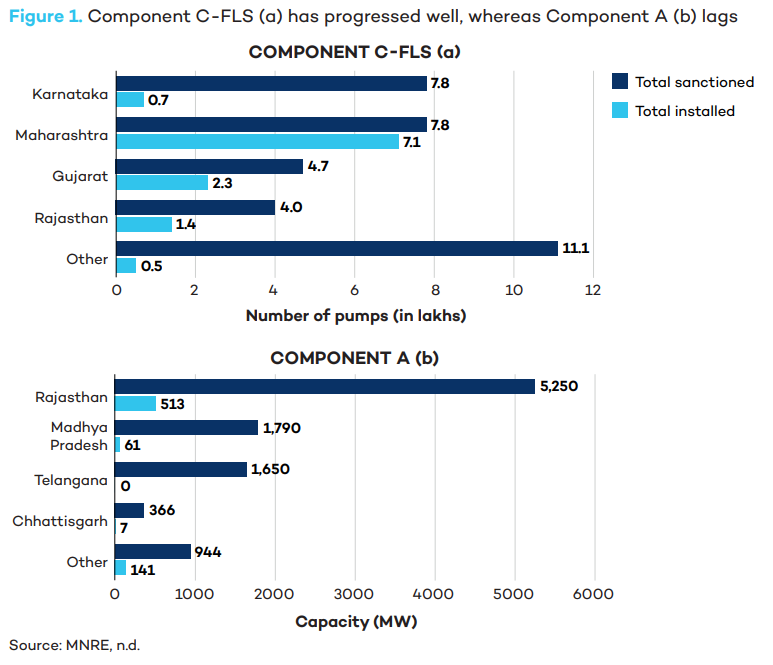
The overall capacity installed under Component A and Component C (FLS) has been far below the intended targets. As of December 31, 2025, 720 MW has been commissioned under Component A against the total sanctioned capacity of 10 GW (7.2% achievement). Component C (FLS) has fared better, with over 11.9 lakh pumps solarized out of 35.6 lakh pumps sanctioned (33.73% achievement). Applying the standard pump size assumption of 7.5 HP, this translates to about 6,658 MW. Progress has been slow in most states. Figure 1 shows the progress in the top states in terms of sanctioned capacity in both components.
2.2 Intended Benefits of Component A and C-FLS
Components A and C-FLS have different objectives. Component A enables farmers to set up renewable energy plants on their land (primarily uncultivated lands, or if it is cultivated, continuing cultivation underneath the panels) and earn additional income. Component C-FLS supports DISCOM in solarizing its agricultural feeders to reduce the burden of providing agricultural electricity subsidies. The flexibility in the two components enables the state to use the two interchangeably to achieve its intended objectives (Rahman et al., 2023). Hence, the intended benefits can also overlap between the components.
There are several key benefits for different stakeholders, including the following:
Farmers
Reliable Daytime Electricity Access
Most states provide power for free or well below the cost of supply to farmers. However, the fiscal burden this subsidy imposes forces states/DISCOMs to limit power supply hours and timing to agricultural connections and often cut back on investments required to maintain agricultural feeders. Across states, farmers face the inconvenience of irregular electricity supply, with power often supplied only during the middle of the night, creating safety risks and reducing productivity, especially for women farmers. Solarizing agricultural feeders ensures a reliable daytime power supply to agricultural connections, enabling farmers to manage irrigation more effectively, potentially enhancing agricultural productivity, their incomes, and overall well-being. A survey in Maharashtra showed that after solarization of feeders in the state, most farmers started receiving a reliable daytime power supply (Nathan et al., 2021).
Improved Incomes
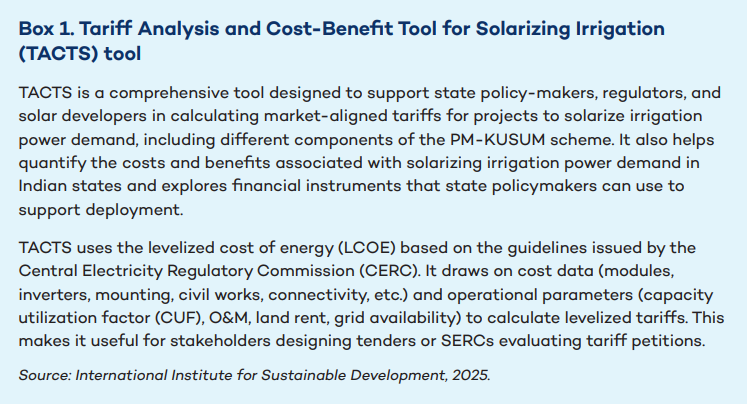
Under PM-KUSUM, farmers with barren or underutilized land can gain new income opportunities in two ways: set up a solar power plant on their land and sell the power to the grid or lease their land to solar developers and earn a land rent. The former is capital-intensive (a 1 MW solar plant costs anywhere between INR 3 crores and 4.5 crores), and we estimated a return on investment (ROI) between 11% and 16% based on the analysis of tariffs in different states (see Table 2). The consortium developed the Tariff Analysis and Cost-Benefit Tool for Solarizing Irrigation (TACTS) tool (IISD, 2025) to analyze the tariff setting for the PM-KUSUM scheme (See Box 1). Under the land lease route, although the income depends upon location, SERC orders indicate an average land lease rate of INR 30,000/acre/year (Madhya Pradesh Electricity Regulatory Commission, 2024; Rajasthan Electricity Regulatory Commission, 2024).
| State | Tariff determined (INR/kWh) | Estimated capital cost during tariff determination (INR crores/MW) | Estimated ROI (%) |
|---|---|---|---|
| Rajasthan | 3.04 | 2.69 | 12.1 |
| Gujarat | 2.95 | 3.20 | 9.7 |
| Haryana | 3.11 | 3.40 | 10 |
| Madhya Pradesh | 3.25 | 3.48 | 11 |
| Uttar Pradesh | 3.1 | 3.20 | 11.7 |
Source: Author's analysis of tariff orders of multiple states. The ROI is calculated based on the TACTS tool developed under the consortium's project.1
Reduced Financial Stress on DISCOMs
Agricultural power subsidies are the largest subsidies in the country. An analysis of tariff orders of 14 key states that account for 86% of national electricity sales shows that in FY 2023, agricultural power subsidies exceeded INR 1 lakh crores.2 Without major reform of agricultural tariffs, this figure will only increase as agricultural power consumption grows.
Solarizing irrigation power through PM-KUSUM offers an opportunity to reduce the power subsidy burden. Power from solar plants is generally cheaper than the average power purchase cost of states. Irrigation, being primarily a daytime activity (in the absence of restrictions on power supply), can consume this solar power without the need for costly energy storage systems. Additionally, decentralized solar plants generating electricity closer to consumption points, especially at the 11 kV substation level, reduce transmission and distribution losses and avoid associated charges. Thus, the deviated quantum of subsidized electricity from distributed plants results in direct savings for both states and DISCOMs, eases their financial burden by reducing power procurement needs, and helps defer costly transmission upgrades (see Box 2).
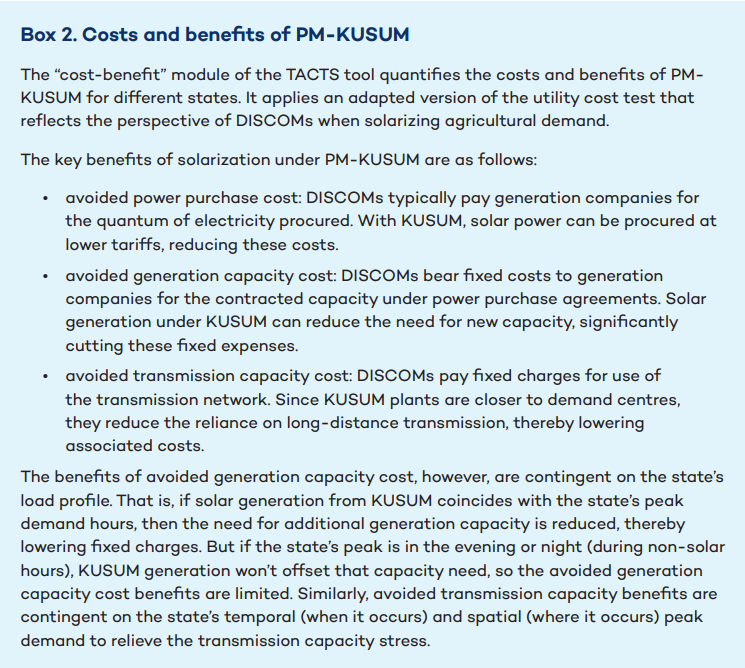
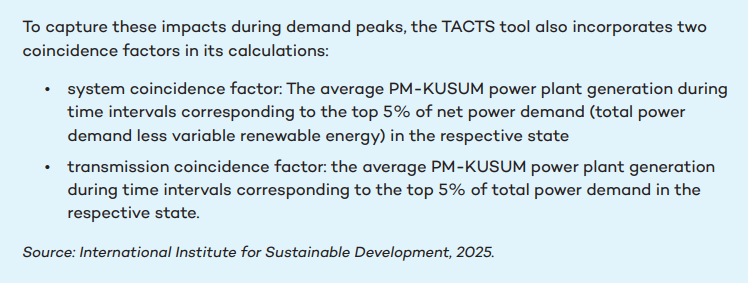
Cost-benefit analysis indicates major savings for different states from PM-KUSUM. For example, by solarizing just 10% of its agricultural demand through grid-connected solarization alone, Rajasthan is projected to see a net benefit of 2,543 crores in 25 years on an NPV basis, whereas Madhya Pradesh sees 6,305 crores. Appendix A estimates the benefits for other states.
The benefits of solarization are already being demonstrated. For instance, in Maharashtra, the DISCOM (Maharashtra State Electricity Distribution Company Limited [MSEDCL]) highlighted in its petition to the SERC that its overall power procurement costs are projected to fall in the coming years following the implementation of PM-KUSUM/MSKVY3 (Maharashtra Electricity Regulatory Commission, 2024). MSEDCL noted that solarization of feeders helps meet its Renewable Purchase Obligations (RPO) while supplying higher-quality daytime electricity. A reduction in procurement costs can also potentially reduce the crosssubsidy burden on industrial and commercial consumers. In its Multi-Year Tariff (MYT) petition, MSEDCL has projected the average power purchase cost (APPC) for the agricultural sector around INR 3.05–3.30/kWh throughout the control period (FY 2025–26 to FY 2029–30) as against the APPC net in the range of INR 4.65–5.01/kWh,4 thereby significantly reducing the cost of supply for agriculture. It is envisaged that solarizing agricultural power demand, along with other cross-subsidy exercises, would reduce the overall average price of electricity in Maharashtra for HT-industry by 15%, High Tension (HT) commercial category by ~30%, and Low Tension(LT)-Commercial category by ~20%, as compared to the existing tariff (Maharashtra Electricity Regulatory Commission, 2025).
Supporting India’s Clean Energy Transition
Agriculture consumers account for more than 20% of the electricity consumption in India (NITI Aayog, n.d.). Shifting even a small share of power sources to solar can significantly contribute to India’s clean energy and climate goals, including the national target of 500 GW of non-fossil power by 2030. Besides, power generated from decentralized solar plants can contribute toward the RPOs and Distributed Renewable Energy (DRE) RPOs, enabling DISCOMs to meet their mandatory renewable energy procurement targets. Overall, by reducing reliance on fossil-fuel-based electricity, solar irrigation lowers air pollution and greenhouse gas emissions.
Employment Gains
Decentralized solar power plants create green jobs in rural areas, and with PM-KUSUM, these jobs can be geographically well-dispersed. Although PM-KUSUM has not yet been systematically assessed for employment impacts, estimates from a CEEW study (Jain et al., 2025) indicate that Component A projects may generate approximately 4.325 full-time equivalent jobs per MW over their 25-year lifespan. Based on this, the currently installed 720 MW capacity may have created around 3,110 (mostly short-term) jobs during commissioning. For Component C (FLS), applying the same factor and pump size assumptions, the 6,658 MW installed translates to roughly 28,762 jobs. Together, Components A and C are estimated to have created about 31,872 full-time equivalent jobs so far, although more rigorous studies are needed for precise estimates.
2.3 Progress Under Different Components
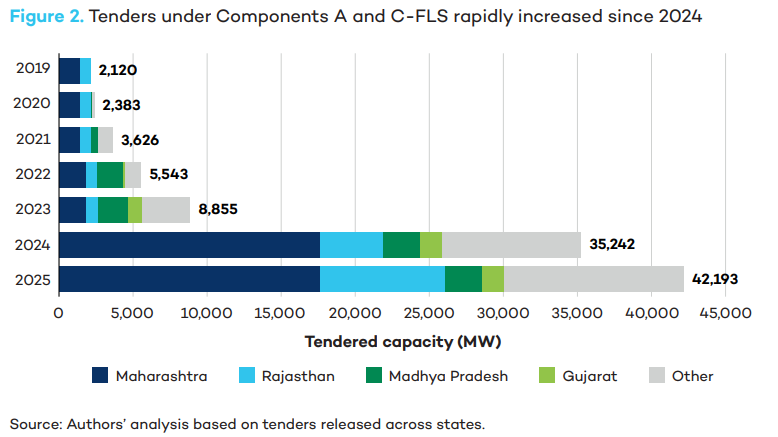
Despite these benefits, the achievements have been modest, as noted in Section 2.1. But the data on projects in the pipeline is more encouraging. We analyzed publicly available documents from the states, totalling 91 tender documents, 66 SERC orders, and one state government notification, across 22 states as of September 30, 2025.6 Figure 2 shows the cumulative capacity at different stages, including made available under tender, letter of awards (LoAs) issued, power purchase agreements (PPAs) signed and commissioned under the scheme across different states. More than 40 GW capacity has been tendered in total, most of them in the last 2 years. Based on consultations with officials, we estimate that PPAs for more than 20 GW have been signed, and most of the remaining capacities are in the LoA stage.
The uptake of the scheme was slow after its launch in 20197 partly due to COVID-related challenges. But the last few years have seen significant activity in many states. With a typical commissioning timeline between 9 and 15 months, many of the projects for which PPAs were signed in the last 2 years are likely to be commissioned before the sunset of this scheme. Hence, we expect to see improved achievement numbers across both Components A and C (FLS) toward the end of the current phase of the scheme in March 2026.
A learning curve is also evident in some states’ experience with implementing this scheme. Most states were unable to attract significant interest from developers for their initial tenders, but were able to attract very competitive participation in the later iterations. Figure 3 compares the awarded capacity to the tendered capacity in a few states and shows this learning curve in action. LoAs issued under initial tenders were low, but in recent tenders, these states have been able to sign LoAs for the majority of the tendered capacity. These states have been able to iteratively improve the attractiveness through better tariffs, addressing some of the developers’ concerns and willingness to try out innovative models.
At its core, the challenges in implementing PM-KUSUM stem from a new business model. Traditionally, DISCOM’s solar power procurement involved either utility-scale solar plants or rooftop solar plants. But PM-KUSUM is different. The capacity of individual PM-KUSUM plants sits between the two—smaller than typical ground-mounted plants, but much larger than typical rooftop plants, requiring high capital investment. While these plants resemble utility-scale projects in terms of procedural requirements, such as land identification and right of way clearances, having to undertake these processes for every project substantially increases logistical costs on a per-megawatt basis. Consequently, established players from both rooftop and utility-scale segments are not easily attracted to PM-KUSUM.
For DISCOMs, the processing of PM-KUSUM applications resembles rooftop solar, involving a large number of small projects that require speedy application processing. At the same time, the points of injection of these plants are the rural distribution grid, which is technically weak and sometimes unstable in many states, unlike transmission-connected utility-scale solar or relatively robust urban networks typical for rooftop systems. Thus, PMKUSUM requires DISCOMs and state administration to fundamentally rethink their internal processes and grid operations.
Thus, the scheme presents its own set of unique challenges. In most states, the ecosystem is learning new challenges on the go, leading to this learning curve in implementation. While significant progress has been achieved, our work uncovered lingering and new challenges in the scheme.
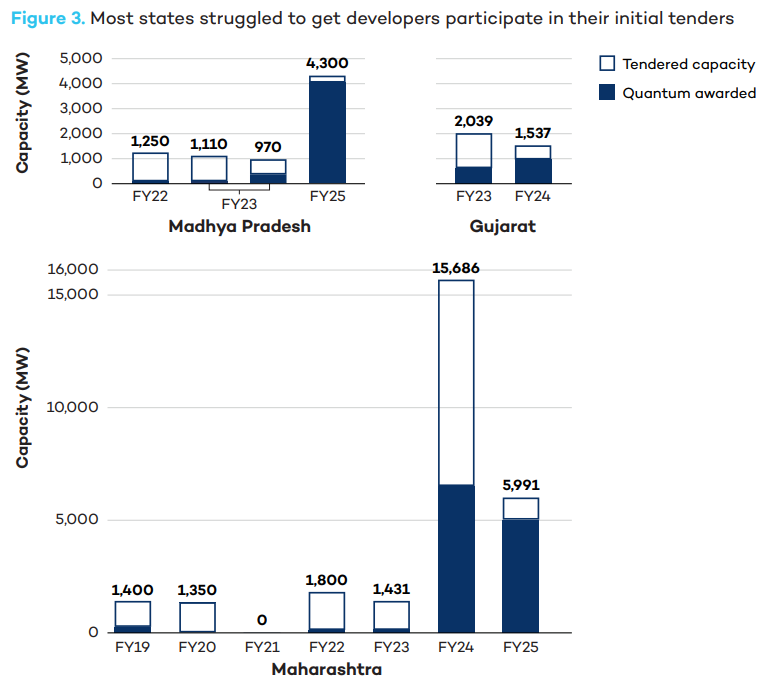
Note: In several instances, states went through multiple rounds of tenders because capacities were not awarded in the initial rounds. With repeat tenders, adding up all tender capacity would lead to doublecounting. Hence, we took the highest capacity tendered in a year as the tendered capacity in that year in the above chart. Maharashtra’s data includes both PM-KUSUM and MSKVY.
Source: Authors’ analysis based on tenders released across states.
2.4 What Is Delaying Implementation?
Our consultations reveal a mixed picture of the scheme’s on-the-ground impact. While there are emerging benefits, some practical challenges continue to impede progress. This section distills some of the key insights from the cross-section of stakeholders consulted.
Farmers
A widespread lack of awareness of the scheme and its components hinders farmers’ participation. The non-intuitive nature of Components A, B, and C fails to convey the underlying business models, making it harder for potential beneficiaries to evaluate and adopt them. Political leaders are also unaware of the benefits to farmers (particularly that Component C-FLS aligns well with a longstanding demand from farmer communities for reliable daytime power) and therefore do not provide the necessary support for implementation.
In Component A, among scheme participants, technical understanding was limited; for instance, many farmers were unaware of the efficiency differences between panel types or best practices, like DC-side oversizing. This often led to poor vendor choices, weak O&M, and lower generation. Many farmers who benefited from Component A are relatively welloff farmers with supplementary income or larger landholdings, and came to know about the scheme through their social circles. While the land lease model under Component A offers a potential pathway for smallholders to participate without substantial investment, awareness of this option remains low.
States
For states, PM-KUSUM represents a relatively new model of decentralized solar, and much of its rollout has been a learning process. The renewable energy development agency has been designated as the state implementing agency (SIA) in over half of the states. However, this has led to delays, data gaps, and inefficiencies because DISCOMs (which are central to substation assessments, interconnection approvals, grid upgrades, and data provision) operate with limited capacity and accountability. A recurring issue reported was a mismatch between the capacity of the tenders and the actual capacity available at the substations, resulting in overestimation of eligible Central Financial Assistance (CFA) and stranded investments in unused land for developers. Weak grid infrastructure preparedness has slowed progress: in Madhya Pradesh, for instance, a feeder-level solar plant had to scale back daytime supply soon after commissioning due to transformer overloading. Further, frequent trippings and chronic low voltages undermine generation. At the operational level, substation staff often lack the technical know-how of distributed solar, leading to avoidable outages. These experiences underscore the need for practical governance reforms, capacity building, and proactive investment in local grid infrastructure to enable PM-KUSUM to scale effectively.
Developers
A large share of developers under PM-KUSUM are new entrants to the sector. While this broadens participation, it also brings new challenges. Many first-time developers struggled with cost estimations amid volatile module prices and uncertainty around domestic content requirements, while others faced difficulties in navigating the fragmented approval processes across land, grid, and metering.
Financing is another key challenge for many developers. High and inconsistent bank guarantee requirements deterred smaller firms. Even after commissioning, frequent grid outages and low voltages reduced generation, while billing delays and difficulties in claiming compensation for outages created cash flow concerns. These hurdles highlight the need for clearer processes, stronger market development, and a robust grid readiness to sustain developer participation under PM-KUSUM.
In the subsequent sections, we detail these challenges and identify potential solutions and recommendations for PM-KUSUM and future solar irrigation schemes.
A Union Government scheme, especially a flagship one such as PM-KUSUM, ideally limits its scheme design to the overall objectives and leaves enough incentives and flexibility to the state administration. Too often, there is little ownership of the scheme at the state level, where implementation occurs. PM-KUSUM faced some challenges on these fronts, but there have also been success stories.
3.1 Scheme Awareness and Branding
Low levels of awareness about solar pumps and solarized feeders have been highlighted in multiple studies (Nathan et al., 2021). Some of these studies were conducted early in the scheme’s implementation and might have improved over time. But the consortium’s observations on the ground, including a survey covering 40 farmers across six districts of Karnataka, show continuing knowledge barrier challenges in at least some states (Appendix D). Only 3% of farmers were aware of all components, while 36% had knowledge confined to Component B (off-grid solar pumps). The challenge is higher for Component A and C-FLS, which are very new deployment models. Despite the opportunity for farmers to benefit from them either through direct income or through reliable daytime power, there is a widespread misconception that the scheme is primarily for solar developers. In the survey, when asked about their interest in setting up solar plants, 21% expressed willingness to adopt solar, 45% stated they were not interested, and 34% indicated conditional interest—stating they might consider participation if the scheme were made more farmer-centric. PM-KUSUM clearly has a branding problem.
Among the many factors that did not help the outreach, an important one is the current naming system of Components: “A,” “B,” “C-IPS,” and “C-FLS.” They are unintuitive and can be confusing for potential beneficiaries. Even state policy-makers and developers struggled with the names. Simple and clear names are very critical in scheme information, education, and communication (IEC) campaigns. It is notable that in many of the successful IEC examples of scheme implementation among states, the state administration adapted the name. For instance, in Maharashtra, Component B was publicized as “PM-KUSUM Magel Tyala Saur Krushi Pump Yojana,” a Marathi name that translates to “solar pump for those that ask for it,” and it is the most successful implementation across the country in terms of the number of deployments. Similarly, in Rajasthan, Component C-FLS was adapted to “PMKUSUM Surya Kisan Aay Yojana” (translation: “farmer’s income from solar”), emphasizing the farmers’ benefits in the component.
Encouraging states to adapt the component names serves two purposes: one, states can create simple and intuitive names in the local language, making IEC easier, and two, the state political leadership gets to partly claim the scheme’s achievements and put a sense of ownership in the state administration.
States’ lack of ownership is also evident from their IEC strategies. Very few states have used the conventional channels of outreach to farmers, like the agricultural and allied departments and their extension services, to publicize the components leading to limited farmer awareness. As noted in Section 5.5, the lease-based model under Component A (also possible under Component C-FLS) saw very limited uptake because potential landowner participants were not aware of it.
3.2 Scheme Design Constraints
Another important factor in incentivizing state governments to take ownership of the scheme is the flexibility it provides to adapt the scheme to states’ needs and challenges. In this regard, PM-KUSUM performs well overall, and some states have made good use of this flexibility, especially in Component A and C-FLS. States have experimented with tariff determination methodology (see Section 5.2), tried out different types of tender design, etc., as the scheme leaves ample decision-making space to the states.
However, there is still scope for improvement. Some technical and design requirements maybe rather obstructive for certain states. Two cases stood out during our consultations:
1. Capacity eligible for CFA under component C-FLS: Component C-FLS guidelines prescribe a stringent methodology for calculating the solar power plant capacity eligible for CFA, including a cap of 7.5 HP for pump capacity for any pump in the feeder (MNRE, 2024). It requires SIAs to collect data on previous year consumptions, pumpwise capacity, etc., putting unnecessary compliance costs on them and discouraging the DISCOM from optimizing the solar plant size for the grid condition. In several states, the average pump capacity is much higher in many feeders. Shifting supply in those feeders to daytime, while only receiving limited CFA, may prove uneconomical for many states. The logic of water conservation does not hold well because, solarized or not, the pumps will be running until the irrigation demand is fulfilled.
2. Size constraints and point of injection: Component A mandates a minimum project size of 0.5 MW. Both Components A and C mandate the use of dedicated feeders and insist on 11 kV substations being the point of injection, even when existing infrastructure remains underutilized. Together, these two mandates deprive states of the option to explore newer deployment models. For instance, if a state wants to promote smaller-scale power plants (~100 kW) directly connected to an existing distribution feeder for whatever reason, it won’t be able to do so.
Such restrictions are not aligned with the overall objective of the scheme. Smaller power plants may help small holders to benefit from the scheme. In our Karnataka farmer survey (Appendix D), the top suggestions for scheme modifications included reducing the minimum capacity limit for projects, allowing connections to the nearest grid point instead of mandating substation connectivity, and providing additional CFA for Component A projects. Multiple smaller-scale power plants injected at various points of an existing grid may be a solution in states with land scarcity. It is also possible that these models may not work out due to technical challenges, as was the case in Maharashtra. But keeping the options lets states experiment and adopt what suits them best.
More broadly, the distinction between models Component C-IPS and C-FLS itself is rather restrictive. Effectively, states have to select between very small power plants under C-IPS and megawatt-scale power plants under C-FLS. Intermediate models are not possible. Instead, a broad component under a single flexible framework could provide states with the ability to choose deployment models that best suit them. Given that Component A is also used interchangeably with Component C-FLS, the ground-mounted solar power plants under Component A can also be subsumed under this broad component.
The scheme can align itself with the broader objective of solarizing agricultural power through distributed solar power and enabling farmers to become energy producers and maintain the core financial incentive structure. Guidelines can be limited to these most essential provisions, and the remaining can be released as periodic advisories. The advisory format helps MNRE to incorporate the latest insights from the state and also helps states in cross-learning. We assess that issues like grid integration will become a major challenge in the future as capacity scales up. Cross-learning would be the most effective way to address these concerns. Ultimately, decentralizing more decision-making authority to the states would empower them to innovate and accelerate deployment, allowing the scheme to evolve in response to diverse local realities.
3.3 Recommendations
Scheme Awareness and Branding
1. Adopt names that reflect the underlying objectives and business model. Naming is important in creating a brand and a favourable impression about the scheme among beneficiaries.
2. Incentivize states to take ownership of the scheme by allowing them to adapt the components’ names to local names. Having local-language names also eases IEC activities.
Scheme Design Constraints
1. Improve the scheme flexibility for the states by limiting guidelines to the most essential provisions. Do away with aspects such as the constraints on plant size and the point of injection. Such restrictions limit states’ scope for innovation.
2. Rationalize the grid components into a single broad and flexible component, allowing states ample room to experiment with models.
3. Encourage states to experiment and innovate with the deployment model. This will unlock newer deployment approaches, such as cluster-based tendering in the current phase.
4. Release periodic advisories to complement the guidelines. MNRE can work with states to incorporate their learning experience into these advisories with a quick turnaround.
A well-designed governance structure is critical for the successful rollout of PM-KUSUM. This section examines the administrative approach of PM-KUSUM and explores the bottlenecks and potential improvements to enhance coordination and streamline the implementation process.
4.1 DISCOMs’ Role in PM-KUSUM Implementation
Under PM-KUSUM, states have the discretion to designate the SIA for different components. Several states assigned this role for Components A and C-FLS to the state nodal agency for renewable energy or the power holding company (see Appendix C). But DISCOM’s role is preeminent in anything grid-connected, and without its ownership of the scheme, implementation has been affected by delays, data inconsistencies, and operational inefficiencies in several states. DISCOM is pivotal at every stage of project implementation, as shown in Table 3. This underscores the imperative to firm up DISCOMs’ role, either by designating them as the SIA with clear accountability and adequate institutional capacity, or, in cases where there are good reasons for other agencies to be the SIA, establishing stronger coordination mechanisms between the SIA and DISCOMs.
| Project stage | Key activities requiring DISCOM's involvement |
|---|---|
| Pre-tender |
|
| Post-tender |
|
| Post-commissioning |
|
Source: Authors' compilation.
Our field visits, engagements and analysis of documents highlight how governance gaps manifest on the ground, starting from the foundational scheme-related information. Tender documents often provided inadequate information to bidders. Tenders from states like Assam, Tripura, Haryana, Bihar, and Odisha, for instance, lacked basic details, such as substation names or their hosting capacities for solar installations. In contrast, states like Madhya Pradesh provided additional information on the coordinates of the hosting substations and their hosting capacities. These data are critical to prospective bidders in their project planning and can only be prepared with the DISCOM’s active participation. Maharashtra and Andhra Pradesh went a step further by providing details on spare bay availability, coordinates of potential land parcels for plant installation, and the distances from substations, thereby supporting developer participation.
Consultations with developers reveal further operational challenges that undermine project viability. In some states, developers reported facing discrepancies between notified and actual substation capacities and the availability of substation bays. Delays in signing PPAs, lack of standardized practices for preparing plant-to-grid connection estimates, and unclear timelines for grid connectivity approvals often push back commissioning schedules.
Even post-commissioning, grid connectivity concerns persist. Section 7 details the grid infrastructure constraints that lead to plant shutdown and major generation losses. However, the DISCOM’s operational inefficiencies, lack of planning, and lack of adequate training for local staff also play a major role. In Madhya Pradesh, full daytime agricultural power supply initiated after the commissioning of an FLS plant had to be rolled back because poor planning led to transformer overloading. There were instances of dedicated solar feeders being disconnected during unrelated maintenance, causing needless generation loss. Although PM-KUSUM guidelines and PPAs provide for compensation due to grid unavailability, the absence of SOPs for outage management, coupled with poor record-keeping on outage frequency and duration, renders such claims nearly impossible to realize. Further, billing delays put a strain on the developers’ cash flow. Section 5.6 details the developers’ concerns caused by the delay in joint meter reading (JMR).
A review of current installations indicates an important pattern: states that have positioned their DISCOMs as SIAs are generally leading the way. Maharashtra, Gujarat, Karnataka, and Rajasthan have shown the strongest progress under Component C (FLS). However, as stated earlier, it is also not imperative for the DISCOMs to be the SIA; the important factor is for DISCOMs to have ownership in the scheme. For instance, our analysis of the scheme functioning in Himachal Pradesh and Madhya Pradesh reveals that effective coordination between DISCOMs and SIAs has enabled smoother data flows, faster approvals, and greater developer confidence, boosting overall installations.
DISCOM’s ownership and leadership are central to the success of the scheme’s gridconnected components. Addressing bottlenecks requires procedural consistency, clear accountability and targeted capacity building. Until DISCOMs incorporate the scheme into their power purchase portfolio planning, the operational challenges are likely to continue.
4.2 Involvement of Union Government Stakeholders
The issue of interagency coordination is also critical at the Union Government level. DISCOMs often view the Ministry of Power (MoP) as their parent ministry, while PMKUSUM lies under MNRE. MoP administers several DISCOM infrastructure schemes, some of which complement the PM-KUSUM objectives. However, an absence of strong coordination between the ministries risks siloed functioning, leading to missed opportunities for synergy.
For instance, MoP’s Revamped Distribution Sector Scheme (RDSS) incentivizes feeder segregation and overall network strengthening. RDSS can support grid infrastructure upgrades, which, as Section 7 shows, will increasingly become the main bottleneck in PMKUSUM implementation in several states. States like Maharashtra allocated additional resources for substation upgrades (MSEDCL, 2023), which could be scaled nationally by incorporating incentives directly into RDSS. The RDSS guidelines prioritize feeders identified by PM-KUSUM under its feeder segregation provision (MoP, 2022). However, currently, this is just a suggestion without any explicit incentives to do so, nor is there a mechanism to ensure that DISCOMs are following this suggestion. Further, the remaining fund provisions, including for substation augmentation and transmission infrastructure upgrades, do not mention PM-KUSUM. Hence, there is a significant scope in converging PM-KUSUM with RDSS.
Other key actors at the Union Government level are CERC and the Forum of Regulators (FOR). Tariff determination power in PM-KUSUM lies with SERCs. However, as discussed in Section 5.2, tariffs have been a sticky issue in several states due to poor benchmarking, reliance on incorrect market data, and lack of consideration for local variations, such as land rent. CERC and FOR can play a guiding role by harmonizing tariff regulations, setting technology-specific parameters, and issuing flexibility guidelines, while advising SERCs on financial principles and service standards. They can also facilitate rapid cross-learning between states. For example, Madhya Pradesh has provided compensation to developers who adjust inverters for dynamic voltage control, thereby supporting local reactive power management (See Section 7.2). FOR can enable scaling up of such innovations at the national level.
PM-KUSUM implementation will benefit from an institutionalized mechanism to coordinate between different Union Government stakeholders. Between MNRE and MoP, this would include a joint review of the PM-KUSUM and RDSS (and other relevant schemes) guidelines to ensure tighter convergence and periodic joint reviews. With CERC and FOR, the coordination mechanism should enable the flow of information regarding the challenges and innovations at the state level without undermining the independence of the regulators. This may include a standing line item for reviewing PM-KUSUM in the regular meetings of the FOR working committee on renewable energy, where MNRE’s comments are also invited.
4.3 Approval Mechanisms
As discussed in Section 2.2, the challenges faced in PM-KUSUM implementation are related to a new business model. Section 5 details how market factors impacted the scheme implementation. Equally important is how existing governance systems, especially approvals, clearances and project monitoring, cope with the change in business model. Our analysis shows that PM-KUSUM requires significant changes in these systems.
Firstly, current approval mechanisms are inadequate. Table 4 lists the approvals required by a developer for a typical solar plant. In PM-KUSUM, this becomes an issue for two reasons:
1. The number of approvals scales with the number of power plants, not the capacity. Approval procedures and personnel allocated by different agencies are tailored to the conventional approach of buying from larger power plants (typically of tens of megawatt size). With PM-KUSUM, a purchase of the same capacity would mean an increase in the approvals by an order of magnitude. This leads to inordinate delays. In the PM Surya Ghar scheme, which also faces this scaling issue, DISCOMs have recognized this and have been reforming their processes to reduce paperwork and touchpoints. But a similar effort is lacking in PM-KUSUM.
2. As noted in Section 5.1, most of the developers participating in PM-KUSUM are new and relatively inexperienced entrepreneurs; many of them are securing just one solar plant. An established player will know the procedures and plan their human resources to get the approvals. But someone new with just one power plant will not have the know-how to deal with these approvals, including which approvals to take when and whom to approach—nor do they have the resources to manage them.
The sheer number of projects also overwhelms SIAs’ capability to monitor the progress of these projects with their existing systems.
| Approvals | Relevant government department |
|---|---|
| Approval for land diversion | State revenue department |
| Single line diagram for connectivity to the substation and plant layout | Chief Electrical Inspectorate Division |
| Approval of metering plan | Concerned DISCOM |
| Testing of CT-PT set, metering equipment, and availability-based tariff meters | Approval by the concerned DISCOM, followed by testing at a National Accreditation Board for Testing and Calibration Laboratories (NABL)-accredited lab |
| Approval for connectivity, commissioning, & synchronization of the solar power plant | Concerned DISCOM |
| Submission of the final JMR report | Concerned DISCOM |
Source: Authors' compilation.
The states leading in PM-KUSUM implementation, like Maharashtra and Gujarat, have tried to tackle these issues through the following initiatives:
• Single-window clearance to facilitate RE projects, including those under PMKUSUM: States like Maharashtra and Gujarat have developed a single-window clearance portal that centralizes permissions from multiple departments, ensuring faster processing, transparency, and reduced timelines. A nodal officer will address grievances and queries to facilitate the ease of doing business.
• SOPs: Madhya Pradesh published an SOP document detailing the steps and designating officials for different approvals. It also outlines the factors to be considered in identifying substations, the timelines for each milestone until plant commissioning, and the officials responsible for each activity.
• Rajasthan and Maharashtra have also adopted a project monitoring tool to monitor progress and identify issues hampering project commissioning.
These initiatives have helped the states to improve the efficiency with which the scheme is being implemented, and there is a need for other states to also adopt these initiatives. States can be encouraged to adopt faster approval mechanisms and project monitoring tools through advisories recommended in Section 3.3. MNRE can organize workshops to facilitate crosslearning between states and highlight these best practices. States should also be encouraged to adopt project monitoring tools to track all projects under Component A and C-FLS.
4.4 Recommendations
DISCOMs’ Role in PM-KUSUM Implementation
1. State governments should ensure DISCOMs’ leadership and ownership in the scheme implementation. Grid-connected models like Components A and C should be embedded in the power purchase portfolio planning of DISCOMs.
2. DISCOMs should be the SIA by default unless there are strong reasons otherwise, in which case the state government should establish a strong coordination mechanism between the DISCOM and the SIA.
Involvement of Union Government Stakeholders
1. Institutionalize a coordination mechanism between different Union Government stakeholders. MNRE and MoP can create joint reviews of PM-KUSUM and related schemes like RDSS. FoR’s Working Committee on Renewable Energy can include PM-KUSUM regulatory-related concerns in their monthly meeting and invite MNRE suggestions.
Approval Mechanisms
1. States should assess the compatibility of existing administrative structures with the scale that they aim to achieve in PM-KUSUM. Several approval processes are designed for operationalizing large-scale solar power plants rather than multiple small power plants. States can think of process engineering like a single-window mechanism or develop SOPs for these approvals.
At its scale, PM-KUSUM Components A and C-FLS create a new market segment for solar projects outside the utility-scale and rooftop segments. Although there are comparable open-access projects, they are few and mostly limited to certain states. Hence, achieving PMKUSUM’s scale also requires states to foster a robust ecosystem for private sector investment in this segment. This includes creating attractive investment opportunities, policy stability, and targeted awareness efforts to build investor confidence. This section explores the key elements needed to enable a nurturing market environment.
5.1 Tailoring the Scheme to States’ Developer Ecosystem
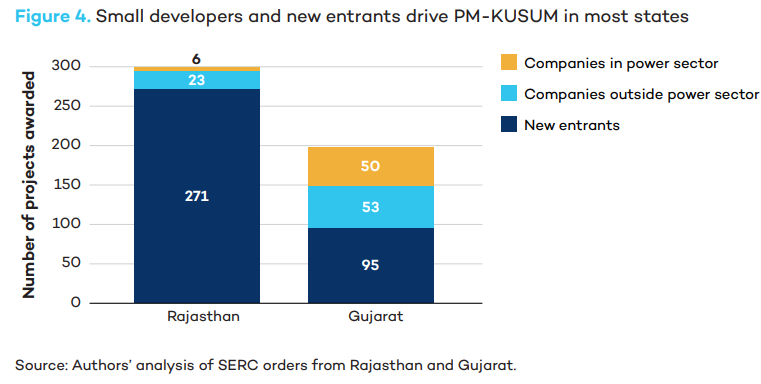
State-wise achievements under PM-KUSUM show a strong correlation to the maturity of local developer ecosystems. Maharashtra, Gujarat, Rajasthan, and Karnataka, the overall top achievers, are also among the states with a more established renewable energy industry, supportive land-use policies, and prior experience in large-scale deployment. However, our analysis of SERC orders, as shown in Figures 3a and 3b, reveals that in most states, including the most successful ones in terms of capacity commissioned, a significant share of sanctioned projects went to new entrants—self-proprietorships and companies from non-energy sectors, like building infrastructure. While having an established industry in the state helps, it does not appear to be necessary for PM-KUSUM implementation.
Our consultations with developers reveal that established developers from utility-scale and rooftop are not easily enticed by PM-KUSUM prospects. Large established developers find the logistical cost of land identification and lower economies of scale to be major barriers. Rooftop developers find the upfront capital requirement and loan financing to be the biggest challenges. The key challenge for each state is to identify the potential participants based on its developer ecosystem and tailor the scheme to make it more attractive to them. An analysis of PM-KUSUM tender documents (Appendix B) shows a clear pattern—states trying different approaches until they hit the right one, which varies from state to state.
State-Level Experiences
Maharashtra, after only modest achievements in its initial tenders, revamped the scheme with an intensive land-aggregation effort designed to attract large players. They also complemented their regular tender with a cluster-based approach in which all substations in a geographical area—typically a district or a DISCOM circle—are bundled into one project, and a land bank (See Section 6.4), potentially enabling bidders to get economies of scale. They had great success with these approaches, with about 14 GW in PPAs signed subsequently. About 70% went to large developers, and a majority of the remaining also went to established developers. Gujarat, Rajasthan, and Karnataka went the other way. After initial failures, they relaxed technical and financial criteria for bidders to attract small-scale developers and new entrants. As shown in Figure 4, these states have a good mix of new entrants, small developers, and established companies. Our consultations with some of these states reveal that in the absence of a land bank, the state-based small developers seem to perform much better in terms of identifying land and setting up plants within the stipulated time.
Madhya Pradesh’s recent success is a good illustration of the importance of experimenting. The state, after failing to attract investments in the initial tenders, adopted a cluster-based tender with limited success.8 The availability of land in the state may have helped attract some large players. They pivoted back to the strategy of attracting small developers and made several reforms to improve the attractiveness of the scheme for developers. They also undertook intensive developer engagement, leading to the successful conclusion of the tender.
On the other hand, there have also been experiences, for instance in Punjab, where the lowering of entry barriers, like waiver of earnest money deposit (EMD)9 for start-ups and MSMEs led to aggressive bidding by non-serious players who do not have financial closure capacity, thus leading to tender scrapping. States should be mindful of risks and keep adequate safeguards in their incentive measures.
5.2 Improving Tariff Viability
The tariff-setting approach is different for Components A & C (FLS). Under Component A, the SERCs set a pre-fixed levelized tariff for the solar power plants, followed by competitive bidding if the applications received for a substation exceed the notified capacity. Under Component C (FLS), states have to adopt competitive bidding, and there is no mandate for a ceiling tariff. In many states, SERCs chose to set a ceiling tariff under this component as well in the initial years of the scheme.
Several of the tenders and expressions of interest in the initial years elicited very few bidders. Our interactions with solar developers and landowners revealed that the ceiling tariffs in most states were lower than their expectations. We analyzed 60 SERC orders across 13 states under the scheme, listed in Appendix B, and found critical concerns on tariff viability. These concerns stem from the mismatch between several SERC assumptions and market expectations, including the following:
Capital Costs
The price of solar modules, which typically accounts for 45%–60% of the capital cost of a solar power plant, has fluctuated greatly in the past few years. However, most of the SERCs do not have reliable sources of data for module prices for the estimation of project costs. Figure 5 shows the variation in module prices over the years.
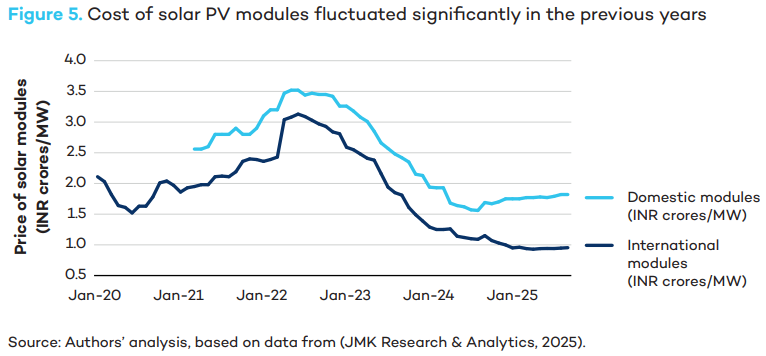
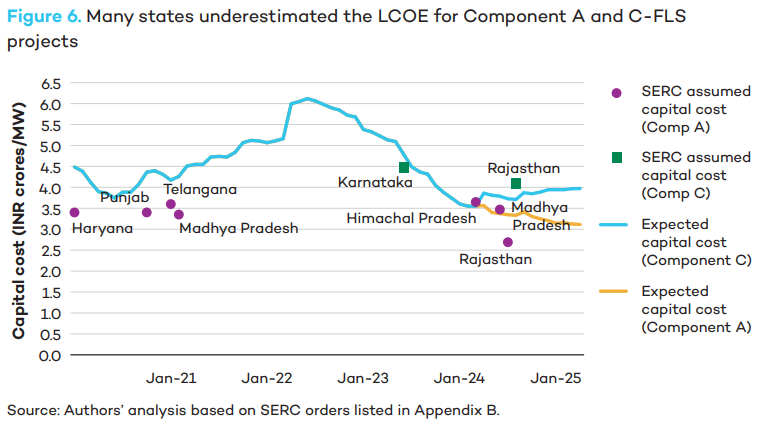
However, our analysis shows that the project cost assumed by the SERCs remained frozen despite the varying module costs, resulting in the assumed capital costs being significantly lower than the actual costs in most parts of the scheme’s operational period. In Figure 6, we compared the SERC-determined tariff (dots) to our estimation of the tariff based on this historical data using the TACTS tool (International Institute for Sustainable Development, 2025). Our assumptions are given in Appendix E. It is only with the recent softening of module prices that we see the two converging. As one would expect, the period with a significant difference between the two also coincides with the lowest activity under PMKUSUM, including stalled and cancelled projects.
Annual O&M Costs
The O&M costs assumed by SERCs across states vary widely, from INR 4.5 lakhs/MW to INR 10.5 lakhs/MW. As calculated via the TACTS tool (International Institute for Sustainable Development, 2025), a change in O&M cost of INR 1 lakh/MW/year typically leads to a change of about INR 0.09/unit in LCOE tariff, which is significant. Based on our developer consultations, we infer that market-aligned O&M cost is between INR 5 and INR 6 lakh/MW/ year, which is higher than most states’ assumptions.
Annual Land Lease Rent
Except for a few states like Madhya Pradesh and Rajasthan, most have not factored land lease rent costs into their tariff calculations. Our analysis shows that with an annual increase of INR 10,000/acre in land lease rent, the tariffs could increase by INR 0.032/unit. Without land rent consideration, the LCOE gets underestimated.
Grid Availability Factor
As noted in Section 4, grid unavailability is a major challenge for many projects and impacts their financial viability due to lower-than-planned generation. Our analysis shows that a grid unavailability of 2% can result in a generation loss in the range of 1.4%–2.6% for the developers. The corresponding levelized tariff increase to compensate for this loss should be in the range of INR 0.06–0.10/unit. Given the fact that trippings are more frequent in the peak irrigation period (see Section 7.1), which in many states coincides with peak solar generation, the potential loss is likely to be on the higher side. States like Maharashtra and Punjab have included grid guarantee clauses in their tenders, which provide for compensation to developers in case of unavailability of grid below a set threshold (98% in the case of Maharashtra), but these clauses are rarely enforced due to procedural difficulty.
Measures to Improve Tariff Viability
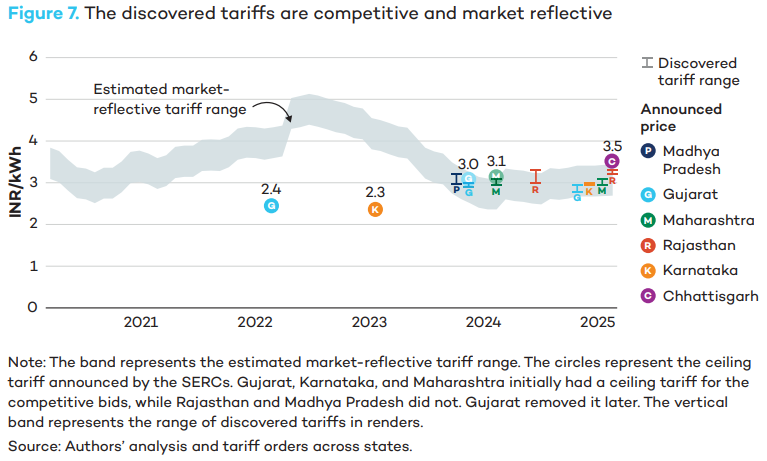
Improving tariff viability is among the easiest measures states can take to accelerate the scheme. Solar tariffs are already very competitive compared to other sources and probably do not need to be capped anymore. States like Rajasthan and Gujarat, which have adopted competitive bidding without any ceiling tariff, discovered attractive tariffs and great developer enthusiasm, leading to LoAs and PPAs. The key is to ensure vibrant market participation. The tariffs discovered through competitive bidding in recent years are also well-aligned with our estimates of levelized cost based on the TACTS tool (Figure 7).
1. Good reference data for input cost parameters like module costs, annual O&M costs, etc., when SERCs set pre-fixed levelized tariffs or ceiling tariffs. Linking the tariffs to robust market data and insights from broader industry engagement could improve the tariff-setting process. The TACTS tool can help and is being updated monthly with the latest module prices to ensure market-reflective tariffs are calculated.
2. The tariff setting should be flexible to accommodate spatial variations in factors like land rent and responsive to policy changes, as mentioned in Section 4.2. The ceiling tariff should be adjusted regularly with changes in law and market variations.
3. Strengthening the grid guarantee clauses by prescribing the SOP for claiming the compensation can reduce risks for developers, as they will be assured of compensation for income loss due to the grid’s unavailability for power evacuation.
5.3 Attention to Quality and Maintenance of Installations
Quality of installation and appropriate plant O&M are critical for achieving the intended CUF and remunerative returns for the developers or farmers. From our field visits and consultations with plant owners, we identified major issues with the quality of installations and O&M practices. Many of these challenges were seen in Component A projects developed by first-time entrepreneurs who were still learning the technical and procedural aspects of implementation. In several cases, the slow adoption of standard practices reflected a lack of awareness among farmers and new developers rather than deliberate poor workmanship and cost-cutting.
Suboptimal Installation Quality
Quality installation involves proper mounting, wiring, and robust plant design. In multiple installations, we found that developers used polycrystalline panels, which typically have 13%–17% efficiency, instead of the more efficient monocrystalline ones (15%–20% efficiency) (Ukpanah, 2024). Monocrystalline is also more heat-tolerant and therefore more suitable for India’s climate. Developers were also largely unaware of the standard practice of DC oversizing.
In the absence of a credible repository of Engineering, Procurement and Construction (EPC) contractors, first-time developers with limited technical know-how found it difficult to discriminate between providers. As a result, some EPC contractors installed substandard components, such as brittle glass panels, with developers unaware of their long-term implications on the plant performance. Establishing a centralized repository, possibly in the existing PM-KUSUM portal, where EPCs can register and share information about their track records, areas of operation and other relevant information could help mitigate this challenge. Such a repository would provide first-time developers with a ready list of credible EPC contractors, so that they would not have to rely on informal channels.
Improper Plant O&M
Some plants lacked essential cleaning infrastructure, leading to a higher rate of plant degradation. In one such instance, due to improper cleaning, water accumulation led to the emergence of dark spots on panels that impacted the plant’s energy yield. Developing an easy-to-understand manual for the operation and maintenance of solar plants, particularly highlighting the best practices on O&M and the new evolving technologies for plant maintenance, could support new entrants. This can also be in the form of short video tutorials hosted on the PM-KUSUM portal.
PM-KUSUM Component A guidelines place the responsibility for quality control and monitoring on SIAs and advise them to involve technical consultants if necessary. However, we found no such initiatives from most SIAs, whose support for first-time developers seemed inadequate.
5.4 Policy Stability and Communication of Policy Changes
The operational period of PM-KUSUM saw several solar policy changes, including a change in basic customs duty (BCD) for imported modules and cells, the ALMM-1 and ALMM2 lists coming into effect, operationalization of the domestic content requirement (DCR) mandate and multiple changes in Goods and Services Tax. This had a critical impact on the scheme implementation in many states.
Developers reported that they learned of some of these changes once tenders were already underway, leaving them unable to adjust tariff quotes appropriately. Discovered tariffs were based on pre-policy-change assumptions, whereas actual procurement costs increased sharply after LoA issuance. This mismatch rendered projects financially unviable, forcing several developers to go back on their bid. Many states had to cancel or revise tenders mid-course.
Two aspects of the communication of policy changes impacted PM-KUSUM:
1. Effective publicization: Although some of these policy changes were communicated in advance, many developers, especially first-time developers and new entrepreneurs, were unaware of them, leading to misaligned cost expectations. This was visible in the tenders around BCD and DCR changes. There were multiple instances of bid withdrawal and tender cancellations around these timelines. Tender documents also often failed to clearly articulate the policy change, adding to confusion at the bid preparation stage.
2. Clarity and lead time in communicating policy changes: Lack of clarity and sufficient lead time in policy changes negatively impact the scheme outlook. For instance, the operationalization of ALMM-2 happened without adequate consultation and prior notice, and there was considerable confusion regarding the original notification. Due to a lack of clarity around the date the list came into force, many states froze the implementation of Component A in the first half of 2025. Similarly, the conflicting communication regarding the sunset timeline and eligibility of projects for CFA prompted many states to delay their tenders under Component C-FLS in recent months. Developers also expressed their reservations about participating in some of the tenders that came out in 2025 due to this uncertainty.
Tender data suggests a marked slowdown around the timing of these policy changes. In the months after the BCD hike and DCR notification, tendering activity dropped, and the tenders that were issued faced lukewarm participation. Developers interviewed during consultations highlighted the uncertainties in such periods, discouraging competitive discovery of tariffs.
Policy changes usually serve a larger developmental objective. However, these changes should enable a smooth transition with provisions like phased implementation of the new scheme and communicating grandfathering clauses exempting projects before a certain deadline sufficiently in advance. Consultation, clear communication, and proactive measures by the Union and state governments can mitigate the negative impacts to some extent.
Shortage of DCR-Compliant Panels
The supply-side challenge of DCR-compliant modules also contributed to delays in PMKUSUM. Developers consistently reported that not only were DCR panels costlier, but they were also in short supply, especially with the demand coming from PM Surya Ghar, the other national scheme with a DCR mandate. This shortage led to an increase in procurement costs and effectively priced out smaller developers
5.5 Limited Uptake of Lease-Based Model in Component A: Communication gaps and farmer constraints
As detailed in Section 2.2, Component A provides two distinct models for deployment of solar power plants: the farmer-owned model and the lease-based model. The lease model is particularly relevant for farmers who possess sufficient land but lack the financial capacity or technical expertise to set up a solar plant themselves. Under this arrangement, the farmer leases their land to a developer, who owns and operates the solar plant in return for a fixed lease rent.
However, this model has had only limited uptake so far. Most installations under Component A in states such as Madhya Pradesh and Rajasthan have followed the farmer-owned model. For example, in Madhya Pradesh, all 32 projects commissioned under Component A (with a total capacity of ~ 52 MW) so far are farmer-owned.
One critical reason for this skewed uptake is the communication and outreach strategy. Statelevel implementation agencies largely publicized Component A as a means for farmers to set up solar plants on their own land and generate income through electricity sales. Expressions of Interest and application formats released by states typically invited farmers directly to come forward as developers, with little emphasis on the alternative lease-based approach. The option of leasing land to a developer was neither highlighted nor explained adequately to farmers. Many developers interested in the scheme were unaware of the opportunities in Component A, limiting the possibility of a developer-led uptake of the scheme.
This communication gap has significant implications. Expecting small and marginal farmers who often lack financial resources, networks, and knowledge of regulatory processes to identify and partner with private developers is unrealistic. Our farmer survey in agriculturally intensive regions of Karnataka under Chamundeshwari Electricity Supply Corporation Limited (CESC) DISCOM (Appendix D) revealed that 61% of farmers were not aware of the PMKUSUM scheme. Without targeted facilitation and handholding, these farmers are effectively excluded from participating in Component A. As a result, the scheme’s potential to benefit landowners with limited capital remains largely untapped.
Without addressing these bottlenecks, Component A risks remaining restricted to larger, better-off landowners who can afford the upfront investment.
5.6 Improving Payment Security
Timely payments are critical for the sustainable scaling up of PM-KUSUM. It helps developers maintain project financial viability through timely debt servicing and having adequate working capital, improves lenders’ and investors’ confidence in project bankability, and maintains developer interest in the scheme. Payment delays from DISCOMs have been a persistent problem for renewable energy generators in the past (Ranjan, 2021). The problem is particularly challenging for small developers and farmers under PM-KUSUM who have limited financial buffers to service their debt obligations on time.
PM-KUSUM guidelines mandate DISCOMs to maintain an escrow account for timely payments to solar developers. Additionally, the model PPA mentions about 12 months of letter of credit for developers as a payment security mechanism. Despite these provisions in the guidelines, payment security remains an important concern for developers participating in PM-KUSUM, either because states have not adopted these measures or due to their lack of enforcement.
Some developers with commissioned projects expressed concerns over timely payments from the cash-strapped DISCOMs. They also highlighted delays in JMR, which is necessary for releasing payments. JMR involves taking meter readings from the meter at the solar plant and the bi-directional meter at the point of common coupling in the substation, in the presence of the DISCOM and developer representative. The readings record the energy exported to the grid and imported energy, if any, and are used for the bill settlement. Additionally, the practice of issuing separate bills for solar generation and plant consumption, where the generation bill is issued only after the consumption bill is paid, creates administrative hassles and delays payments.
These legacy systems, which may have been effective for large-scale utility projects, are proving to be inadequate for the PM-KUSUM plants with multiple layers of complexity.
To address the billing and payment-related concerns, states can adopt some of the following best practices from other regions:
Under MSKVY 2.0, Maharashtra has utilized its Green Energy Cess, a state government cess instituted in 2004 on commercial and industrial consumers for funding renewable energy generation to establish an INR 100 crores revolving fund (Mandal & Rangarajan, 2015; MSEDCL, 2023). The fund compensates the developers in case of 3 or more months of delays in payments from the DISCOM. If the fund is utilized any time for compensation, it is replenished by diverting an equivalent amount from the state’s subsidy transfers to the discom. This mechanism reduces the risk perception of these projects and enhances investor confidence.
Further, a revolving fund can reduce the financing costs for developers and thereby lead to a reduction in the discovered tariff. Our discussions with stakeholders reveal that the financiers factor in risks like payment delays while deciding the interest rate for projects. Payment guarantees can mitigate those risks and reduce the interest rate. For instance, if a state establishes a revolving fund for 100 MW solar capacity to cover payment security equivalent to 3 months, we estimate that the corpus required will be INR 13.6 crores. In this context, if banks are able to reduce the lending rate by even 0.15%, there is a potential tariff reduction of INR 0.014 per unit. This will benefit the DISCOM through annual savings of INR 1.24 crores in power purchase cost.
The billing process can be further streamlined using remote billing mechanisms to reduce hassle for both the DISCOM and developers. For example, State Energy Accounting reports, which record meter readings captured remotely from solar plants connected to State Load Dispatch Centres for scheduling and forecasting and are available to all developers. They can be considered for billing by default. However, the minimum threshold of the power plant size for taking part in forecasting and scheduling is 5 MW, which leaves out most of the PM-KUSUM power plants. Hence, the DISCOMs will have to implement other remote monitoring systems and incorporate those mandates into the tender and enable automated remote billing.
5.7 Improving Financing Access
Access to affordable financing remains one of the toughest challenges for developers, especially new entrepreneurs or farmers-turned-developers. Financiers see at least three kinds of risks with the scheme:
• borrower risks: Many of the developers lack established credit histories or collateral.
• project risks: Banks often view distributed solar projects as high risk. Most banks have not diversified their loan portfolio to decentralized solar projects. Our consultations with developers reveal that only a handful of banks are focusing on this sector. Other project risks include the process-related difficulties elaborated in Section 4.3, including approval delays.
• counterparty risk: This relates to the risk arising from DISCOM’s payment as detailed in Section 5.6.
As a result, many developers have faced high interest rates or outright loan rejections, significantly slowing down the scheme’s scale up. Several initiatives have emerged to address these issues.
Dedicated Credit Products by Public Financial Institutions
The Indian Renewable Energy Development Agency, National Bank for Agriculture and Rural Development, and Small Industries Development Bank of India announced dedicated credit lines, and major commercial banks (State Bank of India, Bank of Baroda, Canara Bank, Union Bank, Axis Bank, etc.) rolled out loan products tailored to PM-KUSUM projects. In practice, however, uptake of these facilities has been limited.
State Facilitation in Financing
One promising example is Madhya Pradesh’s memorandum of understanding with the State Bank of India to streamline financing for PM-KUSUM Components A and C projects, essentially creating a channel for developers to access credit with some state-level facilitation. This model can reduce the perceived risk for the bank through state endorsement and by aggregating demand.
First-loss Guarantee Mechanisms
Some financiers have suggested a First-Loss Guarantee Fund wherein an entity (e.g., the state or a multilateral agency) assures a certain portion of the defaults, thereby shielding banks from worst-case losses. This significantly lowers risk perception—if multiple projects default, the guarantee fund would cover, say, the first 10%–20% of the projects, making banks far more willing to lend. The guarantee facility’s design can draw on successful models in MSME financing and would ideally be coupled with capacity building for local bank branches on appraising such projects.
Interest Subvention Schemes
The Agriculture Infrastructure Fund (AIF) already provides a 3% interest subvention on loans for PM-KUSUM projects, effectively cheapening the cost of capital. However, awareness and processing of AIF support have been slow; many eligible developers either didn’t know about it or found the application bureaucratic. Our consultations with experts in the sector reveal that many bankers lack clarity on the procedure for obtaining AIF benefits for PM-KUSUM loans. As of March 2025, only 26 projects under Component A had been sanctioned loans via the central AIF, and ~371 projects across Components B and C, which is modest relative to the scheme’s targets. A push by MNRE and state nodal agencies to educate beneficiaries on AIF (through workshops or help desks) could increase adoption. If possible, the application process for AIF loans should be integrated into the KUSUM portal or singlewindow system, creating a seamless one-stop application for both scheme participation and subsidized financing. Some states, like Rajasthan, have also explored accessing MSME interest subvention schemes for Component A.
| Types of risks | Potential solutions |
|---|---|
| Borrower risks |
|
| Project risks |
|
| Counterparty risk |
|
Source: Authors’ analysis.
Another key factor concerning financing is bankers’ awareness and confidence in the scheme. GIZ India, which undertook a series of capacity-building workshops on PM-KUSUM for officials from a few nationalized banks in five states, has reported bankers’ lack of clarity about the PM-KUSUM scheme as a key barrier in financing. Some of these banks have announced PM-KUSUM loan products. But the scheme implementation design varies between the states, and bank officials at the frontline do not have sufficient information about the design. Specifically, the bankers needed clarifications on the workflow of the scheme, including timelines for each step of project development, the roles and responsibilities of different agencies (Ghose, 2025).
SIAs can help improve financing by communicating key aspects of the scheme with the state bankers working with the state-level banking committees. In addition, the measures proposed to improve the scheme administration (see Section 4.3) and strengthen the payment security (see Section 5.6) become important to increase financiers’ confidence in the scheme.
5.8 Recommendations
Tailoring the Scheme to States’ Developer Ecosystem
States should assess their market to identify the potential participants in the scheme and design tenders accordingly. New entrants can be incentivized by reducing entry barriers, streamlining approvals (see Section 4.3) and ensuring payment security (see Section 5.6). At the same time, large players can be attracted through cluster-based tenders and landaggregation measures. States could try a combination approach to make the best use of both. Sequencing a cluster-based tender before an individual-substation-based tender would avoid overlaps and help one tender complement the other. States could also consider relaxing the clauses related to subcontracting or forming joint ventures to enable strategic partnerships.
Give equal importance to process reforms and outreach. Streamlining approvals is as critical as tender design in attracting small developers. States also need to intensify their pretender outreach with developers to understand the market.
Explore other state-specific incentives. For states with a not-yet-mature solar industry, consider interventions like partnerships with banks for financing.
Improving Tariff Viability
Adopt competitive bidding wherever possible. Solar is very cost-competitive, and states can expect to find prices low enough if other bottlenecks are reasonably addressed.
Link tariffs to robust market data if the states prefer prefixed tariffs. Allow for locational and temporal variations by indexing the tariff to a reputable data set. For example, linking the land rent component to the district-level committee rate or capital cost to a module cost data set. This could also help overcome delays caused by policy changes.
Attention to Quality and Maintenance of Installations
Create a central repository of EPC contractors interested in the scheme, along with data on their track records, to provide first-time developers a ready list of credible EPC contractors.
Develop training materials on standard O&M practices for first-time developers.
Incentivize SIAs to engage consultants for ensuring the quality of installation, regular maintenance, and publicizing the training manuals.
Policy Stability and Communication of Policy Changes
Announce major policy changes sufficiently in advance, accompanied by transition guidelines to allow developers and states to align procurement and bidding strategies.
States must explicitly incorporate important policy changes like the DCR mandate and sunset date in their tenders. MNRE can help states by releasing scheme-specific advisories on the policy changes. States also need to be proactive in their pre-bidding communications to highlight the policy changes.
MNRE should initiate a clear communication strategy for scheme extension or phaseout to prevent last-minute uncertainty and allow states to plan tenders and developers to secure financing with confidence.
MNRE could publish quarterly DCR panel availability reports in partnership with manufacturers, helping developers plan procurement pipelines and overcome the current panel shortages.
Improving Payment Security
Operationalize payment security instruments like letters of credit or payment guarantee corpus funds to ensure timely payment to developers, thereby reducing counterparty risks for them.
Simplify bill payment procedures by automating meter readings based on Supervisory Control and Data Acquisition systems and limiting manual interventions, such as joint meter readings.
Improving Financing Access
State governments may facilitate better bank financing by developing appropriate instruments for reducing risk perception, such as partnerships with public and private banks to create dedicated funding windows for PM-KUSUM, creation of a First-Loss Guarantee Fund, in collaboration with multilateral development banks or green finance institutions. Leverage interest subvention schemes like the AIF and other state-level incentives for MSMEs.
Encourage broadening of the pool of financing beyond conventional bank financing to sources such as infrastructure debt funds.
Land identification for solar plants and getting RoW for the evacuation infrastructure have been the biggest bottlenecks for components A and C-FLS in several states.
6.1 Nature of the Land Challenge
PM-KUSUM’s land challenge is unique. In other common business models, either the state/ DISCOM is responsible for identifying project land and setting up transmission, as in solar parks, or the developers have a high degree of flexibility in deciding the plant location and point of injection, as in open-access projects. But in PM-KUSUM, the substations are notified in advance, and the smaller size of the plants makes it infeasible to locate them beyond a few kilometres from the substation due to the prohibitive cost of setting up the lines and higher transmission losses. Developers are expected to independently locate, acquire, or lease suitable land parcels. In doing so, they run into several challenges.
1. Logistical Challenges
Locating land parcels suitable for solar plants—ideally flat, barren, or uncultivated land—is a major challenge. Technical constraints, such as uneven terrain, flood-prone areas, or rocky soil, further reduce the number of viable sites. Accessibility is also an issue; unlike solar parks, small projects may not be able to absorb the construction cost of access roads if there are no existing roads. The developers we interviewed mentioned that they usually depend on local-level land aggregators for land identification. However, this system is insufficient to address the scale and breadth of PM-KUSUM. Developers mentioned instances of speculative increases in land lease rates by aggregators when tenders are announced.
In Component C-FLS (and to a great extent in Component A), states select the substations based on higher agricultural load. Hence, there is a higher chance that the area surrounding the notified substation is agriculturally intensive. Land and RoW challenges are exacerbated in such areas. Our farmer survey in agriculturally intensive areas of Karnataka also examined willingness to lease land for solar projects. Only about half of them were open to leasing, but the rent expectations by a majority of farmers were more than INR 80,000/acre, which was well above the viable range based on the state’s ceiling tariff, according to our calculations. Developers mentioned that in several cases, the issue is with the duration of the lease required for solar plants. Farmers are not ready to lock in lands for such long periods.
2. Issues With Land Records
Developers flagged that land titles are outdated in several states, with issues like joint ownership or other title encumbrances cropping up in the later part of land negotiation. Although most states have computerized their land records, they need to be regularly updated before developers can use them for site selection.
3. Land-Use Diversion Delays
In most states, land designated as agricultural land cannot be used for any other purpose unless its land-use status is changed legally. However, the land-use diversion is very cumbersome and time-consuming in many states. Some states have introduced special measures like “deemed diversion”11 for renewable projects. But developers highlight that the situation on the ground hasn’t changed much.
4. Land Leasing Laws
In some states, the land leasing laws restrict the period for which an agricultural land parcel can be leased to 5–7 years. The life span of a solar plant is above 25 years. Developers are unwilling to invest without certainty of land tenure.
5. RoW Negotiations
The developer must negotiate and acquire the RoW from other landowners to lay the transmission lines and approach the road. The number of these negotiations scales up with the number of plants with a developer, adding significant logistical overhead for them.
For these reasons, land and RoW continue to be the main deterrents for developers, especially the large ones looking for scale in participating in the scheme. The alternative model of landowners owning the solar plant has not picked up for various reasons (See Sections 4.3, 5.3, and 5.7), but even there, the RoW challenge remains. Two top crop-producing states scaled back their ambitions for Component A and C-FLS after multiple rounds of failed tenders due to land challenges. Several other states recognized the need to help developers achieve their ambitious scale under the scheme.
6.2 Role of States in Facilitating Land Access
The interventions by the states have largely followed two approaches: a) facilitate leasing of private lands and b) make unused government lands available for the scheme.
In facilitating leasing of private lands, the states’ role is mostly to act as an intermediary between the developers and the landowners interested in leasing their lands. States have followed different approaches with varying degrees of success, such as
• collating the information of interested farmers through inviting expressions of interest from farmers/landowners willing to lease their land (Odisha, Uttar Pradesh) or
• creating a web portal for farmers/landowners to register their interest (Tamil Nadu, Rajasthan).
In general, these measures haven’t been very successful. In most states, the communication efforts accompanying such measures did not reach the intended targets. The developers we interviewed mentioned that even in states where the measures were successful in attracting registrations, they encountered several issues. For example, in Rajasthan, where the state government publicized this effort by branding it as a flagship scheme, “Surya Kisan Aay Yojana,” they got a very good response from landowners. However, much of the registered land had legal issues related to title or joint ownership or was unsuitable for solar plants.
Maharashtra went beyond collating the data and also undertook an assessment of the registered private lands for suitability for solar projects. This reduces a lot of logistical costs for the developers and provides them with more project-ready land parcels. The state also guaranteed a minimum land rent rate based on the guidelines value of the property12 rates, which provided a reliable benchmark for both landowners and developers.
A few states, including Maharashtra and Karnataka, tried to make use of unused government lands for the scheme on a large scale. In Karnataka, the state collected the data of government land near substations under different departments and offered it to the developers. But developers highlighted that parcels identified were sometimes technically unsuitable due to topography or location constraints. In some cases, sites were situated in buffer zones near forest areas, requiring environmental clearances and further delaying approvals. This situation often arises because state governments direct the revenue department or district collectors to identify land without conducting technical feasibility assessments. In addition, several projects faced local opposition, as communities perceived that the earmarked land could be put to more beneficial uses than solar deployment—such as agriculture, community infrastructure, or other livelihood-supporting activities.
Maharashtra’s effort to aggregate public lands has also been very successful. The state, in addition to collating data on unused government lands, also undertook a technical feasibility assessment and acquired all necessary approvals. At the tender stage, developers are given full access to data related to each of these land parcels, including their approval status. These measures reduced the project risk enormously for the developers. Coupling these measures with a cluster-based tender approach, Maharashtra was able to significantly increase the participation of big developers in their scheme (See Section 5.1). Maharashtra also included state-level incentives for panchayats where solar plants are being installed to improve the popularity of the scheme.
6.3 GIS-Based Approaches for Land Identification
State facilitation of land identification certainly helps in accelerating PM-KUSUM. But the successful examples we came across, like Maharashtra, were also administratively very intensive. Activities like land assessment, transferring land between departments, monitoring of approvals, etc., need a great deal of paperwork and staff time and resources from several departments. For the Maharashtra state government, the scheme was a political priority, and it leveraged the apparatus of district administrations to get the initiative going, to the extent that district magistrates’ performance in the initiative was included in their annual appraisal. But not all states will have the same policy priority to use their political capital like this. However, a low-effort initiative like a portal also would not work as mentioned above. Are there any costeffective ways of doing meaningful land facilitation?
We have determined that GIS-based tools can be highly effective. Almost all states have computerized their land records, and DISCOMs have their distribution substations mapped out. GIS-based analysis can act as a first-level filter to identify lands based on these data and satellite images, which can reveal terrain and topography, vegetation, accessibility and potential issues in getting RoW (such as railway tracks, national highways, etc.).
As part of our technical assistance for states, we developed prototypes for Madhya Pradesh and Karnataka based on their interest. The tool uses a multi-criteria decision-making technique to evaluate the potential of each land parcel. The tool is intended to work in different ways:
1. For landowners, it will help them to understand the solar potential of their land.
2. For developers, it acts as a first-level filter to shortlist potential land parcels near a substation. They get to know the legal status of the land parcels they have shortlisted. If government lands are made available, they can assess the suitability of these lands immediately.
3. For the government, it shortlists the most suitable government lands near substations and can significantly reduce the administrative overheads in creating government land banks.
Several state officials we interacted with noted these benefits. With higher ambitions under a distributed solar plant, land would increasingly become the main challenge, and states will have to figure out cost-effective ways to secure land to achieve the intended scale.
6.4 Recommendations
Nature of the Land Challenge
1. Rationalize land leasing laws to promote lease-based models of solar power deployment. This includes increasing the permissible lease tenure for solar projects, creating model lease agreements, and developing an enabling framework for the dual use of land (agrivoltaics).
2. Evaluate land-use diversion regulations and harmonize them with the food–energy demands of the state. Land-use diversion of agricultural lands was developed to ensure food security. But many states’ regulations in this regard are anachronistic and need reform. Operationalizing the “deemed diversion” mechanism or waiver of land-use diversion requirement for certain land parcels (ones which have not been cultivated for an extended period, etc.) could be explored. Regardless of which instrument states end up using, the focus should be on creating a mechanism that simplifies application procedures and processes applications in a time-bound manner.
Role of States in Facilitating Land Access
1. Assess their institutional strength to design facilitation measures of land identification. Such measures can range from a web-based portal for aggregation of interested landowners to creating a land bank of approval-ready government lands.
2. Integrate data-driven tools like GIS-based analysis to reduce administrative workload and increase the utility of aggregation portals.
In addition to these measures, targeted awareness (See Section 3.1) and creating flexible deployment models (See Section 3.2) may help alleviate land challenges to some extent.
Successful implementation of PM-KUSUM depends not only on the deployment of solar capacities but also on the readiness of the grid infrastructure. Integration of renewable energy into grids can pose challenges in maintaining voltage stability and avoiding frequent trippings (Saleem et al., 2024). This issue is likely to be exacerbated in the case of DRE integrated into a weak distribution grid, a concern that is increasingly becoming evident across states (Lecoque et al., 2024). In addition to affecting overall system stability, grid challenges can also impact plant output and efficiency. Addressing these limitations is crucial to maximizing the benefits of solarization of agricultural power demand. Below, we discuss the major issues identified during our field visits and engagements.
7.1 Voltage Fluctuations and Tripping
Rural substations are prone to frequent supply interruptions, largely due to network overloading, inadequate system strengthening, and gaps in O&M practices. Agricultural feeders are particularly vulnerable during peak pumping season, with demand often exceeding the available loading capacity. The overloading leads to substantial voltage drop and, therefore, feeder tripping.
Under PM-KUSUM, distributed solar plants are expected to be connected at the 33 or 11kV busbar of the substation. Persistent low- or high-voltage issues on a feeder with DRE connected can potentially lead to plant tripping when its protection system is triggered. These trippings impact the overall plant CUF and, thereby, the revenue generated for the developers.
Our field visit to a few commissioned plants highlighted the same concern. During the peak agricultural season, one of the plants experienced 10 to 12 trippings daily, and voltage levels dropped to ≤650 V, preventing power from being fed into the grid and resulting in generation losses. The overall daily generation of the solar plant dropped by half, affecting the developer’s returns. While fault management protocols are in place, inadequate protection system upgrades and a lack of protection system coordination lead to wider outages.
7.2 Reactive Power Management
Agricultural loads, primarily pump sets, are inherently reactive in nature and require reactive power to operate. For the effective utilization of decentralized solar plants, agricultural supply is increasingly being shifted to daytime hours. Under current regulatory settings, solar inverters are configured to operate at unity power factor, supplying only active power to the grid. This means that the reactive power requirement continues to be met from the grid.
Reactive power requirement in the distribution grid is generally fulfilled by large generators injecting reactive power into the transmission network. However, in the case of rural feeders, the challenge is more severe due to poor feeder maintenance, long feeder lengths catering to high agricultural demand, and limited reactive power support infrastructure. Field visits to solar plants in Madhya Pradesh and interactions with plant owners and substation operators revealed voltage deterioration issues due to limited reactive power support. Voltage levels often drop well beyond the permissible range recommended under the Indian Electricity Grid Code, especially during the peak agricultural season when pumps consume power for irrigation. Low-voltage conditions lead to inverter trips, which prevent solar plants from injecting active power into the grid. This results in economic losses for developers and adversely affects the plant’s CUF.
A study conducted by the Maulana Azad National Institute of Technology Bhopal (Siddiqui & Paliwal, 2025), on a feeder having a solar plant connected under Component A in Madhya Pradesh, illustrated the impact of enabling inverters to provide reactive power. The study and our further consultations with the team revealed the following:
1. Voltage levels on the feeder were observed to fall by more than 15% from nominal during peak agricultural demand seasons.
2. The problem was linked to long feeder length (~82 km) and high agricultural loading.
3. When inverters were configured to inject reactive power along with active power,
a. voltage profile improved by ~3%
b. system losses reduced by ~6%
c. improved voltage conditions and reduced losses translated into nearly 16% increase in developer revenues, as generation and CUF improved significantly.
Recognizing these challenges, Madhya Pradesh introduced a compensation framework for developers operating inverters in reactive power control mode:
• during low-voltage conditions: If developers inject reactive power, they are compensated; if they absorb reactive power, they are penalized.
• during high-voltage conditions: If inverters inject reactive power, they are penalized; if they absorb reactive power, they are compensated.
This approach incentivizes developers to configure their inverters for dynamic voltage control, aligning plant operations with grid stability requirements.
Operating solar inverters in reactive power mode has strong potential to improve feeder voltage conditions, reduce losses, and enhance the performance of decentralized solar plants. With suitable compensation mechanisms, states can ensure better utilization of distribution infrastructure while enabling developers to safeguard revenues and improve solar plant operations.
7.3 Gaps in the Assessment of Grid-Hosting Capacity and Reverse Flow
The hosting capacity of a distribution network refers to the amount of distributed energy resources (DERs) that can be added before a system upgrade is required for the safe and reliable integration of additional DERs. System upgrade enhances the network capacity to absorb more DERs. The hosting capacity also varies depending on the nature and location of DERs and the distribution planning practices of the DISCOMs (Ghosh, 2020). Therefore, having a snapshot of the hosting capacity across the distribution network is critical to identify the operational limits of the network and help DISCOMs to make more efficient and costeffective choices regarding DER deployment (Interstate Renewable Energy Council, 2021).
In this context, assessing and considering grid-hosting capacity becomes a necessity for DISCOMs when planning PM-KUSUM deployments. Deploying PM-KUSUM plants without adequate consideration to hosting capacity can lead to the following challenges:
• technical issues: Excess generation during the low agricultural demand season can lead to upstream flow of electricity, referred to as reverse power flow. Traditionally, grids are designed for unidirectional flow, including the protection system, transformers, and conductors, and upstream flow can overload the system and cause equipment stress and grid congestion (Majeed & Nwulu, 2022).
• economic and operational impact: Unplanned and inefficient PM-KUSUM integration can increase the DISCOMs’ distribution losses rather than decreasing them. Additionally, equipment stress or failure due to reverse power flow can increase DISCOMs’ O&M costs. DISCOMs may also have to resort to solar plant curtailment in over-voltage scenarios that may hurt developers’ returns (Bat-Orgil et al., 2025).
• long-term impact: Inadequate attention to the grid and its capacity can potentially delay national- and state-level DRE targets, create grid instability, and deter future investment (Aggarwal & Chawla, 2019).
While the scale of implementation under PM-KUSUM has so far been limited, and these issues are yet to emerge widely, field visits and interactions with officials across states highlight the following concerns:
• In Madhya Pradesh, during non-agricultural seasons, solar generation at one of the plants occasionally exceeded feeder demand, leading to potential reverse power flow. Substation staff were not aware of managing such a situation.
• Rajasthan also reported overvoltage and reverse power flow issues arising from decentralized solar plants.
• With Maharashtra aiming to commission 16 GW of distributed solar capacity by 2026, officials of MSEDCL and the State Load Dispatch Centre have raised concerns over the integration of these plants into the grid. It is in this context that MSEDCL is targeting distributed solar as a way forward to enhance system hosting capacity and address reverse power flow concerns.
7.4 Reassessing Feeder Segregation Strategies
Segregating agricultural loads from mixed feeders, where commercial and domestic consumers are also connected, enables better management of agricultural supply. With FLS being rolled out under the PM-KUSUM scheme, such segregation is critical to provide reliable daytime power to agriculture without disrupting supply for other categories of consumers.
Traditionally, feeder segregation has been achieved by physically laying separate distribution infrastructure for agricultural loads. While effective, building a separate network is capitalintensive and takes years to complete. New feeders also get delayed due to land and RoW constraints. In rural areas, loads are highly scattered and mixed. Setting up new distribution lines requires land aggregation and clearances, both of which pose significant hurdles.
To address these challenges, Internet of Things (IoT)-based virtual feeder segregation offers a promising alternative. This approach uses IoT devices installed at the distribution transformer to remotely regulate and segregate agricultural supply. By eliminating the need for extensive physical infrastructure, it reduces the time, cost, and complexity of traditional segregation methods.
A pilot project implemented by Jaipur Vidyut Vitaran Nigam Limited (JVVNL) in Rajasthan demonstrated the viability of this model (Jethani et al., 2022). The pilot reported the following:
• ~90% savings in both time and cost compared to physical segregation
• improved loss reduction through better accounting of supply
• enhanced quality of supply for both agricultural and non-agricultural consumers.
Insights from a field visit to this virtual segregation pilot further underscore its operational value. The pilot spans seven feeders equipped with nearly 800 IoT devices, covering around 2,500 distribution transformers. The system provides real-time visibility into supply status, helping DISCOM staff quickly identify whether a fault originates at the feeder or consumer end. Officials also noted that transformer burnouts during peak summer months have fallen by 10%–15% earlier to about 5%, as granular load data now helps identify overload hotspots and enables timely transformer replacement.
However, as this technology is still new, a comprehensive life-cycle assessment of its longterm impact on transformers, connected distribution transformer infrastructure, and overall distribution network performance is yet to be undertaken. Such analysis will be essential to fully understand asset wear, reliability implications, maintenance requirements, and replacement cycles as virtual segregation scales.
The MoP has put in place a provision for segregating around 1,000 feeders under the RDSS (REC Limited, 2023). If virtual segregation approaches are mainstreamed within this framework, they could deliver significant savings in cost and time while also improving operational efficiency.
Overall, experience from Rajasthan shows that virtual segregation through IoT-based solutions is a scalable, cost-effective, and technically robust alternative to physical segregation. Adopting this approach could accelerate FLS under PM-KUSUM while enabling DISCOMs to optimize resources and improve service quality.
7.5 Recommendations
Voltage Fluctuations and Tripping
1. DISCOMs should conduct substation-wise assessments of relay and protection systems to identify and address coordination issues causing frequent trippings and voltage fluctuations.
2. States should adopt a structured, data-driven framework for prioritizing 33/11 kV substations for solarization under PM-KUSUM.
3. Undertake detailed pre-feasibility studies with support from state-based technical institutions, to determine optimal injection voltage for PM-KUSUM projects, considering local grid conditions and economic trade-offs.
Reactive Power Management
1. Develop and standardize protocols for solar inverter configuration and operations. Introduce supportive policy and tariff mechanisms incentivizing the use of solar inverters for reactive power compensation.
Gaps in the Assessment of Grid-Hosting Capacity and Reverse Flow
1. States should conduct comprehensive grid planning to accommodate decentralized solar plants and assess their impact on the grid. Through hosting capacity and load flow studies, phased corrective measures may be enforced depending on the design of the distribution system
2. States should explore incentivizing the distributed battery storage potential to support the integration of DRE to the grid and avoid the curtailment of solar generation.
Reassessing Feeder Segregation Strategy
1. Optimize feeder segregation approaches for economic payback by exploring alternatives to physical feeder segregation, like IoT-based virtual feeder segregation. IoT-based segregation can also enable operational benefits such as targeted supply schedules and fault detection, while providing significant economic benefits to the DISCOMs.
2. MoP should include alternative strategies of feeder segregation in the RDSS framework.
PM-KUSUM is the first comprehensive solar irrigation scheme by the Union Government, and it ends in March 2026. With several states now starting to explore different models under the scheme, as highlighted in Section 2.3, PM-KUSUM is unlikely to be the last scheme. The Union and state governments have started deliberating the next phase. There could also be new state-level initiatives in the future.
Beyond the recommendations for the individual components outlined in the previous chapters of this report, our work also yields several overarching learnings that policy-makers can consider for future schemes for solarization.
1. The next phase of PM-KUSUM should be designed in the spirit of cooperative federalism between the Union and states.
The solarization models in the current phase of PM-KUSUM were inspired by innovative experiments in different states prior to the scheme. Innovations happen at the state level. A Union Government scheme aiming to scale up successful experiments should also create conditions for further innovations within the scheme. The scheme should be structured to encourage states to take ownership, adapt, and claim their success. This would involve a careful consideration of the following aspects:
• Naming of the Scheme/Components
The naming is not just important for branding; a state that wants to put its political weight behind a scheme would like to see their own co-branding. The naming of the next phase of PM-KUSUM should be a co-branded one with the local language incorporated.
• Flexibility in Deployment Models
The new phase should avoid straightjacketing states with well-defined models. Instead, the guidelines should only provide their objectives and high-level design and limit their mandates to absolute fundamentals. For example, instead of providing two rigid models of solarizing existing grid-connected pumps (IPS and FLS), the scheme guidelines could incentivize only the solarization of pumps through a subsidy and leave the specific model to the state.
• Focus on Advisories and Cross-Learning
Substitute rigid guidelines with advisories that can list different models experimented with by different states. Advisories enable MNRE to rapidly incorporate learnings from different state initiatives and kick-start the cycle of innovation and adaptation. We assess that this will be particularly important in grid-integration challenges, which are only starting to appear as the installations come online. Complementing advisories, MNRE can also organize regular in-depth workshops involving implementers of PM-KUSUM.
2. States should design an “incentive stack” on top of the Union Government incentives.
As Section 5 details, developing an ecosystem for a nascent model is hard. Private entrepreneurs are concerned about both subsidies and unforeseen risks. The state, if it wants to achieve scale quickly, needs to identify these risks and develop measures to address them. This could involve identifying limitations of existing governance structures to deal with the scale of PM-KUSUM and reengineering of the scheme (see Section 4.3) facilitating land identification through land banks (See Section 6.2), instituting payment guarantee measures (see Section 5.6), improving access to financing (see Section 5.7), or a combination of these. All these measures involve some administrative costs to the state. But part of states taking the ownership of the scheme is about the willingness to bear such costs.
3. Solar is a mature technology.
Falling module costs and technology maturity have already made solar the most costcompetitive in terms of LCOE. But the tariff frameworks in most states still treat it as a regulated one. With low cost, any market fluctuation will have an outsized impact on the tariff. SERC-determined tariffs are static for long periods and are often misaligned with market conditions. Most successful states in the current phase relied on competitive bidding and got cost-effective tariffs. Hence, it is time for states and regulators to adopt competitive bidding as much as possible in all models of solarizing agricultural power demand.
4. DISCOMs should integrate solarization targets of agricultural power demand in their power procurement planning.
Section 4.1 detailed the central role of DISCOM in solarization of agricultural power. The general trend in the current scheme has been one where DISCOM were asked by state energy departments to achieve certain targets, making PM-KUSUM just an afterthought in DISCOM’s planning. However, achieving scale demands solarization targets be placed at the heart of DISCOM’s energy transition plan. Large-scale integration of solar power at the distribution end requires grid upgrades, improving forecasting and dispatch communication methods, and even storage solutions. It also requires DISCOMs to undertake system-level analysis of costs and benefits. An important opportunity arises with the operationalization of the resource adequacy planning at the national level, where the DISCOMs create short-, medium-, and long-term power purchase plans to fulfill the forecasted demand. PM-KUSUM targets should come from resource adequacy planning exercises.
5. A joined-up approach by departments/agencies is critical to solarization at scale.
Inter-departmental coordination is often recommended but seldom happens meaningfully due to practical difficulties of coordinating between departments/agencies of very different mandates. But activities under PM-KUSUM are so disparate that they would not fall in any one department’s core competency. DISCOMs are not structured to reach out to farmers for Component A and C(IPS). They do not have the human resources, nor is their relationship with farmers one of a knowledge provider. On the other hand, agriculture and allied departments have the institutional structure to deliver this. If the state wants to implement a land bank, revenue and land records department buy-in is inalienable. States should make efforts to implement the scheme as a multi-department scheme. The principle of devolution is applicable here also—departments/agencies should be given clear ownership of parts of the scheme and should be able to claim their success.
PM-KUSUM is India's flagship solar irrigation scheme, launched in 2019 with three components. Component A sets up 0.5–2 MW solar plants on farmers' land for additional income; Component B installs stand-alone solar pumps; and Component C solarises existing grid-connected pumps — either individually (C-IPS) or at the feeder level (C-FLS). Components A and C-FLS are unique because they promote medium-scale plants (1–10 MW) connected to rural distribution substations — a model between conventional utility-scale and rooftop solar, requiring novel procurement processes and grid readiness.
The report identifies seven interconnected barriers. SERCs set tariffs below actual market costs — the gap was largest when module prices spiked in 2021–23. DISCOMs were often excluded from scheme design. Land identification and right-of-way clearances proved far harder than anticipated near agricultural substations. Financing was inaccessible for new-entrant developers. Abrupt policy changes on customs duties and domestic content requirements froze tenders. Low farmer awareness and poor scheme branding compounded all of the above.
Under C-FLS, agricultural connections now receive reliable daytime power — previously many received power only at night, creating safety risks. Under Component A, farmers leasing land earned an average of INR 30,000/acre/year. Those investing in their own solar plants achieved estimated returns of 11–16% on investment, though capital requirements (INR 3–4.5 crores per MW) exclude most smallholders. The lease-based model was designed to address this gap, but awareness of it remains very low.
Maharashtra, Gujarat, Karnataka, and Rajasthan are the top performers. Maharashtra succeeded by positioning its DISCOM (MSEDCL) as lead agency, creating a pre-cleared government land bank, adopting cluster-based tenders for economies of scale, and establishing a revolving payment guarantee fund. Gujarat and Rajasthan attracted smaller developers by relaxing entry criteria and adopting competitive bidding without ceiling tariffs — discovering market-reflective prices. The common thread is DISCOM ownership and iterative experimentation.
The report calls for cooperative federalism: national guidelines should define objectives and financial incentives but leave deployment models to states. DISCOMs must be placed at the centre of planning, with solarisation targets embedded in their power procurement plans. Tariff frameworks should shift to competitive bidding. States need to build an incentive stack — land banks, payment guarantee funds, financing partnerships, and grid reinforcement plans. Inter-departmental coordination between energy, revenue, and agriculture departments must be institutionalised.
Rural distribution substations face frequent voltage fluctuations, transformer overloading, and tripping — particularly during peak irrigation season. As capacity scales, reverse power flow during non-irrigation seasons will become a serious challenge. The report recommends proactive substation-wise hosting capacity assessments, incentivising solar inverters to provide reactive power compensation (as piloted in Madhya Pradesh), and IoT-based virtual feeder segregation as a scalable, low-cost alternative to physical feeder separation.

Enabling Corporate India's Clean Energy Transition
Solarising Agricultural Power Demand by 2030
Scaling India’s Data Centre Ecosystem
Anatomy of Distribution Losses in India’s Power Sector:

Vidyut Sakhi HandbookHow to become a Successful Vidyut Sakhi