Council on Energy, Environment and Water Integrated | International | Independent

Suggested citation: Next Generation India Fellows. (2025). Our Future India. United Nations Foundation and Council on Energy, Environment and Water.
Over half the Indian population is under 30 years of age. This generation will shape India@2047 as it pursues sustainable development, seeking to become a developed nation by its hundredth year of Independence. This journey must be undertaken in a world facing multiple uncertainties and disruptions.
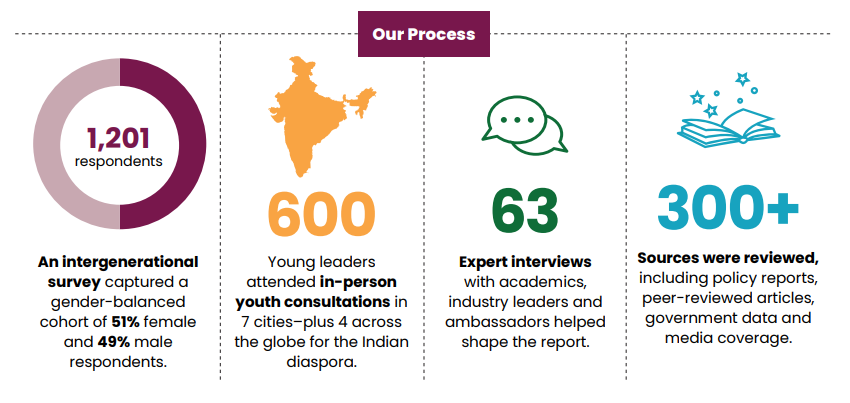
This report offers a roadmap for turning disruptive mega trends into opportunities for India and the world’s growth. It is an outcome of a mixed method approach, including an online survey of 1,200 people, 23 in-person and virtual consultations with more than 600 people across eight cities, and interviews with more than 60 experts across sectors.
As 10 young Indians part of the Next Generation India Fellowship, we represent the voices, ambitions, and ideas of a generation that makes up the largest share of our country’s population. Despite our different backgrounds and expertise, we are united by a simple but powerful purpose: to imagine a future we want to inherit.
Emboldened by this ambition, and with the support of the United Nations Foundation and CEEW, we began a journey of envisioning the future of India at its centenary of independence in 2047.1 It is a national call to action: to become a fully developed economy, a sustainability leader, and a reformer of global governance in time for our centenary of independence.2 For those outside India, Viksit Bharat is best understood as our North Star—a vision of what a strong, inclusive, future-ready nation should be.
But achieving Viksit Bharat is not inevitable. The question is not whether India has a vision—it does. The question is whether this generation can navigate disruption to make that vision real. With 734 million citizens under 30, nearly one in ten young people alive today is Indian.3 That makes our stake in the outcome impossible to ignore.
This report is our attempt to turn disruption into possibility. It is not written about young people, but by us. It is not a plea for inclusion, but a playbook for transformation intended to fulfill the promise of Viksit Bharat by sparking an intergenerational movement where every voice could contribute towards shaping a developed India.
Across months of listening, debating, and imagining with nearly 600 young Indians, five forces emerged as the great disruptors of our time. Each is a threat—but each, if grasped with courage, could be a lever for renewal and the realization of Viksit Bharat:
The Double-Edged Dividend
India’s youth bulge is historic. Yet, for many, it feels less like a dividend and more like pressure. Every year, millions enter the workforce with degrees in hand but uncertainty in their hearts.
Take Binati, who we met from a tribal community in Odisha.
a. At just 19, she contested panchayat elections. Though she did not win, her campaign lit a spark, showing other young women that political participation was not a privilege, but a right. Her courage speaks to the possibilities of this demographic moment: if youth are trusted with responsibility, we can reshape governance from the ground up.
The government’s call for Viksit Bharat depends on precisely this kind of participation. Without jobs, voice, and dignity for youth, the demographic dividend becomes a demographic burden. And time is short: by 2050, India’s population will begin to age.4 What we do now will decide if Viksit Bharat is a shared reality or an unfulfilled promise.
Building Next-Generation Cities
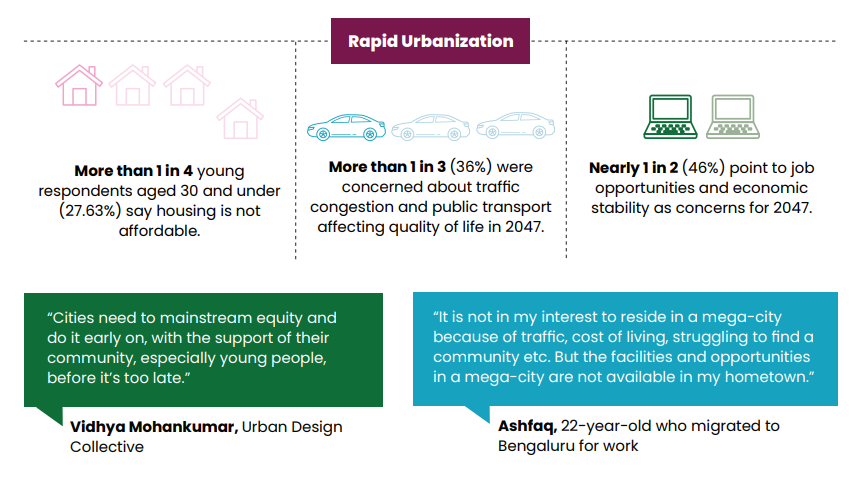
By 2036, India will add more than 600 million new urban dwellers.5 Cities are already where 60% of GDP,6 is produced and where young people chase opportunity, identity, and independence.
Yet, the lived experience is more complicated. Mubeena, a young professional who migrated from her village to Kochi, told us that staying away from family was the hardest thing she had to overcome, but she made the move to the city for work. Her story mirrors millions who migrate out of necessity, not choice, only to face soaring rents, fragile infrastructure, and unsafe streets.
Urbanization is the test of whether Viksit Bharat will be inclusive. Will it create megacities of inequality, or participatory 15-minute cities that work for everyone? Will migration constrain opportunities, or will Smart Village Hubs make India’s rural life more inviting?
Innovation and Skilling
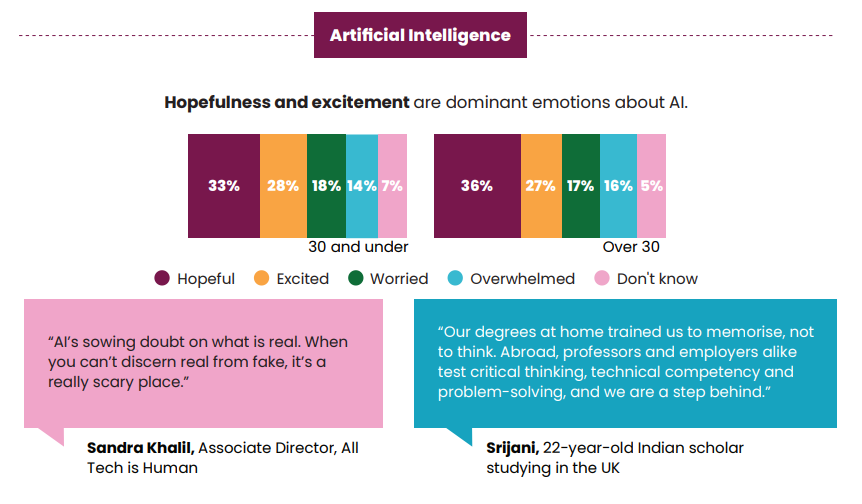
We are the first generation to come of age alongside technology that can make up their own stories, draw their own pictures, and even write their own songs. For some, AI can uplift and educate; for others, it is a looming threat to jobs and truth itself.
Ashim, a student we met in Silchar, dreams of solving his city’s traffic chaos using open-source datasets. He is proof that given access to equitable AI, young people in rural towns can innovate solutions that matter.
For Viksit Bharat to mean more than growth on paper, India must ensure that AI is in itself democratizing. That will require skilling, governance, and ethics to govern our path.
Moving From Anxiety to Action
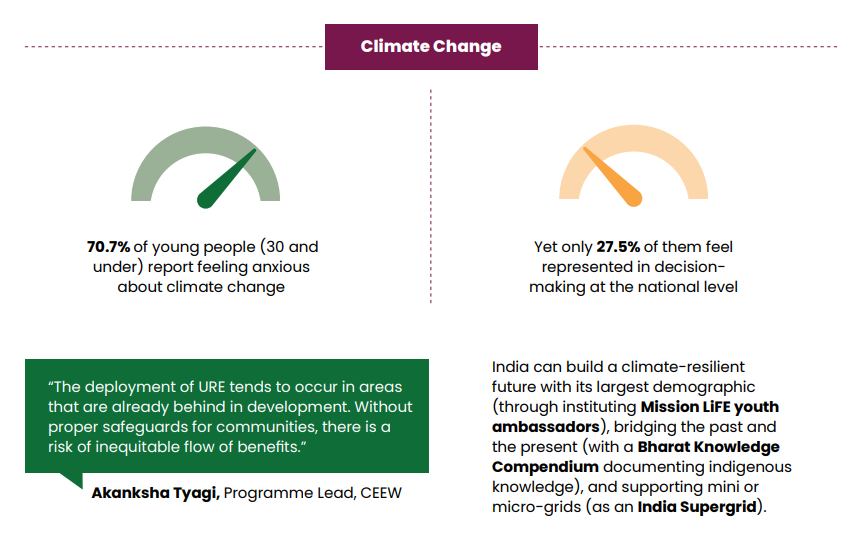
For our generation, climate change is not tomorrow’s story—it is today’s reality. Every consultation we held surfaced as a defining anxiety.
Consider Ravi, a student we met in Silchar, who nearly missed his exams when annual floods repeatedly delayed trains. Or Shraddha, who sees green jobs as a chance to earn while saving the planet. Their testimonies depict the dual nature of climate disruption: it is devastating, but it can also birth entirely new livelihoods.
India has placed climate action at the core of its Viksit Bharat vision. From leading the International Solar Alliance (ISA),7 to scaling Mission LiFE.8 But unless young people are empowered as co-creators of this transition—as innovators, farmers, entrepreneurs, and ambassadors—Viksit Bharat will fall short of its own promise.
Reimagining the future of global cooperation
The world our generation inherits is fractured. Multilateral institutions still reflect 1945, not 2045. Supply chains wobble under political strain. Conflicts erupt, pulling futures into uncertainty
Yet, young Indians are refusing to be bystanders. Harsh, a 24-year-old we met from Jammu and Kashmir, founded a youth-led think tank on foreign policy, making space for our voices in debates usually dominated by grey suits. And Nomzamo, a Zimbabwean student studying aerospace engineering in India, reminded us: “Countries like India are trying to cooperate a lot with young countries like mine, and our demographic strength is reflected in this knowledge-sharing process.”
For Viksit Bharat to make a difference globally, India must also lead a new grammar of cooperation that centers young countries, and ensures youth have a seat on the global table.
If Viksit Bharat is to be realized, vision must translate into action now, especially where young Indians live, learn, and lead. The pathways we propose are concrete steps—some quick wins that can be embedded into existing architecture building on current policies, others bold moonshots that demand new institutions and imagination that will require time but are essential for Viksit Bharat to endure. Together, they form an intergenerational playbook for India’s journey to its centenary.
At the heart of these proposals is a series of cross-cutting foresight innovations for a Future India centered with a Ministry of Future Affairs (MoFA). This new institution would anchor futures thinking across government, ensuring every budget, law, and program is tested for its impact on coming generations. MoFA would act as a bridge between quick wins and moonshots, making Viksit Bharat aspirational as well as achievable.
Demographic Trends
To safeguard people in the midst of demographic transitions
Rapid Urbanization
To power sustainable, and resilient people-centered cities
Artificial Intelligence
Establishing guidelines for inclusive and ethical use of AI for social good and growth
Climate Change
To turbocharge on climate change, moving from climate anxiety to climate action
Geopolitical Shifts
To centre young people at the heart of global decision making
To understand what these changes mean, imagine a day in 2047
It begins in a village in Jharkhand, where a teenage girl logs on at her local Smart Hub. Her project on solar-powered cold storage is mentored by an engineer in Bengaluru and funded by microcredit she accessed online. She does not need to leave her community to chase opportunity; opportunity has come to her.
In Bengaluru, her cousin joins his neighborhood’s annual City Sabha. Citizens vote on budget allocations—from flood-resilient infrastructure to youth sports facilities—and see the results implemented within months. For him, democracy is not something distant, but lived every day.
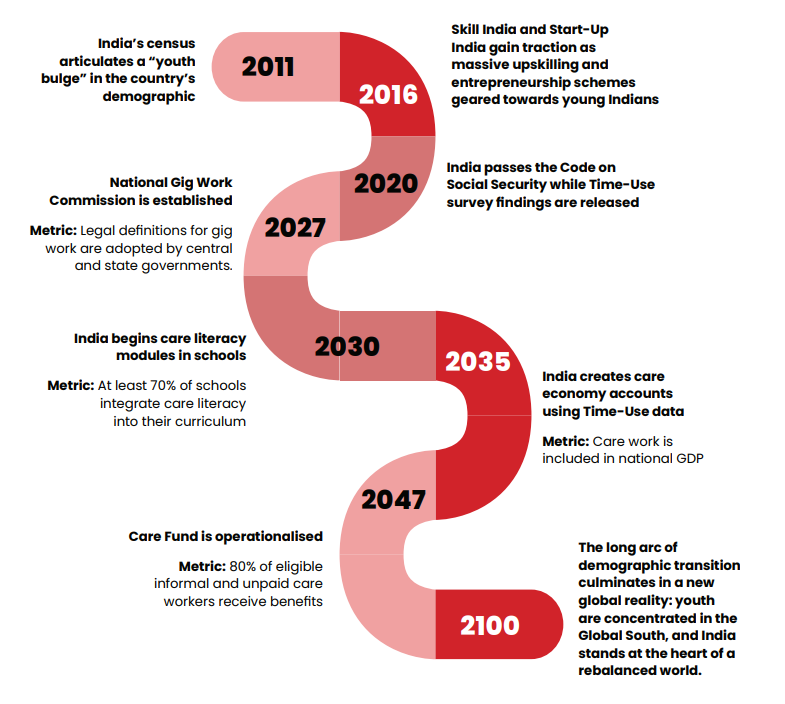
In Delhi, a group of gig workers meet with their representatives on the National Gig Work Commission. Their contracts guarantee sick leave, maternity benefits, and stable wages. They no longer fear the precarity of work, but see dignity in it.
On India’s coasts, renewable energy flows seamlessly through the India Supergrid. A sarpanch in Ladakh sends surplus solar power south; a young entrepreneur in Coimbatore trades neighborhood wind credits on an app. Electricity is not just a utility but a shared asset.
And at the United Nations, Maya, a youth delegate from Tawang, addresses the General Assembly. She speaks not only as a representative of India but as a guardian of future generations. Behind her sit peers from Africa and L.atin America—alumni of the Global South Fellowship—shaping negotiations through trust built years ago.
This is Viksit Bharat: not only a developed economy, but a society where every generation builds on the last, leaving more possibilities than it inherited. Global history teaches us that demographic windows close quickly.9 If India misses this moment, the cost will be borne for generations. If we seize it, however, India can show the world how the largest democracy and the youngest population can reimagine governance, sustainability, and solidarity for the 21st century.
This is our promise as Fellows: to be a generation that not only inherits the future but redefines it. But we cannot do it alone.
We call on policymakers to institutionalize foresight through a Ministry of Future Affairs. We call on businesses to invest in skills and care as seriously as they do in profits. We call on civil society to amplify young voices, not tokenize them. And we call on our peers—India’s 734 million young people—to see themselves as protagonists of Viksit Bharat.
This is the premise of Our Future India.
It is a manifesto of possibility; it is a blueprint for action; and primarily, it is an invitation to every generation to co-create the future with us.
The choice is ours. The time is now.
Our Future India draws on a combination of quantitative and qualitative evidence, shaped through extensive engagement with young people and an intergenerational group of experts across India and its diaspora. We chose this approach to ensure that the analysis is anchored in present realities while anticipating future shifts. This is critical to bridge short-term policy priorities with India’s long-term vision.
The locations for our research were selected based on relevance to the disruptors, accessibility, and geographic and socioeconomic diversity. Direct efforts were made through grassroots youth organizations to invite young people from marginalized communities. Experts were selected with an emphasis on intergenerational collaboration and multisectoral insights.
Combined with literature reviews, this provided a rigorous body of evidence on which to build our recommendations.
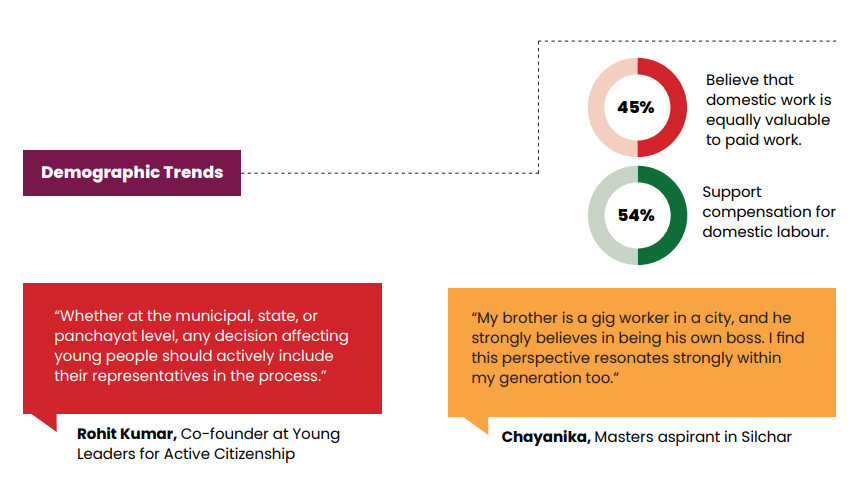
India needs to value young people by giving them a seat at the table (through a Young India Advisory Council), securing their livelihood (with a Gig Work Commission that defines new and emerging forms of work) and by ensuring wellness for young women in particular (via a central Care Fund compensating domestic labor through satellite accounts).
By building India’s villages with opportunities (with Smart Village Hubs that promote rural entrepreneurship) and its cities with participation (through a Jan Bhagidari, ‘peoples’ participation,’ model) young Indians will be able to shape the future irrespective of geography.
India can utilise AI for public good by building the next generation of AI-learners (in a Skills-First Education model with worker vouchers and credit-based courses) and simultaneously navigate its risks (by way of a Panel on AI and Emerging Tech that establishes guardrails through a rapid-response ethics board).
India is positioned to be the voice of the Global South. These efforts can be furthered through building the next generation of leaders (with a Young India Secretariat, embedding them in multilateral delegations) and connecting them with other young countries (through a Global South Fellowship, exchanging talent and ideas to co-create solutions).
We, the Next Generation India Fellows, are coming of age in an unprecedented moment.
More than 80 countries that gained independence in the aftermath of World War II will celebrate their centenaries in the coming decades.10 India is among the first.11 Many of these are young countries across the Global South where 50-80% of the population is under 30.12 Together, these young countries represent nearly nine out of ten people on the planet,13 and hold the majority of the world’s natural resources.14 Young people and young countries are architects of the 21st century. And we are doing so amidst profound disruption.
Five global forces—artificial intelligence, climate change, rapid urbanization, demographic shifts, and geopolitical change—are radically transforming how countries like ours think and act for the future.
Rising seas and heatwaves threaten livelihoods, while automation changes how we work and learn. Some nations struggle with aging while others grapple with massive youth bulges. Cities swell as millions migrate for opportunity, even as global power balances shift.
These disruptions bring risks—but with foresight and innovation, they can also become levers to leapfrog traditional development pathways, allowing India to disrupt the 21st century for the better.15 For us, as Fellows, these are not abstract trends. They are the daily realities shaping our futures, and they could also be the drivers of bold new opportunities.
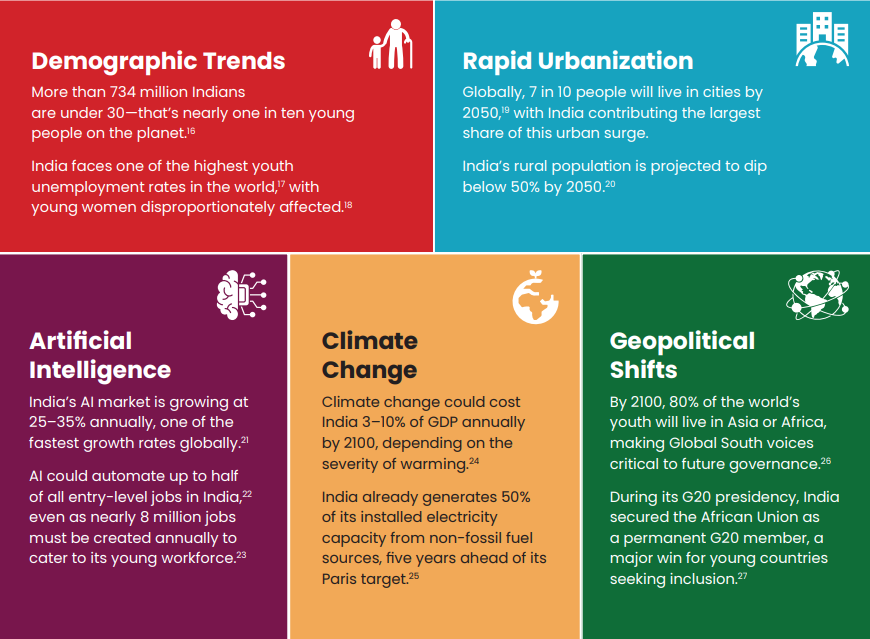
India stands at a defining crossroads. Our government has declared bold ambitions under the Viksit Bharat agenda: to become a developed economy, a global sustainability leader, and a leader of multilateral governance by 2047. But to actualize this vision in the face of disruption, India must harness its most powerful asset: us, its young people. With 734 million citizens under the age of 30, nearly one in ten young people in the world is Indian.
Our purpose in Our Future India is to present a youth-informed roadmap that could power India’s transformation by its centenary. We are clear that India’s path to 2047 cannot be imagined without young people leading it. Our recommendations are not demands but proposals—ideas that could take root in existing systems or inspire entirely new ones.
We know the risks if we fail. When we look to 2047, we see two possible versions of India.
In one, the disruptors converge into a perfect storm. Cities crumble under unplanned growth.28 AI displaces more jobs than it creates.29 Climate change forces migration and hunger.30 Multilateralism remains broken.31 Young Indians—the very asset meant to propel us forward—feel sidelined. Viksit Bharat becomes a deferred dream.
In the other, disruption becomes a springboard. Villages thrive as Smart Hubs where entrepreneurship is ingrained in local culture. Cities are inclusive, green, and participatory. AI becomes as empowering as electricity—invisible but everywhere. Climate action necessitates a wave of innovation and ingenuity, creating 54 million green jobs.32 India leads a Global South that speaks, becoming architects of a new global grammar. In this world, Viksit Bharat is fulfilled—not only as a government plan, but as a people’s project, shaped and led by young people. Our generation could be the one that reimagines governance; moving from reacting to crises to anticipating them.
This is why we believe India could shift from reactive policymaking to anticipatory governance—embedding foresight into every institution. Choices made in the next few years will define our route to 2047 and beyond. Will India merely react to shifting trends, or will it seize the moment to lead the way in employing AI, battling climate change, steering urbanization, leveraging its demographic strength, and championing a new era of multilateral cooperation? The answer lies in what we do next.
Turning vision into reality requires moving from diagnosis to action. The following pathways reframe and expand the recommendations of the Our Future India as an intergenerational playbook to achieve the status of a Viksit Bharat by 2047, with a blueprint centered on becoming a developed nation marked by economic success, scientific and technological prosperity, and social equity.
Each pathway addresses one of the five major disruptors. Tying them together is a cross-cutting institutional innovation: a proposed Ministry of Future Affairs to champion long-term thinking and intergenerational equity. These pathways are designed as concrete actions for policymakers, and communities to collaboratively secure India’s future. Quick wins tackle urgent needs with pilot programs and policy tweaks, while moonshot missions aim for transformational change by 2047. Throughout, we envision young people as active partners and leaders in bringing about these solutions. Each strategy listed is grounded in ongoing efforts or proven models, to ensure that India hits the ground running.
Above all, this playbook emphasizes that siloed interventions are not enough–coordination, intergenerational participation, and futures-thinking must underpin the nation’s approach to every challenge. Through these pathways, India can translate its demographic dividend, technological prowess, cultural wisdom, and global goodwill into concrete benefits for all citizens, present and future.
India’s demographic reality is a promise as well as a warning. With more than half of the population under 30,33 we are at the precipice of a historic opportunity: a vast, energetic workforce that could drive growth, and global influence. But this promise is fragile. Today’s young Indians face a paradox: they are entering the workforce in greater numbers, but often without adequate jobs or social support. India currently faces one of the highest rates of youth unemployment,34 particularly among young women.35 At the same time, India’s population is aging quickly, adding new care responsibilities that disproportionately fall, unpaid and unrecognized, on women and girls.36
For young Indians, this paradox is personal. Many of us are trying to find decent work and independence, while also carrying the weight of caring for our younger siblings and aging parents. If left unaddressed, such an imbalance risks turning our youth bulge into a liability rather than a dividend. To unlock the demographic dividend, India must do two things at once: create meaningful jobs for the millions of young people entering the workforce every year, and build a care system that shares responsibilities equally, without overburdening women.
We believe India’s youthful energy can become a transformative force for prosperity and social harmony if we tackle employment and care collectively. By investing in education-to-employment pipelines, supporting entrepreneurship, expanding green and digital jobs, and valuing the care economy as real work, we can enable young Indians to be innovators and caregivers without sacrificing their potential. Harnessing this moment means treating young people not as a challenge to be managed, but as equal stakeholders building a more prosperous, and future-ready India.
Objective: Transform India’s booming gig and informal work sector into a sustainable engine of employment with proper protections for workers.
India’s young workforce is increasingly engaged in non-traditional work–freelancing, gig jobs, platform-based services–that fall outside legacy labor laws.37 Acknowledging this shift, the government has begun extending social security for gig workers. The Code on Social Security (2020) legally defined gig and platform workers and laid a foundation for welfare measures.38
In 2025, the Union Budget expanded health coverage to gig workers via the e-Shram portal, a national database of unorganized workers.39 Some states, like Rajasthan, Karnataka, and Telangana,40 have gone further–pioneering laws such as the Rajasthan Platform-Based Gig Workers Act (2023) which guarantees social security and grievance redressal for gig workers.41
These are promising first steps, but India needs a dedicated institutional mechanism to continuously adapt policies to the ever evolving world of work.
We recommend establishing a Gig Work Commission at the national level as a standing body that brings together government, industry, worker representatives, and sectoral experts. The Commission’s mandate could include:
The Gig Work Commission would require high-level coordination. It could be anchored by the Ministry of Labour and Employment in partnership with the Ministry of Electronics and IT, considering the digital nature of many platforms. Close engagement with state governments would be essential since labor is a concurrent subject–states like Rajasthan and Karnataka can be incubators for innovation. The Commission could also collaborate with academic institutions and think tanks for data analysis, and with international organizations for aligning with global standards. Funding could come from a mix of government budget and contributions from industry to finance worker surveys and welfare programs. Crucially, gig workers themselves need representation–e.g. seats on the Commission or a formal consultation group–to ensure policies reflect on-theground realities. By institutionalizing this collaborative framework, we can create a responsive regulatory ecosystem that keeps pace with the future of work.
Objective: Build an infrastructure of support by way of compensation for care work– especially the unpaid and underpaid care provided by women–to address India’s aging population and free up young caregivers, allowing them to participate fully in India’s economy.
As India’s population ages with 347 million people over 60 projected by 2050, the burden of care is increasing exponentially.43 Indian women already perform three times more unpaid care work than men44 limiting their work opportunities.45 If unaddressed, this imbalance will entrench gender inequality while dragging down economic productivity and straining young caregivers–the backbone of India’s demographic dividend.
There is increasing recognition of this issue: the Indian government’s recent Time-Use Surveys have quantified women’s unpaid work,46 and national consultations on the care economy have recommended strengthening care infrastructure.47 The government’s Pradhan Mantri Matru Vandana Yojana (PMMVY) gives cash incentives for maternal health to pregnant and lactating mothers.48 Some states have begun innovative schemes such as Kerala’s Aswasakiranam initiative provides stipends to caregivers;49 Goa’s Griha Aadhar,50 and Assam’s Orunodoi scheme,51 offer cash transfers to housewives. Furthermore, India’s leadership at the G20 secured a commitment to address unequal care burdens.52 Building on these efforts, India can blaze a trail by formally valuing care work, incorporating it into its society and the economy.
Building on previous initiatives, we propose launching a comprehensive Care Fund and Framework that encompasses public awareness, education, and direct financial support for caregivers:
Implementing care reform at scale will require political will and coalition-building. The Ministry of Women and Child Development could lead the charge on designing the Care Fund and literacy programs, in collaboration with the Ministry of Finance (for funding) and MoSPI (for data). Partnerships with state governments are vital–states can pilot cash-for-care schemes and scale those that work. The private sector can be incentivized through CSR contributions to the Care Fund or awards for “family-friendly workplaces.” Civil society and women’s organizations will be critical for outreach–both to identify deserving beneficiaries and to monitor that benefits reach them. Financially, while remunerating unpaid work is ambitious, even a modest starting investment in the Care Fund could yield high social returns by enabling more women to work paid jobs (broadening the tax base) and improving health outcomes (reducing public healthcare burden through better athome care). International examples (like Europe’s caregiver allowances,56 or South Africa’s community health worker stipends)57 can offer models. Ultimately, valuing care is not just a welfare measure but a structural economic reform–one that future-proofs India for an aging society and unlocks the full potential of its youth, particularly young women.
We are witnessing one of the largest urban transitions in human history unfold in India. By 2050, more than half of the world will live in cities,58 with India alone projected to add 600 million urban dwellers by 203659 and contributing to one of the largest shifts in human settlement. For our generation, this transformation brings both daunting challenges and unique opportunities. On the one hand, we already feel the pressures of housing shortages, congested roads, rising pollution, and crumbling infrastructure.60 Our cities increasingly resemble concrete jungles,61 crowding out nature and local identities are fading. On the other, we see a chance to reimagine how our cities are designed–to make them engines of productivity, innovation, and dignity.
But urban growth tells only half the story. We know from our own villages and small towns that rural communities are often left behind. The rural share of India’s population is projected to fall below 50% by mid-century.62 Without urgent action, many of our peers will be forced to leave their homes and migrate en masse to overloaded metros, not because they want to, but because they have no opportunities where they are.63
We believe India’s goal must be twofold: to make our cities inclusive and livable, and to rejuvenate our villages as centers of growth. In other words, we need to build a future where young people can thrive whether they choose an urban or a rural life.
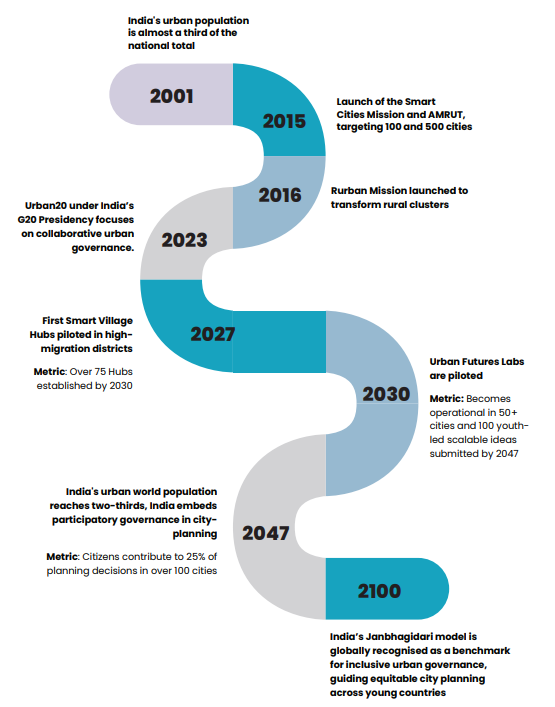
We recognize the government is already working on both fronts–the Smart Cities Mission has positioned 100 cities as innovation hubs,64 while the Atal Mission for Rejuvenation and Urban Transformation (AMRUT) is improving basic services in 500 cities.65 At the same time, programs like the Rurban Mission, 66 and the Startup Village Entrepreneurship Program, 67 are helping infuse enterprise into rural areas. Yet in our consultations and research, we found that these efforts often operate in silos. What we propose is a more cohesive approach–one that integrates these initiatives so that urban and rural transformation go hand-in-hand, ensuring no young Indian is left behind in this transition.
Objective: We have seen how migration shapes the lives of young people across India. Many of us leave our homes not by choice, but because opportunities are concentrated in cities. To change this, we propose creating Smart Village Hubs–local centers that bring digital infrastructure, skills training, mentorship, and incubation directly to villages. These hubs would turn rural areas into attractive places to live, work, and start businesses–giving young people the freedom to choose their futures without being forced to migrate.
The idea of stemming migration by improving rural livelihoods is not new, but our consultations confirmed that it is gaining urgency as India urbanizes. India’s Voluntary National Review 2025 also recognizes that focusing only on metros is insufficient and calls for empowering rural clusters.68 We see promising beginnings in initiatives like the Rurban Mission, which is creating hybrid rural– urban clusters with better infrastructure,69 and private efforts such as “Yuva Junction,” which is skilling rural youth.70
We propose dedicated Smart Village Hubs in high out-migration regions that combine infrastructure, technology, and entrepreneurship support into one cohesive model:
The Ministry of Rural Development, along with the Ministries of Skill Development and Youth Affairs, could spearhead the Smart Village Hubs initiative. State governments would need to lead on-the-ground implementation–for instance, Punjab’s Innovation Mission,72 or Kerala’s Startup Mission could pilot hubs in their states.73 Each hub could operate as a public–private partnership: local governments provide space and basic funds, a respected NGO or educational institution manages operations, and companies contribute through CSR, whether by donating equipment or sponsoring skill programs.
We suggest that a multi-stakeholder steering committee at each hub–including panchayat leaders, youth representatives, and mentors–ensure the model stays responsive to local needs. Key metrics such as reduced youth migration, new enterprises created, and increased rural incomes should be tracked to measure success. At the national level, the government could establish a “Hub Fund” that states apply competitively, with readiness and need as criteria. International donors focused on rural development and digital empowerment could also be tapped.
Over time, hubs could be scaled nationwide and networked together, enabling a youth in one village to collaborate with peers across India. Ultimately, Smart Village Hubs would transform rural India by embedding opportunities where people live–so that “city or village” becomes a matter of preference, not survival.
Objective: We want deeper, everyday democracy in our cities. Our proposal is a Jan Bhagidari (People’s Participation) Framework—with participatory budgeting and citywide “urban labs”—so development is cocreated with citizens, especially young people, leading to more livable and equitable cities.
As our cities expand, we keep seeing top-down planning miss local needs and marginalize communities. There’s a better way—and it’s already proving itself in India and around the world: give residents real power to shape budgets and projects. From participatory budgeting that builds trust and services like in Porto Alegre,74 to Copenhagen’s neighborhood councils that co-design urban renewal,75 the evidence is clear. India has piloted similar approaches—from ward-level voting on local works in places like Pune,76 to village-level drives like Prashasan Gaon Ki Aur. 77
To truly harness youth ideas and energy in city-building, participation now needs to move beyond ad-hoc experiments to a structured framework across all cities.
We recommend implementing a Jan Bhagidari Urban Governance Framework with two key pillars:
Institutionalizing participatory governance needs both top-down support and bottomup engagement. The Ministry of Housing and Urban Affairs could issue a national participatory budgeting framework and a practical toolkit (drawing on UN-Habitat’s participatory decision-making guides),78 which could potentially be set up under the Urban Challenge Fund that incentivizes cities to become growth hubs.79 It could also train municipal staff and ward officers to facilitate inclusive meetings, run digital voting, and co-design projects. This would involve partnering with local NGOs, universities, and civic-tech teams to convene residents and analyze ideas. Where needed, state municipalities could formally allocate a budget slice to citizen decision-making and to recognize Urban Futures Labs as advisory/innovation partners. If successful, the approach can extend to rural governance through gram sabhas, linking with the 73rd Amendment spirit. By 2047, Jan Bhagidari can be simply “how we do things” in India’s cities—a democratic innovation worthy of the world’s largest democracy at 100, with young people co-authoring the future of their places.
We are living through one of the most dramatic technological revolutions in history, led by Artificial Intelligence (AI) and digital technologies. As Fellows, we see India at the very forefront of both opportunity and risk in this transformation. On one hand, our tech sector is booming: India’s AI market is growing at 25–35% annually,80 private AI investment reached $1.4 billionmaking India a top-10 AI investor country in 2023,81 and the government has committed over $1.25 billion to build AI capacity.82 Initiatives like the IndiaAI Mission,83 and new AI Centres of Excellence are underway.84 Young Indians–Generation AI–are quick adopters; in our survey, one in three of us expressed hopefulness about AI’s potential. We already see inspiring examples–from teenagers building AI health tools to startups tackling local challenges with AI-powered solutions.85
But our research and conversations also made clear that these technologies bring risks with them. By some estimates, AI-driven automation could threaten half of entry-level jobs in India,86 even as nearly 8 million jobs must be created annually to cater to its young workforce.87
Digital divides continue–many of us still don’t have smartphones or reliable internet,88 meaning the benefits AI provides could remain uneven. Concerns around privacy, algorithmic bias, and misinformation are urgent: 76% of young people we engaged reported encountering online misinformation regularly, and only 2% said they could reliably spot fake news.89 The challenge, then, is twofold: to govern technology responsibly (to mitigate risks and protects our rights) and to empower young people through technology (to access the skills and opportunities of the digital economy).
The following strategies are our proposals for how India can lead in AI in a way that is inclusive and ethical.
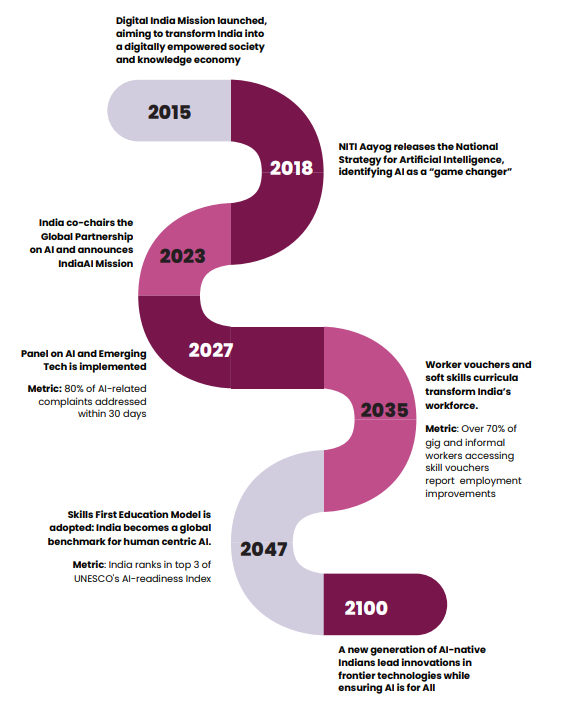
Objective: We propose creating a permanent, multi-stakeholder Panel on AI and Emerging Technologies–an agile governance body that mandates AI’s deployment ethically, inclusively, and in step with society’s needs, while also responding rapidly to threats like, misinformation, and algorithmic bias.
India has already begun important steps in tech governance–from the Digital Personal Data Protection Act to guidelines on AI’s responsible use.90 We also saw India play a global role by chairing the Global Partnership on AI (GPAI), 91 and co-hosting a summit focusing centered around AI for All.92 Yet, policy is struggling to keep pace with the breakneck speed of technological change; advisories issued in 2024 had to be revised within months,93 underscoring the challenges of keeping policy in-step with fast-moving technologies. From our perspective, a new approach is required–one that combines regulatory authority with foresight and flexibility, and includes youth voices at the table.
We propose that the National Panel on AI and Emerging Tech, under the Ministry of Electronics and Information Technology, have three main components:
The panel should be set up via executive order or legislation, anchored in the Ministry of Electronics and Information Technology (MeitY). Funding could come from a mix of government allocations and industry contributions. India has previously had foresight experience in this space, specifically with the Technology Information, Forecasting and Assessment Council (TIFAC),94 and high-level advisory bodies such as the Office of the Principal Scientific Adviser to the Prime Minister.95 The real credibility will come from transparency: publishing reports, consulting the public, and showing impact. With time, this panel could shape India’s domestic standards as well as its global norms, creating a paradigm where young, developing countries influence the rules of the game rather than simply adopting Silicon Valley’s.
Objective: Adopt a Skills-First Education Model that shifts hiring from degrees to demonstrated skills, preparing India’s youth for jobs that do not even exist yet.
We hear every day from young people who ask: “Will my degree actually prepare me for a job?” Too often, the answer is no. Traditional rote learning and degree-centric hiring are leaving graduates unemployed or underemployed, even when paper qualifications look good.
Nearly half of India’s graduates were deemed unemployable.96 The rise of AI makes this urgency sharper: as some skills vanish, the ability to continuously learn and adapt becomes essential. We propose a Skills-First Education Model–one that values what people can do, not just the degree they hold, and embeds future-oriented skills at every stage of learning.
Implementing this model will require coordination between the Education, Skill Development, and Labor ministries. It will need investment in vouchers, digital infrastructure, and teacher training. Partnerships with ed-tech platforms and industry will be crucial for delivery at scale. Accreditation and quality assurance will ensure credibility of new credentials. Just as important, we need a cultural shift: families and employers must begin valuing skills and certifications alongside degrees. If government recruitment starts piloting skill-based exams, it will send a strong signal. By focusing on what every young Indian can do and nurturing that, we can safeguard against the churn of the AI age and ensure our youth are ready for the jobs of the future
For our generation, climate change is not some far-off possibility; it’s the daily reality of heatwaves, erratic monsoons, cyclones, floods, droughts, and air that makes us sick. These disruptions already affect millions of Indians, and if global warming persists, India could lose between 3–10% of GDP annually by 2100.99 We are the ones who will live through the sharpest edge of these changes, but we are also the ones stepping up with solutions.
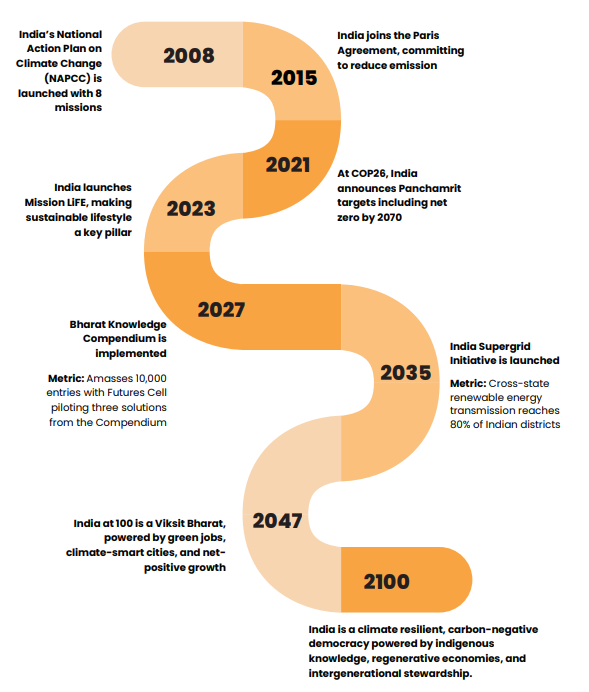
India has shown that rapid progress is possible. We are proud that our country has already achieved 50% of its installed electricity capacity from non-fossil fuel sources—five years ahead of the 2030 target under the Paris Agreement.100 This milestone signals accelerating momentum in the clean energy transition. We have also taken global leadership through the ISA,101 the Coalition for Disaster Resilient Infrastructure,102 and the launch of Mission LiFE (Lifestyle for Environment) to drive sustainable living.103
Objective: We propose creating a Bharat Climate Knowledge Compendium—a national digital and physical repository that documents, validates, and shares traditional and local knowledge on sustainability, and climate adaptation. Importantly, youth must lead at every stage: gathering wisdom, testing ideas, and turning them into action.
India has centuries of indigenous wisdom on how to co-exist with nature—from traditional farming techniques and water harvesting to herbal medicine, sacred groves, and community-led forest management. Such practices are often low-cost, locally adapted, and proven over generations. Yet many are at risk of being forgotten at precisely the time when we need them most.
We’ve already seen efforts like the Traditional Knowledge Digital Library, 104 which protects indigenous medicinal knowledge from biopiracy, and People’s Biodiversity Registers which document ecological practices in some regions.105 But these need to go further. In our conversations, young people repeatedly told us how these traditional practices are disappearing, and the 2025 Voluntary National Review itself flagged concerns about this erosion.106 We believe the Compendium can safeguard this heritage and translate it into actionable strategies for climate resilience.
Start with a bottom-up, evidence-based approach through:
We propose that the initiative be anchored in the Department of Science and Technology by way of the Anusandhan National Research Foundation,110 with the Ministries of Environment, Agriculture, Tribal Affairs, and Rural Development as key partners. Funding could draw from climate budgets or even rural employment schemes—imagine if workdays included knowledge documentation. Tech firms could build the platform as part of corporate social responsibility. It is important to note that this requires trust-building: working with community leaders and affirming intellectual property rights so that communities are never exploited.
To maximize impact, Compendium outputs should feed directly into District Climate Action Plans. Universities should encourage PhD research on documented practices, deepening scientific validation. With time, the Compendium could become a flagship of India’s climate leadership— fortifying resilience, creating jobs for youth in documentation, and reviving cultural practices in the process.
Objective: Build an India Supergrid, connecting renewable hotspots with communities nationwide—a decentralized, resilient, and green energy democracy.
India has actively promoted a clean energy transition through several initiatives. The National Solar Mission aimed to install 20 GW of solar capacity by 2022, a target that was later revised upward to 100 GW, reflecting growing ambition.111 On the international front, India has championed a Global Biofuels Alliance,112 and co-founded the ISA.113 At home, initiatives like the PM Kisan Urja Suraksha Evam Utthan Mahabhiyan scheme are driving solar adoption at every level.114
But we see real challenges. Renewables like wind and solar are variable, and often far away from where energy demand is highest. India’s grid is trying to improve its reliability and expand access in underserved communities, where power outages are a common occurrence or electricity is unavailable.115 That’s the challenge the Supergrid intends to address.
An India Supergrid could act as a nextgeneration power system that brings together massive renewable projects while decentralizing micro-grids. Think of it as an internet of energy: flexible, distributed, and interconnected. A grid built for both efficiency and equity, affording every young person in India, no matter where they live, access to clean power and the ability to shape a green future.
Launch the India Supergrid Initiative with the following components:
We know this won’t be easy. Transforming India’s grid will take investment in the hundreds of billions over decades. But much of this can build on what’s already planned, if channeled smartly. Ministries of Power and Renewable Energy could lead together, with agencies, state utilities, and regulators aligned. New laws must unlock micro-grid sales and peer-to-peer energy trading. Financing can come from climate funds, or even a “Green Grid Accelerator” backed by global banks. India could also draw lessons from decentralized energy models in countries like Kenya,119 where mini-grids have expanded rural access, and Indonesia,120 where micro-hydro power implementation has strengthened off-grid communities. The rollout can start small before scaling nationwide. Resistance from traditional utilities is real, but business models can change: from sole sellers to platform providers. If India pulls this off, it won’t just hit climate goals—it will set a global standard for inclusive growth. By its centenary, India could proudly offer its people the greatest gift: clean and reliable energy for all.
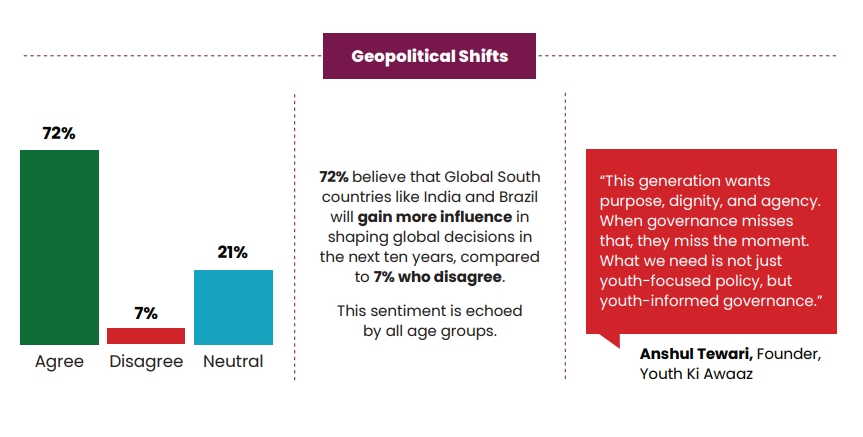
The global order is being reshaped before our eyes. Traditional institutions are struggling with legitimacy and delivery, while new power centers rise. As one of the world’s largest and youngest democracies, India is stepping into a bigger leadership role, from calling for reforms in multilateral bodies to shaping agendas at the G20.121 But true leadership isn’t only about governments; it’s about people. And with half the world under 30 and 80% of all young people projected to live in Asia or Africa by 2100,122 global cooperation that sidelines their voices is bound to falter.
For young people, today’s geopolitical shifts are not abstract. Economic dependencies,123 trade dynamics,124 and tightening migration policies cut off opportunities to learn and work abroad. Global knowledge and innovation are still concentrated in the North, leaving the South underrepresented.125 New frontiers such as cybersecurity, AI, space, and health security urgently need fresh governance frameworks—areas where young, tech-savvy nations like India can bring vision and solutions.
We believe India can help shape a fairer world order by championing youth as the bridge across countries and cultures. Imagine South-South cooperation led not just by diplomats but by young entrepreneurs, activists, and innovators. Picture global institutions infused with the creativity and urgency of the next generation, enabling them to be more responsive to the challenges of our century. This is how we see a future where India’s leadership means lifting up the voices of a generation that will inherit the future.
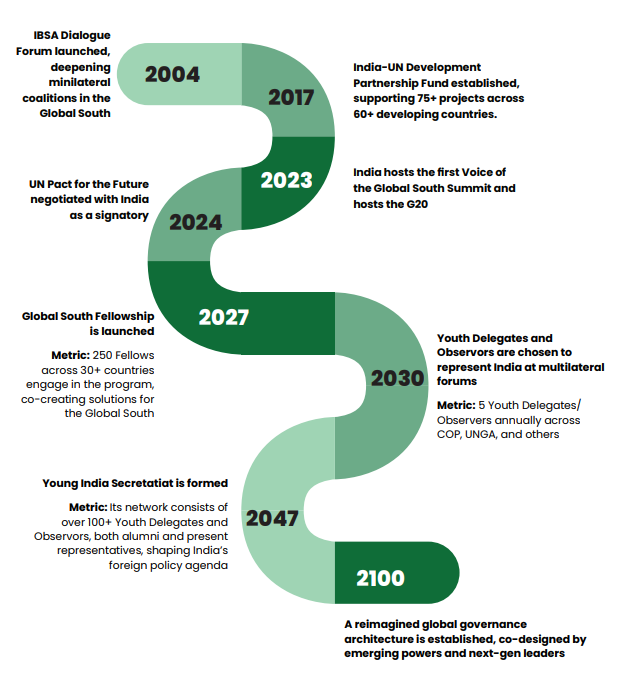
Objective: We propose launching a Global South Young Leaders Fellowship—a flagship program that connects India’s youth with peers from Africa, Latin America, South Asia, and Southeast Asia. The idea is simple but powerful: two-way exchanges that build a network of next-generation leaders committed to shared development, diplomacy, and lifelong ties across continents.
India’s tradition of South-South cooperation runs deep. Generations of students have crossed borders through ICCR scholarships or diaspora programs like “Know India.”126 India also signed multiple bilateral youth exchange programs with countries including Japan and Poland.127 But with Africa’s youthful population booming, Latin America’s experiments in social frameworks, and Asia’s rapid transformation, there’s a new urgency to nurture these connections. Instead of one-off exchanges, we need a bold fellowship that creates a community of leaders who think, work, and solve problems together.
As proposing implementing the Global South Fellowship with these key elements:
Implementation requires vision in partnership with the Ministry of External Affairs. We recommend starting with pilot countries before scaling. Funding can be pooled into a dedicated Global South Fellowship Fund, with international cooperatives and private endowments joining in. To ensure mutual ownership, the fellowship could be built in collaboration with partner countries. This may take the form of bilateral or multilateral MoUs with governments, and universities across countries. Success could be measured by the networks built and alumni rising to leadership
By implementing this fellowship, India positions itself as a convener and mentor of young global talent. More than diplomacy, it’s about investing in a generation ready to lead together, proving that South-South cooperation isn’t aspirational, it’s transformational.
Objective: A Young India Secretariat would ensure youth representatives and advisors are part of India’s official delegations and diplomatic work at major global forums like the UN, G20, and BRICS. This would guarantee that the outlook of young people, both from India and worldwide, are directly included in shaping international positions, while also facilitating Indian youth as bridges for global cooperation.
The time has come to make youth inclusion in diplomacy standard practice. Other countries have already shown what is possible: Germany, Mexico, Australia, Sri Lanka, and others have created UN Youth Delegate programs,128 where young representatives join national delegations, carry out consultations, and bring youth voices into global discussions.
India, through its vast and dynamic youth population, has an unparalleled opportunity to lead. During India’s 2023 G20 Presidency, the Y20 engagement group demonstrated this capability by producing a youth communiqué that called for institutionalizing youth representatives for future generations.129 We believe it’s time to go further—creating a standing Secretariat that coordinates and sustains youth participation and representation across all global platforms where India has a role.
Develop the Young India Secretariat with these features:
The Young India Secretariat requires both political will and practical systems. The government must commit to youth as legitimate actors in foreign policy. Early concerns about experience or discipline can be tackled with clear selection criteria, training, and coordination protocols. Youth delegates would function as part of the delegation team, under the leadership of the head of delegation, with speaking slots in appropriate forums. The Ministry of Youth Affairs can align the Secretariat with the National Youth Policy, giving it bureaucratic backing. Costs would be modest— covering travel, a small Secretariat office, and training workshops—while the returns in human capital and global credibility would be immense.
Coordination with international institutions is feasible, as the UN already encourages youth delegates. India could also push within the G20 to formalize youth representation, ensuring Y20 recommendations flow directly into G20 outcomes. Over time, if India secures a permanent United Nations Security Council (UNSC) seat, a youth advisor sitting behind the Ambassador’s chair would symbolize India’s intergenerational leadership. The key will be continuity: embedding the Secretariat in long-term policy frameworks so it survives political transitions.
When future historians look back at innovations in diplomacy, India’s Young India Secretariat could stand alongside peacekeeping as a proud national contribution—one that redefined international relations to be more inclusive, forward-looking, and just.
As India strides towards Viksit Bharat@2047, we recognise that utilizing the five global disrupters for good will require bold sectoral reforms as well as new institutional catalysts. They demand governance that is anticipatory, inclusive, and youth-engaged.
In the spirit of working with and for young people for a better future, we propose three transformative enablers to future-proof India’s development journey:
These three catalysts form a triad of institutional innovations that could unlock the full potential of India’s youth and ensure our nation is prepared for the future. They are ambitious but achievable with the right mix of investment and empowerment of young changemakers. Each reinforces the other: with a Ministry looking to the future, a Council bringing youth to the table, and youth leaders galvanising communities, the whole becomes greater than the sum of its parts.
By enacting these enablers, India would cement young people as co-creators of Vision 2047. It would demonstrate that India is future-ready. And it would show the world a model of how a large, diverse nation can transform itself from within, harnessing the idealism and ideas of youth to steer the ship of state through disruptive waters. This is our collective call to action–a call we hope will resonate from the halls of Parliament to the classrooms of our villages. The journey to Viksit Bharat has room for every generation; our recommendation is to make sure the youngest generation is helping chart the course.
Envisioning Future-Ready Governance
In 2024, the UN Declaration on Future Generations sounded the alarm that complex, interrelated challenges “if left unaddressed, will compound harm to future generations,” and that many such risks are “now more foreseeable than in the past”.131 The preceding chapters have detailed structural recommendations to tackle today’s disruptions based on current trends. Yet, given the nonlinear and accelerated characteristics of these disruptions, siloed, short-term interventions are not enough.132 Combating such compounding crises requires disruptive thinking. We need to institutionalise futures thinking: systematically exploring multiple scenarios and acting toward desirable outcomes–the creation of a Ministry of Future Affairs is a bold step to make anticipation and intergenerational fairness an everyday part of how India governs. By embedding futures thinking into our institutions, India would be better positioned to navigate a world in flux , safeguarding the rights of future generations while addressing present needs.
Building on India’s Foresight Foundations
India is steadily laying the groundwork for institutionalised foresight. A prominent example is the creation of NITI Aayog in 2015 to replace the 65-year-old Planning Commission–a recognition that five-year plans were too short-sighted for India’s evolving developmental needs. As the Prime Minister said then, India needed “a new body, a new soul, a new thinking, a new direction […] to lead the country based on creative thinking”.133
Since then, NITI Aayog has been charged with envisioning Viksit Bharat@2047 and has released multi-decade roadmaps for India’s development. Under this vision, many ministries have produced long-term strategy documents–from the Health Ministry’s Public Health Surveillance Vision 2030, 134 to the Technology Vision 2035 by TIFAC under DST.135 Several states are following suit: Tamil Nadu charted a path to a $4.2 trillion economy by 2047,136 Uttar Pradesh is preparing a Vision@2047 focused on its cities,137 and Gujarat’s blueprint for Viksit Bharat is a “living document” regularly revised.138 Notably, Maharashtra in 2023 introduced a pioneering Future Generations Bill,139 inspired by Wales’ globally trailblazing Well-being of Future Generations (Wales) Act 2015. 140 That bill–one of the first serious attempts in a large democracy to legislate long-termism–would mandate the state government to consider the long-term impact of its decisions and create an independent Commissioner for Future Generations. Such developments show a growing appetite in India for futures-oriented governance.
Yet, vision documents and pilot initiatives, while a good start, are not truly anticipatory; they routinely assume linear progress and are unable to account for cross-sectoral disruptions (for example, how climate volatility might reshape health outcomes or in what ways AI could upend labor markets). The next step is to transition from isolated foresight exercises to a permanent, integrated mechanism that scans the horizon and acts across silos.
To that end, we propose establishing the Ministry of Future Affairs–a dedicated body at the national level to champion long-range planning, and integrated governance. It would continuously anticipate the crosscutting impacts of current and future global disruptions. Crucially, MoFA would enable policymakers to anticipate, prepare for, and even prevent crises–using futures tools such as scenario mapping and strategic foresight–. By institutionalizing horizon-scanning and “future-proofing” across government, MoFA keeps India a step ahead of disruptions that could otherwise snowball.
MoFA would also create an enabling ecosystem to scale up innovation pilots that address these disruptions. India boasts a vibrant hub of startups, social enterprises, and pilot projects tackling problems from climatesmart agriculture to AI-driven skilling. Yet too often, promising solutions remain stuck at pilot stage and are unable to scale nationally.141 The proposed MoFA would embed innovation into mission-mode projects. It would launch timebound, goal-driven missions (6–24 months) on pressing issues, with dedicated budgets and clear targets, and crucially include “sunset clauses” and handover protocols. Successful missions would then be handed off to line ministries for expansion, ensuring localized innovations translate to large-scale impact. Such an approach combines agility with institutional backing, so that a clever solution piloted in one district can swiftly become a national program.
Finally, MoFA answers the need for thought leadership from the Global South on longterm governance. Until now, the futures discourse has been dominated by frameworks from advanced economies (the Wales Act being a prime example).142 While valuable, those models do not fully reflect the realities of countries like India that must pursue development amid disruption. India’s own G20 Presidency in 2023 proved our ability to inject a long-term, inclusive perspective– championing digital public goods and reforming MDB for future resilience.143 Echoing the UN call for member states to adopt futureoriented governance,144 India has the chance to demonstrate how a populous, developing democracy can institutionalise futurereadiness. By creating MoFA, India will not only plan for its centenary milestones but will help shape a century where the interests of future generations are a priority of the government today.
Under MoFA’s umbrella, several game-changing initiatives can lead the way to 2047:
In summary, a mission-oriented Ministry of Future Affairs would ensure that India’s development over the next 25 years is guided by a coherent long-term vision. It centers on the belief that planning for the next generation must start now, in this generation. By 2047, MoFA’s impact could be transformative–India having weathered disruptions and leaped ahead in multiple domains because we had the foresight to plan, the agility to innovate, and the solidarity to include every voice, especially the youth, in shaping our country. We see MoFA as the institutional bridge to make the bold ideas of this report a reality, safeguarding a prosperous, and equitable India for decades to come.
Bridging Generations at the Pinnacle of Policy
Over the past decade, India has consulted young people on numerous policies that impact their future. The formulation of the National Education Policy, for instance, involved inputs from youth and students.148 India’s Voluntary National Review on the SDGs included dedicated consultations with children and youth.149 The Prime Minister himself has voiced an ambition to engage 100,000 youth in public affairs.150
Structures for youth engagement do exist, notably a National Youth Advisory Council under the Ministry of Youth Affairs and Sports,151 but these are relatively limited in mandate and reach. As India accelerates towards its Viksit Bharat goals, the time is ripe to institutionalise youth participation at the highest level of government.
Countries worldwide are experimenting with formal avenues for youth input. Every municipality in Finland is required by law to have a Youth Council or equivalent body for young people’s representation.152
Rwanda’s robust National Youth Council feeds youth perspectives into national development planning.153 Building on India’s progress and these global lessons, we propose a Youth Advisory Council to the Prime Minister: a permanent, empowered body to channel the insights of India’s young generation directly into the Prime Minister’s Office (PMO).
The Path Ahead–From Forums to Formal Voice
India’s initiatives like the Viksit Bharat Youth Parliament,154 and the Young Leaders Dialogue have energized youth to contribute ideas on nation-building.155 These forums, alongside ad-hoc consultations, display a growing recognition that young Indians are stakeholders in today’s decisions. The natural next step is to move from episodic engagement to a continuous advisory mechanism. A Youth Advisory Council to the PM would reflect this sentiment. It would institutionalise a two-way dialogue between India’s youth and its top leadership, ensuring that the vision for 2047 is informed by those who will live the longest with its consequences.
Conceived akin to the Economic Advisory Council to the Prime Minister (EAC-PM), the Youth Council would serve as a consultative body on emerging issues and generational priorities. Concretely, the Council would:
Provide Direct Policy Insights: It would offer independent, evidence-based advice to the PMO on issues that affect young and future generations such as–the future of work in an AI-driven economy, bridging digital divides, accelerating the energy transition towards green jobs and more. Having a standing council allows the government to get youth perspectives quickly on fastevolving challenges, circumventing the need to convene large-scale events each time. For instance, if a sudden spike in youth unemployment occurs or a new social media trend raises ethical questions, the PMO could task the Youth Council to analyze it and recommend actions within weeks.
Institutionalise Foresight and Feedback: The Council could meet regularly (say, quarterly) and publish Youth Advisories or “Youth White Papers” on topics of national priorities. Much like the EAC-PM releases economic outlooks,156 the Youth Council could release reports on themes such as “India’s Innovation Decade: Youth Entrepreneurship Roadmap” or “Building an Inclusive Digital Economy for Young India.” These advisories would be publicly available, adding transparency while giving a broader youth audience a reference point for policy discourse. They would also act as a feedback loop, conveying which government initiatives are successful on ground and which are not from a youth perspective.
What Will It Take–Structure and Political Will
To bring the Youth Advisory Council to life, we envision a model with around 25–30 members, selected by a transparent and competitive process to ensure diversity of geography, gender, caste, socio-economic background, and expertise. The Council could comprise young achievers and community leaders (18–35 years) from different fields– entrepreneurs, students, activists, artists, scientists–truly representing the mosaic of New India. Each member would serve a twoyear term. Alumni would form a network of former members mentoring new Councillors and carrying forward the ethos of youth participation in other areas. Importantly, the Council should be anchored in the PMO to provide an official pathway to decisionmaking. This mirrors global best practice: Canada’s Prime Minister’s Youth Council, for example, is run out of the Canadian PM’s office and convenes with the Prime Minister and officials regularly to advise on national issues.157
Procedurally, the Youth Council might function similar to the EAC-PM in terms of workflow.158 It would have a small secretariat to support research and logistics. The Council could be subdivided into task forces aligned with priority themes impacting young people’s lives and futures, each producing briefs and recommendations. We propose quarterly meetings where Council members present their findings and insights directly to the PM and relevant ministers. Additionally, the Council’s reports would be submitted to the Union Cabinet or NITI Aayog for further consideration, ensuring youth-informed ideas enter the bureaucratic pipeline.
A crucial success factor will be legitimacy and non-partisanship. The selection process would be merit-based and insulated from politics–perhaps involving an eminent jury or an independent panel–so that the Council is viewed as credible by both government and the public. By design, this Council is advisory; it does not usurp any decision-making power, which mitigates any political resistance. The Council provides the PMO a sounding board that keeps policies attuned to the pulse of young India.
If implemented well, by 2047 it could give rise to a dynamic pipeline of young leaders feeding into mainstream leadership. The Youth Advisory Council would have created a cadre of alumni who go on to serve in government, politics, academia, and civil society, all acting as champions of–participatory governance. Even more, it would normalize the inclusion of young changemakers in all major national conversations. India’s democracy will be stronger for it.
Youth at the Forefront of Climate Action
Climate change and environmental sustainability are now daily realities instead of distant concerns. Recognising this, India has been actively involving its young generation in its climate initiatives. During India’s G20 Presidency in 2023, the Youth20 (Y20) Summit convened young delegates from across the world who unequivocally called for greater youth inclusion in climate governance and action.159 At home, innovative campaigns have tapped into youth volunteerism–for example, the Youth for Swachhata under Swachh Bharat Mission Urban have mobilised young volunteers to champion cleanliness and waste management in cities.160 In thousands of schools nationwide, Eco-Clubs are fostering environmental responsibility in schools, from tree-planting drives to plastic-free campus initiatives.161 Building on this momentum, India’s flagship Mission LiFE (Lifestyle for Environment)–which advocates sustainable everyday behaviors, offers an ideal platform to spur on youth leadership on climate and sustainability. We propose a dedicated Mission LiFE Youth Ambassador Programme that empowers young Indians to drive local climate solutions, influence community behaviors, and bridge grassroots action with national climate benchmarks.
From Classrooms to Communities: Mission LiFE focuses on making sustainability a mass movement, encouraging individuals to adopt simple lifestyle tweaks that collectively have a big impact. The Mission LiFE Youth Ambassadors could take this mission beyond the classroom eco-clubs into communities and online spaces, making it aspirational for young people to lead climate-friendly lives. The programme could create pathways for youth to become climate champions, each Ambassador catalyzing change in their own circle of influence. Bringing youth into structured methods of climate action with real authority and backing would unleash their leadership.
A Mission LiFE Youth Ambassador could serve as a local leader and role model for sustainable lifestyle practices. Each year (or two-year term), a cohort of Youth Ambassadors could be selected across all states–for example, 500 exceptional young people aged 15–29 who have shown passion for climate action. These Ambassadors would:
Lead Hyper-Local Campaigns: Every Ambassador would design and implement at least one grassroots campaign complimenting the 7 themes of Mission LiFE (such as energy saving, water conservation, reduced waste, healthy lifestyle, etc.). This could involve organizing neighborhood plastic-free drives, building composting systems in their village, promoting cycling to school in their town, or running an online pledge drive for responsible consumption. These campaigns are hyper-local and as such, are tuned to their community’s needs, encouraging others to join, and creating a domino effect on behavior change.
Bridging Local and National Action: Youth Ambassadors could provide insights to the government on what works at the ground level and what challenges are faced in living sustainably. They effectively become the eyes and ears of Mission LiFE across India’s vast diversity. For example, if many Ambassadors report that lack of public transport is a barrier to “No-Car Sundays” in small towns, that insight can inform policy tweaks. Conversely, Ambassadors could also help translate national campaigns into local languages, ensuring central policies resonate with the public. In this way, they connect policy with people. Each cohort would formally be attached to the Mission LiFE secretariat, contributing to periodic reports or strategy updates based on their on-ground learnings.
Making It Happen–Support and Scale
To operationalise the Youth Ambassador programme, a robust support system would be required. First, a selection and training network should be established. This could leverage present structures: for example, the NYKS (Nehru Yuva Kendra Sangathan).162 The selection would prioritize not just academic achievers but also young people who have shown initiative on climate action.
Once selected, Ambassadors would undergo training on sustainable technologies, community mobilization, and behavior change communication. They would be provided with toolkits like– a Mission LiFE mobile app or handbook–that gives them ideas, resources, and even a way to log their activities. Partnerships with other organizations like NGOs, environmental groups, and CSR initiatives would be helpful here. Many civil society groups are already active in climate education; collaborating with them can increase reach and provide mentorship to the Ambassadors. Public-private partnerships could bring in funding and innovation.–For example, a tech company might support an online platform for Ambassadors to collaborate on campaign ideas, or a renewable energy firm could sponsor solar kits for Ambassadors to distribute in villages.
Crucially, the programme should recognise and reward the Ambassadors to incentivize membership. They could receive certificates from the government acknowledging their service, and exceptional Ambassadors might get opportunities like an annual meeting with the Prime Minister or Minister of Environment, Forest and Climate Change, or representing India in international youth forums. A national summit of Mission LiFE Youth Ambassadors could be held annually, as a forum for collaboration and to celebrate their contributions. Over the years, this would build a powerful alumni network–a generational cohort of climate-conscious leaders by 2047.
The Youth Ambassadors programme could expand in scope. Today’s focus might be on lifestyle changes, but by 2030 or 2040, experienced Ambassadors could focus on municipal climate cells, advising city officials on urban resilience, or in school eco-councils mentoring younger students. The programme’s flexibility means it could evolve as new issues arise (for example, in a decade the focus might shift to Ambassadors advocating for green jobs or climate-smart agriculture in their localities).
The core of the Mission LiFE Youth Ambassador Programme is to embed the energy and idealism of India’s youth into our national climate priorities. It acknowledges that achieving a “Lifestyle for Environment” on a large scale is as much a social endeavor as a governmental one–and who better to lead a social movement than the youth?
By 2047, we envision an India in which sustainable living is second nature to every citizen, largely because young Ambassadors led the way in making it a mass movement. Thousands of young Indians would have grown through the programme into environmental leaders in their own right, greening their lives and influencing their families, communities, and workplaces. The ripple effects–on everything from reduced carbon emissions, to strengthened social fabric and international reputation, will be marked for generations.
India stands on the edge of a new era. The choices we make today will decide whether global disruption becomes a crisis or opportunity. From artificial intelligence to climate change, from the strain of urbanization to the promise of our demographic dividend, the challenges are immense. Yet, so is the energy and imagination of young people. In these pages we have laid out a roadmap that is both ambitious and achievable: bold reforms, new institutions, and a generation ready to lead
The journey to India@2047 demands urgency in starting, patience in seeing results, courage to attempt what has never been tried before, and humility to adapt along the way. Most significantly, it demands unity of purpose—between young and old, government and citizen, city and village. The next step is not more words—it is action.
To India’s Leaders and Policymakers
These proposals are not isolated dreams. Many are already seeded in government policies, state programmes, and community pilots. What is needed is scale, speed, and seriousness. We propose starting with the scaffolding: set up the Futures Cell in the PMO or NITI Aayog within the year to embed anticipatory governance. Signal intent by announcing a Ministry of Future Affairs—an institution that will keep India focused on long-term priorities, across governments and political cycles.
Take forward the 10 strategies of Our Future India agenda by creating inter-ministerial task forces on Jobs and Care, Urban Revamp, Gen-AI, Climate Resilience, and Global Youth Leadership. Some reforms can start immediately—fold a Gig Workers’ Commission into the labour code review, pilot Participatory Budgeting in the next urban mission, allocate budget lines for the Care Fund, Smart Village Hubs, and the Global South Fellowship. Where necessary, legislate for continuity: give MoFA statutory backing, propose a Future Generations Bill, and make intergenerational justice a principle of governance
History will not only ask what you did for the young, it will ask if you did it in time.
To Public Institutions and Civil Society
India’s future will be built in classrooms, courtrooms, media rooms, and panchayat halls. Each of you has a role.
Together, become the champions and the watchdogs of the future.
To Young India—Changemakers, Builders, Citizens
This agenda is for you, but it will only succeed if it is led by you. You are not bystanders but architects of what comes next.
Organise in your own spaces. Form youth councils in your wards to shaping local planning. Turn your student club into a Mission LiFE hub. Start a small innovation project in your town or village. Apply for fellowships, step up as Mission LiFE Ambassadors, volunteer as Youth Delegates. Every action—big or small—matters.
Rural or urban, young women or young men, North or South—our strength is in our solidarity. Four in five young Indians already believe our actions today will decide India@2047. Make that belief visible every single day.
Do not wait for permission. Lead where you can. The ideas you trial today can become tomorrow’s national policy.
2047 is not far away. We cannot afford drift or delay. This report gives us a map and a compass. The heavy lifting begins now, in ministries and schools, in gram sabhas and boardrooms, in start-ups and on street corners.
We imagine an India where every ministry includes a young representative or a futures analyst in its deliberations. Where every new law is tested for its effect on future generations. Where a new social contract binds the generations together.
So let us be clear in our charge:
To the government: be bold to make reforms that will last
To institutions: work across silos, because transformation happens only when boundaries fall.
To young people: this future belongs to you; claim it with courage, and imagination.
As reiterated by the Prime Minister, Sabka Saath, Sabka Vikas, Sabka Vishwas, Sabka Prayas (Everyone's support, everyone's development, everyone's trust, everyone's effort) is our guiding mantra.163 Together, let us collaborate on this blueprint, refine it, and then back it with action. Judge us not by the promises we make, but by the outcomes we deliver—by 2030, and again by 2047: jobs and dignity for every young Indian; clean air, water, and a livable climate; governance that is representative, responsive, and future-ready; and an India that is a beacon of solidarity and solutions.
The future is watching. Let us rise to meet it.
Our dreams must now become our shared future.
Our Future India begins today.

India in Future Tense: 47 words for 2047