Council on Energy, Environment and Water Integrated | International | Independent


Suggested citation: Bhanja, Pratyush, Satheskumar Kanagaraj, Rishav Thakur, Eshita Kochhar, Parvathy Subha, Anjaly John, and Madhumitha Srinivasan. 2026. What Drives Natural Farming Adoption in Andhra Pradesh? Evidence from Farmer Behaviours and Practice Trends. New Delhi: Council on Energy, Environment and Water.
India’s Green Revolution transformed the country into a food-surplus nation, but it also intensified dependence on synthetic fertilisers, pesticides, and irrigation-intensive cultivation systems. Over time, this input-intensive model has contributed to soil degradation, rising cultivation costs, farmer indebtedness, and ecological stress.
In response, natural farming (NF) has emerged as a promising agroecological alternative. Andhra Pradesh’s Community-managed Natural Farming (APCNF) programme—launched in 2016 and implemented by Rythu Sadhikara Samstha (RySS)—is among the world’s largest state-led agroecological transitions. The programme aims to transition 8 million farming households to natural farming in the next decade.
This Issue Brief analyses longitudinal survey data from 933 long-term natural farming households across Andhra Pradesh to understand the institutional, behavioural, and agroecological factors influencing the adoption of NF practices. Drawing from data collected from May 2023 to April 2024, the study examines how adoption varies across regions, seasons, farmer categories, and programme engagement.
The findings highlight that sustained community resource person (CRP) engagement, irrigation access, women’s participation in decision-making, and health motivations are among the strongest drivers of adoption. The study also finds that once farmers transition, adoption intensity is similar across landholding sizes—including medium and semi-medium farmers in Green Revolution regions.
The analysis offers actionable recommendations for scaling natural farming through community-led extension systems, context-specific demonstrations, and women-centred dissemination strategies.
1. Sustained cadre interaction is one of the strongest drivers of natural farming adoption
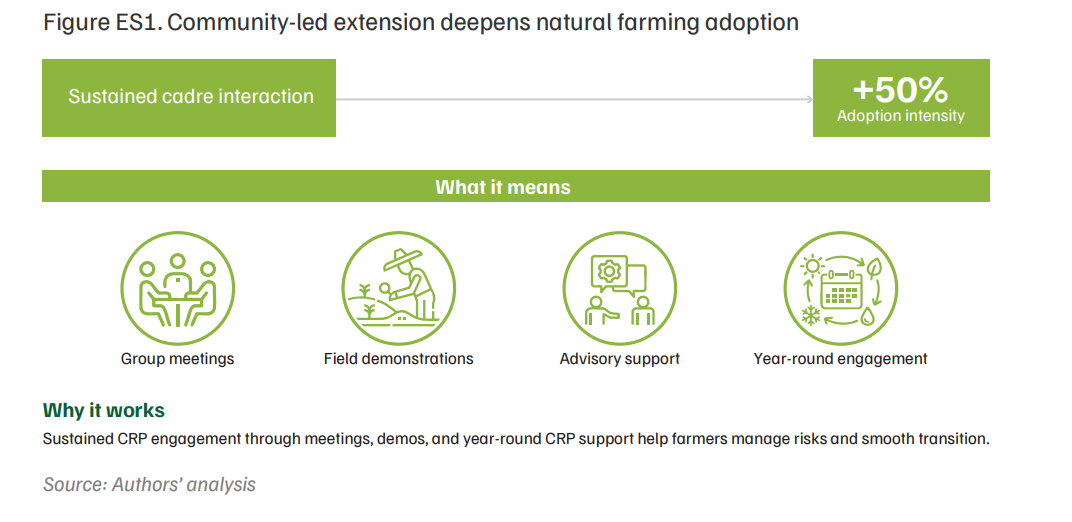
Farmers who regularly interacted with Community Resource Persons (CRPs) adopted 51 per cent more NF practices during the rabi season and 36 per cent more during kharif. Field demonstrations and peer learning networks further strengthened adoption.
Key insight: Natural farming adoption is not a one-time behavioural shift. Sustained handholding and embedded community extension systems are critical for long-term uptake.
2. Green Revolution regions show strong natural farming adoption among transitioned farmers
Contrary to prevailing assumptions, farmers in Andhra Pradesh’s Godavari and Krishna zones—regions characterised by input-intensive agriculture—demonstrated high adoption of biostimulants and integrated pest management (IPM) practices.
The study also finds no clear correlation between landholding size and adoption intensity among already transitioned farmers.
Key insight: Medium and semi-medium farmers in irrigated and input-intensive regions can sustain NF adoption when supported through tailored demonstrations and long-term engagement.
3. Women’s participation in farm decision-making increases adoption intensity
Households where women actively participated in farm-related production decisions adopted 14 per cent more NF practices.
Women-led self-help groups (SHGs), which form the backbone of the APCNF dissemination model, emerged as important institutions for behaviour change and peer learning.
Key insight: Women are not just participants in agroecological transitions—they are central agents of adoption and dissemination.
4. Health and nutrition concerns are major motivators for natural farming adoption
Around 84 per cent of surveyed farmers cited concerns regarding synthetic chemicals in food production as a primary motivation for adopting NF. More than half highlighted the importance of producing chemical-free food for household consumption.
Key insight: Farmers increasingly associate natural farming with safer and healthier food systems. Public messaging around nutrition and health could strengthen adoption pathways.
India’s Green Revolution of the 1960s transformed the country, lifting it from a state of food insecurity to food surplus. However, the input-intensive practices that underpinned the movement have brought significant ecological and socio-economic externalities, including soil degradation, adverse health impact of chemical exposure, and rising farmer debt — making our agriculture system highly vulnerable to shocks (Kumar et al. 2017). In response, alternative models of sustainable agriculture have emerged in recent years. One such initiative is the Andhra Pradesh Community-managed Natural Farming (APCNF) programme, launched in 2016, which promotes chemical-free agroecological practices. The programme aims to scale natural farming (NF) through community-led models by empowering women-led self-help groups (SHGs), fostering peer learning and providing critical support for training.
The APCNF programme seeks to transition all six million farmers and eight million hectares under cultivation in Andhra Pradesh to NF by 2031. The Indian government also aims to have 10 million (1 crore) farmers practising NF by 2027 (PIB 2023). Several states in India are introducing dedicated plans and budgets for scaling NF1. In this issue brief, we analyse longitudinal survey data from October 2022 to April 2024 of farmers in Andhra Pradesh to identify the drivers and barriers to NF adoption and to derive pathways for scale-up.
Our study covers 933 households who practice natural farming in 78 gram panchayats (GPs) spread across all (13 former) districts of Andhra Pradesh, where the APCNF programme was introduced between 2016 and 2019. The selected households have been practising natural farming in at least 10 per cent of the cultivated area for a minimum of two years. These households offer insights into the long-term trajectory of NF adoption.
We analyse adoption patterns across agricultural seasons and agroclimatic contexts by first validating and cleaning the dataset and then segmenting observations by season to reflect the state’s cropping calendar.
To identify the determinants of adoption intensity, we estimate a Poisson regression for the number of NF practices adopted, and use logistic regressions to assess what drives the adoption of specific practices, controlling for key socio-economic and geographic factors (e.g., wealth, education, land ownership and agroclimatic zone) and relevant household characteristics.
The findings summarise what this evidence reveals about the strongest levers and bottlenecks for scaling NF adoption in Andhra Pradesh. (Refer to Chapter 2 for more details on our sampling approach).
1. Sustained engagement with community resource persons (CRPs) is a key driver of natural farming adoption and sustenance
Evidence from long-term APCNF farmers shows that consistent CRP support is associated with a 50 per cent higher adoption of natural farming practices compared to households without regular engagement. Through group meetings, field demonstrations, and year-round advisory support, CRPs enable smooth transitions and reinforce practice uptake.
Adoption patterns also highlight the programme’s promise to evolve farmer behaviour over time— while over 70 per cent of APCNF farmers currently use biostimulants (a past programme focus), practices like 365-day green cover or border and trap crops, though initially adopted by less than 40 per cent of farmers, are now becoming more widely used, as observed in later rounds of data collection and field visits. This underscores the need for policymakers to institutionalise community networks as a long-term (5+ years) extension strategy, complemented by performance-based incentives for extension workers, as envisaged under National Mission on Natural Farming (NMNF), to sustain high-impact farmer engagement.
2. Targeted support can drive high natural farming adoption even in input-intensive regions.
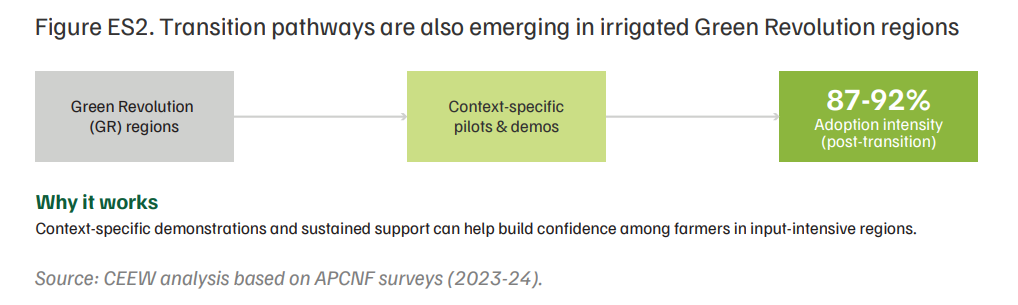
We find that APCNF farmers from Andhra Pradesh’s Godavari zone—a chemical inputintensive, irrigated, Green Revolution (GR) region—show high adoption intensity of NF practices. Among APCNF farmers in this region, 87–92 per cent report using biostimulants. Notably, we also find that the intensity of NF adoption is consistent across marginal, small, semi-medium, and medium landholders once they transition—an important insight for GR regions, where medium and large farmers dominate and drive input-intensive agriculture. During our consultations with programme implementers, we found that although they faced initial resistance to the transition in the GR regions, the farmers who adopted NF showed stronger commitment and higher adoption intensity than farmers in other regions.
To tap into this opportunity, agroecological programmes should consider piloting strategies in GR regions to:

3. Households where women are active in decision-making are more likely to adopt a greater number of natural farming practices.
Evidence from APCNF farmers demonstrate that the involvement of women in farm-related decisions led to a 14 per cent rise in the number of NF practices adopted. Given women’s critical role in agricultural labour and household food & nutrition decisions, the scale-up strategy for NF must target rural women via SHGs. In the APCNF programme, women SHGs have demonstrated significant merit in dissemination and uptake of the programme. Women’s aspiration to provide chemical-free, nutritious food for their families makes them natural leaders in the movement toward sustainable agricultural practices.
4. Produce being nutritionally safer and healthier is a major driver for natural farming adoption.
As many as 84 per cent of the farmers surveyed cited the harms of using synthetic inputs for food production as their primary motivation for adopting NF, demonstrating awareness of input-intensive agriculture's negative impact on health, nutrition, and soil. Among these, 51 per cent of farmers specifically highlighted NF's ability to provide chemical-free food for their families as a primary motivator, underscoring their concerns regarding health and nutrition.
With the NF scale-up currently targeting small and marginal farmers who typically rely on family labour and consume a significant share of their produce, the health benefits of NF emerge as a critical factor in driving adoption. Reduced use of synthetic inputs lowers exposure risks for household members involved in cultivation, while the self-consumption of produce supports safer and healthier food consumption for the family. Positioning NF produce as nutritionally safer and healthier may unlock greater buy-in from farmers and accelerate adoption. Moreover, integrating NF produce into public procurement systems such as Public Distribution System (PDS), Integrated Child Development Services Scheme (ICDS), and Pradhan Mantri Poshan Shakti Nirman (PM-POSHAN) may create stable market access, extend health gains to nutritionally vulnerable populations, and enhance programme reach by leveraging existing public distribution platforms for wider dissemination.
To summarise, for a successful scale-up of natural farming, and sustainable practices in general, the focus must be on (i) sustained and long-term engagement of CRPs with farmers; (ii) awareness campaigns on health and nutrition benefits of NF; (iii) Promoting context-specific training and demonstration plots tailored to farmers in GR regions; and (iv) engagement of women as a critical entry point for initial dissemination of NF approaches and its impacts.
Natural Farming (NF) is an agroecological approach to agriculture that seeks to reduce dependence on synthetic chemical inputs such as fertilisers, pesticides, and herbicides. Instead, it promotes the use of locally prepared natural bio-inputs, ecological pest management, crop diversity, mulching, and soil health restoration practices such as pre-monsoon dry sowing. NF aims to lower cultivation costs, improve soil health, reduce ecological stress, and support safer and healthier food systems.
The Andhra Pradesh Community-managed Natural Farming (APCNF) programme is a state-led agroecological initiative launched in 2016 and implemented by Rythu Sadhikara Samstha (RySS). It is among the world’s largest community-driven natural farming programmes. APCNF aims to transition 8 million farming households in Andhra Pradesh to natural farming by 2036. The programme relies on women-led self-help groups (SHGs), community resource persons (CRPs), peer learning, and local extension systems to support farmer transition and long-term adoption.
The Andhra Pradesh Community-managed Natural Farming (APCNF) programme is among the world’s largest agroecological transitions. Its scale, institutional design, and long-term implementation offer valuable lessons for India’s broader natural farming mission.
The study identifies sustained CRP engagement, peer networks, women’s participation in farm decisions, and health motivations as key drivers.
No. The study finds that adoption intensity among already transitioned farmers does not vary significantly by landholding size.
Women’s participation in household production decisions positively influences adoption intensity. Women-led SHGs also play a central role in dissemination and peer learning.