Council on Energy, Environment and Water Integrated | International | Independent


Agroforestry (AF) is defined as land-use systems and technologies where woody perennials (trees, shrubs, palms, bamboos, etc.) are deliberately used on the same land-management units as agricultural crops and/or animals, in some form of spatial arrangement or temporal sequence (European Union 2020). Agroforestry systems range from subsistence livestock and pastoral systems in home gardens, alley intercropping and biomass plantations spread across different context-specific biophysical conditions and varied socio-ecological characteristics (Singhal et al. 2019). It has addressed key societal issues like rural development, poverty reduction, food security, feed security, industrial raw material production, climate resilience and provision of livelihood security for 350 million people (Kumar et al. 2023) while also enhancing ecosystem benefits such as soil health, water security, and biodiversity. Agroforestry also supports the achievement of various Sustainable Development Goals (SDGs) (Telwala 2023). In line with India’s commitment to achieving net-zero by 20701 and Bonn challenge2 , many national strategies recognise agroforestry as a critical strategy (MoEFCC 2023).
In addition, the Agroforestry is being scaled through the Submission on Agroforestry under the National Mission for Sustainable Agriculture (NMSA) and National Agroforestry Policy, 2014. At present, it meets more than half of fuelwood needs for the country, around two-thirds of small timber, 70-80 percent of plywood, 63 percent of the raw material for paper pulp, and 9-11 per cent of the green fodder requirement of livestock, as well as meeting subsistence needs of households for food, fruit, fibre, medicine, etc (Kumar et al. 2016). Despite a decade of dedicated efforts, the area under agroforestry in India has increased by only 0.45 per cent of the total geographic area (TGA) from 2013 to 2023 (ICARF 2024). This modest progress underscores the urgency of enhancing India’s carbon sink, especially as net greenhouse gas emissions continue to rise.
Agroforestry is particularly critical for the state of Odisha, where Agriculture, Forestry and Land-use (AFOLU) sector emissions remain net positive, unlike the national trend, despite 39 per cent of the state's area being under forest cover. Recognizing the need to develop the sink, the state has a target to increase the forest cover to 43 per cent (SAPCC 2020), while 28.79 per cent of its agricultural land is degraded and exhibiting low productivity (GoO 2020). The state also recorded one of the lowest farm households incomes in the country (PIB 2022).
With 14 per cent of cultivable land already practising agroforestry (Newaj et al., 2017), Odisha is poised to harness its full potential as a long-term viable strategy. Through scaling up of agroforestry, Odisha could become one of the leading states in India to convert the croplands as net sinks while addressing multiple outcomes across social and economic challenges in the state3 (Watson 2017).
Jobs, market and investment opportunity:
For scaling up of agroforestry, we consider two broad models: block plantation and alley cropping and all other models such as low-density block plantations, cover cropping, boundary plantations, etc., are assumed to be part of the two spatial arrangement models chosen. We have estimated the technical capacity of the state in scaling up agroforestry as per application of two broad models across various degrees of suitability4 of different land categories5 .
Carbon sink enhancement: Odisha is uniquely positioned to emerge as a leading state in enhancing India’s carbon sink to align with the country’s net-zero targets. Despite having 39-40 per cent of its area under forests and 37 per cent forest cover (SAPCC 2020), the state remains the 4th largest emitter nationally, with net-positive emissions from the Agriculture, Forestry, and Land-Use (AFOLU) sector, primarily driven by rice cultivation and not livestock. This provides an opportunity for the state to expand its agroforestry practice as a transformative solution, complementing natural forest restoration and contributing significantly to Odisha’s ambitious target of achieving 43 per cent forest cover. With the potential to sequester up to 586 Gg C yr⁻¹ by 2040 (Singh and Pandey 2011), and leveraging agro-climatic systems capable of capturing 5-10 kg C ha⁻¹ over 25 years or 100-250 kg C ha⁻¹ in just 10 years in species-intensive systems (Nair et al. 2009). By concentrating efforts to scale agroforestry, Odisha can become the leading contributor to India’s carbon sink development and achieve long-term climate action.
Pioneer in addressing land degradation: Odisha has a unique opportunity to position itself as a national leader in combating land degradation and achieving Land Degradation Neutrality (LDN) for India. With 34 per cent of its TGA degraded (VEDAS 2021) and 28.79 per cent of agricultural land affected (GoO 2020), the state faces significant challenges impacting crop yields, production, and livelihoods. However, agroforestry offers a transformative solution. By scaling agroforestry systems, Odisha can boost crop productivity by 20-60 per cent and reduce input costs (ICAR-CAFRI 2020), while restoring degraded lands and enhancing resilience in its predominantly rainfed agriculture. In addition, agroforestry has been found to reduce soil erosion by 50 per cent and increase soil carbon by 21 per cent (Muchane et al. 2020). In addition, tree roots in agroforestry systems (AFS) have been shown to significantly reduce nitrogen and phosphorus groundwater leaching by up to 97.7 per cent and 90 per cent, respectively, while also achieving up to 100 per cent attenuation of surface runoff (Pavlidis and Tsihrintzis 2017). With 14 per cent of its cropland already under agroforestry, Odisha is well-positioned to lead in scaling this practice, setting an example for India in arresting desertification and achieving LDN by 2030.

The WADI agroforestry system, promoted by BAIF Development Research Foundation in Maharashtra, integrates multipurpose trees, fruit, and nut trees within agricultural fields. This model improves soil and water conservation through trenches and bunds. Implemented from 2001 to 2005, the programme saw 64 per cent adoption among eligible farmers. Each wadi typically included 0.4 hectares of land with an average of 43 surviving fruit trees per farm, primarily cashew, mango, and amla. This system increased tree cover, reducing reliance on local forests for fuelwood. Socio-economically, 48 per cent of adopters reported income from fruit yields, and the programme helped mitigate distress migration. Key to its success was the five-year technical support, free planting materials, and community-based planning, which aligned local needs with conservation goals (Doshi, Brockington, and Brook 2015).
Who could support in scaling agroforestry?
1. Role of departments:
Department of Agriculture and Farmers' Empowerment: The department could ensure policy convergence, inter-departmental coordination, and optimised financial support for the Sub-mission on Agroforestry. It could designate ICAR-CAFRI as the nodal agency and collaborate with relevant departments (Land Resources, Forest, Technology, and Horticulture) for developing knowledge, technological and operation infrastructure for implementation such as information, education and communication (IEC) channels, quality planting material (QPM) production standards, monitoring frameworks and financial incentives for adoption. The department could collaborate with Odisha State of Agriculture & Technology (OUAT) for capacity development of institutions such as extension networks to support adoption and develop demonstration farms tailored to agro-ecological zones (AEZs) of the state. Additionally, with the Forest Department and OUAT, the department could create a compendium of agroforestry models for converging the Green Credit Mechanism to foster scalability of agroforestry.
Directorate of Horticulture: In coordination with the Department of Agriculture, the directorate of horticulture could develop diversified models of horticulture crop combination compendium and create model farms and aid in development IEC channels. With ICAR-CAFRI and Forest Department, the directorate could lead the facilitation and development of obtaining agroforestry products and QPM certification programmes.
Department of Mission Shakti and Department of Co-operation: Given small operational land holding sizes in Odisha, these departments could focus on promotion of agroforestry practices among women farmers, self-help groups (SHGs), farmer cooperatives, Farmer producer organisations (FPOs) through collectivisation models.
Odisha State Agricultural Marketing Board: The board could develop incubation centres to ensure branding, certifications and marketing strategies are developed for cooperatives and FPOs practising agroforestry to ensure better economic realisation. The department could also be involved in contractual framing through tripartite agreements with farmer cooperatives or FPOs and private players to ensure fair compensation to the farmers.
Odisha State Cooperative Bank (OSCB): Along with NABARD 6 , the bank could develop specialised credit mechanisms for agroforestry projects that may include insurances, no collateral loans, zero-interest credit for applying for certifications and credits value addition enterprises at the farm gate.
Odisha Rural Development and Marketing Society (ORMAS): ORMAS could assist in developing market linkages and value chains for agroforestry products. This shall help in creation of domestic demand for agroforestry products with Odisha-based industries. ORMAS could also assist in developing producer groups for agroforestry products such as fruit or timber producers. It may also provide support in technology adoption, product diversification, packaging, branding, and sales for farmers to increase adoption of the practice.
2. Role of the private sector:
Demand creation through sustainable raw material sourcing practices: The private sector in Odisha could play a critical role in creating demand for agroforestry-based products by adoption of principles of sustainable sourcing of their raw materials. For example: the wood-based industries in Odisha could adopt a mandate for Forest Stewardship Council (FSC) certified timber7 , or sourcing fruits for food processing industries. Such mandates could scale the adoption due to market requirements.
Collaboration: Manufacturers can collaborate with agricultural producers through FPOs or farmer cooperatives to secure a long-term stable supply of feedstock or raw material for the industries by ensuring financial support for certifications and assured buy-back policies. The private sector could collaborate through strategic partnerships across the state to institutionalise fair trade practices across the value chains.
Financing: Private sector plays a huge role in mobilising corporate social responsibility (CSR) funds to scale up adoption of agroforestry. As agroforestry is a multi-outcome strategy, the private sector could ensure in-flow of CSR funds for scaling agroforestry through the partnerships with civil society organisations (CSOs). They could also mobilise funds for certification and enable green credit access to the farmers through strategic landscape development CSR initiatives.
3. Role of local administration and civil society organisations (CSOs):
Awareness creation: CSOs could play a vital role in promoting agroforestry by engaging with local communities to raise awareness about its benefits. They can organise workshops, campaigns, and community meetings to educate farmers on how agroforestry can improve soil health, increase biodiversity, and provide additional income streams. By encouraging the formation of agroforestry-based FPOs and cluster-based business organisations (CBBOs), CSOs can help farmers collaborate, share knowledge, and leverage collective bargaining power.
On-ground implementation and handholding: CSOs could support the on-ground implementation of agroforestry practices by providing training and technical assistance to farmers. This includes offering guidance on tree selection, planting techniques, and integrated pest management. CSOs can also connect farmers with financial institutions to secure funding for agroforestry projects, ensuring they have the necessary resources to succeed. Continuous handholding and support from CSOs can help farmers navigate challenges and optimise their agroforestry systems for better yields and sustainability.
Enabling market linkages: CSOs can help farmers access markets for agroforestry products through various channels. By organising exhibitions, trade fairs, and utilising online platforms, CSOs could connect farmers with potential buyers and promote their products. Additionally, CSOs can assist in developing quality standards and fostering product innovation to enhance the marketability of agroforestry produce. By facilitating market linkages, CSOs could ensure that farmers receive fair prices and stable income from their agroforestry endeavours.
Overcoming challenges to scale agroforestry
1. Land tenure issues: Tenure insecurity presents a significant barrier to the adoption of agroforestry, particularly in Odisha, where weak land tenure systems, institutional challenges, and socio-economic disparities limit long-term investments in tree-based systems. With the average landholding size ranging from 1 to 1.25 hectares (GoO n.d.), and competing land-use demands for cultivation, pastures, and cash crops, farmers face disincentives to integrate trees into agricultural landscapes (FAO 2019). The absence of formalised tenure frameworks further exacerbates this issue, hindering efforts to scale agroforestry practices and address agricultural vulnerabilities in the state (UNDP 2008).
Way forward: As part of its Vision 5T initiative, the Odisha government has undertaken a large-scale effort to regularise and digitise land records through the Bhulekh portal, aiming to address land tenure security challenges (The Hindu, 2024). While this initiative is critical, recognising ownership at the household or community level for land parcels cultivated for over 10 years remains essential. Community-based ownership models, such as those implemented under community forest rights, FPOs, or farmer cooperatives, offer viable solutions. These models promote collectivised farming practices, enhance land-use efficiency, and address tenure-related constraints, fostering inclusive and sustainable agroforestry adoption.
2. Lack of access to credit and information: The long-term nature of agroforestry, with timber requiring 10 to 20 years for harvesting and horticultural crops taking 5 to 6 years, underscores the need for tailored financial mechanisms. Access to credit becomes essential for smallholder farmers, as delayed returns make it challenging to sustain operations without adequate financial support. However, information asymmetry in informal credit systems, coupled with high perceived risks, leads to unaffordable lending rates. This highlights the necessity of complementary support mechanisms, such as insurance, which remain underdeveloped in India, and the broader need for improved access to formal credit to facilitate agroforestry adoption.
Way forward: To address the credit-related challenges, lenders can develop standardized risk assessment frameworks tailored to agroforestry, leveraging data on land productivity and climate risks, and partnering with agricultural experts to improve borrower evaluation. To attract investors, risk mitigation tools such as insurance, crop diversification strategies, and strengthened property rights are essential. Farmers should receive financial literacy training and have access to farmer cooperatives or FPOs to enhance collective bargaining power and improve credit access. Financial institutions can offer tailored loan products with extended repayment terms that align with agroforestry’s long-term nature. Additionally, government policies should incentivise low-interest loans from non-banking financial institutions and microfinance networks and support the creation of a carbon credit framework to attract further investment. Institutions like the OSCB and NABARD can play a key role by offering specialised financial products, providing technical support, and facilitating stronger linkages between farmers and financiers. Formal credit systems where agriculture is a priority area, should further prioritise agroforestry based credits and incentives with repayment periods for the same for farmers.
3. Lack of access to Quality Planting Material: Currently, only 10 per cent of planting materials meet the quality standards required for a successful agroforestry cycle, as outlined in the Agroforestry Policy, 2014 (FAO 2014). This limited availability of high-quality, high-yield, and disease-resistant tree species poses significant challenges to the effective implementation of agroforestry practices, increasing the risks associated with their adoption and diminishing the overall success rates.
Way forward: Adopting certification processes for nurseries and implementing quality control measures is essential to address these challenges. Establishing mandatory mother blocks for various species in nurseries (CIAH 2018) and developing agroforestry plantation standards will ensure that planting seasons and seedling age are agro-climatically suitable, reducing attrition rates and controlling input costs.
4. Lack of market infrastructure: Underdeveloped market linkages and systems that favour traditional monocropping practices pose significant barriers to scaling agroforestry, especially for small and marginal landholders (Agroforestry Network, 2020). Agroforestry products often struggle to access broader markets due to weak supply chains, inadequate infrastructure, and market fragmentation. This limits farmers' ability to obtain fair prices and undermines the financial viability of agroforestry, reducing its potential to provide sustainable income.
Way forward: It is crucial for cooperatives and FPOs in Odisha to forge strategic partnerships with institutions such as the Agricultural & Processed Food Products Export Development Authority (APEDA) and ORMAS to facilitate access to broader markets for agroforestry-based food and other products. The Department of Cooperation, in collaboration with the Odisha State Agricultural Marketing Board, NABARD, and OSCB, can drive marketing incubation initiatives to strengthen market linkages. Additionally, adopting models like contractual farming, which ensures fair terms for farmers, and buy-back agreements that guarantee stable, long-term income without exploitation, will provide security and foster trust. Introducing staggered income structures over multiple years can further mitigate financial risks, ensuring consistent income for farmers as they transition to agroforestry systems.
Risk-proofing the scale-up of agroforestry
1. Regulatory market risks: India meets 63 per cent of its timber production through agroforestry systems. However, wood-based industries (WBIs), which predominantly rely on timber sourced from agroforestry, face stringent felling and transit, and many license-based regulations. These regulatory constraints, owing to conservation policies, expose WBIs to significant compliance and market risks, potentially leading to a decline in demand and, consequently, a reduction in timber prices (EACPM 2024). For instance, a study on poplar-based agroforestry systems highlighted a cumulative economic loss of USD 2.7 billion attributed to market downturns following Supreme Court directives in 1997 and 2002. These rulings mandated the closure of unlicensed plywood factories, sawmills, and veneer units (TERI 2020). The absence of consistent government support exacerbates the vulnerability of farmers, particularly smallholders with limited landholdings and financial capital, who often lack the resources to delay harvesting their timber until market conditions stabilise. This precarious environment undermines the economic viability of agroforestry systems, thereby discouraging broader adoption.
Mitigation: To mitigate regulatory and market risks associated with timber-based agroforestry systems, it is imperative for the state’s Department of Agriculture to adopt a proactive approach. This includes facilitating the inclusion of all farms under the Indian Forest and Wood Certification Scheme. Such certification would enhance credibility and market access, aligning timber production with sustainable forestry standards. Furthermore, the deregulation of felling and transit rules is critical to reducing bureaucratic barriers, thereby ensuring smoother operations and fostering competitiveness in both domestic and international markets.
2. Natural hazards: Agroforestry systems are widely recognised for enhancing the adaptive capacity of agricultural systems. However, in climate-vulnerable regions such as Odisha, early-stage agroforestry plantations are particularly susceptible to natural hazards, including cyclones, earthquakes, and floods, which pose significant risks to their establishment and productivity (CEEW 2021). As a long-term intervention at the farm level, agroforestry requires higher initial investments compared to conventional cropping systems. This increased input cost amplifies the economic vulnerability of farmers, particularly small and marginal landholders, who are less equipped to absorb the financial risks associated with such interventions.
Mitigation: While agroforestry systems have undergone significant evolution over time, the development of robust financing mechanisms to support these systems remains inadequate. Existing financing models, including credit schemes, carbon credits, and private investments, often fail to address the unique vulnerabilities associated with agroforestry, particularly during the early stages of seedling establishment. To ensure the sustainability and scalability of agroforestry, financing frameworks must integrate risk insurance mechanisms that provide coverage until seedlings reach a resilient growth stage. Such measures would not only mitigate financial risks for stakeholders but also enhance the attractiveness of agroforestry as a long-term investment option.
3. Major pests and diseases: The integration of diverse tree and crop combinations within agroforestry systems creates complex, multi-layered ecosystems that, while beneficial for biodiversity, also introduce novel ecological niches for harmful organisms. Conventional pest and disease management strategies, often designed for monoculture systems, are typically inadequate in addressing the complexities of such diverse agroecosystems. This necessitates the development and adoption of innovative, ecologically informed approaches tailored to the unique dynamics of agroforestry systems (CAFRI-ICRAF, 2019).
Mitigation: Advancing pest management in agroforestry systems requires a comprehensive approach that integrates scientific understanding of pest-predator dynamics with traditional farmer knowledge to effectively leverage natural biocontrol mechanisms (CAFRI-ICRAF 2019). Large-scale agroforestry initiatives should incorporate integrated pest and disease management strategies, encompassing host and vector management, as well as tailored tending operations. To facilitate widespread adoption, the development of IEC channels with user-friendly interfaces for farmers is essential. Furthermore, block plantations employing monoculture practices should be minimised to reduce the susceptibility to pest outbreaks. Enhanced integration of agroforestry systems within state-level insurance schemes, such as the Fasal Bima Yojana, is also critical to mitigate economic risks for farmers and promote resilience in these systems.
In this analysis, we focus on employment opportunities created specifically for the agroforestry value chain, from input production to the farm gate. We exclude value-added activities and market linkages, as these are highly product specific and not practice specific.
We limit our scope to jobs generated when cropland is converted to agroforestry practices, focusing on new employment created through agroforestry integration. We consider roles related to tree planting, maintenance, and management in these areas, and quantify them using full-time equivalent (FTE) factors. Accordingly, we have scoped agroforestry to be practiced exclusively on cultivable lands which includes net sown area and in Odisha, to avoid the risk of disrupting the ecology of wastelands or forest areas.
Using the FAO guidelines on land suitability assessment as a framework (FAO, n.d.), we conducted an in-house evaluation to determine the potential suitability of agroforestry practices across cropland and fallow land in Odisha. This systematic assessment identified areas classified as highly suitable and moderately suitable within both net sown areas (cropland) and fallow lands, providing a detailed understanding of the spatial distribution of agroforestry potential in the region.
We developed a comprehensive inventory of agroforestry models and conducted 5 in-depth key informant interviews (KIIs) with subject matter experts, including practitioners and researchers. The purpose of these interviews was to align specific agroforestry models with the land suitability categories identified in our assessment. This mapping exercise established linkages between land suitability classifications and corresponding agroforestry systems at an aggregate level, enabling a more precise estimation of market potential and scalability for each model.
The selected agroforestry models are intentionally output-agnostic, excluding specific crop combinations or end-market linkages to retain flexibility in market estimations. However, the models primarily fall within the categories of agri-horticulture or agri-silviculture systems.
Table 1: Land area suitable for agroforestry to be practised in Odisha
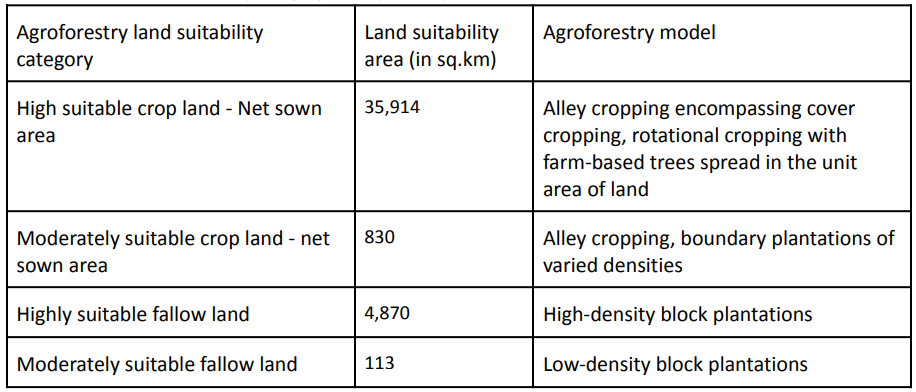
The analysis focuses on additional areas deemed suitable for agroforestry, excluding the 0.8 million hectares in Odisha where agroforestry is already practiced (Newaj et al. 2017).
The direct employment opportunities generated through agroforestry practices encompass the following components:
Production of Quality Planting Material (QPM): This includes job creation related to the establishment and management of nurseries, focusing on the production of high-quality planting materials.
Implementation and Maintenance of Agroforestry Systems: This involves labour-intensive activities such as planting, establishment, and ongoing maintenance of agroforestry systems per unit area of land for a 4-year implementation period. It is assumed that after 4 years, the agroforestry system becomes resilient and requires very low maintenance efforts.
Jobs and market estimation
Jobs estimation
The total number of jobs that can be created in Odisha by 2030 is calculated using categorisation of full-time equivalent (FTE) coefficients per unit of area under which various models of agroforestry are practiced. Per unit of area is expressed as 1 ha.
Data collection:
To assess labour requirements for each stage of Agroforestry practice, a total of 6 KIIs were conducted with nursery managers, agroforestry project developers and CSOs across Odisha and other states. The KIIs focused on gathering data on the activities in nursery and effort required in terms, transportation of planting material, site prepping, plantation, maintenance and harvesting. A mix of purposive and convenience sampling was employed to select project developers, ensuring relevance and accessibility of data sources.
The KIIs were structured to capture quantitative and qualitative information on forestry as practice. The quantitative section focused on the number of people employed or effort required at various stages. Additionally, qualitative questions explored risks, and challenges, alongside potential interventions to address these challenges in various stages of the value chain.
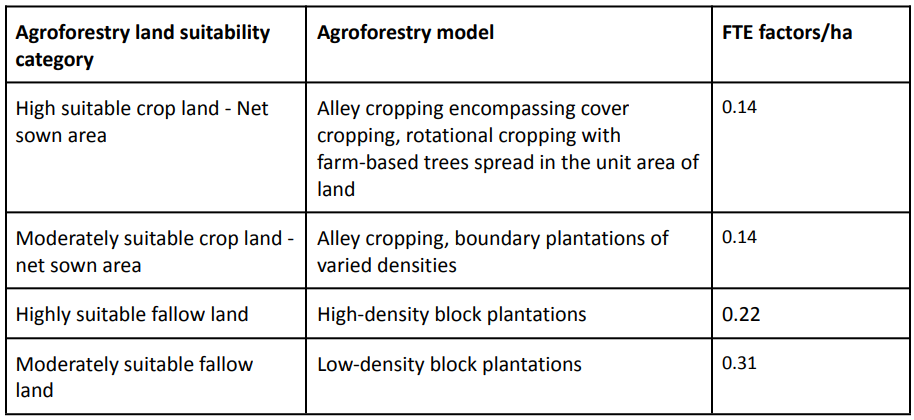
FTE calculation: The total FTE was determined using an FTE factor, derived from the number of man days required per hectare, inclusive of the quality planting material (QPM) production needs per hectare over a four-year period. This analysis was conducted across various agroforestry models under consideration.
The FTE factor for each year was calculated based on the following:
Number of man days required to produce the required amount of planting material for various agroforestry models models
Number of man days required in the span of 4 year implementation period per ha which includes planting, establishment, ongoing maintenance of agroforestry systems and for harvesting.
Accordingly, it was assumed that 1 Man day is equivalent to 8 hours of work.
This method provided an estimate of the total labour required, expressed as FTE, offering a clear metric for understanding the full-time workforce for scaling agroforestry to its full potential by 2030.
FTE factor per model per ha :

Total FTEs by 2030 in Odisha:

Table 2: FTE factor per model
We calculated the investment required per ha for nursery establishment, planting material, equipment costs, input costs and labour costs for various models in Table 3. The investments exclude land costs or lease costs and other land related transaction costs. The investment required captures solely the infrastructure and machinery needs for manufacturing and storage.
Table 3: Investment per ha for 4 years of implementation
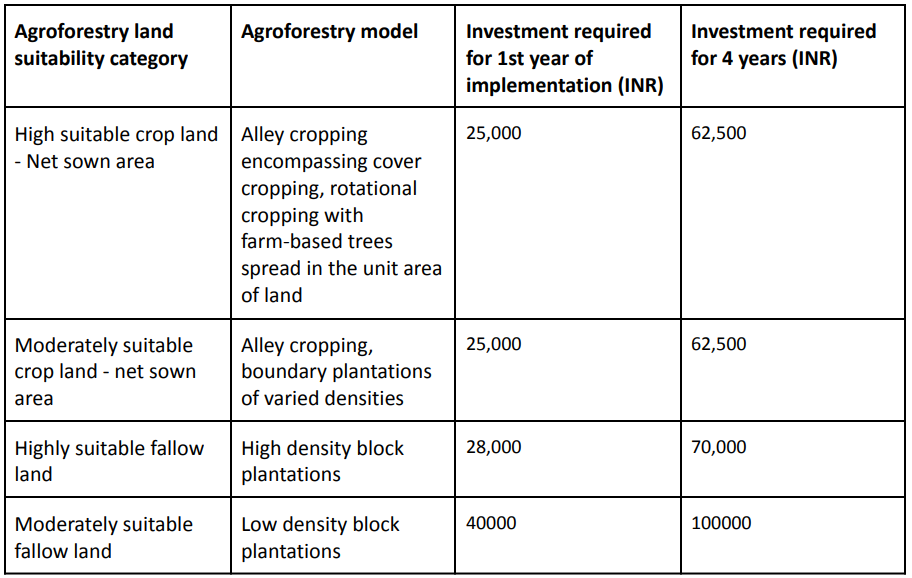
The cost of implementation ratios between 1st to 4th years are assumed to follow the ratio of 40:20:20:20 as per the sub-mission on agroforestry (FAO 2014) and validated by stakeholder consultation.
Total investment by 2030 in Odisha:

The benefit-cost ratio (BCR) for 24 agroforestry models, as reported by (ICAR - CAFRI 2020), ranged from 1.01 to 4.17. For a conservative estimation, the lower bound of the BCR, 1.01, was utilised as a scaling factor to project the market opportunity in 2030, based on the total estimated investment for each model.
1 FTE is defined as 8 hrs of work for 365 days
Key assumptions
The total man-days includes production of planting material per ha for the agroforestry model under consideration.
Investment opportunity was calculated based on the total investment required to produce planting material, plant and maintain the agroforestry system for four years until it becomes self-sustainable (as per stakeholder consultation).
Costs for 1st year of plantation per ha for each agroforestry models are as follows (this includes production of planting material, plantation costs, site prep costs and labour costs per ha)
Alley cropping/boundary plantation: INR 25,000
HD block plantation: INR 40,000
LD block plantation: INR 28,000 (assuming that it is 70 per cent of costs required for HD block plantation).
Assuming the costs between the four years of the agroforestry for each model is in the ratio of 40:20:20:20 as per the sub-mission on agroforestry and validated by stakeholder consultation.
The total investment = Sum of (Sum of (costs of each year for each agroforestry model)* suitable area of that agroforestry model)
It is assumed that 1 USD = 83 INR
For conservative estimates, the lower end of benefit to cost ratio of 1.01 was used as a factor to calculate market opportunity in 2030 based on the total investment.
It is assumed that 1 USD = 83 INR
Agroforestry Network. 2020. AGROFORESTRY VALUE CHAINS AND MARKET SYSTEMS.https://agroforestrynetwork.org/wp-content/uploads/2020/05/Agroforestry-...
Beetles, J., Battisti, D. S., Cook-Patton, S. C., Kroeger, T., Spector, J. T., Wolff, N. H., & Masuda, Y. J. (2021). Agroforestry and non-state actors: A review. Forest Policy and Economics, 130. https://doi.org/10.1016/j.forpol.2021.102538
Bisoyi, Sujit. 2024. “Half of Odisha districts prone to migration, state forms task force to plug the flow.” Indian Express, 2024. CAFRI - ICAR. 2019. “.
Successful Agroforestry Models for Different Agro-ecological regions in India.” World Agroforestry (ICRAF). https://apps.worldagroforestry.org/downloads/Publications/PDFS/B17980.pdf.
CEEW. 2021. “26 Districts in Odisha Vulnerable to Extreme Climate Events: CEEW.” CEEW. https://www.ceew.in/press-releases/26-districts-odisha-vulnerable-extreme-climate-events-ceew.
Chavan, S., S. K. Dhyani, A. K. Handa, R. Newaj, K. Rajarajan, and A. Keerthika. 2015. “National Agroforestry Policy in India: A low hanging fruit.” Current Science 108 (10). https://library.ignfa.gov.in/library-documents-2019-21/people-and-forest....
CIAH. (2018). Production of Quality Seed and Planting Materials. ICAR-CIAH, Bikaner. https://ciah.icar.gov.in/publication/Technical_bulletin/2018/production_of_quality_seed.pdf
Doshi, Pratik, James Brockington, and Robert M. Brook. 2015. “Assessing agroforestry adoption in tribal areas of Maharashtra, India.” -. https://www.researchgate.net/publication/282211789_Assessing_agroforestry_adoption_in_tribal_a reas_of_Maharashtra_India.
EACPM. 2024. “Agroforestry: Missing Trees For The Forest.” Economic Advisory Council to the Prime Minister. https://eacpm.gov.in/wp-content/uploads/2024/09/Working-Papr-on-Agroforestry.pdf.
European Union. June 2020. “Agroforestry in the European Union.” European Parliament.
https://www.europarl.europa.eu/RegData/etudes/BRIE/2020/651982/EPRS_BRI(2020)651982_EN.pdf
FAO. 2014. “National Agroforestry Policy 2014.” Food and Agriculture Organization. https://faolex.fao.org/docs/pdf/ind203552.pdf.
FAO. 2019. “Agroforestry and tenure.” Food and Agriculture Organization.
https://openknowledge.fao.org/server/api/core/bitstreams/2a3fe0f9-4395-4...
FAO. n.d. “Land suitability evaluation steps.” Food and Agriculture Organization. https://www.fao.org/4/t0715e/t0715e06.htm
GoO. 2020. “Economic Survey, 2020 - Chapter 4 - Agriculture.” Economic Survey Odisha. https://pc.odisha.gov.in/sites/default/files/2020-03/eco-4.pdf.
GoO. n.d. “Agriculture Policy.” Directorate of Horticulture. https://www.odihort.nic.in/agriculturepolicy#:~:text=The%20average%20size%20of%20holding,rainfall%20and%20other%20agroclimatic%20factors.
The Hindu. 2024. “Odisha land records regularisation initiative | From legacy displacement to land ownership.” The Hindu (Bhubaneshwar), February 8, 2024. https://www.thehindu.com/news/national/odisha-land-records-regularisation-initiative-from-legacydisplacement-to-land-ownership/article67728412.ece.
ICAR - CAFRI. 2020. “Agroforestry for Income Enhancement, Climate Resilience and Ecosystem Services.” Central Agroforestry Research Institute. https://www.cifor-icraf.org/publications/pdf_files/brief/9240-Brief.pdf
ICFRE. 2020. Agroforestry models. N.p.: Indian Council of Forestry Research and Education. https://icfre.gov.in/books-file/book23.pdf.
ICRAF. 2024. “The success of a national agroforestry policy in India has become a model for other countries.” CIFOR - ICRAF. https://www.cifor-icraf.org/publications/pdf_files/brief/9240-Brief.pdf.
IUCN. 2018. “Bonn Challenge and India: Progress on Restoration Efforts across States and Landscapes.” IUCN Portal. https://portals.iucn.org/library/sites/library/files/documents/2018-026-En.pdf.
Kant, P., and R. Nautiyal. 2021. “India Timber Supply And Demand 2010-2030.” Teak Net.
https://teaknet.org/download/IndiaTimber%20Supply%20and%20Demand%202010%...
Kumar, A., M. S. Hooda, and R. Bhadur. 2016. “Impact of Multipurpose Trees on Productivity of Barley in Arid Ecosystem.” Annals of Arid Zone 37 (2). https://epubs.icar.org.in/index.php/AAZ/article/view/65483.
MoEFCC. 2023. “National Action Plan to Combat Desertification and Land Degradation Through Forestry Interventions.” Ministry of Environment, Forest and Climate Change. https://www.moef.gov.in/uploads/2023/07/NAP%20final-2023.pdf.
Muchane, M. N., G. W. Sileshi, Sofia Gripenberg, Mattias Jonsson, Lorena Pumariño, and Edmundo Barrios. 2020. “Agroforestry boosts soil health in the humid and sub-humid tropics: A meta-analysis.” Agriculture, Ecosystems & Environment 295 (June). https://doi.org/10.1016/j.agee.2020.106899.
Nair, Ramachandra, V. D. Nair, B. M. Kumar, and S. G. Haile. 2009. “Soil carbon sequestration in tropical agroforestry systems: a feasibility appraisal.” Environmental Science & Policy 12, no. 8 (December): 1099-1111. https://doi.org/10.1016/j.envsci.2009.01.010.
Newaj, Ram, Raza H. Rizvi, O. P. Chaturvedi, Badre Alam, Rajendra Prasad, Dhiraj Kumar, and A. K. Handa. 2017. “A country level assessment of area under agroforestry and its carbon sequestration potential.” ICAR - CAFRI. https://www.researchgate.net/publication/338818714_A_country_level_assessment_of_area_under _agroforestry_and_its_carbon_sequestration_potential#:~:text=Agroforestry%20systems%20provide%20the%20climate,level%20under%20different%20agroforestry%20systems.
Pavlidis, G., and V. A. Tsihrintzis. 2017. “Pollution control by agroforestry systems: A short review.” European Water 59:297-301. https://ewra.net/ew/pdf/EW_2017_59_40.pdf.
Pradhan, Ashok. 2016. “Odisha men most undernourished: Annual Health Survey.” Times of India, 2016. https://timesofindia.indiatimes.com/city/bhubaneswar/odisha-men-most-undernourished-annual-h ealth-survey/articleshow/54346145.cms.
SAPCC. 2020. “Odisha Climate Change Action Plan 2021-30.” Climate Change Cell, Odisha. https://climatechangecellodisha.org/pdf/Odisha_SAPCC_2021-30..pdf.
Singh, V. S., and D. N. Pandey. 2011. “Multifunctional Agroforestry Systems in India: Science-Based Policy Options.” Indian Council of Agriculture Research. https://krishi.icar.gov.in/jspui/bitstream/123456789/32624/1/Existing%20and%20improved%20agro forestry%20systems%20in%20low%20rainfall%20areas%20of%20India.pdf.
Singhal, Vibha, Sheeraz S. Bhat, Suheel Ahmad, Nazim H. Mir, and Charan Singh. 2019. “Development of adoption index: A proxy measure for assessing the adoption rate of agroforestry practices in Indian context.” Internal Journal of Chemical Studies 7 (1). https://www.chemijournal.com/archives/?year=2019&vol=7&issue=1&ArticleId=4993&si=false.