Council on Energy, Environment and Water Integrated | International | Independent

Access to affordable energy is critical to promoting local economic growth and upliftment of rural poverty. For rural enterprises, grid electricity use is often constrained, and while India's national grid has reached most villages, reliability is still a critical concern (Das et al. 2019). Solar mini-grids can act as an essential complementary solution to national electrification efforts. A mini-grid is a decentralised electricity generation system with capacities exceeding 10 kW and caters to various needs like unserved and underserved households, businesses, institutions, etc.
It is also important to note that there are two models of mini-grid deployment - off-grid and grid-connected systems. While off-grid systems initially received higher uptake due to non-reliance on the grid, maintenance issues and high costs led to a shift in preference to grid-connected systems. This is evident in the case of Odisha's 100 percent solar village, Barapitha, which has a 1 kW foldable solar system with a battery. It powered 60 households in the village; however, with no maintenance of the mini-grid, especially after Cyclone Fani in 2017, the plant stopped functioning, and the villagers shifted to grid-connected electricity for their source of power (Kumar 2022). Thus, the focus of mini-grid deployment in Odisha should be on grid-connected systems that can aid in the supply of reliable power in rural areas.
There is also rising momentum and traction towards mini-grid integration in rural economies, as seen under various central government schemes and state policies, such as the PM KUSUM scheme, where 10,000 MW of solar capacity is aimed to be added through the installation of small solar plants with a capacity up to 2 MW, the Jharkhand Solar Policy 2022, which targets 110 MW of mini/micro grid installation, etc.
Opportunities for 2030
Jobs overview
● Based on CEEW employment coefficients (Joshi et al. 2021), it is estimated that If Odisha meets the target of 720 MW, it can generate 82,000 FTE jobs 1 (excluding productive use jobs 2 ).
Market Opportunity
● INR 800 crore (USD 100 mn) is the market opportunity in terms of revenue accruals from electricity if Odisha installs mini-grids with a capacity of 720 MW in 2030.
Why should Odisha invest in mini-grid deployment?
1. The Government of India launched the Pradhan Mantri Sahaj Bijli Har Ghar Yojana – SAUBHAGYA scheme in October 2017 to provide electrical connections to all unelectrified rural households and poor households in urban areas in the country. Under this scheme, Odisha has achieved 100 per cent household electrification (MOP 2023). However, the scheme targets providing electricity connections while the quality of power supply continues to remain a challenge. In 2020-21, rural Odisha faced an average of 997 hours of power outages as compared to 54 hours in urban Odisha (MOP 2022). Further, as per the Indian Residential Electricity Survey, 26 per cent of households surveyed in Odisha faced long-duration outages at least once while 15 per cent of households faced voltage fluctuations at least once in the previous month (Agrawal et al 2020). The survey by Smart Power India 2019 also found that one in two grid users faced a power cut at least eight hours daily. Thus, the evidence points to the low reliability of the central grid in remote and rural areas despite high degrees of electrification. Mini-grids offer a viable solution to this problem with their high reliability, good performance in remote areas, and high electricity quality and efficiency (Graber et al. 2019, Joshi et al. 2021, Concessao et al. 2023). Mini-grid performance in rural areas currently exceeds that of the grid due to generation and production happening at the same place, and the satisfaction level of consumers towards mini-grids is twice that of the centralised grid (Graber et al. 2018).
2. Enhanced energy access for rural households through microgrids can help increase GDP and living standards (Thirumurthy et al. 2012) and offer a complementary solution to national electrification efforts. Further, they also provide various economic co-benefits in the form of job creation, stimulating rural economies, reduced transmission losses to remote areas, improved access to information and opportunities, and betterment of public services, etc. (Graber et al. 2019; Joshi et al. 2021, Das et al. 2019, ISA 2024). Additionally, with access to mini-grids and PUE (productive use of electricity) appliances, there is a scope for alternative business models and livelihood options, which previously needed to be unlocked in these remote areas (Concessao et al. 2023).
3. Beyond electrification of rural households, mini-grids can be scaled up as an effective electrification alternative for urban household and commercial electrification as well. Mini-grids, interconnected with individual DRE systems such as rooftop solar and connected to the central grid to ensure decentralised management along with the grid taking and feeding electricity, could be foreseeable in the future in India, with the designing of effective interventions in the sector (Palit 2024).
Mlinda operates as a decentralised renewable energy provider in Jharkhand, catering to the energy needs of both residential and commercial sectors by delivering dependable power. The company has successfully implemented and managed mini-grids in 45 villages, with plans to extend its reach to 125 communities. Through its efforts, Mlinda has impacted 7,000 households, supplying electricity to a population of 35,000 to 40,000 individuals. The deployment of Mlinda's community mini-grids has resulted in the creation of around 986 jobs between 2016 and 2020, averaging 15 to 28 jobs for each mini-grid (Joshi et al., 2021 case study). Its business model expands beyond distribution and transmission and focuses on capacity development efforts. It aids its members in buying energy-efficient appliances and also grants micro-finance to help them purchase appliances like rice hullers and millers, which help increase productive use loads and generate new entrepreneurial opportunities (VoisPlanet 2022).
1. Role of departments
a. Department of Energy and Odisha Renewable Energy Development Authority (OREDA) - Department of Energy to spearhead the mini-grid deployment effort by announcing a state vision for mini-grid deployment, as announced by states like Jharkhand and Uttar Pradesh. Further, OREDA to set up a monitoring system for contractors and impose penalties if needed (Pandey 2023). Additionally, using PUE appliances to be encouraged by offering last-mile financing options like subsidies to gain maximum energy access.
2. Role of local administration and civil society organisations (CSOs)
CSOs like Gram Vikas and local government bodies like gram panchayats have an essential role in mobilising finance, gaining community buy-in, and ensuring social equity in electricity distribution. They can act as facilitators between different stakeholders like financiers, developers, and local communities to ensure a sound and just governance mechanism. Given the risks of lack of proper maintenance of these systems, the local panchayats or CSOs can also take up the role of owning and maintaining these systems, undertaking training of locals in maintenance as well. This is already done by CSOs like Gram Vikas, who not only act as facilitators of funds but also ensure proper maintenance by training women in the surrounding areas. Further, they can also play a key role in generating consumer awareness about mini-grid systems and their advantages, as well as financial implications
3. Role of the private sector
a. International and national financiers need to play a critical role in de-risking investment in mini-grids for communities (Malhotra et al). Given that mini-grids are currently not self-sustainable, to ensure reliable electricity access in remote areas, financial institutions need to ensure the provision of flexible credit options to communities to be able to pay the upfront cost of mini-grids and associated PUE appliances (Concessao et al. 2023). Local NGOs, NBFCs, and MFIs need to offer innovative solutions like dealer credit, PAYGO, etc., to ensure the communities' productive adoption of the system.
b. Private companies, via their CSR initiatives, can also help scale mini-grid deployment in the country. For instance, Tata Power Microgrid (TPRMG), a wholly-owned subsidiary of Tata Power, was launched in October 2019 to roll out 10,000 microgrids. So far, 200 microgrids have been commissioned in Uttar Pradesh and Bihar, and a pilot is also being conducted in Odisha (Karthik, 2022).
c. Lastly, research and development in the technology upgrade of mini-grids is essential to reducing upfront costs.
1. High initial cost and lack of financing
a. Mini-grid installation requires a high initial capex cost and is often not a self-paying system. Energy charges of mini-grids vary across states and different locations within the same state, and are a lot more expensive than grid power (mini-grids are two to six times (Shiv 2023) / three to seven times (VoisPlanet 2022) more expensive than grid power). This is because grid-based electrification is highly subsidised, especially in rural areas, making it hard for mini-grids to compete (ET EnergyWorld 2020). Thus, commercial use of mini-grids is unfeasible in cases where the grid is reliable and available. Further, due to affordability challenges (high cost of operation), mini-grids are limited to essential lighting and cooling purposes.
It thus becomes essential to increase mini-grid capacity utilisation by supporting the uptake of PUE (productive use of electricity) appliances for livelihoods (Concessao et al. 2023). It is costly to pay the total upfront cost of PUE appliances, and hence, last-mile financing options need to be provided in the form of government subsidies, low-interest loans, innovative servicing models facilitated by developers (for example, pay-as-you-go 3 ), innovative financing models (for example, access to credit through margin money support, revolving funds and grants, which is the model adopted by SELCO Foundation) (Concessao et al. 2023, Jha et al. 2019). Community-led formal entities can look into more such livelihood activities.
2. Need for finance and innovative financing mechanisms
a. Lack of financing due to unfavorable risk-return profiles, small investment volumes, and the absence of appropriate financing sources and structures (Malhotra et al. 2017) is one of the significant challenges currently.
b. Aggregating mini-grid assets strategically into diversified portfolios can significantly address investment risks for the private sector, bring economies of scale, and enable payment security to cover default risk (Malhotra et al. 2017). Further, innovative financing models like PAYGO, dealer credit, subsidised loans, etc., need to be introduced through MFIs, NBFCs, and NGOs in the area (ISA 2024). In addition, newer mini-grid models could be adopted out of the various existing models: 4 community-owned, entrepreneur-based, DISCOM-based, and hybrid (Choubey 2019).
3. In the community-owned model of mini-grid, given that resources are pooled at the community level, various challenges arise as follow :
a. Through consultations, it was found that social hierarchies play a crucial role in community-owned devices and it can lead to several injustices at the village level. This can vary from access to socially and economically advantaged households only, even at the village level.
It was noted that formalised institutions within the community, like self-help groups, farmer producer organisations, and Panchayati Raj institutions, play an essential role in ensuring the inclusion of all in infrastructure planning for villages and benefits are accrued to all (Concessao et al. 2023).
b. Further, maintaining customer base/energy demand is also a key challenge when it comes to mini-grid sustainability. To be able to overcome this, leading distribution companies have started to offer services beyond electricity supply. These include building community capability by providing services like credit to finance appliance purchases, running technical training and entrepreneurial skills programmes, and creating market linkages for farmers and new entrepreneurs, etc (Joshi et al. 2021).
It becomes essential to promote community engagement for the inclusive growth of mini-grids. It is noted that community buy-in and engagement are critical from the planning stage so that systems do not become obsolete due to lack of utilisation or inadequate management (Concessao et al. 2023).
4. Technical and skilling-related challenges
a. Certain technical challenges exist, such as household demand forecasting for effective planning, understanding the complexity of distribution utility and load factor, etc., which, if not addressed, can lead to increased system costs. Further, the availability of individuals with such advanced skills is also a challenge in remote areas.
Adequate capacity building is thus essential to tackle these challenges. Hands-on training and capacity-building workshops to service and operate these systems would help improve their long-term viability (ISA 2024). Since these are advanced skill sets, the Odisha Skill Development Authority (OSDA) and academic institutions will have to work together to build these capabilities within Odisha.
b. Further, grid maintenance is a key challenge given its location in remote areas and the need for locally trained personnel. For local maintenance, minimum ITI-level training and an understanding of circuitry, safety norms, equipment, etc., are needed.
For this, it becomes necessary for local bodies within the community to undertake and fund the training of individuals from the community to ensure that the established mini-grid is sustainable in the long run.
5. Need for formalised regulations in the sector
a. Currently, mini-grids are unregulated, and developers often decide tariff rates and structures which are non-uniform in nature. Further, developers charge high tariffs to sustain and expand their operations, mainly because unfunded mini-grids do not offer high returns in the long run.
There is a need for regulatory oversight to ensure tariff determination, balance the interests of different stakeholders, and settle disputes (Concessao et al. 2023). Further, effective tariff design would also help ensure that mini-grid systems are adopted as urban solutions of electrification and help scale the technology (Bhattacharyya et al. 2019).
1. Grid uncertainty and waste disposal: Grid-connected mini/micro grids face uncertainties in the strengthening of grids in remote areas and grid maintenance risks in coastal areas with high rainfall or cyclone risk. There is also the risk of effective PV disposal and waste recycling, which needs to be undertaken once the plant undergoes decommissioning.
Mitigation: It is important to invest in local skills and capacity building for maintenance of the grid as well as have targeted grid strengthening plans for remote areas. Further, PV module waste disposal management and recycling is critical, with encouragement given to research and investment in recycling technologies.
The mini-grid value chain covered includes the deployment phase only: This stage involves all activities encompassing the direct application of the designated product towards its desired end-use activity. In mini-grid deployment, this includes site selection, project design, procurement of components such as solar panels, construction, commissioning and O&M.
Jobs estimation:
The full-time equivalent (FTE) coefficient of 0.277 jobs/kWp (without productive use jobs) was taken from Joshi et al. 2021. This was then segregated into the four phases as follows by taking the proportional phase-wise distribution as mentioned in a case study in Joshi et al. 2021:
Table 1
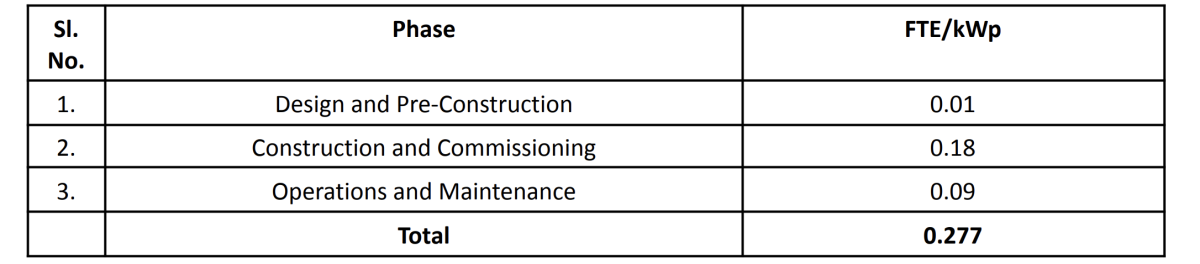
Source: Author’s analysis adapted from Joshi et al., 2021
Market sizing (in units):
Estimating households with unreliable electricity as well as installations for agricultural purpose:
Estimating rural households with unreliable electricity: Out of rural households in Odisha, households facing long duration outages were considered to be the target market for mini/micro grid installation (Agrawal et al. 2020). Odisha's average household electricity consumption derived from India Residential Energy Survey was used to map the system demand of such households (Mani et al. 2020).
Agricultural demand: PM Kusum Component A aims at 10,000 MW installation of solar plants up to 2 MW. Assuming that all of it comes from a mini-grid, we utilise the current allocation of 500 MW as per the national portal for PM-Kusum as the deployment target for the state (MNRE n.d.).
To find yearly revenue potential from the sale of power, the following formula was used to calculate injected energy (MWh) from project capacity (MW):
Capacity Utilisation Factor (CUF) = [Injected energy (MWh)/(Project capacity (MW) * 8766)]* 100
Revenue potential = Tariff rate (USD/kWh) * Injected energy (kWh
Further, a degradation rate of 0.7 per cent and a performance ratio of 80 per cent (CEA, 2022) have also been applied to account for generation losses.
The values taken and the rationale for each parameter are mentioned below:
Table 3
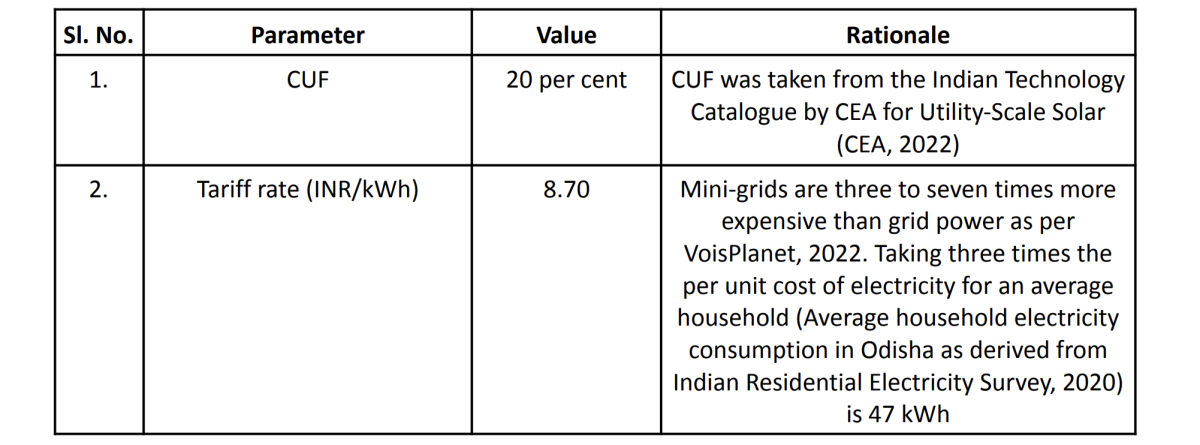
Source: Authors’ analysis
A case study approach was followed to calculate investment methodology wherein the system size and costs of 10 mini-grids surveyed by Das et al. 2019 were taken. From the 10 case studies, only those installed after 2015 were considered since technology is rapidly evolving, and the costs of mini-grids have been declining 6 . Using the system size and capex cost per system, an INR lakh/kW figure was calculated for each case study, and an average was taken - INR 2.93 lakh per kW. The different case studies and costs are mentioned in the table below:

1 USD = INR 83
The upfront investment cost worldwide fell from ~USD 8,000/kW in 2010 to less than USD 3,700/kW in 2021. It is also estimated that the costs will further decline to ~USD 2,500/kW by 2030 (ESMAP, 2022). Further, there is also a reduction in operating costs due to remote monitoring, smart meters, etc.
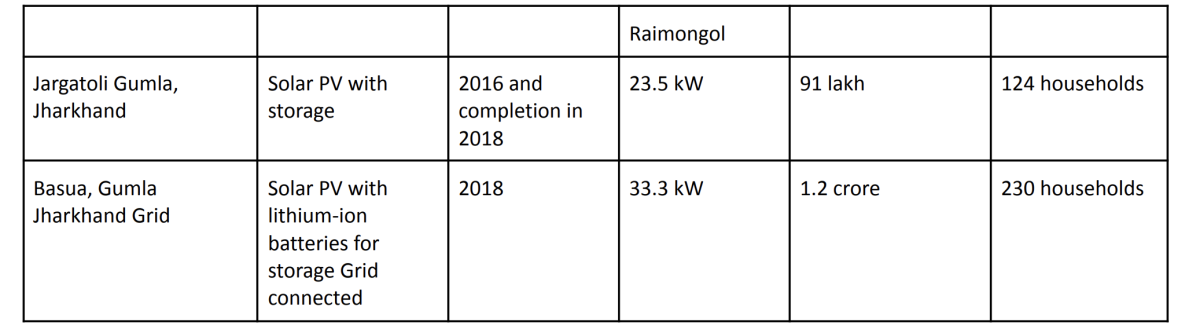
Source: Das et al., 2019
Thus, an average of the capex costs was considered, and it was INR 2.93 lakh per kW.
This average was then multiplied by the market potential to get the total cost (1 USD = INR 83).
Agrawal, Shalu, Sunil Mani, Abhishek Jain, and Karthik Ganesan. 2020 “State of Electricity Access in India Insights from the India Residential Energy Survey (IRES) 2020,” https://www.ceew.in/sites/default/files/ceew-research-on-state-of-electr...
Bhattacharyya, S., Palit, D., K. Sarangi, G., Srivastava, V., & Sharma, P. (2017). Solar PV mini-grids versus large-scale embedded PV generation: A case study of Uttar Pradesh (India). Elsevier, 128, 36–44.
https://doi.org/10.1016/j.enpol.2018.12.040
Comello, S., Reichelstein, S., Sahoo, A., & Schmidt, T. S. 2017. “Enabling Mini-Grid development in rural India.” World Development, 93, 94–107. https://doi.org/10.1016/j.worlddev.2016.12.029
Central Electricity Authority (CEA). 2022. Indian Technology Catalogue, Generation and Storage of Electricity. Ministry of Power
https://cea.nic.in/wp-content/uploads/irp/2022/02/First_Indian_Technolog... _and_Storage_of_Electricity-2.pdf
Choubey, Satya Prakash 2019 “Rationale for mini-grids in India-II” Cseindia.org.
https://www.cseindia.org/rationale-for-mini-grids-in-india-ii-11486.
Concessao, Lanvin and Gupta, Dheeraj, 2023. “The Status of Mini-Grids in Rural India” WRI INDIA..
https://wri-india.org/publication/status-mini-grids-rural-india.
Das, Binit, Batra Aditya and Bhatti Jasleen 2019 “VOL 1: Mini-Grids a Just and Clean Energy Transition” Cseindia.org
https://www.cseindia.org/mini-grids-a-just-and-clean-energy-transition-1... 0A%20SCOPING%20STUDY,capacities%20less%20than%2010%20kW
Shiv, Jay, 2023. “Minigrids Are Evolving to Be Reliable Sources of Access to Renewable Energy in Rural India,” Down To Earth
https://www.downtoearth.org.in/renewable-energy/minigrids-are-evolving-t...
ET EnergyWorld. 2020 “OPINION: Energy Access - Moving beyond the Grid vs Mini-Grid Binary.” ETEnergyworld.com. ETEnergyWorld https://energy.economictimes.indiatimes.com/news/power/opinion-energy-ac... he-grid-vs-mini-grid-binary/76828462.
ESMAP. 2022. “Mini grids for half a billion people | Market Outlook and Handbook for Decision makers” ESMAP. https://www.esmap.org/mini_grids_for_half_a_billion_people_the_report
Graber, Sachiko & Narayanan, Tara & Alfaro, Jose & Palit, Debajit. 2019. “Perceptions towards solar mini-grid systems in India: A multi-stakeholder analysis.” Natural Resources Forum. 43. 10.1111/1477-8947.12181.
Jha, Shaily, Sasmita Patnaik, and Abhishek Jain. “Financing Solar-powered Livelihoods in India: Evidence from Micro Enterprises.” New Delhi: Council on Energy, Environment and Water. 2019
Joshi, Madhura, Marie McNamara, Akanksha Tyagi, Sameer Kwatra, Neeraj Kuldeep. 2021. “Creating Jobs and Income: How Solar Mini-Grids Are Making a Difference in Rural India.” New Delhi: Council on Energy, Environment, and Water; Natural Resources Defense Council; and Skill Council for Green Jobs. https://www.ceew.in/publications/creating-jobs-and-income-how-solar-mini...
Karthik, Maitreyi, 2022. “Paving the way to sustainable energy generation with microgrids” Down To Earth
https://www.downtoearth.org.in/energy/paving-the-way-to-sustainable-ener...
Khanna, Vaani, 2924. “Indian villages are 100% electrified, but what’s next?.” Down To Earth
https://www.downtoearth.org.in/blog/governance/indian-villages-are-100-e... xt--94273#:~:text=In%20the%20current%20scenario%2C%20rural,a%20subpar%20supply%20of%20e lectricity
Kumar, M. 2022. “In Odisha’s first solar village, maintenance issues plague the mini solar plant.” Mongabay-India.
https://india.mongabay.com/2022/02/in-odishas-first-solar-village-mainte... ini-solar-plant/
Malhotra, Abhishek, Tobias S Schmidt, Léonore Haelg, and Oliver Waissbein. “Scaling up Finance for Off-Grid Renewable Energy: The Role of Aggregation and Spatial Diversification in Derisking Investments in Mini-Grids for Rural Electrification in India.” Energy Policy 108 (September 1, 2017): 657–72. https://doi.org/10.1016/j.enpol.2017.06.037.
Mani, Sunil, Shalu Agrawal, Abhishek Jain and Karthik Ganesan. 2021. State of Clean Cooking Energy Access in India: Insights from the India Residential Energy Survey (IRES) 2020. New Delhi: Council on Energy, Environment and Water.
Ministry of Power (MOP). 2022. “RAJYA SABHA UNSTARRED QUESTION NO.796 ANSWERED ON 08.02.2022 AVERAGE HOURS OF CONTINUED POWER SUPPLY IN RURAL AREAS OF THE COUNTRY” Government of India
https://sansad.in/getFile/annex/256/AU796.pdf?source=pqars
Ministry of power. 2023. “SAUBHAGYA ELECTRIFICATION SCHEME - a Total 2.86 Crore Households Have Been Electrified – Union Power & NRE Minister Shri R. K. Singh,” Press Information Bureau
https://pib.gov.in/PressReleaseIframePage.aspx?PRID=1907728.
MNRE n.d. “National Portal for PM Kusum”
https://pmkusum.mnre.gov.in/#/landing
Mehrotra, Karishma. “India Joins Rush to Renewables, but Its Rural Solar Systems Fall off Grid.” Washington Post. The Washington Post, July 31, 2023. https://www.washingtonpost.com/world/2023/07/31/india-solar-energy/.
NITI Aayog. 2023. “NATIONAL MULTIDIMENSIONAL POVERTY INDEX.” Niti Aayog
https://www.niti.gov.in/sites/default/files/2023-08/India-National-Multi... 023.pdf
Palit Debajit. 2024. “Potential of Renewable energy based Minigrids in India’s clean energy transition” FSR GLOBAL.
https://fsrglobal.org/potential-of-renewable-energy-based-minigrids-in-i... n/
Pandey, Kundan. 2023. “The Potential of Mini-Grids as a Sustainable and Economical Alternative for Global Electrification.” Mongabay-India https://india.mongabay.com/2023/08/are-mini-grids-the-sustainable-and-ec... hieving-global-electrification/.
Saubhagya.gov.in. 2019. “Household Electrification Status: All India"
Singh, Rahul. 2023. “Sun Shines on Bihar's Renewable Energy Sector, but Lack of Subsidy Creates Hurdle” NewsClick 2023.
https://www.newsclick.in/sun-shines-bihars-renewable-energy-sector-lack-....
Thirumurthy, N, L Harrington, D Martin, L Thomas, J Takpa, and R Gergan. 2012 “Opportunities and Challenges for Solar Minigrid Development in Rural India,” NREL
https://www.nrel.gov/docs/fy12osti/55562.pdf.
VoisPlanet 2022. "Electrifying Rural India: A Case Study on Mlinda's Solar Mini-Grids," VoisPlanet
https://voisplanet.com/public/assets/images/casestudy/Electrifying-rural...
Energy transition
 Battery Energy Storage Systems
  Public Charging Stations for Electric Vehicles
 Electric Vehicle and Battery Manufacturing
  Biomass to Power
 Green Hydrogen and Electrolyser Manufacturing
 Rooftop Solar
 Floating Solar Photovoltaic (FSPV)
 Solar Mini/Micro Grid
 Pumped Storage Hydropower (PSH)
 Renewable Energy Equipment Manufacturing
 Small Hydropower (SHP)
 Utility-Scale Solar Deployment
 Wind Deployment
 Decentralised Renewable Energy (DRE) Technologies for Livelihoods