Council on Energy, Environment and Water Integrated | International | Independent

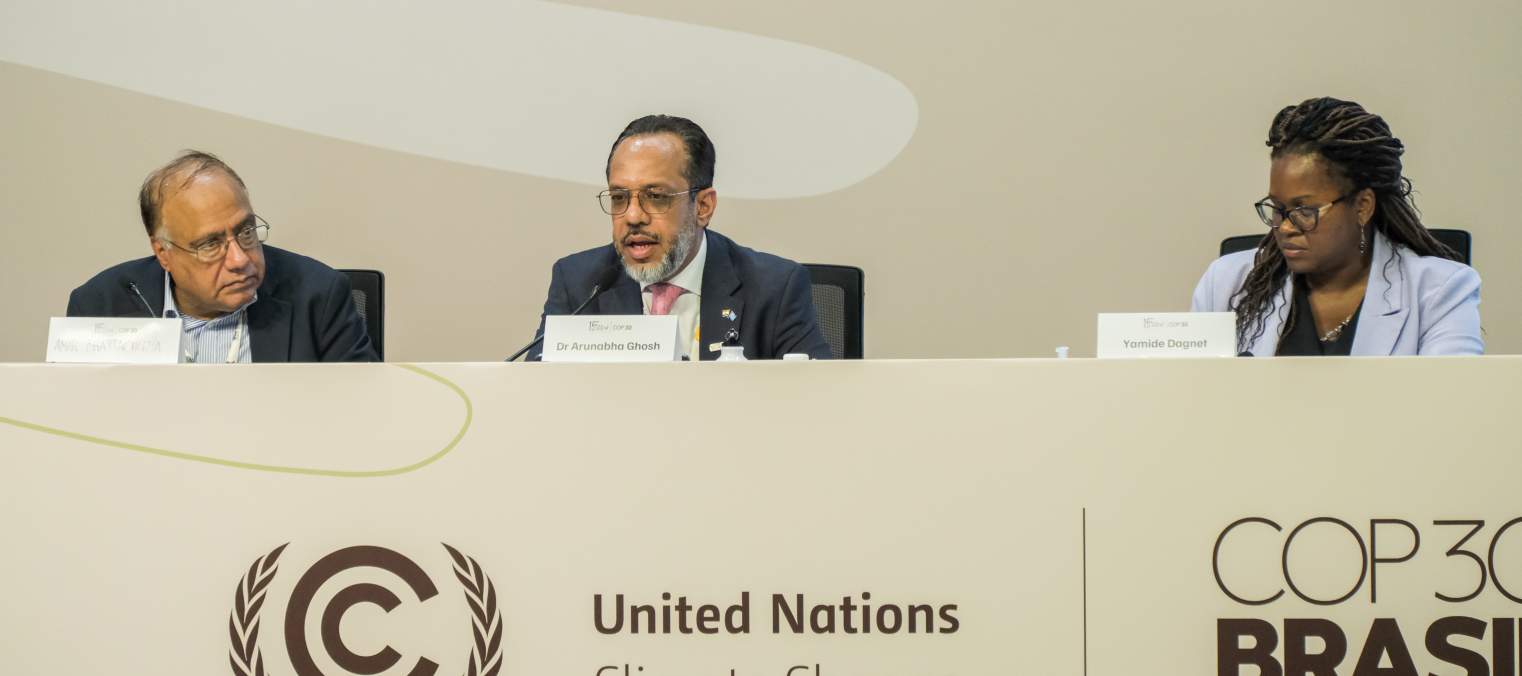
Belém, Brazil, 11 November 2025: At COP30, the Council on Energy, Environment and Water (CEEW) called for a renewed compact on climate action—anchored in global solidarity, regional cooperation, and verifiable implementation. The press conference, held in Belém, was convened by Dr Arunabha Ghosh, CEO, CEEW, and Special Envoy to COP30 representing South Asia, and also featured interventions from Prof. Amar Bhattacharya (Senior Fellow, Center for Sustainable Development, Brookings Institution) and Yamide Dagnet (Senior Vice President, International, at the Natural Resources Defense Council).
A new CEEW study finds that if the world’s most responsible economies contributed just 0.08 per cent of GDP to the Fund for Responding to Loss and Damage, it could unlock USD 60 billion annually—a 75-fold increase over current pledges of roughly USD 800 million. While still below the USD 400 billion per year sought by developing countries, such a floor would raise global commitments to 15 per cent of the required finance, up from 0.2 per cent that has been currently mobilised.
“Embedding vulnerability into the architecture of global climate finance is not charity—it is rational economics,” said Arunabha Ghosh, CEO, CEEW and Special Envoy to CO30 representing South Asia. “Every dollar invested in resilience yields multiple dividends—in stability, productivity, and dignity. The 0.08 per cent floor must become the foundation of global economic security and a step toward meaningful cooperation.”
CEEW’s framework redefines burden sharing for Loss and Damage finance by factoring historical responsibility, capability, and vulnerability. Analysing 150 countries across 11 indicators, it identifies a ‘Most Responsible’ bloc of 25 countries with the ability to pay—such as the United States, Australia, Japan, and members of the EU—expected to lead with predictable contributions.
Ten years after the Paris Agreement, the world has expanded its climate ambition but fallen short on delivery. Over 90 per cent of the global economy is now covered by net zero pledges, yet CEEW’s assessment of 203 international climate initiatives since 2015 finds that only 5 per cent have achieved their goals, while over a fifth are inactive. Although most initiatives have stated objectives, only 28 per cent have dedicated budgets. Starkly, less than a third of the initiatives focus solely on Global South regions across Africa, Asia, or Latin America.
This shortfall points to a partnership gap—where ambition has multiplied, but collaboration and resources have not. That is why the Brazil COP30 Presidency’s emphasis on Global Mutirão—its call for widened collective climate action—echoes this spirit and finds a natural ally in India’s leadership.
Despite not hosting a COP in the past decade, India has led eight international climate initiatives, each engaging an average of 47 countries, matching the mobilisation potential of COP Presidencies. India has already achieved 50 per cent non-fossil electricity capacity, five years ahead of target, and is on track to reduce emissions intensity of GDP by 48-57 per cent by 2030, exceeding its NDC target.
“India is showing what solidarity looks like in action,” said Dr Ghosh. “From several initiatives, such as the International Solar Alliance to South-South collaborations, its cooperation is both practical and principled.”
Global CO₂ emissions rose only 1.2 per cent annually in the decade after the Paris Agreement—down from 18.4 per cent over the previous ten years (Energy and Climate Intelligence Unit). It led to the shifting of the projected warming path from 3-3.5°C to about 2.3-2.5°C if all pledges are met (UNEP Emissions Gap Report). This progress must be acknowledged as proof that multilateralism works but its inadequacy must also be recognised. Much more has to be done.
The Asia-Pacific has suffered the world’s most extreme events and losses—over 980,000 lives and USD 4.3 trillion since 1970 (Asia-Pacific Disaster Report 2023)—showing that climate action is an economic imperative, not just an environmental one.
Still, countries are failing to deliver on commitments: only two developed nations are on track to meet their 2030 NDCs, according to CEEW research. The Brazilian COP30 Presidency’s vision of an ‘Implementation COP’ is the right focus as it aims to close this gap by turning pledges into delivery, the expansive and detailed Action Agenda, and its objective of building a Granary of Solutions. But to bridge the ambition gap and the implementation gap, we must first fill the perception gap — recognising the countries, regions, cities and companies in the Global South that are meeting their goals ahead of time and demonstrating a bias for action.
Addressing the adaptation gap requires regional resilience frameworks. COP30, unfolding amid record heat and rising geopolitical and economic strains, must rebuild trust and deliver tangible results. CEEW launched a South Asia Granary of Solutions earlier today, to showcase policy, institutional, market and behavioural interventions across countries in the region, which can serve as examples for others to emulate. This report positions regional resilience as shared security.
Drawing from government and civil society consultations across Bangladesh, Bhutan, India, Maldives, Nepal, and Sri Lanka, it identifies replicable good practices to address the adaptation gap in one of the world’s most climate-vulnerable regions.
Home to over two billion people, South Asia is stepping up with pragmatic, collaborative solutions because action cannot wait. The Granary, which functions as a regional public good, recommends:
Developing countries (excluding China) account for less than 15 per cent of global climate finance flows, despite representing a quarter of global GDP. These countries need roughly USD 3.2 trillion per year by 2035, of which USD 1.3 trillion must come from international sources. Today, 3.4 billion people live in countries that spend more on interest on sovereign debt than on health or education.
The Baku to Belém Roadmap to USD 1.3T, a joint COP29-COP30 initiative, charts how the world can mobilise USD 1.3 trillion annually in international climate finance by 2035. It reflects CEEW’s proposals by prioritising concessional and grant finance for adaptation and expanding climate insurance to build resilience, scaling debt-for-climate swaps, reforming MDBs and deploying their capital in a catalytic manner and unlocking innovative sources such as rechannelled Special Drawing Rights, carbon markets and solidarity levies (CEEW recommends exemptions for developing countries). In its recent study, Increasing Climate Investment in Developing Countries: Proposals for the Baku to Belém Roadmap to 1.3T, CEEW recommends:


For media queries and interviews, contact:
Tulshe Agnihotri – tulshe.agnihotri@ceew.in
The Council on Energy, Environment and Water (CEEW)—a homegrown institution with headquarters in New Delhi—is among the world’s leading climate think tanks. The Council uses data, integrated analysis, and strategic outreach to support public policy, transform markets, shape technology, and nudge behaviour. CEEW seeks to explain—and change—the use, reuse, and misuse of resources. It addresses pressing global challenges through an integrated and internationally focused approach. The Council prides itself on the independence of its high-quality research and strives to impact sustainable development at scale. In over 15 years of operation, CEEW has impacted over 400 million lives and engaged with over 20 state governments. Follow us on LinkedIn and X (formerly Twitter) for the latest updates.