Council on Energy, Environment and Water Integrated | International | Independent


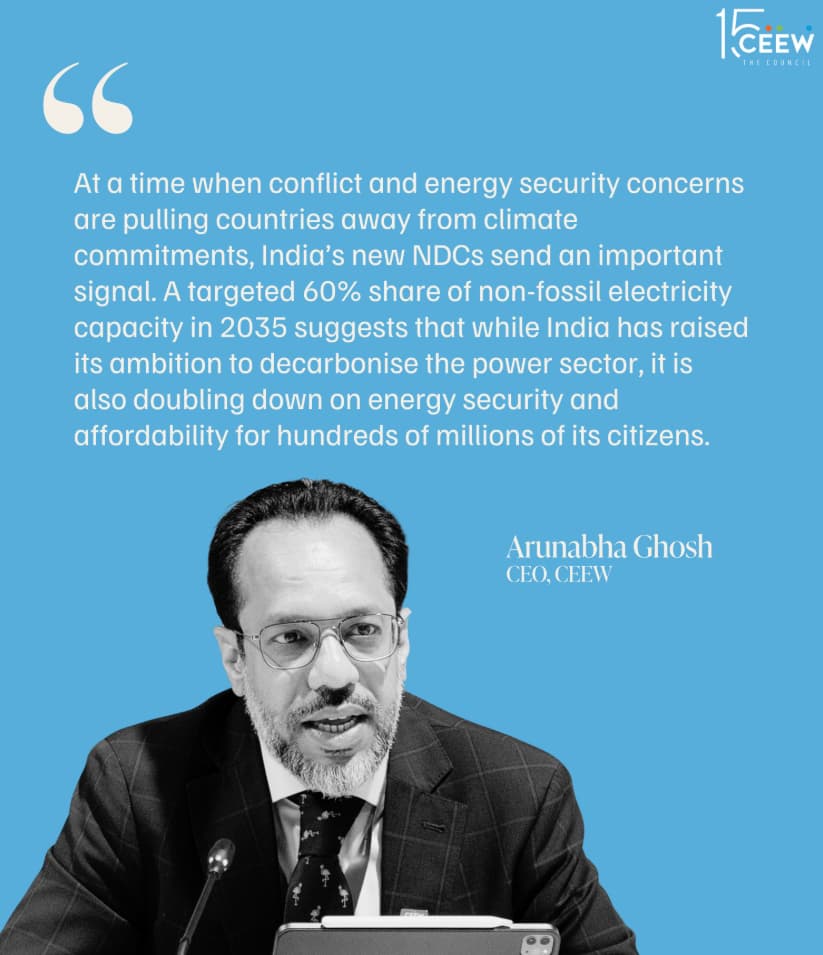
At a time when conflict and energy security concerns are pulling countries away from climate commitments, India’s new NDCs send an important signal. A targeted 60% share of non-fossil electricity capacity in 2035 suggests that while India has raised its ambition to decarbonise the power sector, it is also doubling down on energy security and affordability for hundreds of millions of its citizens. It is important to note that India's power markets are rapidly evolving. If that trajectory is maintained and supply chain disruptions ease, we estimate that India will exceed its target, as it has repeatedly done in the past.
The emissions intensity target — now 47% — also represents progress under current uncertainties in the global economy. The emphasis on innovation means that green hydrogen, critical minerals, carbon capture, and advanced batteries will also be crucial to securing India’s energy transition beyond the power sector alone. India also aims to substantially enhance the creation of carbon sinks, which can open avenues for investments in agroforestry, soil health, and protecting biodiversity.
Further, the strong emphasis on resilient infrastructure and adaptation reflects a clear recognition of India’s climate vulnerabilities — whether erratic rainfall, heatwaves, or coastal risks — and the need to protect growth, livelihoods, and infrastructure. Measures such as mangrove restoration and coastal protection, early warning systems for cyclones and storm surges, and the expansion of Heat Action Plans across states show that adaptation and resilience are becoming central pillars of India’s climate strategy. At the same time, Mission LiFE offers opportunities in the circular and bioeconomy — and shows how sustainable lifestyles can drive new growth and value creation.
Finally, the targets also suggest that India is internalising the idea of a ‘green economy’ — where climate action is not treated in a silo, but embedded within the country’s broader development and economic strategy. Faced with macroeconomic shocks and climate extremes, India has stayed the course on its climate commitments, and has announced an NDC balancing energy security and resilience.